
- Home
- »
- Next Generation Technologies
- »
-
Border Security Market Size & Share Report, 2026-2033GVR Report cover

Border Security Market (2026 - 2033)
Size, Share & Trends Analysis Report By Domain (Land, Maritime, Airborne), By Systems, By Installation (New Installations, Upgradation), By Vertical, By Region, And Segment Forecasts
Market Size, 2025
$30.0BMarket Estimate, 2026
$32.0BMarket Forecast, 2033
$52.2BCAGR, 2026–2033
7.3%Border Security Market Summary
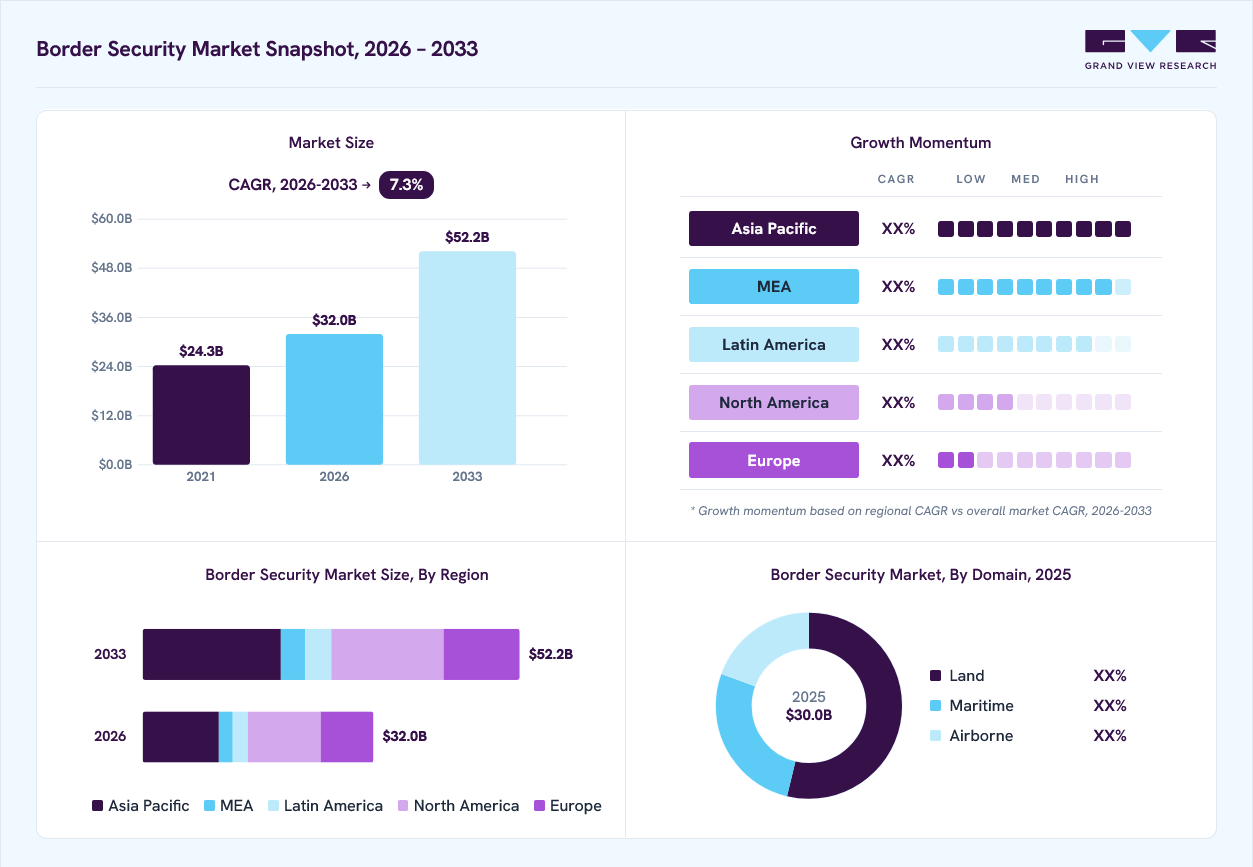
The global border security market size was valued at USD 30.0 billion in 2025 and is projected to grow from USD 32.0 billion in 2026 to USD 52.2 billion by 2033, at a CAGR of 7.3% from 2026 to 2033. Asia Pacific dominated the market, accounting for a revenue share of 32.5% in 2025. The region's leadership is driven by increasing defense budgets, ongoing territorial disputes, extensive land and maritime borders, and rising investments in advanced border surveillance and monitoring infrastructure.
 Source: Grand View Research, IR Documents, Primary Interviews, Paid DatabasesTo learn more about this report,
 Download Free Sample Report
Key Market Trends & Insights
- By Domain: Land segment led the market and held the largest revenue share of over 53.7% in 2025.
- By System: Surveillance Systems segment led the market and held the largest revenue share of over 26.1% in 2025.
- By Installation: Upgradation segment is the fastest growing segment with CAGR 8.5% during the forecast period 2026 to 2033.
Regional Highlights
- Largest regional market: Asia Pacific (32.5% revenue share, 2025)
- By country: The China held the largest market share in 2025
Market Size & Forecast
- Market size in 2025: USD 30.0 Billion
- Estimated market size in 2026: USD 32.0 Billion
- Projected market size by 2033: USD 52.2 Billion
- CAGR (2026-2033): 7.3%
Three ways to get this report
Buy it, customize it, or ask a question.Ask an Analyst
Analyst response in 1 business day
- AccessReport author, directly
- Reply timeWithin 1 working day
- No sales callDirect answer only
- FormatEmail reply
- CostFree, no cost
Get the Full Report
What the study covers
- FormatsPDF · Excel · Dashboard
- Timeline2026–2033 annual, 2025 base
- Coverage20+ countries, 5 regions
- Companies10+ key players profiled
Customize the Report
20% free customization
- IncludeCountries, segments, points
- TailorTo your product definition
- ExtendDeeper competitor detail
- OrA fully bespoke study
- Turnaround5–10 working days
Governments across the region are rapidly deploying integrated border security solutions, including smart fencing, biometric identification systems, unmanned aerial vehicles (UAVs), radar networks, thermal imaging cameras, and AI-powered surveillance platforms to strengthen national security and combat illegal migration, cross-border terrorism, smuggling, and unauthorized maritime activities. The market encompasses a wide range of technologies, including unmanned aerial vehicles (UAVs), biometrics, radar systems, and advanced detection and tracking systems. The adoption of artificial intelligence (AI) and machine learning (ML) in border security is also gaining traction, enabling real-time threat detection and response. The growth is further propelled by collaborations between defense contractors and governments, leading to the development of innovative solutions tailored to specific border security needs.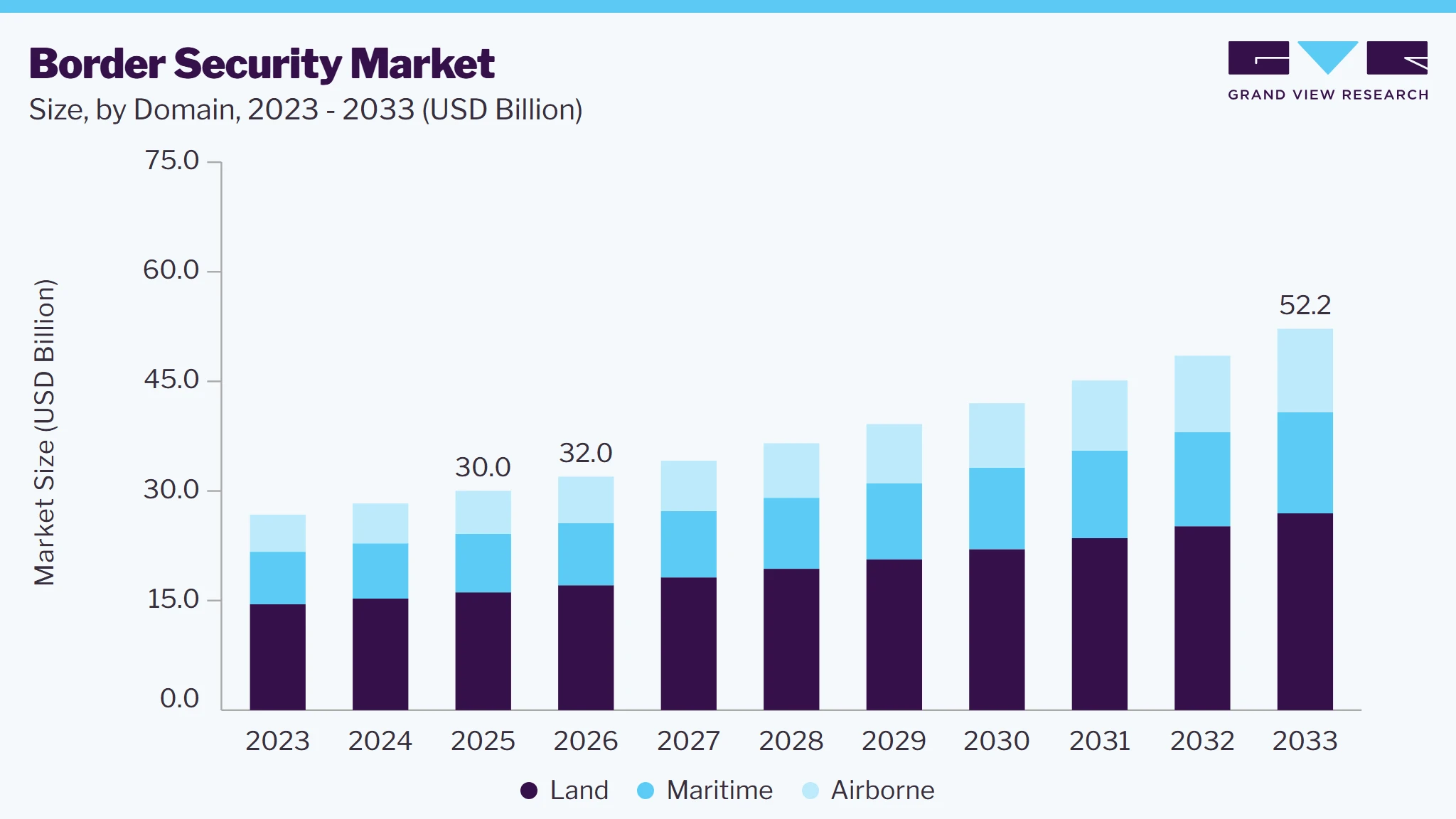 To learn more about this report, Download Free Sample Report
Security products are widely utilized across various industries for applications, including aerial photography and videography, mapping and surveying, rescue operations, asset inspection, research, and emergency response. The increasing adoption of unmanned aircraft, as well as unmanned ground and underwater vehicles in the defense sector, is anticipated to boost the demand for advanced long-range obstacle detection and collision avoidance systems. Moreover, the growing need for security is being driven by the deployment of autonomous systems for tasks such as site exploration, rescue and recovery missions, location surveillance, and crowd monitoring by defense forces and regulatory authorities.
Emerging countries are increasingly pressured to maintain the highest levels of security due to the growing number of threats. In response, governments have implemented advanced border protection technologies to ensure effective and reliable security measures. These strategies are designed to identify and neutralize potentially harmful risks that could threaten national security. Additionally, security technologies come in various forms, each offering unique advantages. Innovations such as security scanners, electronic gates, perimeter intrusion detection systems, surveillance cameras, land vehicles, radar systems, maritime and riverine vessels, airplanes and helicopters, and unmanned aerial vehicles (UAVs, UGVs) are enhancing protection against a wide range of threats from different platforms.
Market Dynamics
The Border Security Market is experiencing strong growth, driven by increasing geopolitical tensions, rising cross-border security threats, and growing government investments in modern border protection infrastructure. The expansion of illegal immigration, cross-border terrorism, human trafficking, drug smuggling, and illicit trade has intensified the need for advanced border surveillance and monitoring systems. Governments worldwide are increasingly deploying integrated border security solutions comprising intelligent surveillance cameras, radar systems, biometric identification, unmanned aerial vehicles (UAVs), command-and-control centers, thermal imaging, and AI-powered analytics to strengthen situational awareness and improve response capabilities. Technological advancements in artificial intelligence, machine learning, IoT-enabled sensors, satellite surveillance, and autonomous monitoring systems are further enhancing border security operations. However, high implementation costs, complex system integration, and privacy concerns associated with surveillance technologies remain key challenges. Nevertheless, increasing investments in smart border initiatives, digital transformation of border management, and the adoption of integrated security ecosystems are expected to create substantial growth opportunities during the forecast period.
The Border Security Market is being driven by the increasing incidence of illegal immigration, cross-border terrorism, human trafficking, narcotics smuggling, arms trafficking, and transnational organized crime. Governments are strengthening border surveillance capabilities to prevent unauthorized crossings while ensuring national security and public safety. Growing concerns over critical infrastructure protection and territorial sovereignty have accelerated investments in advanced surveillance technologies, including AI-enabled video analytics, biometric authentication, UAVs, ground surveillance radar, smart fencing, and automated threat detection systems. These solutions enable real-time monitoring, faster threat identification, and improved operational efficiency, driving sustained demand for border security technologies globally.
Despite robust growth prospects, the Border Security Market faces challenges due to the significant investment required for deploying advanced border security infrastructure. Large-scale implementation of surveillance systems, biometric platforms, communication networks, radar installations, drones, and command-and-control centers requires substantial financial resources and long project timelines. In addition, integrating diverse technologies from multiple vendors into a unified border management system presents technical and operational complexities. Ongoing maintenance requirements, cybersecurity risks, and the need for skilled personnel to operate sophisticated systems further increase operational costs, particularly for developing economies with budget constraints.
The growing adoption of smart border management initiatives presents significant opportunities for the Border Security Market. Governments are increasingly investing in AI-powered surveillance, biometric verification, autonomous drones, intelligent video analytics, satellite-based monitoring, and integrated command-and-control platforms to improve border monitoring and response capabilities. The modernization of land, maritime, and air border infrastructure, coupled with increasing deployment of cloud-based security platforms and real-time data analytics, is enabling more efficient border operations. Furthermore, rising international collaboration on border security, coupled with advancements in sensor technologies, predictive analytics, and autonomous surveillance systems, is expected to generate substantial growth opportunities for solution providers throughout the forecast period.
Market Concentration & Characteristics
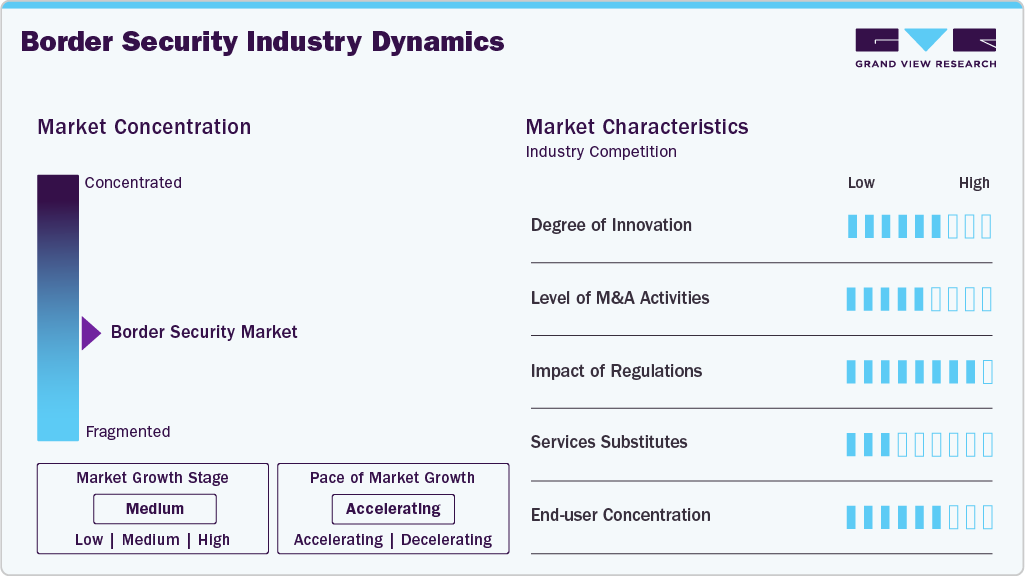
The Border Security Market is moderately concentrated, with competition driven by established defense contractors, aerospace companies, and security technology providers offering integrated border surveillance, monitoring, and threat detection solutions. Market participants compete based on surveillance capabilities, sensor integration, AI-enabled analytics, radar performance, biometric identification, unmanned systems, command-and-control platforms, and interoperability across land, air, and maritime border environments. Continuous investments in artificial intelligence, autonomous surveillance technologies, advanced electro-optical and infrared (EO/IR) systems, smart fencing, and integrated border management platforms are reshaping the competitive landscape. Strategic partnerships, government contracts, product innovations, acquisitions, and investments in next-generation defense technologies are further strengthening market competitiveness.
 To learn more about this report, Download Free Sample Report
Key market participants include Northrop Grumman Systems Corporation, Airbus SAS, Lockheed Martin Corporation, General Dynamics Corporation, BAE Systems, Thales, RTX Corporation, Elbit Systems Ltd., RAFAEL Advanced Defense Systems Ltd., and Teledyne FLIR LLC. These companies are focused on expanding their border security portfolios through advanced surveillance radar, electro-optical and infrared imaging systems, unmanned aerial systems, integrated command-and-control solutions, biometric identification technologies, smart border infrastructure, and AI-powered threat detection platforms. Their strategies emphasize enhancing situational awareness, improving real-time border monitoring, strengthening operational interoperability, supporting national security initiatives, and enabling comprehensive protection across land, maritime, and aerial borders.
Analyst Perspective
The Border Security Market is undergoing significant transformation as governments worldwide strengthen national security measures in response to rising geopolitical tensions, illegal immigration, cross-border terrorism, smuggling, human trafficking, and other transnational threats. Increasing investments in smart border initiatives are driving the deployment of advanced surveillance technologies, including AI-powered video analytics, biometric identification systems, unmanned aerial vehicles (UAVs), radar systems, thermal imaging, satellite surveillance, and integrated command-and-control platforms. These technologies are enhancing situational awareness, enabling real-time threat detection, and improving the efficiency of border monitoring across land, maritime, and air domains.
The market is also benefiting from continuous advancements in artificial intelligence, machine learning, IoT-enabled sensors, autonomous surveillance systems, and secure communication networks, enabling border security agencies to respond more effectively to evolving security challenges. Governments are increasingly modernizing legacy border infrastructure and adopting integrated border management solutions that combine surveillance, detection, communication, and intelligence capabilities into unified security ecosystems. Looking ahead, sustained defense spending, growing cross-border security concerns, and ongoing technological innovation are expected to drive long-term market growth, creating significant opportunities for solution providers offering intelligent, interoperable, and scalable border security technologies.
Domain Insights
Based on domain, the land segment led the market with the largest revenue share of 53.7% in 2025, primarily due to the increasing need for robust security measures across land borders, which are often the most vulnerable to illegal crossings, smuggling, and other threats. Governments worldwide have been investing heavily in advanced land-based security technologies, such as surveillance cameras, perimeter intrusion detection systems, radar systems, and UGVs. These technologies are critical for monitoring and securing extensive land borders, particularly in regions with high levels of cross-border activities. Additionally, geopolitical tensions and the rising concerns over terrorism, illegal immigration, and human trafficking have further intensified the focus on securing land borders.
The maritime segment is predicted to foresee significant growth in the coming years, driven by the increasing focus on securing vast and porous coastlines that are susceptible to illegal activities such as smuggling, piracy, and unauthorized fishing. With global trade heavily reliant on maritime routes, the need for enhanced maritime security has become more critical than ever. Additionally, the rise in geopolitical tensions and territorial disputes in critical regions like the South China Sea and the Gulf of Aden has further fueled the demand for maritime security solutions. The growing importance of safeguarding maritime borders, coupled with advancements in technology, is expected to propel the maritime segment’s rapid growth in the coming years.
Systems Insights
Based on system, the Surveillance Systems segment led the market with the largest revenue share of 26.1% in 2025. These systems are critical for monitoring vast and often challenging terrains, including remote land borders and expansive maritime zones. The rise in cross-border terrorism, smuggling, and illegal immigration has further intensified the demand for robust surveillance solutions. Additionally, the integration of AI and ML in surveillance systems has enhanced their capability to analyze vast amounts of data, enabling quicker and more accurate threat detection. The effectiveness of these systems in providing continuous, real-time intelligence has made them a cornerstone of modern border security strategies.
The unmanned systems segment is predicted to foresee significant growth in the coming years. These systems offer significant advantages, such as enhanced surveillance capabilities, reduced risk to human personnel, and the ability to operate in challenging or inaccessible terrains. The rising demand for 24/7 border monitoring and the need for rapid response to potential threats has led to greater reliance on unmanned systems, which can cover large areas efficiently and provide real-time intelligence. Furthermore, advancements in autonomy, sensor technology, and AI-driven analytics are making these systems more sophisticated and effective in detecting, tracking, and responding to illegal activities.
Installation Insights
Based on installation, the New Installations segment led the market with the largest revenue share of 56.5% in 2025. Many countries, particularly those facing heightened security challenges, have prioritized the deployment of advanced border security systems to address evolving threats such as terrorism, illegal immigration, and smuggling. This has led to substantial investments in new installations of surveillance systems, perimeter intrusion detection systems, and unmanned technologies. The focus on securing land, maritime, and air borders has resulted in the construction of new facilities equipped with cutting-edge technologies to enhance border protection. Additionally, the adoption of new installations is often driven by the need to replace outdated or ineffective systems, ensuring that border security remains robust and up to date.
The upgradation segment is anticipated to witness significant growth in the coming years. As threats become more advanced, there is a growing demand to upgrade outdated systems with the latest technologies, including AI-driven analytics, advanced sensors, and enhanced surveillance systems. Governments and security agencies are focusing on retrofitting their current installations to improve efficiency, reliability, and response times. This includes upgrading perimeter intrusion detection systems, enhancing cybersecurity measures, and integrating unmanned systems for better operational capabilities. The upgradation of existing systems is often more cost-effective and quicker to implement than building new installations, making it an attractive option for many countries facing budget constraints.
Vertical Insights
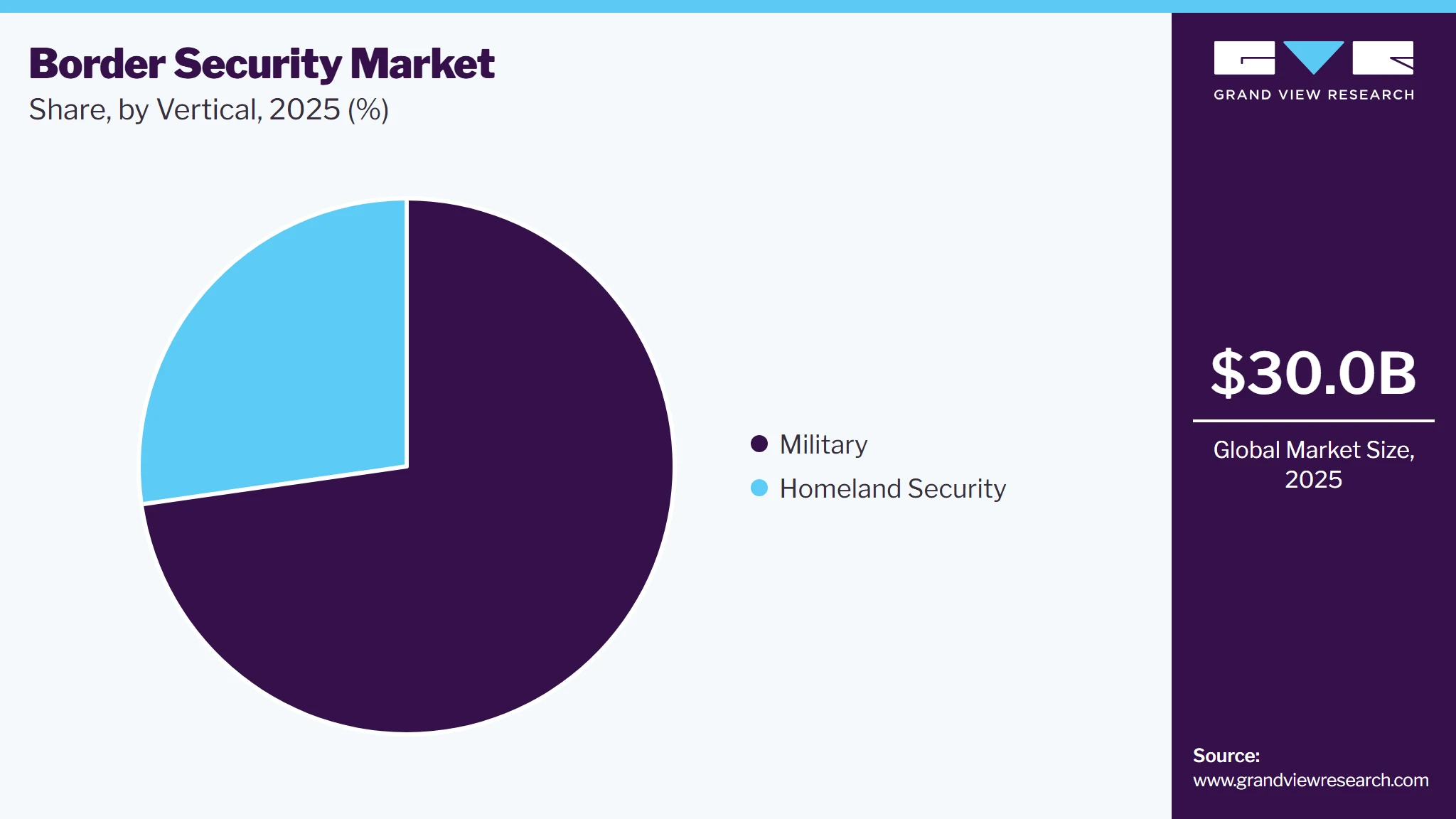
Based on vertical, the Military segment led the market with the largest revenue share of 72.7% in 2025. Militaries worldwide are increasingly focusing on comprehensive border security solutions to address a range of threats, including terrorism, illegal smuggling, and cross-border conflicts. This focus has led to substantial expenditures on sophisticated surveillance systems, unmanned vehicles, radar systems, and advanced communication technologies. The military's need for high-performance, reliable, and integrated systems to ensure national security has driven the demand for cutting-edge border security solutions.
 To learn more about this report, Download Free Sample Report
The homeland security segment is anticipated to exhibit the highest CAGR over the forecast period. Governments are investing heavily in enhancing homeland security measures to address challenges such as terrorism, cyberattacks, natural disasters, and border control issues. This includes deploying advanced technologies for surveillance, detection, and response, and improving coordination among various agencies. The integration of innovative solutions like AI-driven analytics, biometric systems, and sophisticated communication networks is crucial for enhancing situational awareness and operational effectiveness. Additionally, the growing focus on comprehensive security strategies and emergency preparedness has spurred investments in both new installations and upgrades of existing systems.
Regional Insights
North America dominated with a revenue share of over 31.0% in 2023. The U.S. government, in particular, has dedicated significant resources to enhancing its border security infrastructure to address threats such as illegal immigration, drug trafficking, and terrorism. This includes deploying sophisticated surveillance systems, UAVs, and advanced perimeter intrusion detection systems. The region's focus on national security, coupled with high defense budgets and technological innovation, has driven the development and implementation of cutting-edge border security solutions. Additionally, the strategic importance of North America's borders, both with neighboring countries and in maritime areas, has reinforced the need for robust security measures.
U.S. Border Security Market Trends
The U.S. border security market is expected to grow significantly from 2024 to 2030. The U.S. has implemented robust border enforcement measures and innovative technologies like biometric systems and automated border control systems. The country's large defense budget and commitment to national security have enabled it to lead in the development and deployment of cutting-edge border security solutions.
Europe Border Security Market Trends
The border security market in the European region is expected to witness significant growth over the forecast period. European countries have faced increasing challenges related to illegal immigration, terrorism, and cross-border crimes, prompting substantial government spending on state-of-the-art security solutions. Additionally, the European Union's focus on enhancing border control and cooperation among member states has driven the adoption of integrated security technologies and infrastructure upgrades.
Asia Pacific Border Security Market Trends
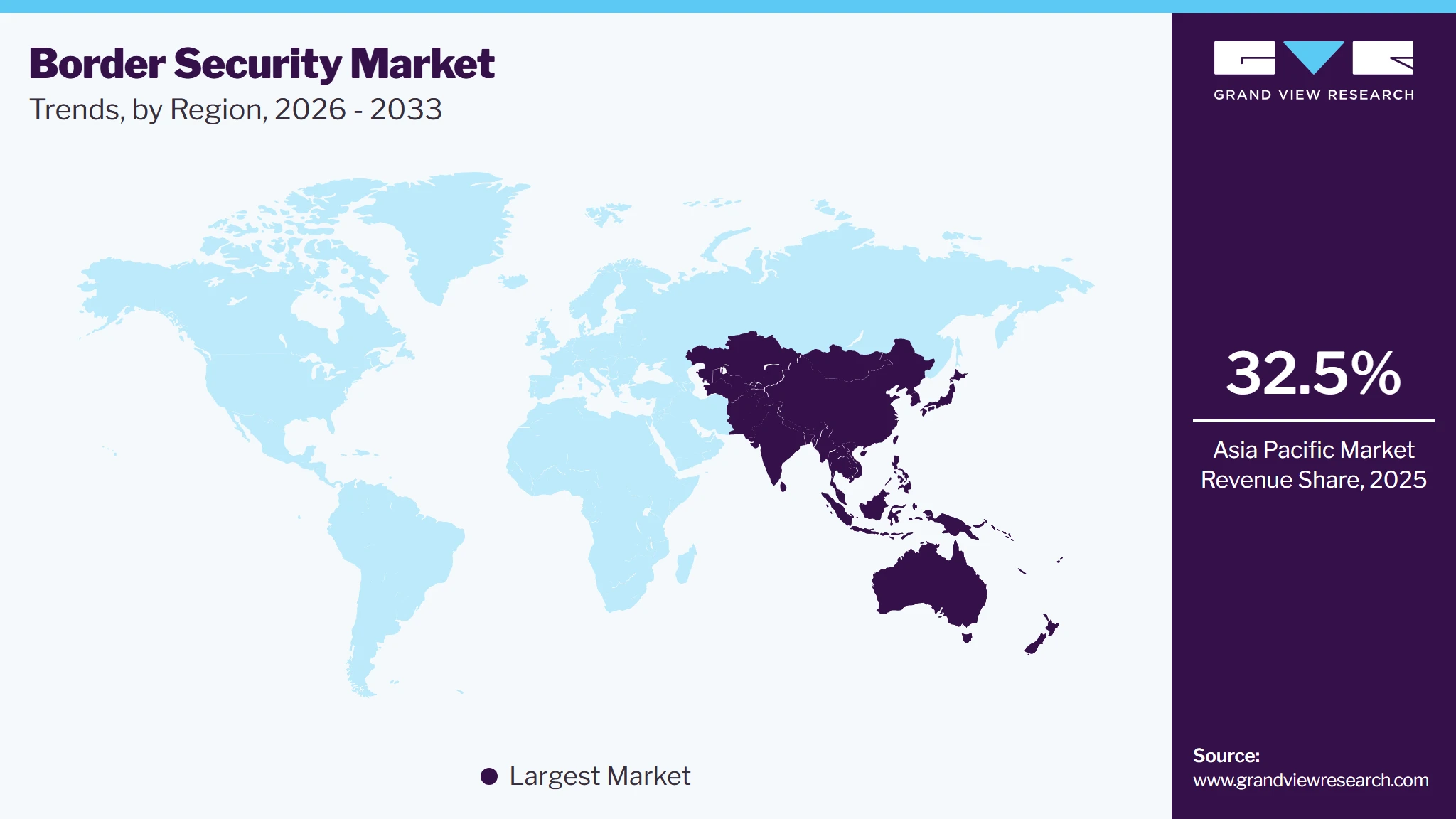
Asia Pacific dominated the Border Security Market with the largest revenue share of 32.5% in 2025. The region's dominance is attributed to increasing defense expenditures, extensive land and maritime borders, and rising geopolitical tensions across several countries. Governments are investing heavily in advanced border surveillance technologies, including smart fencing, UAVs, radar systems, thermal imaging, and AI-enabled monitoring platforms to strengthen national security. Additionally, growing concerns over illegal immigration, cross-border terrorism, smuggling, and maritime security, coupled with ongoing border infrastructure modernization programs, continue to drive market growth across the region.
 To learn more about this report, Download Free Sample Report
China Border Security Market Trends
China held the largest share of the Asia Pacific Border Security Market in 2025. The country's dominance is driven by significant investments in border surveillance infrastructure, AI-enabled monitoring systems, smart border management technologies, and the modernization of land and maritime security to strengthen national defense and address evolving cross-border security threats.
Key Border Security Company Insights
Key border security companies include Northrop Grumman Systems Corporation, Airbus SAS, Lockheed Martin Corporation, and General Dynamics Corporation. Companies active in the border security market are focusing aggressively on expanding their customer base and gaining a competitive edge over their rivals. Hence, they pursue various strategic initiatives, including partnerships, mergers & acquisitions, collaborations, and new product/ Installation development. For instance, in March 2024, drone manufacturer Garuda Aerospace introduced Trishul, a new surveillance drone designed for border patrol operations. This drone is capable of monitoring human movement, natural disasters, and traffic conditions, among other applications. Equipped with an array of sensors, including high-definition cameras, infrared, and radar, Trishul offers detailed data on speed and potential safety threats.
Key Border Security Companies:
The following key companies have been profiled for this study on the border security market.
-
Northrop Grumman Systems Corporation
-
Airbus SAS
-
Lockheed Martin Corporation
-
General Dynamics Corporation
-
BAE Systems
-
Thales
-
RTX Corporation
-
Elbit Systems Ltd.
-
RAFAEL Advanced Defense Systems Ltd.
-
Teledyne FLIR LLC
Competitive Benchmarking
Category
Operating Strategies
Competitive Edge
Weakness
Established Players: Northrop Grumman Systems Corporation, Airbus SAS, Lockheed Martin Corporation, General Dynamics Corporation, BAE Systems, Thales
- Focus on expanding integrated border security portfolios through advanced surveillance systems, radar technologies, command-and-control platforms, biometric identification, AI-enabled analytics, smart border solutions, and autonomous surveillance systems. These companies invest heavily in defense R&D, next-generation sensor technologies, border modernization programs, and long-term government contracts while strengthening strategic partnerships to enhance national security capabilities.
- Strong global defense presence, extensive government relationships, comprehensive border security portfolios, advanced surveillance and radar technologies, significant R&D investments, proven system integration capabilities, and the ability to deliver large-scale, mission-critical border security solutions across land, maritime, and air domains.
- High development and deployment costs, dependence on government procurement cycles, lengthy contract approval processes, regulatory and export control restrictions, and complex integration requirements for large-scale border security projects.
Emerging Players: RTX Corporation, Elbit Systems Ltd., RAFAEL Advanced Defense Systems Ltd., Teledyne FLIR LLC
- Focus on developing advanced electro-optical and infrared (EO/IR) systems, AI-powered surveillance, unmanned systems, intelligent sensors, thermal imaging, precision detection technologies, and integrated border monitoring solutions. These companies emphasize innovation, operational flexibility, and rapid deployment of advanced technologies to address evolving border security threats.
- Strong expertise in sensor technologies, thermal imaging, AI-enabled surveillance, unmanned systems, and rapid product innovation. Agile development capabilities, specialized defense technologies, and the ability to provide customized solutions for diverse border security requirements enhance their competitive position.
- Comparatively smaller global defense footprint than leading prime contractors, reliance on defense budgets and government contracts, exposure to geopolitical and export restrictions, and increasing competition from larger defense integrators offering comprehensive end-to-end border security solutions.
Recent Developments
-
In August 2024, Canadian border authorities introduced a new app designed to assist in tracking individuals who have been ordered to leave the country. The Canada Border Services Agency (CBSA) will use facial biometrics to verify identities and employ the app to monitor their locations. The app, called ReportIn, is intended to enable foreign nationals and permanent residents who are subject to immigration enforcement conditions to report their status without needing to visit a CBSA office in person.
-
In April 2024, ideaForge Technology Ltd., a prominent player in drone technology and manufacturing, unveiled new cutting-edge solutions aimed at strengthening its position in the U.S. market. These advanced solutions for Border Protection and Public Safety highlight the company's dedication to tackling key challenges faced by border patrol agencies and law enforcement through technological innovation.
-
In June 2023, SITA introduced its most advanced intelligence and targeting solution to date. This offering serves as the core for dynamic and integrated border management, aiding governments in identifying and managing risks well before they approach their land, sea, and air borders. SITA Intelligence and Targeting employs sophisticated risk assessment techniques and artificial intelligence to greatly reduce the time required for strategic risk analysis and operational situational awareness across various data streams. This allows for actionable intelligence to be gathered, enabling proactive measures against high-risk individuals before they enter the country.
Border Security Market Report Scope
Report Attribute
Details
Market size in 2025
USD 30.0 billion
Estimated market size in 2026
USD 32.0 billion
Projected market size by 2033
USD 52.2 billion
Growth rate
CAGR of 7.3% from 2026 to 2033
Base year for estimation
2025
Historical data
2021 - 2024
Forecast period
2026 - 2033
Quantitative units
Revenue in USD billion/billion and CAGR from 2026 to 2033
Report coverage
Revenue forecast, company ranking, competitive landscape, growth factors, and trends
Segments covered
Domain, systems, installation, vertical, region
Regional scope
North America; Europe; Asia Pacific; Latin America; MEA
Country scope
U.S.; Canada; UK; Germany; China; India; Japan; South Korea; Australia; Brazil; Mexico; KSA; UAE; South Africa
Key companies profiled
Northrop Grumman Systems Corporation; Airbus SAS; Lockheed Martin Corporation; General Dynamics Corporation; BAE Systems; Thales; RTX Corporation; Elbit Systems Ltd.; RAFAEL Advanced Defense Systems Ltd.; Teledyne FLIR LLC
Customization scope
Free report customization (equivalent up to 8 analysts' working days) with purchase. Addition or alteration to country, regional & segment scope.
Pricing and purchase options
Avail customized purchase options to meet your exact research needs. Explore purchase options
Global Border Security Market Report Segmentation
This report forecasts revenue growth at global, regional, and country levels and provides an analysis of the latest industry trends in each of the sub-segments from 2021 to 2033. For this study, Grand View Research has segmented the global border security market report based on domain, system, installation, vertical, and region:
-
Domain Outlook (Revenue, USD Million, 2021 - 2033)
-
Land
-
Maritime
-
Airborne
-
-
System Outlook (Revenue, USD Million, 2021 - 2033)
-
Surveillance Systems
-
Detection Systems
-
Communication Systems
-
Border Security Systems
-
Laser Systems
-
Unmanned Systems
-
Perimeter Intrusion Detection Systems
-
Cybersecurity Systems
-
-
Installation Outlook (Revenue, USD Million, 2021 - 2033)
-
New Installations
-
Upgradation
-
-
Vertical Outlook (Revenue, USD Million, 2021 - 2033)
-
Military
-
Homeland Security
-
-
Regional Outlook (Revenue, USD Million, 2021 - 2033)
-
North America
-
U.S.
-
Canada
-
Mexico
-
-
Europe
-
UK
-
Germany
-
France
-
-
Asia Pacific
-
China
-
India
-
Japan
-
Australia
-
South Korea
-
-
Latin America
-
Brazil
-
-
MEA
-
UAE
-
South Africa
-
KSA
-
-
Research Methodology
The border security market figures in this report are based on a proven research process that combines executive interviews with secondary research from proprietary databases, company filings, and recognized regulatory and institutional sources. Market size is built through value-chain sizing - reconciling supply-side and demand-side estimates - and triangulated with bottom-up and top-down approaches. Every estimate passes multiple levels of expert validation before publication, with each border security segment quantified using the revenue-capture definitions in the table below.
Segment Definition
Segment - Domain
Revenue capture definition
Land
Revenue in this segment is generated through border security solutions deployed to protect and monitor land borders using advanced surveillance and detection technologies. These solutions include smart fencing, ground surveillance radar, electro-optical and infrared (EO/IR) systems, biometric identification, unmanned aerial vehicles (UAVs), AI-powered video analytics, and integrated command-and-control platforms to detect unauthorized crossings, prevent illegal activities, and enhance real-time situational awareness.
Maritime
Revenue in this segment is generated through border security solutions designed to monitor and protect coastal areas, territorial waters, ports, and maritime boundaries. These solutions include coastal surveillance radar, maritime patrol vessels, unmanned surface and aerial systems, satellite-based monitoring, electro-optical sensors, automatic identification systems (AIS), and integrated command-and-control platforms to detect unauthorized vessels, prevent smuggling and illegal fishing, and strengthen maritime domain awareness.
Airborne
Revenue in this segment is generated through airborne border security systems that provide continuous surveillance and monitoring of national borders and sensitive regions. These solutions include surveillance aircraft, unmanned aerial vehicles (UAVs), helicopters, aerostats, airborne radar, and electro-optical/infrared (EO/IR) imaging systems to enhance situational awareness, detect unauthorized border crossings, support reconnaissance missions, and enable rapid response to emerging security threats.
Segment - Systems
Revenue capture definition
Surveillance Systems
Revenue in this segment is generated through the deployment of advanced surveillance technologies used to monitor and secure land, air, and maritime borders. These systems include fixed and mobile surveillance cameras, thermal imaging devices, ground surveillance radar, electro-optical/infrared (EO/IR) sensors, unmanned aerial systems (UAS), and AI-powered video analytics that enable real-time threat detection, continuous monitoring, and enhanced situational awareness.
Detection Systems
Revenue in this segment is generated through technologies designed to identify, detect, and track unauthorized activities and potential threats across border regions. These systems include ground surveillance radar, motion and seismic sensors, intrusion detection systems, chemical and radiation detectors, acoustic sensors, and AI-enabled threat detection platforms that support early warning, rapid response, and enhanced border protection.
Communication Systems
Revenue in this segment is generated through secure communication and networking solutions that enable seamless coordination among border security personnel, surveillance assets, and command centers. These systems include encrypted radio networks, satellite communication systems, wireless communication infrastructure, data transmission networks, and integrated command-and-control platforms that facilitate real-time information sharing, situational awareness, and rapid incident response across border operations.
Border Security Systems
Revenue in this segment is generated through integrated border protection solutions that combine surveillance, detection, biometric identification, communication, and command-and-control technologies. These systems enable real-time monitoring, threat detection, access control, and coordinated response across land, maritime, and air borders, helping governments strengthen national security and prevent illegal crossings, smuggling, and other cross-border threats.
Laser Systems
Revenue in this segment is generated through laser-based technologies used for border surveillance, target detection, range finding, and perimeter protection. These systems include laser scanners, LiDAR systems, laser rangefinders, and laser illumination technologies that enable accurate threat detection, long-range monitoring, terrain mapping, and enhanced situational awareness across land, air, and maritime border environments.
Unmanned Systems
Revenue in this segment is generated through autonomous and remotely operated platforms deployed for border surveillance, reconnaissance, and threat detection. These systems include unmanned aerial vehicles (UAVs), unmanned ground vehicles (UGVs), and unmanned surface vessels (USVs) equipped with cameras, radar, thermal imaging, and AI-powered analytics to monitor remote border areas, detect unauthorized activities, and enhance operational efficiency while reducing risks to security personnel.
Cybersecurity Systems
Revenue in this segment is generated through cybersecurity solutions that protect border security networks, surveillance systems, communication infrastructure, and critical data from cyber threats. These systems include network security platforms, encryption technologies, intrusion detection and prevention systems, identity and access management, and AI-driven cyber threat intelligence solutions that ensure secure border operations and safeguard critical infrastructure.
Segment - Installation
Revenue capture definition
New Installations
Revenue in this segment is generated through the deployment of newly established border security infrastructure and technologies across land, maritime, and air borders. This includes the installation of surveillance systems, smart fencing, radar, biometric identification systems, communication networks, command-and-control centers, and unmanned systems as part of new border modernization and security enhancement projects.
Upgradation
Revenue in this segment is generated through the modernization and enhancement of existing border security infrastructure and systems. This includes upgrading surveillance equipment, radar systems, communication networks, biometric technologies, command-and-control platforms, and AI-enabled analytics to improve operational efficiency, strengthen threat detection capabilities, and extend the lifespan of existing border security assets.
Segment - Vertical
Revenue capture definition
Military
Revenue in this segment is generated through the deployment of border security solutions by defense forces to safeguard national borders against external threats. These solutions include advanced surveillance systems, radar, unmanned platforms, command-and-control systems, and integrated monitoring technologies that enhance situational awareness, support reconnaissance missions, and strengthen border defense operations.
Homeland Security
Revenue in this segment is generated through the deployment of border security solutions by homeland security agencies to prevent illegal immigration, cross-border terrorism, smuggling, human trafficking, and other transnational threats. These solutions include integrated surveillance systems, biometric identification, communication networks, command-and-control platforms, and AI-enabled monitoring technologies that enhance border management, threat detection, and rapid response capabilities.
Estimation Model
Layer Name
Key Question
Description
Addressable End-user Base Layer
Which organizations generate demand for border security solutions?
Identify the global addressable base of organizations investing in border security technologies and services. This includes defense ministries, homeland security agencies, border patrol forces, customs and immigration authorities, coast guards, law enforcement agencies, airport and port authorities, and other government organizations responsible for securing land, maritime, and air borders.
Application Layer
Which applications drive border security adoption?
Assess demand across key applications, including border surveillance, intrusion detection, perimeter protection, biometric identification, immigration and customs management, maritime domain awareness, airspace monitoring, critical infrastructure protection, command-and-control operations, intelligence gathering, and counter-smuggling and counter-terrorism activities.
Technology Adoption Layer
How extensively are border security technologies utilized?
Estimate technology adoption based on the deployment of surveillance cameras, ground surveillance radar, electro-optical/infrared (EO/IR) sensors, biometric identification systems, smart fencing, unmanned aerial, ground, and maritime systems, satellite surveillance, AI-powered video analytics, IoT-enabled sensors, secure communication networks, and integrated command-and-control platforms across border security operations.
Revenue Generation Layer
How much revenue is generated?
Calculate market revenue by assessing spending on border surveillance systems, detection technologies, biometric solutions, communication infrastructure, unmanned systems, cybersecurity platforms, command-and-control software, installation, system integration, maintenance, upgrades, consulting, training, and managed services. Revenue is generated through equipment sales, software licensing, system integration contracts, maintenance agreements, modernization programs, and long-term government procurement and defense contracts.
Delivered Customizations
This report has been delivered with the following In-depth customizations
Client Request
Customization Delivered
Value Adds
Competitive Intelligence & Market Positioning Assessment
Performed an in-depth evaluation of leading border security solution providers, defense contractors, surveillance technology companies, and system integrators. Assessed market positioning, border surveillance capabilities, product portfolios, radar and sensor technologies, unmanned systems, strategic partnerships, government contracts, regional presence, and recent developments across the border security ecosystem.
Enables stakeholders to identify key market participants, benchmark competitive positioning, evaluate technology capabilities, assess partnership and acquisition opportunities, and gain insights into the evolving competitive landscape of the Border Security Market.
Application Adoption & End-user Analysis
Analyzed adoption trends across key applications, including land border surveillance, maritime security, airspace monitoring, perimeter protection, biometric identification, customs and immigration management, counter-terrorism, anti-smuggling operations, and critical infrastructure protection across defense, homeland security, customs, coast guard, and border patrol agencies.
Provides actionable insights into application-specific demand, end-user adoption trends, investment priorities, and modernization initiatives, supporting informed decisions related to product development, market expansion, and government procurement strategies.
Technology Advancements & Future Growth Potential Evaluation
Assessed the impact of artificial intelligence (AI), machine learning, biometric identification, unmanned aerial systems (UAS), electro-optical/infrared (EO/IR) sensors, smart fencing, ground surveillance radar, satellite surveillance, IoT-enabled sensors, and integrated command-and-control platforms on market development. Identified emerging innovation areas and high-growth opportunities in intelligent border management and autonomous surveillance technologies.
Supports long-term strategic planning by identifying attractive investment opportunities, prioritizing technology innovation, uncovering future revenue streams, and understanding the key trends shaping the evolution of the Border Security Market.
Frequently Asked Questions About This Report
The global border security market size was valued at USD 30.0 billion in 2025 and is expected to reach USD 32.0 billion in 2026.
The global border security market is expected to grow at a compound annual growth rate of 7.3% from 2026 to 2033 to reach USD 52.2 billion by 2033.
Asia Pacific dominated the Border Security Market with a revenue share of 32.5% in 2025. China, in particular, has invested heavily in strengthening its border security infrastructure to address challenges such as illegal immigration, cross-border smuggling, terrorism, and territorial security.
Some key players operating in the border security market include Northrop Grumman Systems Corporation, Airbus SAS, Lockheed Martin Corporation, General Dynamics Corporation, BAE Systems, Thales, RTX Corporation, Elbit Systems Ltd., RAFAEL Advanced Defense Systems Ltd., and Teledyne FLIR LLC.
Key factors that are driving the border security market growth include innovations in surveillance, detection, and communication technologies, and significant investments by governments in modernizing border security infrastructure and expanding capabilities to address evolving threats.
Land leads the domain segment with revenue share of 53.7% in 2025, While Airborne is the fastest growing segment in the border security market.
Surveillance Systems leads the system segment with revenue share of 26.1% in 2025, While Unmanned Systems is the fastest growing segment in the border security market.
New Installations leads the segment with revenue share of 56.5% in 2025, while Upgradation is the fastest growing installation segment in the market.
Asia Pacific is the fastest growing region with CAGR 8.9% during forecast period 2026 to 2033.
About the Author(s)
Next Generation Technologies Research Team
Technology · Next Generation TechnologiesThis report was authored by the next generation technologies research team at Grand View Research - comprising two research analysts, one senior research analyst, and one industry expert - with specialized expertise in the next generation technologies segment of the technology industry. All findings are based on proprietary technology databases, executive interviews, and regulatory analysis, subject to internal peer review prior to publication.
Last Updated:
Speak to Analyst

Customize this report to your needs - add regions, segments, or data points, with 20% free customization.
Or view our licence options:


ISO 9001:2015 & 27001:2022 Certified
We are GDPR and CCPA compliant! Your transaction & personal information is safe and secure. For more details, please read our privacy policy.


