
- Home
- »
- Medical Imaging
- »
-
Brain PET-MRI Systems Market Size & Share Report, 2033GVR Report cover

Brain PET-MRI Systems Market (2026 - 2033)
Size, Share & Trends Analysis Report By Phase (Clinical, Pre-Clinical), By Product (Traditional Systems, Helium Free Systems), By End Use, By Region, And Segment Forecasts
Market Size, 2025
$382.8MMarket Estimate, 2026
$405.7MMarket Forecast, 2033
$610.1MCAGR, 2026–2033
6.0%Brain PET-MRI Systems Market Summary
The global brain PET-MRI systems market size was valued at USD 382.8 million in 2025 and is projected to grow from USD 405.7 million in 2026 to USD 610.1 million by 2033, growing at a CAGR of 6.0% from 2026 to 2033. North America dominated the market, accounting for a revenue share of 30.0% in 2025. Positron emission tomography is mainly used in neurology for its ability to provide high-resolution, 3D images of functional, physiological, and molecular targets. PET scanners are frequently integrated with other imaging modalities, particularly MRI, to ensure precise alignment with anatomical structures and pathological alterations.
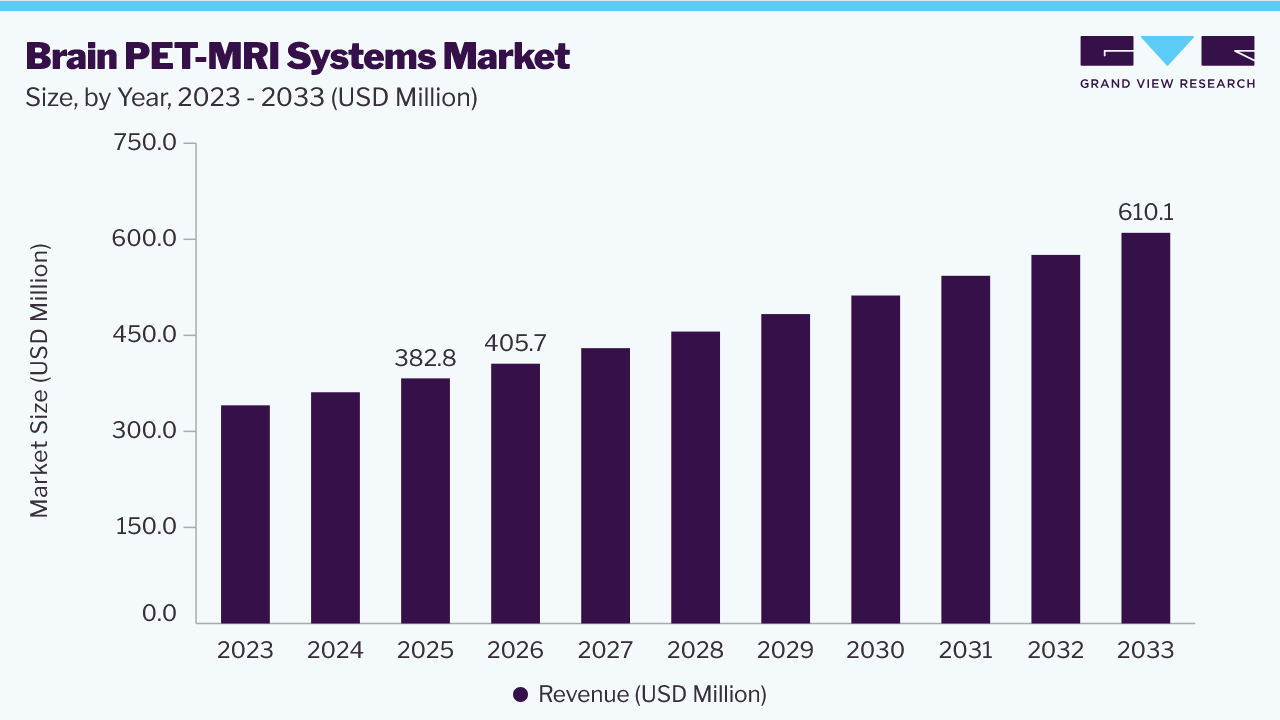 Source: Grand View Research, IR Documents, Primary Interviews, Paid DatabasesTo learn more about this report,
 Download Free Sample Report
 Key Market Trends & Insights
- By product: The traditional PET-MRI systems segment dominated the market, with a revenue share of about 60.0% in 2025.
- By phase: The pre-clinical brain PET-MRI systems segment held the largest revenue share of over 58.0% in 2025.
- By end use: The hospitals segment held the largest revenue share of over 42.0% in 2025.
Regional Highlights
- Largest regional market: North America (30.0% revenue share, 2025)
- Fastest-growing regional market: Asia Pacific (Highest CAGR, 2026-2033)
Market Size & Forecast
- Market size in 2025: USD 382.8 Million
- Estimated market size in 2026: USD 405.7 Million
- Projected market size by 2033: USD 610.1 Million
- CAGR (2026-2033): 6.0%
Three ways to get this report
Buy it, customize it, or ask a question.Ask an Analyst
Analyst response in 1 business day
- AccessReport author, directly
- Reply timeWithin 1 working day
- No sales callDirect answer only
- FormatEmail reply
- CostFree, no cost
Get the Full Report
What the study covers
- FormatsPDF · Excel · Dashboard
- Timeline2026–2033 annual, 2025 base
- Coverage20+ countries, 5 regions
- Companies10+ key players profiled
Customize the Report
20% free customization
- IncludeCountries, segments, points
- TailorTo your product definition
- ExtendDeeper competitor detail
- OrA fully bespoke study
- Turnaround5–10 working days
The combination of MRI and PET is widely recognized as a highly efficient hybrid imaging modality in neurology. The capability of magnetic resonance imaging (MRI) to depict the brain's structure, along with its ability to assess physiological and metabolic aspects such as perfusion, edema, vascular supply, and functional activation, enhances its appeal when used in conjunction with PET Systems. Consequently, the combined data from the MRI and PET hybrid imaging systems play a crucial role in improving the diagnosis of neurological conditions.
PET-MRI systems for the brain have created new possibilities for multiparametric neuroimaging by simultaneously observing the brain's physiological and biochemical processes. Consequently, there is a growing trend of installing these devices in various medical settings. Furthermore, companies are conducting research to assess the efficacy of MRI-PET scanners in both animal and human subjects.
The use of brain PET-MRI systems in preclinical imaging is on the rise, creating opportunities for new market entrants. There has been a significant global push to enhance MRI resolution for studying the human brain, resulting in the development of an ultra-high-resolution 7 Tesla scanner. This scanner can capture up to 10 times more detail than current 7T scanners and over 50 times more detail than current 3T scanners, which are widely used in most hospitals. The enhanced clarity allows scientists to observe fMRI features as small as 0.4 millimeters, compared with the usual 2 or 3 millimeters in the current standard 3T fMRI.
Analyst Perspective
The brain PET-MRI systems market is expected to grow steadily, driven by the rising prevalence of neurological disorders and increasing demand for precision diagnostics. PET-MRI enables simultaneous structural and metabolic imaging, supporting the diagnosis and monitoring of Alzheimer’s disease, Parkinson’s disease, epilepsy, and brain tumors. Advances in digital PET detectors, AI-assisted image reconstruction, and quantitative imaging software are improving accuracy and expanding clinical applications. Growing neuroscience research, biomarker-based diagnosis, and personalized treatment approaches are further supporting market growth. However, high costs, complex installation, and limited availability remain key challenges. North America and Europe currently lead the market, while Asia Pacific is expected to witness significant growth.
Phase Insights
The pre-clinical brain PET-MRI systems segment accounted for the largest revenue share of approximately 58.0% in 2025. Segment dominance can be attributed to the growing use of preclinical imaging systems in neurological research, drug discovery, and translational neuroscience. With an increasing number of preclinical studies focused on improving the diagnosis and understanding of neurological disorders, market players are developing advanced preclinical brain PET-MRI systems to strengthen their market position. Growing investments in translational neuroscience, neurodegenerative disease research, and drug discovery are encouraging manufacturers to develop advanced preclinical PET-MRI platforms with higher sensitivity and multimodal capabilities. For instance, Bruker continues to strengthen its preclinical imaging portfolio with PET/MR solutions designed for neuroscience and molecular imaging applications, supporting research in neurological disorders, drug discovery, and therapeutic development. Its continued focus on preclinical molecular imaging technologies reflects the increasing demand for PET-MRI systems in neurological research and supports the dominance of the pre-clinical segment.
The clinical brain PET-MRI systems segment is expected to witness steady growth over the forecast period. Segment growth is primarily driven by the rising prevalence of Alzheimer’s disease, brain tumors, and other neurological disorders, which is increasing demand for advanced imaging systems capable of simultaneously providing anatomical, metabolic, and functional insights. The growing need for early diagnosis, accurate disease monitoring, and personalized treatment planning is further supporting the adoption of clinical brain PET-MRI systems. In addition, advancements in AI-assisted image reconstruction, improved workflow efficiency, and enhanced imaging accuracy are expected to accelerate market growth. The increasing adoption of hybrid imaging technologies in hospitals and specialized neurology centers is further contributing to segment expansion.
Product Insights
By product, the traditional PET-MRI systems held the largest revenue share, above 60.0%, in 2025, primarily due to their established adoption in clinical and research settings and their proven effectiveness in multimodal brain imaging applications. These systems offer high magnetic field strength and enable the simultaneous acquisition of anatomical, metabolic, and functional information, improving diagnostic accuracy and disease monitoring. Traditional PET-MRI systems have gained significant acceptance for the diagnosis and monitoring of neurological disorders, including Alzheimer’s disease, epilepsy, and brain tumors. In addition, continuous technological advancements and product innovations by leading companies such as Siemens Healthineers, GE HealthCare, and Bruker are further strengthening the segment’s position. The availability of mature imaging infrastructure, proven diagnostic performance, and increasing demand for precision medicine and molecular imaging applications are also contributing to the continued dominance of traditional brain PET-MRI systems.
Helium-free brain PET-MRI systems are expected to witness the fastest CAGR over the forecast period. Growing concerns regarding helium shortages, rising helium prices, and supply chain disruptions are encouraging manufacturers to develop helium-free and cryogen-free imaging systems. These systems reduce dependence on liquid helium, lower operational costs, and simplify installation and maintenance requirements, making them increasingly attractive for both clinical and research applications. For instance, Philips continues to expand its helium-free MRI portfolio with its BlueSeal technology, which uses only 7 liters of helium in a sealed system, compared with conventional MRI systems that typically require around 1,500 liters. The technology significantly reduces helium dependency and operating complexity, supporting broader adoption of sustainable imaging solutions. Growing industry focus on low-helium and helium-free MRI technologies is expected to accelerate innovation in next-generation brain PET-MRI systems. The increasing demand for cost-efficient and operationally sustainable imaging solutions is expected to support segment growth over the forecast period.
End Use Insights
Hospitals accounted for the largest revenue share of approximately 42.0% in 2025, primarily due to the rising burden of neurological disorders and the growing demand for advanced brain imaging procedures. Brain PET-MRI systems require sophisticated infrastructure, specialized expertise, and substantial capital investment, making hospitals the primary end users. The rising prevalence of neurological and oncological disorders, coupled with the increasing need for precision diagnostics and early disease detection, is encouraging hospitals to invest in advanced molecular imaging technologies. For instance, Omega Hospitals offers AI-powered Digital PET-MRI imaging for advanced neurological applications, including epilepsy, dementia, and brain tumor evaluation. The hospital highlights that PET-MRI provides superior anatomical and metabolic imaging for accurate diagnosis of neurological disorders. This reflects hospitals' growing investment in advanced hybrid imaging infrastructure to improve diagnostic accuracy and patient outcomes. The availability of advanced imaging infrastructure, skilled healthcare professionals, and integrated diagnostic capabilities continues to strengthen hospitals’ position as the leading end use segment in the brain PET-MRI systems market.
Diagnostic imaging centers are expected to witness the fastest CAGR over the forecast period. The increasing preference for outpatient diagnostic services, rising patient volumes, and growing demand for advanced imaging technologies are encouraging diagnostic imaging centers to expand their infrastructure and adopt advanced imaging platforms to improve accessibility and patient experience. Growing demand for early diagnosis, faster imaging workflows, and cost-effective diagnostic services is further supporting segment growth. In addition, increased investment in specialized neurological imaging services and advanced molecular imaging technologies is expected to create growth opportunities for diagnostic imaging centers. The shift toward decentralized, outpatient-based diagnostic care, along with expanding access to precision imaging technologies, is expected to support growth in the segment over the forecast period.
Regional Insights
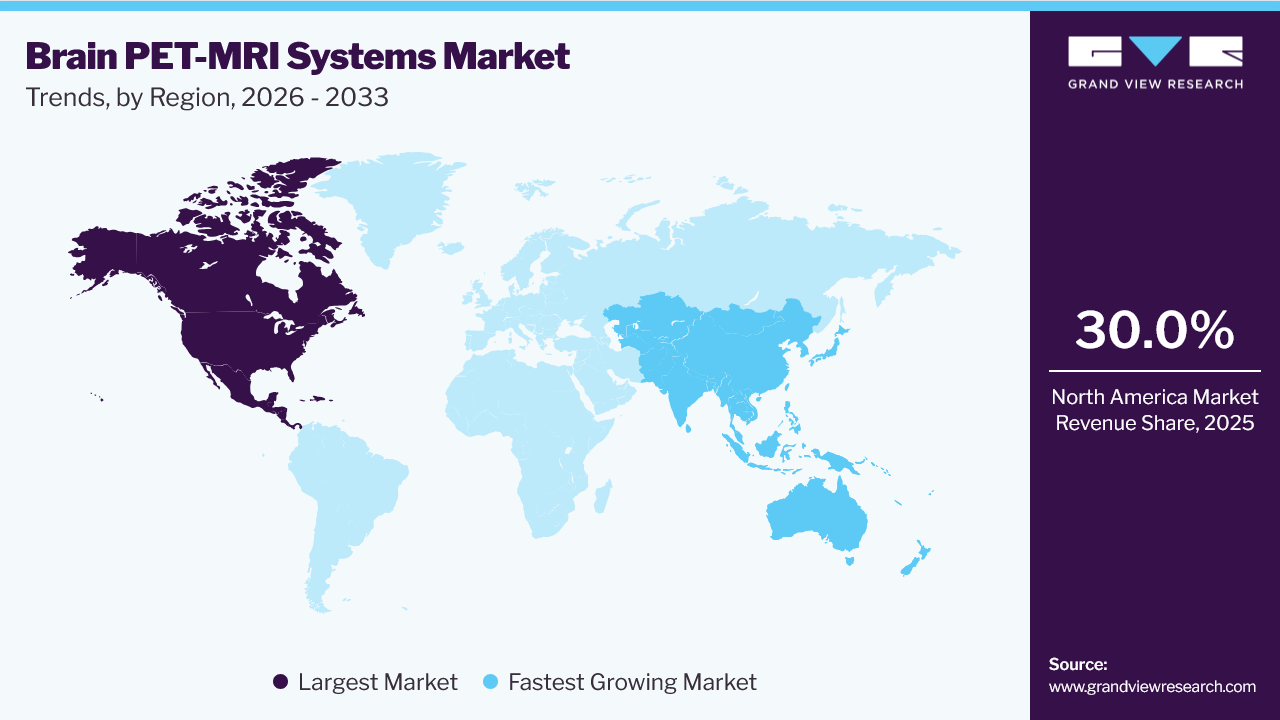
North America brain PET-MRI systems industry held the largest revenue share of approximately 30.0% in 2025, primarily due to the strong presence of advanced healthcare infrastructure, high healthcare expenditure, and increasing adoption of advanced diagnostic imaging technologies across the region. The presence of leading research centers, universities, and academic medical institutions further supports the adoption of brain PET-MRI systems for clinical and research applications. In addition, extensive research activities in neuroscience, growing investments in molecular imaging technologies, and rising demand for precision diagnostics are driving market growth across North America. The increasing focus on early diagnosis, biomarker-based disease assessment, and translational research is also accelerating the adoption of advanced brain imaging systems. Strong industry presence, favorable research funding, and continuous technological advancements are expected to reinforce North America’s leadership in the brain PET-MRI systems market over the forecast period.
 To learn more about this report, Download Free Sample Report
 U.S. Brain PET-MRI Systems Market Trends
The brain PET-MRI systems industry in the U.S. dominated the North American market with a share of above 80.0% in 2025, primarily driven by the country’s advanced healthcare infrastructure, strong research ecosystem, and early adoption of advanced diagnostic imaging technologies. The U.S. is home to leading research institutions, universities, and academic medical centers actively engaged in neuroscience and molecular imaging research. Extensive research and development activities focused on neurological disorders, brain mapping, and precision diagnostics are further supporting market growth. In addition, significant investments in molecular imaging technologies and increasing demand for early disease detection are driving the widespread adoption of brain PET-MRI systems across the country.
Europe Brain PET-MRI Systems Market Trends
The European brain PET-MRI systems industry is expected to witness significant growth over the forecast period. Growing awareness regarding hybrid imaging technologies in the region is expected to drive the adoption of brain PET-MRI systems for neurological imaging applications. The growing burden of neurological disorders, including Alzheimer’s disease, Parkinson’s disease, and brain tumors, is encouraging healthcare providers and research institutions to adopt advanced multimodal imaging techniques that provide comprehensive anatomical and functional information. In addition, favorable regulatory frameworks, expanding clinical research activities, and ongoing technological advancements by leading imaging manufacturers are contributing to the growing adoption of brain PET-MRI systems across Europe.
The UK brain PET-MRI systems industry is expected to grow rapidly in the coming years, owing to the rising burden of neurological disease and the aging population in the UK. Further, the rising demand for early and accurate diagnosis of neurodegenerative diseases, coupled with ongoing technological advancements in hybrid imaging systems, is supporting market expansion. Furthermore, the presence of world-renowned research institutions, favorable healthcare infrastructure, and growing collaborations between academia and healthcare providers are accelerating the adoption of brain PET-MRI systems across the UK.
Thebrain PET-MRI systems industry in Germany held a substantial share in 2025 owing to its advanced healthcare infrastructure, strong government support for healthcare innovation, and growing focus on research and development. The rising demand for early and accurate diagnosis of neurological disorders, coupled with growing awareness regarding the clinical benefits of hybrid imaging technologies, is supporting market growth. Furthermore, the presence of leading research institutions and continuous technological advancements by major imaging manufacturers are accelerating the adoption of brain PET-MRI systems across Germany.
Asia Pacific Brain PET-MRI Systems Market Trends
Asia Pacific brain PET-MRI systems industry accounted for approximately 28.0% of revenue in 2025, driven by the rising prevalence of neurological disorders and growing investments in advanced diagnostic technologies across the region. The region is also expected to witness the fastest CAGR over the forecast period, driven by the rising adoption of advanced imaging systems across research centers, universities, and healthcare institutions. Growing healthcare expenditure, improving healthcare infrastructure, and increasing focus on early disease diagnosis are further supporting market growth. For instance, United Imaging Healthcare continues to expand its advanced molecular imaging portfolio across Asia-Pacific, supporting broader access to high-end diagnostic imaging technologies. In addition, expanding research activities in neuroscience and increased investments in molecular imaging technologies are contributing to the growing adoption of brain PET-MRI systems across the Asia-Pacific region.
The China brain PET-MRI systems industry is expected to witness significant CAGR over the forecast period. This growth can be attributed to the country’s rapidly aging population and the rising prevalence of neurological disorders, including Alzheimer’s disease and other neurodegenerative conditions. Growing demand for early and accurate diagnosis, coupled with expanding healthcare infrastructure, rising healthcare expenditure, and ongoing investments in advanced imaging technologies, is accelerating the adoption of brain PET-MRI systems nationwide. In addition, increasing research activities in neuroscience and growing focus on precision diagnostics are further supporting market growth.
The brain PET-MRI systems industry in India is projected to witness significant CAGR over the forecast period, driven by rising healthcare expenditure and the increasing burden of neurological disorders, including Alzheimer’s disease and dementia. The market is primarily driven by the growing demand for advanced neuroimaging solutions, supported by increasing investments in healthcare infrastructure and diagnostic capabilities. The rising prevalence of neurological and oncological disorders, coupled with greater emphasis on early disease detection and precision medicine, is accelerating the adoption of hybrid imaging technologies. In addition, expanding research activities, increasing availability of specialized healthcare facilities, and continuous technological advancements are further contributing to market growth across the country.
Key Brain PET-MRI Systems Company Insights
Market participants are actively pursuing strategic initiatives, including product launches, technological advancements, partnerships, and acquisitions, to strengthen their competitive positions and expand their product portfolios.
Key Brain PET MRI Systems Companies:
The following key companies have been profiled for this study on the brain PET-MRI systems market:
-
Siemens Healthineers AG
-
Koninklijke Philips N.V.
-
GE Healthcare.
-
Bruker
-
Mediso Ltd.
-
MR Solutions
-
Cubresa Inc.
-
Aspect Imaging Ltd.
-
Shanghai United Imaging Healthcare Co., LTD
-
MILabs B.V.
Recent Developments
- In December 2024, Siemens Healthineers acquired the diagnostic arm of Advanced Accelerator Applications to strengthen its radiopharmaceutical portfolio for molecular imaging. This supports the expansion of PET imaging, including neurological applications such as brain tumor and neurodegenerative imaging.
Brain PET-MRI Systems Market Report Scope
Report Attribute
Details
Market size in 2025
USD 382.8 million
Estimated Market size in 2026
USD 405.7 million
Projected Market size by 2033
USD 610.1 million
Growth rate
CAGR of 6.0% from 2026 to 2033
Base year for estimation
2025
Actual data
2021 – 2024
Forecast period
2026 – 2033
Quantitative units
Revenue in USD million and CAGR from 2026 to 2033
Report coverage
Revenue forecast, company ranking, competitive landscape, growth factors, trends
Segments covered
Phase, product, end use, region
Regional Scope
North America; Europe; Asia Pacific; Latin America; MEA
Country scope
U.S.; Canada; Mexico; Germany; UK; France; Italy; Spain; Denmark; Sweden; Norway; Japan; China; India; Australia; South Korea; Thailand; Brazil; Argentina; South Africa; Saudi Arabia; UAE; Kuwait.
Key companies profiled
Siemens Healthineers AG; Koninklijke Philips N.V.; GE Healthcare.; Bruker; Mediso Ltd.; MR Solutions; Cubresa Inc.; Aspect Imaging Ltd.; Shanghai United Imaging Healthcare Co., LTD; MILabs B.V.
Customization scope
Free report customization (equivalent to up to 8 analysts working days) with purchase. Addition or alteration to country, regional & segment scope.
Pricing and purchase options
Avail of customized purchase options to meet your exact research needs. Explore purchase options
Brain PET-MRI Systems Market Report Segmentation
This report forecasts revenue growth at global, regional, and country levels and provides an analysis of the latest industry trends in each of the sub-segments from 2021 to 2033. For this study, Grand View Research has segmented the global brain PET-MRI systems market report based on phase, product, end use, and region:
-
Phase Outlook (Revenue, USD Million, 2021 - 2033)
-
Clinical
-
Pre-clinical
-
-
Product Outlook (Revenue, USD Million, 2021 - 2033)
-
Traditional PET-MRI systems
-
Helium-free PET-MRI systems
-
-
End Use Outlook (Revenue, USD Million, 2021 - 2033)
-
-
Hospitals
-
Diagnostic imaging centers
-
Others
-
-
Regional Outlook (Revenue, USD Million, 2021 - 2033)
-
North America
-
U.S.
-
Canada
-
Mexico
-
-
Europe
-
Germany
-
UK
-
France
-
Italy
-
Spain
-
Denmark
-
Sweden
-
Norway
-
-
Asia Pacific
-
China
-
Japan
-
India
-
Thailand
-
South Korea
-
Australia
-
-
Latin America
-
Brazil
-
Argentina
-
-
Middle East & Africa
-
South Africa
-
Saudi Arabia
-
UAE
-
Kuwait
-
-
-
Frequently Asked Questions About This Report
North America dominated with an approximately 30.0% revenue share in 2025.
Key factors that are driving the market growth include increasing prevalence of neurological disorders, growing number of research studies on brain PET/MRI systems, and development of helium-free PET/MRI systems.
The global brain PET-MRI systems market size was valued at USD 382.8 million in 2025 and is estimated at USD 405.7 million for 2026.
The global brain PET-MRI systems market is expected to grow at a CAGR of 6.0% from 2026 to 2033, reaching USD 610.1 million.
The pre-clinical brain PET-MRI systems segment accounted for the largest revenue share of approximately 58.0% in 2025.
About the Author(s)
Medical Imaging Research Team
Healthcare · Medical ImagingThis report was authored by the medical imaging research team at Grand View Research - comprising two research analysts, one senior research analyst, and one industry expert - with specialized expertise in the medical imaging segment of the healthcare industry. All findings are based on proprietary healthcare databases, executive interviews, and regulatory analysis, subject to internal peer review prior to publication.
Last Updated:
Speak to Analyst

Customize this report to your needs - add regions, segments, or data points, with 20% free customization.
Or view our licence options:


ISO 9001:2015 & 27001:2022 Certified
We are GDPR and CCPA compliant! Your transaction & personal information is safe and secure. For more details, please read our privacy policy.


