
- Home
- »
- Next Generation Technologies
- »
-
Bring Your Own Device Market Size Report, 2026-2033GVR Report cover

Bring Your Own Device Market (2026 - 2033)
Size, Share & Trends Analysis Report By Device (Smartphones, Tablets, Laptops), By Organization Size (Mid-to-large-sized businesses, Small businesses), By Industry (Retail, IT, Healthcare), By Region, And Segment Forecasts
Market Size, 2025
$110.5BMarket Estimate, 2026
$124.0BMarket Forecast, 2033
$258.5BCAGR, 2026–2033
11.0%BYOD Market Summary
The global bring your own device market size was valued at USD 110.5 billion in 2025 and is projected to grow from USD 124.0 billion in 2026 to USD 258.5 billion in 2033, at a CAGR of 11.0% from 2026 to 2033. North America bring your own device market held the largest revenue share of over 35.0% in 2025. Increased proliferation of smartphones and the roll-out of services such as 4G LTE are expected to drive market growth in both developing and developed economies.
Key Market Trends & Insights
- By device: Smartphones segment dominated the market in 2025, accounting for over 46.0%
- By organization size: Mid-to-large-sized businesses segment held the highest market share in 2025.
- By industry: IT segment accounted for the largest share of the bring your own device market.
Regional Highlights
- Largest regional market: North America (35.0% revenue share, 2025)
- Fastest-growing regional market: Asia Pacific (highest CAGR, 2026-2033)
Market Size & Forecast
- Market size in 2025: USD 110.5 Billion
- Estimated market size in 2026: USD 124.0 Billion
- Projected market size by 2033: USD 258.5 Billion
- CAGR (2026-2033): 11.0%
Three ways to get this report
Buy it, customize it, or ask a question.Ask an Analyst
Analyst response in 1 business day
- AccessReport author, directly
- Reply timeWithin 1 working day
- No sales callDirect answer only
- FormatEmail reply
- CostFree, no cost
Get the Full Report
What the study covers
- FormatsPDF · Excel · Dashboard
- Timeline2026–2033 annual, 2025 base
- Coverage20+ countries, 5 regions
- Companies10+ key players profiled
Customize the Report
20% free customization
- IncludeCountries, segments, points
- TailorTo your product definition
- ExtendDeeper competitor detail
- OrA fully bespoke study
- Turnaround5–10 working days
As employees become more acquainted with their personally owned devices, they can perform tasks more efficiently, boosting work productivity. Employees have shown a greater inclination towards using a single device for both personal and professional applications to avoid the hassles such as theft and inconvenience caused by carrying separate dedicated devices. The need for carrying multiple devices or switching between work and personal devices is eliminated in such an environment. Source: Grand View Research, IR Documents, Primary Interviews, Paid DatabasesTo learn more about this report,
 Download Free Sample Report
 Overcoming security concerns presented by BYOD implementation is one of the major challenges for enterprises adopting this model. Possible security risks include unregulated third-party access to sensitive information, challenges in measuring risk exposure and tracking data, device theft, and employees with these devices leaving the organization.
The growing acceptance of hybrid work and employee preference for familiar devices continue to support BYOD adoption across organizations. Most organizations allow employees to use personal devices for work, reflecting the increasing reliance on BYOD to enhance productivity and flexibility. However, security remains a critical challenge, according to a 2025 Ivanti survey, 44% of employees use personal smartphones for work, increasing the need for robust endpoint security, access controls, and device management solutions to protect corporate data.
Market Dynamics
The Bring Your Own Device (BYOD) market is expanding as organizations adopt hybrid work models and digital workplace strategies. BYOD policies allow employees to use personal laptops, smartphones, and tablets for work-related activities, enhancing flexibility, productivity, and employee satisfaction. The widespread adoption of cloud-based applications, collaboration tools, and enterprise mobility solutions has further accelerated BYOD implementation across industries. In addition, organizations benefit from reduced hardware procurement costs while employees gain seamless access to corporate resources from familiar devices, supporting continued market growth.
The increasing adoption of remote and hybrid work arrangements is a major driver of the BYOD market. Organizations are prioritizing workforce flexibility and digital collaboration, enabling employees to access corporate applications and data from personal devices regardless of location. BYOD policies help businesses reduce device procurement costs while improving employee productivity and satisfaction by using familiar technology. The growing reliance on cloud computing, SaaS platforms, and enterprise mobility management solutions has further strengthened the business case for BYOD adoption across sectors such as IT, BFSI, healthcare, education, and professional services.
The continued expansion of hybrid work practices supports this trend. According to the Work Trend Index, up to 73% of employees want flexible remote work options, while organizations continue to invest in digital workplace technologies to support distributed teams. In addition, JumpCloud's 2024 IT Trends Report found that 70% of organizations permit employees to use personal devices for work, highlighting the growing acceptance of BYOD policies globally. As businesses seek to balance workforce mobility, operational efficiency, and employee experience, BYOD adoption is expected to increase further.
Data security and regulatory compliance concerns remain significant restraints for the BYOD market. Personal devices often operate outside direct corporate control, increasing the risk of unauthorized access, data leakage, malware infections, and credential theft. Organizations face challenges in securing sensitive business information when employees use multiple devices, applications, and networks. The growing sophistication of cyberattacks, combined with increasing regulatory requirements surrounding data privacy, has made BYOD implementation more complex for enterprises.
Compliance obligations under regulations such as GDPR, HIPAA, CCPA, and industry-specific cybersecurity standards require organizations to maintain strict controls over corporate data regardless of device ownership. Failure to adequately secure employee-owned devices can expose businesses to regulatory penalties and reputational damage. According to IBM's 2025 Cost of a Data Breach Report, the global average cost of a data breach reached USD 4.4 million, emphasizing the financial consequences of inadequate endpoint security. These risks continue to make some organizations cautious regarding large-scale BYOD deployment.
The increasing adoption of Bring Your Own Device (BYOD) programs is creating significant opportunities for providers of Zero Trust security architecture and AI-driven endpoint protection solutions. As employees access corporate applications and data through personal smartphones, tablets, and laptops, organizations are prioritizing security frameworks that continuously verify user identities, device health, and access privileges before granting access to enterprise resources. Zero Trust models help organizations strengthen security while maintaining the flexibility and productivity benefits associated with BYOD environments.
Advancements in artificial intelligence and machine learning are further enhancing endpoint security capabilities across BYOD ecosystems. Security platforms are increasingly using AI-powered threat detection, behavioral analytics, and automated incident response tools to identify suspicious activity and mitigate risks in real time. These technologies enable organizations to secure employee-owned devices without disrupting user experience, making them particularly valuable in hybrid and remote work environments.
Industries handling sensitive information, including banking, healthcare, government, and professional services. As regulatory requirements surrounding data privacy and cybersecurity continue to tighten, enterprises are increasing investments in identity and access management (IAM), unified endpoint management (UEM), mobile device management (MDM), and AI-enabled security solutions. The growing need to secure distributed workforces while ensuring compliance is expected to create substantial growth opportunities for BYOD technology vendors throughout the forecast period.
Furthermore, the continued evolution of cloud computing, Software-as-a-Service (SaaS) platforms, and remote collaboration tools is expanding the attack surface for enterprises operating BYOD programs. Organizations are therefore integrating Zero Trust Network Access (ZTNA), multi-factor authentication (MFA), and AI-powered security monitoring into their BYOD strategies to strengthen cyber resilience. As businesses increasingly adopt digital workplace models, demand for intelligent endpoint security and access control solutions is expected to accelerate over the forecast period.
Analyst Perspective
The BYOD market is benefiting from a powerful convergence of workforce mobility, enterprise digitalization, and the growing expectation that work can be performed from any device and any location. While device access itself is becoming increasingly commoditized, the long-term competitive advantage will accrue to vendors that can seamlessly combine endpoint management, identity security, compliance, and user experience into a unified platform. As organizations continue balancing employee flexibility with data protection requirements, solutions that transform BYOD from a security challenge into a strategic productivity enabler will be best positioned to capture sustained enterprise spending.
Device Insights
The smartphones segment dominated the market in 2025, accounting for over 46.0% of the total market share. It can be attributed to the fact that mobile developers have rolled out several applications reminiscent of popular programs such as Microsoft Word, Microsoft Excel, and Microsoft PowerPoint, which help employees achieve an effective blend of work and personal lives. In addition, the widespread availability of high-speed mobile internet, cloud-based business applications, and collaboration tools has enabled employees to securely access corporate resources from their smartphones. The growing adoption of hybrid work models and increasing preference for mobile-first workplace strategies have further strengthened demand for smartphone-based BYOD deployments across organizations.
The laptops segment is expected to grow at the fastest CAGR, owing to familiarity with the programs above, which help employees create a work environment at home. Laptops provide enhanced functionality for business tasks such as document creation, data analysis, software development, and virtual collaboration, making them a preferred device for professional use. The increasing adoption of hybrid work policies is also encouraging employees to use personal laptops for seamless transitions between home and office environments. Supporting this trend, a 2025 Gallup survey found that 52% of remote-capable employees in the U.S. work in a hybrid arrangement, highlighting the sustained demand for devices that support flexible work models.
Organization Size Insights
The mid-to-large-sized businesses segment dominated the market in 2025. It can be attributed to more resources and sophisticated communication networks with adequate security provisions. Furthermore, large organizations typically have established IT governance frameworks and dedicated teams to manage device access, security policies, and compliance requirements. They are also increasingly adopting digital transformation and workforce mobility initiatives to improve employee productivity, collaboration, and operational flexibility, which continues to support BYOD adoption across enterprise environments.
The small businesses segment is expected to record the fastest CAGR during the forecast period. Many SMBs have utilized a Mobile Device Management (MDM) solution for governing and managing mobile devices to alleviate security concerns. Educating employees and establishing policies around mobility is on top of the agenda for several SMBs’ IT executives. Mid-sized businesses have driven the demand for MDM adoption. Furthermore, BYOD allows small businesses to improve workforce productivity and operational flexibility without significant investments in company-owned hardware. The increasing availability of affordable cloud-based collaboration, security, and device management solutions is also enabling SMBs to implement BYOD programs more effectively while maintaining control over corporate data and applications.
Industry Insights
The IT segment accounted for the largest share of the bring your own device market. For companies, implementing a BYOD policy can lead to cost savings. Instead of providing company-owned devices, organizations can allow employees to use them, reducing the need to purchase and maintain a large fleet. IT organizations have a highly mobile and digitally connected workforce that frequently relies on cloud platforms, collaboration tools, and remote access technologies to support daily operations. Supporting this trend, Microsoft reported that more than 400 million paid seats of Microsoft 365 were in use globally in 2024, reflecting the widespread adoption of digital workplace tools that facilitate employee access from personal devices.
The automotive segment is expected to record the fastest CAGR over the forecast period, BYOD can be cost-effective for both employees and organizations. Employees use their own devices, reducing the need for organizations to invest in providing dedicated devices. It might be particularly relevant in industries like automotive, where adopting specialized technology can be expensive. Furthermore, automotive companies are increasingly digitizing manufacturing, supply chain, field service, and dealership operations, creating greater demand for mobile access to enterprise applications and real-time communication tools. The growing adoption of connected workplace technologies and mobile workforce solutions is also encouraging employees to utilize personal devices to improve operational efficiency and collaboration across business functions.
Regional Insights
North America bring your own device market accounted for a share of over 35.0% in 2025. North America, particularly the U.S., has a well-developed and advanced technology infrastructure, including widespread access to high-speed internet and a robust cellular network. This infrastructure facilitates the use of personal devices for work-related tasks. Also, several companies in the U.S. offer their employees an option to work from home, resulting in a very high penetration in North America.
 To learn more about this report, Download Free Sample Report
 Asia Pacific Bring Your Own Device Market Trends
The Asia Pacific bring your own device market is expected to record the fastest CAGR over the forecast period. The proliferation of smartphones and tablets and IT consumerization fueled Asia Pacific's BYOD industry. Although many users in the region use their devices during work, the need for formalized policies for BYOD support is a challenge. Employees in countries such as China and India strongly prefer working even outside of office hours, a trend that has yet to be observed in the U.S. and most European countries.
Key Bring Your Own Device Company Insights
The BYOD market is moderately fragmented, with enterprise mobility, cybersecurity, telecom, and cloud solution providers competing through secure device management, endpoint security, identity access management, and mobility solutions. Companies are focusing on AI-driven security, zero-trust frameworks, cloud-based management platforms, and strategic partnerships to strengthen their market presence and support the growing adoption of hybrid work environments.
-
In July 2025, Ivanti announced a new integration with Google Cloud to support secure access to Google Workspace and Google Cloud applications from employee-owned iOS and Android devices. The collaboration enables organizations to implement zero-trust access controls and strengthen security across BYOD environments.
-
In May 2025, Cisco Systems, Inc. launched Duo Identity and Access Management (IAM), a new security-first identity platform designed to strengthen authentication, access management, and protection against AI-driven identity threats. The solution includes passwordless authentication, identity routing capabilities, and enhanced support for securing employee-owned and unmanaged BYOD devices across enterprise environments.
Key Bring Your Own Device Companies
The following key companies have been profiled for this study on the bring your own device market.
-
ALE International
-
Omnissa, LLC
-
Jamf
-
Cisco Systems, Inc.
-
Hewlett Packard Enterprise Development LP
-
AT&T Intellectual Property
-
IBM
-
Ivanti.
-
Oracle
-
Verizon
-
Microsoft
-
Aperian Global, Inc.
Bring Your Own Device Market Report Scope
Report Attribute
Details
Market size in 2025
USD 110.5 billion
Estimated market size in 2026
USD 124.0 billion
Projected market size by 2033
USD 258.5 billion
Growth rate
CAGR of 11.0% from 2026 to 2033
Base year for estimation
2025
Historical data
2021 - 2024
Forecast period
2026 - 2033
Quantitative units
Revenue in USD billion, and CAGR from 2026 to 2033
Report coverage
Revenue forecast, company ranking, competitive landscape, growth factors, and trends
Segments covered
Device, organization size, industry, and region
Regional Scope
North America; Europe; Asia Pacific; Latin America; Middle East & Africa
Country scope
U.S.; Canada; Germany; UK; France; China; Japan; India; South Korea; Australia; Brazil; Mexico; Saudi Arabia; South Africa; UAE
Key companies profiled
ALE International; Omnissa, LLC; Jamf; Cisco Systems, Inc.; Hewlett Packard Enterprise Development LP; AT&T Intellectual Property; IBM; Ivanti; Oracle; Verizon; Microsoft; Aperian Global, Inc.
Customization scope
Free report customization (equivalent up to 8 analysts working days) with purchase. Addition or alteration to country, regional & segment scope.
Pricing and purchase options
Avail of customized purchase options to meet your exact research needs. Explore purchase options
Global Bring Your Own Device Market Report Segmentation
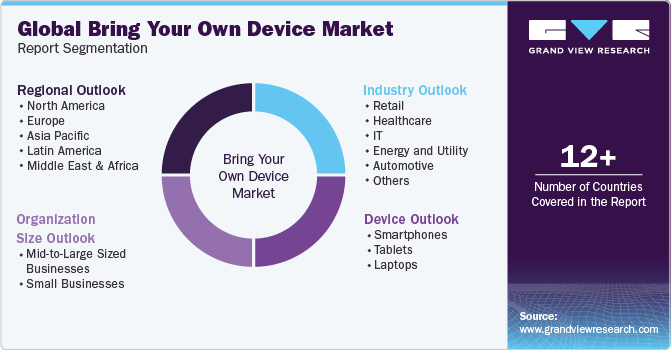
This report forecasts revenue growth at the regional, and country levels and provides an analysis on the latest industry trends and opportunities in each of the sub-segments from 2021 to 2033. For the purpose of this study, Grand View Research has segmented the global bring your own device market report on the basis of device, organization size, industry, and region:
 To learn more about this report, Download Free Sample Report
 -
Device Outlook (Revenue, USD Billion, 2021 - 2033)
-
Smartphones
-
Tablets
-
Laptops
-
-
Organization Size Outlook (Revenue, USD Billion, 2021 - 2033)
-
Mid-to-Large Sized Businesses
-
Small Businesses
-
-
Industry Outlook (Revenue, USD Billion, 2021 - 2033)
-
Retail
-
Healthcare
-
IT
-
Energy and Utility
-
Automotive
-
Others
-
-
Regional Outlook (Revenue, USD Billion, 2021 - 2033)
-
North America
-
U.S.
-
Canada
-
Europe
-
U.K.
-
Germany
-
France
-
Asia Pacific
-
Japan
-
China
-
India
-
Australia
-
South Korea
-
Latin America
-
Brazil
-
Mexico
-
Middle East & Africa
-
South Africa
-
Saudi Arabia
-
UAE
-
Frequently Asked Questions About This Report
The global bring your own device market size was valued at USD 110.5 billion in 2025 and is estimated at USD 124.0 billion for 2026.
The global bring your own device market is expected to grow at a CAGR of 11.0% from 2026 to 2033, reaching USD 258.5 billion.
North America dominated with a 35.0% revenue share in 2025.
Smartphones dominated the bring your own device market with a share of 46.0% in 2025.
Key players include ALE International; Omnissa, LLC; Jamf; Cisco Systems, Inc.; Hewlett Packard Enterprise Development LP; AT&T Intellectual Property; IBM; Ivanti; Oracle; Verizon; Microsoft; Aperian Global, Inc.
About the Author(s)
Next Generation Technologies Research Team
Technology · Next Generation TechnologiesThis report was authored by the next generation technologies research team at Grand View Research - comprising two research analysts, one senior research analyst, and one industry expert - with specialized expertise in the next generation technologies segment of the technology industry. All findings are based on proprietary technology databases, executive interviews, and regulatory analysis, subject to internal peer review prior to publication.
Last Updated:
Speak to Analyst

Customize this report to your needs - add regions, segments, or data points, with 20% free customization.
Or view our licence options:


ISO 9001:2015 & 27001:2022 Certified
We are GDPR and CCPA compliant! Your transaction & personal information is safe and secure. For more details, please read our privacy policy.


