
- Home
- »
- Pharmaceuticals
- »
-
Bronchodilators Market Size, Share & Growth Report, 2033GVR Report cover

Bronchodilators Market (2026 - 2033)
Size, Share & Trends Analysis Report By Disease (Asthma, COPD), By Route Of Administration (Inhalable, Oral), By Drug Class (Beta-Adrenergic, Anticholinergics), By Region, And Segment Forecasts
Market Size, 2025
$27.2BMarket Estimate, 2026
$28.3BMarket Forecast, 2033
$37.8BCAGR, 2026–2033
4.2%Bronchodilators Market Summary
The global bronchodilators market size was valued at USD 27.2 billion in 2025 and is projected to grow from USD 28.3 billion in 2026 to USD 37.8 billion by 2033, at a CAGR of 4.2% from 2026 to 2033. North America dominated the market, accounting for a revenue share of around 40.0% in 2025. The market is growing due to factors such as the aging population, rising prevalence of lung diseases, and increasing awareness of lung disease treatment, aided by escalating R&D efforts by key players in the market.
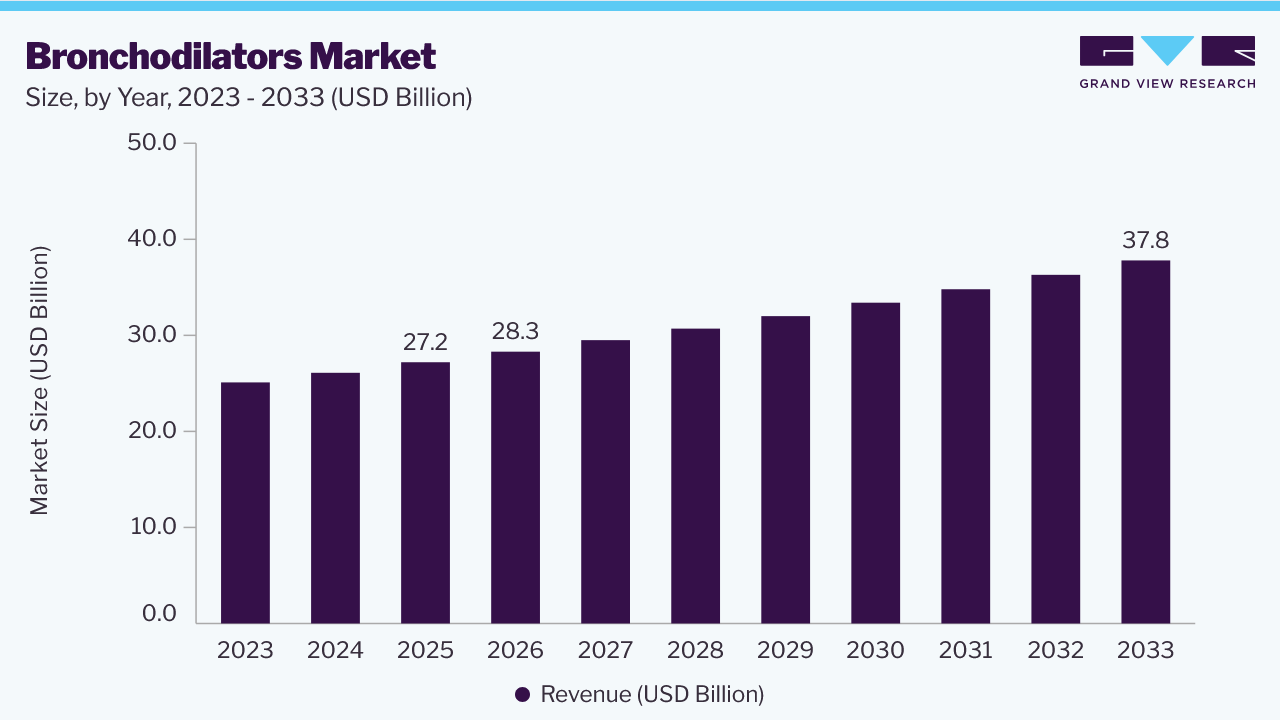 Source: Grand View Research, IR Documents, Primary Interviews, Paid DatabasesTo learn more about this report,
 Download Free Sample Report
Key Market Trends & Insights
- By drug class: Beta-adrenergic bronchodilators dominated the market with over 40.0% revenue share in 2025.
- By route of administration: Nasal (Inhalable) segment held the largest share of approximately 52.0% in 2025.
- By disease: Asthma segment accounted for the largest revenue share of around 42.0% in 2025.
Regional Highlights
- Largest regional market: North America (40.0% revenue share, 2025)
- Fastest-growing regional market: Asia Pacific (highest CAGR, 2026-2033)
Market Size & Forecast
- Market size in 2025: USD 27.2 Billion
- Estimated market size in 2026: USD 28.3 Billion
- Projected market size by 2033: USD 37.8 Billion
- CAGR (2026-2033): 4.2%
Prism AI by Grand View Research Free to tryAsk a question about the bronchodilators marketTry asking✓Every figure cited from GVR research Prefer the report? Download free sample →The growing geriatric population worldwide is expected to remain a key market driver, as older adults are more vulnerable to severe respiratory conditions and asthma-related complications, increasing the need for effective bronchodilator therapies. In the coming years, the global aging trend is expected to further expand the patient pool and support demand for bronchodilators used in the management of chronic respiratory diseases.
Furthermore, the development and introduction of advanced bronchodilator products are being supported by the rising prevalence of respiratory disorders, particularly asthma and chronic obstructive pulmonary disease (COPD). Bronchodilators alleviate respiratory symptoms by relaxing airway muscles and improving airflow, making them an important component of treatment for obstructive airway diseases. The increasing focus on improving treatment efficacy, delivery mechanisms, and patient outcomes is expected to support product development, approvals, and launches, thereby contributing to market growth.
However, stringent and complex regulatory requirements may restrain market growth. Bronchodilator manufacturers must demonstrate product safety, efficacy, and quality through rigorous clinical and regulatory processes before commercialization. Increasing regulatory scrutiny surrounding the safety and long-term use of respiratory medicines may extend approval timelines and increase development costs. Such regulatory complexities and compliance requirements could limit the pace of new product launches and expansion in the bronchodilators market.
Market Dynamics
The bronchodilators market is primarily driven by the rising prevalence of asthma and chronic obstructive pulmonary disease (COPD), particularly among the growing elderly population requiring long-term respiratory treatment. Increasing disease awareness and continued advances in treatment and drug-delivery technologies are further supporting market growth. However, stringent regulatory requirements and complex approval processes can increase development costs and delay product commercialization. Meanwhile, smart inhalers and connected respiratory devices are creating new opportunities by supporting medication adherence, treatment monitoring, and disease management.
The growing geriatric population worldwide is expected to remain a key driver of the bronchodilators market, as older adults experience a higher burden of chronic respiratory diseases and are more likely to require long-term respiratory management. Looking toward 2030, the continued global aging trend is expected to expand the patient pool and support demand for bronchodilator therapies.
Furthermore, the rising prevalence of respiratory disorders is driving the development and introduction of advanced products for the management of asthma and COPD. Bronchodilators relieve respiratory symptoms by relaxing airway muscles and improving airflow, making them an important component of treatment for obstructive airway diseases. A peer-reviewed study published in 2025 found that the prevalence of asthma and COPD increased substantially with age among adults aged 45 years and older in India. Among individuals aged 60 years and above, the prevalence of asthma and COPD was 5.91% and 2.81%, respectively, compared with 3.08% and 1.49% among those aged 45–59 years. The study also highlighted the greater disease burden and vulnerability to geriatric complications among older adults with these respiratory conditions.
Stringent regulatory requirements represent a key restraint for the bronchodilators market. Regulatory agencies such as the U.S. FDA and EMA require manufacturers to demonstrate the safety, efficacy, quality, and consistency of respiratory medicines through rigorous clinical and regulatory processes. In addition to premarket evaluation, approved medicines are subject to ongoing safety monitoring and post-market surveillance, which can increase compliance requirements and associated costs.
These requirements can increase the time and investment needed to develop and commercialize new bronchodilator therapies, creating challenges for smaller companies and new market entrants. Furthermore, differences in regulatory requirements across regions can add complexity for pharmaceutical companies seeking global commercialization. Collectively, these regulatory and compliance requirements may slow product launches, increase development costs, and constrain the pace of innovation in the bronchodilators market.
The development and adoption of smart inhalers and connected respiratory devices represent a significant emerging opportunity in the bronchodilators market. These technologies combine inhaled drug delivery with digital capabilities such as dose tracking, usage monitoring, medication reminders, sensors, mobile applications, and cloud-based platforms. Smart inhalers can help patients monitor medication use and adherence while enabling healthcare professionals to assess treatment patterns remotely, supporting more effective management of conditions such as asthma and COPD.
Digital technologies can provide patients with reminders and feedback while generating treatment-use data that can support clinical decision-making. The UK National Institute for Health and Care Research (NIHR) and NHS-linked research programs have evaluated smart inhalers for asthma management, while evidence reviews have assessed their potential to improve medication adherence, asthma control, and cost-effectiveness. Therefore, the arising collaboration between pharmaceutical and medical-device companies to develop connected inhalation solutions is expected to create opportunities for product differentiation and value-added respiratory care.
Analyst Perspective
The bronchodilators market is expected to witness steady growth, supported by the rising prevalence of asthma and COPD and the expanding elderly population worldwide. Market participants are increasingly focusing on advanced drug-delivery technologies and digital solutions to improve treatment adherence and respiratory disease management. While stringent regulatory requirements and associated development costs may constrain product commercialization, the growing adoption of smart inhalers and connected respiratory devices is expected to create new opportunities for innovation and product differentiation.
Drug Class Insights
The beta-adrenergic bronchodilators segment accounted for the largest revenue share in 2025, exceeding 40.0%. Beta-adrenergic bronchodilators, primarily β2-agonists, relax airway smooth muscle and improve airflow by dilating the bronchial airways. Major short-acting products include levalbuterol (Xopenex HFA) and albuterol, which is marketed under brands such as ProAir, Proventil, AccuNeb, and Ventolin. Albuterol remains one of the major revenue-generating molecules in this category, supported by widespread clinical use and the availability of generic formulations. Increasing approvals for generic products and product launches are also contributing to market accessibility.
The anticholinergic bronchodilators segment is also expected to experience strong growth during the forecast period. The availability of both short- and long-acting formulations supports their use across respiratory conditions, particularly COPD. Anticholinergic bronchodilators inhibit muscarinic receptor-mediated airway constriction, thereby promoting airway relaxation and improving airflow. Their established role in COPD maintenance therapy and increasing demand for long-acting respiratory treatments are expected to support segment growth. However, potential adverse effects associated with anticholinergic activity, particularly among older adults and patients with multiple comorbidities, may influence treatment selection and constrain adoption in certain patient populations.
Disease Insights
The asthma segment accounted for the largest revenue share of around 42.0% in 2025, driven by the substantial global prevalence of asthma and continued demand for effective symptom-control and maintenance therapies. According to the WHO, asthma affected an estimated 363 million people globally in 2023 and caused approximately 442,000 deaths, underscoring the significant global disease burden. Although the latest WHO global estimate is based on 2023 data, the burden remains substantial and continues to underpin demand for respiratory treatments. Ongoing advances in inhaled therapies, combination formulations, and multi-mechanism treatments are further expanding the asthma treatment landscape, with manufacturers increasingly focusing on improving disease control, treatment adherence, and patient outcomes.
The COPD segment is expected to witness significant growth during the forecast period, supported by the rising prevalence of the disease, population aging, and increasing demand for long-term respiratory therapies. Older adults are at greater risk of developing COPD owing to cumulative exposure to risk factors and age-related declines in lung function. COPD remains a major cause of morbidity and mortality globally, particularly in low- and middle-income countries, where exposure to tobacco smoke, household air pollution, occupational pollutants, and other risk factors remains substantial.
Route of Administration Insights
The nasal (Inhalable) segment held the largest market share, at more than 52%, in 2025. Inhalation is the primary route for administering bronchodilators as it delivers the active ingredient directly to the respiratory tract, enabling rapid and targeted therapeutic effects while generally limiting systemic exposure. Common inhalation devices include metered-dose inhalers (MDIs), dry powder inhalers (DPIs), nebulizers, and soft-mist inhalers. Soft-mist inhalers generate a slow-moving aerosol cloud that can facilitate drug deposition in the lungs and may offer advantages for patients who have difficulty coordinating actuation and inhalation with conventional MDIs. Increasing adoption of advanced inhalation devices, improvements in drug-device combinations, and the availability of generic inhaled therapies are expected to support segment growth.
The oral segment is expected to witness steady growth during the forecast period. Oral bronchodilators remain an alternative treatment option for selected patients and are available in formulations with established generic availability. However, inhaled therapies generally remain preferred for many obstructive respiratory conditions as they deliver medication directly to the lungs and can reduce systemic exposure compared with oral administration.
Regional Insights
North America bronchodilators market dominated the global market in 2025, supported by the high prevalence of asthma and COPD, a large geriatric population, established healthcare infrastructure, and strong demand for advanced respiratory therapies. Key COPD risk factors in the region include cigarette smoking, exposure to occupational dust and fumes, air pollution, and secondhand smoke. The American Lung Association identifies cigarette smoking as the leading risk factor for COPD, with smoking estimated to account for approximately 85% to 90% of COPD cases in the U.S. The presence of major pharmaceutical companies established reimbursement systems, high healthcare expenditure, and rapid adoption of novel inhaled therapies further support regional market growth.
 To learn more about this report, Download Free Sample Report
Asia Pacific Bronchodilators Market Trends
Asia Pacific is expected to be the fastest-growing regional market during the forecast period. The region has a substantial respiratory disease burden, a rapidly aging population, expanding healthcare infrastructure, and increasing access to respiratory treatments. The presence of established pharmaceutical companies such as Glenmark Pharmaceuticals and Cipla also supports the availability of cost-effective generic respiratory therapies. Furthermore, increasing investments in advanced inhalation technologies and the introduction of new respiratory products are expected to create additional growth opportunities. For instance, in 2025, Cipla announced plans to launch four major respiratory products by 2026, reinforcing its focus on expanding its respiratory portfolio and strengthening its position in the asthma and COPD treatment market.
Key Bronchodilator Company Insights
Key players in the global bronchodilators market are focusing on portfolio expansion, respiratory drug development, strategic collaborations, and geographical expansion to strengthen their market positions. Companies are also increasingly investing in advanced inhalation technologies and environmentally sustainable drug-delivery solutions to address the evolving needs of patients with asthma and COPD.
Key Bronchodilators Companies
The following key companies have been profiled for this study on the bronchodilators market.
-
AstraZeneca
-
Boehringer Ingelheim International GmbH.
-
Cipla Inc.
-
Glenmark Pharmaceuticals Limited
-
GSK plc.
-
Merck & Co., Inc.
-
Mylan N.V.
-
Novartis AG
-
Sun Pharmaceutical Industries Ltd.
-
Teva Pharmaceutical Industries Ltd.
Recent Development
- In October 2025, Cipla announced plans to launch four major respiratory products by 2026, reinforcing its focus on expanding its respiratory portfolio and strengthening its position in the asthma and COPD treatment market. The planned launches reflect the company's continued emphasis on respiratory therapies and its established presence in inhaled medicines.
- In May 2025, Lupin announced plans to develop next-generation respiratory inhalers using Honeywell's Solstice Air (HFO-1234ze(E) cGMP), an ultra-low global warming potential propellant. The technology is intended for use in pressurized metered-dose inhalers (pMDIs) for patients with asthma and COPD and is designed to substantially reduce the environmental impact associated with conventional HFC-based inhaler propellants. Lupin stated that it aims to become the first Indian pharmaceutical company to integrate Solstice Air into respiratory inhalers at scale.
Bronchodilators Market Report Scope
Report Attribute
Details
Market size in 2025
USD 27.2 billion
Estimated market size in 2026
USD 28.3 billion
Projected market size by 2033
USD 37.8 billion
Growth rate
CAGR of 4.2% from 2026 to 2033
Base year for estimation
2025
Historical data
2021 – 2024
Forecast period
2026 – 2033
Quantitative units
Revenue in USD billion, and CAGR from 2026 to 2033
Report coverage
Revenue forecast, company ranking, competitive landscape, growth factors, and trends
Segments covered
Drug class, route of administration, disease, region
Regional Scope
North America; Europe; Asia Pacific; Latin America; MEA
Country Scope
U.S.; Canada; Mexico; Germany; UK; France; Italy; Spain; Denmark, Sweden, Norway, China; Japan; India; Australia; Thailand, South Korea; Brazil; Argentina; South Africa; Saudi Arabia; UAE; Kuwait
Key companies profiled
GSK plc.; AstraZeneca; Teva Pharmaceutical Industries Ltd.; Cipla Inc.; Mylan N.V.; Merck & Co., Inc.; Novartis AG; Boehringer Ingelheim International GmbH.; Sun Pharmaceutical Industries Ltd.; Glenmark Pharmaceuticals Limited.
Customization scope
Free report customization (equivalent to 8 analyst working days) with purchase. Addition or alteration to country, regional & segment scope.
Pricing and purchase options
Avail of customized purchase options to meet your exact research needs. Explore purchase options
Global Bronchodilators Market Report Segmentation
This report forecasts revenue growth at global, regional, and country levels and provides an analysis of the latest trends in each of the sub-segments from 2021 to 2033. For this report, Grand View Research has segmented the bronchodilators market based on drug class, route of administration, disease, and region
-
Drug Class Outlook (Revenue, USD Billion, 2021- 2033)
-
Beta-Adrenergic Bronchodilators
-
Xanthine Derivatives
-
Anticholinergic Bronchodilators
-
-
Route of Administration Outlook (Revenue, USD Billion, 2021- 2033)
-
Oral
-
Nasal (Inhalable)
-
Injectable
-
-
Disease Outlook (Revenue, USD Billion, 2021- 2033)
-
Asthma
-
Chronic Obstructive Pulmonary Disease (COPD)
-
Others
-
-
Regional Outlook (Revenue, USD Billion, 2021- 2033)
-
North America
-
U.S.
-
Canada
-
Mexico
-
-
Europe
-
UK
-
Germany
-
France
-
Italy
-
Spain
-
Denmark
-
Sweden
-
Norway
-
-
Asia Pacific
-
Japan
-
China
-
India
-
Australia
-
Thailand
-
South Korea
-
-
Latin America
-
Brazil
-
Argentina
-
-
Middle East and Africa
-
South Africa
-
Saudi Arabia
-
UAE
-
Kuwait
-
-
Frequently Asked Questions About This Report
North America dominated with approximately 40.0% revenue share in 2025.
Some key players operating in the bronchodilators market include F. Hoffmann-La Roche Ltd, GSK plc., Johnson & Johnson Services, Inc., AstraZeneca, Siemens Healthcare GmbH, Abbott, Bio-Rad Laboratories, Inc., Thermo Fisher Scientific, Quest Diagnostics Incorporated., and FOUNDATION MEDICINE, INC.
The asthma segment accounted for the largest revenue share of around 42.0% in 2025.
The global bronchodilator market size was valued at USD 27.2 billion in 2025 and is estimated at USD 28.3 billion for 2026.
The global bronchodilator market is expected to grow at a CAGR of 4.2% from 2026 to 2033, reaching USD 37.8 billion by 2033.
About the Author(s)
Pharmaceuticals Research Team
Healthcare · PharmaceuticalsThis report was authored by the pharmaceuticals research team at Grand View Research - comprising two research analysts, one senior research analyst, and one industry expert - with specialized expertise in the pharmaceuticals segment of the healthcare industry. All findings are based on proprietary healthcare databases, executive interviews, and regulatory analysis, subject to internal peer review prior to publication.
Last Updated:
Speak to Analyst

Customize this report to your needs - add regions, segments, or data points, with 20% free customization.
Or view our licence options:


ISO 9001:2015 & 27001:2022 Certified
We are GDPR and CCPA compliant! Your transaction & personal information is safe and secure. For more details, please read our privacy policy.


