
- Home
- »
- Plastics, Polymers & Resins
- »
-
Bulk Chemical Packaging Drums Market Size Report, 2033GVR Report cover
![Bulk Chemical Packaging Drums Market Size, Share & Trends Report]()
Bulk Chemical Packaging Drums Market (2026 - 2033) Size, Share & Trends Analysis Report By Product (Plastic Drums, Steel Drums, Fiber Drums), By Capacity (Up to 100 Liters, 100-250 Liters, Above 250 Liters), By End Use, Region, And Segment Forecasts
- Report ID: GVR-4-68040-876-8
- Number of Report Pages: 130
- Format: PDF
- Historical Range: 2021 - 2024
- Forecast Period: 2026 - 2033
- Industry: Bulk Chemicals
- Report Summary
- Table of Contents
- Segmentation
- Methodology
- Download FREE Sample
-
 Download Sample Report
Bulk Chemical Packaging Drums Market Summary
The global bulk chemical packaging drums market size was valued at USD 27.3 billion in 2025 and is projected to reach USD 46.8 billion by 2033, growing at a CAGR of 7.0% from 2026 to 2033. The demand for bulk chemical packaging drums is growing steadily across the global market, primarily driven by the continued expansion of the chemical manufacturing industry.
Key Market Trends & Insights
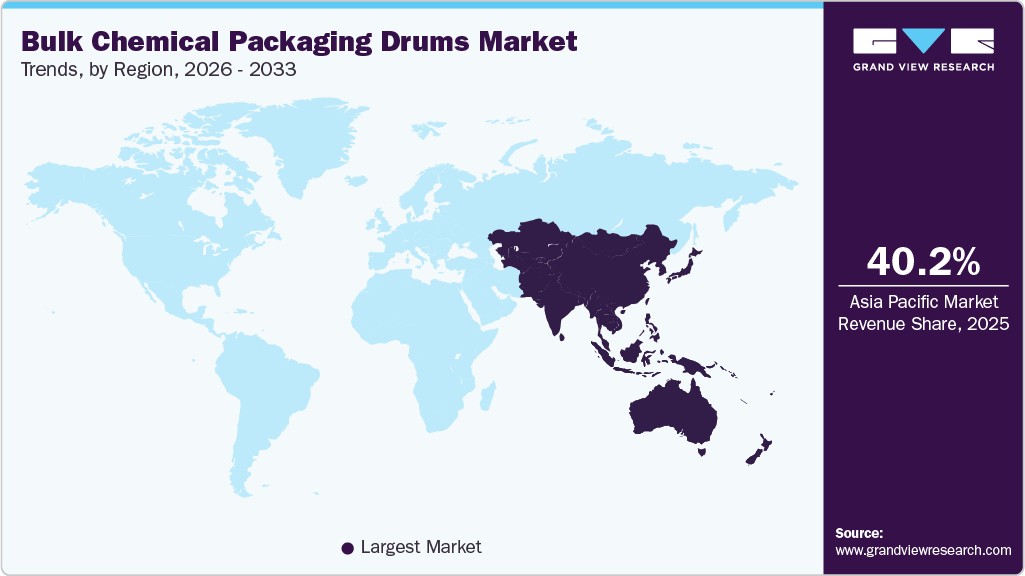
- In terms of region, Asia Pacific dominated the regional market with a major revenue share of 40.2% in 2025.
- Based on product, the steel drums segment dominated the market with 45.0% of the overall revenue share in 2025.
- On the basis of capacity, the 100-250 Liters segment dominated the market with the major revenue share of 66.1% in 2025.
- Based on end use, the chemicals & fertilizers segment led the market with the largest revenue share of 34.9% in 2025.
Market Size & Forecast
- 2025 Market Size: USD 27.3 Billion
- 2033 Projected Market Size: USD 46.8 Billion
- CAGR (2026-2033): 7.0%
- Asia Pacific: Largest market in 2025
Over the past decade, the production of industrial chemicals, specialty chemicals, and intermediates has increased significantly, particularly in developing economies where manufacturing activity is accelerating. As chemical producers scale up production, they require reliable packaging solutions capable of safely storing and transporting large volumes of hazardous and non-hazardous materials. Bulk chemical drums, typically ranging between 100 and 250 liters, offer an efficient balance between capacity, durability, and handling convenience, making them one of the most widely adopted packaging formats in chemical logistics. Their ability to withstand pressure, prevent leakage, and maintain product integrity makes them essential for transporting chemicals across long distances in global supply chains.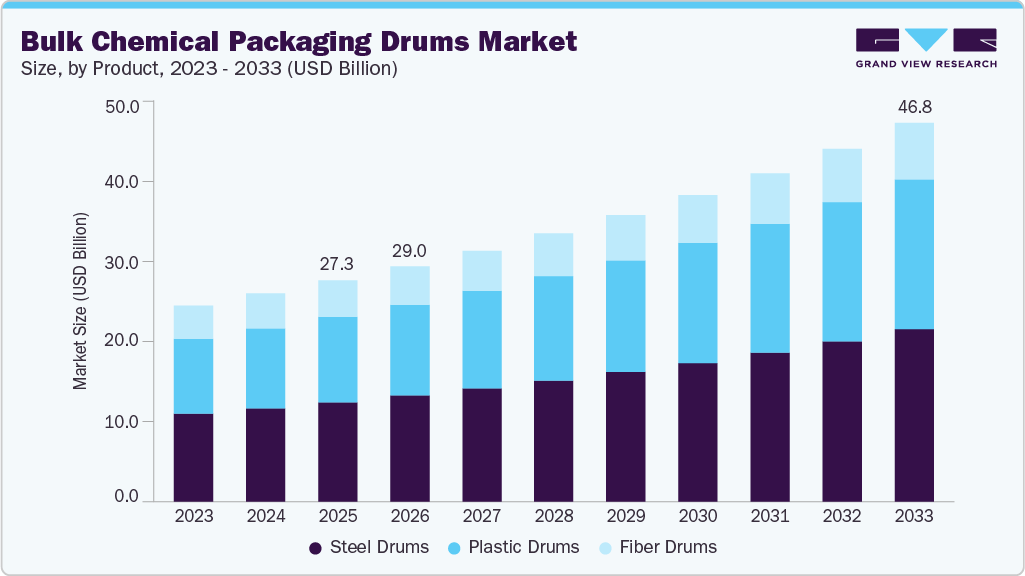
Another major factor contributing to the growing demand for chemical packaging drums is the rise in international trade of chemicals and related products. Globalization of chemical supply chains means that chemicals are frequently transported across regions and continents, requiring packaging solutions that comply with stringent international safety regulations. Industrial drums made from steel or high-density polyethylene (HDPE) are widely certified under United Nations (UN) hazardous goods transportation standards, making them suitable for cross-border logistics. These certifications ensure that chemicals remain safely contained during shipping, handling, and storage, thereby minimizing environmental risks and safety hazards. As chemical exports increase, especially from manufacturing hubs in Asia-Pacific and the Middle East, the need for standardized, regulation-compliant drum packaging continues to rise.
The versatility of bulk chemical drums across multiple end-use industries also plays a key role in market growth. Beyond traditional chemical manufacturing, these drums are widely used in sectors such as petrochemicals, pharmaceuticals, paints and coatings, agrochemicals, and food ingredients. Many of these industries require secure packaging for liquids, powders, and semi-solid materials, all of which can be effectively stored in drums. For example, lubricants, solvents, resins, and industrial oils are commonly transported in tight-head drums, while powders and viscous materials are often stored in open-head drums. The ability of drums to accommodate diverse chemical forms and viscosities makes them a versatile packaging option across numerous industrial applications.
Sustainability trends are also contributing to increased demand for bulk chemical drums, particularly through the growth of reconditioning and reuse programs. Unlike many single-use packaging formats, industrial drums, especially steel and plastic drums, can be cleaned, reconditioned, and reused multiple times without compromising structural integrity. This aligns with the broader shift toward circular economy practices in industrial packaging. Many chemical companies are increasingly adopting drum return and reconditioning systems to reduce packaging waste and lower the costs of purchasing new containers. As environmental regulations tighten and companies focus on improving sustainability metrics, reusable drum packaging is becoming increasingly attractive as a cost-effective, environmentally responsible solution.
Market Concentration & Characteristics
The bulk chemical packaging drums industry is heavily influenced by regulatory frameworks that govern the storage, handling, and transportation of hazardous and non-hazardous chemicals. Since many chemicals are flammable, toxic, corrosive, or reactive, governments and international organizations impose strict standards to ensure safe containment and prevent environmental contamination or workplace hazards. Packaging drums used for chemical transportation must comply with certifications such as the United Nations (UN) Recommendations on the Transport of Dangerous Goods, as well as region-specific regulations, including the U.S. Department of Transportation (DOT) hazardous materials regulations and the European ADR guidelines for road transport of dangerous goods. These standards dictate parameters such as material strength, leak-proof design, stacking capability, pressure resistance, and labeling requirements. As a result, manufacturers of bulk chemical drums must invest significantly in testing, certification, and quality assurance processes, which increase operational costs and create high entry barriers that protect established players in the market.
Although bulk chemical drums remain one of the most widely used packaging formats for industrial chemicals, several alternative packaging solutions compete with them depending on the type of chemical, transportation requirements, and storage volumes. One of the primary substitutes is the intermediate bulk container (IBC), which typically has a capacity of around 1,000 liters and is widely used for transporting larger volumes of liquid chemicals. IBCs offer advantages such as higher storage efficiency, easier dispensing through integrated valves, and better space utilization during shipping. In large-scale chemical distribution networks where bulk quantities are required, IBCs may replace multiple drums, reducing handling and logistics costs. However, drums continue to maintain a strong position for smaller volume shipments, specialty chemicals, and applications where portability and flexible handling are important.
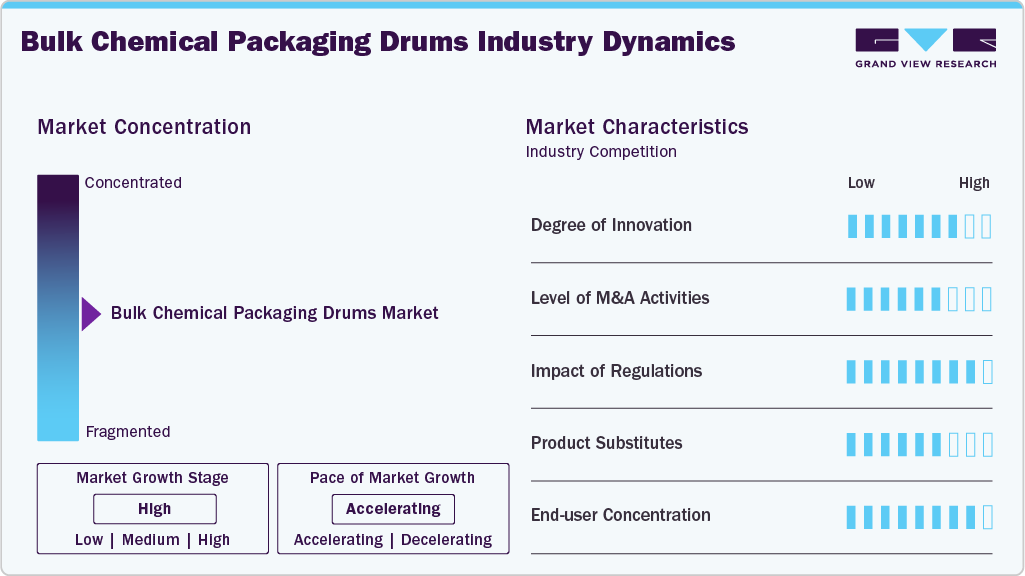
The market for bulk chemical packaging drums exhibits moderate to high end-user concentration, with demand largely driven by major industrial sectors such as chemical manufacturing, petrochemicals, pharmaceuticals, paints and coatings, lubricants, and agrochemicals. Among these, the chemical and petrochemical industries account for the largest share of drum consumption due to their extensive need to transport raw materials, intermediates, and finished products along supply chains. Large multinational chemical companies often purchase drums in high volumes through long-term supply agreements with packaging manufacturers or distributors. This concentration of demand among a relatively limited number of large industrial buyers gives these customers substantial negotiating power over pricing, quality standards, and supply reliability.
Product Insights
Based on product, steel drums dominate the bulk chemical packaging drums market primarily due to their exceptional strength, durability, and ability to safely store and transport hazardous materials. Many chemicals are highly reactive, flammable, or corrosive, requiring packaging solutions that can withstand high internal pressure, physical impact during transportation, and varying environmental conditions. Steel drums offer superior mechanical strength compared to most alternative materials, making them suitable for storing aggressive chemicals, petroleum derivatives, solvents, and industrial intermediates. Additionally, steel drums can be tightly sealed and are less permeable to gases and vapors, ensuring product integrity and reducing the risk of leaks or contamination during long-distance transportation.
Another important factor contributing to the dominance of steel drums is their reusability and compatibility with industrial reconditioning systems. Steel drums can be cleaned, refurbished, and reused multiple times without significant performance degradation, making them cost-effective for large-scale chemical producers. Their compatibility with strict hazardous materials transportation regulations further strengthens their market position. Industries such as petrochemicals, lubricants, paints, and specialty chemicals widely rely on steel drums because they provide reliable protection for sensitive or dangerous materials while complying with global safety and regulatory standards.
Plastic drums are the fastest-growing segment due to their lightweight structure, corrosion resistance, and increasing suitability for transporting a wide range of liquid chemicals. High-density polyethylene (HDPE) plastic drums are particularly popular because they are resistant to moisture, chemicals, and rust, making them ideal for acids, detergents, food-grade liquids, and agricultural chemicals. Their lighter weight compared to steel drums reduces transportation costs and improves handling efficiency across supply chains. Additionally, advancements in polymer technology and the increasing demand for cost-efficient, recyclable packaging solutions are accelerating the adoption of plastic drums across industries, especially in sectors that require non-corrosive, contamination-free packaging.
Capacity Insights
On the basis of capacity, the 100-250 liters capacity segment dominates the industry because it represents the most practical and widely accepted standard size for industrial chemical storage and transportation. Drums within this capacity range provide an optimal balance between storage efficiency and ease of handling. They are large enough to transport significant volumes of chemicals, yet small enough to be easily moved using forklifts, pallet systems, or manual handling equipment. This capacity range is widely used across industries such as chemicals, lubricants, paints, and pharmaceuticals, where consistent batch sizes and standardized logistics processes are essential. The standardization of this drum size across global supply chains has further strengthened its dominance, as it simplifies stacking, shipping, and warehouse storage operations.
In addition to dominating the market, the 100-250 liters segment is also the fastest-growing capacity category due to its versatility across diverse industrial applications. As chemical production and international trade continue to expand, manufacturers prefer packaging formats that can support efficient distribution while minimizing handling risks. Drums in this capacity range are suitable for both hazardous and non-hazardous materials, making them widely applicable in sectors ranging from petrochemicals to food ingredients. Furthermore, increasing adoption of automated material handling systems in warehouses and logistics hubs is reinforcing demand for standardized drum sizes, particularly those within the 100-250 liters range.
End Use Insights
The chemicals and fertilizers industry represents the largest end-use segment in the bulk chemical packaging drums industry due to the vast volume of raw materials, intermediates, and finished chemical products that require secure packaging and transportation. Chemical manufacturing involves a wide variety of substances, including solvents, acids, alkalis, additives, and specialty compounds, many of which must be stored and transported in durable containers that prevent leaks, contamination, and exposure to environmental conditions. Bulk drums provide an efficient packaging format that ensures the safe handling of these substances throughout the supply chain, from manufacturing facilities to distribution centers and end users.
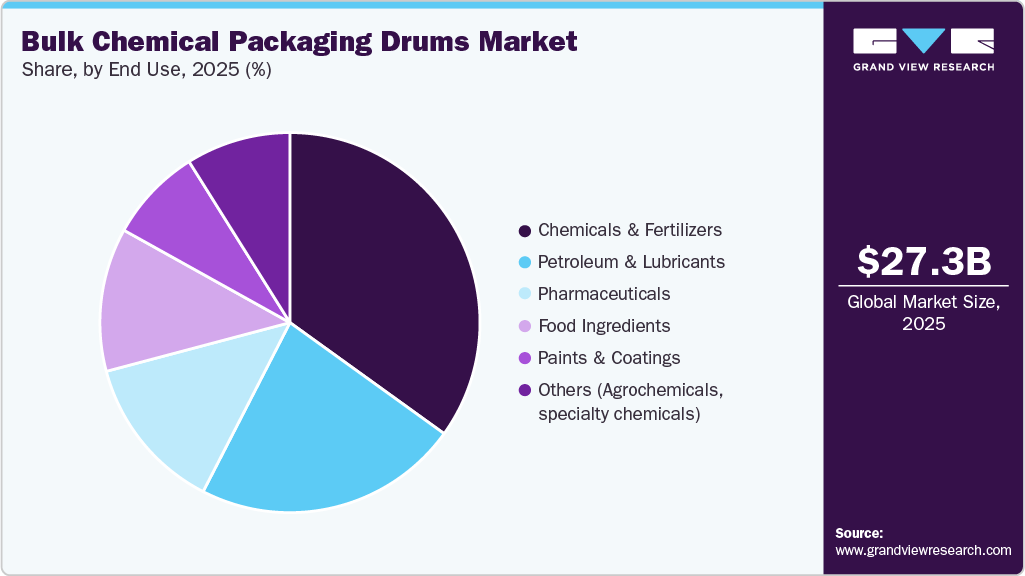
Furthermore, the fertilizers sector contributes significantly to drum demand due to the global expansion of agricultural production and the increasing use of chemical inputs to enhance crop yields. Liquid fertilizers, nutrient solutions, and agrochemical formulations are often transported in industrial drums to maintain product stability and prevent contamination. As agricultural productivity becomes increasingly important to support global food demand, the fertilizer industry continues to scale production and distribution networks, thereby driving steady demand for bulk chemical packaging drums across international markets.
The food ingredients segment is expected to grow at the fastest CAGR of 7.5% from 2026 to 2033. This is attributed to the rapid expansion of global food processing and ingredient manufacturing industries. Ingredients such as flavorings, edible oils, syrups, enzymes, and liquid additives are increasingly transported in industrial drums to maintain hygiene, prevent contamination, and ensure product quality during long-distance transportation. The rising demand for processed and convenience foods, along with the globalization of food supply chains, is significantly increasing the movement of bulk food ingredients across regions. As food manufacturers expand production and sourcing networks, the need for reliable, food-grade drum packaging solutions is growing rapidly, driving the segment's accelerated growth.
Regional Insights
The bulk chemical packaging drums industry in the Asia Pacific is forecast to grow at the fastest CAGR of 7.5% from 2026 to 2033. This is due to the strong presence of large-scale chemical manufacturing industries, expanding industrial production, and growing export-oriented supply chains. Countries across the region have rapidly increased production of petrochemicals, specialty chemicals, fertilizers, and industrial intermediates, all of which require safe, durable bulk packaging solutions. In addition, the region has become a major global manufacturing hub for sectors such as pharmaceuticals, automotive chemicals, coatings, and agrochemicals, which rely heavily on drum packaging for storage and transportation. Rapid industrialization, expanding logistics networks, and rising chemical trade within and outside the region continue to strengthen demand for bulk packaging drums across Asia Pacific.
The China bulk chemical packaging drums industry is growing rapidly due to the country’s position as one of the world’s largest producers and exporters of chemicals and industrial materials. China has an extensive chemical manufacturing ecosystem that includes petrochemicals, specialty chemicals, fertilizers, and industrial solvents, all of which require reliable bulk packaging for transportation and storage. As Chinese manufacturers increasingly export chemicals to global markets, the need for standardized, regulatory-compliant packaging formats, such as steel and plastic drums, has grown significantly. Additionally, government initiatives to support industrial expansion and improve logistics infrastructure have further stimulated demand for bulk chemical packaging solutions.
Europe Bulk Chemical Packaging Drums Market Trends
The bulk chemical packaging drums industry in Europe is supported by the region’s advanced chemical manufacturing sector and strong regulatory focus on safe handling and transportation of industrial chemicals. European industries such as pharmaceuticals, coatings, lubricants, and specialty chemicals rely heavily on drum packaging for bulk storage and logistics operations. Additionally, the presence of well-developed export networks across European Union countries encourages the use of standardized industrial packaging formats that meet regulatory requirements. The increasing emphasis on sustainability, recycling, and reconditioning of steel drums also contributes to continued demand in the European market.
The Germany bulk chemical packaging drums industryis one of the key drivers of the market in Europe due to its strong position as a leading global chemical manufacturing hub. The country hosts several major chemical and pharmaceutical companies that produce a wide range of industrial chemicals, specialty formulations, and raw materials that require safe bulk packaging for transportation. Germany’s highly developed industrial supply chains and export-oriented economy further increase the need for reliable packaging solutions such as steel and plastic drums. In addition, strict regulatory standards for chemical handling and logistics reinforce the use of high-quality drum packaging across the country’s manufacturing and distribution networks.
North America Bulk Chemical Packaging Drums Market Trends
The bulk chemical packaging drums industry in North America is driven by the region’s well-established chemical, petrochemical, and food processing industries. Major chemical producers rely on durable drum packaging for the safe transport of raw materials, solvents, lubricants, and specialty chemical formulations across extensive supply chains. The region also benefits from advanced logistics networks and strict regulatory frameworks governing the transportation of hazardous materials, which reinforce the use of high-quality drum packaging. Furthermore, the growth of specialty chemicals, agricultural inputs, and food ingredient manufacturing is supporting consistent demand for bulk packaging drums across the region.
U.S. Bulk Chemical Packaging Drums Market Trends
The U.S.bulk chemical packaging drums industry represents a major market due to its strong chemical manufacturing base and large-scale industrial production. The country hosts numerous petrochemical plants, pharmaceutical manufacturers, agricultural chemical producers, and specialty chemical companies that require safe bulk packaging for domestic distribution and international exports. In addition, the expansion of shale-based petrochemical production has increased the movement of industrial liquids and chemical intermediates across the supply chain. Strict transportation safety regulations and the need for reliable packaging for hazardous materials further drive demand for high-quality steel and plastic drums in the U.S. market.
Key Bulk Chemical Packaging Drums Company Insights
The competitive environment in the bulk chemical packaging drums market is characterized by the presence of several established global manufacturers along with a large number of regional and local suppliers. Major companies compete primarily on factors such as product durability, compliance with international safety standards, customization capabilities, and pricing.
Leading manufacturers offer a wide portfolio of drum types, including steel and high-density polyethylene (HDPE) drums, designed to meet the packaging requirements for hazardous and non-hazardous chemicals. In addition, companies increasingly emphasize drum reconditioning and recycling services as part of their product offerings, enabling customers to reduce costs while meeting sustainability objectives. Long-term supply agreements with large chemical producers, petrochemical companies, and food ingredient manufacturers also play a crucial role in strengthening competitive positioning.
-
In April 2023, Greif announced the completion of a USD 145 million all-cash transaction, increasing its ownership in Centurion Container from 9% to 80%. In Greif’s joint venture with the Chicago-area company since 2020, Centurion is recognized as the second-largest provider of reconditioned and rebottled intermediate bulk containers (IBCs) and plastic drums.
-
In May 2022, Stewardship Group launched the OneDrum bulk battery shipping kit. In this bulk collection service, household hazardous waste collection sites, MRFs, electronics recycling facilities, and other battery accumulators can ship a variety of rechargeable and single-use batteries without the need for labor-intensive fire-prevention measures.
Key Bulk Chemical Packaging Drums Companies:
The following key companies have been profiled for this study on the bulk chemical packaging drums market.
- Greif Inc.
- Mauser Packaging Solutions
- SCHÜTZ GmbH & Co. KGaA
- Time Technoplast Ltd.
- Balmer Lawrie & Co. Ltd.
- TPL Plastech Limited
- Sicagen India Ltd.
- Myers Container LLC
- Skolnik Industries Inc.
- The Metal Drum Company
- Peninsula Drums Pty Ltd.
- Snyder Industries
- Cleveland Steel Container
- Orlando Drum & Container Corporation
- Hoover Ferguson Group
Bulk Chemical Packaging Drums Market Report Scope
Report Attribute
Details
Market size value in 2026
USD 29.0 billion
Revenue forecast in 2033
USD 46.8 billion
Growth rate
CAGR of 7.0% from 2026 to 2033
Base year for estimation
2025
Historical data
2021 - 2024
Forecast period
2026 - 2033
Quantitative units
Revenue in USD million/billion and CAGR from 2026 to 2033
Report coverage
Revenue forecast, company ranking, competitive landscape, growth factors, and trends
Segments covered
Product, capacity, end use, region
Regional scope
North America; Europe; Asia Pacific; Latin America; Middle East & Africa
Country scope
U.S.; Canada; Mexico; Germany; UK; France; Spain; Italy; China; India; Japan; Australia; South Korea, Brazil; Argentina; South Africa; UAE; Saudi Arabia
Key companies profiled
Greif Inc.; Mauser Packaging Solutions; SCHÜTZ GmbH & Co. KGaA; Time Technoplast Ltd.; Balmer Lawrie & Co. Ltd.; TPL Plastech Limited; Sicagen India Ltd.; Myers Container LLC; Skolnik Industries Inc.; The Metal Drum Company; Peninsula Drums Pty Ltd.; Snyder Industries; Cleveland Steel Container; Orlando Drum & Container Corporation; Hoover Ferguson Group,
Customization scope
Free report customization (equivalent up to 8 analysts’ working days) with purchase. Addition or alteration to country, regional, and segment scope.
Pricing and purchase options
Avail customized purchase options to meet your exact research needs. Explore purchase options
Global Bulk Chemical Packaging Drums Market Report Segmentation
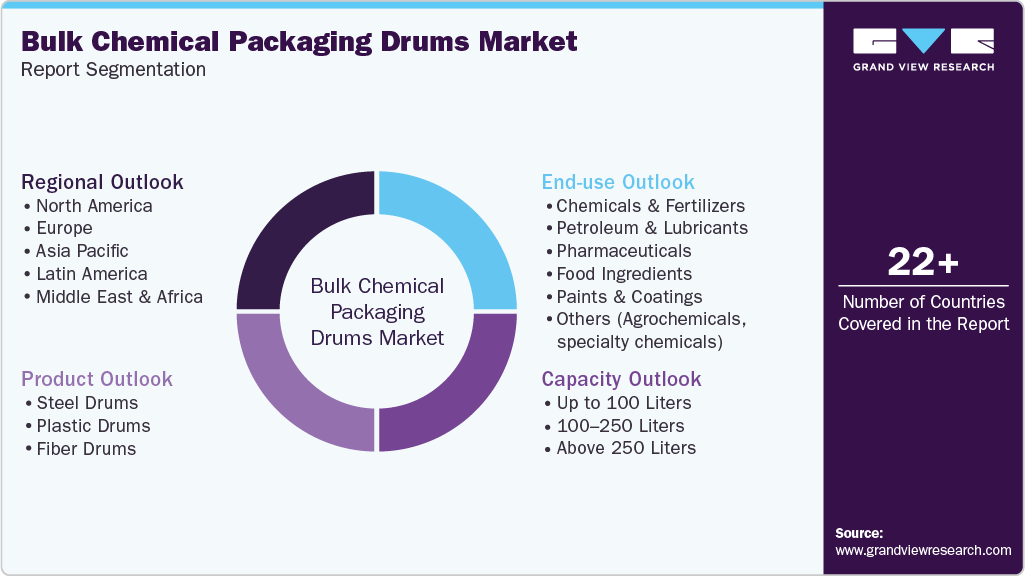
This report forecasts revenue growth at the global, regional, and country levels and provides an analysis of the latest industry trends in each of the sub-segments from 2021 to 2033. For this study, Grand View Research has segmented the global bulk chemical packaging drums market report on the basis of product, capacity, end use, and region:
-
Capacity Outlook (Revenue, USD Million, 2021 - 2033)
-
Up to 100 Liters
-
100-250 Liters
-
Above 250 Liters
-
-
Product Outlook (Revenue, USD Million, 2021 - 2033)
-
Steel Drums
-
Plastic Drums
-
Fiber Drums
-
-
End Use Outlook (Revenue, USD Million, 2021 - 2033)
-
Chemicals & Fertilizers
-
Petroleum & Lubricants
-
Pharmaceuticals
-
Food Ingredients
-
Paints & Coatings
-
Others (Agrochemicals, specialty chemicals)
-
-
Regional Outlook (Revenue, USD Million, 2021 - 2033)
-
North America
-
U.S.
-
Canada
-
Mexico
-
-
Europe
-
Germany
-
UK
-
France
-
Italy
-
Spain
-
-
Asia Pacific
-
China
-
India
-
Japan
-
Australia
-
South Korea
-
-
Latin America
-
Brazil
-
Argentina
-
-
Middle East & Africa
-
South Africa
-
Saudi Arabia
-
UAE
-
-


Share this report with your colleague or friend.
Need a Tailored Report?
Customize this report to your needs — add regions, segments, or data points, with 20% free customization.


ISO 9001:2015 & 27001:2022 Certified
We are GDPR and CCPA compliant! Your transaction & personal information is safe and secure. For more details, please read our privacy policy.
Trusted market insights - try a free sample
See how our reports are structured and why industry leaders rely on Grand View Research. Get a free sample or ask us to tailor this report to your needs.













