
- Home
- »
- Homecare & Decor
- »
-
Camping And Caravanning Market Size Report, 2026-2033GVR Report cover

Camping And Caravanning Market (2026 - 2033)
Size, Share & Trends Analysis Report By Revenue Type (Vehicle Rental, Pitch/Campsite Rental), Trip Length (Short-stay (1 To 3 Nights), Medium-stay, Long-stay, By Age Group, By Booking Mode, By Region, and Segment Forecasts
Market Size, 2025
$66.4BMarket Estimate, 2026
$71.4BMarket Forecast, 2033
$143.9BCAGR, 2026–2033
10.5%Camping And Caravanning Market Summary
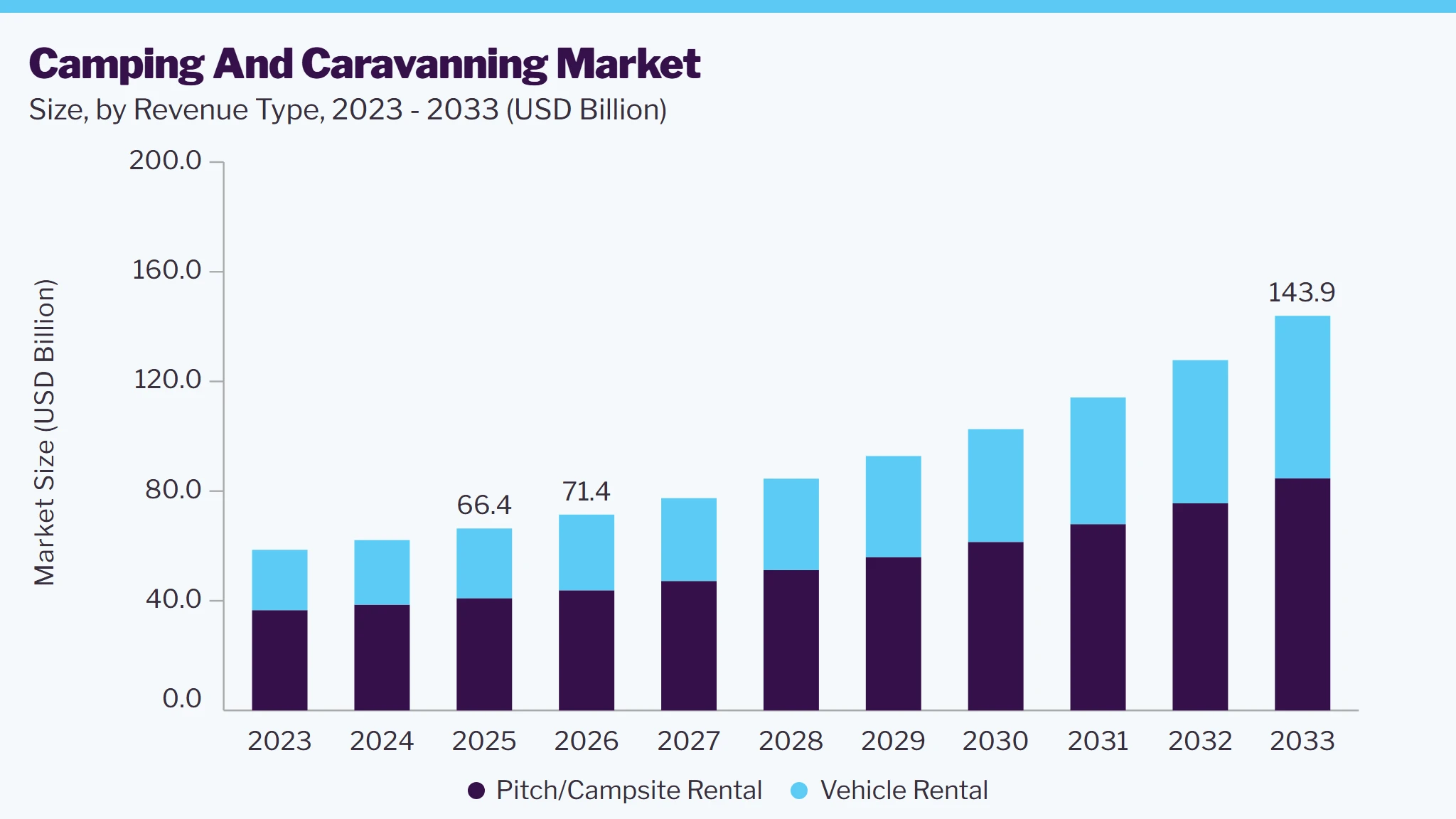
The global camping and caravanning market size was valued at USD 66.4 billion in 2025 and is expected to grow from USD 71.4 billion in 2026 to USD 143.9 billion by 2033, at a CAGR of 10.5% from 2026 to 2033. Europe dominated the market, accounting for a revenue share of 57.7% in 2025. The market is driven by increasing consumer interest in nature-based travel, rising demand for flexible and self-directed holidays, growing participation in outdoor recreation, expansion of camping and caravan infrastructure, and increasing preference for road trips and overnight stays that offer greater proximity to nature.
 Source: Grand View Research, IR Documents, Primary Interviews, Paid DatabasesTo learn more about this report,
 Download Free Sample Report
Key Market Trends & Insights
- By revenue type: Pitch/campsite rental, camping and caravanning accounted for the largest share of 61.7% of the global revenue in 2025.
- By trip length: Short-stay (1 to 3 Nights) led the market and accounted for a share of 61.4% in 2025.
- By age group: Camping and caravanning for the 55 years & above age group led the market and accounted for a share of 48.8% in 2025.
- By booking mode: Online travel agencies (OTAs) led the market and accounted for a share of 45.7% in 2025.
Regional Highlights
- Largest Region: Europe (57.7% revenue share, 2025)
- Fastest-growing Region: North America (highest CAGR, 2026-2033)
Market Size & Forecast
- Market Size in 2025: USD 66.4 Billion
- Estimated Market Size in 2026: USD 71.4 Billion
- Projected Market Size by 2033: USD 143.9 Billion
- CAGR (2026-2033): 10.5%
Three ways to get this report
Buy it, customize it, or ask a question.Ask an Analyst
Analyst response in 1 business day
- AccessReport author, directly
- Reply timeWithin 1 working day
- No sales callDirect answer only
- FormatEmail reply
- CostFree, no cost
Get the Full Report
What the study covers
- FormatsPDF · Excel · Dashboard
- Timeline2026–2033 annual, 2025 base
- Coverage20+ countries, 5 regions
- Companies10+ key players profiled
Customize the Report
20% free customization
- IncludeCountries, segments, points
- TailorTo your product definition
- ExtendDeeper competitor detail
- OrA fully bespoke study
- Turnaround5–10 working days
The camping and caravanning market is being driven by rising consumer preference for experiential and adventure-based holidays that combine accommodation with outdoor recreation and destination experiences. Travelers are increasingly seeking activities such as hiking, fishing, cycling, kayaking, wildlife viewing, and off-road exploration, encouraging camping and caravan operators to develop activity-oriented destinations and packages. The growing emphasis on exploration, adventure, and immersive experiences is increasing demand for campsites, RV parks, campervan stays, and experience-led outdoor accommodation, thereby supporting the expansion of the camping industry.
Younger consumers are increasingly entering the camping and caravanning market, creating a broader customer base for RV travel, campervans, and outdoor accommodation. For instance, the RV Industry Association reported in May 2025 that millennials and gen z recorded the highest intent to travel by RV, at 83% and 81%, respectively, while Millennials were the most likely generation to consider purchasing an RV within the following year. The growing interest of younger generations in RV travel and road-based vacations is creating additional demand for campsites, RV rentals, and related outdoor travel services, supporting the expansion of the camping industry.
 To learn more about this report, Download Free Sample Report
The transition toward electric mobility is creating new opportunities across the camping and caravanning market, as travelers increasingly incorporate electric vehicles, e-bikes, electric microcars, and emerging electric campervans into outdoor trips. The Camping and Caravanning Club identified “camping goes electric” as a key 2026 trend, highlighting the growing use of lightweight e-bikes and electric microcars for motorhome travel. The increasing adoption of electric mobility is encouraging campsites and caravan parks to consider EV charging infrastructure and other electric-vehicle facilities, creating new opportunities for the camping industry.
Market Dynamics
Growing preference for nature-based outdoor recreation is driving the camping and caravanning market, as consumers increasingly seek leisure experiences that provide relaxation, time in natural surroundings, and opportunities to participate in outdoor activities. Camping and caravanning enable travelers to combine accommodation with hiking, sightseeing, wildlife experiences, and other outdoor pursuits, supporting demand across the broader camping industry. According to The Camping and Caravanning Club’s Outjoyment Report, 91% of campers reported that camping makes them feel relaxed, while 98% participate in outdoor activities, highlighting the strong connection between camping and outdoor recreation.
High costs associated with camping and caravanning can restrain the camping and caravanning market, as consumers may incur multiple expenses related to campsite bookings, pitch selection, length of stay, vehicle use, and additional facilities. For instance, the camping and caravanning club states that campsite prices vary based on factors such as season, site, length of stay, pitch type, membership status, and party size, while additional facilities may involve separate charges. The accumulation of these expenses can increase the overall cost of camping and caravanning, particularly for families and longer-stay travelers, potentially discouraging price-sensitive consumers and limiting participation in the broader camping industry.
The expansion of premium and experience-oriented camping presents an opportunity for the camping and caravanning market, as consumers increasingly seek greater comfort, convenience, and distinctive experiences while staying close to nature. VisitEngland highlighted new and upgraded glamping offerings that combine nature-based stays with premium amenities such as private bathrooms, stylish communal areas, hot tubs, private decking, firepits, and luxury accommodation. Such developments demonstrate the potential to attract consumers seeking an enhanced alternative to traditional camping while creating higher-value offerings across the camping industry.
Analyst Perspective
The camping and caravanning market is evolving toward more flexible, experience-led outdoor travel, with camping and caravan trips increasingly serving as alternatives to conventional vacations for consumers seeking nature, adventure, relaxation, and greater control over their travel itineraries. Demand is supported by growing interest in outdoor recreation and nature-based experiences, while campsite and caravan operators are enhancing facilities, accommodation options, and recreational amenities to improve comfort and attract a broader range of travelers. The camping industry is also expanding beyond traditional camping through premium stays, glamping, upgraded caravan facilities, and experience-focused offerings that combine outdoor recreation with convenience and comfort.
Consumer Insights
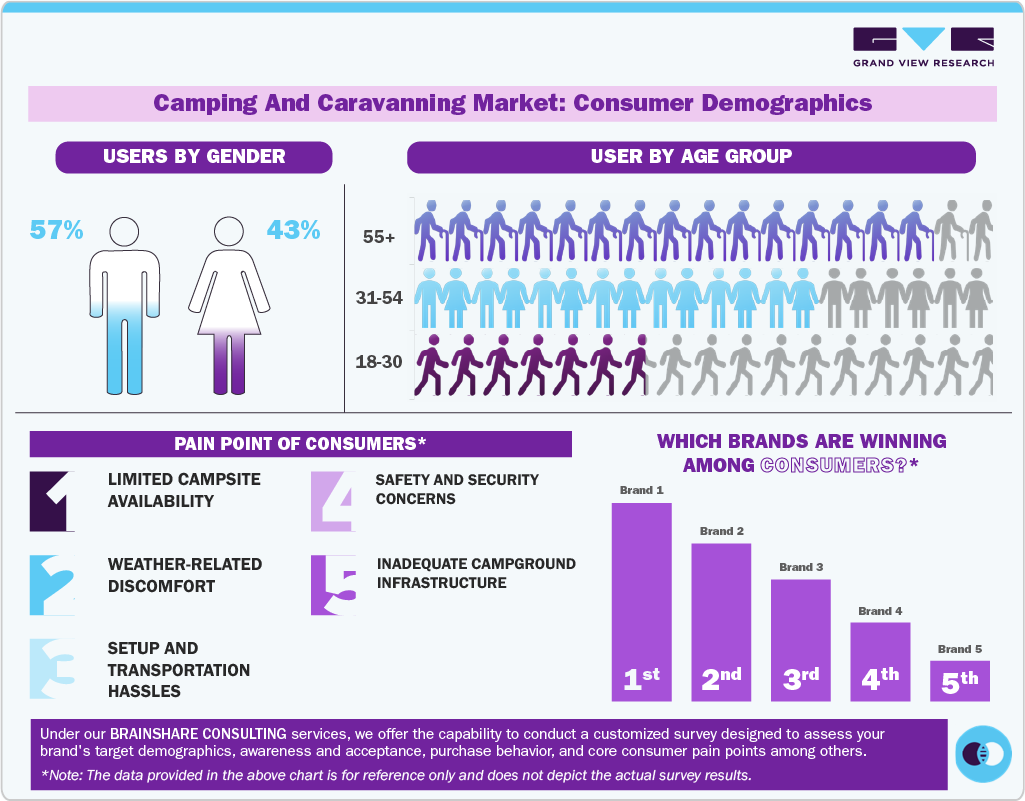
The camping and caravanning market serves outdoor enthusiasts, families, couples, recreational travelers, road-trip travelers, and individuals seeking nature-based leisure experiences across diverse age groups and genders.
 To learn more about this report, Download Free Sample Report
Users by Gender:
-
Male consumers account for an estimated 57% share, reflecting their significant participation in camping trips, caravanning, road travel, outdoor recreation, and vehicle-based leisure activities. Male users also represent an important consumer group for caravan-related travel, campsite selection, outdoor equipment, and trip planning within the camping and caravanning segment.
-
Female consumers account for 43%, supported by their participation in family camping trips, leisure travel, nature-based tourism, recreational stays, and caravan holidays. Female participation also contributes to demand for comfortable campsites, convenient amenities, safety features, and well-equipped camping facilities across the camping industry.
Users by Age Group:
-
Consumers aged 55 and above represent the largest user group in the camping and caravanning market, including retirees, older couples, and experienced travelers who seek leisure trips, scenic destinations, extended road travel, and comfortable outdoor accommodation. This group tends to value convenience, reliable facilities, accessible campsites, and comfort-oriented caravanning experiences.
-
Consumers aged 35-54 include working professionals, families, and established travelers who participate in camping holidays, road trips, and outdoor recreational activities, often prioritizing family-friendly facilities, spacious caravans, and flexible travel experiences.
-
Consumers aged 18-34 primarily include younger adults, couples, and adventure-oriented travelers who engage in tent camping, weekend getaways, and nature-based activities, with interest in affordable equipment, flexible itineraries, social experiences, and outdoor exploration.
Consumers in the camping and caravanning market commonly face several challenges when planning and undertaking camping or caravan trips.
-
Limited campsite availability remains a major concern, particularly during peak travel periods, as consumers may face difficulty securing suitable pitches at preferred destinations and dates, affecting the convenience of camping and caravanning trips.
-
Weather-related discomfort affects the overall camping experience, as extreme temperatures, rainfall, wind, and changing weather conditions can disrupt outdoor activities and reduce comfort.
-
Setup and transportation hassles create challenges for consumers, particularly caravan users who need to manage towing, parking, equipment installation, campsite setup, and transportation of camping gear.
-
Safety and security concerns influence campsite selection, with consumers considering personal safety, vehicle security, wildlife encounters, and the safety of camping equipment and belongings.
-
Inadequate campground infrastructure reduces consumer satisfaction when campsites have limited access to clean sanitation facilities, electricity connections, water supply, waste disposal, parking, and other essential amenities, creating a key challenge for the broader camping industry.
Revenue Type Insights
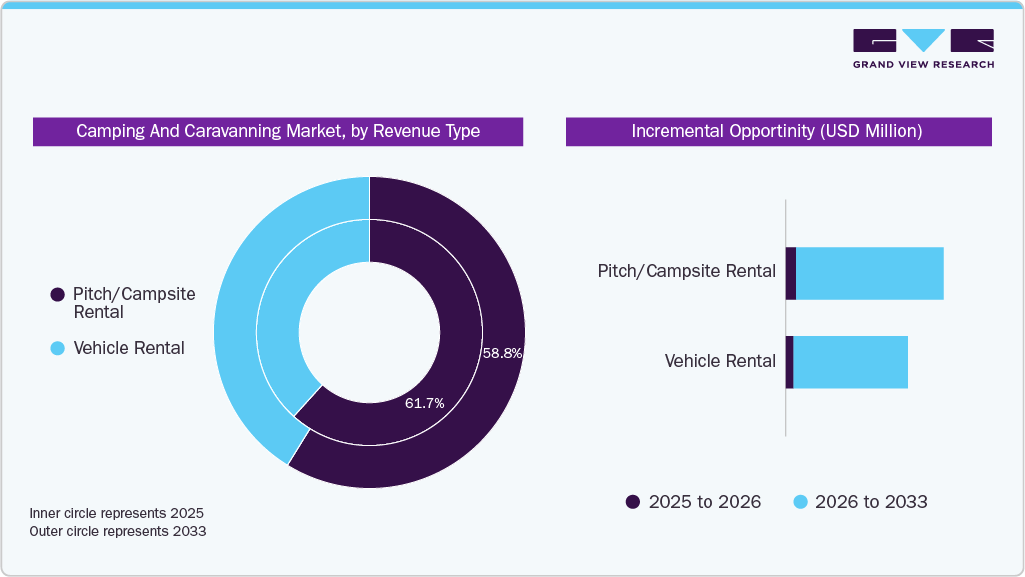
In the revenue type segment, pitch/campsite rental accounted for the largest revenue share of 61.7% in 2025, driven by the recurring demand for designated camping pitches and caravan spaces among travelers seeking flexible and nature-oriented accommodation. For instance, the camping and caravanning club offers multiple pitch options, including grass pitches with electric hook-up, hardstanding pitches with electric hook-up, and larger-unit pitches, allowing travelers to select accommodation based on their vehicle type and facility requirements. The availability of differentiated pitch options supports revenue generation from campsite rentals across the camping and caravanning market.
 To learn more about this report, Download Free Sample Report
In the revenue type segment, the vehicle rental is expected to grow with a CAGR of 11.5% from 2026 to 2033, driven by increasing consumer preference for flexible road-based travel and the ability to access caravans, campervans, and motorhomes without the high upfront cost of ownership. For instance, El Monte RV offers RV rentals across multiple vehicle categories, enabling travelers to combine transportation and accommodation for camping and road trips. Such rental options are supporting greater accessibility to camping and caravanning experiences and creating opportunities for vehicle rental revenue within the camping and caravanning market.
Trip Length Insights
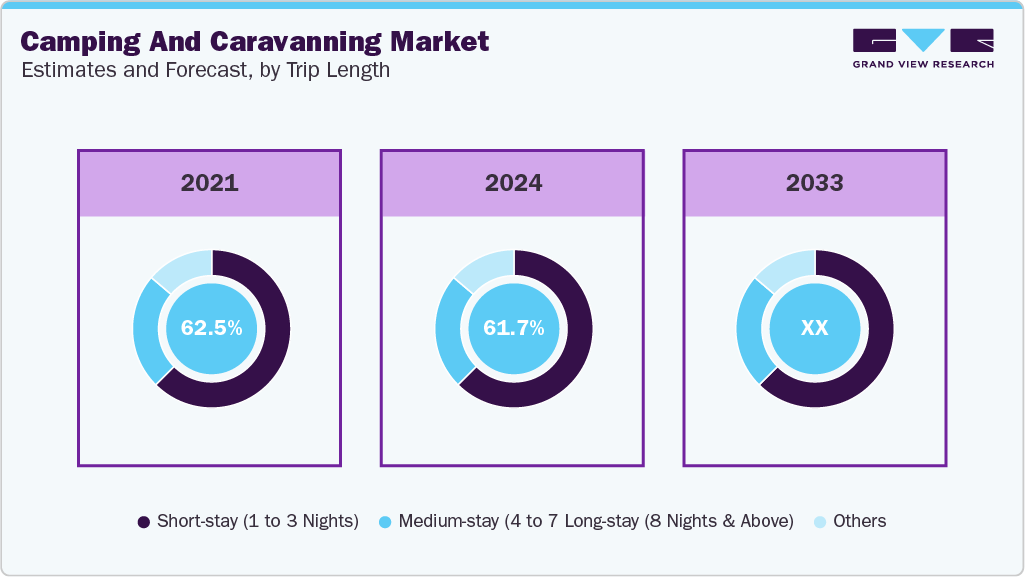
Based on trip length, short stays (1 to 3 nights) accounted for the largest revenue share of 61.4% in 2025, driven by growing consumer interest in weekend getaways, short road trips, and convenient nature-based breaks that require less time and planning than extended holidays. Short-duration trips allow travelers to combine outdoor recreation and sightseeing while fitting travel around work schedules and other commitments. For instance, The Camping and Caravanning Club’s 2026 UK road-trip recommendations feature the approximately 150-mile Cotswolds Romantic Road, which can be completed in two days and includes campsites along the route. The availability of a dedicated two-day itinerary with camping facilities supports the appeal of short-duration camping and caravanning experiences and strengthens demand for short-stay trips across the camping and caravanning market.
 To learn more about this report, Download Free Sample Report
Camping and caravanning for medium stay (4 to 7 nights) are expected to grow with a considerable CAGR of 12.1% from 2026 to 2033, driven by increasing consumer preference for multi-day outdoor holidays that provide sufficient time for sightseeing, recreational activities, and relaxation. Medium-duration trips allow travelers to explore multiple attractions while making greater use of campsite and caravan facilities compared with short weekend stays. For instance, The Camping and Caravanning Club’s 2026 minimum-stay guidance specifies five-night minimum stays at selected destinations during the high season, including Bowness-on-Windermere, Derwent Water, Keswick, and Braithwaite Village. The availability of multi-night stays at popular destinations supports demand for medium-duration camping and caravanning experiences across the camping and caravanning market.
Age Group Insights
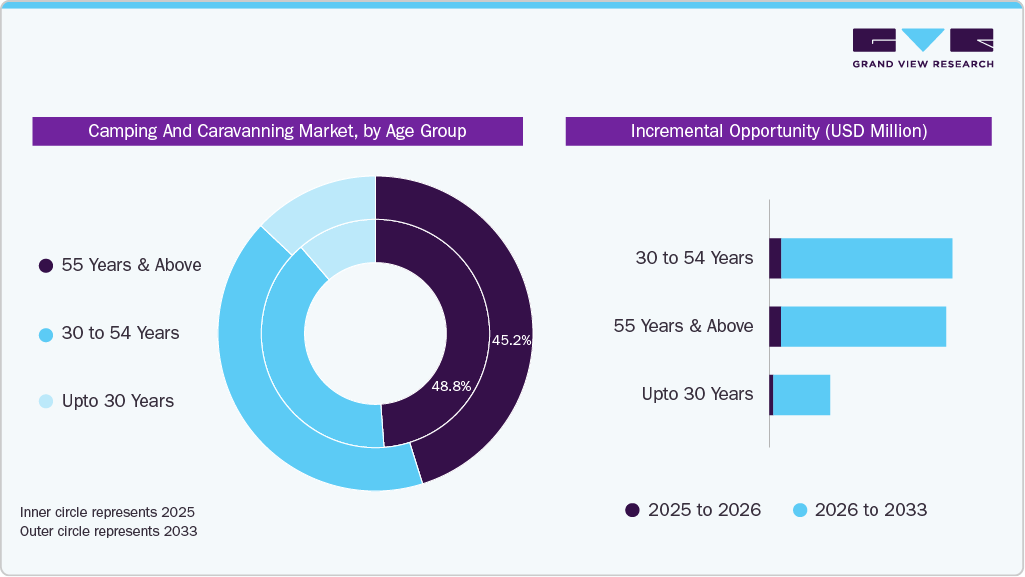
Based on age group, the 55 years and above age group accounted for the largest revenue share of 48.8% in 2025, reflecting the strong participation of older consumers in RV- and caravan-based travel. According to The Dyrt’s 2025 Camping Report, 61% of campers aged 55 and above identified an RV or trailer as their primary camping type, which was 50% higher than the average camper. The report also found that 79.1% of campers aged 55 and above planned to visit national parks after retirement, while 73.6% planned to undertake open-road exploration, indicating that greater post-retirement flexibility is encouraging nature-based and self-directed travel.
These preferences are further supported by the RV Industry Association, which reported that 81% of Casual Campers are aged 55 and above, with 48% retired and 80% identifying camping as a hobby. The segment also showed a strong preference for travel trailers, with conventional travel trailers accounting for 70% of the RV types most often owned. Such preferences support demand for RV parks, caravan sites, and convenient outdoor accommodation options within the camping and caravanning market, while also reinforcing the importance of older consumers to the broader camping industry.
 To learn more about this report, Download Free Sample Report
Camping and caravanning for up-to-30-year age group are expected to grow at a CAGR of 12.5% from 2026 to 2033, reflecting the participation of younger consumers in adventure-oriented outdoor travel. According to Overland Expo’s 2025 Industry Report, 41% of new overlanders are under 30 years, highlighting the significant presence of younger consumers entering the overlanding and outdoor recreation space. The report further indicates that this younger group is motivated by freedom, solitude, and adventure, while 54% use tent camping, demonstrating a preference for flexible and immersive outdoor experiences. These preferences are supporting participation among younger consumers and creating opportunities for experience-oriented offerings within the camping and caravanning market and the broader camping industry.
Booking Mode Insights
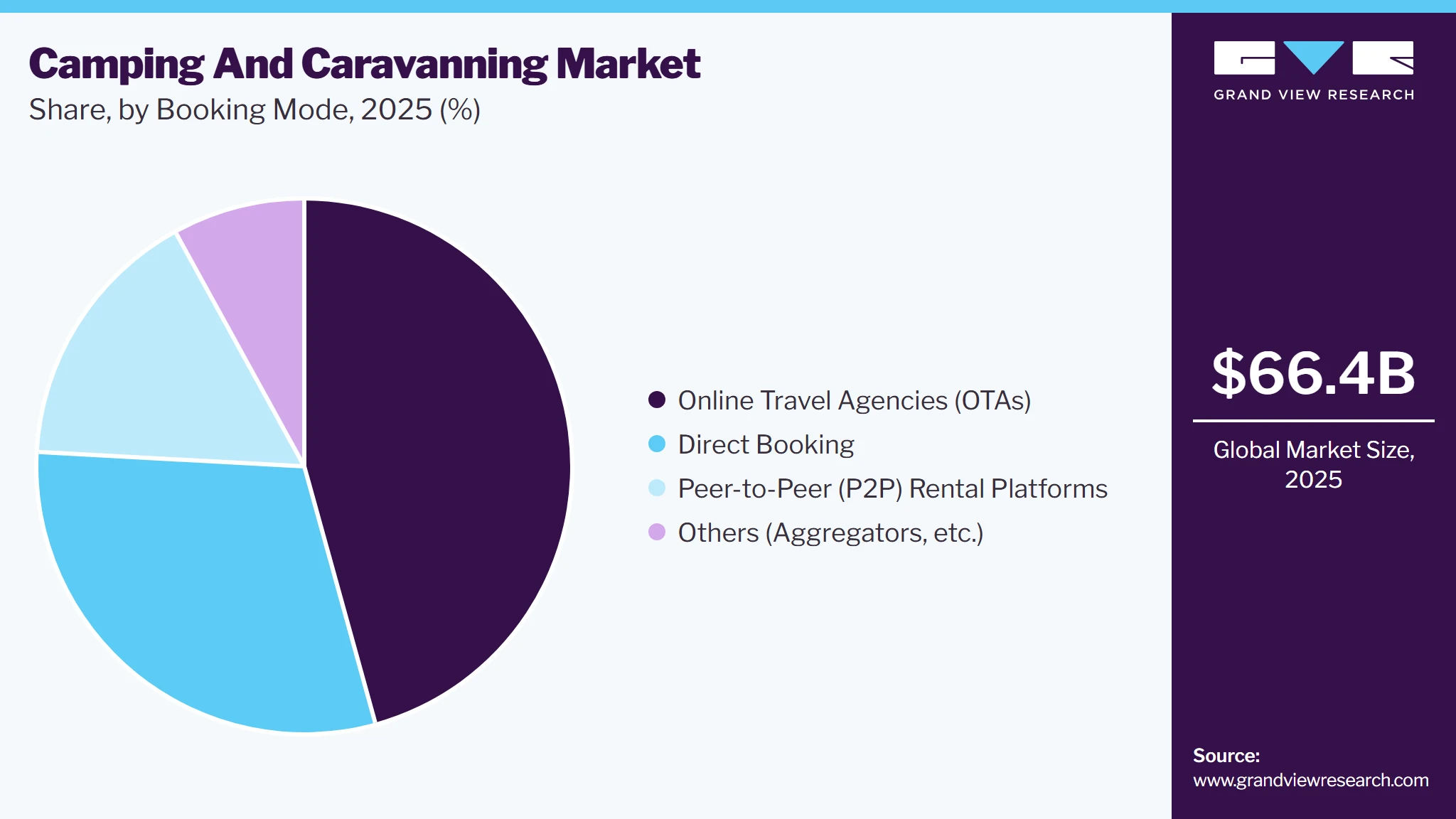
Based on bookings mode, online travel agencies (OTAs) accounted for the largest revenue share of 45.7% in 2025, reflecting the growing importance of digital platforms for discovering, comparing, and booking Camping and Caravanning experiences. According to PiNCAMP, 23% of surveyed campers book through a platform or camping portal, while 48% of app users use Booking.com for information or bookings. In addition, 65% of campers prefer campsites that can be booked online, highlighting the importance of digital availability and booking convenience in the camping and caravanning market. The growing use of digital booking platforms further reinforces the expanding role of online booking within the camping industry.
 To learn more about this report, Download Free Sample Report
Camping and caravanning bookings through Peer-to-Peer (P2P) rental platforms are expected to grow at a CAGR of 12.2% from 2026 to 2033, driven by increasing access to privately owned recreational vehicles and flexible rental options. For instance, Outdoorsy operates as a peer-to-peer marketplace that connects RV owners with travelers seeking to rent RVs, motorhomes, campervans, and trailers, allowing users to search for available vehicles and submit booking requests directly to hosts. Such platforms are expanding access to camping and caravanning experiences without requiring consumers to own an RV, creating greater flexibility within the camping and caravanning market and contributing to the evolving digital booking ecosystem across the camping industry.
Regional Insights
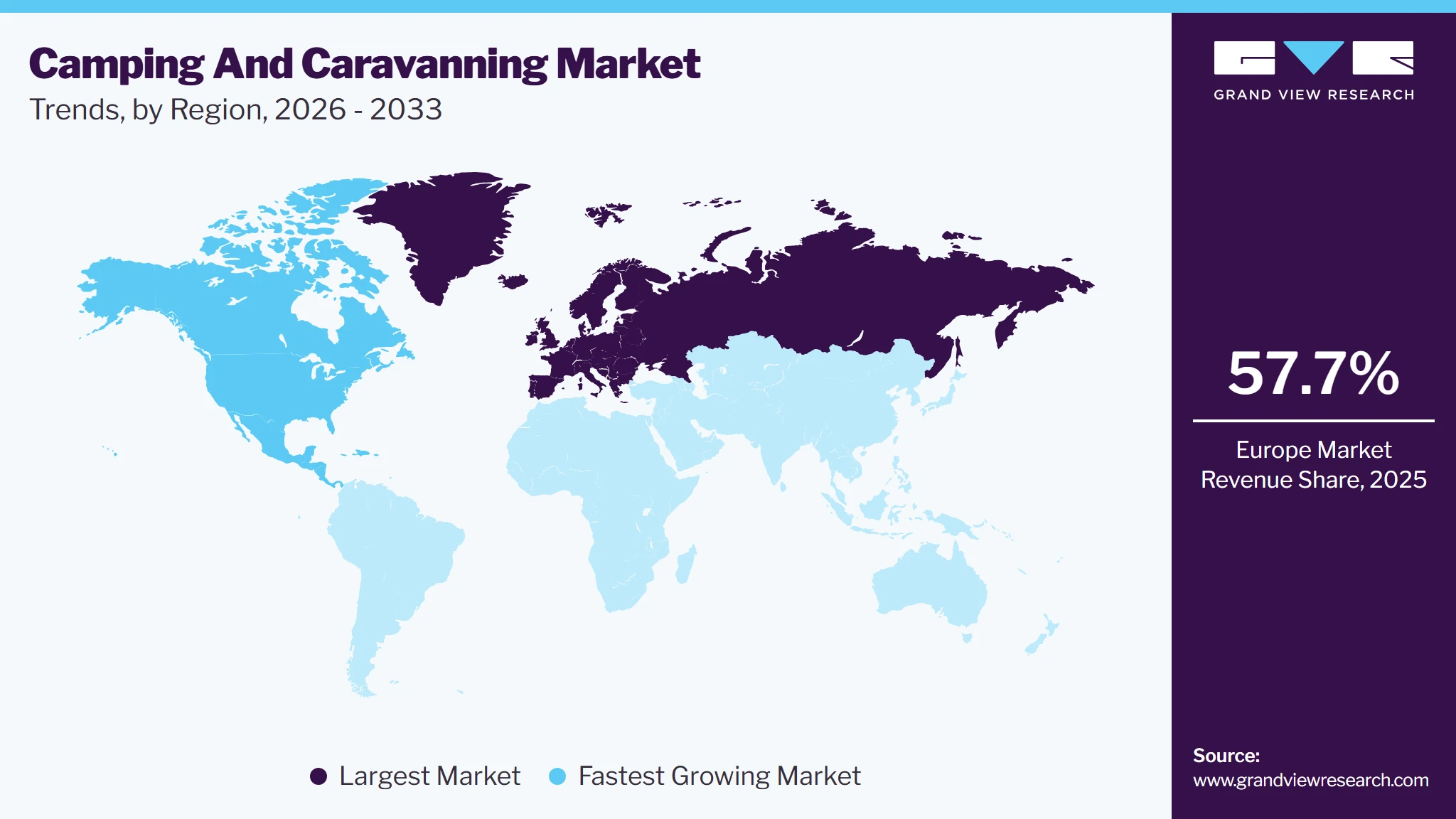
The North America camping and caravanning market accounted for a share of around 27.3% in 2025, is being shaped by strong consumer participation in outdoor recreation, increasing interest in road-based travel, and demand for flexible accommodation options. The region benefits from an extensive network of campgrounds, RV parks, and outdoor recreation destinations across the U.S. and Canada, supporting the continued popularity of camping and caravanning. The growing adoption of recreational vehicles and vehicle-accessible camping is also encouraging demand for campground infrastructure, RV rental services, and digitally enabled booking platforms. These developments are expanding opportunities for campground operators, RV rental companies, and peer-to-peer platforms across the camping industry in North America.
U.S. Camping And Caravanning Market Trends
The U.S. camping and caravanning market is projected to grow at a CAGR of 7.6% from 2026 to 2033, is experiencing sustained demand as consumers increasingly participate in RV travel, vehicle-accessible camping, and outdoor recreation. According to the RV Industry Association, 44 million Americans planned to travel by RV during the 2025 summer season, reflecting continued consumer interest in RV-based travel. In addition, 42.3 million Americans participated in camping close to their vehicles in 2025, representing an increase of more than 5% from the previous year. The continued popularity of RV travel and vehicle-accessible camping is supporting demand for campgrounds, RV parks, rental services, and related outdoor accommodation options, strengthening the broader camping and caravanning ecosystem and camping industry in the U.S.
Europe Camping And Caravanning Market Trends
The camping and caravanning market in Europe accounted for a share of 57.7% in 2025, recorded strong activity in 2025, with camping grounds, recreational vehicle parks, and trailer parks accounting for 413 million overnight stays across the EU and representing 13.4% of total tourist accommodation nights. In Q2 2026, these accommodation types accounted for 14.4% of total tourist accommodation nights in the EU, highlighting the continued importance of camping and caravanning within European tourism. The sustained contribution of outdoor accommodation is supporting demand for campsites, RV parks, holiday parks, and related services across the camping industry.
 To learn more about this report, Download Free Sample Report
The camping and caravanning market in Germany accounted for a share of 18.8% in 2025, recorded strong activity in 2025, is benefiting from sustained consumer interest in outdoor and nature-based travel, with German campsites recording nearly 44.7 million overnight stays in 2025, according to Germany’s Federal Statistical Office (Destatis). The Schleswig-Holstein Baltic Sea coast was the most visited camping region, recording 3.5 million overnight stays, followed by the Black Forest with 2.6 million. The high level of camping activity is supporting demand for campsites, motorhome pitches, and outdoor accommodation, strengthening camping and caravanning activity and the broader camping industry in Germany.
The camping and caravanning market in UK accounted for a share of 16.2% in 2025, shaped by growing interest in flexible road-based holidays and domestic outdoor travel. In 2025, bookings for campervan holidays at The Camping and Caravanning Club increased by 9%, while campers increasingly made short-notice travel decisions, with nearly half of July and August bookings made for the same month. The Club also reported rising interest in roof tents, reflecting demand for more flexible and mobile forms of camping and caravanning. In addition, a 2025 survey by the Club found that 77% of UK travelers had revisited a destination at least sometimes, with camping locations among the places consumers chose to return to. These trends are encouraging demand for campervan pitches, campsites, and flexible outdoor accommodation across the camping industry in the UK.
Asia Pacific Camping And Caravanning Market Trends
The Asia Pacific camping and caravanning market is expected to grow at a CAGR of 16.2% from 2026 to 2033. Rising disposable incomes, expanding middle-class populations, and improved road infrastructure in countries such as Australia, New Zealand, Japan, South Korea, and parts of Southeast Asia are making road travel more accessible and attractive. Younger consumers and families are increasingly seeking experiential travel that offers outdoor recreation, wellness benefits, and a break from crowded urban environments. In addition, the influence of social media, growing awareness of sustainable travel, and post-pandemic preferences for self-contained accommodation have accelerated interest in camping equipment, campervans, and caravans across the region.
Middle East & Africa Camping And Caravanning Market Trends
The camping and caravanning market in Middle East & Africa accounted for a share of 4.0% in 2025, is developing around nature-based tourism, desert and mountain camping, and experience-led outdoor accommodation. In the Middle East, destinations such as Dubai are expanding the range of camping and glamping experiences, from traditional desert camps and tent stays to luxury domes and caravan-based accommodation. Dubai’s official tourism platform highlights camping across deserts, beach, and mountain environments, while newer offerings such as Hatta Caravan Park and Caravan Hatta are adding caravan and nature-focused stays to the region’s outdoor accommodation landscape. In Africa, destinations such as South Africa are leveraging their wildlife, landscapes, and adventure tourism assets to attract travelers seeking nature-oriented experiences, creating opportunities for campsites, caravan facilities, and experience-led outdoor accommodation. These developments are creating a broader base for camping and caravanning experiences and supporting the gradual development of the regional camping industry.
Central & South America Camping And Caravanning Market Trends
The camping and caravanning market in Central & South America accounted for a share of 2.9% in 2025, reflecting the region’s expanding outdoor tourism ecosystem and growing interest in nature-based travel experiences. Countries such as Chile, Argentina, and Brazil offer diverse landscapes spanning Patagonia, the Andes, tropical forests, and coastal areas, supporting a wide range of camping and outdoor accommodation experiences. In Chile, tourism authorities promote outdoor activities and camping across destinations including Patagonia and the Atacama Desert, while Argentina’s national parks provide designated camping facilities for visitors exploring protected natural areas. These tourism assets are creating opportunities for campsites, glamping facilities, caravan accommodation, and related outdoor travel services across the camping and caravanning.
Key Camping And Caravanning Company Insights
The camping and caravanning market is characterized by a diverse competitive structure comprising European camping and holiday-park operators, destination-focused outdoor hospitality companies, and specialized RV and campervan rental providers. Competition is primarily shaped by campsite and holiday-park presence, geographic coverage, accommodation variety, vehicle availability, brand recognition, digital booking capabilities, and the ability to deliver convenient and experience-oriented outdoor travel.
-
European Camping & Holiday Park Operators: European Camping Group, Sandaya, Siblu Holiday Parks, Roompot, Capfun, First Camp, Huttoppia, EuroParcs, Yelloh Village, and Hu Holding S.p.A. (Human Company) compete through campsite networks, holiday parks, mobile-home accommodations, camping pitches, recreational facilities, and family-oriented outdoor experiences. These operators differentiate their offerings through destination variety, accommodation formats, on-site amenities, entertainment, and nature-focused experiences, catering to consumers seeking both traditional camping and more comfortable holiday-park stays.
-
RV Rental & Outdoor Travel Platforms: Outdoorsy, Cruise America, Road Bear RV Rentals, Indie Campers, and Apollo RV/Apollo Tourism & Leisure compete through motorhome, campervan, and recreational vehicle rental services. These companies provide travelers with flexible access to vehicles that combine transportation and accommodation, supporting road trips, camping holidays, and independent travel. Competition within this group is influenced by fleet variety, vehicle features, rental flexibility, booking convenience, pickup locations, and customer support.
-
Premium & Experience-led Camping Providers: Sandaya, Capfun, EuroParcs, Yelloh Village, Siblu Holiday Parks, and Human Company strengthen their market positioning through upgraded accommodation, resort-style amenities, recreational activities, and destination-based experiences. Their offerings increasingly combine outdoor accommodation with comfort, entertainment, wellness, and family activities, appealing to consumers seeking alternatives to traditional camping while retaining access to nature and outdoor recreation.
 To learn more about this report, Download Free Sample Report
Key Camping And Caravanning Companies
The following key companies have been profiled for this study on the camping and caravanning market:
-
EUROPEAN CAMPING GROUP
-
Sandaya
-
Siblu Holiday Parks
-
Roompot
-
Capfun
-
First Camp
-
Huttoppia
-
EuroParcs
-
Yelloh Village
-
Hu Holding S.p.A. (Human Company)
-
Outdoorsy
-
Cruise America
-
Road Bear RV Rentals
-
Indie Campers
-
Apollo RV/Apollo Tourism & Leisure
Competitive Benchmarking
Category
Operating Strategies
Competitive Edge
Key Challenges
Established Players (EUROPEAN CAMPING GROUP; Sandaya; Siblu Holiday Parks; Roompot; Capfun; First Camp; Huttopia; EuroParcs; Yelloh Village; Hu Holding S.p.A. (Human Company); Outdoorsy; Cruise America; Road Bear RV Rentals; Indie Campers; Apollo RV/Apollo Tourism & Leisure)
- Focus on expanding campground, campsite, holiday park, and recreational vehicle networks across major camping destinations. Operators invest in premium pitches, mobile homes, cabins, glamping accommodation, RV facilities, recreational amenities, and digital booking platforms. Camping operators such as European Camping Group combine campsite operations with mobile-home and bare-pitch rentals, while Sandaya focuses on 4- and 5-star outdoor hospitality.
- Established players benefit from strong brand recognition, extensive destination or vehicle networks, established customer bases, and diversified revenue streams. Large campsite operators can combine accommodation, pitch rentals, recreational facilities, food and beverage, and ancillary services, while RV rental companies benefit from fleet availability, established reservation systems, and broad geographic coverage. Outdoors adds a marketplace model connecting travelers with RV owners and professional operators.
- High capital requirements for campground development, property acquisition, RV fleet management, and facility maintenance can pressure margins. Players also face seasonal demand, weather dependency, rising operating costs, regulatory requirements, and changing traveler expectations. Competition is increasing across premium camping, glamping, holiday parks, and RV rentals, requiring continuous investment in facilities, digital booking capabilities, vehicle fleets, and differentiated experiences.
Regional & Specialized Players (Sandaya; Siblu Holiday Parks; First Camp; Huttopia; Yelloh Village; Hu Holding S.p.A. (Human Company); Cruise America; Road Bear RV Rentals; Indie Campers; Apollo RV/Apollo Tourism & Leisure)
- Focus on specific geographic markets, customer segments, accommodation formats, or travel experiences. Regional camping operators emphasize destination-specific offerings, family-oriented facilities, nature-based stays, premium campsites, and holiday-park experiences, while specialized RV companies focus on motorhome and campervan rental for road-trip travelers. Huttopia, for instance, emphasizes natural environments and low-impact infrastructure, while European Camping Group's network spans multiple European countries.
- Regional expertise, specialized accommodation formats, destination knowledge, and targeted customer propositions enable these companies to compete against larger multi-market operators. Specialized players can respond more quickly to local tourism patterns and develop differentiated experiences around nature, family recreation, premium camping, or RV travel.
- Smaller geographic reach or specialization can limit scale advantages and brand visibility. Companies may also face strong seasonality, dependence on particular destinations, limited campsite or vehicle availability, and higher customer-acquisition costs. Maintaining consistent service quality while expanding into new destinations can further increase operating complexity.
Recent Developments
-
In May 2026, First Camp announced the development of a new 17,000-square-meter motorhome area at Älmhult’s shopping destination in Sweden, offering daily rental pitches for motorhomes and targeting short-term visitors staying for one to two nights. The new site is located directly alongside Road 23 and is planned to include a waste-disposal station to improve services for motorhome guests during the summer season. The development will become First Camp’s 91st destination and 57th destination in Sweden, providing travelers with convenient access to shopping, restaurants, and attractions including IKEA Älmhult.
-
In September 2026, Cruise America introduced the C18 Ultra Compact RV, its smallest and first two-person motorhome, designed for couples, solo travelers, and first-time RV renters. Measuring 19.6 feet long and 7 feet wide, the C18 combines a compact footprint with essential motorhome amenities, including a rear bed, kitchen, bathroom with hot-water shower, air conditioning, and fresh-, gray-, and sewage-water tanks. The new RV is available at selected Cruise America rental centers across the U.S. and Canada, expanding the company's rental options for travelers seeking a more maneuverable and accessible RV experience.
Camping and Caravanning Market Report Scope
Report Attribute
Details
Market size in 2025
USD 66.4 billion
Estimated market size in 2026
USD 71.4 billion
Projected market size by 2033
USD 143.9 billion
Growth rate
CAGR of 10.5% from 2026 to 2033
Base year for estimation
2025
Historical data
2021 - 2025
Forecast period
2026 - 2033
Quantitative units
Revenue in USD million/billion and CAGR from 2026 to 2033
Report coverage
Revenue forecast, company ranking, competitive landscape, growth factors, and trends
Segments covered
Revenue type, trip length, age group, booking mode, region
Regional scope
North America; Europe; Asia Pacific; Central & South America; Middle East & Africa
Country scope
U.S.; UK; Germany; France; Italy; Spain; Netherlands; Norway; Sweden; Switzerland; Austria; Croatia; India; Japan; South Korea; Australia; Brazil; UAE; South Africa
Key companies profiled
EUROPEAN CAMPING GROUP; Sandaya; Siblu Holiday Parks; Roompot; Capfun; First Camp; Huttoppia; EuroParcs; Yelloh Village; Hu Holding S.p.A. (Human Company); Outdoorsy; Cruise America; Road Bear RV Rentals; Indie Campers; Apollo RV/Apollo Tourism & Leisure
Customization scope
Free report customization (equivalent up to 8 analysts working days) with purchase. Addition or alteration to country, regional & segment scope.
Pricing and purchase options
Avail customized purchase options to meet your exact research needs. Explore purchase options
Global Camping And Caravanning Market Report Segmentation
This report forecasts revenue growth at global, regional & country levels and provides an analysis of the latest trends and opportunities in each of the sub-segment from 2021 to 2033. For this study, Grand View Research has segmented the camping and caravanning market on the basis of the revenue type, trip length, age group, booking mode, and region.
-
Revenue Type Outlook (Revenue, USD Million, 2021 - 2033)
-
Vehicle Rental
-
Caravan Rentals
-
Recreational Vehicle (RV) Rentals
-
Campervan Rentals
-
-
Pitch/Campsite Rental
-
-
Trip Length Outlook (Revenue, USD Million, 2021 - 2033)
-
Short stay (1 to 3 Nights)
-
Medium stay (4 to 7 Nights)
-
Long stay (8 Nights & Above)
-
-
Age Group Outlook (Revenue, USD Million, 2021 - 2033)
-
Upto 30 Years
-
30 to 54 Years
-
55 Years & Above
-
-
Booking Mode Outlook (Revenue, USD Million, 2021 - 2033)
-
Direct Booking
-
Online Travel Agencies (OTAs)
-
Peer-to-Peer (P2P) Rental Platforms
-
Others
-
-
Regional Outlook (Revenue, USD Million; 2021 - 2033)
-
North America
-
U.S.
-
-
Europe
-
UK
-
Germany
-
France
-
Italy
-
Spain
-
Netherlands
-
Norway
-
Sweden
-
Switzerland
-
Austria
-
Croatia
-
-
Asia Pacific
-
India
-
Japan
-
South Korea
-
Australia
-
-
Central & South America
-
Brazil
-
-
Middle East & Africa
-
UAE
-
South Africa
-
-
Research Methodology
The camping and caravanning market figures in this report are based on a proven research process that combines executive interviews with secondary research from proprietary databases, company filings, and recognized regulatory and institutional sources. Market size is built through value-chain sizing reconciling supply-side and demand-side estimates, and triangulated with bottom-up and top-down approaches. Every estimate passes multiple levels of expert validation before publication, with each camping and caravanning segment quantified using the revenue-capture definitions in the table below.
Segment Definition
Revenue Type
Revenue capture definition
Vehicle Rental
Revenue generated from the rental of caravans, motorhomes, campervans, and other recreational vehicles used for camping and caravanning trips. Includes short-term and long-term rental charges for vehicles provided by rental operators, dealerships, and peer-to-peer platforms.
Pitch/Campsite Rental
Revenue generated from renting campsites, tent pitches, caravan pitches, and RV/motorhome sites. Includes charges for overnight or multi-night stays and site fees covering access to designated camping spaces, vehicle hookups, parking, and basic campsite facilities.
Estimation Model
Camping & Caravanning Base Layer
Camping Demand Layer
Service & Booking Layer
Monetization Layer
Who participates in camping and caravanning?
Who actively plans camping or caravanning trips?
Who purchases campsites, caravan/RV pitches, or related services?
How much revenue is generated?
Identifies the population of individuals and households participating in outdoor recreation, camping, caravanning, and RV travel. Includes leisure travelers with access to tents, caravans, motorhomes, campervans, or other camping equipment.
Captures active campers, caravanners, and RV travelers who plan overnight outdoor trips. Focuses on leisure travelers, families, groups, and outdoor enthusiasts with an intention to undertake camping or caravanning trips.
Segments demand by accommodation type, including tent campsites, caravan pitches, RV parks, motorhome sites, and camping resorts. Also considers direct bookings, online camping platforms, campground operators, and related services such as hookups, parking, equipment rental, and on-site amenities.
Converts camping and caravanning participation and bookings into market revenue. Uses campsite and pitch fees, accommodation charges, RV/caravan site rates, equipment rentals, facility fees, and ancillary spending on activities and campground services.
Delivered Customizations
This report has been delivered with the following In-depth customizations
Client Request
Customization Delivered
Value Adds
Camping and Caravanning Market Demand, Traveler Preferences & Booking Behavior Analysis
Conducted a detailed assessment of camping and caravanning demand, covering traveler profiles, camping frequency, trip duration, accommodation preferences, destination choices, booking behavior, and preferences for campsites, caravan pitches, RV parks, and related outdoor experiences.
Helps stakeholders identify high-potential traveler segments, understand evolving camping and caravanning preferences, optimize campsite and accommodation offerings, and develop targeted marketing and booking strategies.
Camping and Caravanning Market Product Innovation, Experience Customization & Emerging Trends
Evaluated innovation across camping and caravanning experiences, including premium campsites, glamping integration, technology-enabled booking platforms, recreational vehicle rentals, campsite amenities, utility hookups, outdoor recreation facilities, and family- and pet-friendly offerings.
Provides insights into evolving traveler expectations, supports differentiation through enhanced campsite experiences and amenities, and identifies opportunities for technology integration, premium services, and customized outdoor experiences.
Camping and Caravanning Market Distribution & Market Opportunity Assessment
Assessed growth opportunities across campsites, caravan parks, RV parks, campgrounds, camping resorts, vehicle rental providers, and online booking platforms, while analyzing regional demand, destination attractiveness, infrastructure availability, and emerging camping and caravanning destinations.
Supports investment and expansion decisions by identifying high-potential destinations, underserved camping locations, attractive accommodation formats, and distribution opportunities across direct and online booking channels.
Frequently Asked Questions About This Report
The global camping and caravanning market size was valued at USD 66.4 billion in 2025 and is estimated at USD 71.4 billion for 2026.
The global camping and caravanning market is expected to grow at a CAGR of 10.5% from 2026 to 2033, reaching USD 143.9 billion by 2033.
Pitch/campsite rental segment accounted for the largest share of 61.7% of the global revenue in 2025 while vehicle rental segment is expected to be the fastest-growing market.
The key factors that are driving the global camping and caravanning market include growing interest in travel and tourism among the consumers and increasing participation in outdoor activities such as hiking, fishing, and camping.
Key players include EUROPEAN CAMPING GROUP; Sandaya; Siblu Holiday Parks; Roompot; Capfun; First Camp; Huttoppia; EuroParcs; Yelloh Village; Hu Holding S.p.A. (Human Company); Outdoorsy; Cruise America; Road Bear RV Rentals; Indie Campers; Apollo RV/Apollo Tourism & Leisure
By trip length, the short stay led the market and accounted for a share of 61.4% in 2025.
The 55 years and above age group accounted for the largest revenue share of 48.8% in 2025, reflecting the strong participation of older consumers in RV- and caravan-based travel.
Europe dominated the market with the largest revenue share of 57.7% in 2025.
North America is the fastest-growing region over the forecast period.
About the Author(s)
Homecare & Decor Research Team
Consumer Goods · Homecare & DecorThis report was authored by the homecare & decor research team at Grand View Research - comprising two research analysts, one senior research analyst, and one industry expert - with specialized expertise in the homecare & decor segment of the consumer goods industry. All findings are based on proprietary consumer goods databases, executive interviews, and regulatory analysis, subject to internal peer review prior to publication.
Last Updated:
Speak to Analyst

Customize this report to your needs - add regions, segments, or data points, with 20% free customization.
Or view our licence options:


ISO 9001:2015 & 27001:2022 Certified
We are GDPR and CCPA compliant! Your transaction & personal information is safe and secure. For more details, please read our privacy policy.


