
- Home
- »
- Pharmaceuticals
- »
-
Cannabidiol Oil Market Size And Share Report, 2026-2033GVR Report cover

Cannabidiol Oil Market (2026 - 2033)
Size, Share & Trends Analysis Report By Source (Hemp-derived, Marijuana-derived), By Products, By Application, By Formulation, By Distribution Channel, By Region (North America, Europe, Asia Pacific, Middle East & Africa), And Segment Forecasts
Market Size, 2025
$4.4BMarket Estimate, 2026
$4.9BMarket Forecast, 2033
$8.3BCAGR, 2026–2033
7.9%Cannabidiol Oil Market Summary
The global cannabidiol oil market size was valued at USD 4.4 billion in 2025 and is projected to grow from USD 4.9 billion in 2026 to USD 8.3 billion by 2033, at a CAGR of 7.9% from 2026 to 2033. The market in North America dominated with a revenue share of 65.9% in 2025. The market is growing owing to the increasing legalization and acceptance of hemp-derived CBD products, growing consumers' preference for natural and plant-based wellness solutions, and strong research on the medical benefits of CBD in therapeutic applications.
 Source: Grand View Research, IR Documents, Primary Interviews, Paid DatabasesTo learn more about this report,
 Download Free Sample Report
Key Market Trends & Insights
- By source: Hemp-derived CBD oil segment held the largest market share of 52.7% in 2025.
- By products: Tinctures (dropper bottles) segment held the largest market share of 46.3% in 2025.
- By application: Medical /therapeutic segment held the largest market share of 30.5% in 2025.
- By formulation: Full-spectrum CBD segment held the largest market share of 30.5% in 2025.
- By distribution channel: B2C/indirect sales segment held the largest market share of 60.5% in 2025.
Regional Highlights
- Largest regional market: North America (65.9% revenue share, 2025)
- Fastest-growing regional market: Europe (highest CAGR, 2026-2033)
- By country: U.S. held the largest market share in 2025
Market Size & Forecast
- Market size in 2025: USD 4.4 Billion
- Estimated market size in 2026: USD 4.9 Billion
- Projected market size by 2033: USD 8.3 Billion
- CAGR (2026-2033): 7.9%
Three ways to get this report
Buy it, customize it, or ask a question.Ask an Analyst
Analyst response in 1 business day
- AccessReport author, directly
- Reply timeWithin 1 working day
- No sales callDirect answer only
- FormatEmail reply
- CostFree, no cost
Get the Full Report
What the study covers
- FormatsPDF · Excel · Dashboard
- Timeline2026–2033 annual, 2025 base
- Coverage20+ countries, 5 regions
- Companies10+ key players profiled
Customize the Report
20% free customization
- IncludeCountries, segments, points
- TailorTo your product definition
- ExtendDeeper competitor detail
- OrA fully bespoke study
- Turnaround5–10 working days
In addition, the greater availability of CBD online and its expansion into supplements, cosmetics, beverages, and healthcare products, in combination with improved manufacturing and labeling standards, are also building consumer trust and driving market growth. To learn more about this report, Download Free Sample Report
The section below outlines the key factors driving market growth, highlighting supportive CBD regulations that are enhancing consumer confidence, ongoing product innovation, and the development of high-potency CBD formulations, rising pet humanization and awareness of CBD benefits in pet wellness, and the increasing legalization and use of medical cannabis across different countries.
Market Dynamics
The market is growing owing to changing regulatory frameworks that are differentiating hemp-derived CBD products from psychoactive cannabis. As governments implement clearer regulations surrounding the production, distribution, and use of cannabidiol, manufacturers are gaining improved access to investment opportunities, retail channels, and standardized compliance pathways. These regulatory developments are also strengthening consumer confidence by establishing clearer safety, labeling, quality, and testing standards for CBD products, thereby supporting broader market adoption and commercial expansion. For instance, in February 2026, the European Food Safety Authority (EFSA) established a provisional safe intake level for hemp-derived CBD at 0.0275 mg/kg body weight per day, under the EU novel food framework. The limit applies specifically to CBD formulations with at least 98% purity and reflects the increasing regulatory standardization of CBD products across Europe. The new regulatory standards from government agencies and food safety authorities are expected to increase acceptance of CBD products.
CBD Oil Regulation by Country
Country/Region
Regulatory Status of CBD Oil
Key THC Limit / Regulatory Framework
Impact on CBD Market Growth
U.S.
Hemp-derived CBD is federally legal, but state-level variation exists
The 2018 Farm Bill legalized hemp-derived CBD with <0.3% Delta-9 THC
Strong retail expansion, e-commerce growth, wellness product innovation, and investment inflow are driving rapid market expansion
Canada
Fully regulated under the Cannabis Act
CBD regulated as cannabis; industrial hemp allowed with ≤0.3% THC
A clear national framework supports pharmaceutical-grade CBD, retail sales, exports, and licensed cultivation growth
European Union
CBD permitted under the Novel Food framework
Most EU countries allow ≤0.2% THC; industrial hemp threshold up to 0.3%
Harmonized regulations are improving cross-border trade, product standardization, and consumer confidence
Thailand
Progressive cannabis liberalization supports the CBD industry
CBD permitted under controlled cannabis reforms
Government-backed cannabis liberalization has encouraged cultivation, tourism, and wellness product development.
The increasing focus on pet health and wellness is leading to more people adopting CBD oil products designed for animals. Pet owners are using CBD oils and treats to help manage issues such as anxiety, joint pain, inflammation, stress, and other health problems in their pets. This trend is gaining traction in North America and Europe, where spending on high-quality pet healthcare and wellness products keeps rising. Studies show a notable increase in the use of cannabis-based wellness products for pets. One study of Danish dog owners found that nearly 38% regularly gave their pets some form of cannabis-derived product. Similarly, earlier research in the U.S. and Canada indicated that about 80% of dog owners had bought cannabis products for their pets. Growing awareness of CBD’s benefits for conditions such as chronic pain, anxiety, epilepsy, and inflammation in humans has led many pet owners to investigate similar wellness options for animals with related issues. Overall, the rising use of CBD products in pet wellness is creating new opportunities for manufacturers and boosting demand in the global market.
The market is also driven by ongoing product innovation and the introduction of high-potency formulations focused on meeting various wellness and therapeutic needs. Companies are introducing advanced CBD products to meet the rising consumer demand for natural solutions for various health issues. For instance, in October 2025, the Indian medical cannabis startup Awshad launched a 6500 mg CBD oil, intended to help manage conditions such as chronic pain, cancer-related discomfort, epilepsy, severe anxiety, and insomnia. The launch also came as the company achieved profitability, showing the growing commercial potential of cannabis-based wellness products in India. The launch of stronger and more specialized CBD formulations is increasing consumer interest and broadening the therapeutic uses of CBD oil, which supports further growth of the global market.
A major restraint for the market is the lack of large-scale, standardized clinical evidence showing its long-term effectiveness and safety for various therapeutic uses. While CBD is often advertised for benefits such as pain relief, anxiety reduction, and inflammation management, most studies are either small, preclinical, or do not have consistent dosage and formulation standards. This uncertainty leads healthcare professionals to question the best dosing, treatment methods, and long-term outcomes. As a result, CBD products are typically seen as wellness or alternative remedies rather than fully approved medical treatments, which hinders their acceptance in mainstream healthcare. In addition, the lack of standardized clinical guidelines limits physician recommendations and slows down institutional adoption of these products, significantly limiting market growth.
One of the major challenges facing the market is the lack of consistent global regulatory standards regarding product approval, THC limits, labeling requirements, advertising, and health claims. While some countries permit broad commercial sales of CBD products, others impose strict restrictions or unclear compliance frameworks. This fragmented regulatory landscape creates difficulties for manufacturers in product development, international trade, and long-term investment planning. In addition, inconsistent quality standards and the presence of mislabeled or low-quality CBD products can reduce consumer trust and increase scrutiny from regulatory authorities, thereby limiting wider market adoption.
Market Concentration & Characteristics
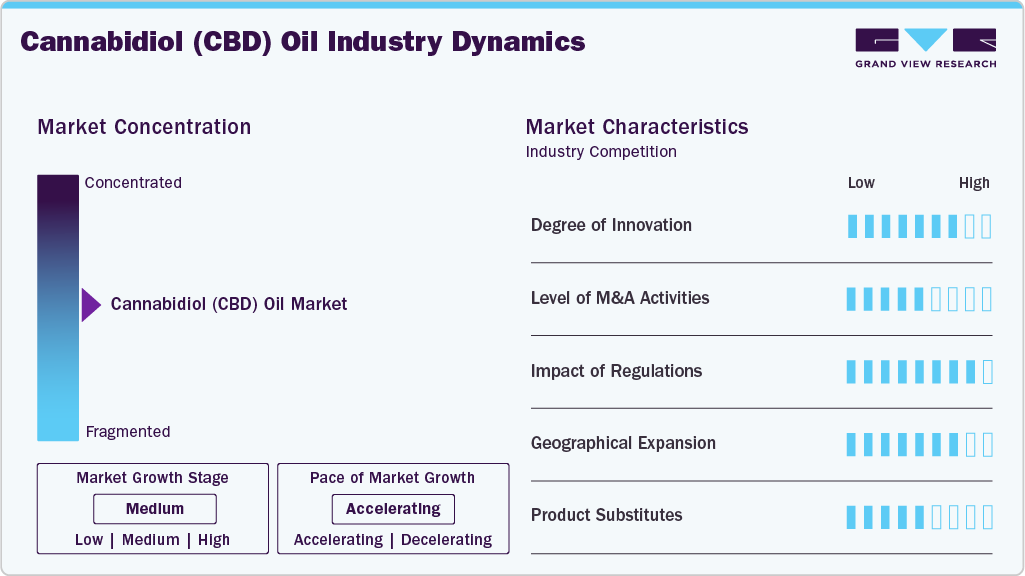
The cannabidiol (CBD) oil industry features a high level of innovation, majorly driven by improvements in cannabinoid extraction methods, nanoemulsion technologies, better bioavailability formulations, and personalized wellness products. Companies are investing more in research and development to create targeted CBD formulations for pain management, anxiety relief, sleep support, and skincare. For instance, in May 2026, CBD Life Sciences Inc. launched CBD Flavored Vapes that are nicotine-free.
The cannabidiol (CBD) oil industry has a medium to high level of merger and acquisition (M&A) activities as companies focus on strengthening their product lines, expanding manufacturing, and growing their geographical reach. Many acquisitions and partnerships now focus on wellness brands, retail growth, and cannabinoid research. For instance, in October 2024, Canopy Growth Corporation announced that Canopy USA, LLC, completed the acquisition of Wana, which includes Wana Wellness, The CIMA Group, and Mountain High Products. This gives Canopy USA full ownership of the company. Along with its earlier majority acquisition of Jetty, Canopy USA aims to create a leading cannabis brand that focuses on legal markets and hemp-derived products across the U.S. The companies also found ways to collaborate, including joint sales efforts in New York for edible and vape products.
 To learn more about this report, Download Free Sample Report
The market is heavily shaped by changing laws about hemp farming, cannabinoid extraction, product labeling, and safety standards. Regulators in various countries are putting more quality control measures and compliance rules in place for CBD wellness products. In the U.S, the U.S. Food and Drug Administration continues to monitor the commercialization and health claims associated with CBD products to ensure consumer safety. These regulatory changes are promoting product standardization, increasing transparency, and helping the market grow over the long term.
Several market participants are adopting strategies to expand their geographical reach and improve retail distribution networks. They are partnering with pharmacies, wellness retailers, and e-commerce platforms to reach more consumers. For instance, in April 2026, Aurora Cannabis Inc. announced a major expansion of its global medical cannabis portfolio by launching new products in Canada, Europe, and Australia. This step showed Aurora Cannabis’s continued focus on innovation, product quality, patient-focused solutions, and sustainable growth while strengthening its presence in important regulated markets worldwide.
The market faces a moderate threat from substitutes. Consumers have options, including herbal supplements, essential oils, prescription pain relievers, and traditional cannabis products. However, CBD oil is gaining popularity as it is non-psychoactive, and more people prefer plant-based wellness solutions. In addition, more clinical research on stress management, pain relief, and sleep improvement supports the use of CBD oil. This research reduces the impact of substitute products in the market.
Source Insights
The hemp-derived CBD oil segment accounted for the largest revenue share of 52.7% in 2025. The hemp-derived market is driven by government regulations that support the farming of industrial hemp and permit the sale of low-THC CBD products. Since hemp has only small amounts of psychoactive THC, many governments treat hemp-derived CBD separately from marijuana products. This approach allows for broader acceptance and commercialization. For instance, in Idaho, CBD oil is legal only if it comes from industrial hemp and has no THC. Products with up to 0.3% THC are classified as marijuana under state law. These regulatory differences have helped the growth of hemp-derived CBD in wellness, nutraceutical, cosmetic, and food markets.
The marijuana-derived CBD oil segment is expected to grow at a CAGR of 7.5% over the forecast period. The segment is experiencing growth as more people are using medical cannabis for issues such as epilepsy, chronic pain, cancer symptoms, anxiety disorders, and neurological diseases. Clinics often prefer these products as they have a wider range of cannabinoids, which some healthcare providers believe may improve treatment effectiveness. In addition, increased interest from scientists and pharmaceutical companies is speeding up research on CBD’s role in managing pain, controlling inflammation, treating mental health issues, and protecting the nervous system. This research is boosting clinical credibility and encouraging more investment in cannabis-based therapies. Furthermore, as social acceptance of medical cannabis rises, more patients see cannabinoid-based treatments as alternatives to opioids and traditional medications, supported by legalization efforts and increased awareness among doctors.
Products Insights
The tinctures (dropper bottles) segment led the market in 2025, accounting for the largest revenue share of 46.3%. CBD tinctures are widely used because they are absorbed quickly under the tongue, producing faster effects than capsules or edibles. The dropper format also allows precise dosing, making it suitable for both new and experienced users seeking support for anxiety, sleep problems, or chronic pain. This ease of use and versatility have made tinctures a common entry product in the CBD market. For instance, in May 2026, Newport Bitch, a California-based cannabis brand, launched THC: CBD tincture collections, reflecting rising demand for balanced cannabinoid formulations that combine the therapeutic properties of THC and CBD. Companies are also expanding their product portfolios to meet growing demand for wellness-focused cannabis products aimed at stress relief, pain management, relaxation, and sleep support.
The oral CBD oil (ingestible) segment is expected to witness the fastest CAGR over the forecast period. Oral CBD oil, including capsules and swallowed oil formulations, is increasingly preferred owing to its long-lasting effects compared to sublingual tinctures. Epidiolex is a medically approved ingestible CBD, a prescription cannabidiol oral solution authorized by the U.S. FDA. This pharmaceutical-grade formulation is different from over-the-counter CBD oils. It is specifically approved to treat seizures associated with Lennox-Gastaut syndrome, Dravet syndrome, and tuberous sclerosis complex in patients aged one year and older. This approval emphasizes the established clinical use of orally administered CBD for serious neurological conditions and supports its place in evidence-based medicine.
Application Insights
The medical /therapeutic segment accounted for the largest revenue share of 30.5% in 2025, driven by the rising demand for products that help with recovery and performance among athletes and active consumers. For instance, in April 2026, High Moon Wellness launched its secure online store. This move expanded access to its premium CBD recovery and wellness products for athletes and active consumers in 42 U.S. states. The brand offers a variety of products, including a Post-Workout Recovery Cream with nanotechnology for muscle comfort and recovery. Other items include Herbal Recovery Balm, CBD-infused oil in tincture form, Muscle Comfort Cream, a 3,000 mg Full Spectrum Tincture, and an Ultimate Recovery and Wellness Bundle. These products are designed to support mobility, post-exercise recovery, and everyday wellness, making it easy for people to integrate them into their active lifestyles.
The personal care & cosmetics segment is expected to witness the fastest CAGR over the forecast period. The personal care and cosmetics segment is growing quickly owing to the increased use of hemp-derived CBD in skincare and haircare products. The growth is also driven by new ready-to-use formulation solutions that make it easier for cosmetic brands to innovate. For instance, in March 2026, US-based NourishUs Naturals launched its CBD Ready Collection, which includes ten tested cosmetic bases designed for stability, texture, and preservation when mixed with hemp-derived CBD. The range features creams, gels, serums, cleansers, toners, lotions, balms, and exfoliators for face, body, and scalp care.
Formulation Insights
The full-spectrum CBD segment accounted for the largest revenue share of 30.5% in 2025, driven by a strong consumer preference for the entourage effect. This effect occurs when multiple cannabinoids and terpenes work together to potentially improve benefits for conditions such as pain, anxiety, and sleep disorders. A nationally representative U.S. survey called Self-reported use of cannabidiol as a substitute or adjunct for approved medications, conducted through the Ipsos KnowledgePanel, analyzed responses from 1,523 qualified participants. This survey covered about 97% of U.S. adults, including offline households, and highlighted widespread real-world CBD usage patterns and found that 20.6% of CBD users prefer full-spectrum products, showing strong global adoption of this type of formulation.
The broad-spectrum CBD segment is expected to witness the fastest CAGR from 2026 to 2033. The broad-spectrum CBD segment is growing owing to its THC-free profile and increasing acceptance in professional sports and recovery applications. For instance, the World Anti-Doping Agency (WADA) withdrew cannabidiol (CBD) from its 2018 list of banned substances. However, tetrahydrocannabinol (THC) remains banned, and CBD products made from cannabis plants may still have trace levels of THC. This means athletes must be careful and ensure product purity through testing. This regulatory change has led to a notable rise in demand for THC-free broad-spectrum formulations, as athletes and fitness enthusiasts want the benefits of CBD without the risk of doping violations.
Distribution Channel Insights
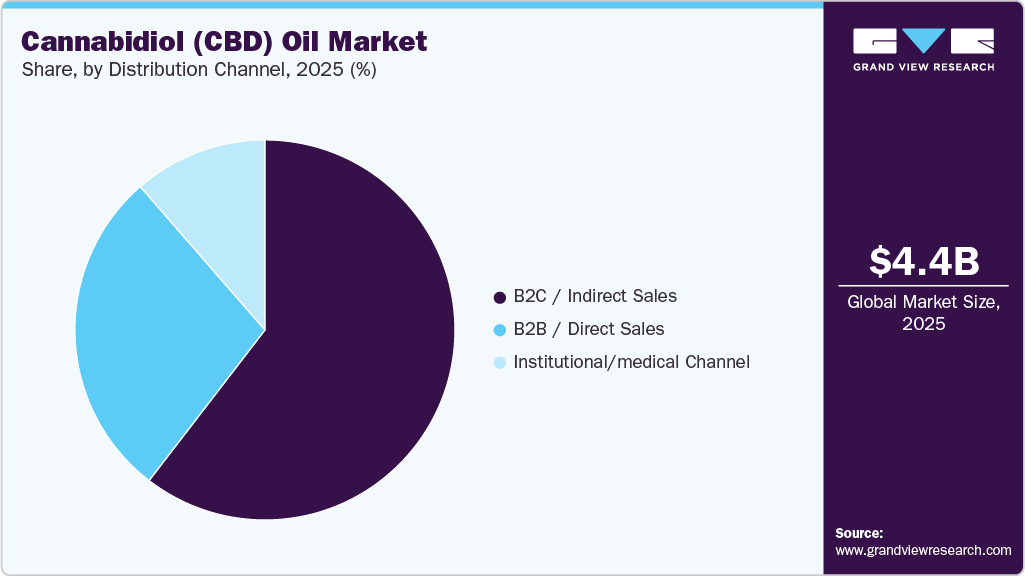
The B2C/indirect sales segment dominated the market in 2025, accounting for the largest revenue share of 60.5%, and is expected to witness the fastest CAGR over the forecast period. The B2C segment, especially e-commerce platforms, drives the market as more consumers shift to online shopping. Digital channels allow brands to bypass traditional retail limits, educate customers about products, and provide discreet buying options for wellness items such as CBD oil. Features such as easy product comparison, subscription services, and home delivery improve convenience and encourage online shopping. In addition, retail pharmacies and wellness stores also contribute to market growth by building trust and access, particularly for first-time users who want regulated healthcare settings and pharmacist advice.
 To learn more about this report, Download Free Sample Report
The B2B / direct sales segment is expected to witness growth from 2026 to 2033. The B2B or direct sales segment is witnessing strong growth as pharmaceutical companies are increasingly investing in CBD research and drug development for neurological, pain-related, and seizure disorders, leading to bulk procurement and long-term supply agreements with manufacturers. In addition, nutraceutical companies are integrating CBD oil into dietary supplements, capsules, gummies, and functional wellness products, driven by rising demand for preventive healthcare and plant-based nutrition, according to the GOV.UK, CBD oil remains the most sold CBD product, but the product range is rapidly expanding to include supplements, beverages, cosmetics, and vaping liquids. Cosmetic manufacturers are also adopting CBD oil as a functional ingredient in skincare, haircare, and beauty formulations due to its anti-inflammatory and antioxidant properties, while food and beverage companies are expanding into CBD-infused drinks, edibles, and functional foods to meet wellness-oriented consumer demand.
Regional Insights
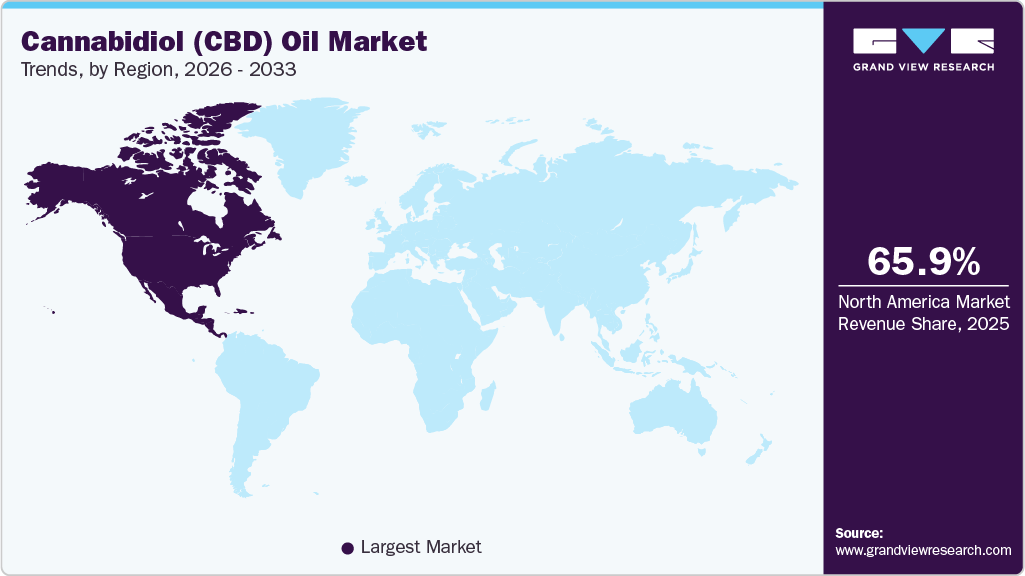
North America dominated the market with a revenue share of 65.9% in 2025. The North American market is largely driven by the strong presence of established cannabis growers, CBD makers, pharmaceutical companies, and wellness brands in the U.S. and Canada. The region has built a well-organized cannabis system supported by modern growing techniques, extraction facilities, research abilities, and large distribution networks. Major companies are constantly investing in new product launches, partnerships, acquisitions, and expanding production to strengthen their market position and meet growing consumer demand.
 To learn more about this report, Download Free Sample Report
U.S. Cannabidiol Oil Market Trends
The cannabidiol (CBD) oil market in the U.S. held the largest share in the region in 2025. The market is growing owing to the evolving federal cannabis policies and more support for medical cannabis research and access, which are driving this change. Greater policy flexibility encourages pharmaceutical development, opens investment opportunities, and boosts consumer confidence in cannabis-based wellness and therapeutic products. For instance, in April 2026, the U.S. Department of Justice reclassified FDA-approved or state-licensed marijuana products from Schedule I substances to Schedule III drugs. This places them in the same category as medications such as Tylenol with codeine. The goal is to expand medical access and speed up scientific research on cannabis safety and effectiveness. These regulatory changes and government-supported research initiatives are expected to strengthen the legal and commercial framework for cannabis-derived products, speeding up growth in the U.S.
Europe Cannabidiol Oil Market Trends
The cannabidiol (CBD) oil market in Europe is growing rapidly owing to the rising use of medical cannabis, wider distribution networks, and higher demand for cannabinoid-based therapeutic products in the region. Positive regulatory changes and increasing acceptance of medical cannabis are prompting companies to expand their operations and improve supply chains in European markets. For instance, in May 2026, High Tide Inc. reported that its subsidiary, Remexian Pharma GmbH, achieved its highest-ever quarterly medical cannabis distribution volume in the second fiscal quarter, which ended in April 2026. The company sold 7.6 tonnes of medical cannabis in Germany. This marked a 21% increase compared to the previous quarter and a 49% rise from the same time last year. The increased consumption of medical cannabis and the growth of pharmaceutical distribution are driving the development of the Europe market, creating significant opportunities for cannabinoid-based healthcare products throughout the region.
Asia Cannabidiol Oil Market Trends
The cannabidiol (CBD) oil market in Asia is growing due to more government support for industrial hemp cultivation and the rising recognition of hemp-based industries as new economic growth areas. Regulatory efforts that promote controlled hemp farming are boosting the availability of raw materials. They also encourage investments in cannabinoid-based wellness, pharmaceutical, and industrial uses throughout the region. For instance, in December 2025, the Government of Himachal Pradesh in India launched the “Green to Gold” initiative. This initiative aims to legalize and regulate industrial hemp cultivation as part of a broader strategy to turn the state into a bio-economy hub and promote self-reliance by 2027. This increasing legalization and regulation of industrial hemp cultivation across Asian countries are strengthening the supply chain for hemp-derived products, which is further supporting the long-term market growth.
Latin America & Caribbean Cannabidiol Oil Market Trends
The cannabidiol (CBD) oil market in Latin America & Caribbean is being strongly driven by the region’s favorable agricultural conditions and cost-efficient cannabis cultivation capabilities. Countries in the region are increasingly emerging as competitive hubs for large-scale hemp and cannabis production, supporting the global supply of CBD raw materials and extracts. Colombia is considered one of the most strategically positioned countries for sustainable cannabis cultivation due to its ideal climate and geographic advantages. Located near the equator, the country receives nearly 12 hours of sunlight throughout the year, enabling continuous cannabis cultivation unlike seasonal outdoor production in North America and Europe. These factors significantly lower production costs, allowing cannabis to be cultivated for nearly USD 0.06 per gram of dried flower compared to production costs that can reach up to USD 2 per gram in North America and Europe. The region’s low-cost cultivation environment and strong agricultural advantages are attracting investments in cannabis production and strengthening the growth potential of the Latin America & Caribbean CBD market.
Oceania Cannabidiol Oil Market Trends
The cannabidiol (CBD) oil market in Oceania is witnessing strong growth driven by increasing acceptance of medical cannabis, expanding patient access to regulated cannabinoid therapies, and rising demand for clinically supported wellness products across the region. In addition, improved healthcare infrastructure is prompting companies to boost their medical cannabis offerings and distribution networks in Oceania, especially in Australia. For instance, in March 2026, Tilray Medical, a part of Tilray Brands Inc., announced its largest portfolio expansion in Australia. The company added more EU-GMP-certified medical cannabis products to meet the rising patient demand within Australia’s regulated medical cannabis system. This latest expansion shows the growing use of compliant cannabis-based healthcare products in the area. Increased regulatory support, better access to medical cannabis, and more commercialization of cannabinoid-based therapies are playing a key role in market growth.
Key Cannabidiol Oil Company Insights
Major players in the market are increasingly adopting different growth strategies to strengthen their competitive edge and expand their market presence. These strategies mainly involve expanding product lines by introducing new CBD formulations, wellness blends, and targeted therapies. Companies are also forming partnerships and collaborations with wellness brands, healthcare providers, and retail distributors to improve accessibility. In addition, they are pursuing mergers and acquisitions to combine skills and speed up growth. Expanding digital and e-commerce channels is also crucial for improving consumer access and brand visibility.
Key Cannabidiol Oil Companies:
The following key companies have been profiled for this study on the cannabidiol oil market.
- Charlotte’s Web CBD & Botanicals
- Canopy Growth Corporation
- Aurora Cannabis Inc.
- Tilray Brands, Inc.
- Jazz Pharmaceuticals plc
- CV Sciences (PlusCBD Oil)
- Medterra CBD
- CBDistillery
- Elixinol
- NuLeaf Naturals
Competitive Benchmarking
Operating Strategies
Competitive Edge
Weaknesses
Mature Players: Charlotte's Web CBD & Botanicals; Canopy Growth Corporation
- Develop vertically integrated supply chains that cover hemp cultivation, extraction, formulation, and distribution.
- Expand product portfolios in wellness, nutraceuticals, pharmaceuticals, and personal care to meet varied consumer demand.
- Strong brand recognition and an early-mover advantage in regulated CBD markets build consumer trust and loyalty.
- Established compliance frameworks and quality assurance systems help navigate the complex and changing regulatory landscape.
- A high dependence on fragmented and changing regulatory frameworks creates uncertainty in long-term product positioning and approvals.
- Limited standardized clinical validation for CBD's effectiveness lowers acceptance in mainstream pharmaceutical markets.
Emerging Players: Polymer Solutions International (PSI); Novatec Pagani S.A. de C.V.; TranPak Inc.; Greystone Logistics; Norplast Peru; TriEnda Holdings LLC
- Target niche agricultural, specific pharmaceutical cleanroom, or single-use regional logistics applications with tailored product dimensions.
- Focus on strategic regional production expansions and flexible, lower minimum-order-quantity (MOQ) contract manufacturing.
- Develop cost-effective lightweight crates and short-cycle pallets to capture entry-level wood-to-plastic conversion markets.
- High operational flexibility and agility in providing application-specific customized dimensions or short product runs.
- Competitive pricing structures and strong customer relationships in target regional or mid-tier industrial sectors.
- Focused innovations on localized agricultural distribution and specialized material handling needs.
- Limited presence in large-scale pooling networks, restricting penetration in highly integrated global supply chains.
- Lower bargaining power in raw material sourcing and polymer resin procurement compared to global industry giants.
- Narrower global distribution and service footprint to support multinational enterprise logistics accounts.
Recent Developments
-
In March 2026, Splash Beverage Group, Inc. announced a non-binding Letter of Intent for a potential merger with Medterra CBD, LLC, a key player in federally compliant cannabinoid wellness manufacturing. This proposed deal is seen to turn Splash into a growth-focused platform for cannabinoid wellness and regulated consumer health. The partnership aims to use its combined scale, access to public markets, and brand development skills to boost its market position. The companies also plan to take part in a CBD pilot initiative being reviewed by the Centers for Medicare & Medicaid Services.
-
In December 2025, Charlotte's Web Holdings, Inc. announced that it would provide CBD for a potential landmark pilot program led by the Center for Medicare and Medicaid Innovation. This initiative aimed to help treat senior oncology patients by allowing Medicare and Medicaid to reimburse for science-backed CBD products for the first time. The program was seen as an important step forward in senior healthcare policy. It offered better personalization, access, and affordability for patients and healthcare providers looking for hemp-based wellness solutions.
-
In November 2024, The Cannabist Company entered a partnership with Veda Warrior, an Ayurvedic wellness brand based in New Jersey. The partnership focused on launching cooking products infused with cannabis, such as ghee, olive oil, and coconut oil, with plans to expand into edibles and topicals that integrate Ayurvedic herbal blends.
Cannabidiol Oil Market Report Scope
Report Attribute
Details
Market size in 2025
USD 4.4 billion
Estimated market size in 2026
USD 4.9 billion
Projected market size by 2033
USD 8.3 billion
Growth rate
CAGR of 7.9% from 2026 to 2033
Actual data
2021 - 2025
Forecast data
2026 - 2033
Quantitative units
Revenue in USD million/billion and CAGR from 2026 to 2033
Report coverage
Revenue forecast, company ranking, competitive landscape, growth factors, and trends
Segments covered
Source, products, application, formulation, distribution channel, region
Regional scope
North America; Europe; Asia; Oceania; Latin America & Caribbean; Africa
Country scope
U.S.; Canada; Mexico; Germany; UK; Italy; France; Netherlands; Switzerland; Spain; Poland; Czech Republic; Croatia; China; India; Japan; Thailand; Australia; New Zealand; Brazil; Uruguay; Colombia; Argentina
Key companies profiled
Charlotte’s Web CBD & Botanicals; Canopy Growth Corporation; Aurora Cannabis Inc.; Tilray Brands, Inc.; Jazz Pharmaceuticals plc; CV Sciences (PlusCBD Oil); Medterra CBD; CBDistillery; Elixinol; NuLeaf Naturals
Customization scope
Free report customization (equivalent up to 8 analyst working days) with purchase. Addition or alteration to country, regional & segment scope.
Pricing and purchase options
Avail customized purchase options to meet your exact research needs. Explore purchase options
Global Cannabidiol Oil Market Report Segmentation
This report forecasts revenue growth at global, regional, and country levels and provides an analysis of the latest industry trends in each of the sub-segments from 2021 to 2033. For this study, Grand View Research has segmented the global cannabidiol (CBD) oil market report based on source, products, application, formulation, distribution channel, and region:
-
Source Outlook (Revenue, USD Billion, 2021 - 2033)
-
Hemp-derived CBD Oil
-
Marijuana-derived CBD Oil
-
-
Products Outlook (Revenue, USD Billion, 2021 - 2033)
-
Tinctures (dropper bottles)
-
Oral CBD Oil (ingestible)
-
Topical CBD Oil (oil-based only)
-
-
Application Outlook (Revenue, USD Billion, 2021 - 2033)
-
Medical/therapeutic Use
-
Wellness & Lifestyle
-
Personal Care & Cosmetics
-
Pet Care
-
Others
-
-
Formulation Outlook (Revenue, USD Billion, 2021 - 2033)
-
Full-Spectrum CBD
-
Broad-Spectrum CBD
-
CBD Isolate
-
-
Distribution Channel Outlook (Revenue, USD Billion, 2021 - 2033)
-
B2C / Indirect Sales
-
B2B / Direct Sales
-
Institutional/medical Channel
-
-
Regional Outlook (Revenue, USD Billion, 2021 - 2033)
-
North America
-
U.S.
-
Canada
-
Mexico
-
-
Europe
-
Germany
-
UK
-
Italy
-
France
-
Netherlands
-
Switzerland
-
Spain
-
Poland
-
Czech Republic
-
Croatia
-
-
Asia
-
China
-
Japan
-
India
-
Thailand
-
-
Oceania
-
Australia
-
New Zealand
-
-
Latin America & Caribbean
-
Brazil
-
Uruguay
-
Colombia
-
Argentina
-
-
Africa
-
Delivered Customizations
This report has been delivered with the following In-depth customizations
Client Request
Customization Delivered
Value Adds
Country-wise CBD regulatory analysis
Detailed assessment of CBD oil regulations, THC limits, legalization frameworks, and compliance policies across North America, Europe, Asia-Pacific, Latin America, and MEA
Helps identify favorable regulatory markets and expansion opportunities
Opportunity mapping by application
Detailed opportunity analysis across medical therapeutics, wellness supplements, cosmetics, pet CBD, and pharmaceutical applications
Identifies high-growth investment and revenue segments
Consumer trend analysis
Insights into demand trends related to stress management, sleep support, pain relief, and plant-based wellness products
Helps align branding and product positioning with consumer behavior
Pricing and formulation analysis
Assessment of CBD oil pricing trends by potency, formulation type, and regional market
Supports pricing optimization and premium product strategy
Investment and partnership landscape
Analysis of mergers, acquisitions, partnerships, and funding trends in the global CBD industry
Assists stakeholders in identifying collaboration and investment opportunities
Frequently Asked Questions About This Report
The CBD oil market is growing owing to the increasing legalization and acceptance of hemp-derived CBD products, growing consumers' preference for natural and plant-based wellness solutions, and strong research on the medical benefits of CBD in therapeutic applications.
The hemp-derived CBD oil segment led with a 52.7% revenue share in 2025, while the marijuana-derived CBD oil segment is the fastest-growing.
The tinctures (dropper bottles) segment led with a 46.3% revenue share in 2025, while the oral CBD oil (ingestible) segment is the fastest-growing.
The medical /therapeutic segment led with a 30.5% revenue share in 2025, while the personal care & cosmetics segment is the fastest-growing.
Full-spectrum CBD segment held the largest share (over 30.0%) in 2025, while the broad-spectrum CBD segment is the fastest-growing.
The global cannabidiol oil market size was valued at USD 4.4 billion in 2025 and is estimated at USD 4.9 billion for 2026.
The global cannabidiol oil market is expected to grow at a CAGR of 7.9% from 2026 to 2033, reaching USD 8.3 billion by 2033.
North America dominated with a 65.9% revenue share in 2025.
Europe is the fastest-growing region over the forecast period.
Key players include Charlotte’s Web CBD & Botanicals; Canopy Growth Corporation; Aurora Cannabis Inc.; Tilray Brands, Inc.; Jazz Pharmaceuticals plc; CV Sciences (PlusCBD Oil); Medterra CBD; CBDistillery; Elixinol; NuLeaf Naturals
About the Author(s)
Pharmaceuticals Research Team
Healthcare · PharmaceuticalsThis report was authored by the pharmaceuticals research team at Grand View Research - comprising two research analysts, one senior research analyst, and one industry expert - with specialized expertise in the pharmaceuticals segment of the healthcare industry. All findings are based on proprietary healthcare databases, executive interviews, and regulatory analysis, subject to internal peer review prior to publication.
Last Updated:
Speak to Analyst

Customize this report to your needs - add regions, segments, or data points, with 20% free customization.
Or view our licence options:


ISO 9001:2015 & 27001:2022 Certified
We are GDPR and CCPA compliant! Your transaction & personal information is safe and secure. For more details, please read our privacy policy.


