
- Home
- »
- Consumer F&B
- »
-
Capsicum Market Size, Share & Growth Report, 2026-2033GVR Report cover
![Capsicum Market (2026 - 2033)Report]()
Capsicum Market (2026 - 2033)
Size, Share & Trends Analysis Report By Form (Powder, Oleoresin, Whole), By End Use (Food, Pharmaceuticals, Cosmetics), By Region (North America, Europe, APAC), Consumer Behavior And Competitive Analysis, And Segment Forecasts
Market Size, 2025
$94.7BMarket Estimate, 2026
$102.3BMarket Forecast, 2033
$169.7BCAGR, 2026–2033
7.5%Capsicum Market Summary
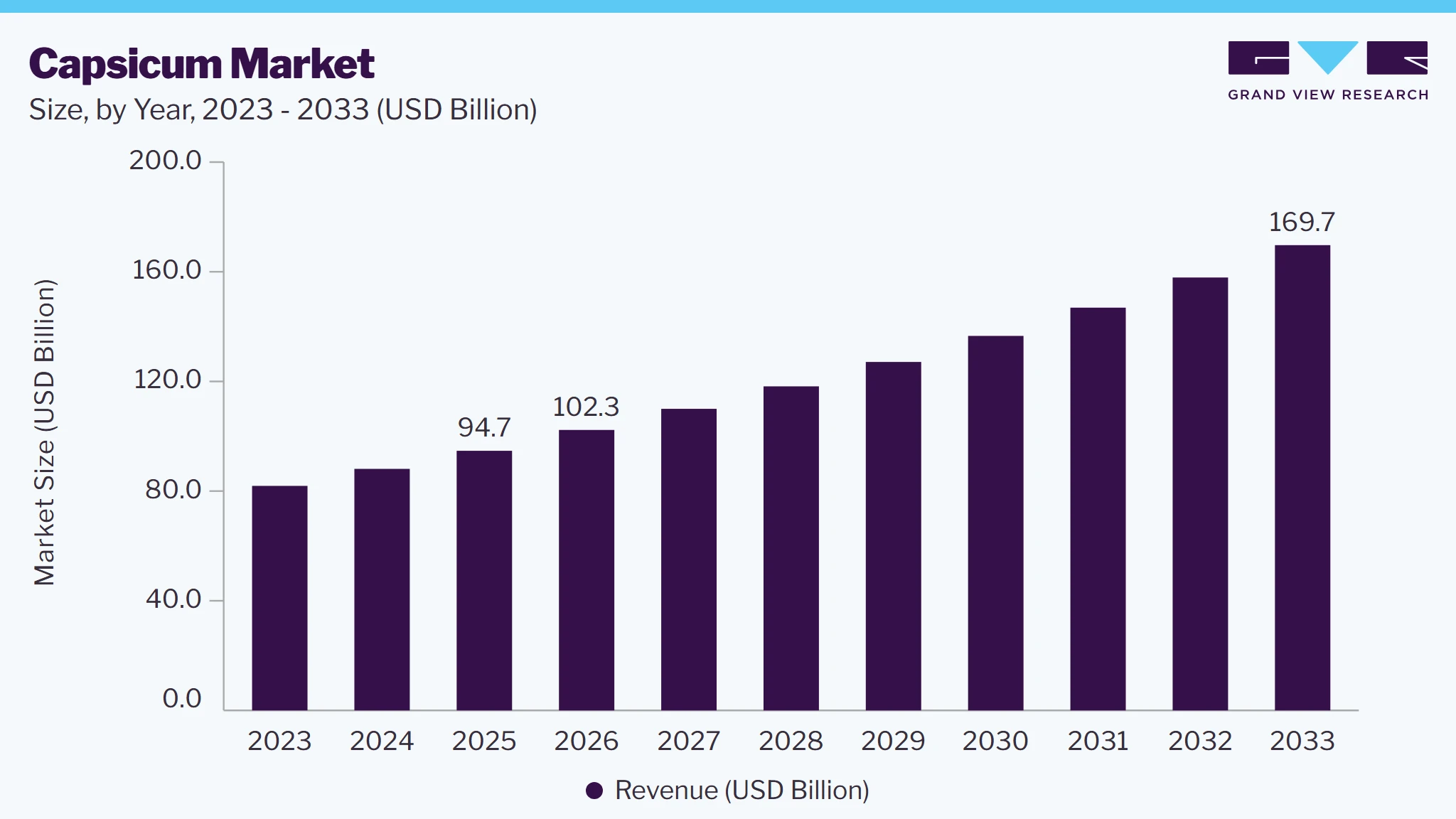
The global capsicum market size was valued at USD 94.7 billion in 2025 and is projected to grow from USD 102.3 billion in 2026 to USD 169.7 billion in 2033, at a CAGR of 7.5% from 2026 to 2033. Asia Pacific dominated the global market, accounting for the largest revenue share of 67.0% in 2025. The rising health consciousness and health benefits associated with capsicum are expected to drive market growth.
Key Market Trends & Insights
- By form: The whole form segment held the largest revenue share of around 50.0% in 2025.
- By end use: The food segment accounted for the largest share, over 81.0% in 2025.
Regional Highlights
- Largest regional market: Asia Pacific (67.0% revenue share, 2025)
- Fastest-growing regional market: North America (highest CAGR, 2026-2033)
Market Size & Forecast
- Market size in 2025: USD 94.7 Billion
- Estimated market size in 2026: USD 102.3 Billion
- Projected market size by 2033: USD 169.7 Billion
- CAGR (2026-2033): 7.5%
Three ways to get this report
Buy it, customize it, or ask a question.Ask an Analyst
A direct answer, usually in 1 working day
- AccessReport author, directly
- Reply timeWithin 1 working day
- No sales callDirect answer only
- FormatEmail reply
- CostFree, no cost
Get the Full Report
What the study covers
- FormatsPDF · Excel · Dashboard
- Timeline2026–2033 annual, 2025 base
- Coverage20+ countries, 5 regions
- Companies10+ key players profiled
Customize the Report
20% free customization
- IncludeCountries, segments, points
- TailorTo your product definition
- ExtendDeeper competitor detail
- OrA fully bespoke study
- Turnaround5–10 working days
The inclusion of capsicum in the regular diet, as it is rich in vitamins and minerals and has high fiber and water content, is also contributing to market growth. Supply chain disruptions, higher freight costs, and scarce raw materials keep triggering trouble for many businesses. In food and drink, this means delays in getting both sources and products out on time. So, companies are working harder to secure local supplies and improve their logistics. This helps stabilize and strengthen their supply lines.
Capsicum has various names depending on the place and type, such as paprika, red pepper, green pepper, chili pepper, and bell pepper. There are numerous ways to incorporate capsicum into meals, given the availability of various varieties with different colors, flavors, and health benefits. Curry, pizza, breakfast hash, stir-fries, and pasta dishes are just a few foods that can benefit from the addition of capsicum salads, grilled as a hummus topping, or in soups. Capsicum's nutritional composition makes it a great food for weight loss. Capsicums are abundant in vitamins and minerals, but they are also high in fiber and water. Moreover, capsicum contains a high amount of antioxidants and nutrients that aid in weight loss.
Modern consumers are more willing to experiment with different foods from various parts of the world. Moreover, the trend of cooking and learning new cuisines is driving the demand for vegetables. A vegetable with an impressive nutritional profile, capsicums are available in a broad range of colors and varieties. They contain vitamins, minerals, antioxidants, and compounds, such as capsanthin and capsorubin.
The demand for capsicum is anticipated to be driven by the expansion of the hotel and restaurant sector in countries such as Far East Asia and China, supported by favorable government policies that back the development of city infrastructure. Additionally, the growing middle-class population in nations like Saudi Arabia and the UAE, which prefers eating out on weekends, will create new possibilities in the food service industry. As a result, the market is expected to expand in the coming years.
Market Dynamics
The market is growing as more people opt for healthy, organic, vitamin-packed veggies and turn to plant-based diets. Demand is also growing with capsicum's popularity in salads, sauces, and ready-to-eat meals at restaurants and stores. The trend of using fresh, natural ingredients in packaged foods is further contributing to growth. Rising urbanization and expanding modern retail networks are improving accessibility and availability of capsicum across both developed and emerging markets.
Advancements in greenhouse farming and controlled cultivation techniques are ensuring year-round supply and better quality produce, further supporting market expansion. For instance, data from the Government of India’s Agricultural and Processed Food Products Export Development Authority (APEDA) indicates a steady trend in capsicum-related horticultural exports, reflecting India’s strengthening position in global fresh produce trade. Growing consumer awareness of capsicum's immune-boosting properties and high vitamin C content continues to support global demand and drive market expansion.
The market faces critical issues, such as a super-short shelf life that causes significant post-harvest losses and makes long-distance transport difficult. Production is seasonal and weather-dependent, leading to supply fluctuations and unstable prices. Also, insufficient cold storage facilities and inefficient supply chain management in developing areas hamper market growth. Perishable veggies like capsicum often get wasted during storage and transport, hurting profit for farmers and suppliers. This makes it tough for producers to maintain a steady year-round supply and earn consistent profits from capsicum or the products made from it. The aforementioned issues hinder consistent product availability in stores, lead to price surges, and restrict market growth.
Opportunity: Growing Use of Capsicum in Food Processing and Nutraceutical Applications
Strong growth potential exists in the capsicum sector due to increased use in processed foods, sauces, frozen vegetables, and natural food colorings. Demand for clean-label and chemical-free products is driving food companies to add capsicum as a value-added ingredient. Increased greenhouse and hydroponic farming provide opportunities to increase capsicum output year-round with consistent supplies. Controlled-environment farming techniques are on the rise for capsicum production, enabling better-quality produce. The trend toward plant-based, healthy diets is also supporting continued growth in the use of capsicum in functional foods across the global food industry.
Analyst Perspective
The market is expected to grow steadily over the coming years, driven by rising consumer demand for fresh, nutritious, and versatile vegetables. Increasing awareness of the health benefits of capsicum, including its high vitamin C and antioxidant content, is supporting consumption. Growth in organized retail, cold chain infrastructure, and advanced farming methods such as greenhouse and hydroponic cultivation is improving year-round availability. Key trends include the rising demand for organic and specialty-colored capsicum, sustainable farming practices, and investments in seed innovation and efficient supply chains.
Form Insights
The whole form segment accounted for approximately 50.0% of revenue in 2025. It is anticipated that the product's growing importance as a significant source of various nutritional components, such as vitamin A and vitamin C, will continue to favor the segment’s growth. Additionally, the catering and food industries are the key drivers of demand for whole capsicums. In restaurants, capsicums are frequently served fresh as snacks, in soups, or as part of salads, adding freshness and a crunchy texture. They can also be filled with other foods and grilled, baked, or sautéed, then used as ingredients in spicy recipes, stir-fries, or main courses. This is expected to boost demand for whole capsicum in the coming years.
The powder form segment is expected to grow rapidly from 2026 to 2033. An increase in the acceptance of international cuisine has made it easier for consumers to access varied food products. The marketplaces for herbs and spices are expanding, resulting in a surge in demand and availability of this product in developed economies. Capsicum powder is also used to treat conditions such as nerve discomfort. Several other applications, such as digestive issues, heart and blood vessel conditions, and a variety of other uses, are expected to drive segment growth.
End-use Insights
The food segment held the largest revenue share of over 81.0% in 2025. The food & beverage industry is the largest consumer of capsicum. Innovative uses of capsicum as an ingredient are expected to drive growth. Increasing incomes and changing lifestyles are other factors driving demand, as people increasingly prefer fresh vegetables. Furthermore, customers' purchasing habits are dramatically affected by growing health concerns. Consumers are becoming more particular about the quality of vegetables used in food items; this trend is expected to impact the market positively in the coming years.
The pharmaceuticals segment is expected to register a significant CAGR during the forecast period. Fibromyalgia, rheumatoid arthritis, trigeminal neuralgia, shingles, diabetic neuropathy, osteoarthritis, post-herpetic neuralgia, and back pain can all be treated with capsicum when applied directly. Others have used capsicum as a gargle for laryngitis and to relieve muscular spasms. Capsicum-derived compounds, such as capsaicinoids, are increasingly used by pharmaceutical companies to formulate topical pain-relief creams, patches, and anti-inflammatory products, opening new avenues for market growth.
Regional Insights
Asia Pacific capsicum market held the largest revenue share of over 67.0% in 2025. This can be attributed to urbanization in developing nations such as China, Southeast Asia, and Australia, rising disposable incomes, and a growing population. A major driver is rising consumer inclination toward nutritious products. The market has benefited from a shift toward a healthy, innovative strategy, driven by the growing trend of leading a healthy lifestyle.

North America Capsicum Market Trends
The capsicum market in North America is expected to register a significant CAGR during the forecast period. The predominant consumption patterns among consumers from the U.S. and Mexico are projected to boost demand for capsicum in the region in the coming years. One of the main factors driving the industry’s growth is the rising popularity of healthy cooking among consumers. Market growth is also driven by rising capsicum consumption across a variety of sectors, including the food, pharmaceutical, and cosmetic industries.
Key Capsicum Company Insights
Some of the leading manufacturers, including Lipman and Pero Family Farms Inc, are focusing on geographical expansion. Widening the geographical presence helps reach a wider audience base and strengthen the foothold in the global market. It is anticipated that developing strategies and working with customers to create new products will remain crucial success factors. Companies are also focusing on new product launches, expansion, automation, and technological adoption.
Key Capsicum Companies
The following key companies have been profiled for this study on the capsicum market:
-
Lipman Family Farms
-
Pero Family Farms
-
Oakes Farms
-
Southern Paprika Limited (SPL)
-
Fruit Farm Group
-
GK Fresh Greens
-
Titan Farms Inc.
-
Lewis Taylor Farms
Recent Developments
- In April 2026, Syngenta introduced new California pepper varieties, including Spartanos (red) and Cintra (yellow). The launch reflects ongoing investment in high-performance capsicum varieties tailored to changing market and climate conditions.
Capsicum Market Report Scope
Report Attribute
Details
Market size in 2025
USD 94.7 billion
Estimated market size in 2026
USD 102.3 billion
Projected market size by 2033
USD 169.7 billion
Growth rate
CAGR of 7.5% from 2026 to 2033
Historical data
2021 - 2025
Forecast period
2026 - 2033
Quantitative units
Revenue in USD million/billion, and CAGR from 2026 to 2033
Report coverage
Revenue forecast, company ranking, competitive landscape, growth factors, and trends
Segments covered
Form, end use, region
Regional scope
North America; Europe; Asia Pacific; Rest of the World
Country scope
U.S.; Mexico; UK; France; Germany; Spain; Italy; Netherlands; Belgium; China; Far East Asia; Southeast Asia; Central Asia
Key companies profiled
Lipman Family Farms, Pero Family Farms, Oakes Farms, Southern Paprika Limited (SPL), Fruit Farm Group, GK Fresh Greens, Titan Farms Inc., Lewis Taylor Farms
Customization scope
Free report customization (equivalent up to 8 analysts working days) with purchase. Addition or alteration to country, regional & segment scope.
Pricing and purchase options
Avail of customized purchase options to meet your exact research needs. Explore purchase options
Global Capsicum Market Report Segmentation
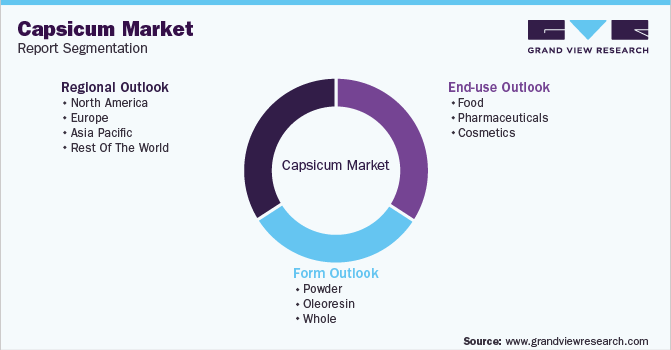
This report forecasts revenue growth at the global, regional, and country levels and provides an analysis of the latest industry trends and opportunities in each of the sub-segments from 2021 to 2033. For this study, Grand View Research has segmented the global capsicum market report based on form, end use, and region:
-
Form Outlook (Volume, Tons; Revenue, USD Million, 2021 - 2033)
-
Powder
-
Oleoresin
-
Whole
-
-
End-use Outlook (Volume, Tons; Revenue, USD Million, 2021 - 2033)
-
Food
-
Pharmaceuticals
-
Cosmetics
-
-
Regional Outlook (Volume, Tons; Revenue, USD Million, 2021 - 2033)
-
North America
-
U.S.
-
Mexico
-
-
Europe
-
U.K.
-
France
-
Germany
-
Spain
-
Italy
-
Netherlands
-
Belgium
-
-
Asia Pacific
-
China
-
Far East Asia
-
Southeast Asia
-
Central Asia
-
- Rest of the World
-
Frequently Asked Questions About This Report
Asia Pacific dominated the capsicum market with a share of 67.0% in 2025.
The global capsicum market size was valued at USD 94.7 billion in 2025 and is estimated at USD 102.3 billion in 2026.
Some key players operating in the capsicum market include Lipman Family Farms, J&J Family of Farms Corporate, Pero Family Farms Inc., Oakes Farms, Southern Paprika Limited (SPL), and Fruit Farm Group.
The global capsicum market is expected to grow at a CAGR of 7.5% from 2026 to 2033, reaching USD 169.7 billion by 2033.
The whole form segment held the largest revenue share of around 50.0% in 2025.
About the Author(s)
Consumer F&B Research Team
Consumer Goods · Consumer F&BThis report was authored by the consumer f&b research team at Grand View Research - comprising two research analysts, one senior research analyst, and one industry expert - with specialized expertise in the consumer f&b segment of the consumer goods industry. All findings are based on proprietary consumer goods databases, executive interviews, and regulatory analysis, subject to internal peer review prior to publication.
Last Updated:
Speak to Analyst


Customize this report to your needs - add regions, segments, or data points, with 20% free customization.
Or view our licence options:


ISO 9001:2015 & 27001:2022 Certified
We are GDPR and CCPA compliant! Your transaction & personal information is safe and secure. For more details, please read our privacy policy.


