
- Home
- »
- Next Generation Technologies
- »
-
Carbon Accounting Software Market Size Report, 2026-2033GVR Report cover

Carbon Accounting Software Market (2026 - 2033)
Size, Share & Trends Analysis Report By Deployment (Cloud, On-premises), By Enterprise Size (Large Enterprises, SMEs), By End Use (Energy & Utilities, IT & Telecom, Healthcare), By Region, And Segment Forecasts
Market Size, 2025
$14.1BMarket Estimate, 2026
$16.9BMarket Forecast, 2033
$67.6BCAGR, 2026–2033
21.9%Carbon Accounting Software Market Summary
The global carbon accounting software market size was valued at USD 14.1 billion in 2025 and is projected to grow from USD 16.9 billion in 2026 to USD 67.6 billion by 2033, at a CAGR of 21.9% from 2026 to 2033. North America dominated the market, accounting for a revenue share of 39.0% in 2025. The industry is driven by increasing regulatory requirements for ESG and climate disclosures, rising corporate net-zero and decarbonization commitments, growing adoption of automated carbon data management and reporting solutions, rapid adoption of AI-powered sustainability management solutions, increasing investor focus on transparent environmental reporting, and the expanding integration of carbon management platforms across enterprise operations.
 Source: Grand View Research, IR Documents, Primary Interviews, Paid DatabasesTo learn more about this report,
 Download Free Sample Report
 Key Market Trends & Insights
- By deployment: Cloud led the global carbon accounting software industry and accounted for a share of 73.0% in 2025.
- By enterprize size: Large enterprises segment led the market in 2025.
- By end use: Energy & Utilities segment led the market in 2025.
Regional Highlights
- Largest regional market: North America (39.0% revenue share, 2025)
- Fastest growing regional market: Asia Pacific (highest CAGR, 2026-2033)
- By country: The U.S. held the largest market share in 2025.
Market Size & Forecast
- Market size in 2025: USD 14.1 Billion
- Estimated market size in 2026: USD 16.9 Billion
- Projected market size by 2033: USD 67.6 Billion
- CAGR (2026-2033): 21.9%
Three ways to get this report
Buy it, customize it, or ask a question.Ask an Analyst
Analyst response in 1 business day
- AccessReport author, directly
- Reply timeWithin 1 working day
- No sales callDirect answer only
- FormatEmail reply
- CostFree, no cost
Get the Full Report
What the study covers
- FormatsPDF · Excel · Dashboard
- Timeline2026–2033 annual, 2025 base
- Coverage20+ countries, 5 regions
- Companies10+ key players profiled
Customize the Report
20% free customization
- IncludeCountries, segments, points
- TailorTo your product definition
- ExtendDeeper competitor detail
- OrA fully bespoke study
- Turnaround5–10 working days
The industry is gaining momentum due to growing demand for enterprise-wide carbon transparency and data-driven climate risk management solutions. Organizations are adopting advanced carbon accounting platforms to streamline emissions measurement, automate ESG disclosures, and improve sustainability decision-making across global operations. The market also shows strong innovation in AI-enabled carbon analytics and real-time emissions monitoring. These advances help businesses improve reporting accuracy and operational efficiency. Additionally, software providers are expanding their platforms through strategic collaborations and technology integrations to offer comprehensive decarbonization and regulatory compliance solutions. This trend supports sustained market growth as enterprises focus more on sustainability governance, investor transparency, and long-term climate resilience strategies.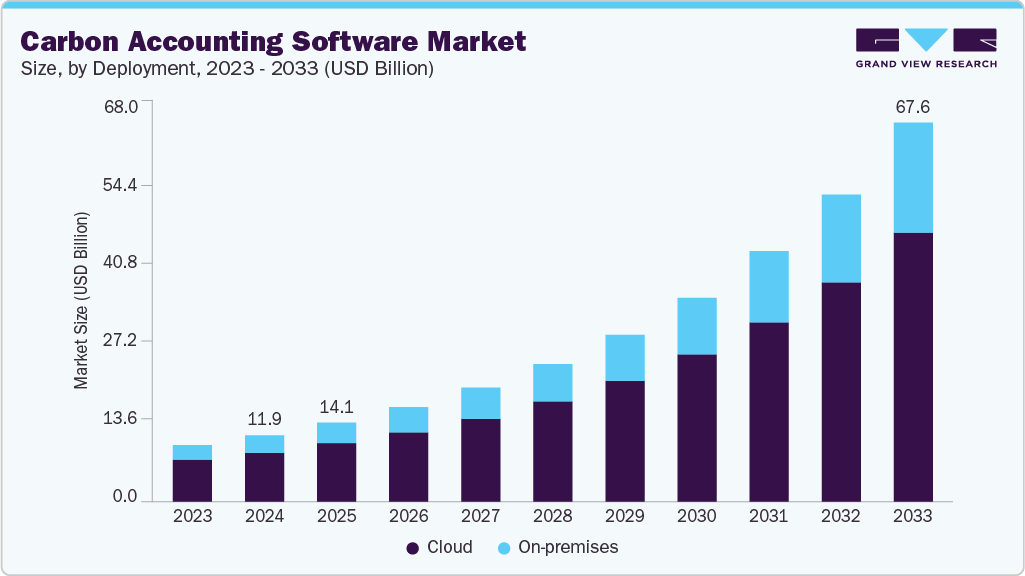 To learn more about this report, Download Free Sample Report
 The increasing emphasis on corporate sustainability is driving businesses to emphasize their environmental initiatives. Carbon accounting software enables companies to transparently monitor and report their carbon footprint, showcasing their dedication to sustainability and appealing to eco-conscious consumers and investors. The market is also benefiting from the increasing adoption of cloud-based solutions, which offer scalability and ease of access, making carbon accounting more accessible to small and medium-sized enterprises. With the ongoing global shift towards sustainability and the decarbonization of industries, the industry is poised for robust growth in the coming years, playing a crucial role in helping businesses meet their environmental objectives.
Moreover, many governments and regulatory bodies mandate organizations to report their carbon footprint and greenhouse gas (GHG) emissions as part of strict environmental regulations or voluntary initiatives like the Carbon Disclosure Project (CDP) or the Task Force on Climate-related Financial Disclosures (TCFD). Carbon accounting software aids organizations in meeting these regulatory requirements and standards by offering standardized reporting templates and efficient data management tools. These factors are generating significant opportunities for the adoption of carbon accounting software in the market.
Market Dynamics
The carbon accounting software market is growing as organizations place greater emphasis on monitoring and managing their environmental impact. Increasing awareness of sustainability goals and corporate responsibility is encouraging the adoption of digital solutions for tracking and reporting emissions. Technological advancements are improving the efficiency, accuracy, and accessibility of these platforms. Businesses are also seeking better visibility into operational performance and resource usage, which supports market growth. At the same time, factors such as implementation challenges and evolving compliance requirements continue to influence adoption trends across industries.
The intensification of regulatory compliance and reporting mandates constitutes a primary driver of the carbon accounting software market. Policymakers across jurisdictions are advancing stringent disclosure obligations, compelling enterprises to adopt standardized frameworks for monitoring and communicating greenhouse gas (GHG) emissions. The European Union's Corporate Sustainability Reporting Directive (CSRD), the U.S. SEC climate disclosure rules, and the adoption of global standards by the International Sustainability Standards Board (ISSB) are establishing a unified architecture for corporate sustainability reporting. These frameworks extend the scope of mandatory disclosures to include Scope 3 value-chain emissions but also demand audit-ready datasets to enhance comparability and investor confidence. Consequently, firms are compelled to deploy digital platforms capable of automated data integration, real-time analytics, and streamlined reporting workflows to mitigate compliance risks.
Industry participants are responding to these pressures with strategic collaborations and technological advancements. Artificial intelligence, in particular, is emerging as a key enabler of next-generation carbon accounting systems. For instance, in January 2025, PwC partnered with Microsoft to integrate AI agents into enterprise operations. These AI-driven systems can independently process large datasets, automate reporting workflows, and support decision-making, capabilities that are increasingly vital for managing audit-ready sustainability disclosures. Such innovations strengthen the role of carbon accounting platforms as critical compliance infrastructure in a data-intensive regulatory environment.
The expanding scope of sustainability regulations continues to shape corporate strategies, positioning carbon accounting software as a critical compliance infrastructure. Regulators are moving beyond voluntary disclosure and introducing binding requirements that demand consistent, verifiable emissions data across industries. For instance, in June 2024, SCS Global Services, partnered with Sustain. Life, provider of carbon accounting platform, to provide an integrated carbon management system suitable for organizations across different scales. The collaboration enables companies to streamline carbon measurement, management, and reporting processes while aligning outcomes with regulatory compliance and assurance requirements.
A significant restraint on the carbon accounting software market is the high cost of implementation, integration, and ongoing operation. Deploying carbon accounting platforms often requires substantial upfront investment in technology, infrastructure, and training. Carbon accounting software must be customized to reflect industry-specific emission factors, organizational structures, and supply chain dynamics unlike traditional financial or operational systems. This customization increases development complexity and implementation timelines, particularly for multinational enterprises operating across multiple jurisdictions. For small and medium-sized enterprises (SMEs), the financial burden can be prohibitive, as they often lack the resources to invest in advanced digital systems, consultants, or dedicated sustainability teams to manage the transition.
Beyond the initial deployment, operational costs present an ongoing challenge. Maintaining data accuracy and consistency requires regular system updates, integration with evolving regulatory standards, and coordination across different business units and external partners. Organizations frequently need to hire or contract specialized sustainability professionals to interpret data, ensure compliance, and translate outputs into actionable strategies. These recurring expenses can diminish the cost-benefit appeal of carbon accounting software, particularly for companies where sustainability reporting is not yet seen as a central business priority. In addition, the cost of integrating carbon accounting solutions into existing enterprise systems, such as ERP, procurement, or supply chain management platforms, can further increase financial and resource commitments.
This restraint is compounded by uncertainty regarding the return on investment. While regulatory compliance and stakeholder expectations create strong incentives, many organizations perceive the benefits of carbon accounting systems as long-term rather than immediate. For businesses under financial pressure or in industries with thin margins, sustainability investments often compete with other strategic priorities, making it difficult to justify significant expenditure on software adoption. As a result, even though awareness and regulatory requirements are rising, the high cost of implementation and operations may slow down adoption rates, particularly among SMEs and firms in developing economies. Without more cost-effective or flexible models, scalability of the carbon accounting software market will remain limited.
Rising investments in net-zero commitments and enterprise decarbonization strategies are generating substantial growth opportunities within the carbon accounting software market. Organizations across diverse sectors are increasing budgets for emissions monitoring, sustainability reporting, and carbon reduction planning to align with global climate objectives. This trend fuels demand for advanced carbon accounting platforms that provide accurate emissions tracking, automated reporting, and data-driven sustainability insights. Enterprises are increasingly prioritizing digital tools that quantify operational carbon footprints and facilitate long-term environmental compliance. As sustainability becomes integral to corporate governance, software vendors have significant opportunities to enhance platform capabilities and drive broader enterprise adoption.
Government-led climate initiatives, green financing programs, and increasingly stringent environmental regulations are driving significant growth in the global carbon accounting software market. Businesses are adopting scalable carbon accounting platforms that facilitate net-zero transition strategies, comprehensive direct and indirect emissions monitoring, and enhanced sustainability transparency throughout supply chains. The growing focus on sustainable business practices is prompting enterprises to integrate carbon management solutions with enterprise resource planning (ERP), energy management, and operational intelligence systems. Furthermore, heightened investor attention to environmental, social, and governance (ESG) performance and climate risk disclosure is increasing demand for advanced analytics, audit-ready sustainability reporting, and real-time carbon intelligence. This expanding sustainability investment ecosystem is anticipated to support ongoing product innovation, greater enterprise adoption, and sustained market expansion for carbon accounting software providers.
Market Concentration & Characteristics
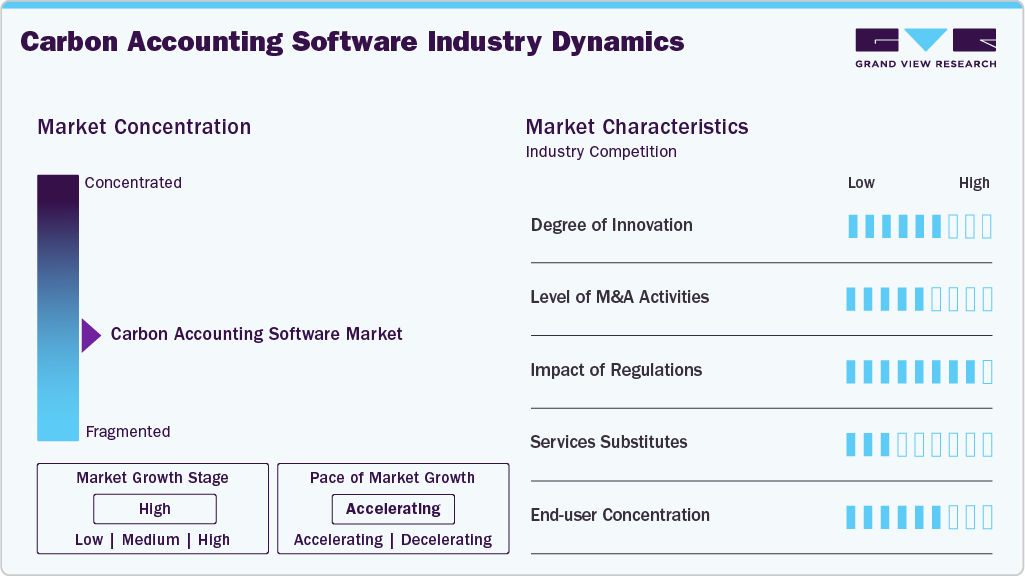
The carbon accounting software market is characterized by a high degree of innovation, driven by rapid advancements in AI-powered emissions analytics, automated ESG reporting, and value chain emissions tracking technologies. Vendors are increasingly investing in cloud-native sustainability platforms, predictive carbon intelligence, and enterprise integration capabilities to strengthen market competitiveness. The level of M&A activities is steadily increasing as established enterprise software providers acquire sustainability-focused startups to expand their ESG and decarbonization solution portfolios. In addition, the growing impact of environmental regulations and mandatory climate disclosure frameworks is accelerating enterprise adoption of carbon accounting software across multiple industries.
 To learn more about this report, Download Free Sample Report
 The market demonstrates moderate service substitution as organizations continue transitioning from manual carbon reporting processes and consulting-led sustainability assessments toward automated digital carbon management platforms. Enterprises are increasingly prioritizing integrated software solutions that deliver real-time emissions visibility, regulatory compliance support, and sustainability performance monitoring. End-user concentration remains moderately high, with large enterprises across manufacturing, energy, transportation, technology, and financial services sectors accounting for a significant share of market demand. Growing sustainability investments, rising net-zero commitments, and expanding ESG compliance requirements are expected to further accelerate market growth and competitive intensity over the forecast period.
Analyst Perspective
The Carbon Accounting Software Market is transitioning from a niche sustainability tool to a broader business management platform as organizations integrate environmental performance into strategic decision-making. Vendors are expanding platform capabilities through automation, analytics, and integration with enterprise systems, enhancing the value proposition beyond emissions reporting. Adoption is expected to broaden across industries as sustainability objectives become more closely linked with operational efficiency and corporate governance. Market participants that offer scalable, user-friendly, and data-driven solutions are likely to strengthen their competitive positioning. Over the long term, increasing emphasis on transparency and measurable sustainability outcomes is expected to support continued market expansion.
Deployment Insights
Based on deployment, the cloud segment led the market with a significant revenue share of 73.0% in 2025. Cloud-based solutions allow organizations to access carbon accounting tools from anywhere, enabling real-time tracking and management of emissions data across multiple locations. This accessibility is particularly beneficial for companies with distributed operations or remote teams. Additionally, cloud solutions reduce the need for significant upfront investments in IT infrastructure, making them more attractive to small and medium-sized enterprises. The automatic updates and maintenance provided by cloud service providers further enhance their appeal, ensuring that organizations stay compliant with the latest environmental regulations and standards. These advantages have driven the widespread adoption of cloud-based carbon accounting software.
The on-premises segment is predicted to experience significant growth in the coming years. Organizations with stringent data protection requirements, such as those in the financial services, healthcare, and government sectors, prefer on-premises solutions to maintain full control over their sensitive carbon emissions data. Additionally, on-premises deployments allow for greater customization to meet specific business needs and integration with existing IT infrastructure. As regulatory pressures intensify and the importance of precise carbon accounting grows, companies are increasingly investing in robust, on-premises solutions to ensure compliance while safeguarding their proprietary information, contributing to the segment's high growth over the forecast period.
Enterprise Size Insights
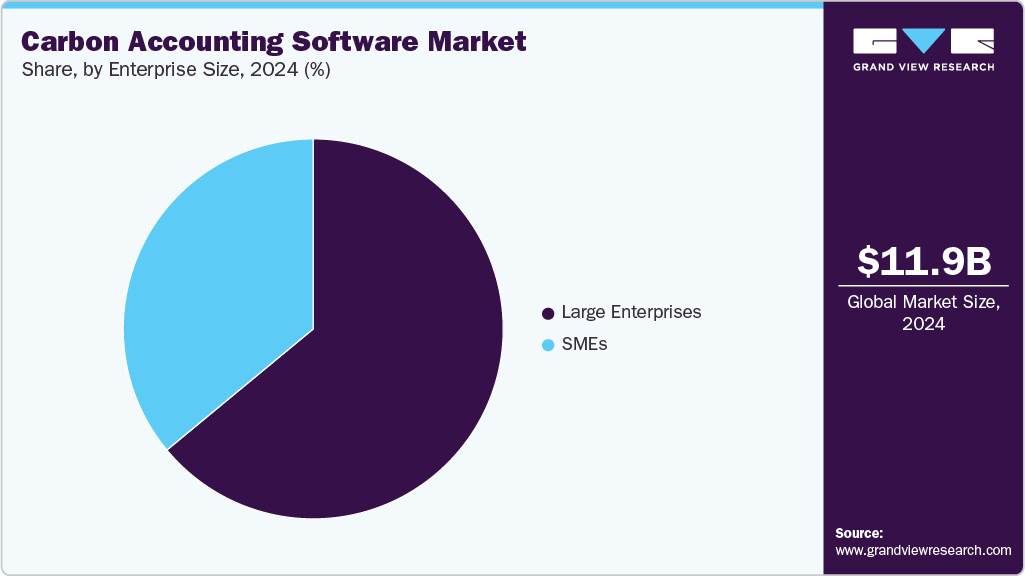
Based on enterprise size, the large enterprises segment led the market with the largest revenue share of 63.8% in 2025. Large enterprises often operate across multiple regions and industries, requiring advanced tools to accurately monitor and report their carbon emissions on a global scale. The need for comprehensive compliance with environmental regulations, coupled with the pressure to meet ESG standards, drives significant investment in advanced carbon accounting software. These solutions provide detailed insights, customizable reporting, and integration with broader enterprise systems, enabling large companies to manage their sustainability efforts and maintain transparency with stakeholders effectively.
The small and medium enterprises (SMEs) segment is anticipated to witness significant growth in the coming years. As environmental regulations become more stringent, SMEs are increasingly adopting carbon accounting software to ensure compliance and enhance their sustainability credentials. The growing availability of affordable, user-friendly cloud-based solutions makes it easier for SMEs to implement these tools without high upfront costs. Additionally, the rising demand from consumers and partners for transparent environmental practices is prompting SMEs to invest in carbon management to remain competitive.
End Use Insights
Based on end use, the energy & utilities segment led the market with a significant revenue share of 20.3% in 2025 .Energy and utility companies are among the largest emitters of greenhouse gases, making them subject to stringent environmental regulations and reporting requirements. These organizations are under significant pressure to reduce their carbon footprint and transition to more sustainable practices. Carbon accounting software provides these companies with the tools to accurately track emissions across their operations, optimize energy use, and report compliance with environmental standards. The sector's focus on sustainability, coupled with regulatory demands, has driven the widespread adoption of carbon accounting software.
 To learn more about this report, Download Free Sample Report
 The transportation & logistics segment is expected to exhibit the highest CAGR over the forecast period. As governments implement stricter environmental regulations and carbon reduction targets, companies within this segment are compelled to adopt advanced carbon accounting software to monitor and manage their emissions more effectively. The rise of green logistics initiatives, coupled with consumer demand for eco-friendly supply chains, is also pushing the industry toward more sustainable operations. Additionally, the growing adoption of electric and alternative fuel vehicles requires precise tracking of emissions reductions, further boosting the need for robust carbon accounting software in this sector.
Regional Insights
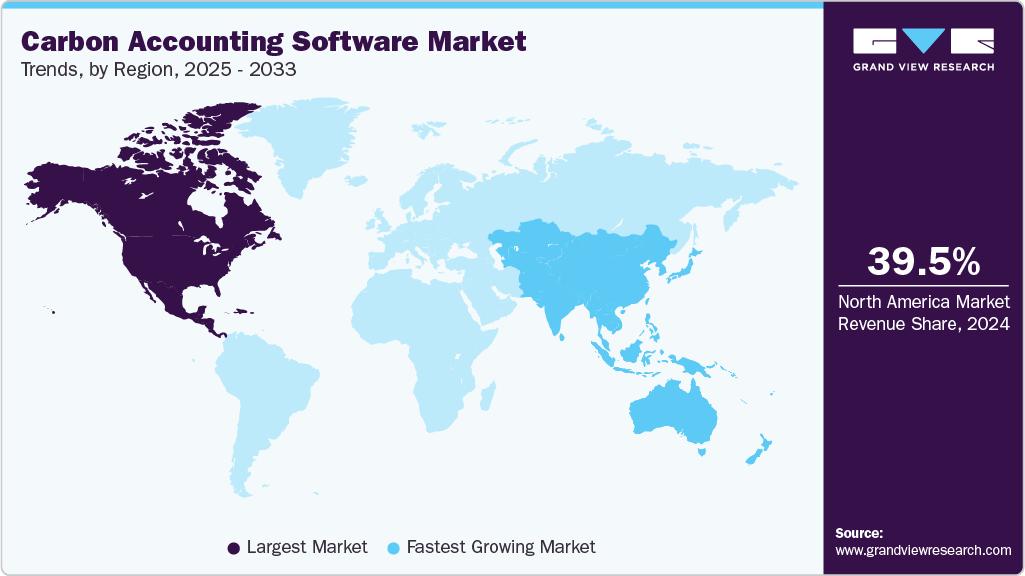
North America dominated the carbon accounting software market with the largest revenue share of 39.0% in 2025. The U.S. and Canadian governments have implemented rigorous reporting requirements for greenhouse gas emissions, compelling organizations across various industries to adopt carbon accounting software. Additionally, the growing focus on ESG practices among North American companies has driven demand for advanced tools to monitor and report carbon emissions. The presence of major market players and a high level of technological adoption in the region further contributed to North America's high share of the market. These factors, combined with increasing investor and consumer pressure for transparency in sustainability efforts, fueled the widespread adoption of carbon accounting solutions.
 To learn more about this report, Download Free Sample Report
 U.S. Carbon Accounting Software Market Trends
The carbon accounting software market in the U.S. held the largest share in the North America region in 2025. The carbon accounting software industry in the U.S. is expected to grow significantly. As the U.S. government enforces stricter environmental regulations and carbon reduction targets, businesses across various sectors are increasingly adopting carbon accounting software to ensure compliance and enhance their sustainability reporting. The U.S. market also benefits from a robust tech ecosystem, which facilitates the development and adoption of innovative carbon accounting solutions and contributes to the anticipated high growth rate.
Europe Carbon Accounting Software Market Trends
The carbon accounting software industry in Europe is expected to witness significant growth over the forecast period. The European Union's ambitious climate goals, such as the European Green Deal and the commitment to becoming carbon-neutral by 2050, are pushing organizations to adopt advanced carbon accounting solutions. The region's proactive approach to environmental responsibility, coupled with government incentives and support for green technologies, is fueling the rapid adoption of carbon accounting software, leading to significant market growth during this period.
Asia Pacific Carbon Accounting Software Market Trends
The carbon accounting software industry in the Asia Pacific region is anticipated to register rapid growth over the forecast period. As countries like China, India, and Japan implement stricter environmental regulations and carbon reduction initiatives, businesses are increasingly adopting carbon accounting software to comply with these requirements and reduce their environmental impact. The growing awareness of climate change and the need for sustainable practices among corporations in the region is also contributing to this trend.
Key Carbon Accounting Software Company Insights
Some key companies in the carbon accounting software industry areIBM Corporation, SAP SE., Salesforce, Inc., Microsoft, and others.
-
IBM Corporation is a prominent player in the carbon accounting software industry through its Envizi ESG Suite, which enables organizations to measure, manage, and report Scope 1, 2, and 3 greenhouse gas emissions. The platform integrates with IBM’s environmental intelligence suite and cloud carbon calculator, providing advanced analytics, automation, and AI-driven insights for emissions tracking and sustainability reporting. Leveraging its strong enterprise presence and consulting expertise, IBM Corporation helps clients streamline ESG data collection and align with global reporting frameworks.
-
SAP SE offers an integrated suite of carbon accounting and sustainability tools designed to embed emissions data directly into enterprise systems. Its main solutions include SAP sustainability footprint management, which calculates corporate and product emissions (Scopes 1, 2, and 3), SAP sustainability data exchange for sharing carbon data across supply chains, and the recently launched SAP Green Ledger, which aligns emissions data with financial accounting to enable “transactional” carbon tracking. SAP’s tools are ERP-centric, leveraging SAP S/4HANA and related systems to pull in master and transactional data, thus allowing granular, auditable, and near-real-time insights rather than just averages.
Key Carbon Accounting Software Companies:
The following key companies have been profiled for this study on the carbon accounting software market.
- IBM Corporation
- SAP SE
- Salesforce, Inc.
- Microsoft
- Persefoni AI
- Sphera
- Greenly
- Diligent Corporation
- SINAI Technologies
- Net0.
Competitive Benchmarking
Operating Strategies
Competitive Edge
Weaknesses
Mature Players: IBM Corporation, SAP SE, Salesforce, Inc., Microsoft, Sphera
- Mature players are increasingly focusing on AI-enabled cloud accounting platforms integrated with ESG reporting, ERP, and supply chain management systems. Their strategies emphasize automated compliance tracking, regulatory compliance support, and enterprise-wide sustainability management capabilities.
- Their competitive advantage is driven by comprehensive functionality, advanced analytics infrastructure, and simple integration capabilities. Extensive cloud ecosystems and technology partnerships enable scalable deployment across multinational organizations.
The companies often experience slower product innovation cycles due to complex enterprise software architectures and lengthy deployment processes. High implementation and customization costs can also limit adoption among SMEs and mid-sized enterprises. Emerging Players: Persefoni AI, Greenly, Diligent Corporation, SINAI Technologies, Net0
- The companies often experience slower product innovation cycles due to complex enterprise software architectures and lengthy deployment processes. High implementation and customization costs can also limit adoption among SMEs and mid-sized enterprises.
- The companies often experience slower product innovation cycles due to complex enterprise software architectures and lengthy deployment processes. High implementation and customization costs can also limit adoption among SMEs and mid-sized enterprises.
The companies often experience slower product innovation cycles due to complex enterprise software architectures and lengthy deployment processes. High implementation and customization costs can also limit adoption among SMEs and mid-sized enterprises. Recent Developments
-
In March 2026, Novisto acquired Minimum, a London-based carbon management software provider, to strengthen its ESG and carbon accounting platform capabilities. The acquisition enables Novisto to enhance its sustainability reporting offerings through the integration of advanced carbon accounting and emissions tracking solutions. The combined platform is expected to support enterprises in improving ESG disclosures, regulatory compliance, and decarbonization strategy management. This development reflects the growing demand for integrated carbon accounting software solutions driven by increasing corporate sustainability and climate reporting requirements.
-
In April 2026, Karbon-X Corp. partnered with carbon-connect AG to strengthen its enterprise climate platform and expand its carbon accounting capabilities. The partnership is aimed at enhancing emissions tracking, ESG reporting, and decarbonization management solutions for enterprise customers. The combined offering will support organizations in managing Scope 1, 2, and 3 emissions while improving sustainability reporting and regulatory compliance processes. This strategic collaboration reflects the growing demand for integrated carbon accounting software solutions driven by increasing corporate climate and ESG initiatives.
-
In January 2026, Diginex Limited acquired the Bulgarian-founded climate technology company, Plan A, for EUR 55 million to strengthen its ESG and carbon accounting software capabilities. The acquisition is intended to expand Diginex’s presence in the sustainability technology market through the integration of Plan A’s AI-powered carbon accounting platform. The combined platform will enable enterprises to improve carbon emissions tracking, ESG reporting, and decarbonization management across operations. This development highlights the growing demand for integrated carbon accounting software solutions driven by increasing corporate sustainability and regulatory compliance requirements.
Carbon Accounting Software Market Report Scope
Report Attribute
Details
Market size in 2025
USD 14.1 Billion
Estimated market size in 2026
USD 16.9 Billion
Projected market size by 2033
USD 67.6 Billion
Growth rate
CAGR of 21.9% from 2026 to 2033
Base year for estimation
2025
Historical data
2021 - 2024
Forecast period
2026 - 2033
Quantitative units
Revenue in USD million/Million and CAGR from 2026 to 2033
Report coverage
Revenue forecast, company ranking, competitive landscape, growth factors, and trends
Segments covered
Deployment, enterprise size, end use, region
Regional scope
North America; Europe; Asia Pacific; Latin America; MEA
Country scope
U.S.; Canada; Mexico; Germany; UK; France; China; India; Japan; Australia; South Korea; Brazil; UAE; South Africa; KSA
Key companies profiled
IBM Corporation; SAP SE; Salesforce, Inc.; Microsoft; Persefoni AI; Sphera; Greenly; Diligent Corporation; SINAI Technologies; Net0.
Customization scope
Free report customization (equivalent up to 8 analysts' working days) with purchase. Addition or alteration to country, regional & segment scope.
Pricing and purchase options
Avail customized purchase options to meet your exact research needs. Explore purchase options
Global Carbon Accounting Software Market Report Segmentation
This report forecasts revenue growth at global, regional, and country levels and provides an analysis of the latest industry trends in each of the sub-segments from 2021 to 2033. For this study, Grand View Research has segmented the global carbon accounting software market report based on deployment, enterprise size, end use, and region.
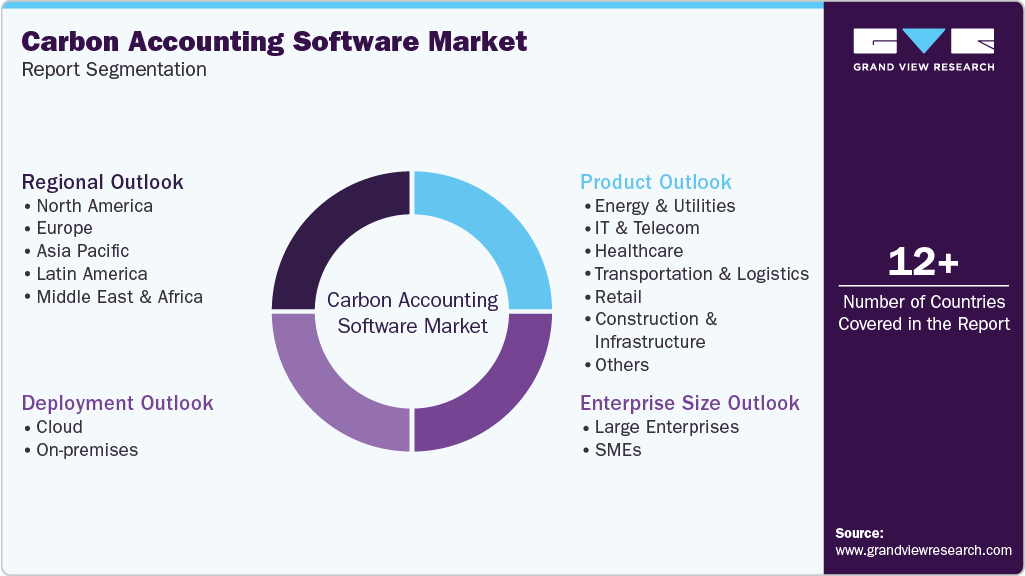 To learn more about this report, Download Free Sample Report
 -
Deployment Outlook (Revenue, USD Billion, 2021 - 2033)
-
Cloud
-
On-premises
-
-
Enterprise Size Outlook (Revenue, USD Billion, 2021 - 2033)
-
Large Enterprises
-
SMEs
-
-
End Use Outlook (Revenue, USD Billion, 2021 - 2033)
-
Energy & Utilities
-
IT & Telecom
-
Healthcare
-
Transportation & Logistics
-
Retail
-
Construction & Infrastructure
-
Food & Beverages
-
Chemicals
-
Others
-
-
Regional Outlook (Revenue, USD Billion, 2021 - 2033)
-
North America
-
U.S.
-
Canada
-
Mexico
-
-
Europe
-
UK
-
Germany
-
France
-
-
Asia Pacific
-
China
-
India
-
Japan
-
Australia
-
South Korea
-
-
Latin America
-
Brazil
-
-
MEA
-
UAE
-
South Africa
-
KSA
-
-
Research Methodology
The carbon accounting software market figures in this report are based on a proven research process that combines executive interviews with secondary research from proprietary databases, company filings, and recognized regulatory and institutional sources. Market size is built through value-chain sizing - reconciling supply-side and demand-side estimates - and triangulated with bottom-up and top-down approaches. Every estimate passes multiple levels of expert validation before publication, with each carbon accounting software segment quantified using the revenue-capture definitions in the table below.
Segment Definition
Segment - Deployment
Revenue Capture Definition
Cloud
Revenue generated from cloud-hosted platforms delivered through subscription-based models, including implementation, technical support, updates, and maintenance services.
On-premises
Revenue derived from software installed on an organization's internal IT infrastructure, along with licensing, integration, upgrade, and support services.
Segment - Enterprise Size
Revenue Capture Definition
Large Enterprises
Revenue earned from solutions deployed by large organizations to monitor emissions, manage sustainability data, and support environmental reporting across extensive operations.
SMEs
Revenue generated from adoption by small and medium-sized businesses seeking to track environmental performance and meet sustainability objectives.
Segment - End Use
Revenue Capture Definition
Energy & Utilities
Revenue attributable to use by power generators, utility providers, and energy companies for emissions monitoring, reporting, and compliance management.
IT & Telecom
Revenue captured from technology and telecommunications firms using these platforms to assess environmental impact and track sustainability metrics across business activities.
Healthcare
Revenue arising from adoption by hospitals, clinics, laboratories, and other healthcare organizations to monitor emissions and support sustainability programs.
Transportation & Logistics
Revenue generated from deployment within transportation, freight, shipping, and logistics operations to measure and manage emissions associated with movement of goods and services.
Retail
Revenue earned from retailers utilizing these solutions to evaluate environmental performance, monitor emissions, and support sustainability reporting initiatives.
Construction & Infrastructure
Revenue associated with usage by construction companies and infrastructure developers to assess emissions linked to projects, facilities, and material consumption.
Food & Beverages
Revenue derived from food processing, manufacturing, and beverage companies tracking emissions across production, packaging, distribution, and supply chain activities.
Chemicals
Revenue generated from chemical manufacturers managing emissions data, regulatory obligations, and environmental performance across production processes.
Others
Revenue captured from organizations operating in industries not separately classified, including financial services, education, government, manufacturing, and other commercial sectors.
Estimation Model
Layer Name
Key Question
Description
Enterprise End-User Layer
Who creates demand for carbon accounting solutions?
Identifies the total base of organizations requiring emissions measurement, sustainability management, ESG reporting, and environmental compliance capabilities across various industries.
Adoption / Usage Layer
Who actively uses these solutions?
Filters the addressable user base based on sustainability maturity, regulatory exposure, net-zero commitments, ESG initiatives, and adoption of digital environmental management tools.
Solution Deployment Layer
What types of solutions are being implemented?
Estimates adoption across cloud-based and on-premises platforms used for emissions tracking, carbon footprint assessment, sustainability reporting, data management, and environmental performance monitoring.
Revenue Capture Layer
How is revenue generated in the market?
Calculates revenue generated from software subscriptions, licensing fees, implementation services, technical support, maintenance, consulting, integration services, and other recurring or one-time charges associated with platform usage.
Delivered Customizations
This report has been delivered with the following In-depth customizations
Client Objective
Custom Research Modules Delivered
Strategic Value / Business Impact
Market Entry & Expansion Assessment
Regional demand sizing and forecasting
Industry adoption analysis
Competitive landscape benchmarking
Regulatory environment assessment
Identified high-growth market opportunities
Supported go-to-market strategy development
Highlighted investment priorities and risks
Enabled data-driven expansion planning
Product Positioning & Competitive Intelligence
Feature and capability benchmarking
Pricing and value proposition analysis
Customer preference assessment
Competitor strategy evaluation
Improved product differentiation strategy
Supported pricing optimization
Identified unmet customer requirements
Strengthened competitive positioning
Technology & Innovation Assessment
Emerging technology trend analysis
Innovation pipeline assessment
Technology adoption evaluation
Ecosystem and partnership mapping
Identified future growth opportunities
Supported product roadmap planning
Evaluated commercialization potential
Strengthened partnership and investment decisions
Frequently Asked Questions About This Report
The global carbon accounting software market size was valued at USD 14.1 billion in 2025 and is expected to reach USD 16.9 billion in 2026.
The global carbon accounting software market is expected to grow at a compound annual growth rate of 21.9% from 2026 to 2033, reaching USD 67.6 billion by 2033.
Some key players in the carbon accounting software market include IBM Corporation, SAP SE, Salesforce, Inc., Microsoft, Persefoni AI, Sphera, Greenly, Diligent Corporation, SINAI Technologies, and Net0.
Large enterprises segment led the market in 2025.
North America dominated the carbon accounting software market, accounting for 39.0% in 2025. U.S. and Canadian governments have implemented rigorous reporting requirements for greenhouse gas emissions, compelling organizations across various industries to adopt carbon accounting software. Additionally, the growing focus on ESG practices among North American companies has driven demand for advanced tools to monitor and report carbon emissions.
The cloud segment led with a 73.0% revenue share in 2025, while on-premises is the fastest-growing segment.
The energy & utilities segment accounted for the largest share in 2025, while transportation & logistics is the fastest-growing segment.
Key factors include a rise in demand for transparency in environmental reporting, coupled with the growing adoption of ESG standards, is propelling carbon accounting software market expansion.
About the Author(s)
Next Generation Technologies Research Team
Technology · Next Generation TechnologiesThis report was authored by the next generation technologies research team at Grand View Research - comprising two research analysts, one senior research analyst, and one industry expert - with specialized expertise in the next generation technologies segment of the technology industry. All findings are based on proprietary technology databases, executive interviews, and regulatory analysis, subject to internal peer review prior to publication.
Last Updated:
Speak to Analyst

Customize this report to your needs - add regions, segments, or data points, with 20% free customization.
Or view our licence options:


ISO 9001:2015 & 27001:2022 Certified
We are GDPR and CCPA compliant! Your transaction & personal information is safe and secure. For more details, please read our privacy policy.


