
- Home
- »
- Organic Chemicals
- »
-
Carbon Capture Chemicals Market Size Report, 2026-2033GVR Report cover

Carbon Capture Chemicals Market (2026 - 2033) Size, Share & Trends Analysis Report By Chemical (Amine-based Solvents, Alkali-based Chemicals, Physical Solvents), By Application (Power Generation, Oil & Gas, Cement, Iron & Steel, Direct Air Capture), By Region, And Segment Forecasts
Market Size, 2025
$1.7BMarket Estimate, 2026
$1.9BMarket Forecast, 2033
$4.4BCAGR, 2026–2033
12.8%Carbon Capture Chemicals Market Summary
The global carbon capture chemicals market size was valued at USD 1.7 billion in 2025 and is projected to grow from USD 1.9 billion in 2026 to USD 4.4 billion in 2033, growing at a CAGR of 12.8% from 2026 to 2033. North America accounted for the highest revenue share of 38.9% in the global carbon capture chemicals market in 2025. The market is driven by the growing adoption of carbon capture and utilization technologies across power generation, oil & gas, cement, and chemical industries.
 Source: Grand View Research, IR Documents, Primary Interviews, Paid DatabasesTo learn more about this report,
 Download Free Sample Report
Key Market Trends & Insights
- In North America, the U.S. dominated the market with a revenue share of 80.9% in 2025.
- With a 48.4% revenue share recorded in 2025, amine-based solvents emerged as the highest contributing segment in the global carbon capture chemicals market.
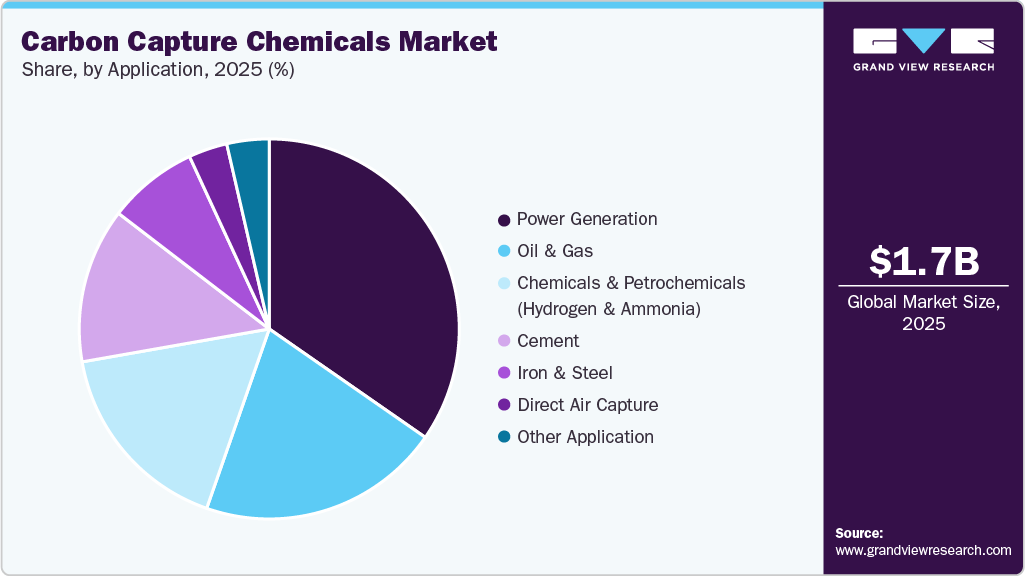
- By application, the power generation segment dominated the global carbon capture chemicals market, accounting for a 34.7% revenue share in 2025.
Market Size & Forecast
- 2025 Market Size: USD 1.7 Billion
- 2033 Projected Market Size: USD 4.4 Billion
- CAGR (2026-2033): 12.8%
- North America: Largest Market in 2025
- Asia Pacific: Fastest Growing Region
Three ways to get this report
Buy it, customize it, or ask a question.Ask an Analyst
Analyst response in 1 business day
- AccessReport author, directly
- Reply timeWithin 1 working day
- No sales callDirect answer only
- FormatEmail reply
- CostFree, no cost
Get the Full Report
What the study covers
- FormatsPDF · Excel · Dashboard
- Timeline2026–2033 annual, 2025 base
- Coverage20+ countries, 5 regions
- Companies10+ key players profiled
Customize the Report
20% free customization
- IncludeCountries, segments, points
- TailorTo your product definition
- ExtendDeeper competitor detail
- OrA fully bespoke study
- Turnaround5–10 working days
Increasing environmental regulations and net-zero emission targets are accelerating the demand for amine solvents, alkali chemicals, and advanced capture agents. The market is experiencing stable growth driven by rising investments in CCUS infrastructure and industrial decarbonization projects. In addition, the expansion of the carbon capture, utilization, and chemicals market, where captured CO₂ is converted into fuels, chemicals, and construction materials, is further supporting chemical consumption across industries.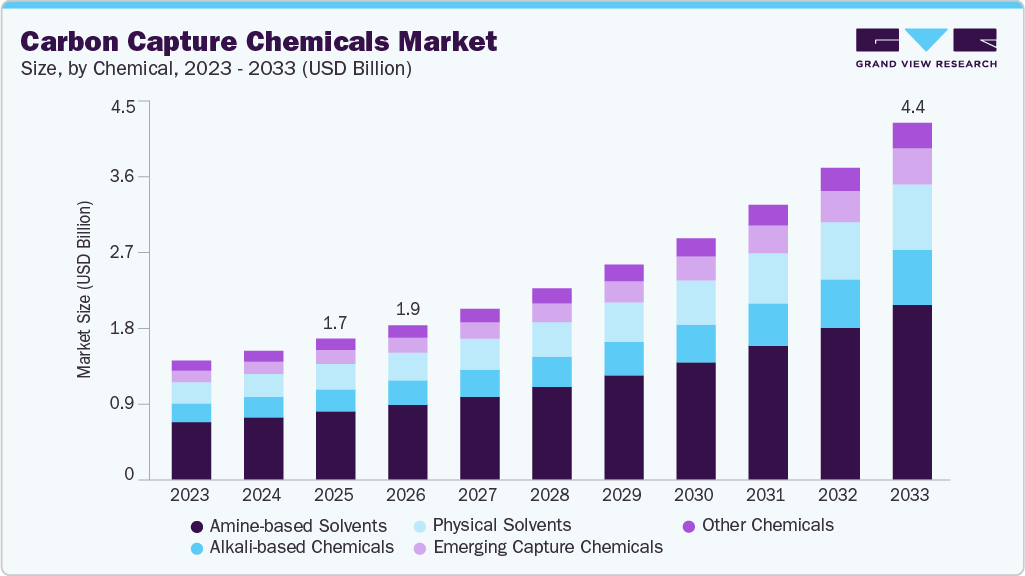 To learn more about this report, Download Free Sample Report
A key opportunity lies in the development of low-energy and high-efficiency capture chemicals for large-scale industrial applications. Growing investments in green hydrogen, blue ammonia, and sustainable fuel projects are expected to create new revenue opportunities for carbon-capture chemical manufacturers worldwide.
Market Dynamics
Growing pressure on industries to reduce carbon emissions is accelerating the adoption of carbon capture technologies across power generation, cement, steel, oil & gas, and chemical sectors. This is increasing the demand for carbon capture chemicals such as amine solvents, alkali-based absorbents, and advanced separation materials that improve CO₂ capture efficiency and support compliance with environmental regulations.
Rising investments in carbon capture, utilization, and storage (CCUS) infrastructure are supporting long-term market expansion. Governments and private companies are increasingly funding large-scale carbon reduction projects, while the growing carbon capture utilization chemicals market is creating additional demand for chemicals used in CO₂ conversion into fuels, chemicals, and industrial products.
The carbon capture chemicals market faces challenges due to the high operational costs associated with solvent regeneration, energy consumption, and chemical replacement. Many capture processes require significant heat and power input, increasing overall operating expenses for industrial facilities implementing carbon capture systems.
Solvent degradation, corrosion issues, and handling requirements increase maintenance and process complexity, particularly in large-scale industrial applications. These factors can limit adoption among small and medium-scale industries where capital efficiency and operating cost optimization remain major priorities.
Market Concentration & Characteristics
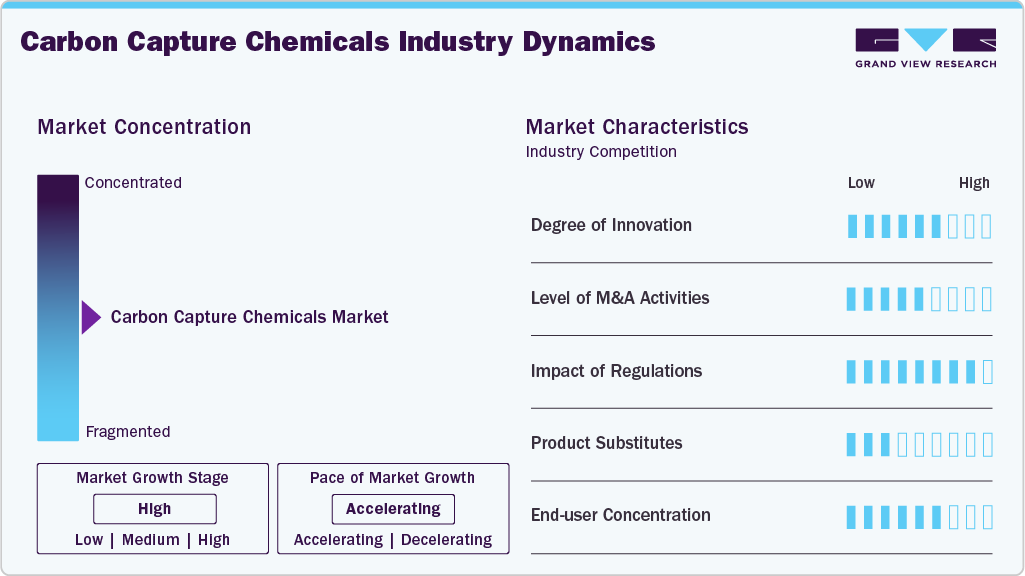
The carbon capture chemicals market is moderately concentrated, with the presence of global chemical manufacturers, specialty solvent producers, and carbon management technology providers competing through product efficiency, solvent performance, and long-term industrial partnerships. Companies are focusing on developing advanced amine-based solvents, low-energy absorbents, and recyclable capture chemicals to strengthen their market position and support large-scale CCUS projects.
 To learn more about this report, Download Free Sample Report
The market is characterized by continuous innovation, rising strategic collaborations, and increasing investments in sustainable carbon management solutions. Demand is largely driven by hard-to-abate industries such as power generation, cement, steel, and chemicals, where companies are prioritizing emission reduction technologies. Growing integration of carbon capture utilization chemicals into fuel production, chemical synthesis, and industrial decarbonization projects is also shaping market expansion globally.
Chemical Insights
Amine-based solvents hold a dominant position in the global carbon capture chemicals market, with a 48.4% revenue share in 2025, driven by their widespread commercial adoption across the power generation, oil & gas, refining, and chemical processing industries. Their strong CO₂ absorption efficiency and compatibility with existing capture infrastructure make them a preferred solution for large-scale industrial carbon management projects.
Emerging capture chemicals are witnessing the fastest growth in the global carbon capture chemicals market with a revenue CAGR of 13.4% during the forecast period, as industries seek advanced carbon capture solutions with lower regeneration energy requirements and improved operational sustainability. Increasing focus on reducing capture costs is accelerating investments in ionic liquids, solid sorbents, hybrid solvents, and other next-generation chemical technologies.
Application Insights
Power generation holds a dominant position in the global carbon capture chemicals market with a revenue share of 34.7% in 2025, due to the high volume of CO₂ emissions produced from coal- and gas-based power plants. Utilities and energy companies are increasingly adopting carbon capture chemicals, such as amine solvents and absorbents, to comply with emissions-reduction regulations and support low-carbon electricity generation initiatives.
 To learn more about this report, Download Free Sample Report
Direct air capture is witnessing the fastest growth in the global carbon capture chemicals market with a revenue CAGR of 13.9% during the forecast period, due to increasing global focus on negative emission technologies and long-term carbon removal solutions. Rising investments in advanced capture chemicals and adsorption technologies are supporting the development of large-scale facilities capable of removing CO₂ directly from the atmosphere.
Regional Insights
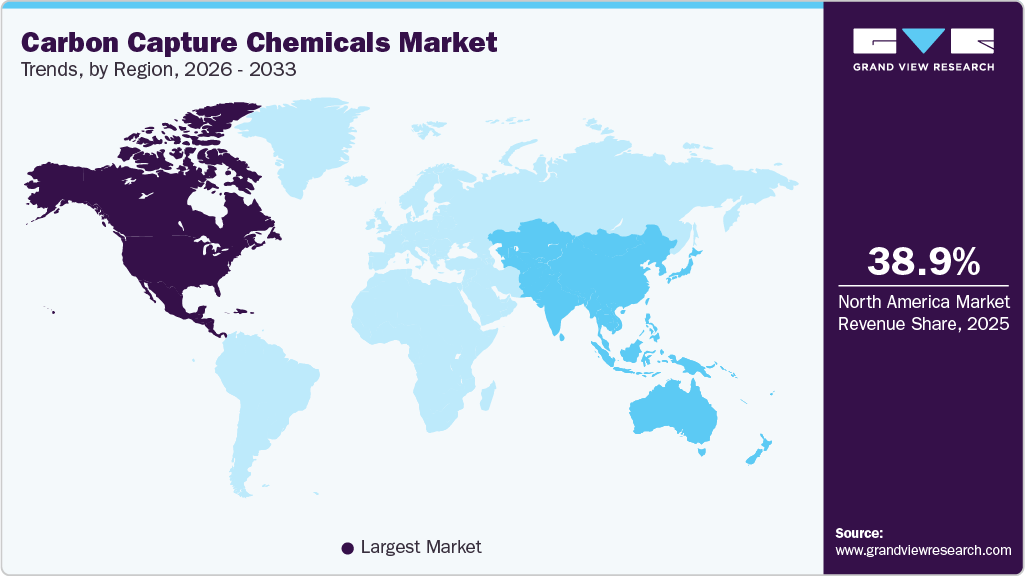
North America holds the largest revenue share of 38.9% in 2025, due to strong investments in carbon capture, utilization, and storage (CCUS) infrastructure across the U.S. and Canada. The presence of established oil & gas, power generation, and chemical industries is increasing the adoption of advanced capture chemicals for industrial emission reduction initiatives.
 To learn more about this report, Download Free Sample Report
U.S. Carbon Capture Chemicals Market Trends
The U.S. represents a key market due to rising deployment of large-scale carbon capture projects across power plants, refineries, hydrogen production, and industrial manufacturing facilities. Growing investments from energy companies and technology providers are increasing demand for high-performance capture solvents and advanced carbon management chemicals.
Asia Pacific Carbon Capture Chemicals Market Trends
Asia Pacific is witnessing fastest growth in the carbon capture chemicals market with a CAGR revenue of 13.7% during forecast period, due to rising industrial emissions and increasing focus on decarbonization across developing economies. Rapid expansion of power generation, steel, cement, and chemical industries is driving demand for carbon capture chemicals in large-scale industrial applications.
China carbon capture chemicals market is emerging as a major growth market due to rising investments in industrial carbon reduction technologies and large-scale CCUS projects. Strong expansion of coal power, cement, and heavy industrial sectors is increasing demand for carbon capture chemicals to support emission management and regulatory compliance.
Europe Carbon Capture Chemicals Market Trends
Europe is witnessing steady growth in the carbon capture chemicals market due to stringent emission reduction regulations and strong focus on industrial sustainability. Increasing adoption of CCUS technologies across power generation, refining, chemicals, and manufacturing sectors is supporting demand for advanced capture chemicals.
Germany carbon capture chemicals market represents a key market in Europe due to its strong industrial base and growing focus on carbon-neutral manufacturing practices. Increasing implementation of carbon capture technologies across chemical, steel, and energy sectors is driving demand for advanced capture solvents and absorbent chemicals.
Middle East & Africa Carbon Capture Chemicals Market Trends
The Middle East & Africa market is growing due to increasing investments in carbon management technologies across oil & gas, petrochemical, and energy industries. Large-scale industrial operations and rising focus on reducing carbon emissions are supporting demand for carbon capture chemicals in the region.
Latin America Carbon Capture Chemicals Market Trends
Latin America is experiencing gradual growth in the carbon capture chemicals market due to increasing awareness regarding industrial emission reduction and sustainable energy development. Expansion of oil & gas, power generation, and industrial processing activities is creating demand for carbon capture solutions across the region.
Key Carbon Capture Chemicals Company Insights
Key companies operating in the carbon capture chemicals market are focusing on expanding advanced solvent portfolios, improving capture efficiency, and developing low-energy carbon management solutions to strengthen their competitive position. Market participants are increasingly investing in research partnerships, CCUS projects, and sustainable carbon capture utilization chemicals to support industrial decarbonization across power generation, oil & gas, chemical processing, and manufacturing sectors.
-
Huntsman Corporation is a global specialty chemicals manufacturer with strong capabilities in performance chemicals, amines, and industrial process solutions supporting carbon capture applications. The company focuses on developing advanced chemical formulations that improve CO₂ absorption efficiency and operational performance for industrial emission reduction projects across energy, refining, and chemical processing sectors.
-
Eastman Chemical Company is a specialty materials and chemical solutions provider engaged in developing sustainable and performance-driven chemical technologies for industrial applications. The company is increasingly focusing on low-emission process innovation, specialty solvents, and sustainable chemical technologies that support carbon capture, industrial decarbonization, and carbon utilization across multiple end-use industries.
Key Carbon Capture Chemicals Companies
The following key companies have been profiled for this study on the carbon capture chemicals market.
-
Huntsman Corporation
-
Eastman Chemical Company
-
TATA Chemicals
-
Dow Chemical Company
-
Nouryon
-
BASF SE
-
Solvay S.A.
-
INEOS Group
-
Honeywell International Inc.
-
Carbon Clean
Competitive Benchmarking
Operating Strategies
Competitive Edge
Weakness
Merge Players: BASF SE; Dow Chemical Company; Honeywell International Inc.; Solvay S.A.; INEOS Group; Eastman Chemical Company; Huntsman Corporation; and Nouryon
- Focus on large-scale CCUS partnerships and industrial decarbonization projects
- Expansion of advanced solvent and specialty chemical portfolios
- Long-term supply agreements with power, refining, and chemical industries
- Strong global manufacturing and distribution capabilities
- Established industrial customer base and financial stability
- High R&D investments and process innovation expertise
- High operational and infrastructure costs in carbon capture projects
- Longer commercialization timelines for advanced capture technologies
- Exposure to fluctuating raw material and energy prices
Emerging Players: Carbon Clean; TATA Chemicals, etc.
- Focus on modular carbon capture systems and next-generation solvents
- Strategic collaborations with industrial facilities and energy companies
- Expansion of pilot-scale and commercial CCUS deployment projects
- Strong specialization in carbon capture utilization of chemicals and modular solutions
- Faster innovation cycle compared to large chemical manufacturers
- Flexible deployment model for industrial carbon capture applications
- Limited global manufacturing scale compared to established players
- Higher dependency on external funding and partnerships
- Smaller customer network and commercial reach
Recent Developments
-
In April 2025, Carbon Clean announced the successful industrial deployment of its CycloneCC modular carbon capture technology at Honeywell International Inc.’s facility in Abu Dhabi. The project utilized advanced amine-promoted solvent technology to improve CO₂ capture efficiency and support industrial-scale carbon utilization in urea production.
-
In July 2025, National Carbon Capture Center initiated pilot-scale testing of KC8 Capture Technologies’ UNO MK3 solvent process for industrial carbon capture applications. The project focuses on improving CO₂ capture performance and reducing operational costs in cement and natural gas facilities.
Carbon Capture Chemicals Market Report Scope
Report Attribute
Details
Market size value in 2025
USD 1.4 billion
Market size value in 2026
USD 1.9 billion
Revenue forecast in 2033
USD 4.4 billion
Growth rate
CAGR of 12.8% from 2026 to 2033
Base year for estimation
2025
Historical data
2021 - 2024
Forecast period
2026 - 2033
Quantitative units
Revenue in USD billion/million, volume in kilotons, and CAGR from 2026 to 2033
Report coverage
Revenue forecast, volume forecast, company ranking, competitive landscape, growth factors, and trends
Segments covered
Chemical, application, region
Regional scope
North America; Europe; Asia Pacific; Middle East & Africa; Latin America
Country scope
U.S.; Canada; Mexico; Germany; UK; Spain; France, Italy; China; India; Japan; South Korea; Brazil; Argentina; South Africa; Saudi Arabia
Key companies profiled
Huntsman Corporation; Eastman Chemical Company; TATA Chemicals; Dow Chemical Company; Nouryon; BASF SE; Solvay S.A.; INEOS Group; Honeywell International Inc.; Carbon Clean
Customization scope
Free report customization (equivalent up to 8 analysts’ working days) with purchase. Addition or alteration to country, regional & segment scope.
Pricing and purchase options
Avail customized purchase options to meet your exact research needs. Explore purchase options
Global Carbon Capture Chemicals Market Report Segmentation
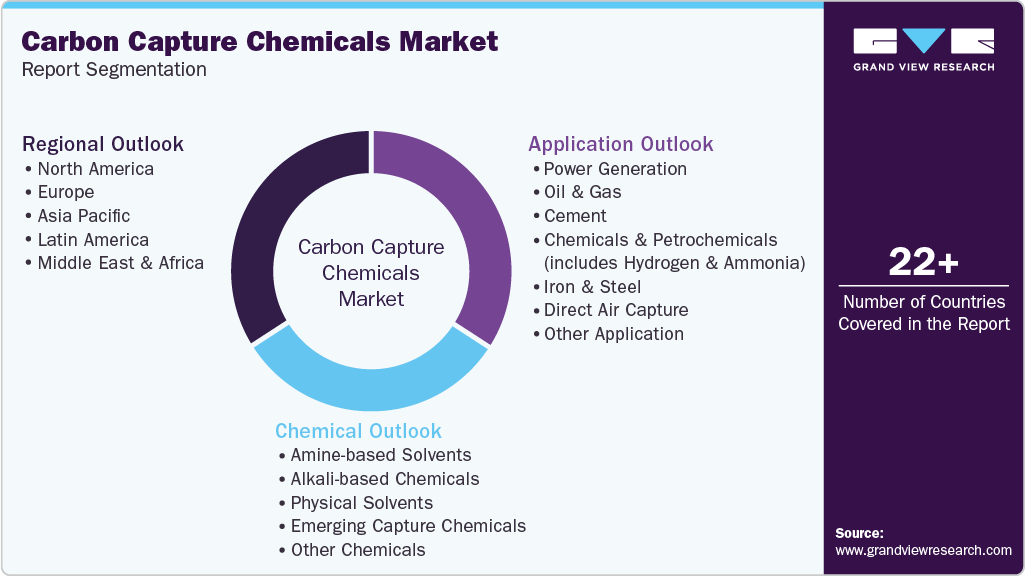
This report forecasts volume & revenue growth at global, regional, and country levels and provides an analysis of the latest industry trends in each of the sub-segments from 2021 to 2033. For this study, Grand View Research has segmented the global carbon capture chemicals market report based on chemical, application and region:
 To learn more about this report, Download Free Sample Report
-
Chemical Outlook (Volume, Kilotons; Revenue, USD Million; 2021 - 2033)
-
Amine-based Solvents
-
Monoethanolamine (MEA)
-
Methyldiethanolamine (MDEA)
-
Diethanolamine (DEA)
-
Others
-
-
Alkali-based Chemicals
-
Sodium Hydroxide
-
Calcium-based Sorbents
-
Others
-
-
Physical Solvents
-
Emerging Capture Chemicals
-
Other Chemicals
-
-
Application Outlook (Volume, Kilotons; Revenue, USD Million; 2021 - 2033)
-
Power Generation
-
Oil & Gas
-
Cement
-
Chemicals & Petrochemicals (includes Hydrogen & Ammonia)
-
Iron & Steel
-
Direct Air Capture
-
Other Application
-
-
Regional Outlook (Volume, Kilotons; Revenue, USD Million; 2021 - 2033)
-
North America
-
U.S.
-
Canada
-
Mexico
-
-
Europe
-
Germany
-
UK
-
Spain
-
France
-
Italy
-
-
Asia Pacific
-
China
-
India
-
Japan
-
South Korea
-
-
Latin America
-
Brazil
-
Argentina
-
-
Middle East & Africa
-
Saudi Arabia
-
South Africa
-
-
Delivered Customizations
This report has been delivered with the following In-depth customizations
Client Request
Customization Delivered
Value Adds
Regional Segmentation
A detailed regional assessment of the carbon capture chemicals market was conducted across North America, Europe, Asia Pacific, Latin America, and Middle East & Africa. The analysis evaluated country-level demand for amine-based solvents, alkali-based chemicals, physical solvents, and emerging capture chemicals across power generation, oil & gas, cement, chemicals & petrochemicals, iron & steel, and direct air capture applications. Regulatory developments, carbon reduction targets, CCUS investments, and industrial decarbonization initiatives were also assessed across major economies.
Enabled identification of high-investment regions and industrial decarbonization hubs with strong carbon capture deployment potential. Supported regional expansion planning, localization strategies, and prioritization of countries with favorable CCUS policy frameworks and emission reduction programs.
Competitive Benchmarking
Key carbon capture chemical manufacturers were benchmarked based on solvent technology portfolio, carbon capture process expertise, production capabilities, strategic collaborations, regional presence, sustainability initiatives, and participation in CCUS projects. The evaluation further reviewed innovation activity related to advanced amines, low-energy regeneration solvents, and next-generation capture chemistries.
Supported evaluation of competitive positioning, technology leadership, and differentiation opportunities within the carbon capture value chain. Enabled strategic partnership assessment, innovation benchmarking, and improved understanding of evolving competitive dynamics.
Opportunity Assessment
Emerging opportunities within the carbon capture chemicals market were analyzed across direct air capture, low-carbon hydrogen production, cement decarbonization, industrial CCUS integration, and next-generation solvent technologies. The assessment also reviewed the increasing adoption of low-energy capture chemicals and sustainable industrial emission reduction initiatives.
Enabled identification of high-potential growth segments and innovation opportunities within industrial decarbonization. Supported long-term investment planning, technology development strategies, and expansion into emerging carbon capture applications.
Frequently Asked Questions About This Report
The global carbon capture chemicals market size was estimated at USD 1.7 billion in 2025 and is expected to reach USD 1.9 billion in 2026.
The carbon capture chemicals market is expected to grow at a compound annual growth rate of 12.8% from 2026 to 2033 to reach USD 4.4 billion by 2033.
North America holds the largest revenue share of 38.9% in 2025, due to strong investments in carbon capture, utilization, and storage (CCUS) infrastructure across the U.S. and Canada. The presence of established oil & gas, power generation, and chemical industries is increasing the adoption of advanced capture chemicals for industrial emission reduction initiatives.
Some of the key players operating in the carbon capture chemicals market include Huntsman Corporation, Eastman Chemical Company, TATA Chemicals, Dow Chemical Company, Nouryon, BASF SE, Solvay S.A., INEOS Group, Honeywell International Inc., Carbon Clean
The market is driven by the growing adoption of carbon capture and utilization technologies across power generation, oil & gas, cement, and chemical industries. Increasing environmental regulations and net-zero emission targets are accelerating the demand for amine solvents, alkali chemicals, and advanced capture agents.
About the Author(s)
Organic Chemicals Research Team
Bulk Chemicals · Organic ChemicalsThis report was authored by the organic chemicals research team at Grand View Research - comprising two research analysts, one senior research analyst, and one industry expert - with specialized expertise in the organic chemicals segment of the bulk chemicals industry. All findings are based on proprietary bulk chemicals databases, executive interviews, and regulatory analysis, subject to internal peer review prior to publication.
Last Updated:
Speak to Analyst

Customize this report to your needs - add regions, segments, or data points, with 20% free customization.
Or view our licence options:


ISO 9001:2015 & 27001:2022 Certified
We are GDPR and CCPA compliant! Your transaction & personal information is safe and secure. For more details, please read our privacy policy.


