
- Home
- »
- Medical Devices
- »
-
Carboxy Therapy Market Size, Share & Trends Report, 2026-2033GVR Report cover
![Carboxy Therapy Market (2026 - 2033)Report]()
Carboxy Therapy Market (2026 - 2033)
Size, Share & Trends Analysis Report By Product Type (Table Top, Portable), By End Use (Hospitals, Aesthetic Clinics, Medspa), By Region (North America, Europe, Asia Pacific, Latin America, MEA), And Segment Forecasts
Market Size, 2025
$163.5MMarket Estimate, 2026
$177.4MMarket Forecast, 2033
$314.8MCAGR, 2026–2033
8.5%Carboxy Therapy Market Summary
The global carboxy therapy market size was valued at USD 163.5 million in 2025 and is projected to grow from USD 177.4 million in 2026 to USD 314.8 million by 2033, at a CAGR of 8.5% from 2026 to 2033. North America dominated the market, accounting for a revenue share of 40.7% in 2025. The growth of the carboxy therapy industry is attributed to the rising adoption of non-invasive aesthetic procedures, technological advancements associated with aesthetic treatments, and the benefits and effectiveness of the therapy.
Key Market Trends & Insights
- By product type: Table top held the largest revenue share of around 53.0% in 2025.
- By end use: Aesthetic clinics held the largest revenue share of over 47.5% in 2025.
Regional Highlights
- Largest regional market: North America (40.7% revenue share, 2025)
Market Size & Forecast
- Market size in 2025: USD 163.5 Million
- Estimated market size in 2026: USD 177.4 Million
- Projected market size by 2033: USD 314.8 Million
- CAGR (2026-2033): 8.5%
The rising awareness and availability of portable devices are fueling market growth. The worldwide desire to maintain a youthful appearance has increased, as it boosts mental health and self-esteem. The recent years have witnessed a surge in demand for aesthetic procedures, including carboxy therapy, and thereby the availability of portable devices, further fueling market growth.
Carboxy therapy is seen as 100% natural, and the use of carbon dioxide treatment helps in complementing and enhancing various other cosmetic procedures and does not interfere with other procedures such as fillers, lasers, and botulinum toxins. Moreover, the devices are generally easy to use and come as portable and stationary units that enhance the adoption of carboxy therapy among end users. The increasing number of applications associated with these devices is further anticipated to boost the overall growth of the market.

Furthermore, the market growth is driven mainly by the global rise in aesthetic plastic surgery. International Society of Aesthetic Plastic Surgery (ISAPS) released a report stating that approximately 37.9 million aesthetic procedures were performed globally in 2024, including around 17.4 million surgical and 20.5 million non-surgical procedures. The data reflects a strong multi-year growth trend in global aesthetic treatments compared to earlier reporting periods, with non-surgical procedures accounting for a growing share of total demand. This ongoing shift indicates sustained consumer preference for minimally invasive aesthetic treatments over the forecast period.
Moreover, recent technological advancements in the carboxy therapy industry, such as portable carboxy therapy devices, improved safety features, and automated carboxy therapy machines, have focused on improving the delivery of carbon dioxide gas to the treatment area. This leads to reduced treatment time and increased treatment effectiveness. These advanced devices are designed to automatically inject carbon dioxide into the treatment area, further reducing the need for manual injections by the therapist, and can make the treatment more efficient and consistent. They can also be used in remote locations or a client's home, enhancing the overall effectiveness of the treatment and providing more comprehensive results.
Market Dynamics
Consumer preference for minimally invasive cosmetic procedures over invasive or surgical options is a primary driver of the carboxy therapy market. There is an increasing trend toward minimally invasive and less risky cosmetic treatments with a minimal post-treatment recovery period, in contrast to invasive cosmetic surgery procedures. Also, increased awareness of beauty, rising disposable incomes, and the influence of social media are motivating more consumers to opt for aesthetic treatments. For instance, in June 2025, the American Society of Plastic Surgeons (ASPS) revealed that overall demand for aesthetic and cosmetic procedures and treatments showed relatively unchanged rates for the entirety of 2024. Demand for minimally invasive cosmetic procedures showed a 1.5% rise over the previous year, despite current economic conditions. These factors reflect consumer trends in look-enhancing and wellness-oriented treatments, which should favor continued uptake of non-surgical aesthetic treatments such as carboxy therapy, during the forecast period.
The cost of conducting multiple sessions and the low awareness level of carboxy therapy among the potential target audience, in comparison with established treatments like Botox, dermal fillers, laser therapy, and chemical peeling, is a key factor hampering market expansion. As several sessions are necessary to achieve the desired results, the overall cost of multiple sessions can be higher and a deterrent for price-sensitive users. The awareness level of carboxy therapy is relatively low among consumers and specialists in developing countries as well. The lack of standardized reimbursement policies for aesthetic procedures across almost all countries is projected to further affect market access. As consumers continue to check for efficacy, safety, and cost-effectiveness, the growth of carboxy therapy in broader markets is expected to be limited.
The rapid expansion of aesthetic clinics and wellness services worldwide presents significant opportunities for the carboxy therapy market. The rise in the use of medical aesthetic procedures, among both younger and older populations, will compel clinics to offer minimally invasive treatments such as carboxy therapy alongside their existing services. Moreover, increasing investments in aesthetic clinics in emerging markets such as Asia Pacific, Latin America, and the Middle East are also enhancing the accessibility of cosmetic procedures. This increased demand for tailored beauty and wellness services is also expected to increase the demand for carboxy therapy service providers and device manufacturers.
Analyst’s Perspective
The global carboxy therapy market is expected to witness sustained growth over the long term, driven by increased demand for less invasive aesthetic procedures, rising awareness of skin rejuvenation treatments, and growing consumer spending on cosmetic care. Market expansion is further supported by the growing number of aesthetic clinics and medi-spas that use advanced technologies and offer non-surgical solutions. The key advantages of carboxy therapy are its relatively low cost, minimal downtime, and broad scope for aesthetic and therapeutic applications. The ability to develop portable, high-performance devices while expanding distribution networks across aesthetic clinics and medspas is likely to act as a key differentiator for leading market participants. Evolving aesthetic preferences and technological advances are expected to support continued market growth in the coming years.
Product Type Insights
The tabletop carboxy therapy devices segment held the largest market share of around 53.0% in 2025. The dominance of the segment is attributed to the increasing demand for aesthetic procedures in wellness and aesthetic clinics. With advancements in cosmetic surgery, novel procedures and devices are being widely adopted and integrated into healthcare systems to provide patients with a wide range of options. Moreover, the demand for tabletop carboxy therapy machines is rising owing to the use of the systems in pain management and medical aesthetics.
The portable segment is expected to expand at a significant pace over the forecast period. The growth of the portable product segment can be attributed to the increasing patient spending on cosmetic procedures and beautification. Portable devices available in the market, including the Medical CO2 Carboxy Therapy Machine, Carboxy-Pen (a compact, mobile carboxy therapy device), and Concerto (a dual device with carboxy therapy and mesotherapy options), are easy to use and readily available. They are highly preferred and used to restore skin texture, rejuvenate the skin, and treat stretch marks, cellulite, and wrinkles.
End User Insights
The aesthetic clinics segment led the carboxy therapy industry, accounting for a share of over 47.5% in 2025. The growth of the segment can be attributed to the lower cost of treatment at these clinics and the availability of cosmetic surgical procedures under the supervision of a licensed physician. Carboxy therapy procedures are offered in aesthetic clinics and require approximately 15-30 minutes, followed by maintenance therapy after about every three to six months, which increases the patients’ visits to aesthetic clinics, further propelling the growth of the segment. In addition, the aesthetics clinics generally offer advanced cosmetic procedures, which make them a prime location for carboxy therapy.
The medspa segment is expected to witness growth at a significant CAGR over the forecast period. Medical spas serve as healthcare settings with the aim of providing rejuvenation, advanced patient services, and the best patient experience. Carboxy therapy is a relatively new technology in the cosmetic industry and is widely adopted in medspas to deliver advanced aesthetic treatments. However, the cost of the procedure in medspa is high and is not covered by insurance or reimbursed, which is expected to restrain the growth of these procedures in medspa.
Regional Insights
North America dominated the carboxy therapy market with a share of approximately 40.7% in 2025 and is anticipated to maintain its dominance over the forecast period. The high share of the market in the region can be due to the growth of the market in the U.S. In the U.S., a growing number of people are focusing on the adoption of aesthetic procedures to maintain their rejuvenated skin. The region shows a high disposable income and high patient spending on cosmetic procedures, which increases the adoption of the procedure. Moreover, the U.S. population is rapidly aging and is expected to grow significantly in the coming years. With the aging population, the need for treating various skin-related issues, including wrinkles, fine lines, and dehydration of the skin, is expected to increase.

Asia Pacific Carboxy Therapy Market Trends
The Asia Pacific carboxy therapy industry is estimated to record a significant CAGR over the forecast period, driven by increasing demand for minimally invasive aesthetic treatments and rising awareness of cosmetic procedures. The market growth can be attributed to the growing popularity of carboxy therapy and the benefits associated with it. The region is emerging as a key growth hub for aesthetic medicine, supported by expanding healthcare infrastructure, growing adoption of medical aesthetics, and increasing consumer interest in skin rejuvenation therapies. The proliferation of advanced aesthetic clinics and specialized dermatology centers is improving access to such treatments. Skin clinics offering advanced services in state-of-the-art facilities are gaining popularity. However, treatment affordability and varying levels of consumer spending across developing markets may pose challenges to the broad adoption of such procedures in the region.
Key Carboxy Therapy Company Insights
The market is highly fragmented, with a majority of the market share held by many small companies. The companies are focusing on adopting several strategies, including product launches, strategic collaborations, and acquisitions, to strengthen their market presence and further contribute to market growth.
Key Carboxy Therapy Companies
The following key companies have been profiled for this study of the carboxy therapy market.
-
DTA Medical
-
Cosmopro
-
Carbossiterapia Italiana
-
MezoPharma
-
MBE Medical Division
-
Beijing Jontelaser Technologies Co., Ltd.
-
Alvi Prague
-
Kastner-Praxisbedarf
-
MEDAiON Plasma
-
Jontelaser Technologies Co., Ltd.
Recent Developments
-
In October 2025, Croma-Pharma GmbH entered a strategic distribution partnership with Renellence in Canada to expand access to its aesthetic medicine portfolio, including the Croma Saypha dermal filler range. The collaboration strengthens the company’s presence in the Canadian market and supports its broader North American growth strategy.
-
In January 2025, Merz Aesthetics was introduced by Ultherapy PRIME in the EMEA market through the IMCAS World Congress 2025. The next-generation non-invasive skin lifting platform reinforces the company’s regenerative aesthetics strategy and expands its portfolio of minimally invasive aesthetic treatment solutions.
Carboxy Therapy Market Report Scope
Report Attribute
Details
Market size in 2025
USD 163.5 million
Estimated market size in 2026
USD 177.4 million
Projected market size by 2033
USD 314.8 million
Growth rate
CAGR of 8.5% from 2026 to 2033
Base year for estimation
2025
Historical data
2021 - 2024
Forecast period
2026 - 2033
Report updated
June 2026
Quantitative units
Revenue in USD million and CAGR from 2026 to 2033
Report coverage
Revenue forecast, company ranking, competitive landscape, growth factors, and trends
Segments covered
Product type, end use, region
Regional Scope
North America; Europe; Asia Pacific; Latin America; MEA
Country Scope
U.S.; Canada; Germany; UK; France; Italy; Spain; Norway; Denmark; Sweden; China; Japan; India; Australia; Thailand; South Korea; Brazil; Mexico; Argentina; South Africa; Saudi Arabia; UAE; Kuwait
Key Companies Profiled
DTA Medical; Cosmopro; Carbossiterapia Italiana; MezoPharma; MBE Medical Division; Beijing Jontelaser Technologies Co., Ltd.; Alvi Prague; Kastner-Praxisbedarf; MEDAiON Plasma; Jontelaser Technologies Co., Ltd.
Customization scope
Free report customization (equivalent to up to 8 analysts’ working days) with purchase. Addition or alteration to country, regional & segment scope
Pricing and purchase options
Avail customized purchase options to meet your exact research needs. Explore purchase options
Global Carboxy Therapy Market Report Segmentation
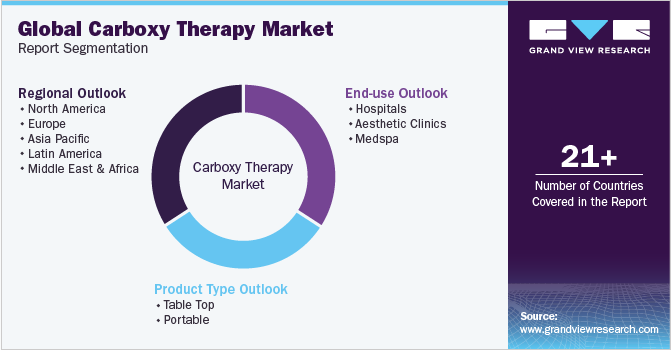
This report forecasts revenue growth at the global, regional & country levels and provides an analysis of the latest industry trends in each of the sub-segments from 2021 to 2033. For this study, Grand View Research has segmented the global carboxy therapy market report based on product type, end use, and region:
-
Product Type Outlook (Revenue, USD Million, 2021 - 2033)
-
Table Top
-
Portable
-
-
End Use Outlook (Revenue, USD Million, 2021 - 2033)
-
Hospitals
-
Aesthetic Clinics
-
Medspa
-
-
Regional Outlook (Revenue, USD Million, 2021 - 2033)
-
North America
-
U.S.
-
Canada
-
-
Europe
-
Germany
-
UK
-
France
-
Italy
-
Spain
-
Denmark
-
Sweden
-
Norway
-
-
Asia Pacific
-
Japan
-
China
-
India
-
Australia
-
Thailand
-
South Korea
-
-
Latin America
-
Brazil
-
Mexico
-
Argentina
-
-
Middle East and Africa (MEA)
-
South Africa
-
Saudi Arabia
-
UAE
-
Kuwait
-
-
Frequently Asked Questions About This Report
The global carboxy therapy market size was valued at USD 163.5 million in 2025 and is estimated at USD 177.4 million for 2026.
The global carboxy therapy market is expected to grow at a CAGR of 8.5% from 2026 to 2033, reaching USD 314.8 million by 2033.
North America dominated with a revenue share of 40.7% in 2025.
Key players include DTA Medical; Cosmopro; Carbossiterapia Italiana; MezoPharma; MBE Medical Division; Beijing Jontelaser Technologies Co., Ltd.; Alvi Prague; Kastner-Praxisbedarf; MEDAiON Plasma; Jontelaser Technologies Co., Ltd.
tabletop carboxy therapy devices dominated the carboxy therapy market with a share of 53.0% in 2025.
About the Author(s)
Medical Devices Research Team
Healthcare · Medical DevicesThis report was authored by the medical devices research team at Grand View Research - comprising two research analysts, one senior research analyst, and one industry expert - with specialized expertise in the medical devices segment of the healthcare industry. All findings are based on proprietary healthcare databases, executive interviews, and regulatory analysis, subject to internal peer review prior to publication.
Last Updated:
Speak to Analyst


Customize this report to your needs — add regions, segments, or data points, with 20% free customization.
Or view our licence options:


ISO 9001:2015 & 27001:2022 Certified
We are GDPR and CCPA compliant! Your transaction & personal information is safe and secure. For more details, please read our privacy policy.


