
- Home
- »
- Animal Health
- »
-
Cattle Management Software Market Size Report, 2026-2033GVR Report cover
![Cattle Management Software Market (2026 - 2033)Report]()
Cattle Management Software Market (2026 - 2033)
Size, Share & Trends Analysis Report By Sector (Dairy, Meat), By Software (Monitoring, Trading/ Marketing), By Modality (On-premise, Cloud), By Application, By Region, And Segment Forecasts
Market Size, 2025
$2.1BMarket Estimate, 2026
$2.3BMarket Forecast, 2033
$5.0BCAGR, 2026–2033
11.6%Cattle Management Software Market Summary
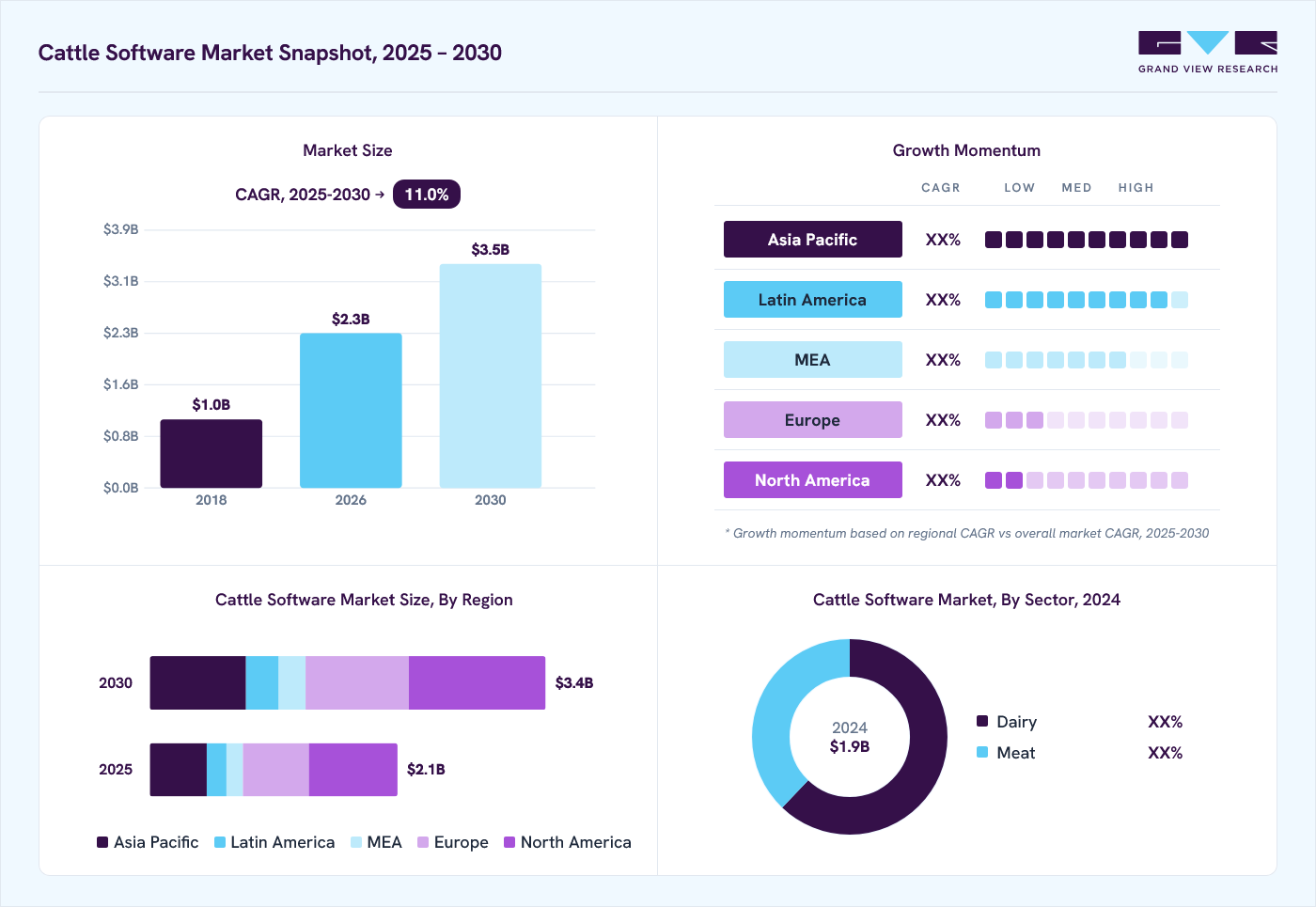
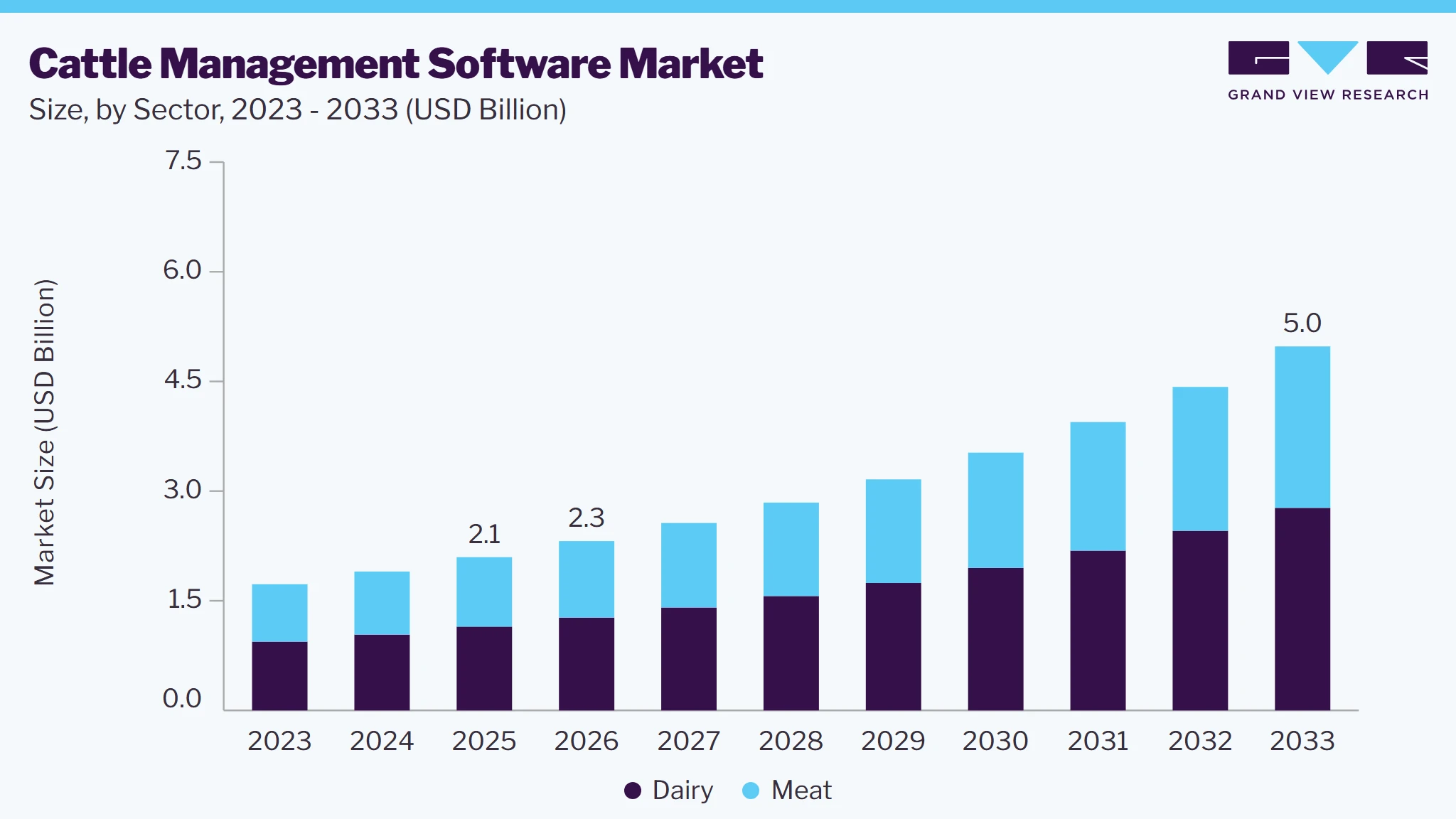
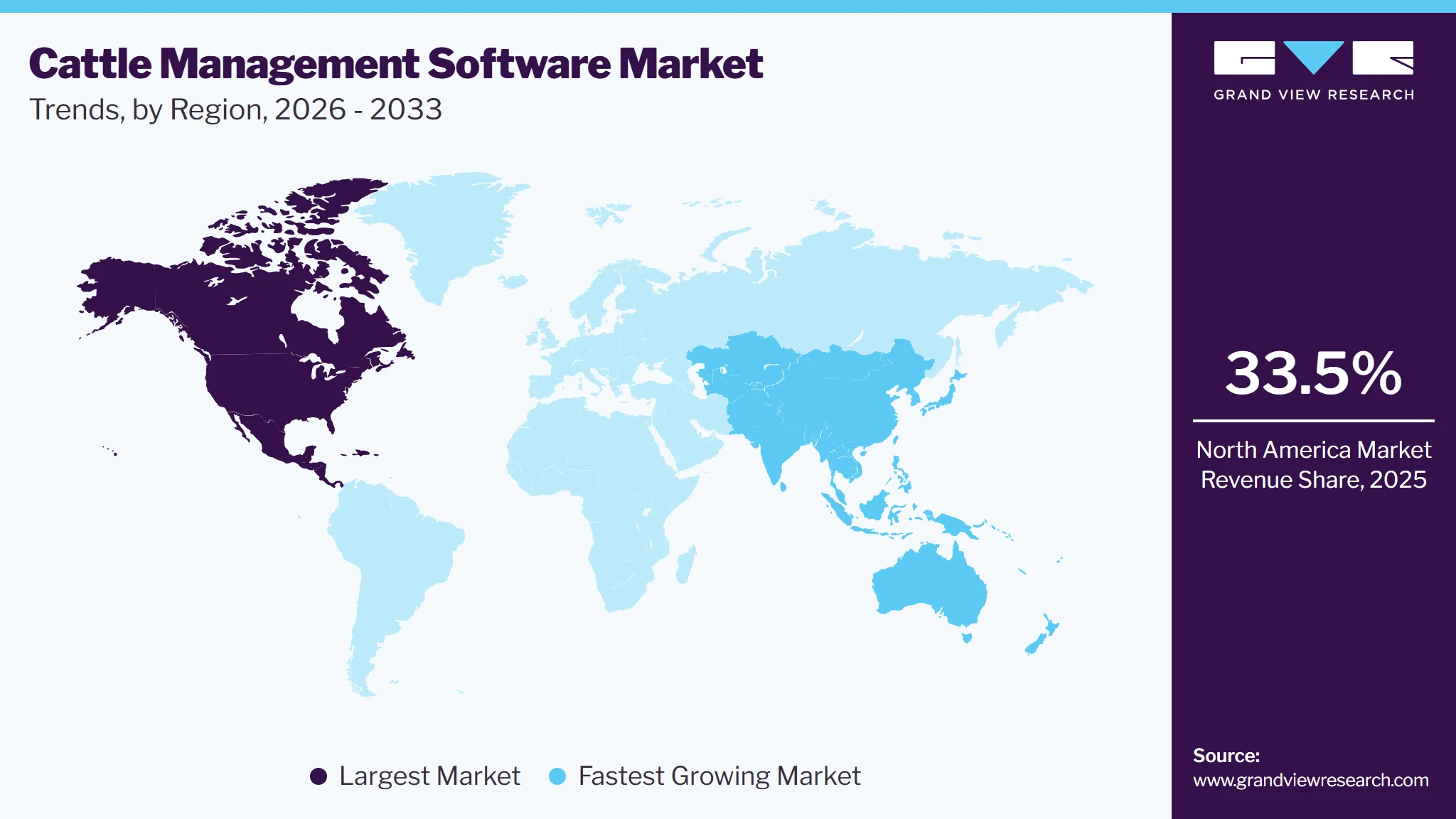
The global cattle management software market size was valued at USD 2.1 billion in 2025 and is projected to grow from USD 2.3 billion in 2026 to USD 5.0 billion by 2033, at a CAGR of 11.6% from 2026 to 2033. North America held the largest share of 33.5% of the global market in 2025. The global market growth is driven by increasing adoption of livestock identification and traceability systems, growing focus on animal health monitoring, rising commercial cattle farming operations, and expanding digitalization across livestock management.
Key Market Trends & Insights
- By sector: Dairy segment led the market with the largest revenue share of 54.7% in 2025.
- By software: Monitoring segment led the market with the largest revenue share of 69.9% in 2025.
- By modality: Cloud segment held the largest market share of 51.3% in 2025.
- By application: Milk harvesting management segment held the largest market share of 30.0% in 2025.
Regional Highlights
- Largest regional market: North America (33.5% revenue share, 2025)
- Fastest-growing regional market: Asia Pacific (highest CAGR, 2026-2033)
- By country: The U.S. held the largest market share in 2025.
Market Size & Forecast
- Market size in 2025: USD 2.1 Billion
- Estimated market size in 2026: USD 2.3 Billion
- Projected market size by 2033: USD 5.0 Billion
- CAGR (2026-2033): 11.6%
Furthermore, stricter disease surveillance requirements, increasing investments in precision livestock farming, and the need to improve productivity, regulatory compliance, and operational efficiency are accelerating software adoption across dairy and beef production systems.Market Dynamics
Governments across major cattle-producing countries are modernizing livestock identification and traceability systems to improve disease surveillance, biosecurity, and livestock movement reporting. In June 2025, the UK Department for Environment, Food & Rural Affairs (Defra) announced reforms to cattle identification, registration, and reporting, including mandatory electronic identification (EID) for all newborn calves from 2027. The reforms are intended to strengthen disease traceability, simplify livestock reporting requirements, support productivity, and facilitate international trade, increasing the need for digital cattle management platforms across commercial farming operations.
Growing emphasis on livestock traceability, disease surveillance, and food safety is increasing the adoption of digital technologies across commercial cattle production. Governments and regulatory authorities are strengthening national cattle management software frameworks to improve livestock movement monitoring, accelerate disease response, and maintain access to domestic and international markets. These developments require cattle producers to maintain accurate digital records of cattle management software, health, breeding, and movement, increasing the importance of integrated cattle management software.
For instance, in February 2025, the Australian Government announced the opening of applications for a USD 3.9 million grant aimed at supporting the transition for the National Livestock Identification System (NLIS) Database Uplift, which is part of a larger USD 46.7 million investment intended to enhance Australia’s livestock traceability system. This initiative is designed to modernize the national livestock database to boost biosecurity, ensure food safety, promote animal welfare, and enhance market access. In addition, the rise in funding for electronic identification systems, integrated livestock databases, and digital animal traceability infrastructure is fostering continuous demand for cattle management software that facilitates compliance with regulations, herd management, and data-driven livestock management in key cattle-producing nations.
The adoption of cattle management software remains constrained by the high costs associated with software deployment, electronic identification systems, sensors, automated monitoring equipment, and ongoing subscription and maintenance services. Small and medium-sized cattle farms, particularly in developing economies, often operate with limited financial resources, making investments in digital herd management technologies less feasible. In addition, inadequate digital infrastructure, inconsistent internet connectivity, and limited technical expertise in rural areas reduce the effective implementation of cloud-based livestock management platforms. Integration with existing farm equipment and migration from conventional record-keeping systems further increase the complexity of implementation. These factors continue to limit software adoption among smaller cattle producers, particularly in price-sensitive markets where operational expenditures are prioritized over long-term technology investments.
The increasing adoption of artificial intelligence (AI) and predictive analytics is expected to create significant growth opportunities for the cattle management software industry by expanding the capabilities of digital herd management platforms beyond conventional record keeping. As commercial cattle farms generate larger volumes of animal health, breeding, feeding, and production data, software providers are increasingly integrating AI-based analytics to deliver predictive insights for disease detection, reproductive management, feed optimization, and productivity improvement. These advanced capabilities enable livestock producers to make data-driven decisions, reduce production losses, and improve operational efficiency across dairy and beef operations. For instance, in June 2025, Unigen Corporation and MACSO Technologies partnered to launch an AI-powered livestock monitoring platform that combines edge computing, artificial intelligence, and connected sensors to provide real-time animal monitoring and predictive herd management. Increasing commercialization of AI-enabled livestock technologies, combined with growing investments in precision livestock farming and connected farm ecosystems, is expected to create new product development opportunities and support long-term demand for advanced cattle management software solutions.
Technological Advancements.
Technology
Key Function
Impact on Cattle Management
AI & Machine Learning
Enables predictive analytics for disease detection, estrus identification, calving prediction, and feed optimization.
Improves herd health, reproductive efficiency, and farm productivity while reducing manual intervention.
IoT & Smart Sensors
Integrates RFID tags, GPS-enabled ear tags, wearable sensors, automated milking systems, and environmental monitoring devices for continuous data collection.
Provides real-time monitoring of animal health, behavior, and location, enabling timely decision-making and improved animal welfare.
Cloud Computing & Precision Livestock Farming
Centralizes farm data, supports remote access, analytics, and integration across multiple farm operations.
Enhances data-driven decision-making, operational efficiency, scalability, and collaboration across livestock enterprises.
Market Concentration & Characteristics
The global cattle management software industry is in a high-growth stage, driven by increasing digitalization across livestock production, rising adoption of precision livestock farming technologies, and growing demand for real-time herd monitoring and data-driven farm management. Increasing labor shortages, expanding commercial dairy and beef operations, and stricter livestock traceability requirements are accelerating software adoption. Furthermore, cloud computing, mobile connectivity, and integration with IoT-enabled devices are improving operational efficiency, supporting the broader commercialization of cattle management platforms.
The industry demonstrates a high degree of innovation, supported by continuous integration of artificial intelligence, machine learning, Internet of Things (IoT), computer vision, wearable livestock sensors, automated feeding systems, and predictive analytics into cattle management platforms. Furthermore, software vendors are expanding cloud-based solutions with mobile applications, reproductive management, health monitoring, precision nutrition, and farm analytics to improve productivity and decision-making across dairy and beef operations.
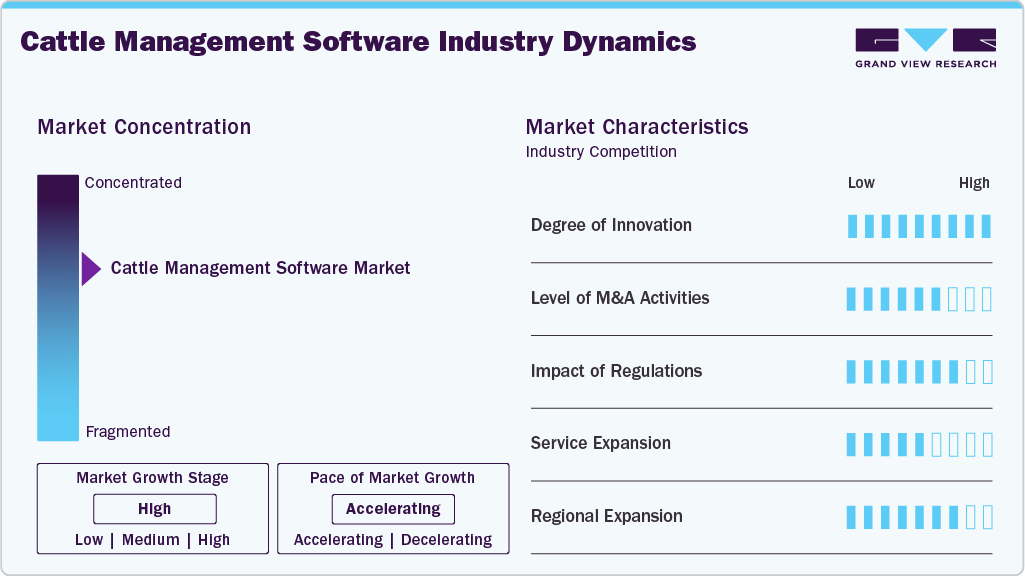
The industry exhibits a moderate level of mergers, acquisitions, strategic partnerships, and technology collaborations as software providers strengthen digital livestock management capabilities and expand geographic presence. Market participants continue to acquire precision livestock technology companies, data analytics providers, and herd monitoring solution developers to broaden product portfolios and deliver integrated farm management ecosystems.
The industry operates under moderate-to-high regulatory oversight due to increasing livestock identification, disease surveillance, animal welfare, food safety, environmental sustainability, and traceability requirements across major livestock-producing countries. Furthermore, government-supported livestock digitization programs, electronic identification mandates, and national animal traceability frameworks continue to encourage software adoption among commercial producers.
The industry is witnessing the continuous expansion of cloud-based subscription services, implementation support, data migration, technical support, software customization, remote monitoring, and analytics consulting. Furthermore, vendors are strengthening managed services, mobile connectivity, and integration capabilities with farm equipment, milking systems, weighing scales, and livestock identification technologies to improve customer retention and long-term platform utilization.
The industry is experiencing steady regional expansion across North America, Europe, Asia Pacific, Latin America, and Oceania, supported by increasing investments in digital agriculture and precision livestock farming. Furthermore, software providers are expanding distribution partnerships, regional support networks, and localized product offerings to address varying herd management practices, regulatory requirements, and livestock production systems across developed and emerging markets.
Analyst Perspective
The cattle management software market is transitioning from conventional herd record management to integrated digital platforms that combine animal health, breeding, production, and operational intelligence within a single ecosystem. Growing implementation of livestock traceability requirements, precision livestock farming technologies, and connected monitoring systems is increasing the strategic importance of software across commercial dairy and beef operations. Future competition is expected to center on artificial intelligence, predictive analytics, interoperability with farm technologies, and cloud-based deployment capabilities. Vendors that deliver scalable, data-driven platforms with strong integration capabilities and regulatory compliance support are likely to strengthen their competitive position as digital adoption continues to expand across the global livestock sector.
Sector Insights
Based on sector, the dairy segment led the market with the largest revenue share of 54.7% in 2025 and is expected to grow during the forecast period. The segment's dominance is driven by the increasing digitalization of commercial dairy farming and the growing need to improve milk production efficiency, herd productivity, and operational profitability. Dairy farms generate large volumes of production and animal performance data daily, creating strong demand for software platforms that consolidate information from automated milking systems, wearable sensors, feeding equipment, and herd management applications. These platforms enable producers to monitor milk yield, reproductive performance, feed efficiency, lactation cycles, and individual animal productivity while supporting timely management decisions and reducing operational costs.
The meat segment is growing significantly, due to the increasing demand for high-quality beef and the need for efficient livestock production. Beef producers are increasingly adopting cattle management software to monitor animal health, breeding, feed intake, weight gain, vaccination schedules, and herd performance, helping improve productivity and reduce operational costs. The software also supports traceability from farm to slaughterhouse, enabling compliance with food safety regulations and export standards. In addition, the growing adoption of precision livestock farming technologies, RFID tags, IoT sensors, and data-driven decision-making is encouraging meat producers to implement digital herd management solutions, further driving the growth of this segment.
Software Insights
Based on software, the monitoring software segment accounted for the largest revenue share of 69.9% in 2025, driven by increasing demand for continuous visibility into cattle health, productivity, and farm operations. Commercial dairy and beef producers are increasingly adopting software platforms that consolidate data from RFID tags, wearable sensors, automated milking systems, weighing equipment, and environmental monitoring devices into a centralized dashboard. These solutions support real-time tracking of animal health, estrus detection, disease identification, feeding behavior, milk yield, and location, enabling timely management decisions and improving herd productivity, operational efficiency, and compliance with livestock traceability requirements.
The other software segment is expected to register the fastest CAGR over the forecast period. Growth is supported by the increasing adoption of specialized applications for sustainability reporting, carbon emissions tracking, animal welfare documentation, supply chain traceability, financial management, and regulatory compliance. In addition, integration of artificial intelligence, predictive analytics, and cloud-based decision-support tools is expanding the capabilities of these platforms beyond traditional herd management. Growing digital transformation across livestock operations and evolving reporting requirements are encouraging producers to adopt specialized software solutions that improve business management and long-term operational planning.
Modality Insights
Based on modality, the cloud segment accounted for the largest revenue share of 51.3% in 2025, driven by increasing digitalization across commercial dairy and beef operations and the growing need for centralized herd management. Cloud-based deployment enables producers to access animal health records, breeding data, production metrics, and operational information across multiple locations through connected devices and mobile applications. The model also supports integration with livestock monitoring systems, electronic identification technologies, and automated farm equipment, enabling continuous data synchronization and simplified software maintenance. Furthermore, cloud platforms facilitate collaboration among farm managers, veterinarians, and consultants by providing real-time access to herd information. For instance, in August 2025, Merck Animal Health announced that its SenseHub Dairy platform was monitoring more than 2 million dairy cows across the United States, demonstrating the growing adoption of connected, cloud-enabled herd management technologies among commercial dairy producers.
The on-premise segment is growing at a significant pace over the period. This deployment model allows farmers, ranch operators, and large dairy or beef businesses to maintain full control over their data, customize their software, and ensure the security of their systems. Organizations with stringent data privacy needs, unreliable or limited internet connectivity, or established in-house IT infrastructure tend to favor on-premise solutions. While these systems usually require a larger initial investment for software licenses, hardware, and upkeep, they provide enhanced flexibility in integrating with farm machinery, RFID systems, milking parlors, and various livestock management technologies, all while enabling continuous operation without the need for constant internet access.
Application Insights
Based on application, the milk harvesting management segment held the dominant revenue share of 30.0% in 2025, supported by the increasing automation of dairy farm operations and the growing adoption of data-driven milk production systems. Producers are deploying software platforms that integrate with automated milking equipment, milk meters, and herd management systems to monitor milk yield, milking frequency, milk quality, lactation performance, and equipment utilization in real time. These solutions improve operational efficiency, reduce manual recordkeeping, optimize herd productivity, and support informed breeding and nutrition decisions. Growing investments in precision dairy farming and large-scale commercial dairy operations continue to strengthen demand for milking management software.
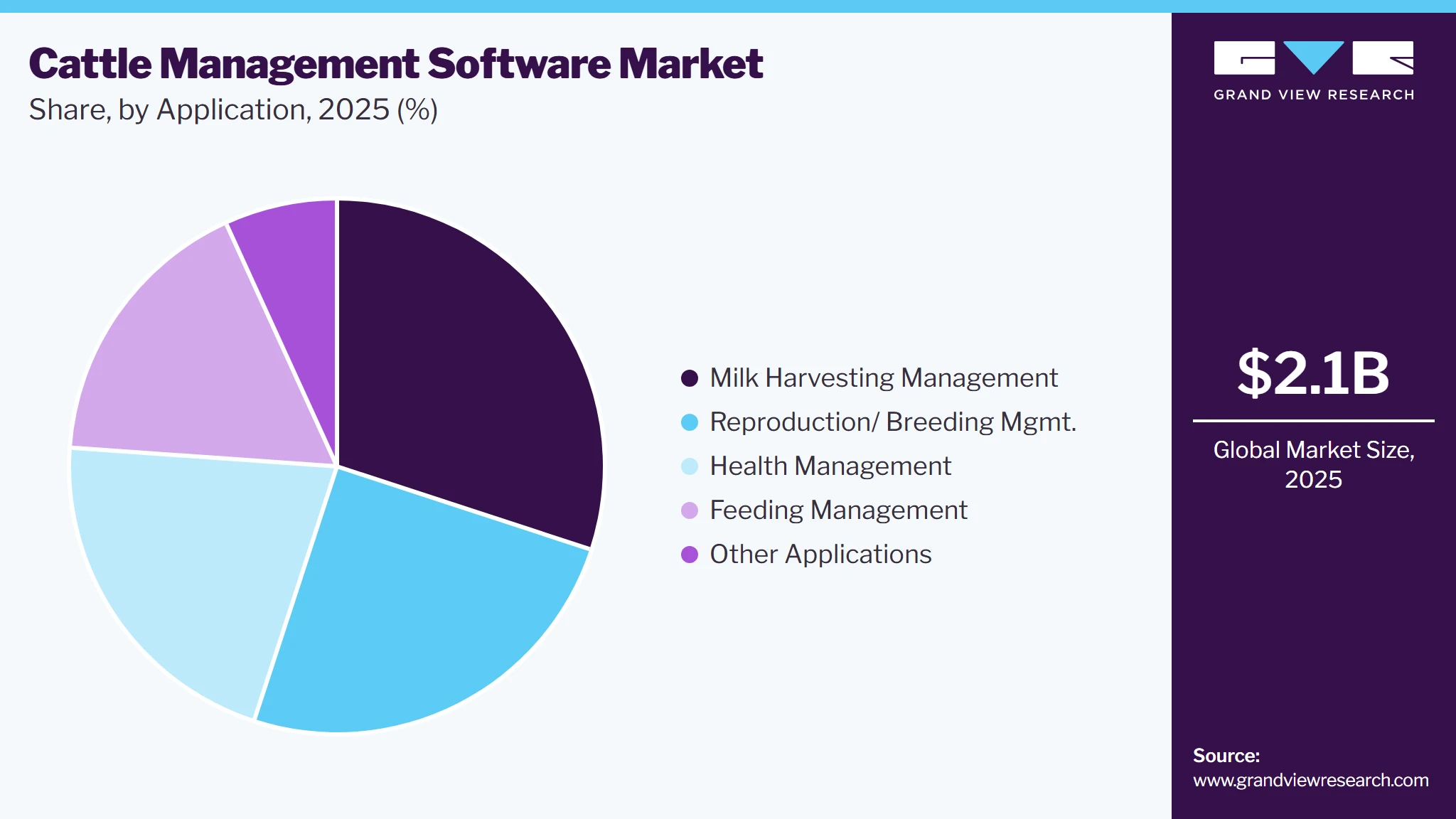
The health management segment is expected to grow at the fastest CAGR over the forecast period, owing to increasing focus on disease prevention, animal welfare, and productivity optimization. Livestock producers are adopting software solutions that enable continuous health monitoring, vaccination scheduling, treatment records, reproductive health tracking, and early disease detection through integration with wearable sensors and connected monitoring devices. The growing prevalence of infectious livestock diseases, expanding livestock traceability requirements, and increasing veterinary digitalization are accelerating adoption across commercial farms. Furthermore, predictive analytics and artificial intelligence are enabling earlier intervention, reducing treatment costs, and improving overall health management outcomes.
Regional Insights
North America Cattle Management Software Market Trends
North America cattle management software industry accounted for the largest market share of 33.5% in 2025, driven by the high concentration of commercial dairy and beef enterprises managing large cattle populations that require digital herd management solutions. The region has been an early adopter of precision livestock farming, enabling producers to consolidate herd records, reproductive planning, feed optimization, inventory management, and financial reporting within unified software platforms. In June 2026, the U.S. Department of Agriculture (USDA) continued implementation of its Animal Disease Traceability (ADT) program by providing electronic identification tags through State Veterinarian offices. This initiative is accelerating digital livestock identification and supporting broader adoption of software platforms for herd record management and regulatory compliance.
U.S. Cattle Management Software Market Trends
The cattle management software industry in the U.S. held the largest share in the North America region in 2025, driven by the presence of large commercial dairy and beef operations and widespread adoption of precision livestock farming technologies. Producers are increasingly implementing digital platforms to manage herd records, reproduction, feed planning, grazing activities, and operational performance across multiple production sites. For instance, in May 2026, URUS announced the acquisition of AgriWebb to strengthen its digital capabilities across beef production and supply chain management. The transaction expands integrated livestock management software offerings by combining grazing management, compliance, and herd data within a unified digital platform.
Canada cattle management software industry is expected to register the fastest CAGR over the forecast period, supported by increasing digitalization across commercial dairy and beef farms and rising adoption of data-driven livestock management practices. Producers are utilizing software platforms to maintain cattle management software records, monitor reproductive performance, manage grazing operations, and streamline regulatory documentation across geographically dispersed herds. For instance, in June 2026, the Canadian Food Inspection Agency (CFIA) announced a revised regulatory approach to the Livestock Traceability Regulations, confirming continued recognition of existing industry reporting systems while modernizing the national livestock traceability framework. The evolving regulatory environment is increasing the importance of digital record management across Canadian cattle operations.
Europe Cattle Management Software Market Trends
Europe cattle management software industry represents a mature market, supported by increasing adoption of precision livestock farming and the growing digital transformation of dairy and beef production systems. Livestock producers are investing in software platforms that integrate herd health monitoring, reproductive management, feeding optimization, traceability, and sustainability reporting to improve operational efficiency and regulatory compliance. The region is witnessing stronger demand for cloud-based farm management solutions capable of consolidating data from wearable sensors, automated milking systems, and livestock identification technologies. In September 2025, the European Commission published a study showing that 83% of surveyed farmers were already using at least one livestock-specific digital technology, highlighting the rapid digitalization of livestock management across the European Union.
Germany cattle management software industry accounted for a significant share in the European region, supported by its highly mechanized dairy industry and widespread adoption of precision livestock farming technologies. Commercial dairy producers increasingly utilize integrated software platforms to manage herd performance, reproductive cycles, feeding operations, and animal health within centralized digital systems. For instance, in July 2026, GEA introduced CowScout Cloud, enabling unlimited cloud-based storage and long-term analysis of individual cow data, including activity, rumination, feeding behavior, and health indicators, strengthening digital herd management capabilities across dairy farms.
Spain cattle management software industry is expected to register the fastest CAGR over the forecast period, driven by increasing digitalization across commercial dairy and beef farms and growing investments in precision livestock management. Producers are adopting software-enabled technologies to improve feed efficiency, animal health monitoring, and operational decision-making while addressing sustainability objectives. For instance, in March 2026, Eurofins Agro and trinamiX expanded their Mobile Forage Analysis solution to Spain, providing cattle producers with real-time forage quality analysis to support feed optimization and livestock management decisions across commercial farming operations.
Asia Pacific Cattle Management Software Market Trends
The Asia Pacific cattle management software industry is expected to register the fastest growth over the forecast period, driven by the rapid modernization of livestock production and increasing investments in precision agriculture across major cattle-producing economies. Commercial producers are implementing digital platforms to improve herd productivity, reproductive planning, feed management, and operational decision-making while addressing labor constraints and improving farm efficiency. The region is also witnessing greater integration of artificial intelligence, satellite connectivity, and remote monitoring technologies into livestock operations. For instance, in March 2026, Meat & Livestock Australia (MLA) announced the successful completion of an AgTech project demonstrating low-cost two-way satellite connectivity for whole-herd monitoring and on-farm IoT sensors, enabling reliable data transmission for remote livestock management. This development supports broader deployment of connected cattle management solutions across geographically dispersed farming operations.
China cattle management software industry accounted for the largest share of the Asia Pacific cattle management software market, supported by the rapid modernization of commercial livestock production and increasing deployment of intelligent farming technologies across large-scale dairy operations. Producers are integrating herd management software with automated feeding systems, wearable monitoring devices, and data analytics platforms to improve production efficiency and animal health management. Continuous investments in smart agriculture and digital livestock infrastructure continue to strengthen the adoption of integrated cattle management solutions.
India cattle management software industry is expected to register the fastest CAGR over the forecast period, driven by increasing digitalization of the dairy and livestock sectors and growing adoption of precision livestock management technologies. Commercial producers are implementing software platforms to improve herd health monitoring, reproductive management, feed planning, cattle management software, and operational decision-making. Rising investments in commercial dairy farming, expanding use of connected livestock devices, and increasing awareness of data-driven farm management are supporting software adoption across organized livestock enterprises. Growing participation of agritech companies and livestock technology providers is further contributing to market expansion.
Latin America Cattle Management Software Market Trends
The Latin America cattle management software industry is experiencing steady growth, supported by the modernization of commercial livestock production and the increasing adoption of digital technologies across dairy and beef operations. Producers are implementing software platforms to improve herd performance monitoring, reproductive management, grazing optimization, and livestock traceability while enhancing operational efficiency across large production systems. The region is also witnessing greater integration of electronic cattle management software, connected monitoring devices, and cloud-based farm management solutions. For instance, in April 2026, Argentina's National Institute of Agricultural Technology (INTA), Fundación Fortalecer, and IPCVA launched the Animal TECH initiative to accelerate the adoption of data-driven livestock management, sensors, and artificial intelligence across cattle production systems. This initiative highlights the increasing role of digital technologies in modernizing livestock management across the region.
Brazil cattle management software industry accounted for the largest share of the Latin America market, supported by its large commercial cattle population and the increasing digitalization of beef and dairy production systems. Livestock producers are adopting software platforms to manage herd records, reproductive performance, grazing activities, feed utilization, and production analytics across large-scale farming operations. Growing investments in precision livestock farming, connected animal monitoring technologies, and integrated farm management solutions continue to strengthen the adoption of cattle management software across commercial enterprises.
Argentina cattle management software industry is expected to grow significantly, supported by the ongoing digital transformation of its cattle industry and increasing implementation of electronic livestock identification systems. Producers are adopting software platforms to improve herd inventory management, animal movement records, breeding documentation, and production monitoring while meeting evolving traceability requirements. In January 2026, Argentina implemented mandatory electronic identification for calves under the National Electronic Animal Identification System, establishing a standardized digital framework for cattle identification and livestock record management across commercial production systems.
Middle East & Africa Cattle Management Software Market Trends
The Middle East & Africa cattle management software industry is witnessing gradual expansion as commercial livestock enterprises increasingly adopt digital solutions to improve herd productivity, breeding management, and operational efficiency. Growing investments in livestock modernization, coupled with rising awareness of data-driven farm management, are encouraging the deployment of software platforms capable of integrating animal records, production performance, feed planning, and resource management within centralized systems. Demand is particularly increasing among commercial dairy and beef producers seeking to improve production efficiency while addressing labor constraints and operational complexity. The expanding availability of cloud-based livestock management solutions and connected monitoring technologies is further supporting the transition toward digitally managed cattle operations across several countries in the region.
South Africacattle management software industry accounted for the significant share, supported by its established commercial beef and dairy industries and increasing adoption of technology-enabled livestock production systems. Commercial producers are utilizing software platforms to manage herd inventories, breeding records, grazing operations, production planning, and business performance across large farming enterprises. The country's organized livestock sector and continued focus on improving herd productivity provide a favorable environment for the adoption of integrated cattle management software.
Saudi Arabiacattle management software industry is anticipated to grow at a lucrative CAGR over the forecast period, driven by increasing investments in livestock modernization and agricultural digital transformation under national development initiatives. Commercial livestock enterprises are adopting digital management platforms to improve herd productivity, breeding management, operational planning, and resource utilization. Increasing emphasis on technology-enabled livestock production and expanding investments in smart agriculture are creating favorable conditions for the adoption of advanced cattle management software across commercial farming operations.
Key Cattle Management Software Company Insights
Companies operating in the global cattle management software industry are focusing on expanding cloud-based herd management platforms, artificial intelligence-enabled analytics, and IoT-integrated monitoring solutions to improve livestock productivity and operational efficiency. Market participants are strengthening platform interoperability, mobile accessibility, and data integration with automated farm equipment and animal monitoring devices while expanding subscription-based software offerings and decision-support capabilities for commercial dairy and beef producers.
Key Cattle Management Software Companies:
The following key companies have been profiled for this study on the cattle management software market:
-
Afimilk Ltd.
-
DeLaval
-
BouMatic
-
Merck & Co., Inc.
-
Zoetis (Performance Livestock Analytics)
-
Lely
-
GEA Group Aktiengesellschaft
-
Fullwood Packo
-
Fancom BV
-
PsiBorg Technologies Pvt. Ltd
-
Breedr
-
Cattlesoft Inc.
-
DigitalBeef, LLC
-
Prudence Technology Pvt. Ltd.
Competitive Benchmarking
Operating Strategies
Competitive Edge
Weaknesses
Mature Players: (Afimilk Ltd.; DeLaval; BouMatic; Merck & Co., Inc. (Performance Livestock Analytics); Zoetis (Performance Livestock Analytics); Lely; GEA Group Aktiengesellschaft; Fullwood Packo; Fancom BV)
- Established companies focus on expanding their cattle management software ecosystems through continuous product innovation, AI- and IoT-enabled herd monitoring, cloud-based farm management platforms, and integration with automated milking, feeding, and animal identification systems. They invest heavily in precision livestock technologies, analytics, and strategic partnerships with dairy farms, livestock producers, equipment manufacturers, and agricultural distributors. Geographic expansion, acquisitions, and continuous software upgrades help strengthen their digital agriculture portfolios and improve customer retention.
- These companies benefit from strong global brand recognition, extensive dealer and service networks, integrated hardware-software solutions, and significant R&D capabilities. Their ability to offer end-to-end herd management platforms-including animal health, reproduction, milk production, feeding, and traceability-creates high customer loyalty and recurring software subscription revenue. Strong technical support and established relationships with large commercial farms further reinforce their market leadership.
- Established players face high R&D and software development costs, continuous cybersecurity and data compliance requirements, and significant investments in cloud infrastructure and product maintenance. Their premium pricing and complex enterprise solutions may limit adoption among small and medium-sized farms. Longer product development cycles and integration with legacy farm systems can also slow innovation and deployment
Emerging Players: PsiBorg Technologies Pvt. Ltd.; Breedr; Cattlesoft Inc.; DigitalBeef, LLC; Prudence Technology Pvt. Ltd.)
- Emerging companies emphasize affordable, scalable, and user-friendly cattle management software tailored for small and medium-sized livestock producers. They focus on mobile applications, cloud-native platforms, AI-driven analytics, breeding and herd performance management, and simplified record-keeping. Growth strategies include subscription-based pricing, partnerships with local distributors and cooperatives, and rapid feature enhancements based on customer feedback to expand adoption in emerging markets.
- Emerging players compete through technological agility, faster software updates, flexible pricing models, and specialized solutions for breeding, herd records, grazing management, and livestock traceability. Their cloud-first architecture, ease of implementation, and customer-centric innovation enable quicker deployment and appeal to cost-conscious farmers seeking digital transformation..
- Emerging companies generally have limited financial resources, smaller customer bases, and lower brand recognition than multinational competitors. They may face challenges in scaling operations, expanding global distribution, integrating with diverse farm equipment, and providing extensive after-sales support. Limited international presence and fewer enterprise-level capabilities may also restrict adoption among large commercial livestock operations..
Recent Developments
-
In July 2026, GEA launched CowScout Cloud, a cloud-based digital herd management platform that provides unlimited lifetime animal data history, real-time behavioral monitoring, and cloud analytics. The solution integrates with DairyNet and other farm management systems to improve herd monitoring and operational decision-making across commercial dairy farms.
-
In February 2026, Ever.Ag launched Feedlot IQ at NCBA CattleCon 2026, introducing a connected intelligence platform that integrates feedlot operational data, analytics, and performance monitoring. The platform is designed to improve decision-making, operational visibility, and production efficiency across commercial feedlot enterprises.
Cattle Management Software Market Report Scope
Report Attribute
Details
Market size in 2025
USD 2.1 billion
Estimated market size in 2026
USD 2.3 billion
Projected market size by 2033
USD 5.0 billion
Growth rate
CAGR of 11.6% from 2026 to 2033
Actual Data
2021 - 2025
Forecast period
2026 - 2033
Quantitative units
Revenue in USD million/billion and CAGR from 2026 to 2033
Report coverage
Revenue forecast, company ranking, competitive landscape, growth factors, and trends
Segments covered
Sector, software, modality, application, region
Regional scope
North America; Europe; Asia Pacific; Latin America; MEA
Country scope
U.S.; Canada; Mexico; UK; Germany; France; Italy; Spain; Denmark; Sweden; Norway; Japan; China; India; Thailand; South Korea; Australia; Brazil; Argentina; South Africa; UAE; Saudi Arabia; Kuwait; Qatar; Oman
Key companies profiled
Afimilk Ltd.; DeLaval; BouMatic; Merck & Co., Inc.; Zoetis (Performance Livestock Analytics); Lely; GEA Group Aktiengesellschaft; Fullwood Packo; Fancom BV; PsiBorg Technologies Pvt. Ltd; Breedr; Cattlesoft Inc.; DigitalBeef, LLC; Prudence Technology Pvt. Ltd.
Customization scope
Free report customization (equivalent up to 8 analysts working days) with purchase. Addition or alteration to country, regional & segment scope.
Pricing and purchase options
Avail customized purchase options to meet your exact research needs. Explore purchase options
Global Cattle Management Software Market Report Segmentation
This report forecasts revenue growth at global, regional, and country levels and provides an analysis of the latest industry trends in each of the sub-segments from 2021 to 2033. For this study, Grand View Research has segmented the global cattle management software market report based on sector, software, modality, application and region.
-
Sector Outlook (Revenue, USD Million, 2021 - 2033)
-
Dairy
-
Meat
-
-
Software Outlook (Revenue, USD Million, 2021 - 2033)
-
Monitoring
-
Trading/ Marketing
-
Other Software
-
-
Modality Outlook (Revenue, USD Million, 2021 - 2033)
-
On-premise
-
Cloud
-
-
Application Outlook (Revenue, USD Million, 2021 - 2033)
-
Milking Harvesting Management
-
Breeding Management
-
Feeding Management
-
Health Monitoring
-
Other Applications
-
-
Regional Outlook (Revenue, USD Million, 2021 - 2033)
-
North America
-
U.S.
-
Canada
-
Mexico
-
-
Europe
-
UK
-
Germany
-
France
-
Italy
-
Spain
-
Denmark
-
Sweden
-
Norway
-
-
Asia Pacific
-
Japan
-
India
-
China
-
South Korea
-
Australia
-
Thailand
-
-
Latin America
-
Brazil
-
Argentina
-
-
Middle East and Africa (MEA)
-
South Africa
-
Saudi Arabia
-
UAE
-
Kuwait
-
Oman
-
Qatar
-
-
Research Methodology
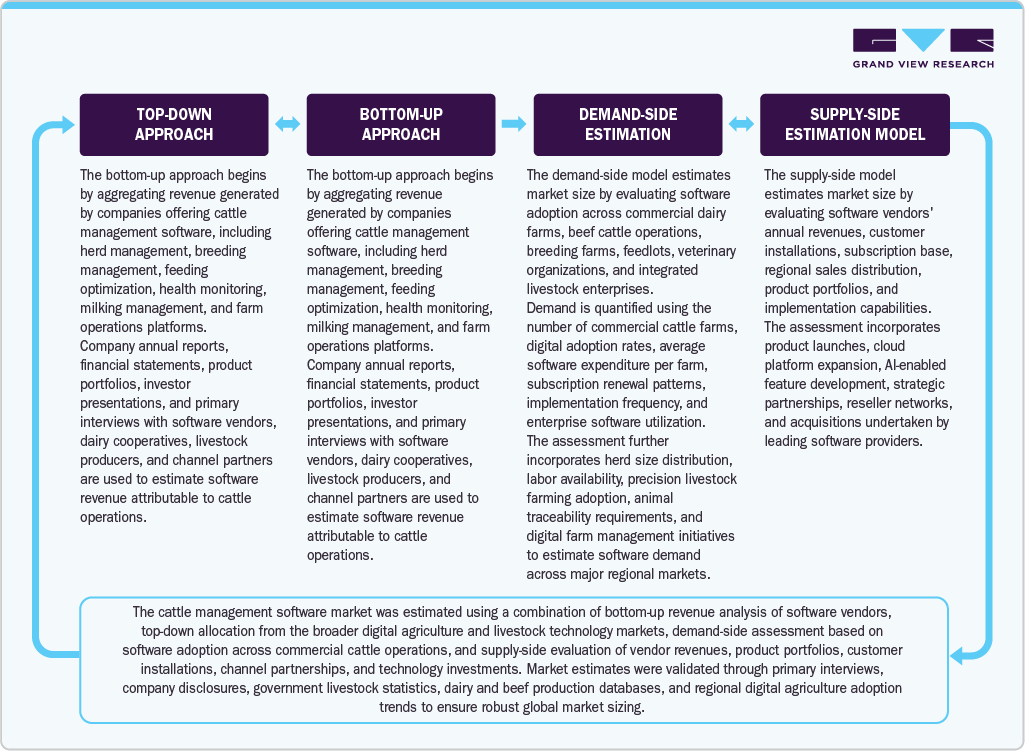
The cattle management software market figures in this report are based on a proven research process that combines executive interviews with secondary research from proprietary databases, company filings, and recognized regulatory and institutional sources. Market size is built through value-chain sizing-reconciling supply-side and demand-side estimates-and triangulated with bottom-up and top-down approaches. Every estimate passes multiple levels of expert validation before publication, with each cattle management software segment quantified using the revenue-capture definitions in the table below.
Segment Definition
Sector Segment
Revenue capture definition
Dairy
Revenue generated from cattle management software used by dairy farms to manage milk production, herd performance, breeding, feeding, animal health, and farm operations.
Meat
Revenue generated from cattle management software used by beef producers to manage herd growth, breeding, feeding, health, traceability, and production efficiency for meat cattle.
Software Segment
Revenue capture definition
Monitoring
Revenue generated from software solutions used to monitor cattle health, behavior, location, productivity, reproduction, and overall herd performance through data collection and analytics.
Trading/Marketing
Revenue generated from software solutions that facilitate cattle trading, livestock marketing, inventory management, sales tracking, and digital marketplace activities.
Other Software
Revenue generated from other cattle management software solutions, including farm record management, financial management, compliance and traceability, reporting, workforce management, and analytics platforms.
Modality Segment
Revenue capture definition
On-premise
Revenue generated from cattle management software installed and operated on local servers or computers within the farm or organization.
Cloud
Revenue generated from cloud-based cattle management software accessed via the internet, enabling remote data access, real-time monitoring, software updates, and scalable farm management.
Application Segment
Revenue capture definition
Milking Management
Revenue generated from software solutions used to monitor, automate, and optimize milking operations, milk yield recording, milk quality, and dairy herd performance.
Breeding Management
Revenue generated from software solutions used to manage breeding programs, heat detection, artificial insemination schedules, pregnancy tracking, calving records, and genetic improvement.
Feeding Management
Revenue generated from software solutions used to plan, monitor, and optimize feed formulation, feed intake, nutrition management, and feeding efficiency for cattle.
Health Monitoring
Revenue generated from software solutions used to monitor animal health, disease detection, treatment records, vaccination schedules, welfare, and veterinary interventions.
Other Applications
Revenue generated from cattle management software used for additional applications, including inventory management, financial management, pasture management, regulatory compliance, traceability, workforce management, and farm performance analytics.
Estimation Model
Delivered Customizations
This report has been delivered with the following In-depth customizations
Client Request
Customization Delivered
Value Adds
Livestock Digitalization Assessment & Farm Software Adoption Analysis
The study was customized to assess software adoption across dairy farms, beef cattle operations, breeding facilities, feedlots, and integrated livestock enterprises. The analysis evaluated adoption by farm size, digital maturity, deployment model, software functionality, and operational priorities across major cattle-producing regions.
Enabled identification of high-potential customer groups, prioritized commercial opportunities by farm profile, and supported targeted product positioning for software providers and technology vendors.
Precision Livestock Technology Benchmarking & Competitive Assessment
The report was expanded to benchmark herd management platforms, AI-enabled monitoring solutions, RFID and GPS tracking systems, automated feeding software, breeding management applications, and animal health monitoring platforms. The assessment compared technology capabilities, integration features, deployment models, and commercialization strategies across key market participants.
Enabled technology providers to benchmark competitive positioning, identify functionality gaps, prioritize product development, and strengthen commercialization strategies based on evolving customer requirements.
Regional Livestock Digital Infrastructure & Market Opportunity Mapping
The study was customized to evaluate cattle population, commercial dairy and beef farming intensity, digital agriculture initiatives, internet connectivity, precision farming adoption, regulatory landscape, and software penetration across North America, Europe, Asia Pacific, Latin America, and the Middle East & Africa. The analysis further identified regional technology readiness and investment opportunities.
Supported regional expansion planning, prioritized high-growth markets, identified underserved regions for software deployment, and assisted stakeholders in selecting target geographies for business expansion.
Farm Operations Workflow & Software Integration Assessment
The report was customized to evaluate integration of cattle management software with milking systems, feeding equipment, wearable sensors, veterinary information systems, financial management platforms, and enterprise farm management solutions. The assessment analyzed operational workflows, interoperability requirements, implementation challenges, and customer adoption preferences.
Enabled software developers to optimize integration strategies, improve platform interoperability, prioritize feature enhancements, and strengthen long-term customer retention through comprehensive digital farm management solution
Frequently Asked Questions About This Report
The global cattle management software market size was valued at USD 2.1 billion in 2025 and is estimated at USD 2.3 billion for 2026.
Some key players operating in the cattle management software market include Afimilk Ltd.; DeLaval; BouMatic; Merck & Co., Inc.; Zoetis (Performance Livestock Analytics); Lely; GEA Group Aktiengesellschaft; Fullwood Packo; Fancom BV; PsiBorg Technologies Pvt. Ltd; Breedr; Cattlesoft Inc.; DigitalBeef, LLC; Prudence Technology Pvt. Ltd.
The cloud segment accounted for the largest revenue share of 51.3% in 2025 and is expected to grow at the fastest rate over the forecast period.
North America accounted for the largest market share of 33.5% in 2025, driven by the high concentration of commercial dairy and beef enterprises managing large cattle populations that require digital herd management solutions.
The market is driven by a combination of factors such as increasing adoption of livestock identification and traceability systems, growing focus on animal health monitoring, rising commercial cattle farming operations, and expanding digitalization across livestock management.
Milk harvesting management segment held the largest share (over 30.0%) in 2025, while the health management segment is the fastest-growing application.
Asia Pacific is the fastest-growing region over the forecast period.
The monitoring software segment led with a 69.9% revenue share in 2025, while the other software segment is the fastest-growing.
The dairy segment led the market with the largest revenue share of 54.7% in 2025 and is expected to grow during the forecast period.
The global cattle management software market is expected to grow at a CAGR of 11.6% from 2026 to 2033, reaching USD 5.0 billion by 2033.
About the Author(s)
Animal Health Research Team
Healthcare · Animal HealthThis report was authored by the animal health research team at Grand View Research - comprising two research analysts, one senior research analyst, and one industry expert - with specialized expertise in the animal health segment of the healthcare industry. All findings are based on proprietary healthcare databases, executive interviews, and regulatory analysis, subject to internal peer review prior to publication.
Last Updated:
Speak to Analyst


Customize this report to your needs — add regions, segments, or data points, with 20% free customization.
Or view our licence options:


ISO 9001:2015 & 27001:2022 Certified
We are GDPR and CCPA compliant! Your transaction & personal information is safe and secure. For more details, please read our privacy policy.


