
- Home
- »
- Next Generation Technologies
- »
-
Causal AI Market Size And Share, Industry Report, 2033GVR Report cover

Causal AI Market (2025 - 2033) Size, Share & Trends Analysis Report By Deployment (Cloud, On-premises, Hybrid), By Technology (Causal Inference Engines, Structural Causal Models), By End Use, By Region, And Segment Forecasts
Market Size, 2024
$40.6BMarket Estimate, 2026
$53.2BMarket Forecast, 2033
$757.7BCAGR, 2025–2033
39.4%Causal AI Market Summary
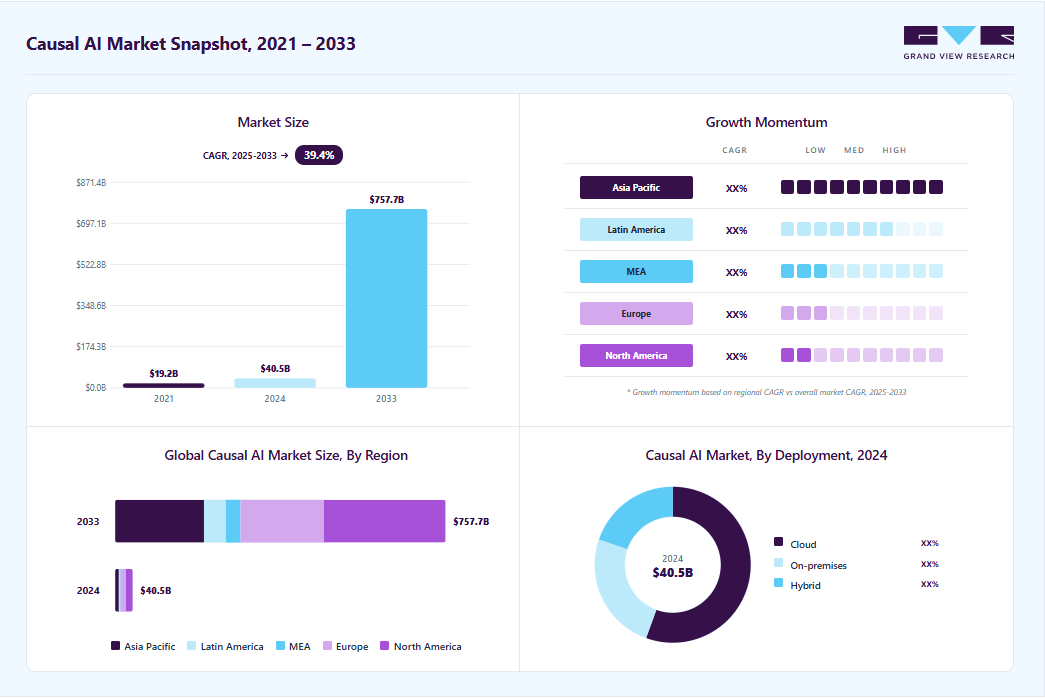
The global causal AI market size was estimated at USD 40.55 billion in 2024 and is projected to reach USD 757.74 billion by 2033, growing at a CAGR of 39.4% from 2025 to 2033. Causal AI is experiencing significant growth as organizations increasingly demand more explainable, reliable, and decision-centric artificial intelligence systems.
 Source: Grand View Research, IR Documents, Primary Interviews, Paid DatabasesTo learn more about this report,
 Download Free Sample Report
 Key Market Trends & Insights
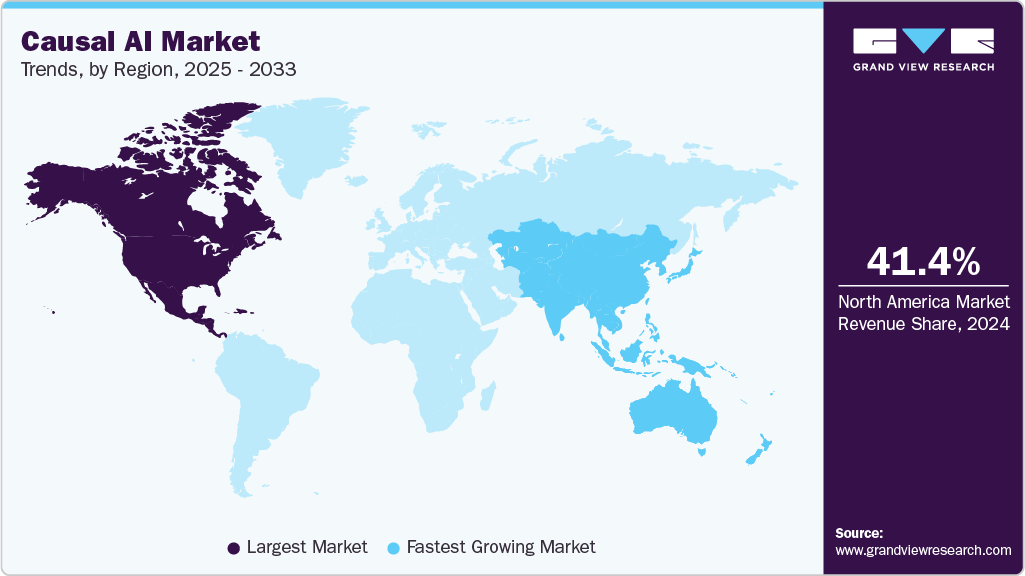
- North America dominated the global causal AI market with the largest revenue share of 41.4% in 2024.
- The causal AI market in the U.S. led the North America market and held the largest revenue share in 2024.
- By deployment, cloud led the market and held the largest revenue share of 55.6% in 2024.
- By end use, the healthcare & life sciences segment held the dominant position in the market and accounted for the leading revenue share of 37.3% in 2024.
- By end use, the financial services segment is expected to grow at the fastest CAGR of 41.4% from 2025 to 2033.
Market Size & Forecast
- 2024 Market Size: USD 40.55 Billion
- 2033 Projected Market Size: USD 757.74 Billion
- CAGR (2025-2033): 39.4%
- North America: Largest market in 2024
- Asia Pacific: Fastest growing market
Three ways to get this report
Buy it, customize it, or ask a question.Ask an Analyst
Analyst response in 1 business day
- AccessReport author, directly
- Reply timeWithin 1 working day
- No sales callDirect answer only
- FormatEmail reply
- CostFree, no cost
Get the Full Report
What the study covers
- FormatsPDF · Excel · Dashboard
- Timeline2025–2033 annual, 2024 base
- Coverage20+ countries, 5 regions
- Companies10+ key players profiled
Customize the Report
20% free customization
- IncludeCountries, segments, points
- TailorTo your product definition
- ExtendDeeper competitor detail
- OrA fully bespoke study
- Turnaround5–10 working days
Unlike traditional AI models that focus on correlations, Causal AI identifies cause-and-effect relationships, enabling deeper insights, better decision-making, and improved policy interventions. The paradigm shift is gaining momentum across sectors such as healthcare, finance, supply chain, and public policy, where understanding the impact of specific actions is critical. In healthcare, Causal AI supports precision medicine by determining the actual impact of treatments on patient outcomes. At the same time, in finance, it enhances risk modeling and regulatory compliance by identifying drivers behind market movements or credit risks. The growing emphasis on ethical AI, accountability, and compliance, especially under evolving regulatory frameworks like the EU AI Act, is also accelerating the demand for Causal AI due to its transparency and interpretability. Furthermore, integration with generative AI and large language models (LLMs) is creating new synergies, where causality improves the reasoning, planning, and simulation capabilities of generative agents.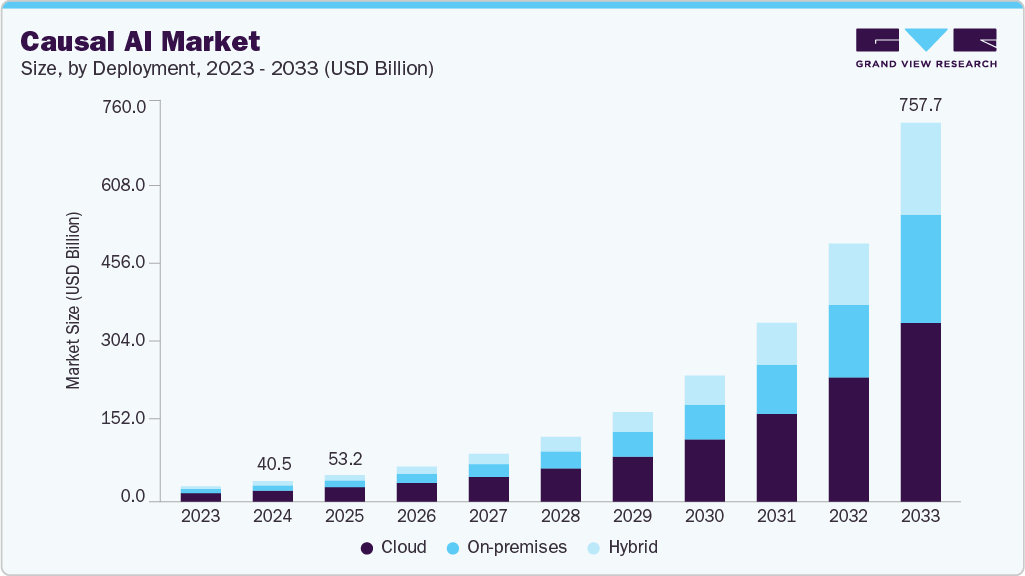 To learn more about this report, Download Free Sample Report
 Technological advancements, including the availability of causal inference libraries, open-source tools, and low-code/no-code platforms, are reducing the entry barrier for enterprises. Consequently, both startups and established tech companies are investing in causal AI platforms to set their solutions apart and provide powerful AI applications. The market remains in a nascent yet rapidly evolving phase, with early adopters experiencing measurable ROI through enhanced operational efficiency and improved decision accuracy. Overall, the growth of Causal AI is influenced by increasing complexity in data environments and a fundamental shift toward more intelligent, explainable systems.
Moreover, the rising need for explainable and trustworthy AI, growing regulatory pressures for transparency, and increasing demand for data-driven decision-making. Businesses seek more than just predictive outputs, as they want to understand the "why" behind outcomes. Additionally, advancements in machine learning algorithms, access to richer datasets, and integration with generative AI and LLMs are accelerating adoption across sectors like healthcare, finance, logistics, and policy planning.
Market Dynamics
The widespread adoption of artificial intelligence across highly regulated industries, including healthcare, banking, insurance, and manufacturing, is a significant driver of the Causal AI market's growth. Organizations now require AI models that not only generate predictions but also elucidate the underlying cause-and-effect relationships that influence business outcomes, operational risks, and customer behavior. In contrast to conventional black-box AI systems, Causal AI enhances transparency, accountability, and trust in automated decision-making processes. This capability is increasingly critical as regulatory bodies and enterprise stakeholders demand greater visibility into AI-driven recommendations and actions.
Furthermore, enterprises are enhancing strategic decision intelligence by leveraging causal inference models to simulate scenarios, predict intervention outcomes, and optimize operational performance. Organizations are increasingly employing Causal AI to identify the root causes of supply chain disruptions, fraud patterns, customer churn, and production inefficiencies in real time. The integration of explainable AI frameworks with machine learning and advanced analytics platforms is accelerating market adoption among global enterprises. As organizations continue to prioritize trustworthy, interpretable AI systems, the demand for Causal AI solutions is expected to grow substantially in the long term.
The expansion of the causal AI market is constrained by the limited availability of high-quality, structured, and contextually relevant datasets necessary for accurate causal inference modeling. Causal AI systems depend on comprehensive historical, behavioral, and contextual data to establish robust cause-and-effect relationships, which are often absent in many organizations. Inconsistent data governance, fragmented enterprise databases, and inadequate data labeling practices further diminish the effectiveness of causal models. Consequently, enterprises face challenges in achieving reliable outcomes and scaling the deployment of causal AI solutions.
Furthermore, the shortage of professionals with expertise in causal inference, probabilistic modeling, advanced statistics, and AI engineering remains a major challenge for market expansion. Implementing causal AI systems requires interdisciplinary knowledge spanning machine learning, econometrics, domain expertise, and data science, which are still limited across many industries. Small and medium-sized enterprises often struggle with the high implementation costs and technical complexity of developing customized causal models. These challenges are slowing widespread adoption, particularly in emerging economies and among organizations with limited digital transformation maturity.
The rapid advancement of autonomous decision-making systems and Generative AI technologies is generating substantial growth opportunities for the Causal AI market. Organizations are increasingly acknowledging the limitations of conventional predictive AI and Generative AI models, particularly their lack of contextual reasoning and causal inference. Causal AI can address these gaps by enabling systems to identify causal relationships, assess the effects of interventions, and provide more robust recommendations. This capability is essential for industries seeking to implement intelligent automation solutions that offer greater accuracy, accountability, and adaptability.
Furthermore, the increasing adoption of digital twins, intelligent process automation, and AI-driven enterprise simulation platforms is anticipated to accelerate demand for Causal AI technologies. Organizations are investing in advanced decision intelligence platforms that support scenario analysis, policy optimization, and real-time strategic forecasting through causal reasoning methods. The integration of Causal AI with cloud computing, edge AI, and large language models is creating additional commercial opportunities for technology providers and enterprises globally. As businesses transition toward autonomous and context-aware AI ecosystems, the market is projected to experience significant innovation-driven growth in the coming years.
Market Concentration & Characteristics
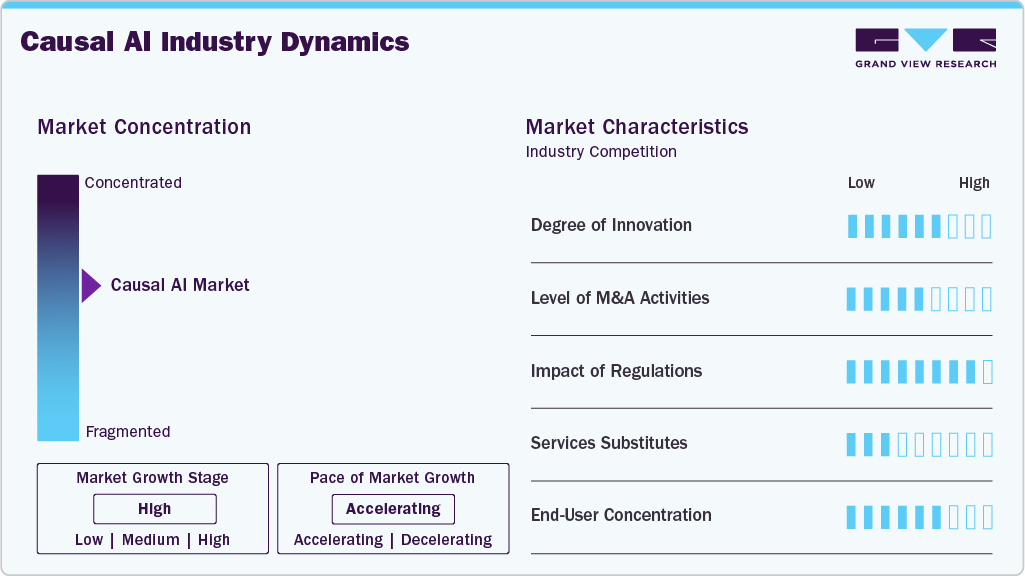
The Causal AI market demonstrates moderate concentration, underpinned by the expanding adoption of explainable AI, causal inference models, and decision intelligence platforms among enterprises. Growth in this market is primarily driven by rising demand for transparent, interpretable AI systems that can identify cause-and-effect relationships to enhance business decision-making. Established technology firms, cloud service providers, and specialized AI vendors are consolidating their positions through investments in advanced analytics, machine learning infrastructure, and enterprise AI integration. Concurrently, increased innovation in generative AI, autonomous decision systems, and industry-specific causal analytics solutions is facilitating the entry of emerging startups and intensifying competition within the market.
 To learn more about this report, Download Free Sample Report
 The market is experiencing robust growth momentum, driven by increased enterprise investments in AI governance, predictive analytics, and intelligent automation technologies across sectors such as healthcare, banking and financial services, retail, manufacturing, and telecommunications. Ongoing advancements in AI explainability, real-time simulation modeling, and causal reasoning frameworks are accelerating the development of next-generation enterprise intelligence solutions. Regulatory focus on responsible AI deployment, algorithm transparency, and ethical AI governance is further motivating organizations to adopt causal AI platforms for risk management and operational optimization. In addition, the rising demand for data-driven strategic planning, scenario analysis, and automated decision-support systems is generating long-term opportunities for technology providers and fostering continuous innovation in the global causal AI market.
Deployment Insights
The cloud segment led the causal AI industry and accounted for 55.6% of the global revenue share in 2024. Cloud adoption is significantly accelerating growth by offering scalable infrastructure, seamless data integration, and real-time model deployment. Cloud platforms enable organizations to run complex causal inference models without heavy on-premise investments, reducing entry barriers for both enterprises and startups. The flexibility of cloud environments supports rapid experimentation and continuous learning, essential for refining causal relationships. Moreover, integration with existing cloud-based AI/ML pipelines enhances operational efficiency and speeds up time-to-insight. Major providers like AWS, Azure, and Google Cloud are actively embedding causal AI capabilities into their services, further fueling mainstream adoption across industries such as healthcare, finance, and retail.
The hybrid segment is predicted to experience significant growth from 2025 to 2030. The growth is driven by the integration of traditional statistical methods with advanced machine learning models, enabling more interpretable and robust decision-making systems. This convergence allows enterprises to simulate interventions while leveraging real-time data patterns, offering both accuracy and explainability. Hybrid approaches are gaining traction in sectors like finance, healthcare, and supply chain, where causality and prediction must coexist. Cloud platforms and scalable infrastructure are further accelerating deployment by simplifying experimentation with hybrid models. As organizations demand AI that goes beyond correlation, hybrid Causal AI stands out for its ability to answer "what-if" scenarios with higher confidence.
Technology Insights
The causal inference engines segment accounted for the largest revenue share of the causal AI market in 2024. Causal inference engines are witnessing accelerated growth as organizations increasingly prioritize decision-making based on cause-and-effect relationships over mere correlations. These engines enable models to simulate interventions, predict counterfactuals, and uncover underlying causal drivers, making them critical in domains like healthcare, finance, and policy modeling. Their integration is expanding through cloud platforms and open-source frameworks, fostering accessibility and innovation. As AI systems mature, the demand for explainability and robust generalization further boosts causal inference adoption, positioning it as a foundational layer in next-generation AI architectures focused on trustworthy, outcome-driven intelligence.
The counterfactual simulation tools segment is predicted to foresee significant growth during the forecast period. Counterfactual simulation tools are gaining traction in the causal AI industry as they offer a powerful means to evaluate “what-if” scenarios, enabling organizations to assess the potential impact of decisions before implementation. These tools are particularly valuable in high-stakes sectors like healthcare, finance, and marketing, where understanding alternate outcomes can significantly optimize strategies. Growth is fueled by the rising need for transparent and ethical AI, with counterfactuals enhancing accountability and fairness. As causal modeling frameworks become more sophisticated and accessible, counterfactual tools are becoming integral to AI pipelines, driving deeper insights and more confident, data-backed decision-making across industries.
End Use Insights
The healthcare & life sciences segment accounted for the largest revenue share of the causal AI industry in 2024, due to its extensive use of AI for managing and optimizing network infrastructure and services. Causal AIs enhance the performance of data centers and cloud computing platforms, which are critical for telecommunications companies handling vast amounts of data. Moreover, telecom operators utilize AI for network management, predictive maintenance, and improving customer experience, all of which require high-performance computing power provided by Causal AIs. The rapid growth of cloud-based services and the increasing complexity of IT infrastructures further drive the demand for these specialized accelerators.
 To learn more about this report, Download Free Sample Report
 The financial services segment is projected to grow significantly over the forecast period. The urgent need for explainability, regulatory compliance, and accurate risk forecasting rapidly drives the growth. Banks and insurance firms are increasingly integrating causal models to go beyond correlations, enabling better decision-making in areas such as loan approvals, fraud prevention, and investment strategy. The adoption is being fueled by advancements in counterfactual reasoning and policy simulation, helping institutions assess outcomes before acting. Additionally, financial regulators are pushing for transparent AI models, making causal AI a strategic imperative. Fintechs are leading early experimentation, while traditional players are scaling pilot projects into core systems.
Regional Insights
The North American causal AI market is experiencing substantial growth, fueled by the capacity of causal AI to facilitate precise decision-making across sectors such as finance, healthcare, retail, and technology. Organizations are increasingly adopting causal inference models to move beyond correlation-based analytics, enabling deeper insights into cause-and-effect relationships. This shift supports more robust risk assessment, personalized treatments, and optimized business strategies. The region benefits from strong academic research, advanced AI infrastructure, and active investments from tech giants and startups alike. Moreover, regulatory frameworks in North America are gradually evolving to accommodate AI innovation, creating a supportive environment for the deployment of causal AI in mission-critical applications.
 To learn more about this report, Download Free Sample Report
 U.S. Causal AI Market Trends
The causal AI industry in the U.S. is expected to grow significantly over the forecast period.In the U.S., causal AI is gaining strong momentum as enterprises seek more explainable and actionable insights from their data. Driven by the country’s leadership in AI research, tech innovation, and venture funding, U.S. companies are rapidly integrating causal inference models to enhance decision-making in areas such as healthcare diagnostics, financial forecasting, marketing attribution, and policy evaluation. The demand for transparency and accountability in AI is pushing firms to favor causal models over black-box algorithms. Government agencies and research institutions are also promoting causal frameworks for evidence-based policymaking, further accelerating adoption. This positions the U.S. as a global frontrunner in Causal AI development.
Europe Causal AI Market Trends
The Europe causal AI industry is witnessing increasing growth, driven by a strong regulatory emphasis on transparency and ethical AI practices. The EU’s AI Act and related policies are encouraging the use of interpretable models, making causal inference highly attractive across sectors. Europe’s academic excellence, particularly in countries like the UK, Germany, and the Netherlands, supports innovation through advanced research and industry collaboration. Additionally, growing adoption in healthcare, public policy, and insurance reflects demand for evidence-based decision-making. Public and private investments, including EU-funded initiatives, are accelerating the development and deployment of causal AI solutions, making Europe a competitive hub for this technology.
Asia Pacific Causal AI Market Trends
The Asia Pacific causal AI industry is anticipated to register the fastest CAGR over the forecast period, fueled by expanding digital transformation across industries like finance, healthcare, manufacturing, and e-commerce. Rising AI awareness, increasing investments from governments and private sectors, and growing startup ecosystems are key drivers. Countries such as China, Japan, South Korea, and India are leading adoption by leveraging causal models to enhance decision-making, risk management, and personalized customer experiences. Additionally, the region’s focus on innovation and smart city initiatives supports the integration of Causal AI. However, challenges like talent scarcity and data privacy regulations remain factors to address for sustained growth.
Key Causal AI Company Insights
Prominent firms have used product launches and developments, followed by expansions, mergers and acquisitions, contracts, agreements, partnerships, and collaborations as their primary business strategy to increase their market share. The companies have used various techniques to enhance market penetration and boost their position in the competitive industry.
-
IBM is a global technology provider with a mission to improve the world through innovation, ethics, and responsible technology, operating in over 170 countries with extensive research facilities worldwide. The company specializes in modernizing businesses by integrating AI and hybrid cloud solutions to enhance productivity, reduce costs, and improve outcomes across industries. IBM has a century-long legacy of pioneering advances in computing and AI, focusing on delivering tailored products and expert services to future-proof businesses. In the causal AI market, IBM stands out as a top player, offering advanced causal inference tools and frameworks that enable organizations to understand cause-and-effect relationships rather than mere correlations.
-
Microsoft is a global technology leader focused on empowering individuals and organizations through innovative software, devices, and cloud services. It offers a broad portfolio including Microsoft 365, Windows 11, Surface devices, and Xbox, with AI-powered tools like Microsoft Copilot integrated across its ecosystem to boost productivity and decision-making. In the causal AI market, Microsoft is a pioneer with a comprehensive suite of open-source tools and libraries such as DoWhy, EconML, and Azua, designed to simplify causal inference and enable robust decision-making by uncovering cause-and-effect relationships from data. These tools support scalable, end-to-end causal discovery and inference, helping users make optimal decisions through interpretable models that improve reliability and reduce bias.
Key Causal AI Companies:
The following are the leading companies in the causal AI market. These companies collectively hold the largest market share and dictate industry trends.
- IBM
- CausaLens
- Microsoft
- Dynatrace
- Causality Link
- Cognizant
- Logility
- DataRobot
- Aitia
- Causaly
Competitive Benchmarking
Operating Strategies
Competitive Edge
Weaknesses
Mature Players: IBM; Microsoft; Google; Cognizant; DataRobot.
- Focus on expanding enterprise-grade causal AI platforms integrated with cloud computing, generative AI, explainable AI, predictive analytics, and intelligent business automation solutions across industries.
- Invest in AI governance frameworks, causal inference engines, digital twin technologies, and real-time decision intelligence platforms to support enterprise-scale automation and strategic forecasting applications.
- Strong global enterprise presence, advanced AI research capabilities, and robust cloud ecosystems strengthen competitive positioning in the Causal AI market.
- Extensive R&D investments, strong data processing infrastructure, and established customer relationships enable accelerated commercialization of advanced causal AI technologies.
- High implementation complexity, significant infrastructure investment requirements, and integration challenges with legacy enterprise systems may limit deployment flexibility.
- Concerns regarding data privacy, algorithm transparency, and regulatory compliance may create operational and reputational risks in highly regulated industries.
Emerging Players: CausaLens; Dynatrace; Causality Link; Aitia; Causaly
- Focus on specialized causal inference platforms, explainable AI models, autonomous decision intelligence systems, and domain-specific causal analytics applications for healthcare, life sciences, and enterprise operations.
- Expand partnerships with research institutions, healthcare organizations, and enterprise software vendors to strengthen AI model validation and accelerate commercialization opportunities.
- Strong specialization in causal reasoning algorithms, AI explainability, and scenario simulation technologies supports differentiated positioning in high-growth causal AI segments.
- Agile development frameworks and faster deployment capabilities enable accelerated innovation in next-generation causal AI and decision intelligence solutions.
- Limited global expansion capabilities and comparatively lower financial resources may restrict large-scale enterprise adoption and international market penetration.
- Lower brand recognition and smaller enterprise partnership ecosystems compared to major technology providers may impact customer acquisition and scalability.
Recent Developments
-
In April 2024, IBM introduces the new Probable Root Cause feature in Instana’s Intelligent Incident Remediation, leveraging Causal AI to rapidly identify the source of application failures. This innovation helps site reliability engineers (SREs) pinpoint issues directly, significantly reducing incident resolution time and associated business costs. By analyzing comprehensive call traces, metrics, events, and topology data, the feature provides precise root cause insights even with partial data. Currently in tech preview, this advancement marks a major step toward accelerating IT operations and minimizing downtime expenses.
-
In August 2024, Microsoft researchers proposed a groundbreaking vision for AI-based copilots designed to generate high-quality causal evidence in healthcare. By integrating a “human-in-the-loop” approach, these AI copilots would guide researchers through every step of causal analysis-from formulating research questions to designing robust statistical plans and interpreting results. Leveraging formal causal frameworks, the system aims to accelerate and enhance the accuracy, transparency, and reliability of real-world data analyses. This innovation has the potential to transform healthcare research and enable more personalized, evidence-driven decision-making at the point of care.
Causal AI Market Report Scope
Report Attribute
Details
Market size value in 2025
USD 53.24 billion
Revenue forecast in 2033
USD 757.74 billion
Growth rate
CAGR of 39.4% from 2025 to 2033
Base year for estimation
2024
Historical data
2021 - 2023
Forecast period
2025 - 2033
Quantitative units
Revenue in USD million/billion and CAGR from 2025 to 2033
Report coverage
Revenue forecast, company ranking, competitive landscape, growth factors, and trends
Segments covered
Deployment, technology, end use, region
Regional scope
North America; Europe; Asia Pacific; Latin America; MEA
Country scope
U.S.; Canada; Mexico; UK; Germany; France; China; Japan; India; South Korea; Australia; Brazil; KSA; UAE; South Africa
Key companies profiled
IBM; CausaLens; Microsoft; Dynatrace; Causality Link; Cognizant; Logility; DataRobot; Google; Aitia; Causaly
Customization scope
Free report customization (equivalent up to 8 analysts working days) with purchase. Addition or alteration to country, regional & segment scope.
Pricing and purchase options
Avail customized purchase options to meet your exact research needs. Explore purchase options
Global Causal AI Market Report Segmentation
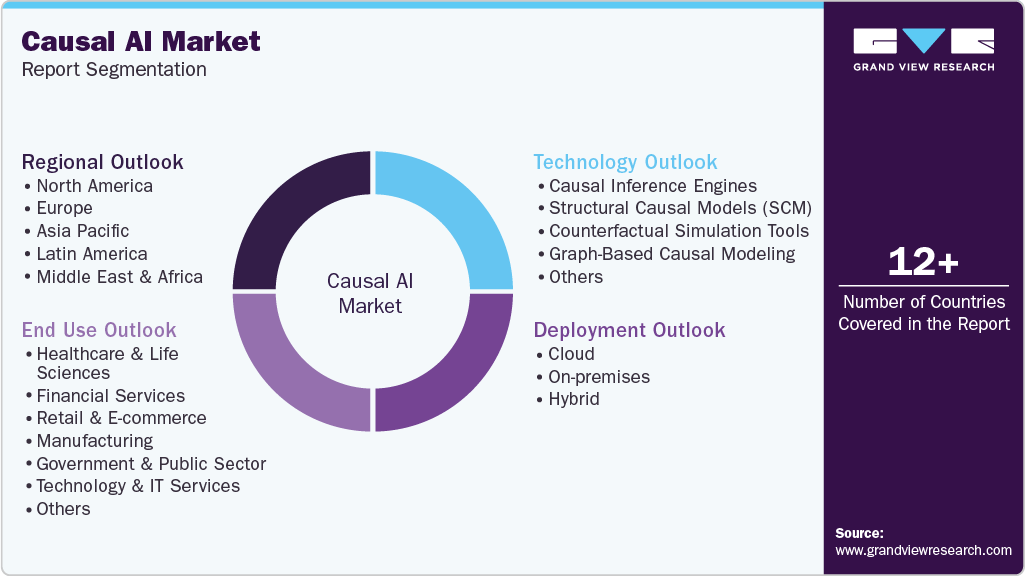
This report forecasts revenue growth at the global, regional, and country levels and provides an analysis of the latest industry trends in each of the sub-segments from 2021 to 2033. For this study, Grand View Research has segmented the global causal AI market report based on deployment, technology, end use, and region:
 To learn more about this report, Download Free Sample Report
 -
Deployment Outlook (Revenue, USD Million, 2021 - 2033)
-
Cloud
-
On-premises
-
Hybrid
-
-
Technology Outlook (Revenue, USD Million, 2021 - 2033)
-
Causal Inference Engines
-
Structural Causal Models (SCM)
-
Counterfactual Simulation Tools
-
Graph-Based Causal Modeling
-
Others
-
-
End Use Outlook (Revenue, USD Million, 2021 - 2033)
-
Healthcare & Life Sciences
-
Financial Services
-
Retail & E-commerce
-
Manufacturing
-
Government & Public Sector
-
Technology & IT Services
-
Others
-
-
Regional Outlook (Revenue, USD Million, 2021 - 2033)
-
North America
-
U.S.
-
Canada
-
Mexico
-
-
Europe
-
UK
-
Germany
-
France
-
-
Asia Pacific
-
China
-
Japan
-
India
-
South Korea
-
Australia
-
-
Latin America
-
Brazil
-
-
Middle East and Africa (MEA)
-
KSA
-
UAE
-
South Africa
-
-
Delivered Customizations
This report has been delivered with the following In-depth customizations
Client Request
Custom Research Modules Delivered
Strategic Value / Business Impact
Causal AI Market Expansion & Enterprise Adoption Strategy
- Enterprise adoption analysis of causal AI solutions across healthcare, BFSI, retail, manufacturing, and telecommunications sectors.
- Benchmark assessment of causal inference platforms, explainable AI frameworks, autonomous decision intelligence systems, and predictive analytics technologies.
- Regional opportunity mapping for AI governance adoption, cloud-based causal AI deployment, and intelligent automation investments.
- Evaluation of AI transparency regulations, ethical AI frameworks, and enterprise data governance requirements.
- Identified high-growth opportunities in explainable AI, decision intelligence, and enterprise causal analytics solutions.
- Supported strategic expansion into AI governance, predictive decision-making, and intelligent automation markets.
- Improved enterprise AI investment planning and deployment optimization strategies.
- Strengthened competitive positioning in next-generation causal reasoning and autonomous AI ecosystems.
Causal AI Technology Benchmarking & Competitive Intelligence
- Causal reasoning engine analysis and intelligent decision automation technology assessment.
- Product benchmarking and feature comparison of causal inference platforms, explainable AI tools, and AI-driven scenario simulation systems.
- Pricing analysis, enterprise AI adoption trends, and cloud-native causal AI deployment assessment.
- Competitor strategy evaluation, strategic AI partnerships, and innovation analysis in explainable and trustworthy AI technologies.
- Enabled differentiation through advanced causal inference capabilities and enterprise AI explainability solutions.
- Supported pricing optimization and AI-driven decision intelligence strategy development.
- Identified emerging opportunities in causal discovery platforms, AI governance technologies, and strategic technology collaborations.
- Enhanced long-term commercialization planning and innovation strategies within the market.
Frequently Asked Questions About This Report
The global causal AI market size was estimated at USD 40.55 billion in 2024 and is expected to reach USD 53.24 billion in 2025.
The global causal AI market is expected to grow at a compound annual growth rate of 39.4% from 2025 to 2033 to reach USD 757.74 billion by 2033.
North America dominated the global causal AI market with a share of 41.4% in 2024. This is attributable to the region's leadership in AI research, tech innovation, and venture funding. U.S. companies are rapidly integrating causal inference models to enhance decision-making in areas such as healthcare diagnostics, financial forecasting, marketing attribution, and policy evaluation.
Some key players operating in the causal AI market include IBM, CausaLens, Microsoft, Dynatrace, Causality Link, Cognizant, Logility, DataRobot, Google, Aitia, Causaly, Data Poem, Lifesight, Parabole.AI, Scalnyx, Xilinx Inc.
Key factors that are driving the market growth include increasing demand for more explainable, reliable, and decision-centric artificial intelligence systems, integration with generative AI and large language models (LLMs), and technological advancements, including the availability of causal inference libraries, open-source tools, and low-code/no-code platforms
About the Author(s)
Next Generation Technologies Research Team
Technology · Next Generation TechnologiesThis report was authored by the next generation technologies research team at Grand View Research - comprising two research analysts, one senior research analyst, and one industry expert - with specialized expertise in the next generation technologies segment of the technology industry. All findings are based on proprietary technology databases, executive interviews, and regulatory analysis, subject to internal peer review prior to publication.
Last Updated:
Speak to Analyst

Customize this report to your needs - add regions, segments, or data points, with 20% free customization.
Or view our licence options:


ISO 9001:2015 & 27001:2022 Certified
We are GDPR and CCPA compliant! Your transaction & personal information is safe and secure. For more details, please read our privacy policy.


