
- Home
- »
- Pharmaceuticals
- »
-
Cellular Immunotherapy Market Size & Share Report, 2030GVR Report cover
![Cellular Immunotherapy Market Size, Share & Trends Report]()
Cellular Immunotherapy Market (2022 - 2030) Size, Share & Trends Analysis Report By Therapy Type (CAR T Cell Therapy, Dendritic Cell Therapy), By Indication (B-cell Malignancies, Prostate Cancer), By End-use, By Region, And Segment Forecasts
Report Overview
The global cellular immunotherapy market size was valued at USD 6.13 billion in 2021 and is projected to expand at a compound annual growth rate (CAGR) of 22.41% from 2022 to 2030. Some of the major factors propelling the market growth are the development of advanced cell-based therapies, the rising prevalence of cancer, and increasing R&D investment by key companies. Moreover, the increasing number of product approvals and growing adoption of these therapies for the treatment of cancer is boosting the market growth.
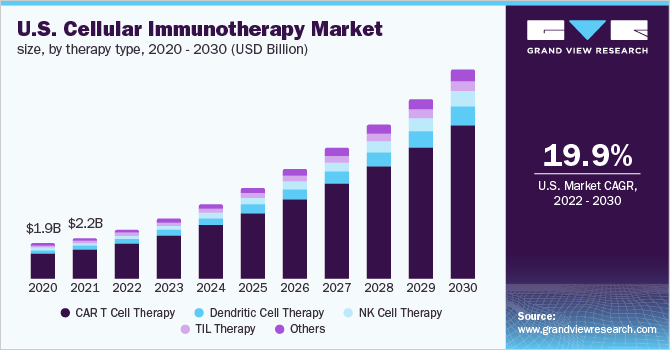
A robust product pipeline is expected to propel the market growth. According to the Cancer Research Institute (CRI) 2020 report, around 1,483 immunotherapy agents are there in clinical trials, with a rise of about 472 new clinical trial candidates than the previous year. In addition, according to the NCBI research studies, most therapies in the developmental phase are autologous (person’s cells). However, there has been a significant rise in allogeneic (off-the-shelf) therapies in recent years.
The rising prevalence of cancer is another impact rendering factor for the growth. According to Globocan estimates, in 2020, an estimated 19.2 million new cancer cases were reported worldwide and this number is projected to reach 24.5 million by 2030. In 2020, cancer accounted for an estimated 10 million deaths. According to Cancer Research U.K., more than 375,000 new cancer cases are reported each year in the U.K. Also, based on WHO estimates, two-thirds of the population aging 60 years & above live in developing countries. Aging is the most common factor that increases the risk of cancer. Therefore, the rising geriatric population is expected to increase the prevalence during the forecast period, which will drive the demand for cellular immunotherapies.
However, the high cost of cellular immunotherapy product manufacturing is expected to restrain the growth. Cellular immunotherapy involves modified immune cells that make them more sensitive to differentiate between healthy and cancer tissues. The manufacturing process is complicated and expensive. The need for high capital investment, a highly aseptic environment, and the presence of significant operational difficulties are some of the factors that raise the cost of cellular immunotherapy manufacturing, thereby increasing the overall cost of the therapy.
The market was highly impacted by the COVID-19 pandemic. Amid the pandemic, a slowdown and disruption in the supply of these therapies had been observed. In addition, clinical trials and regulatory operations such as the product approvals and Health Technology Assessment process had slowed down. However, the impact of the pandemic reduced substantially by the end of 2021 in most countries.
Therapy Type Insights
CAR T cell therapy held the largest market share of the market and is expected to expand at the fastest rate during the forecast period. This can be attributed to a lucrative product pipeline and new product approvals. Owing to its promising therapeutic results, market players are extensively invested in the R&D of new CAR T cell therapy. Currently, there are more than 500 trials underway for CAR T cell therapy. New product approvals and subsequent launches of products are expected to accelerate the market growth during the forthcoming years. For instance, in February 2022, Janssen Global Services, LLC’s CARVYKTI (ciltacabtagene autoleucel) received FDA approval. It is indicated for the treatment of multiple myeloma.
However, high cost of therapy and improper reimbursement scenario, especially in lower-income and middle-income countries, are anticipated to impede the growth. For instance, the one-time infusion cost for Cilta-cel is around 465,000 USD.
Indication Insights
The B-cell malignancy segment accounted for the highest revenue share in 2021 and is expected to advance at the fastest rate throughout the forecast period, which can be attributed to high cellular immunotherapy product penetration for the treatment of B-cell malignancy. Availability of products such as BREYANZI and Yescarta for treating B-cell malignancy are among the primary factors contributing to its high market growth. BREYANZI received FDA approval in February 2021; in its first financial year, it generated a revenue of approximately USD 87 million.
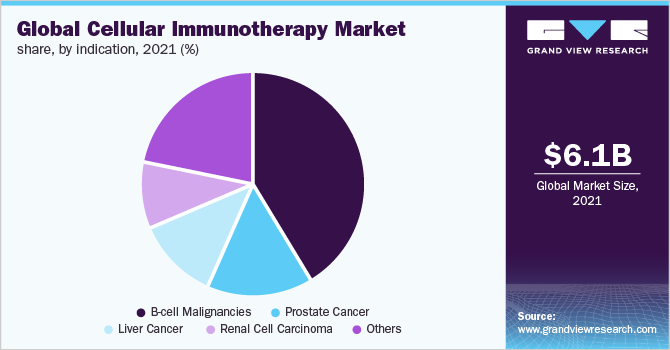
Prostate cancer is expected to hold a significant market share of cellular immunotherapy in 2021. It is the second most commonly occurring cancer in the world after lung cancer. According to WHO, in 2020, it was estimated that 1.4 million people were diagnosed with prostate cancer globally, and this number is expected to grow in the coming decades. In addition, the availability of advanced products such as Sipuleucel-T is another factor that supports the segment growth.
End-use Insights
Hospitals dominated the end-use segment in the global market in 2021. The rising prevalence of cancer has increased the total number of hospitalizations worldwide, leading to a rise in patients in hospital settings. Moreover, infusion of cellular immunotherapy requires skilled healthcare practitioners; such requirements are more compatible with hospital settings, which further increases patient compliance.
Cancer institutes segment is expected to progress at the fastest CAGR during the forecast period. Better availability of products and ease of reimbursement are the major factors propelling the growth of this segment. Cancer institutes offer advanced treatment and care to a high number of patients as well as enable quick reimbursement, resulting in a rising number of patients opting for cancer institute settings.
Regional Insights
North America dominated the market in terms of revenue in 2021, owing to its well-established healthcare infrastructure, availability of advanced therapies, high disposable income, and high per capita healthcare expenditure. The presence of a robust research infrastructure, coupled with a large number of clinical studies being conducted by cell therapy manufacturers in the U.S., has majorly contributed to the dominance of the market in the region.
The Asia Pacific region is expected to exhibit the highest growth rate due to untapped opportunities in the region and growing awareness about cellular immunotherapy, coupled with the rapidly developing healthcare infrastructure. In the Asia Pacific, China is advancing at the fastest CAGR owing to the high number of clinical trials relating to these therapies. Also, growing government investment and favorable regulations in China have resulted in a lucrative growth rate in the region.
Key Companies & Market Share Insights
Companies operating in the market are strategically active in initiatives such as mergers & acquisitions and product launches to gain a high market share. For instance, in April 2020, Adicet Bio, Inc. merged with resTORbio, Inc. Both companies are actively engaged in cellular immunotherapy R&D. This initiative is anticipated to help both companies with the development of novel allogeneic gamma-delta CAR-T cell therapy technology. Also, in July 2021, Kite, a Gilead Sciences Company, signed an agreement with BioNTech SE for the acquisition of Kite’s solid tumor neoantigen TCR R&D platform and clinical manufacturing facility in Gaithersburg, Maryland. Some of the key players in the global cellular immunotherapy market include:
-
Bristol-Myers Squibb Company
-
Novartis AG
-
Gilead Sciences Inc. (Kite Pharma)
-
F. Hoffmann-La Roche Ltd
-
Merck KGaA
-
GlaxoSmithKline plc.
-
AstraZeneca
-
Pfizer Inc.
-
Johnson & Johnson
-
Celyad
-
Adicet Bio, Inc.
-
Dendreon Pharmaceuticals LLC
Cellular Immunotherapy Market Report Scope
Report Attribute
Details
Market size value in 2022
USD 7.5 billion
Revenue forecast in 2030
USD 37.97 billion
Growth Rate
CAGR of 22.41% from 2022 to 2030
Base year for estimation
2021
Historical data
2018 - 2020
Forecast period
2022 - 2030
Quantitative units
Revenue in USD million and CAGR from 2021 to 2030
Report coverage
Revenue forecast, company ranking, competitive landscape, growth factors, and trends
Segments covered
Therapy type, indication, end-use, region
Regional scope
North America; Europe; Asia Pacific; Latin America; MEA
Country scope
U.S.; Canada; Germany; U.K.; France; Italy; Spain; Russia, China; Japan; India; Australia; South Korea; Brazil; Mexico; Argentina; South Africa; Saudi Arabia; UAE
Key companies profiled
Bristol-Myers Squibb Company; Novartis AG; Gilead Sciences Inc. (Kite Pharma); F. Hoffmann-La Roche Ltd; Merck KGaA; GlaxoSmithKline plc.; AstraZeneca; Pfizer Inc.; Johnson & Johnson; Celyad, Adicet Bio, Inc.; Dendreon Pharmaceuticals LLC
Customization scope
Free report customization (equivalent up to 8 analysts working days) with purchase. Addition or alteration to country, regional & segment scope.
Pricing and purchase options
Avail customized purchase options to meet your exact research needs. Explore purchase options
Segments Covered in the Report
This report forecasts revenue growth at global, regional, and country levels and provides an analysis of the latest industry trends in each of the sub-segments from 2018 to 2030. For this study, Grand View Research has segmented the global cellular immunotherapy market report based on therapy type, indication, end-use, and region:
-
Therapy Type Outlook (Revenue, USD Million, 2018 - 2030)
-
CAR T Cell Therapy
-
Dendritic Cell Therapy
-
NK Cell Therapy
-
TIL Therapy
-
Others
-
-
Indication Outlook (Revenue, USD Million, 2018 - 2030)
-
B-cell Malignancies
-
Prostate Cancer
-
Liver Cancer
-
Renal Cell Carcinoma
-
Others
-
-
End-use Outlook (Revenue, USD Million, 2018 - 2030)
-
Hospitals
-
Cancer Institutes
-
Others
-
-
Regional Outlook (Revenue, USD Million, 2018 - 2030)
-
North America
-
U.S.
-
Canada
-
-
Europe
-
Germany
-
U.K.
-
France
-
Italy
-
Spain
-
Russia
-
-
Asia Pacific
-
Japan
-
China
-
India
-
Australia
-
South Korea
-
-
Latin America
-
Brazil
-
Mexico
-
Argentina
-
-
Middle East and Africa (MEA)
-
South Africa
-
Saudi Arabia
-
UAE
-
-
Frequently Asked Questions About This Report
The global cellular immunotherapy market size was estimated at USD 6.13 billion in 2021 and is expected to reach USD 7.5 billion in 2022.
The global cellular immunotherapy market is expected to witness a compound annual growth rate of 22.41% from 2022 to 2030 to reach USD 37.97 billion in 2030.
Based on therapy type, CAR T cell therapy segment held the largest share of 71.40% in 2021, owing to its lucrative product pipeline and new product approvals.
Some key players operating in the cellular immunotherapy market include Bristol-Myers Squibb Company; Novartis AG; Gilead Sciences Inc. (Kite Pharma); F. Hoffmann-La Roche Ltd; Merck KGaA; GlaxoSmithKline plc.; AstraZeneca; Pfizer Inc.; Johnson & Johnson; Celyad, Adicet Bio, Inc.; and Dendreon Pharmaceuticals LLC amongst others.
Key factors driving the cellular immunotherapy market growth are the development of advanced cell-based therapies, rising prevalence of cancer, and increasing R&D investment by key companies.
About the Author(s)
Pharmaceuticals Research Team
Healthcare · PharmaceuticalsThis report was authored by the pharmaceuticals research team at Grand View Research - comprising two research analysts, one senior research analyst, and one industry expert - with specialized expertise in the pharmaceuticals segment of the healthcare industry. All findings are based on proprietary healthcare databases, executive interviews, and regulatory analysis, subject to internal peer review prior to publication.
Last Updated:
Speak to Analyst -


Customize this report to your needs - add regions, segments, or data points, with 20% free customization.
Or view our licence options:


ISO 9001:2015 & 27001:2022 Certified
We are GDPR and CCPA compliant! Your transaction & personal information is safe and secure. For more details, please read our privacy policy.


