
- Home
- »
- Consumer F&B
- »
-
Champagne Market Size, Share & Trends Report, 2026-2033GVR Report cover

Champagne Market (2026 - 2033)
Size, Share & Trends Analysis Report By Type (Prestige Cuvée, Blanc De Noirs, Blanc De Blancs, Rosé Champagne), By Distribution Channel, By Region, And Segment Forecasts
Market Size, 2025
$7.9BMarket Estimate, 2026
$8.2BMarket Forecast, 2033
$11.8BCAGR, 2026–2033
5.3%Champagne Market Summary
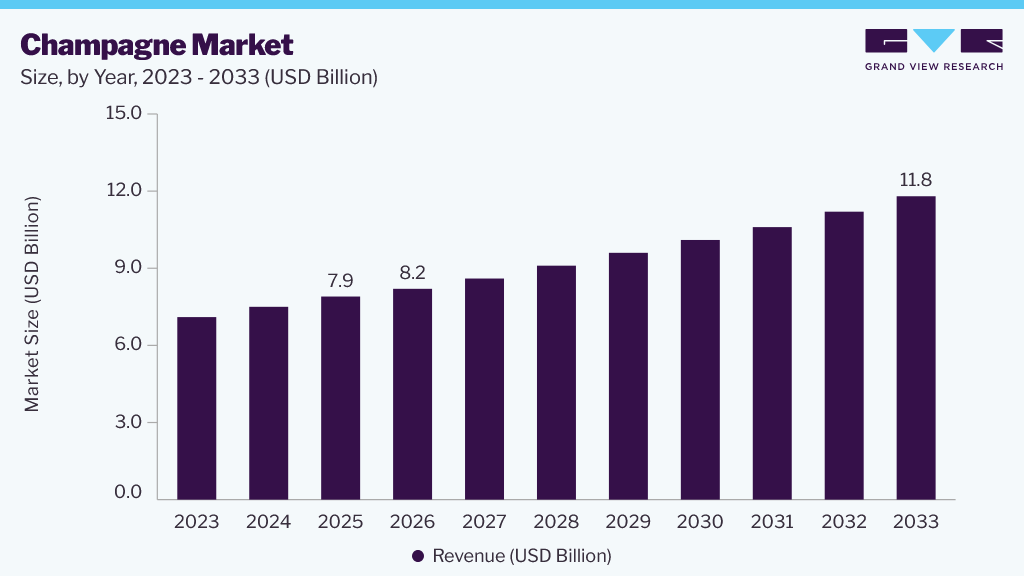
The global champagne market size was valued at USD 7.9 billion in 2025 and is projected to grow from USD 8.2 billion in 2026 to USD 11.8 billion in 2033, at a CAGR of 5.3% from 2026 to 2033. Europe dominated the market, accounting for a revenue share of 64.5% in 2025. The market growth is primarily driven by champagne's strong association with celebrations, luxury, and special occasions. Increasing consumer preference for commemorating significant life events with premium celebratory beverages continues to fuel demand, supported by rising disposable incomes, evolving lifestyle trends, and the growing popularity of social and festive gatherings.
 Source: Grand View Research, IR Documents, Primary Interviews, Paid DatabasesTo learn more about this report,
 Download Free Sample Report
Key Market Trends & Insights
- By type: The blanc de blancs segment dominated the champagne market with a revenue share of around 25.0% in 2025.
- By distribution channel: The off-trade segment held the largest market share in 2025.
Regional Highlights
- Largest regional market: Europe (64.5% revenue share, 2025)
- Fastest-growing regional market: Asia Pacific (highest CAGR, 2026-2033)
Market Size & Forecast
- Market size in 2025: USD 7.9 Billion
- Estimated market size in 2026: USD 8.2 Billion
- Projected market size by 2033: USD 11.8 Billion
- CAGR (2026-2033): 5.3%
Three ways to get this report
Buy it, customize it, or ask a question.Ask an Analyst
Analyst response in 1 business day
- AccessReport author, directly
- Reply timeWithin 1 working day
- No sales callDirect answer only
- FormatEmail reply
- CostFree, no cost
Get the Full Report
What the study covers
- FormatsPDF · Excel · Dashboard
- Timeline2026–2033 annual, 2025 base
- Coverage20+ countries, 5 regions
- Companies10+ key players profiled
Customize the Report
20% free customization
- IncludeCountries, segments, points
- TailorTo your product definition
- ExtendDeeper competitor detail
- OrA fully bespoke study
- Turnaround5–10 working days
Rising corporate events and promotional activities frequently incorporate champagne, driving its demand in the market. Innovation in product offerings is another significant driver of the Champagne market. Producers continuously experiment with new blends, packaging, and product variations to attract consumer segments. Continuous product innovation is driving growth in the champagne market by catering to evolving consumer preferences and expanding premium product portfolios. Champagne producers are introducing new blends, limited editions, and multi-vintage offerings to differentiate their brands and appeal to a broader consumer base.These innovations provide consumers with unique tasting experiences, encourage premiumization, and strengthen brand loyalty, resulting in higher repeat purchases. For instance, in June 2024, Laurent-Perrier launched Heritage, a multi-vintage champagne positioned between the brand's flagship non-vintage range and its premium cuvées. The introduction of this product broadened the company's portfolio by offering consumers a premium yet more accessible option, helping attract new customers while encouraging existing consumers to explore innovative offerings. Developing sustainable and organic champagne options also meets the growing consumer demand for environmentally friendly and ethically produced goods.
The growing popularity of wine tourism is a significant factor supporting the expansion of the champagne market. Renowned champagne-producing regions, particularly France's Champagne region, attract thousands of visitors each year for vineyard tours, cellar visits, guided tastings, and immersive wine experiences. These activities not only generate direct sales but also strengthen brand awareness and consumer loyalty. Wine tourism educates visitors about the production process, heritage, and unique characteristics of champagne, fostering a deeper appreciation for its quality and authenticity.
The emphasis on craftsmanship, tradition, and brand storytelling resonates strongly with consumers seeking premium and luxury experiences, further boosting demand. For instance, in 2025, the Champagne interpretation center Pressoria welcomed over 50,000 visitors, marking a record attendance. Through interactive exhibitions, educational vineyard experiences, and guided champagne tastings, the center enhances consumer understanding of Champagne's heritage and production methods, contributing to stronger brand engagement and increased on-site product sales.
Analyst Perspective
The champagne market is expected to witness steady growth, supported by its premium positioning and strong association with celebrations and luxury consumption. Rising corporate events, increasing spending in the hospitality sector, and the growing preference for premium alcoholic beverages continue to drive demand. Manufacturers are expanding their product portfolios through new blends, multi-vintage offerings, and limited-edition releases to meet evolving consumer preferences and strengthen brand differentiation.
Wine tourism is enhancing brand awareness and consumer engagement by offering immersive vineyard tours, tastings, and educational experiences that encourage direct purchases and long-term brand loyalty. Sustainability is also emerging as a key competitive factor, with producers adopting environmentally responsible production and packaging practices to meet rising demand for eco-conscious luxury products. Despite potential headwinds from economic uncertainty, the market is expected to remain resilient, supported by strong brand equity, ongoing product innovation, expanding wine tourism, and increasing luxury consumption.
Type Insights
The blanc de blancs dominated the champagne market with a revenue share of around 25.0% in 2025. As culinary experiences evolve, consumers are increasingly interested in how champagne complements their meals. Blanc de Blancs's crisp acidity and mineral content make it an ideal choice for pairing with a wide range of cuisines, particularly seafood and light dishes. This versatility enhances dining experiences and encourages consumers to explore different food and champagne combinations, driving demand in the market.
Rosé champagne segment is anticipated to witness the fastest CAGR over the forecast period. The pink shade of rosé champagne captures consumers' attention, making it a popular choice for celebrations, special occasions, and romantic events. Additionally, introducing new blends, styles, and packaging options has diversified the market and attracted new consumers. Producers experiment with different varieties, fermentation techniques, and aging processes to create unique, high-quality rosé champagnes. For instance, in June 2024, Lanson expanded its product portfolio with the launch of Le Rosé Création 67, a rosé champagne crafted without malolactic fermentation. The blend comprises 52% Pinot Noir, 34% Chardonnay, and 14% Meunier sourced from Grand and Premier Cru vineyards, reflecting the company's focus on premium product innovation and portfolio differentiation.
Distribution Channel Insights
The off-trade segment dominated the champagne market in 2025. Off-trade channels, including supermarkets, liquor stores, and online retail platforms, allow consumers to purchase champagne easily and conveniently. These channels stock a variety of champagne brands, types, and price points, catering to different consumer preferences and budgets. This extensive selection allows consumers to experiment with different champagnes and discover new favorites. This convenience and wide selection drive the demand for off-trade channels.
The on-trade is projected to grow at the fastest CAGR during the forecast period. Restaurants, bars, hotels, and clubs provide a unique environment for enjoying champagne, often enhancing the overall experience with ambiance, service, and presentation. Additionally, companies collaborate with restaurants, bars, and hotels to host exclusive events, tastings, and promotional nights featuring limited-edition releases, special menus, and unique experiences. These targeted marketing strategies increase visibility and consumer interest, and are expected to drive sales through the on-trade channel.
Regional Insights
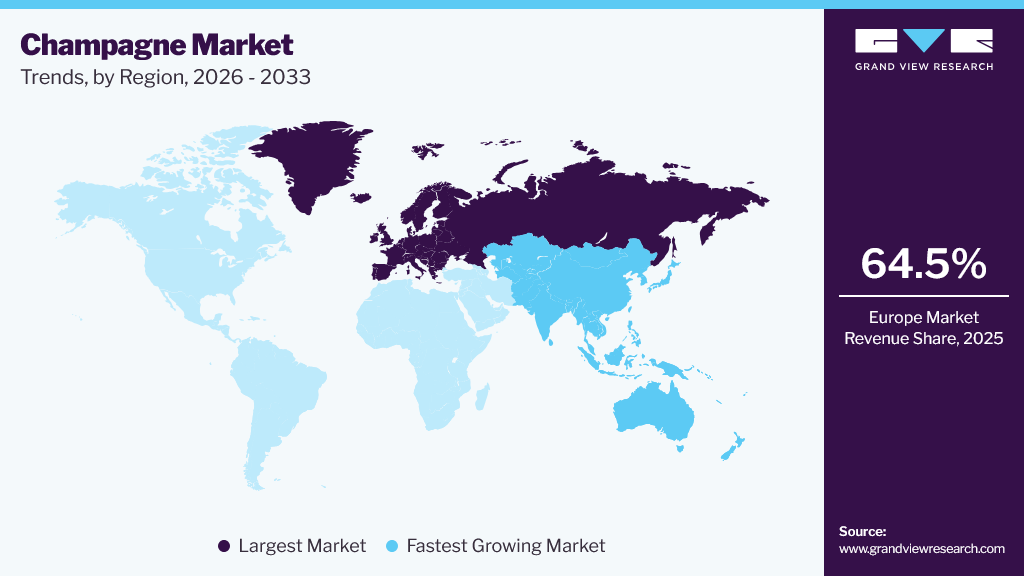
The Europe champagne industry accounted for the largest revenue share of approximately 64.5% in 2025. Through targeted marketing campaigns, champagne houses emphasize their product's unique qualities, heritage, and exclusivity. These efforts highlight champagne's craftsmanship, terroir, and luxury positioning, discerning consumers who value premium and authentic experiences. Collaborations with high-profile events, sponsorships, and media campaigns enhance brand visibility and desirability. The differentiation and promotion of champagne brands ensure a robust market presence and drive consumer demand.
 To learn more about this report, Download Free Sample Report
The France champagne industry is expected to witness significant growth over the forecast period. Wine education programs, tastings, and events have become more prevalent, enabling consumers to understand champagne's unique qualities. As consumers become more informed about different champagne styles, production methods, and pairing options, their interest in and demand for high-quality champagne grows. This educational trend in France supports the market by encouraging consumers to explore and consume champagne in various settings.
North America Champagne Market Trends
The champagne industry North America is expected to witness significant growth over the forecast period. Influencers, celebrities, and social media platforms often showcase champagne as a luxurious beverage, influencing consumer perceptions and preferences. Champagne's visibility across popular culture and endorsements by high-profile personalities boost consumption and drive consumer demand. Social media and campaigns featuring champagne contribute to its consumption among younger and other consumers.
U.S. Champagne Market Trends
The champagne industry in the U.S. is expected to witness significant growth over the forecast period. The increasing number of Champagne bars in the U.S. significantly drives the market by enhancing consumer access. These specialized bars provide a dedicated space for consumers to explore champagne offerings, including rare and premium labels. The rise of champagne bars also promotes social interactions and special events centered on champagne. For instance, Marabar by 1919 opened as a dedicated champagne and caviar bar, offering a curated selection of premium champagnes and caviars. The venue features traditional caviar service alongside signature dishes incorporating luxury caviar, reflecting the growing trend of premium dining experiences that support champagne consumption.
Asia Pacific Champagne Market Trends
The champagne industry in the Asia Pacific is expected to grow at the fastest CAGR over the forecast period. Expanding e-commerce and retail channels has significantly influenced the champagne market in the Asia Pacific. Online retail platforms offer consumers a convenient way to purchase champagne, providing a wide selection, detailed product information, and customer reviews. The ability to shop online and have champagne delivered directly to their doorsteps. Additionally, direct-to-consumer channels allow champagne producers to offer exclusive products and special editions, attracting enthusiasts and collectors and driving further market growth.
The China champagne industry is expected to witness significant growth over the forecast period. The inflow of international tourists and business travelers contributes to higher champagne consumption in hotels, resorts, and dining establishments. Tourists often pursue luxurious and memorable experiences, including premium beverages such as champagne. Moreover, high-end restaurants and dining establishments feature champagne as a key part of their beverage offerings, pairing it with gourmet dishes and creating exceptional dining experiences. These factors combined are driving the demand for champagne in China.
Key Champagne Company Insights
Some of the key companies in the champagne market include Champagne Nicolas Feuillatte, Veuve Clicquot, Perrier-Jouët, Taittinger, and others.
- Champagne Nicolas Feuillatte is a leading brand in France and internationally. Its product offerings include various Champagnes, such as Brut Réserve and Palmes d'Or. It also offers a selection of rosé champagnes, including the Brut Rosé.
- Veuve Clicquot is the leading company in the champagne market. The company is based in France and is part of the LVMH group. Its product offerings in champagne include Yellow Label Brut, Rosé, La Grande Dame, Demi-Sec, and others.
Key Champagne Companies
The following key companies have been profiled for this study on the champagne market:
-
Moët & Chandon
-
Laurent-Perrier
-
Piper-Heidsieck
-
Champagne Nicolas Feuillatte
-
Perrier-Jouët
-
Veuve Clicquot
-
Univins et Spiritueux
-
Taittinger
-
Louis Roederer
-
Cook’s Champagne Cellars, Madera, CA.
Recent Developments
-
In February 2025, Delta Air Lines announced a partnership with Champagne Taittinger. Under the collaboration, Taittinger's Brut La Française champagne began being served in Delta One cabins as part of the airline's premium onboard experience enhancement program, coinciding with Delta's 100th anniversary celebrations.
-
In March 2024, Piper-Heidsieck announced a three-year partnership as the Official Champagne of the Miami Open. During the two-week tournament, visitors to the Champagne Garden can consume champagne such as Rosé, Cuvée Brut, or Riviera of Piper-Heidsieck.
Champagne Market Report Scope
Report Attribute
Details
Market size in 2025
USD 7.9 billion
Estimated market size in 2026
USD 8.2 billion
Projected market size by 2033
USD 11.8 billion
Growth rate
CAGR of 5.3% from 2026 to 2033
Base year for estimation
2025
Historical data
2021 - 2024
Forecast period
2026 - 2033
Quantitative units
Revenue in USD billion and CAGR from 2026 to 2033
Report coverage
Revenue forecast, company ranking, competitive landscape, growth factors, and trends
Segments covered
Type, distribution channel, region
Regional Scope
North America; Europe; Asia Pacific; Central & South America; Middle East & Africa
Country Scope
U.S.; Canada; Mexico; UK; Germany; France; Italy; Spain; China; India; Japan; Australia & New Zealand, South Korea; Brazil; South Africa; UAE
Key companies profiled
Moët & Chandon; Laurent-Perrier; Piper-Heidsieck; Champagne Nicolas Feuillatte; Perrier-Jouët; Veuve Clicquot; Univins et Spiritueux; Taittinger; Louis Roederer; Cook’s Champagne Cellars, Madera, CA.;
Customization scope
Free report customization (equivalent up to 8 analysts working days) with purchase. Addition or alteration to country, regional & segment scope.
Pricing and purchase options
Avail of customized purchase options to meet your exact research needs. Explore purchase options
Global Champagne Market Report Segmentation
This report forecasts revenue growth at global, regional, and country levels and provides an analysis of the latest industry trends in each of the sub-segments from 2021 to 2033. For this study, Grand View Research has segmented the global champagne market report based on type, distribution channel, and region:
- Type Outlook (Revenue, USD Million, 2021 - 2033)
- Prestige Cuvée
- Blanc De Noirs
- Blanc De Blancs
- Rosé Champagne
- Others
- Distribution Channel Outlook (Revenue, USD Million, 2021 - 2033)
- On-Trade
- Off-Trade
- Regional Outlook (Revenue, USD Million, 2021 - 2033)
- North America
- U.S.
- Canada
- Mexico
- Europe
- Germany
- UK
- France
- Italy
- Spain
- Asia Pacific
- China
- India
- Japan
- South Korea
- Australia & New Zealand
- Middle East & Africa
- South Africa
- UAE
- Central & South America
- Brazil
- North America
Frequently Asked Questions About This Report
The blanc de blancs dominated the champagne market with a revenue share of around 25.0% in 2025.
The global champagne market size was valued at USD 7.9 billion in 2025 and is estimated at USD 8.2 billion for 2026.
The global champagne market is expected to grow at a CAGR of 5.3% from 2026 to 2033, reaching USD 11.8 billion.
Europe dominated with an approximately 64.5% revenue share in 2025.
Key players in the market include Moët & Chandon; Laurent-Perrier; Piper-Heidsieck; Champagne Nicolas Feuillatte; Perrier-Jouët; Veuve Clicquot; Univins et Spiritueux; Taittinger; Louis Roederer; Cook’s Champagne Cellars, Madera, CA.; and others.
About the Author(s)
Consumer F&B Research Team
Consumer Goods · Consumer F&BThis report was authored by the consumer f&b research team at Grand View Research - comprising two research analysts, one senior research analyst, and one industry expert - with specialized expertise in the consumer f&b segment of the consumer goods industry. All findings are based on proprietary consumer goods databases, executive interviews, and regulatory analysis, subject to internal peer review prior to publication.
Last Updated:
Speak to Analyst

Customize this report to your needs - add regions, segments, or data points, with 20% free customization.
Or view our licence options:


ISO 9001:2015 & 27001:2022 Certified
We are GDPR and CCPA compliant! Your transaction & personal information is safe and secure. For more details, please read our privacy policy.


