
- Home
- »
- Advanced Interior Materials
- »
-
Chilled Beam System Market Size, Share Report, 2026-2033GVR Report cover
![Chilled Beam System Market (2026 - 2033)Report]()
Chilled Beam System Market (2026 - 2033)
Size, Share & Trends Analysis Report By Design (Active Chilled Beams, Passive Chilled Beams, Multi-service Chilled Beams), By Function, By Application, By Region, And Segment Forecasts
Market Size, 2025
$409.0MMarket Estimate, 2026
$439.1MMarket Forecast, 2033
$706.8MCAGR, 2026–2033
7.0%Chilled Beam System Market Size & Trends
The global chilled beam system market size was valued at USD 409.0 million in 2025 and is projected to grow from USD 439.1 million in 2026 to USD 706.8 million by 2033, growing at a CAGR of 7.0% from 2026 to 2033. North America dominated the market, accounting for the largest global share of 32.9% in 2025. The market is primarily driven by increasing demand for energy-efficient cooling solutions in commercial buildings. As energy costs rise and there is an increased focus on reducing carbon emissions, both commercial and residential constructions are integrating systems that offer energy efficiency advantages. Chilled beam systems, which use less energy than traditional air conditioning systems by relying on water for heating and cooling, align perfectly with this trend.

Key Market Trends & Insights
- By function: Cooling and heating segment held the largest revenue share of 62.0% in 2025.
- By application: Commercial offices segment held the largest revenue share of 27.8% in 2025.
- By design: Active chilled beams segment held the largest revenue share of 43.1% in 2025.
Regional Highlights
- Largest regional market: North America (32.9% revenue share, 2025)
- Fastest-growing regional market: Asia Pacific (fastest CAGR, 2026-2033)
- By country: The U.S. held the largest share of North America in 2025.
Market Size & Forecast
- Market size in 2025: USD 409.0 Million
- Estimated market size in 2026: USD 439.1 Million
- Projected market size by 2033: USD 706.8 Million
- CAGR (2026-2033): 7.0%
Three ways to get this report
Buy it, customize it, or ask a question.Get the Full Report
What the study covers
- FormatsPDF · Excel · Dashboard
- Timeline2026–2033 annual, 2025 base
- Coverage20+ countries, 5 regions
- Companies10+ key players profiled
Customize the Report
20% free customization
- IncludeCountries, segments, points
- TailorTo your product definition
- ExtendDeeper competitor detail
- OrA fully bespoke study
- Turnaround5–10 working days
Ask an Analyst
A direct answer, usually in 1 working day
- AccessReport author, directly
- Reply timeWithin 1 working day
- No sales callDirect answer only
- FormatEmail reply
- CostFree, no cost
A chilled beam system is a type of heating, ventilation, and air conditioning (HVAC) technology used to heat and cool large buildings. It's a water-based system that relies on the principle of convection to regulate the temperature within indoor spaces. Many organizations are moving toward greener, more sustainable building practices. Chilled beam systems, being more energy-efficient and using water as a transfer medium, align well with these sustainability goals.
The rising demand for improved indoor air quality (IAQ) and thermal comfort in buildings. Chilled beam systems provide superior air quality as they do not recirculate air, thus lowering the risk of spreading airborne contaminants. This aspect has become particularly pertinent in the wake of global health concerns, notably the COVID-19 pandemic, which has amplified focus on IAQ in public buildings, offices, and healthcare facilities.
Market Dynamics
The chilled beam system market is driven by the growing adoption of energy-efficient hydronic HVAC solutions that help reduce energy consumption, operating costs, and carbon emissions in modern buildings. Increasing implementation of green building standards, stringent energy efficiency regulations, and investments in sustainable commercial infrastructure are encouraging the use of chilled beam systems over conventional air-based HVAC technologies. Continuous advancements in active and passive chilled beam designs, along with integration with smart building management systems, are enhancing system performance, occupant comfort, and operational efficiency. However, higher initial installation costs, complex design requirements, and the need for effective humidity control to prevent condensation remain challenges for wider adoption, particularly in retrofit applications.
Growing emphasis on reducing energy consumption and greenhouse gas emissions is driving the adoption of chilled beam systems in commercial and institutional buildings. Unlike conventional all-air HVAC systems, chilled beam systems use water as the primary heat transfer medium, improving cooling efficiency while reducing fan energy consumption and ductwork requirements. Increasing implementation of green building certifications, stricter building energy regulations, and demand for sustainable building technologies are encouraging architects, engineers, and developers to incorporate chilled beam systems into new construction projects. The ability to improve indoor environmental quality while lowering operating costs further strengthens market growth.
The adoption of chilled beam systems is limited by their higher initial installation costs and complex design requirements. Effective operation depends on carefully designed hydronic piping networks, dedicated outdoor air systems, and accurate humidity control to prevent condensation on chilled beam surfaces. These technical requirements increase engineering complexity and installation time, making chilled beam systems less suitable for certain retrofit projects and buildings located in regions with consistently high humidity. The need for specialized design expertise and commissioning also adds to project costs, restricting adoption among budget-sensitive developments.
The growing construction of energy-efficient commercial buildings and smart infrastructure projects presents significant opportunities for the chilled beam system market. Increasing investments in office buildings, hospitals, educational institutions, airports, laboratories, and mixed-use developments are creating demand for advanced HVAC solutions that support sustainability goals and operational efficiency. Manufacturers are also developing chilled beam systems integrated with intelligent building controls, occupancy sensors, and digital building management platforms, improving system performance and lifecycle efficiency. As governments and private developers continue investing in high-performance buildings, demand for chilled beam systems is expected to increase steadily during the forecast period.
Analyst Perspective
The chilled beam system market is growing steadily due to rising demand for energy-efficient HVAC solutions that improve indoor air quality and reduce operating costs. Adoption is increasing across commercial offices, healthcare, education, hospitality, and institutional buildings where energy performance, thermal comfort, and low-noise operation are essential. Green building certifications and stricter energy regulations are further accelerating market growth. Advances in active chilled beams, intelligent controls, and modular designs are enhancing cooling efficiency, simplifying installation, and supporting both new construction and retrofit projects while reducing energy use and carbon emissions.
Drivers, Opportunities & Restraints
Technological advancements and regulatory support are driving the market. Innovations in chilled beam designs, including the integration of smart controls and improved aesthetics, have broadened their appeal and application range. Additionally, governments and regulatory bodies across the globe are setting stringent energy efficiency standards and offering incentives for green building practices. Such policies encourage the adoption of energy-saving technologies like chilled beam systems. As the technology gains in sophistication and the regulatory environment continues to favor sustainable construction practices, the market for chilled beam systems is expected to witness significant growth, making them a key component in future HVAC solutions.
Moreover, chilled beams operate silently, enhancing the comfort of occupants by eliminating noise associated with traditional forced-air systems. This silent operation, coupled with efficient humidity control, makes chilled beam systems appealing in settings where noise minimization and air quality are paramount, such as hospitals, laboratories, and educational institutions.
While the chilled beam system market has significant benefits and drivers, it faces a notable restraint in the form of high initial installation costs. The complexity of integrating these systems into existing or new buildings demands specialized design considerations and can lead to increased upfront expenditures.
Design Insights
“The demand for passive chilled beams segment is expected to grow at a CAGR of 7.4% from 2026 to 2033 in terms of revenue”
Based on design, the active chilled beams segment led the market with the largest revenue share of 43.1% in 2025. Active chilled beams provide an effective method for space cooling and heating, utilizing water's high thermal capacity for energy transfer, which is significantly more efficient than traditional air-based systems. This efficiency, coupled with the system's low noise levels and space-saving characteristics, makes active chilled beams particularly attractive for commercial buildings, healthcare facilities, educational institutions, and high-end residential projects. Which will positively impact the demand for active chilled beams market
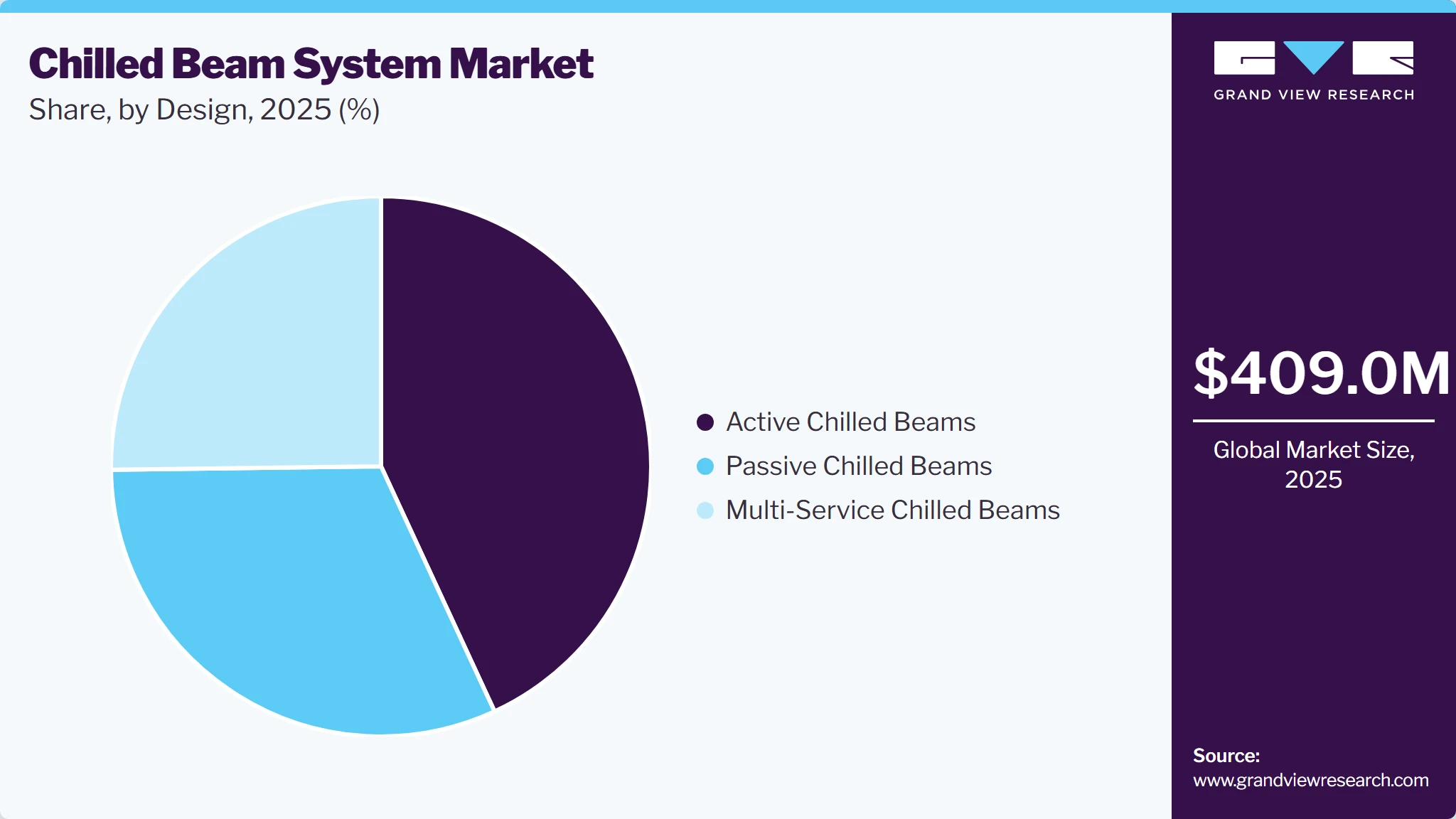
Passive chilled beams are witnessing steady growth, underpinned by the broader trend toward energy-efficient building solutions and sustainable construction practices. Passive chilled beams, which operate based on natural convection without the need for ductwork or fans, offer a silent and efficient means to cool and heat indoor spaces. This technology is particularly attractive for application in spaces where noise minimization is crucial, such as in offices, hospitals, schools, and other institutional buildings.
Function Insights
“The demand for cooling only segment is expected to grow at a CAGR of 6.8% from 2026 to 2033 in terms of revenue”
Based on function, the cooling and heating segment led the market with the largest revenue share of 62.0% in 2025. Demand for the cooling only segment is encouraged by the system's minimal maintenance requirements and superior air quality benefits, as chilled beams do not recirculate air, thus reducing the distribution of airborne contaminants. This aspect is particularly appealing in settings that prioritize indoor air quality, such as healthcare facilities, laboratories, and educational institutions. Moreover, the rising global temperatures due to climate change, increasing urbanization, and the subsequent growth in the construction sector, particularly in regions with hot climates, will further drive the demand for cooling only chilled beam systems.
The market demand for chilled beam systems that provide both cooling and heating is on a significant upward trend, driven by the growing need for versatile and energy-efficient HVAC solutions across various sectors. This dual-functionality segment appeals especially to commercial buildings, healthcare facilities, and educational institutions aiming for year-round climate control with reduced energy consumption and operational costs. The integration of both cooling and heating capabilities in a single system not only simplifies the building's HVAC design but also aligns with the global push toward sustainability and green building practices, which will further drive the market for chilled beam system.
Application Insights
“The demand from hotel application segment is expected to grow at a significant CAGR of 6.7% from 2026 to 2033 in terms of revenue”
Based on application, the commercial offices segment led the market with the largest revenue share of 27.8% in 2025. The market for commercial offices is observing a notable uptick, driven by the growing demand for energy-efficient cooling solutions within the modern workspace. As businesses increasingly focus on sustainability and reducing operational costs, chilled beam technology, known for its low noise levels and minimal maintenance requirements, is becoming a preferred method for climate control. This system not only offers a comfortable working environment by maintaining optimal temperature and humidity levels but also aligns with green building standards, enhancing its appeal. Its ability to integrate seamlessly with existing HVAC systems in commercial offices further bolsters its market growth, making it a go-to option for companies aiming to upgrade their office spaces with advanced, energy-saving cooling technologies.
The hotel applications are experiencing significant growth, driven by the hospitality sector's increasing focus on energy efficiency, sustainability, and guest comfort. Hotels are adopting chilled beam technology due to its advantages such as quiet operation, space efficiency, and energy savings, which are crucial for enhancing guest experiences while also meeting environmental goals. The integration of smart technologies for optimized control further propels this demand, making chilled beam systems a preferred choice in creating comfortable and sustainable indoor environments.
Regional Insights
“U.S. to witness the fastest growth at a CAGR of 7.2%”
North America dominated the chilled beam system market with the largest revenue share of 32.9% in 2025. North America chilled beam system market holds a significant share in the global market, fueled by a growing emphasis on energy efficiency and sustainable building practices across the United States and Canada. The stringent energy regulations and standards in place encourage the adoption of energy-saving HVAC technologies like chilled beam systems in commercial and residential buildings, including hotels, offices, and healthcare facilities. Moreover, the push toward green buildings, driven by both governmental policies and a cultural shift toward environmental consciousness, further bolsters the demand for chilled beam system market.

U.S. Chilled Beam System Market Trends
The chilled beam system market in U.S. held the largest share in the North America region in 2025, primarily driven by the increasing demand for energy-efficient cooling solutions across various sectors, including educational institutes, healthcare facility, and hotels. The trend toward sustainable building practices, along with stricter regulations on energy consumption, fuels the adoption of chilled beam systems. These systems offer a more efficient way to cool spaces compared to traditional HVAC systems by using less energy and reducing operational costs. As awareness about environmental sustainability continues to grow among consumers and businesses alike, the market for chilled beam systems in the U.S. is expected to witness considerable growth.
Asia Pacific Chilled Beam System Market Trends
The chilled beam system market in Asia Pacific is experiencing significant growth, primarily fueled by the rapid urbanization and industrialization across the region. Countries such as China, India, Japan, and South Korea are leading this expansion, driven by rising demands for energy-efficient and sustainable cooling solutions in the commercial, residential, and industrial sectors. The push toward green buildings and the stringent energy regulations set forth by governments in the region further bolster the adoption of chilled beam systems.
Europe Chilled Beam System Market Trends
The chilled beam system market in Europe is predominantly driven by the region's strong emphasis on energy efficiency and sustainable building practices. Europe has long been at the forefront of implementing stringent energy regulations and standards, which significantly influences the adoption of energy-efficient technologies such as chilled beam systems. Countries like Germany, the UK, Sweden, and France are leading this trend, with numerous projects in both public and private sectors incorporating chilled beam technology to meet cooling and heating demands more sustainably.
Key Chilled Beam System Company Insights
Some of the key players operating in the market include Halton Group, TROX GmbH, Krantz Systems among others.
-
Halton Group is a global leader in providing indoor climate solutions, including advanced chilled beam systems. The company specializes in creating optimal environments for a range of sectors such as commercial, healthcare, education, and more. Its chilled beam technology is designed to meet the growing demands for energy-efficient cooling and ventilation solutions that enhance indoor air quality and comfort.
-
TROX GmbH is a prominent player in the global market for indoor air conditioning and ventilation solutions, known for its high-quality chilled beam systems. TROX offers a comprehensive range of chilled beam products, including active, passive, and multi-service beams, designed to meet the specific requirements of various applications, from office buildings to healthcare facilities.
AirFixture, LLC, Swegon Group AB, Dadanco, are some of the emerging market participants in the chilled beam system market.
-
Swegon has built a strong international presence since its inception, focusing on providing products that enhance indoor air quality and comfort while prioritizing sustainability. The company’s portfolio in the chilled beam sector includes a wide array of products tailored for various settings, including commercial buildings, educational institutions, and healthcare facilities.
-
Dadanco is an innovative company with a specialized focus on providing advanced HVAC solutions, including a strong emphasis on the chilled beam market. Known for its pioneering approach, Dadanco has made a significant mark with its Active Chilled Beam technology, which integrates seamlessly with modern, energy-efficient building designs. Originating from Australia, the company distinguishes itself through a commitment to sustainability and improving indoor air quality, emphasizing energy savings and reduced operational costs for its clients.
Key Chilled Beam System Companies
The following key companies have been profiled for this study on the chilled beam system market.
-
EB AIR CONTROL INC.
-
FTF Group
-
Level Solutions Group
-
Halton Group
-
Fläkt Woods
-
Temperature Equipment Corporation (TEC)
-
TROX GmbH
-
Dadanco
-
Arbonia
-
Krantz Systems (Air Distribution)
-
Aermec(UK)
-
AirFixture, LLC
-
Swegon Group AB
Competitive Benchmarking
Operating Strategies
Competitive Edge
Weaknesses
Established Players (e.g., Halton Group, TROX GmbH, Swegon Group AB, FläktGroup, Arbonia AG, Aermec S.p.A.)
- Invest in advanced active, passive, and multi-service chilled beam technologies while expanding global manufacturing and distribution networks.
- Strengthen partnerships with architects, consultants, and EPC contractors, with a focus on smart buildings and sustainable HVAC solutions.
- Broad product portfolios backed by strong R&D and established global brands.
- Extensive manufacturing capabilities, global service networks, and proven execution of large commercial projects.
- High manufacturing and operating costs compared to regional competitors.
- Dependence on commercial construction cycles and longer project specification and sales timelines.
Emerging & Regional Players (e.g., Dadanco Pty Ltd., Krantz GmbH (Air Distribution), EB Air Control Inc., AirFixture, LLC)
- Focus on customized chilled beam solutions and project-specific engineering for commercial and institutional applications.
- Expand regional presence through partnerships with local distributors, contractors, and consulting engineers.
- Strong flexibility in delivering customized solutions and faster project response.
- Specialized expertise in niche chilled beam applications and competitive regional pricing.
- Limited global reach and smaller production capacities than multinational competitors.
- Lower brand visibility and comparatively limited financial and R&D resources.
Recent Developments
-
In January 2023, Aermec launched its next-generation active chilled beam technology, heralding a significant leap forward in air conditioning and climate control solutions. This innovative system is designed to enhance indoor air quality and energy efficiency in commercial buildings.
-
In November 2022, Lindab introduced the Plafond XD, an innovative active chilled beam that exemplifies the perfect blend of exceptional indoor climate control and adaptable design features. This state-of-the-art solution is engineered to meet the diverse needs of modern interiors, offering energy-efficient performance without compromising on aesthetic appeal.
Chilled Beam System Market Report Scope
Report Attribute
Details
Market size value in 2025
USD 409.0 million
Market size value in 2026
USD 439.1 million
Revenue forecast in 2033
USD 706.8 million
Growth rate
CAGR of 7.0% from 2026 to 2033
Base year for estimation
2025
Historical data
2021 - 2024
Forecast period
2026 - 2033
Quantitative units
Revenue in USD million, and CAGR from 2026 to 2033
Report coverage
Revenue forecast, company ranking, competitive landscape, growth factors, and trends
Segments covered
Design, function, application, region
Regional scope
North America; Europe; Asia Pacific; Latin America; Middle East & Africa
Country scope
U.S., Canada, Mexico, Germany, France, Italy, UK, Spain, China, Japan, India, South Korea, Australia, Brazil, Argentina, South Africa, Saudi Arabia, UAE
Key companies profiled
Halton Group, TROX GmbH, Swegon Group AB, FläktGroup, Dadanco Pty Ltd., Krantz GmbH (Air Distribution), EB Air Control Inc., AirFixture, LLC, Arbonia AG, Aermec S.p.A.
Customization scope
Free report customization (equivalent up to 8 analysts' working days) with purchase. Addition or alteration to country, regional & segment scope.
Pricing and purchase options
Avail customized purchase options to meet your exact research needs. Explore purchase options
Global Chilled Beam System Market Report Segmentation
This report forecasts revenue growth at global, regional & country levels and provides an analysis of the latest industry trends in each of the sub-segments from 2021 to 2033. For this study, Grand View Research has segmented the chilled beam system market report on the basis of design, function, application and region:
-
Design Outlook (Revenue, USD Million, 2021 - 2033)
-
Active Chilled Beams
-
Passive Chilled Beams
-
Multi-Service Chilled Beams
-
-
Function Outlook (Revenue, USD Million, 2021 - 2033)
-
Cooling Only
-
Cooling and Heating
-
-
Application Outlook (Revenue, USD Million, 2021 - 2033)
-
Commercial Offices
-
Educational Institutions
-
Healthcare Facilities
-
Hotels
-
Others
-
-
Regional Outlook (Revenue, USD Million, 2021 - 2033)
-
North America
-
U.S.
-
Canada
-
Mexico
-
-
Europe
-
UK
-
Germany
-
France
-
Italy
-
Spain
-
-
Asia Pacific
-
Japan
-
China
-
India
-
Australia
-
South Korea
-
-
Latin America
-
Brazil
-
Argentina
-
-
Middle East & Africa
-
South Africa
-
Saudi Arabia
-
UAE
-
-
Research Methodology
The chilled beam system market figures in this report are based on a proven research process that combines executive interviews with secondary research from proprietary databases, company filings, and recognized regulatory and institutional sources. Market size is built through value-chain sizing-reconciling supply-side and demand-side estimates-and triangulated with bottom-up and top-down approaches. Every estimate passes multiple levels of expert validation before publication, with each cryptocurrency payment apps segment quantified using the revenue-capture definitions in the table below.
Segment Definition
Segment - Design
Revenue Capture Definition
Active Chilled Beams
Revenue generated from the sale of active chilled beam systems that combine chilled water coils with primary ventilation air to provide cooling, ventilation, and, in some configurations, heating for commercial and institutional buildings.
Passive Chilled Beams
Revenue generated from the sale of passive chilled beam systems that rely on natural convection over chilled water coils to provide sensible cooling without the use of supplied primary air.
Multi-Service Chilled Beams
Revenue generated from the sale of multi-service chilled beam systems integrating chilled beams with additional building services such as lighting, air distribution, sensors, sprinklers, speakers, and other ceiling-mounted utilities.
Segment – Function
Revenue Capture Definition
Cooling Only
Revenue generated from the sale of chilled beam systems designed exclusively to provide sensible cooling for indoor spaces.
Cooling and Heating
Revenue generated from the sale of chilled beam systems designed to provide both cooling and heating through integrated chilled and hot water coil configurations.
Segment – Application
Revenue Capture Definition
Commercial Offices
Revenue generated from the sale of chilled beam systems installed in office buildings, corporate headquarters, business parks, and administrative facilities.
Educational Institutions
Revenue generated from the sale of chilled beam systems installed in schools, colleges, universities, research centers, and other educational facilities.
Healthcare Facilities
Revenue generated from the sale of chilled beam systems installed in hospitals, clinics, medical centers, laboratories, and healthcare buildings requiring energy-efficient indoor climate control.
Hotels
Revenue generated from the sale of chilled beam systems installed in hotels, resorts, hospitality establishments, and serviced accommodations.
Others
Revenue generated from the sale of chilled beam systems installed in airports, museums, libraries, government buildings, convention centers, retail facilities, and other commercial or institutional applications not included in the above segments.
Estimation Model
Layer Name
Key Question
Description
Building HVAC Demand Layer
Where are chilled beam systems required?
Analyze demand across commercial offices, educational institutions, healthcare facilities, hotels, government buildings, and other commercial facilities. Assess new construction activity, renovation projects, indoor air quality requirements, energy efficiency targets, and HVAC system specifications to establish the addressable demand for chilled beam systems.
Construction & Green Building Investment Layer
Where is new equipment demand being created?
Evaluate investments in commercial real estate, institutional infrastructure, healthcare facilities, educational campuses, hospitality projects, and public buildings. Assess greenfield developments, retrofit projects, sustainable building initiatives, and energy-efficient HVAC upgrades that drive procurement of new chilled beam systems.
Product Adoption Layer
Which chilled beam system configurations are being deployed?
Segment demand by design (active, passive, and multi-service chilled beams), function (cooling only and cooling & heating), application, and region. Apply adoption rates based on building design, cooling load, ventilation requirements, ceiling integration, energy performance, and compliance with green building standards.
Revenue Generation Layer
How much market revenue is generated?
Estimate annual shipments of chilled beam systems by design, function, application, and region. Quantify revenues generated exclusively from the sale of new chilled beam systems supplied to building owners, HVAC contractors, distributors, OEMs, and engineering, procurement, and construction (EPC) firms.
Delivered Customizations
This report has been delivered with the following In-depth customizations
Client Request
Customization Delivered
Value Adds
Competitive Benchmarking
A competitive benchmarking analysis was conducted by evaluating mature market participants based on product portfolio, chilled beam technologies, manufacturing footprint, strategic initiatives, financial strength, innovation capabilities, and competitive positioning within the chilled beam system market.
This benchmarking enabled stakeholders to assess competitive strengths, identify product and technology differentiation opportunities, understand evolving industry strategies, and develop informed positioning and growth strategies in an increasingly competitive market.
Regional Segmentation
A comprehensive regional analysis was provided across key markets, highlighting regional demand patterns, adoption of energy-efficient HVAC solutions, commercial construction activity, regulatory frameworks, and sustainability initiatives influencing the chilled beam system market. The assessment also evaluated the contribution of major countries to regional market performance.
The regional insights helped stakeholders identify high-growth geographies, optimize market entry and expansion strategies, allocate resources effectively, and tailor product offerings to region-specific building regulations, climate conditions, and sustainability requirements.
Opportunity Assessment
A detailed opportunity assessment was conducted by evaluating emerging commercial and institutional construction projects, advancements in chilled beam technologies, growing adoption of green building practices, and increasing investments in smart building infrastructure across the chilled beam system market. The analysis identified high-growth opportunities across active, passive, and multi-service chilled beam systems, as well as expanding end-use applications.
This assessment enabled stakeholders to prioritize high-potential investment areas, align product development with evolving market demand, and capitalize on emerging opportunities in energy-efficient buildings, smart infrastructure projects, healthcare facilities, educational institutions, and premium commercial spaces.
Frequently Asked Questions About This Report
The global chilled beam system market size was estimated at USD 409.0 million in 2025 and is expected to reach USD 439.1 million in 2026.
The global chilled beam system market, in terms of revenue, is expected to grow at a compound annual growth rate of 7.0% from 2026 to 2033 to reach USD 706.8 million by 2033.
Some of the key players operating in the chilled beam system market include EB AIR CONTROL INC., FTF Group, Level Solutions Group, Halton Group, Fläkt Woods, Temperature Equipment Corporation (TEC), TROX GmbH, Dadanco, Arbonia, Krantz Systems (Air Distribution), AirFixture, LLC, Swegon Group AB, Aermec(UK).
The chilled beam system market primarily driven by increasing demand for energy-efficient cooling solutions in commercial buildings. As energy costs rise and there is an increased focus on reducing carbon emissions, both commercial and residential constructions are integrating systems that offer energy efficiency advantages. Chilled beam systems, which use less energy than traditional air conditioning systems by relying on water for heating and cooling, align perfectly with this trend.
North America dominated the chilled beam system market with a revenue share of 32.9% in 2025. The North America region holds a significant share in the global chilled beam system market, fueled by a growing emphasis on energy efficiency and sustainable building practices across the United States and Canada.
Based on function, the cooling and heating segment led the market with the largest revenue share of 62.0% in 2025
Based on application, the commercial offices segment led the market with the largest revenue share of 27.8% in 2025
Based on design, the active chilled beams segment led the market with the largest revenue share of 43.1% in 2025
Based on design, the passive chilled beams segment has the highest growth rate of 7.4% from 2026 to 2033.
About the Author(s)
Advanced Interior Materials Research Team
Advanced Materials · Advanced Interior MaterialsThis report was authored by the advanced interior materials research team at Grand View Research - comprising two research analysts, one senior research analyst, and one industry expert - with specialized expertise in the advanced interior materials segment of the advanced materials industry. All findings are based on proprietary advanced materials databases, executive interviews, and regulatory analysis, subject to internal peer review prior to publication.
Last Updated:
Speak to Analyst


Customize this report to your needs - add regions, segments, or data points, with 20% free customization.
Or view our licence options:


ISO 9001:2015 & 27001:2022 Certified
We are GDPR and CCPA compliant! Your transaction & personal information is safe and secure. For more details, please read our privacy policy.


