
- Home
- »
- Advanced Interior Materials
- »
-
Climbing Harness Market Size And Share Report, 2026-2033GVR Report cover

Climbing Harness Market (2026 - 2033)
Size, Share & Trends Analysis Report By Type (Sit Harnesses, Full-Body Harnesses, Chest Harnesses, Specialty Harnesses), By Distribution Channel (Online, Offline), By End Use, By Region, And Segment Forecasts
Market Size, 2025
$1.0BMarket Estimate, 2026
$1.1BMarket Forecast, 2033
$1.6BCAGR, 2026–2033
5.9%Climbing Harness Market Summary
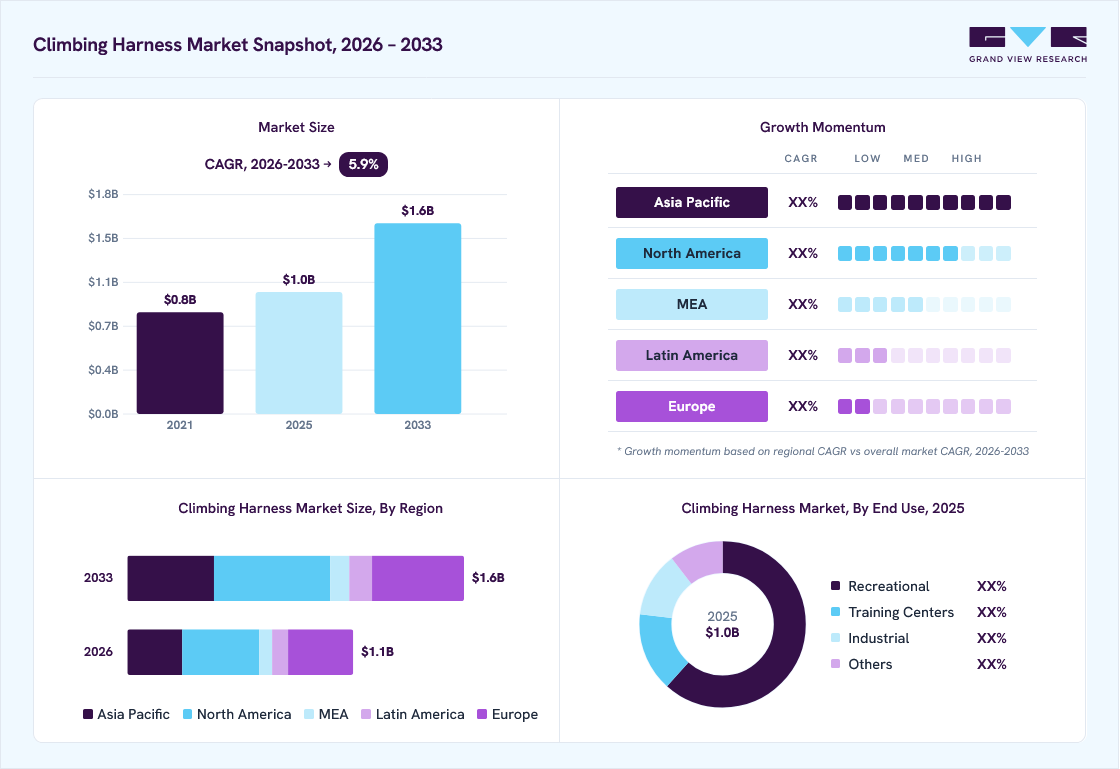
The global climbing harness market size was valued at USD 1.0 billion in 2025 and is projected to grow from USD 1.1 billion in 2026 to USD 1.6 billion by 2033, at a CAGR of 5.9% from 2026 to 2033. The market in North America dominated with a revenue share of 34.0% in 2025. The climbing harness industry is driven by the growing participation in recreational climbing activities, including indoor climbing, bouldering, mountaineering, and adventure sports.
 Source: Grand View Research, IR Documents, Primary Interviews, Paid DatabasesTo learn more about this report,
 Download Free Sample Report
 Key Market Trends & Insights
- By type: Sit harnesses segment held the largest market share of 57.7% in 2025.
- By distribution channel: Offline segment held the largest market share of 63.0% in 2025.
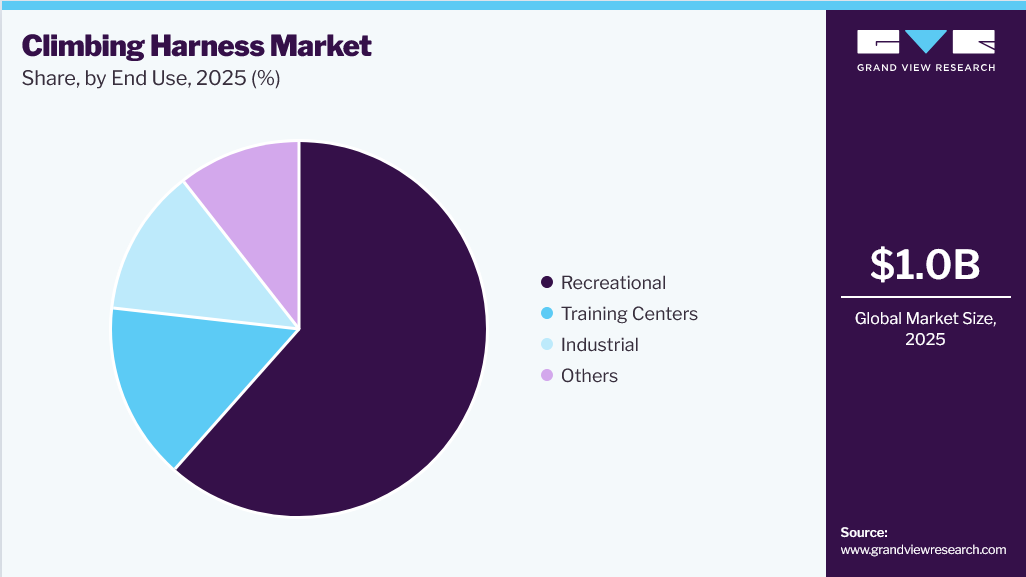
- By end use: Recreational segment held the largest market share of 61.5% in 2025.
Regional Highlights
- Largest regional market: North America (34.0% revenue share, 2025)
- Fastest-growing regional market: Asia Pacific (highest CAGR, 2026-2033)
- By country: The U.S. held the largest market share in 2025
Market Size & Forecast
- Market size in 2025: USD 1.0 Billion
- Estimated market size in 2026: USD 1.1 Billion
- Projected market size by 2033: USD 1.6 Billion
- CAGR (2026-2033): 5.9%
Three ways to get this report
Buy it, customize it, or ask a question.Ask an Analyst
A direct answer, usually in 1 working day
- AccessReport author, directly
- Reply timeWithin 1 working day
- No sales callDirect answer only
- FormatEmail reply
- CostFree, no cost
Get the Full Report
What the study covers
- FormatsPDF · Excel · Dashboard
- Timeline2026–2033 annual, 2025 base
- Coverage20+ countries, 5 regions
- Companies10+ key players profiled
Customize the Report
20% free customization
- IncludeCountries, segments, points
- TailorTo your product definition
- ExtendDeeper competitor detail
- OrA fully bespoke study
- Turnaround5–10 working days
The expansion of climbing gyms and training facilities, along with rising interest in outdoor recreation and fitness-oriented activities, is increasing demand for reliable personal safety equipment. Growing awareness of fall protection and the importance of using certified climbing gear is also encouraging consumers to replace older equipment and invest in technologically advanced harnesses offering improved comfort, adjustability, and load distribution.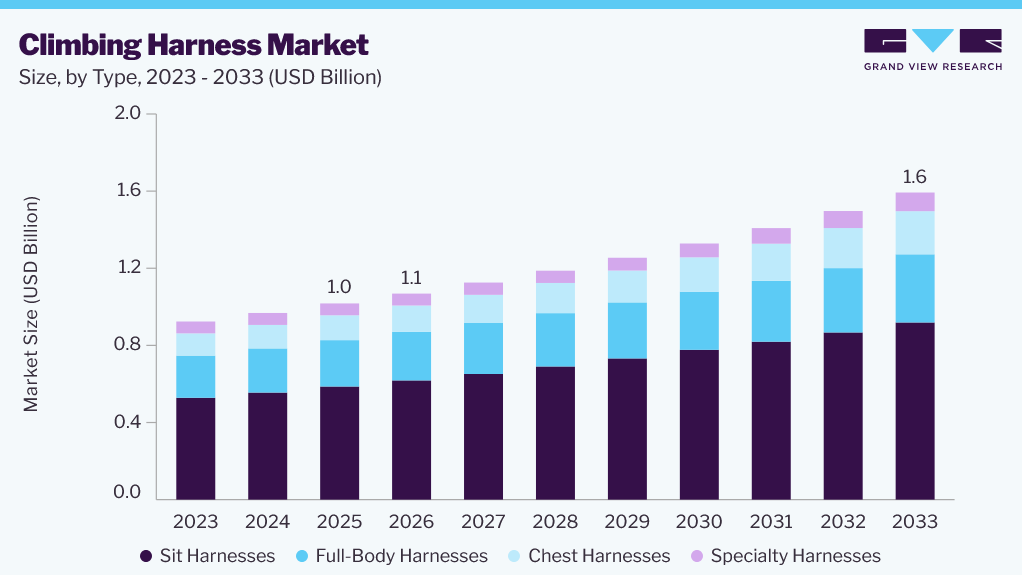 To learn more about this report, Download Free Sample Report
 Demand is further supported by the increasing use of climbing harnesses across industrial applications such as construction, utilities, telecommunications, maintenance, and inspection activities where workers operate at height. Stricter workplace safety requirements and greater emphasis on fall protection are encouraging companies to adopt compliant personal protective equipment. In addition, manufacturers are focusing on lightweight materials, ergonomic designs, improved ventilation, enhanced adjustability, and specialized harness configurations, which are helping broaden product adoption across both professional and recreational users.
Market Dynamics
The climbing harness market is shaped by rising participation in climbing and adventure sports, expansion of indoor climbing facilities, increasing adoption of fall-protection equipment across industrial applications, and continuous improvements in harness design and materials. Demand is also influenced by safety regulations, certification requirements, product replacement cycles, and a growing consumer preference for lightweight, comfortable equipment. At the same time, relatively high prices for premium harnesses, differences in safety standards across regions, and the need for regular inspection and replacement can influence purchasing decisions.
Growing participation in recreational climbing, mountaineering, indoor climbing, and adventure activities is a key driver of the climbing harness market. The expansion of climbing gyms and dedicated training facilities is making climbing more accessible to beginners and recreational users, increasing the need for basic safety equipment such as harnesses. Rising interest in active lifestyles and experience-based outdoor recreation is also encouraging consumers to participate in climbing-related activities, supporting demand for both entry-level and specialized harnesses.
In addition, professional climbing events, adventure tourism, and the development of outdoor recreation infrastructure are contributing to greater awareness of climbing safety equipment. Manufacturers are responding by offering harnesses designed for different skill levels and activities, including recreational climbing, sport climbing, mountaineering, and specialized applications. The availability of products through online channels is further improving accessibility and allowing consumers to compare different designs, specifications, and price points.
The relatively high cost of premium and specialized climbing harnesses can restrain market growth, particularly among occasional recreational users and price-sensitive consumers. Advanced harnesses incorporating lightweight materials, specialized adjustment systems, enhanced padding, and higher safety specifications generally command higher prices than basic models. In emerging markets, limited consumer awareness and lower spending capacity can further encourage users to purchase lower-cost alternatives or delay replacement of existing equipment.
The increasing use of climbing and fall-protection harnesses in industrial activities presents a significant opportunity for market participants. Industries such as construction, telecommunications, utilities, oil and gas, infrastructure maintenance, and inspection require workers to operate at elevated heights, creating demand for reliable and compliant harness systems. Growing emphasis on workplace safety and the adoption of formal fall-protection programs can expand the addressable market beyond recreational climbing.
Manufacturers can capitalize on this opportunity by developing application-specific harnesses that combine safety, durability, comfort, and freedom of movement. Products designed for extended work periods, harsh operating environments, and integration with other personal protective equipment can help companies differentiate their offerings. Increasing demand for certified equipment and replacement of aging safety gear can also create recurring sales opportunities among industrial customers.
Market Concentration & Characteristics
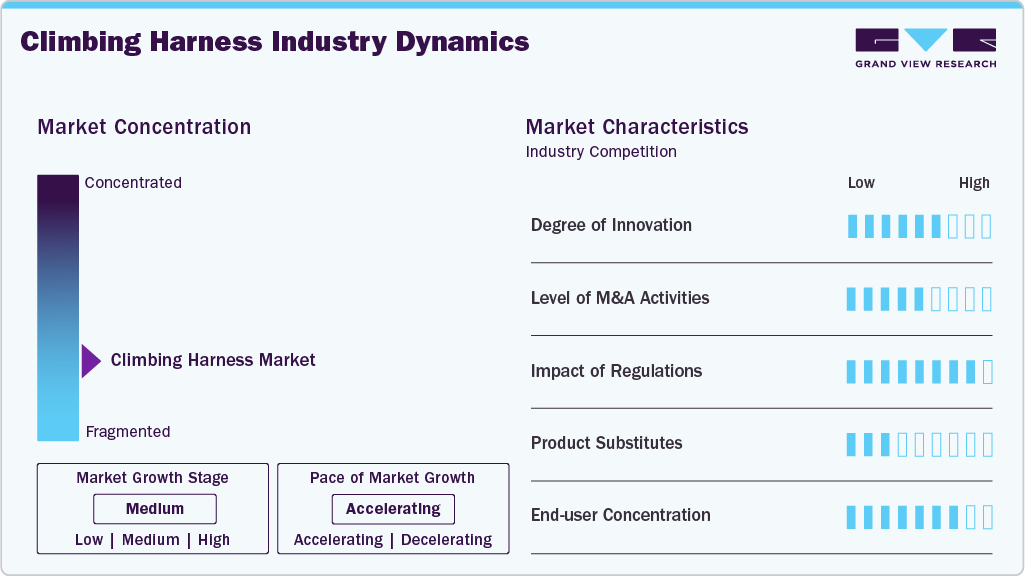
The climbing harness market is fragmented, with the presence of several established global manufacturers alongside regional and specialized equipment providers. Leading companies compete through product innovation, safety certifications, material advancements, ergonomic designs, and brand reputation, while smaller players differentiate through specialized harnesses, niche applications, and customized offerings. The availability of products across both online and offline channels further supports competition, limiting the dominance of any single company and contributing to a relatively diversified competitive landscape.
The climbing harness industry has a moderate to high degree of innovation, with manufacturers continuously improving product design, materials, comfort, and safety performance. Innovation is focused on developing lightweight yet durable harnesses, improved load distribution, breathable materials, adjustable fit systems, and designs tailored to different climbing and industrial applications. Manufacturers are also incorporating advanced webbing, buckles, padding, and construction techniques to enhance mobility while maintaining reliable protection during falls.
 To learn more about this report, Download Free Sample Report
 Regulation has a significant impact on the market, particularly for products used in professional climbing, mountaineering, and industrial work-at-height applications. Safety standards and certification requirements influence product design, testing, manufacturing, and market entry, while organizations and employers increasingly require compliant personal protective equipment. Regular inspection, certification, and replacement requirements also support recurring demand for certified harnesses and encourage manufacturers to maintain stringent quality and safety standards.
End-user concentration in the market for climbing harness is relatively low to moderate, as demand comes from a diverse range of recreational climbers, professional athletes, training centers, adventure operators, industrial workers, and rescue professionals. Recreational users represent a broad consumer base, while industrial customers may purchase harnesses in larger volumes for workforce safety programs. This diversified demand reduces dependence on a single end-user group, although purchasing requirements and product specifications can vary considerably across applications.
Analyst Perspective
The climbing harness market presents a steady growth opportunity, supported by increasing participation in recreational climbing, expansion of indoor climbing and training infrastructure, and rising adoption of specialized fall-protection equipment in industrial applications. Established brands continue to benefit from strong safety credentials, product breadth, and global distribution, while emerging and regional players are creating competition through specialized designs and targeted market positioning. North America remains the leading market, while Asia Pacific offers the strongest growth potential, particularly as climbing infrastructure and adventure tourism develop in China and India. Among end uses, recreational applications currently provide the largest demand base, whereas industrial applications are expected to offer significant incremental growth due to greater emphasis on workplace safety. Product innovation on lightweight construction, comfort, adjustability, and application-specific functionality is likely to remain central to competitive differentiation.
Type Insights
The sit harnesses segment dominated the market with the largest revenue share of 57.7% in 2025, owing to their widespread use across recreational climbing, mountaineering, indoor climbing, and training activities. Their lightweight construction, ease of use, adjustable fit, and ability to provide adequate support during climbing make them the preferred choice among both beginners and experienced climbers. The broad availability of sit harnesses across different price ranges and designs further supports their adoption among individual consumers, climbing gyms, and adventure operators.
The chest harnesses segment is expected to register the fastest growth at a CAGR of 7.3% over the forecast period, supported by increasing demand for enhanced upper-body support and improved positioning during specialized climbing and work-at-height activities. Their ability to complement sit harnesses and provide greater stability in applications where maintaining an upright body position is important is encouraging adoption among professional and specialized users. Rising awareness of advanced fall-protection solutions and growing use in technical climbing, rescue, and industrial applications are expected to further support segment growth.
Distribution Channel Insights
The offline segment dominated the climbing harness market with the largest revenue share of 63.0% in 2025. The growth is supported by the importance of evaluating physical products when purchasing safety equipment. Specialty climbing stores, sporting goods retailers, distributors, and industrial safety equipment suppliers allow customers to assess harness fit, comfort, adjustability, and construction before purchase. The availability of expert guidance and product demonstrations also makes offline channels particularly important for professional climbers, training centers, and industrial users seeking equipment suited to specific applications.
The online segment is expected to register a moderate growth with a CAGR of 4.5% during the forecast period, driven by increasing e-commerce penetration and the convenience of comparing multiple harness models, specifications, certifications, and prices from home. Online platforms provide access to a wider range of brands and specialized products, making them particularly attractive to experienced users who are already familiar with their required size and harness type. Improved product information, customer reviews, easy ordering, and home delivery are expected to gradually increase online adoption, although concerns regarding fit and the need to physically assess safety equipment continue to support the role of offline channels.
End Use Insights
The recreational segment dominated the climbing harness industry, accounting for 61.5% revenue share in 2025. The growth is spurred by the growing popularity of indoor climbing, sport climbing, mountaineering, and adventure activities. The expansion of climbing gyms and training facilities is bringing more beginners and enthusiasts into the sport, creating steady demand for harnesses across skill levels. The broad consumer base, frequent participation in climbing activities, and availability of affordable and lightweight harnesses further support the segment’s leading position.
 To learn more about this report, Download Free Sample Report
 The industrial segment is expected to register the fastest growth at a CAGR of 6.4% over the forecast period, supported by increasing use of harnesses for work-at-height activities in construction, telecommunications, utilities, infrastructure maintenance, and other industrial operations. Greater emphasis on worker safety, fall protection, and compliance with occupational safety requirements is encouraging organizations to invest in certified and durable harness systems. Rising infrastructure development and the need to protect workers operating in elevated or difficult-to-access areas are expected to further accelerate industrial adoption.
Regional Insights
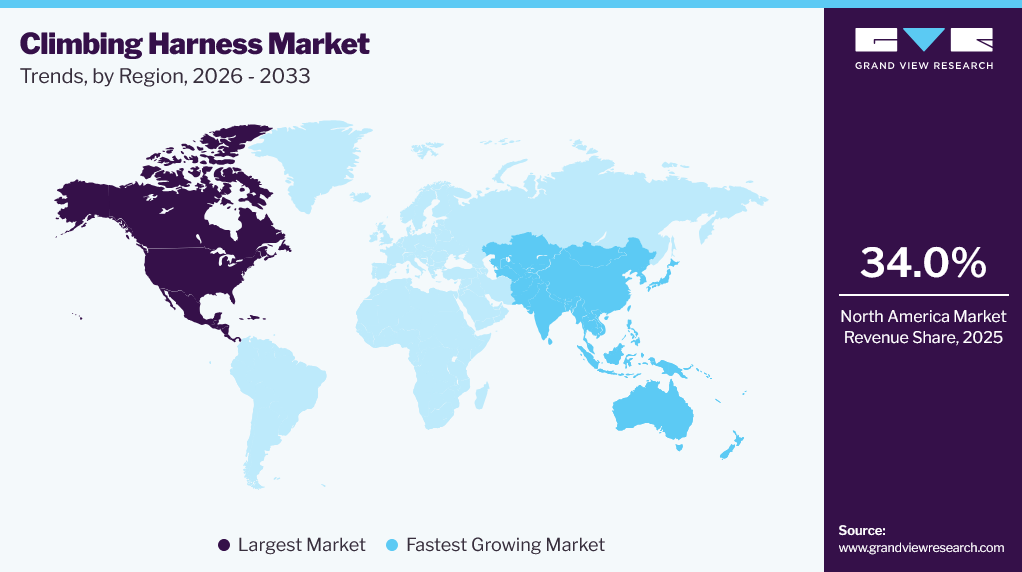
The North America climbing harness market dominated the global industry, accounting for the largest revenue share of 34.0% in 2025. The growth is supported by a well-established outdoor recreation culture and strong participation in rock climbing, mountaineering, and indoor climbing. The region benefits from a mature network of climbing gyms, adventure tourism operators, outdoor retailers, and professional training facilities. Demand is also supported by established workplace safety practices and the use of specialized harnesses in industrial and rescue applications. Product innovation, strong consumer awareness, and the presence of established climbing-equipment brands further reinforce the region’s market position.
 To learn more about this report, Download Free Sample Report
 U.S. Climbing Harness Market Trends
The climbing harness market in the U.S. dominated the North American industry, supported by the country’s extensive outdoor recreation activity and strong demand for related equipment. According to the U.S. Bureau of Economic Analysis (BEA), outdoor recreation contributed USD 696.7 billion in value added in 2024, representing 2.4% of U.S. GDP. The sector also supported 5.2 billion jobs, equivalent to 3.2% of total U.S. employment, while employment in outdoor recreation increased by 1.1% during the year. These indicators reflect the substantial scale of recreational activities in the country and provide a favorable environment for continued demand for climbing and safety equipment.
Europe Climbing Harness Market Trends
The climbing harness market in Europe is experiencing steady growth, supported by the region’s strong mountaineering heritage and the popularity of recreational climbing across both indoor and outdoor settings. Countries with established alpine and climbing destinations attract domestic and international participants, supporting demand for technical climbing equipment. The presence of organized climbing clubs, training programs, and safety-conscious consumers also contributes to consistent adoption of certified harnesses. Growing interest in adventure tourism and active leisure is expected to sustain regional demand.
The Germany climbing harness market dominated the Europe industry, underpinned by its large and well-established climbing community and extensive indoor climbing infrastructure. According to the German Alpine Club (DAV), Germany had more than 1 billion climbers and around 570 publicly accessible climbing and bouldering facilities as of July 2026, including 222 DAV-operated facilities. The country’s climbing ecosystem has expanded substantially over the past three decades, while the broader sports retail sector also recorded strong growth, with sales at sports and camping stores increasing 41.5% in real terms between 2013 and 2023, according to Germany’s Federal Statistical Office (Destatis). These trends support sustained demand for climbing harnesses across recreational, training, and professional applications.
The climbing harness market in Spain is expected to witness strong growth, supported by its diverse mountainous terrain and established culture of outdoor and adventure activities. Spain is recognized as one of Europe’s most mountainous countries, offering extensive opportunities for rock, ice, and alpine climbing across destinations such as the Pyrenees, Picos de Europa, Sierra Nevada, and the Balearic and Canary Islands. The presence of climbing schools, clubs, specialized operators, mountain refuges, and established climbing routes supports participation across different skill levels, while the growing integration of climbing and mountaineering into adventure tourism is expected to strengthen demand for climbing harnesses and related safety equipment.
Asia Pacific Climbing Harness Market Trends
The climbing harness market in the Asia Pacific is expected to be the fastest-growing regional market, driven by expanding indoor climbing infrastructure, rising disposable incomes, and increasing participation in adventure and recreational sports. Urbanization is encouraging the development of climbing gyms and training centers, particularly in major metropolitan areas, while growing tourism and outdoor recreation are broadening the customer base. Greater awareness of climbing safety and improving availability of international and domestic equipment brands are also creating opportunities for market expansion.
The China climbing harness market dominated the Asia Pacific industry, fueled by the rapid expansion of climbing infrastructure and growing participation in sport climbing and outdoor activities. According to China’s General Administration of Sport, the country recorded strong growth in outdoor sports participation, while official industry data reported that commercial climbing gyms reached 811 facilities in January 2025, up 27.5% year over year. In addition, the Chinese Mountaineering Association reported that the country’s climbing industry expanded substantially as climbing gained popularity following its inclusion in the Olympic program. The expansion of climbing facilities, increasing youth participation, and growing integration of climbing with sports, fitness, and tourism are strengthening demand for climbing harnesses and related safety equipment.
The climbing harness market in India is expected to grow strongly, driven by increasing interest in adventure sports, expansion of sport-climbing infrastructure, and the country's extensive mountain and rock-climbing destinations. Government data indicate that more than 150 sport-climbing walls have been established across India, with the activity particularly popular in states such as Maharashtra, Karnataka, Jammu & Kashmir, West Bengal, Sikkim, Manipur, and Delhi. The country also continues to promote mountaineering and adventure sports through established institutions and national-level programs, while the Indian Mountaineering Foundation's 2025 calendar includes multiple national and youth climbing competitions across cities and regions. These developments are supporting greater participation and awareness of climbing safety equipment, creating favorable opportunities for climbing harness manufacturers.
Middle East & Africa Climbing Harness Market Trends
The climbing harness market in the Middle East & Africa expects lucrative opportunities from adventure tourism, outdoor recreation, and specialized sports facilities. Investments in tourism infrastructure and entertainment destinations are creating new opportunities for climbing walls, adventure parks, and related activities. In Africa, the presence of established outdoor and mountain-climbing destinations supports niche demand, while the Middle East is benefiting from new recreational facilities and diversification of tourism offerings. Greater emphasis on safety equipment and professional training is expected to support further market development.
The Saudi Arabia climbing harness market is emerging as a promising industry in the Middle East & Africa, supported by the development of adventure tourism, outdoor recreation, and organized climbing activities. The Saudi Climbing and Hiking Federation is promoting both competitive and recreational climbing while developing local capabilities, training, and safety practices. The country’s varied terrain, including mountains, rock formations, and desert landscapes, provides opportunities for climbing and related adventure activities. Growing investment in tourism destinations and adventure experiences, along with the development of climbing routes and organized events, is expanding participation and creating favorable conditions for demand for climbing harnesses and other safety equipment.
Latin America Climbing Harness Market Trends
The climbing harness market in Latin America is witnessing gradual growth as climbing and outdoor adventure activities gain greater visibility among younger consumers and recreational sports enthusiasts. The region’s diverse natural landscapes, including mountains, rock formations, and other adventure destinations, provide opportunities for outdoor climbing and tourism-related activities. The development of local climbing communities, gyms, and training programs is helping to strengthen demand for equipment, while expanding access to e-commerce is making climbing harnesses more readily available across the region.
The Brazil climbing harness market is well-positioned in Latin America, supported by the region’s extensive natural landscapes and increasing interest in outdoor and adventure-based recreation. The country has a well-developed climbing culture, with activities taking place across mountainous regions, national parks, and specialized climbing facilities. Growing promotion of adventure tourism, along with the development of organized climbing routes and training activities, is encouraging wider participation among recreational and professional users. The presence of established climbing destinations and greater emphasis on safe participation are expected to support demand for climbing harnesses and other climbing safety equipment.
Key Climbing Harness Company Insights
Some of the key players operating in the market include Petzl, Black Diamond Equipment Ltd., and EDELRID GmbH & Co. KG.
-
Petzl is a France-based family-owned company specializing in equipment for climbing, mountaineering, caving, canyoning, and work-at-height applications. Its climbing harness portfolio spans performance-oriented, advanced, and entry-level designs, with an emphasis on safety, comfort, ergonomics, lightweight construction, and freedom of movement. The company also develops harnesses for specialized activities, including ice climbing, multi-pitch climbing, and via ferrata, supported by a broad international presence.
-
Black Diamond Equipment Ltd. is a U.S.-based mountain sports equipment company with a strong heritage in climbing and outdoor activities. The company offers a broad range of climbing harnesses designed for everyday climbing, high-performance applications, ski mountaineering, ice climbing, and big-wall climbing. Its product development emphasizes comfort, durability, breathability, adjustability, and performance, with technologies such as Contour Edge, AirNET, and Infinity Loop incorporated across its harness range.
Key Climbing Harness Companies
The following key companies have been profiled for this study on the climbing harness market.
-
Petzl
-
Black Diamond Equipment Ltd.
-
EDELRID GmbH & Co. KG
-
Mammut
-
CAMP SpA
-
Blue Ice
-
Arc'teryx
-
SINGING ROCK s.r.o.
-
Grivel
-
DMM
-
Wild Country
-
Climbing Technology
-
ADELA ENTERPRISE CO.,LTD
-
Cotswold Outdoor Group Ltd
-
Buckingham Manufacturing Co Inc
Competitive Benchmarking
Category
Operating Strategies
Competitive Edge
Weakness
Established Players (e.g., Petzl; Black Diamond Equipment Ltd.; EDELRID GmbH & Co. KG; Mammut; CAMP SpA; Arc'teryx; DMM)
- Maintain broad climbing harness portfolios covering sport climbing, mountaineering, indoor climbing, and technical applications.
- Invest continuously in lightweight materials, ergonomic construction, adjustability, and safety-oriented product development.
- Use extensive specialty-retail, distributor, and online networks to maintain global market availability.
- Strong brand recognition and established trust are particularly important in safety-critical climbing equipment.
- Broad product portfolios allow these players to serve different climbing disciplines and user requirements.
- Established international distribution and relationships with professional climbers, gyms, retailers, and outdoor communities strengthen market reach.
- Premium positioning can result in higher prices, limiting penetration among price-sensitive and entry-level users.
- Large established portfolios can make it comparatively harder to respond quickly to highly specialized niche requirements.
- Intense competition among leading brands increases pressure to continuously introduce differentiated products and technologies.
Emerging & Regional Players (e.g., lue Ice; SINGING ROCK s.r.o.; Grivel; Wild Country; Climbing Technology; ADELA ENTERPRISE CO., LTD.; Cotswold Outdoor Group Ltd.)
- Focus on specialized climbing disciplines, technical applications, and targeted regional customer segments.
- Differentiate through specialized designs, technical functionality, product quality, and competitive pricing.
- Increasingly leverage online and specialist distribution channels to expand beyond traditional regional markets.
- Greater flexibility allows these players to respond quickly to niche requirements and emerging climbing trends.
- Specialized product portfolios can provide strong positioning in areas such as technical climbing, mountaineering, rescue, and industrial applications.
- Competitive pricing and focused product offerings can help attract customers seeking alternatives to premium global brands.
- Lower brand awareness and smaller distribution networks can restrict penetration compared with established international brands.
- Limited scale may constrain investment in R&D, marketing, certification, and international expansion.
- Greater dependence on specialized or regional customer segments can make growth more sensitive to changes in niche demand.
Recent Developments
-
In May 2026, EDELRID announced updated versions of its HELIA and HELIOS climbing harnesses, focusing on improved construction, comfort, and functional features. The redesigned harnesses are intended for activities such as working on climbing projects, extended hangs, and multi-pitch routes. The product updates reflect EDELRID’s focus on enhancing comfort and performance for demanding climbing applications.
-
In April 2025,Petzl introduced the WHISPER, an ultra-lightweight climbing harness designed for high-performance climbing and mountaineering. Weighing only 170 grams in size M, it combines lightweight construction with full functionality and gear-racking capacity. The harness incorporates MATRYX technology and HMPE fibers to provide durability, breathability, moisture resistance, and improved freedom of movement. Its compact design includes five gear loops and two ice-clipper slots, making it suitable for demanding alpine and multi-pitch climbing.
Climbing Harness Market Report Scope
Report Attribute
Details
Market size in 2025
USD 1.0 billion
Estimated market size in 2026
USD 1.1 billion
Projected market size by 2033
USD 1.6 billion
Growth rate
CAGR of 5.9% from 2026 to 2033
Historical data
2021 - 2025
Forecast period
2026 - 2033
Quantitative units
Revenue in USD billion and CAGR from 2026 to 2033
Report coverage
Revenue forecast, company ranking, competitive landscape, growth factors, and trends
Segments covered
Type, distribution channel, end use, region
Regional scope
North America; Europe; Asia Pacific; Latin America; Middle East & Africa
Country scope
U.S.; Canada; Mexico; UK; Germany; France; Spain; Italy; China; Japan; India; Australia; South Korea; Brazil; Argentina; Saudi Arabia; UAE; South Africa
Key companies profiled
Petzl; Black Diamond Equipment Ltd.; EDELRID GmbH & Co. KG; Mammut; CAMP SpA; Blue Ice; Arc'teryx; SINGING ROCK s.r.o.; Grivel; DMM; Wild Country; Climbing Technology; ADELA ENTERPRISE CO., LTD.; Cotswold Outdoor Group Ltd.; Buckingham Manufacturing Co. Inc.
Customization scope
Free report customization (equivalent up to 8 analysts working days) with purchase. Addition or alteration to country, regional & segment scope.
Pricing and purchase options
Avail customized purchase options to meet your exact research needs. Explore purchase options
Global Climbing Harness Market Report Segmentation
This report forecasts revenue growth at global, regional, and country levels and provides an analysis of the latest industry trends in each of the sub-segments from 2021 to 2033. For this study, Grand View Research has segmented the global climbing harness market report based on type, distribution channel, end use, and region.
-
Type Outlook (Revenue, USD Billion, 2021 - 2033)
-
Sit Harnesses
-
Full-Body Harnesses
-
Chest Harnesses
-
Specialty Harnesses
-
-
Distribution Channel Outlook (Revenue, USD Billion, 2021 - 2033)
-
Online
-
Offline
-
-
End Use Outlook (Revenue, USD Billion, 2021 - 2033)
-
Recreational
-
Training Center
-
Industrial
-
Others
-
-
Regional Outlook (Revenue, USD Billion, 2021 - 2033)
-
North America
-
U.S.
-
Canada
-
Mexico
-
-
Europe
-
Germany
-
France
-
Italy
-
Spain
-
UK
-
-
Asia Pacific
-
China
-
India
-
Japan
-
South Korea
-
Australia
-
-
Latin America
-
Brazil
-
Argentina
-
-
Middle East & Africa
-
Saudi Arabia
-
UAE
-
South Africa
-
-
Research Methodology
The climbing harness market figures in this report are based on a proven research process that combines executive interviews with secondary research from proprietary databases, company filings, and recognized regulatory and institutional sources. Market size is built through value-chain sizing-reconciling supply-side and demand-side estimates-and triangulated with bottom-up and top-down approaches. Every estimate passes multiple levels of expert validation before publication, with each climbing harness segment quantified using the revenue-capture definitions in the table below.
Segment Definition
Type
Revenue Capture Definition
Sit Harnesses
Revenue generated from the sale of harnesses designed to secure the user around the waist and thighs, primarily used for recreational, sport, indoor, and general climbing activities.
Full-Body Harnesses
Revenue generated from the sale of harnesses that provide support around the torso, waist, and legs, offering enhanced body restraint for specialized climbing, rescue, mountaineering, and industrial applications.
Chest Harnesses
Revenue generated from the sale of harnesses designed to provide upper-body support and positioning, either independently for specialized applications or in combination with sit harnesses.
Specialty Harnesses
Revenue generated from the sale of purpose-built harnesses designed for specific climbing disciplines or demanding environments, including ice climbing, mountaineering, technical rescue, and other specialized activities.
Distribution Channel
Revenue Capture Definition
Online
Revenue generated from the sale of climbing harnesses through e-commerce platforms, online sporting-goods retailers, brand websites, and other digital sales channels.
Offline
Revenue generated from the sale of climbing harnesses through physical retail outlets, specialty outdoor stores, sporting-goods stores, distributors, and direct institutional sales.
End Use
Revenue Capture Definition
Recreational
Revenue generated from the sale of climbing harnesses used for leisure-oriented activities, including sport climbing, indoor climbing, recreational mountaineering, and adventure activities.
Training Centers
Revenue generated from the sale of climbing harnesses to climbing schools, training centers, gyms, academies, and other facilities that provide structured climbing instruction and practice.
Industrial
Revenue generated from the sale of climbing harnesses used for work-at-height, maintenance, construction, telecommunications, utilities, inspection, and other occupational safety applications.
Others
Revenue generated from the sale of climbing harnesses used in applications outside the defined recreational, training-center, and industrial categories, including rescue, military, specialized expeditions, and other niche activities.
Estimation Model
Layer Name
Key Question
Description
Industry & Demand Assessment
What factors determine the underlying demand for climbing harnesses?
Assess climbing participation, expansion of climbing gyms and training facilities, adventure tourism, industrial work-at-height activities, replacement requirements, and adoption across major end-use categories.
Segment & Regional Assessment
How is the market distributed across product, channel, end use, and geography?
Evaluate demand across sit, full-body, chest, and specialty harnesses; online and offline channels; recreational, training center, industrial, and other end uses; and major regions and countries.
Market Share & Growth Assessment
What proportion of demand is captured by each segment and market participant?
Determine segment shares, regional contribution, competitive positioning, company presence, and historical growth patterns to establish the relative contribution of each market component.
Revenue
What is the total market revenue?
Aggregate revenue generated across all product, distribution, end-use, regional, and country-level segments to derive the overall climbing harness market value.
Delivered Customizations
This report has been delivered with the following In-depth customizations
CLIENT REQUEST
CUSTOMIZATION DELIVERED
VALUE ADDS
Regional Segmentation
The report provides a detailed regional and country-level assessment of the climbing harness market, covering North America, Europe, Asia Pacific, Latin America, and the Middle East & Africa. Key countries including the U.S., Germany, Spain, China, India, Brazil, and Saudi Arabia were further analyzed based on market maturity, participation trends, climbing infrastructure, adventure tourism, and growth potential.
Provides a clear understanding of regional market leadership and emerging growth pockets, enabling identification of high-potential countries and regional expansion opportunities.
Competitive Benchmarking
The report evaluates major market participants including Petzl, Black Diamond Equipment, EDELRID, Mammut, CAMP, Blue Ice, Arc'teryx, SINGING ROCK, Grivel, DMM, Wild Country, and Climbing Technology, with participants categorized into established and emerging/regional players. Their operating strategies, competitive strengths, and weaknesses were assessed in relation to product innovation, safety, distribution, brand positioning, and market reach.
Enables comparison of competitive positioning, strategic differentiation, product capabilities, and market presence, helping identify areas of competitive advantage and potential gaps in the market.
Opportunity Assessment
The report assesses key opportunities arising from the expansion of recreational climbing, indoor climbing facilities, training centers, adventure tourism, and industrial work-at-height applications. Opportunities were evaluated across product types, distribution channels, end-use segments, and high-growth geographic markets, with particular emphasis on chest harnesses, online distribution, and industrial applications.
Highlights the most attractive growth segments and market-entry opportunities, helping stakeholders prioritize investments, product development, geographic expansion, and channel strategies.
Frequently Asked Questions About This Report
The global climbing harness market is expected to grow at a CAGR of 5.9% from 2026 to 2033, reaching USD 1.6 billion by 2033.
North America dominated with a 34.0% revenue share in 2025.
Key factors driving the global climbing harness market include growing participation in climbing and adventure sports, expansion of indoor climbing facilities, growing industrialization and tighter regulations, rising adventure tourism, and continued innovation in lightweight, ergonomic, and high-performance harness designs.
The global climbing harness market size was valued at USD 1.0 billion in 2025 and is estimated at USD 1.1 billion for 2026.
Asia Pacific is expected to register the fastest growth during the forecast period.
The U.S. held the largest country-level share of the climbing harness market in 2025.
The sit harnesses segment led the market in 2025, accounting for 57.7% of the global revenue.
The recreational segment held the largest share of global revenue among end-use segments in 2025, accounting for 61.5% of the global market.
Some of the key players operating in the global climbing harness market include Petzl, Black Diamond Equipment Ltd., EDELRID GmbH & Co. KG, Mammut, CAMP SpA, Blue Ice, Arc'teryx, SINGING ROCK s.r.o., Grivel, DMM, Wild Country, Climbing Technology, ADELA ENTERPRISE CO., LTD., Cotswold Outdoor Group Ltd., and Buckingham Manufacturing Co. Inc.
About the Author(s)
Advanced Interior Materials Research Team
Advanced Materials · Advanced Interior MaterialsThis report was authored by the advanced interior materials research team at Grand View Research - comprising two research analysts, one senior research analyst, and one industry expert - with specialized expertise in the advanced interior materials segment of the advanced materials industry. All findings are based on proprietary advanced materials databases, executive interviews, and regulatory analysis, subject to internal peer review prior to publication.
Last Updated:
Speak to Analyst

Customize this report to your needs - add regions, segments, or data points, with 20% free customization.
Or view our licence options:


ISO 9001:2015 & 27001:2022 Certified
We are GDPR and CCPA compliant! Your transaction & personal information is safe and secure. For more details, please read our privacy policy.


