
- Home
- »
- Communication Services
- »
-
Cloud Billing Market Size, Share And Trends Report, 2033GVR Report cover

Cloud Billing Market (2026 - 2033)
Size, Share, & Trends Analysis Report By Component (Platform, Service), By Deployment (Public, Private, Hybrid), By Billing Model (Subscription-based, Usage-based, Hybrid), By Service Model, By End Use, By Region, And Segment Forecasts
Market Size, 2025
$14.5BMarket Estimate, 2026
$16.5BMarket Forecast, 2033
$44.2BCAGR, 2026–2033
15.1%Cloud Billing Market Summary
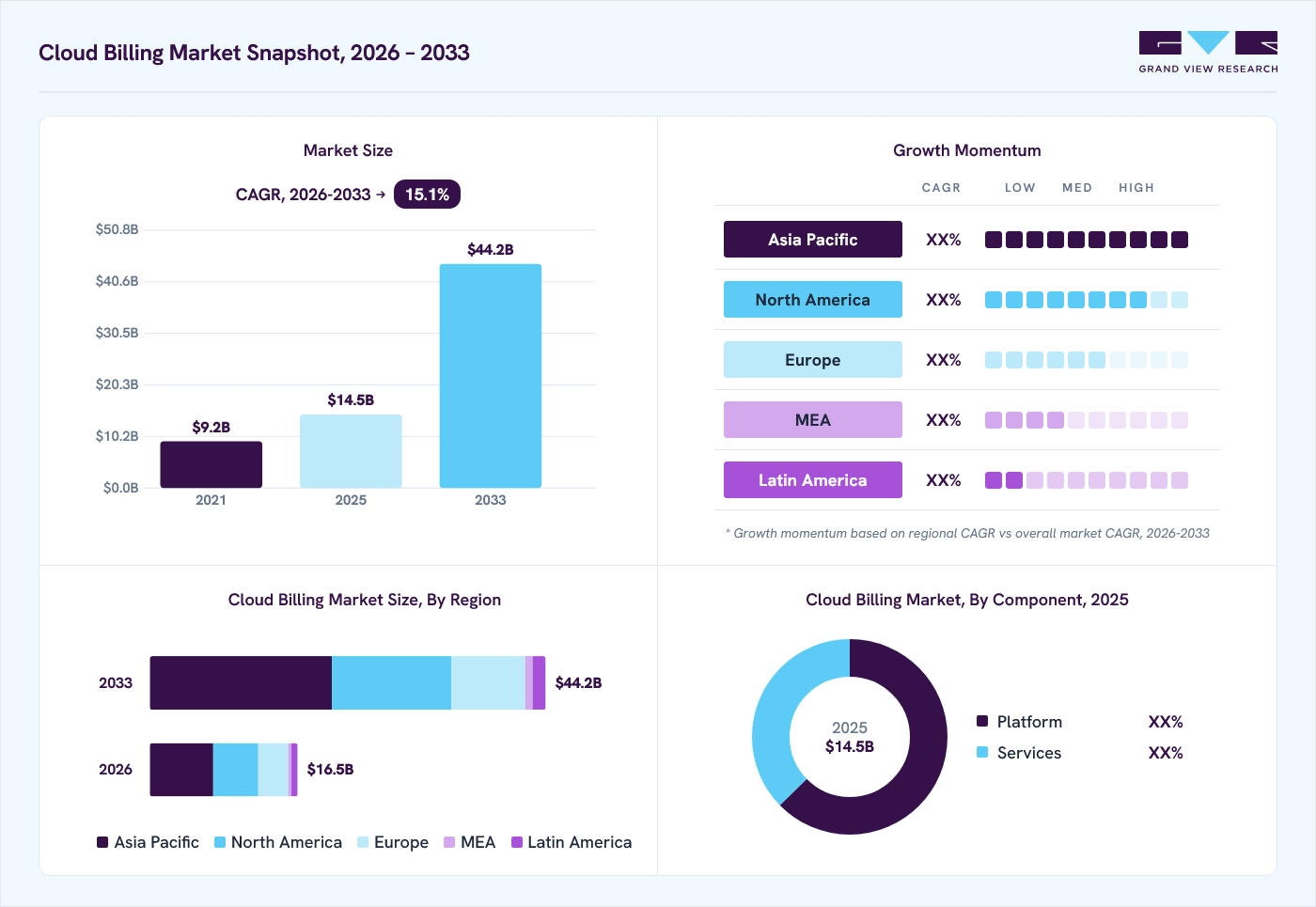
The global cloud billing market size was valued at USD 14.5 billion in 2025 and is projected to grow from USD 16.5 billion in 2026 to USD 44.2 billion by 2033, at a CAGR of 15.1% from 2026 to 2033. Asia Pacific dominated the market, accounting for the revenue share of 42.4% in 2025. The growing adoption of multi-cloud and hybrid-cloud environments is driving demand for cloud billing solutions to manage complex usage, costs, and invoicing across multiple providers.
 Source: Grand View Research, IR Documents, Primary Interviews, Paid DatabasesTo learn more about this report,
 Download Free Sample Report
 Key Market Trends & Insights
- By component: Platform segment dominated the market, with a revenue share of 62.6% in 2025.
- By deployment: Public segment led the market and accounted for a share of 57.1% in 2025.
- By billing model: Subscription-based segment dominated the market, with a revenue share of 57.5% in 2025.
- By service model: SaaS segment dominated the market, with a revenue share of 47.1% in 2025.
- By end use: IT & telecommunications segment held the largest revenue share in 2025.
Regional Highlights
- Largest regional market: Asia Pacific (42.4% revenue share, 2025)
- By country: China held the largest market share in 2025
Market Size & Forecast
- Market size in 2025: USD 14.5 Billion
- Estimated market size in 2026: USD 16.5 Billion
- Projected market size by 2033: USD 44.2 Billion
- CAGR (2026-2033): 15.1%
Three ways to get this report
Buy it, customize it, or ask a question.Ask an Analyst
A direct answer, usually in 1 working day
- AccessReport author, directly
- Reply timeWithin 1 working day
- No sales callDirect answer only
- FormatEmail reply
- CostFree, no cost
Get the Full Report
What the study covers
- FormatsPDF · Excel · Dashboard
- Timeline2026–2033 annual, 2025 base
- Coverage20+ countries, 5 regions
- Companies10+ key players profiled
Customize the Report
20% free customization
- IncludeCountries, segments, points
- TailorTo your product definition
- ExtendDeeper competitor detail
- OrA fully bespoke study
- Turnaround5–10 working days
The rapid adoption of multi-cloud and hybrid-cloud environments is a significant growth driver for the cloud billing market. Enterprises are increasingly deploying workloads across multiple public cloud providers, private clouds, and on-premises infrastructure to improve flexibility, scalability, performance, and cost efficiency. However, managing billing across different cloud platforms is highly complex because each provider uses distinct pricing models, billing structures, usage metrics, discounts, contracts, and invoicing mechanisms. Cloud billing solutions address this challenge by providing centralized visibility into cloud consumption and expenditure, enabling organizations to monitor usage, allocate costs across business units and projects, identify billing discrepancies, and automate invoice generation. The increasing complexity of cloud spending, particularly among large enterprises operating distributed and multi-cloud infrastructures, is therefore increasing demand for sophisticated billing and financial management platforms.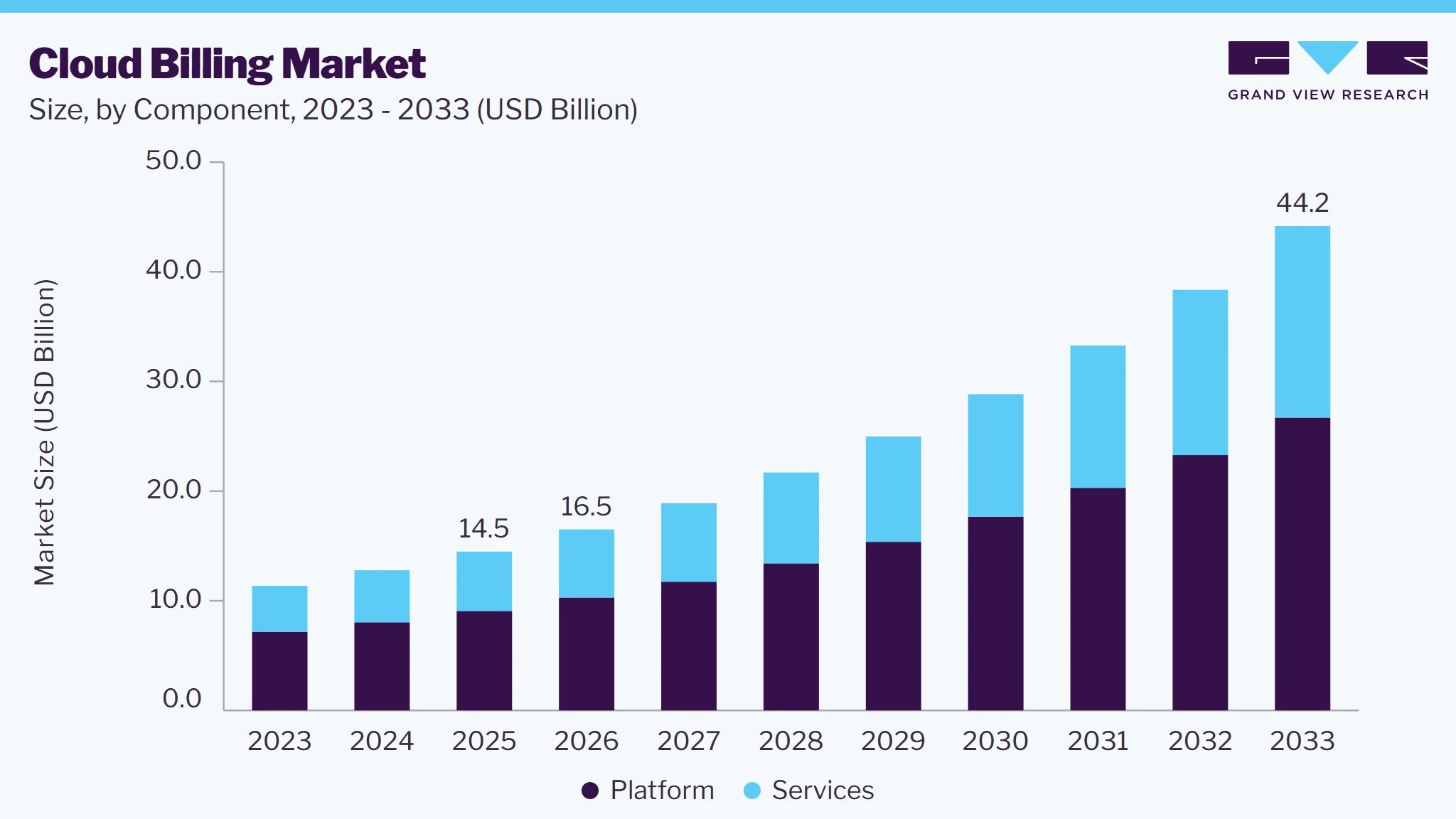 To learn more about this report, Download Free Sample Report
 The growing migration of businesses toward cloud-based applications and services is another significant factor supporting market growth. As organizations expand their use of SaaS, IaaS, and PaaS offerings, the volume of cloud transactions and consumption-based charges continues to increase. This has created a need for automated systems capable of managing subscription billing, usage-based pricing, recurring payments, customer invoicing, taxation, revenue recognition, and payment reconciliation. Cloud billing platforms also enable service providers and enterprises to introduce flexible pricing models, such as pay-as-you-go, tiered pricing, volume-based discounts, and subscription-based plans. Furthermore, the increasing emphasis on FinOps and cloud cost optimization is encouraging organizations to integrate billing data with financial and operational management systems, enabling them to improve cost allocation, forecast expenditure, control cloud waste, and make data-driven decisions about cloud resource consumption.
Market Dynamics
The cloud billing market is driven by the growing adoption of cloud computing, SaaS Service Models, consumption-based services, and multi-cloud environments, which are increasing the complexity of tracking, rating, invoicing, and managing cloud-related revenues and expenses. Organizations and cloud service providers are increasingly adopting cloud billing platforms to automate subscription management, usage metering, invoice generation, revenue recognition, payment processing, and customer account management. The proliferation of AI, real-time analytics, APIs, cloud marketplaces, embedded finance, and automated revenue operations is further transforming cloud billing systems from basic invoicing tools into intelligent platforms that support dynamic pricing, personalized billing, revenue optimization, and real-time financial visibility.
The increasing adoption of consumption-based, subscription-based, and hybrid pricing models is driving the cloud billing market as cloud providers and digital businesses require more sophisticated systems to accurately measure service consumption and generate bills. Organizations are increasingly moving beyond fixed recurring subscriptions toward pricing structures based on compute usage, storage consumption, transactions, API calls, data volumes, and other service-specific metrics. Cloud billing platforms enable automated usage metering, rating, pricing, invoicing, and revenue management across these complex commercial models. The growth of multi-cloud environments and digital services is further increasing the need for a flexible billing infrastructure that can consolidate multiple products, customers, currencies, contracts, and pricing arrangements into unified billing workflows.
Complex integration requirements and fragmented enterprise technology environments can constrain growth in the cloud billing market. Organizations often operate multiple CRM, ERP, payment, accounting, subscription management, customer support, cloud management, and legacy billing systems that use different data formats, application architectures, and operational processes. Integrating cloud billing platforms with these heterogeneous systems can require substantial investments in APIs, middleware, data migration, workflow customization, and system testing. Challenges associated with maintaining billing accuracy, synchronizing real-time usage data, ensuring revenue-recognition compliance, and protecting sensitive customer and financial information can further increase implementation complexity, particularly for large enterprises and organizations operating across multiple countries and regulatory jurisdictions.
The growing application of AI, machine learning, advanced analytics, and FinOps practices creates a significant opportunity for cloud billing providers to expand beyond traditional invoice generation and payment processing. AI-enabled billing platforms can analyze large volumes of consumption, customer, pricing, and payment data to identify billing anomalies, forecast revenues, optimize pricing, detect potential revenue leakage, automate collections, and provide personalized recommendations. The increasing adoption of FinOps and cloud cost-management practices is also expanding demand for platforms that combine cloud usage visibility with financial governance, chargeback, showback, budgeting, forecasting, and cost optimization. This creates opportunities for cloud billing vendors to develop integrated platforms that support both revenue-side billing operations and enterprise cloud financial management.
Analyst Perspective
The convergence of cloud computing, SaaS, consumption-based pricing, AI, FinOps, API-driven services, and automated revenue operations is expected to increasingly shape the cloud billing market. Organizations are moving from traditional billing systems designed around fixed products and recurring invoices to intelligent platforms that manage dynamic service consumption, complex pricing structures, subscriptions, usage events, payments, and revenue processes in real time. AI is expected to transform cloud billing platforms from transactional systems into proactive revenue and financial intelligence solutions that can identify anomalies, predict customer usage, optimize pricing, reduce revenue leakage, and improve financial forecasting. Demand is likely to increase for cloud billing architectures that support multi-cloud and hybrid-cloud environments and address requirements for data security, regulatory compliance, billing accuracy, interoperability, and scalability.
Component Insights
The platform segment dominated the market and accounted for the revenue share of 62.6% in 2025, driven by the increasing need for centralized, scalable billing infrastructure capable of managing complex subscription plans, usage-based charging, pricing rules, invoicing, payments, and customer accounts across cloud services. As cloud providers and digital businesses expand their product portfolios and customer bases, demand is increasing for configurable billing platforms that can integrate with CRM, ERP, payment gateways, cloud marketplaces, and other enterprise applications while supporting automation and real-time billing operations.
The services segment is anticipated to grow at a significant CAGR during the forecast period, driven by the growing implementation complexity of cloud billing solutions, particularly among enterprises with legacy billing environments, multiple cloud platforms, and customized pricing structures. Organizations increasingly require consulting, system integration, migration, customization, managed services, and ongoing support to connect billing platforms with existing IT and financial systems, optimize billing workflows, and ensure accurate deployment and operation.
Deployment Insights
The public segment dominated the market and accounted for the revenue share of 57.1% in 2025 due to the rapid expansion of SaaS, digital platforms, and cloud-native services, which require highly scalable and cost-efficient billing systems. Public cloud deployment enables organizations to rapidly implement billing capabilities without substantial upfront infrastructure investments while supporting elastic capacity, global accessibility, automatic updates, and integration with cloud-based business applications.
The hybrid segment is anticipated to grow at a significant CAGR during the forecast period, driven by enterprises seeking to combine the scalability of cloud-based billing with the security, control, and data management capabilities of private infrastructure. This model is particularly attractive for organizations operating legacy systems or handling sensitive financial and customer information, as it enables selected billing workloads and data to remain within controlled environments while leveraging public cloud resources for scalable processing and analytics.
Billing Model Insights
The subscription-based segment dominated the market and accounted for the revenue share of 57.5% in 2025 due to the continued growth of recurring-revenue business models across SaaS, digital media, telecommunications, software, and cloud services. As providers manage increasingly diverse subscription tiers, add-ons, discounts, renewals, upgrades, and customer lifecycles, demand is growing for billing systems that can automate recurring invoicing, payment collection, account management, and revenue-recognition processes.
The hybrid segment is expected to grow at a significant CAGR during the forecast period, driven by the increasing adoption of commercial models that combine fixed subscription fees with variable, consumption-based charges. Cloud and digital service providers are increasingly offering base service packages alongside usage-based pricing for computing resources, storage, transactions, API consumption, and premium capabilities, creating demand for billing platforms that can simultaneously manage both recurring and variable revenue streams within a unified billing framework.
Service Model Insights
The SaaS segment dominated the market and accounted for the revenue share of 47.1% in 2025, driven by the rapid growth of cloud-delivered software and recurring subscription models, which generate large volumes of recurring billing events across different customer tiers, contract structures, and service bundles. The increasing use of self-service purchasing, freemium models, upgrades, add-ons, and global subscriptions is further driving demand for automated cloud billing platforms that can efficiently manage the complete customer subscription lifecycle.
The PaaS segment is expected to grow at a significant CAGR during the forecast period, driven by the increasing adoption of cloud-native application development, APIs, managed databases, AI development tools, and application platforms, which often use variable or consumption-based pricing. As developers and enterprises consume platform resources based on compute capacity, transactions, storage, or API usage, providers require sophisticated metering and billing capabilities to accurately capture usage data and apply dynamic pricing models.
End Use Insights
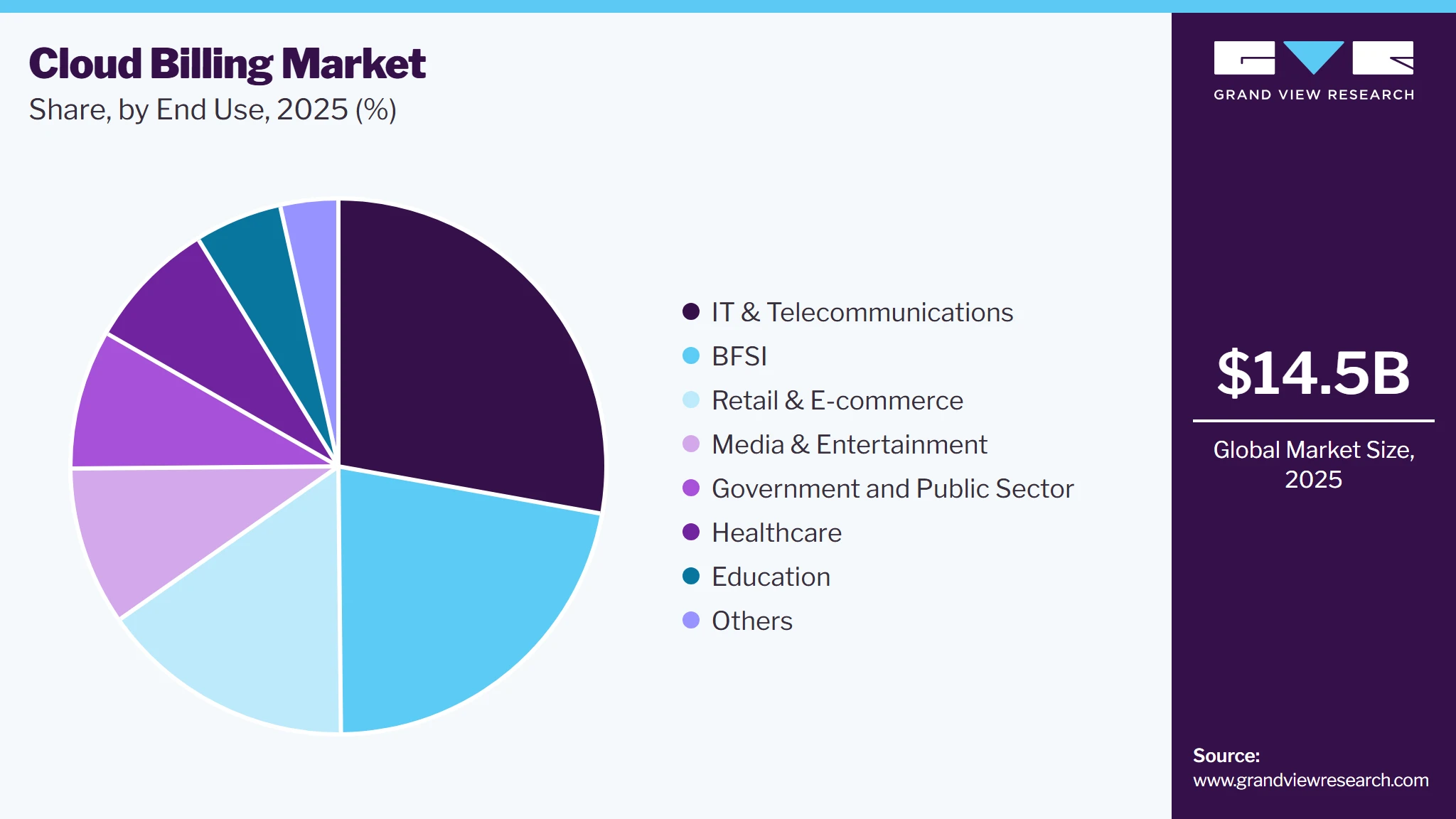
The IT & telecommunications segment dominated the market and accounted for the revenue share of 27.8% in 2025, supported by the increasing complexity of digital service portfolios, including cloud connectivity, managed services, APIs, software platforms, data services, and emerging consumption-based offerings. Providers require advanced billing systems to consolidate high volumes of usage data, support multiple pricing models, manage large customer bases, and enable faster monetization of new digital and cloud-based services.
 To learn more about this report, Download Free Sample Report
 The BFSI segment is expected to grow at a significant CAGR over the forecast period, driven by the growing adoption of cloud-based financial applications, digital banking platforms, fintech services, and embedded financial products that require secure, accurate, and transparent billing and payment processes. Financial institutions increasingly need automated systems capable of managing complex fee structures, recurring charges, transaction-based pricing, regulatory reporting, and revenue recognition while maintaining strong data security, auditability, and compliance controls.
Regional Insights
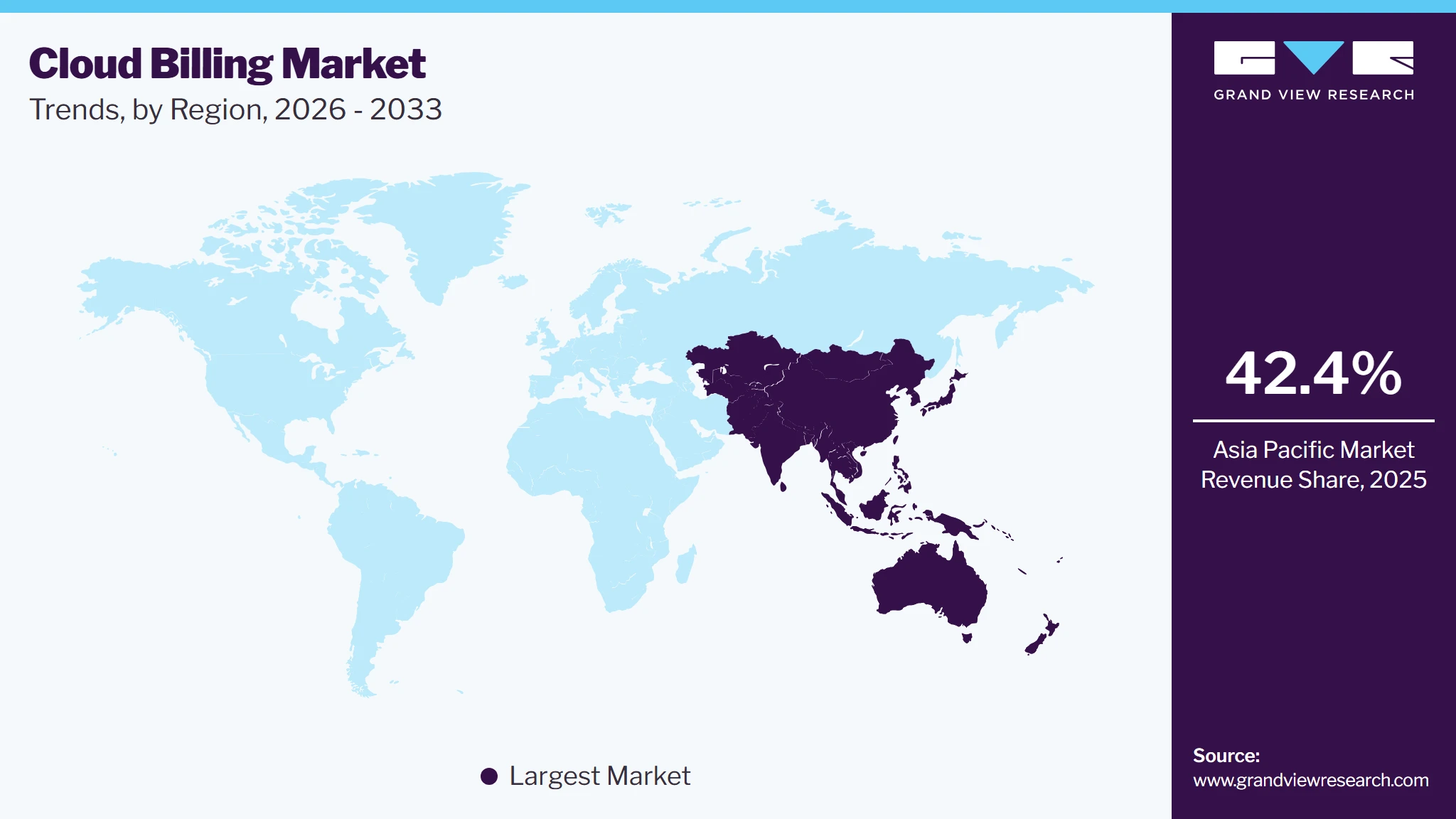
The Asia Pacific cloud billing market dominated the global industry with the largest revenue share of 42.4% in 2025, driven by the rapid expansion of digital economies and the increasing adoption of cloud services among enterprises and small and medium-sized businesses. The region's diverse and fast-growing markets are driving demand for scalable billing systems that can support high customer volumes, localized payment methods, multiple currencies, varying tax structures, and flexible pricing models, while enabling cloud and digital service providers to expand across multiple countries.
 To learn more about this report, Download Free Sample Report
 The Japan cloud billing market is expected to grow rapidly in the coming years, driven by the modernization of enterprise IT environments and the increasing migration of traditionally on-premises business systems toward cloud and managed-service models. As Japanese enterprises adopt recurring IT services while continuing to operate complex legacy environments, demand is growing for cloud billing solutions that can support integration, automated contract administration, recurring charges, and the gradual transition from conventional software licensing toward service-based consumption.
The cloud billing market in China held a substantial market share in 2025, due to the rapid expansion of domestic cloud platforms, digital ecosystems, and large-scale internet-based services that generate substantial transaction and usage volumes. The growth of e-commerce, digital content, cloud infrastructure, enterprise software, and AI services is increasing the need for high-volume billing platforms capable of supporting real-time usage measurement, localized pricing structures, automated transactions, and scalable revenue management across large digital customer ecosystems.
North America Cloud Billing Market Trends
The cloud billing market in North America held a significant share in 2025, driven by the region’s highly developed cloud ecosystem and the widespread adoption of multi-cloud, SaaS, and consumption-based digital services. The expansion of SaaS, PaaS, and cloud-native applications is encouraging businesses to adopt flexible consumption-based pricing models. Cloud billing solutions enable providers to manage usage-based, subscription, tiered, and hybrid pricing structures while automating billing calculations and recurring invoicing, supporting the expansion of cloud-based commercial models across North America.
U.S. Cloud Billing Market Trends
The cloud billing market in the U.S. is expected to grow significantly at a CAGR of 15.1% from 2026 to 2033. The rapid commercialization of AI, cloud-native applications, APIs, and digital platforms is increasing demand for cloud billing systems that support real-time usage tracking, dynamic pricing, and flexible monetization models.
Europe Cloud Billing Industry Trends
The cloud billing market in Europe is anticipated to grow considerably from 2026 to 2033 due to increasing regulatory and financial governance requirements associated with cloud adoption, digital services, and cross-border operations. Organizations require billing platforms that can support multiple currencies, taxation frameworks, invoicing requirements, revenue recognition processes, and data management obligations across European markets, thereby encouraging investment in configurable and compliant cloud billing infrastructure.
The UK cloud billing market is expected to grow rapidly in the coming years, owing to the expanding adoption of subscription-based business models across financial services, software, telecommunications, professional services, and digital commerce.
The cloud billing market in Germany held a substantial market share in 2025 due to the growing digitalization of industrial enterprises and the increasing adoption of Industry 4.0, connected equipment, and cloud-enabled industrial services. Manufacturers are increasingly monetizing software, connected machinery, predictive maintenance, and digital capabilities through recurring and usage-based commercial models, creating demand for billing platforms that integrate operational data with flexible pricing, contract management, and automated invoicing.
Key Cloud Billing Company Insights
Key players operating in the cloud billing industry are Amdocs Inc., Oracle Corporation, Stripe Inc., Zuora Inc., SAP SE, and Salesforce Inc. The companies are focusing on various strategic initiatives, including new product development, partnerships & collaborations, and agreements to gain a competitive advantage over their rivals. The following are some instances of such initiatives.
-
In June 2026, Zuora Inc. announced the launch of its AI Monetization Suite, introducing new capabilities designed to help businesses manage the monetization of AI products from pricing through revenue recognition. The suite enables companies to support flexible pricing models based on usage, tokens, credits, commitments, outcomes, and hybrid structures, while providing tools to simulate pricing strategies and assess their potential impact on revenue and margins. It also incorporates metered entitlements for tracking AI usage, flexible commitments spanning recurring and usage-based charges, and customer-facing tools for monitoring consumption, balances, overages, and top-ups. By connecting usage measurement, billing, and revenue recognition within a unified platform, the offering aims to help businesses manage the increasing complexity of consumption-based and AI-driven billing models.
-
In April 2026, RecVue Inc. and RESPEC announced a strategic partnership aimed at helping enterprises optimize revenue operations through advanced automation and AI-enabled capabilities. The collaboration combines RecVue’s cloud-based billing and revenue management platform with RESPEC’s consulting and technology expertise to support organizations in managing complex pricing, billing, revenue recognition, and monetization processes. The partnership is intended to improve operational efficiency, accelerate revenue transformation, and help businesses manage increasingly complex subscription and usage-based business models. Source announcement
Key Cloud Billing Companies
The following key companies have been profiled for this study on the cloud billing market.
-
Amdocs Inc.
-
Aria Systems Inc.
-
BillingPlatform LLC
-
Cerillion plc
-
Chargebee Inc.
-
CloudBlue
-
Gotransverse LLC
-
LogiSense Corporation
-
Oracle Corporation
-
Recurly Inc.
-
RecVue Inc.
-
Salesforce Inc.
-
SAP SE
-
Stripe Inc.
-
Zuora Inc.
Competitive Benchmarking
Category
Operating Strategies
Competitive Edge
Weakness
Established Players (Amdocs Inc., Oracle Corporation, Stripe Inc., Zuora Inc., SAP SE, and Salesforce Inc.)
Focus on comprehensive cloud billing, subscription management, usage-based billing, charging, invoicing, revenue recognition, monetization, and quote-to-cash platforms.
Invest in AI-enabled billing, real-time usage metering, automated invoicing, revenue management, cloud-native architectures, and flexible pricing models.
Expand cloud billing capabilities through strategic partnerships, acquisitions, product integrations, AI development, and cloud ecosystem alliances.
Target enterprises, telecommunications providers, SaaS companies, digital service providers, and businesses transitioning toward subscription and consumption-based models.
Strong global brands, extensive enterprise customer bases, established relationships with large enterprises and service providers, and broad technology ecosystems.
Comprehensive portfolios spanning cloud infrastructure, ERP, CRM, payments, subscription management, AI, analytics, billing, charging, and revenue management enable end-to-end monetization capabilities.
Emerging Players (Cerillion plc, Chargebee Inc., RecVue Inc., Recurly Inc.)
Focus on specialized subscription billing, recurring billing, usage-based billing, revenue management, invoicing, subscription lifecycle management, and monetization solutions.
Emphasize modular cloud-native platforms, automated billing workflows, flexible pricing models, API-driven architectures, and support for emerging AI and consumption-based business models.
Expand capabilities through partnerships with cloud providers, payment platforms, SaaS companies, system integrators, and enterprise technology providers.
Emphasize rapid deployment, modular architectures, API integration, self-service capabilities, and specialized use cases such as SaaS subscriptions, usage-based pricing, recurring payments, and complex enterprise monetization.
Greater flexibility and faster deployment compared with complex enterprise-wide platforms. Strong capabilities in specialized areas such as subscription management, usage metering, recurring billing, flexible pricing, automated invoicing, and revenue operations.
Modular solutions are attractive to organizations seeking targeted billing capabilities without replacing existing ERP, CRM, or financial infrastructure.
Cloud Billing Market Report Scope
Report Attribute
Details
Market size in 2025
USD 14.5 billion
Estimated market size in 2026
USD 16.5 billion
Projected market size by 2033
USD 44.2 billion
Growth Rate
CAGR of 15.1% from 2026 to 2033
Actual data
2021 - 2025
Forecast period
2026 - 2033
Quantitative units
Revenue in USD billion and CAGR from 2026 to 2033
Report coverage
Revenue forecast, company share, competitive landscape, growth factors, and trends
Segments covered
Component, deployment, billing model, service model, end use, region
Regional scope
North America; Europe; Asia Pacific; Latin America; MEA
Country scope
U.S.; Canada; Mexico; UK; Germany; France; China; India; Japan; Australia; South Korea; Brazil; UAE; Kingdom of Saudi Arabia; South Africa
Key companies profiled
Amdocs Inc.; Aria Systems Inc.; BillingPlatform LLC; Cerillion plc; Chargebee Inc.; CloudBlue; Gotransverse LLC; LogiSense Corporation; Oracle Corporation; Recurly Inc.; RecVue Inc.; Salesforce Inc.; SAP SE; Stripe Inc.; Zuora Inc.
Customization scope
Free report customization (equivalent to 8 analysts working days) with purchase. Addition or alteration to country, regional & segment scope.
Pricing and purchase options
Avail customized purchase options to meet your exact research needs. Explore purchase options
Global Cloud Billing Market Report Segmentation
This report forecasts revenue growth at the global, regional, and country levels and provides an analysis of the latest industry trends in each of the sub-segments from 2021 to 2033. For this study, Grand View Research has segmented the global cloud billing market report based on component, deployment, billing model, service model, end use, and region.
-
Component Outlook (Revenue, USD Billion, 2021 - 2033)
-
Platform
-
Service
-
-
Deployment Outlook (Revenue, USD Billion, 2021 - 2033)
-
Public
-
Private
-
Hybrid
-
-
Billing Model Outlook (Revenue, USD Billion, 2021 - 2033)
-
Subscription-based
-
Usage-based
-
Hybrid
-
-
Service Model Outlook (Revenue, USD Billion, 2021 - 2033)
-
IaaS
-
PaaS
-
SaaS
-
-
End Use Outlook (Revenue, USD Billion, 2021 - 2033)
-
BFSI
-
IT & Telecommunications
-
Education
-
Government and Public Sector
-
Media & Entertainment
-
Retail & E-commerce
-
Healthcare
-
Others
-
-
Regional Outlook (Revenue, USD Billion, 2021 - 2033)
-
North America
-
U.S.
-
Canada
-
Mexico
-
Europe
-
UK
-
Germany
-
France
-
Asia Pacific
-
China
-
India
-
Japan
-
South Korea
-
Australia
-
Latin America
-
Brazil
-
Middle East & Africa
-
UAE
-
Saudi Arabia
-
South Africa
-
Research Methodology
The cloud billing market figures in this report are based on a proven research process that combines executive interviews with secondary research from proprietary databases, company filings, and recognized regulatory and institutional sources. Market size is built through value-chain sizing-reconciling supply-side and demand-side estimates-and triangulated with bottom-up and top-down approaches. Every estimate passes multiple levels of expert validation before publication, with eachcloud billingsegment quantified using the revenue-capture definitions in the table below.
Segment Definition
Component
Revenue capture definition
Platform
Market value is captured through cloud-based billing and monetization software platforms used to manage subscriptions, usage metering, rating, charging, invoicing, payments, pricing, collections, revenue recognition, and customer account management. Revenue includes software licensing, subscription fees, platform fees, transaction-related charges, and other recurring or usage-based fees attributable to cloud billing platforms.
Service
Market value is captured through professional, implementation, integration, consulting, managed, maintenance, and support services associated with cloud billing platforms. Revenue includes implementation and configuration fees, system integration, migration, customization, consulting, training, technical support, and managed billing services attributable to cloud billing deployments.
Deployment
Revenue capture definition
Public
Market value is captured from cloud billing platforms deployed on third-party public cloud infrastructure, where billing applications and related data are hosted by public cloud providers and accessed over the internet. Revenue includes public-cloud-based billing software subscriptions, platform fees, and associated services.
Private
Market value is captured from cloud billing platforms deployed within a dedicated private-cloud environment operated for a single organization. Revenue includes private-cloud software, licensing or subscription fees, implementation, customization, maintenance, and related services.
Hybrid
Market value is captured from cloud billing solutions that combine public-cloud and private-cloud or on-premises environments to manage billing, usage, customer, and financial data. Revenue includes software and services associated with integrating and operating billing workloads across multiple deployment environments.
Billing Model
Revenue capture definition
Subscription-based
Market value is captured through recurring fixed or tiered subscription fees charged for access to cloud billing software and related functionality. Revenue includes monthly or annual subscription charges based on customers, users, accounts, features, transactions, or subscription tiers.
Usage-based
Market value is captured through consumption- or transaction-based charges determined by actual usage of cloud billing capabilities. Revenue includes fees based on transactions, API calls, invoices generated, usage records processed, metered consumption, customers, computing resources, or other measurable billing activities.
Hybrid
Market value is captured through a combination of subscription and usage-based pricing, where customers pay a recurring platform fee together with variable charges based on transactions, usage, customers, invoices, or other consumption metrics.
Service Model
Revenue capture definition
IaaS
Market value is captured from cloud billing solutions supporting the billing, rating, metering, invoicing, and monetization of Infrastructure-as-a-Service resources, including compute, storage, networking, and other infrastructure consumption.
PaaS
Market value is captured from cloud billing solutions supporting the billing and monetization of Platform-as-a-Service resources, including databases, development environments, middleware, APIs, application platforms, and other developer-oriented cloud services.
SaaS
Market value is captured from cloud billing solutions supporting the subscription, usage, invoicing, payment, and revenue management of Software-as-a-Service applications. This includes recurring subscriptions, seat-based pricing, usage-based pricing, consumption billing, and hybrid SaaS monetization models.
End Use
Revenue capture definition
BFSI
Market value is captured from cloud billing solutions used by banks, financial institutions, insurance companies, fintech companies, and other financial service providers to manage subscription, transaction, usage, and service billing.
IT & Telecommunications
Market value is captured from billing platforms used by IT service providers, cloud providers, telecom operators, SaaS companies, and digital service providers to manage subscriptions, usage-based services, charging, invoicing, and complex monetization models.
Education
Market value is captured from cloud billing solutions used by educational institutions, e-learning platforms, EdTech companies, and education service providers to manage subscriptions, course fees, usage charges, and recurring payments.
Government and Public Sector
Market value is captured from cloud billing platforms used by government agencies and public-sector organizations to manage service charges, subscriptions, digital services, invoicing, and payments.
Media & Entertainment
Market value is captured from billing solutions used by streaming platforms, digital media companies, gaming providers, publishers, and entertainment services to manage subscriptions, usage-based charges, advertising-related billing, and digital service monetization.
Retail & E-commerce
Market value is captured from cloud billing platforms used by retailers, e-commerce companies, marketplaces, and digital commerce providers to manage subscriptions, memberships, recurring services, transactions, and customer billing.
Healthcare
Market value is captured from cloud billing solutions used by healthcare providers, health-tech companies, digital health platforms, and medical service organizations to manage subscriptions, recurring services, usage-based charges, and invoicing.
Others
Market value is captured from cloud billing deployments across manufacturing, energy & utilities, travel & hospitality, transportation & logistics, professional services, automotive, and other industries using subscription, usage-based, or hybrid monetization models.
Estimation Model
Layer
Question
Analysis
Cloud Service & Billing Demand Layer
Where is cloud billing required?
Identify cloud-based business environments where organizations require automated management of subscriptions, usage, pricing, charging, invoicing, payments, collections, and revenue recognition. This layer evaluates demand across SaaS providers, IaaS and PaaS providers, telecommunications companies, digital service providers, cloud marketplaces, financial services, media and entertainment, retail, healthcare, education, government, and other organizations adopting recurring, consumption-based, or hybrid monetization models.
Cloud Billing Technology & Infrastructure Layer
What enables cloud billing implementation?
Assess the technologies and infrastructure supporting cloud billing, including cloud-native billing platforms, usage metering, rating engines, charging systems, subscription management, payment gateways, APIs, AI/ML, analytics, revenue recognition, ERP/CRM integrations, data platforms, cybersecurity, and cloud infrastructure. Effective implementation depends on the ability to collect and process high volumes of usage data, apply complex pricing rules, integrate billing with enterprise applications, and provide accurate, scalable, and real-time billing information.
Cloud Billing Application & Deployment Layer
How are cloud billing capabilities delivered?
Analyze the delivery models through which cloud billing capabilities are operationalized, including public, private, and hybrid-cloud deployments supporting subscription billing, usage-based billing, recurring payments, invoicing, charging, collections, and revenue management. Providers deliver capabilities through SaaS platforms, cloud-native applications, APIs, metering and rating engines, automated invoicing, payment integrations, customer portals, billing analytics, AI-powered revenue management, and enterprise-system integrations, supported by implementation, consulting, integration, and managed services.
Cloud Billing Solutions & Enterprise Economics Layer
How is value generated within the cloud billing ecosystem?
Evaluate revenue generated through billing platform subscriptions, software licenses, usage-based fees, transaction charges, implementation and systems integration, consulting, customization, managed services, maintenance, technical support, and professional services. Additional enterprise value is generated through automated billing processes, reduced billing errors, faster invoice generation, improved cash collection, lower administrative costs, enhanced pricing flexibility, accurate revenue recognition, reduced revenue leakage, improved customer experience, and greater visibility into cloud consumption and monetization.
Delivered Customizations
This report has been delivered with the following In-depth customizations
Client Request
Customization Delivered
Value Adds
Cloud Billing Technology Integration & Monetization Trends
- Analyzed cloud billing technologies including usage metering, rating engines, subscription management, charging, invoicing, APIs, AI/ML, cloud infrastructure, payment gateways, analytics, and ERP/CRM integration.
- Helps identify cloud billing technology and integration opportunities.
- Provides insights into automation, interoperability, real-time usage processing, pricing flexibility, and monetization capabilities.
Cloud Billing, AI-Powered Monetization & Revenue Management Trends
- Evaluated adoption of subscription billing, usage-based billing, consumption-based pricing, hybrid pricing, automated invoicing, collections, and revenue recognition.
- Assessed adoption of AI, machine learning, analytics, automation, and real-time billing intelligence for cloud monetization.
- Highlights emerging AI-driven billing and monetization opportunities, particularly for SaaS, IaaS, PaaS, and AI services.
- Enables understanding of the convergence of AI, cloud consumption, usage-based pricing, automated billing, and revenue management.
Cloud Billing Application & Enterprise Opportunity Assessment
- Assessed key applications across IT & telecommunications, BFSI, media & entertainment, retail & e-commerce, healthcare, education, government & public sector, and other industries.
- Evaluated public vs. private vs. hybrid deployment, subscription vs. usage-based vs. hybrid billing, and platform vs. services adoption.
- Helps prioritize opportunities for cloud billing vendors, payment providers, system integrators, cloud service providers, and managed-service providers.
Frequently Asked Questions About This Report
The platform segment led with a 62.6% revenue share in 2025, while the services segment is the fastest-growing segment.
The public segment led with a 57.1% revenue share in 2025, while the hybrid segment is the fastest-growing segment.
Key players operating in the cloud billing market include Amdocs Inc., Aria Systems Inc., BillingPlatform LLC, Cerillion plc, Chargebee Inc., CloudBlue, Gotransverse LLC, LogiSense Corporation, Oracle Corporation, Recurly Inc., RecVue Inc., Salesforce Inc., SAP SE, Stripe Inc., Zuora Inc.
The global cloud billing market size was estimated at USD 14.5 billion in 2025 and is expected to reach USD 16.5 billion in 2026.
The global cloud billing market is expected to grow at a compound annual growth rate of 15.1% from 2026 to 2033 to reach USD 44.2 billion by 2033.
Key factors include growing adoption of multi-cloud and hybrid-cloud environments to manage complex usage, costs, and invoicing across multiple providers.
The SaaS segment held the largest share (over 47.1%) in 2025, while the PaaS segment is the fastest-growing segment.
Asia Pacific dominated with 42.4% revenue share in 2025.
Subscription-based segment dominated the market, with a revenue share of 57.5% in 2025.
About the Author(s)
Communication Services Research Team
Technology · Communication ServicesThis report was authored by the communication services research team at Grand View Research - comprising two research analysts, one senior research analyst, and one industry expert - with specialized expertise in the communication services segment of the technology industry. All findings are based on proprietary technology databases, executive interviews, and regulatory analysis, subject to internal peer review prior to publication.
Last Updated:
Speak to Analyst

Customize this report to your needs - add regions, segments, or data points, with 20% free customization.
Or view our licence options:


ISO 9001:2015 & 27001:2022 Certified
We are GDPR and CCPA compliant! Your transaction & personal information is safe and secure. For more details, please read our privacy policy.


