
- Home
- »
- Communications Infrastructure
- »
-
Cloud Migration Services Market Size Report, 2026 - 2033GVR Report cover

Cloud Migration Services Market (2026 - 2033)
Size, Share & Trends Analysis Report By Platform(Solution, Service), By Deployment (Private, Public, and Hybrid), By Enterprise Size (Large Size Enterprises, SMEs), By End Use Industry, By Region, And Segment Forecasts
Market Size, 2025
$42.0BMarket Estimate, 2026
$50.5BMarket Forecast, 2033
$224.7BCAGR, 2026–2033
23.8%Cloud Migration Services Market Summary
The global cloud migration services market size was valued at USD 42.0 billion in 2025 and is projected to grow from USD 50.5 billion in 2026 to USD 224.7 billion by 2033, at a CAGR of 23.8% from 2026 to 2033. The North America market dominated, with a revenue share of 39.4% in 2025. The increasing preference for rapid and streamlined application deployment through a pay-as-you-go model, along with the widespread integration of cloud-based migration into business operations, is expected to accelerate market growth.
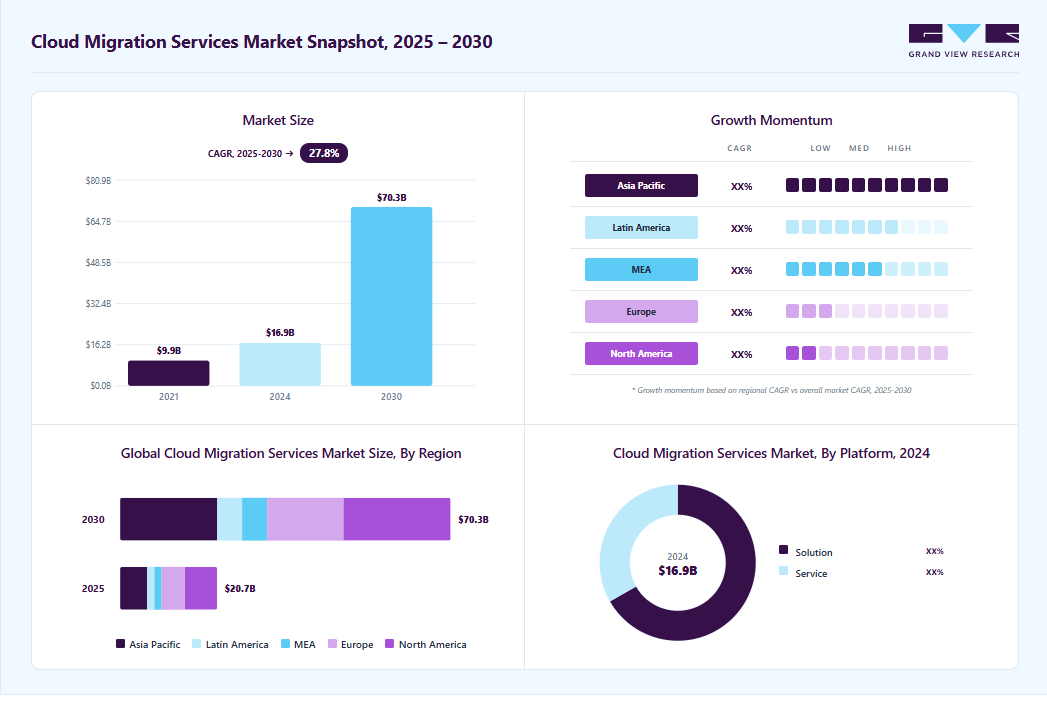 Source: Grand View Research, IR Documents, Primary Interviews, Paid DatabasesTo learn more about this report,
 Download Free Sample Report
 Key Market Trends & Insights
- By platform: Solution segment dominated the market, with a revenue share of 67.3% in 2025
- By deployment: Public segment held the largest market share of 47.3% in 2025
- By enterprise size: Large-sized enterprises segment held the largest revenue share in 2025
- By end-use industry: IT & telecommunications segment held the largest revenue share in 2025
Regional Highlights
- Largest regional market: North America (39.4% revenue share, 2025)
- Fastest-growing regional market: Asia Pacific (highest CAGR, 2026-2033)
- By country: The U.S. held the largest market share in 2025
Market Size & Forecast
- Market size in 2025: USD 42.0 Billion
- Estimated market size in 2026: USD 50.5 Billion
- Projected market size by 2033: USD 224.7 Billion
- CAGR (2026-2033): 23.8%
Three ways to get this report
Buy it, customize it, or ask a question.Ask an Analyst
Analyst response in 1 business day
- AccessReport author, directly
- Reply timeWithin 1 working day
- No sales callDirect answer only
- FormatEmail reply
- CostFree, no cost
Get the Full Report
What the study covers
- FormatsPDF · Excel · Dashboard
- Timeline2026–2033 annual, 2025 base
- Coverage20+ countries, 5 regions
- Companies10+ key players profiled
Customize the Report
20% free customization
- IncludeCountries, segments, points
- TailorTo your product definition
- ExtendDeeper competitor detail
- OrA fully bespoke study
- Turnaround5–10 working days
The need for greater business agility and the rising implementation of automation solutions are anticipated to be key drivers of market expansion in the coming years. In addition, the increasing preference for rapid and streamlined application deployment through a pay-as-you-go model, along with the widespread integration of cloud-based migration into business operations, is expected to further accelerate market growth.The increasing adoption of hybrid cloud solutions is also a significant driver of the cloud migration services market. Organizations are shifting towards hybrid cloud environments to enhance flexibility, scalability, and operational efficiency. By leveraging hybrid cloud models, businesses can optimize workloads, improve data management, and reduce costs, leading to a surge in demand for cloud migration services.
 To learn more about this report, Download Free Sample Report
 Another key factor fueling market growth is the rising need for business agility. Companies across various industries are prioritizing digital transformation initiatives to remain competitive in a rapidly evolving business landscape. Cloud migration enables organizations to respond quickly to market changes, enhance collaboration, and streamline operations, making it an essential component of modern business strategies.
The growing adoption of automation solutions is also playing a crucial role in accelerating cloud migration. Businesses are increasingly integrating automation tools to simplify migration processes, reduce downtime, and minimize operational risks. Automation-driven cloud migration enhances efficiency, lowers costs, and improves security, making it a preferred choice for enterprises looking to modernize their IT infrastructure. For instance, in December 2024, Amazon Web Services, Inc. launched AWS Migration Hub Automation, a new feature designed to streamline cloud migrations by automating common tasks. This enhancement reduces manual effort, minimizes errors, and improves efficiency, making migrations more cost-effective and scalable. The automation integrates seamlessly with existing AWS migration tools, including AWS Application Migration Service, enabling businesses to adopt AWS best practices and accelerate their transition to the cloud.
In addition, the demand for faster and more straightforward application deployment is propelling market growth. The pay-as-you-go model offered by cloud service providers allows businesses to scale resources based on demand while minimizing upfront costs. This model supports cost-effective IT infrastructure management and also facilitates seamless migration of applications, thereby driving increased adoption of cloud migration services.
Market Dynamics
The cloud migration services market is experiencing strong growth as organizations accelerate digital transformation initiatives and modernize legacy IT environments to improve scalability, agility, and operational efficiency. Enterprises across industries are increasingly migrating workloads, applications, databases, and infrastructure from on-premises environments to public, private, and hybrid cloud platforms to support business continuity, innovation, and cost optimization. The growing adoption of artificial intelligence (AI), data analytics, containerization, DevOps, and cloud-native applications is further driving demand for specialized cloud migration expertise. Additionally, organizations are seeking migration partners that can help reduce complexity, minimize downtime, and ensure security and compliance during cloud transformation projects.
The market is also being shaped by the increasing prevalence of multi-cloud and hybrid cloud strategies, where enterprises distribute workloads across multiple cloud providers to enhance resilience and avoid vendor lock-in. Cloud migration is no longer viewed as a one-time infrastructure upgrade but as a continuous modernization journey involving application transformation, cloud optimization, FinOps, security governance, and managed services. As enterprises continue to prioritize digital resilience, operational flexibility, and AI readiness, demand for cloud migration services is expected to remain robust throughout the forecast period.
The cloud migration services market is primarily driven by growing enterprise demand for modernization of legacy applications and infrastructure. Organizations are increasingly adopting cloud-first strategies to improve scalability, business agility, disaster recovery capabilities, and access to advanced technologies such as AI, machine learning, analytics, and automation. Traditional on-premise systems often struggle to meet evolving business requirements, prompting enterprises to migrate workloads to cloud environments that offer greater flexibility and operational efficiency. Furthermore, rising demand for remote work enablement, digital customer experiences, and data-driven decision-making continues to accelerate cloud adoption across industries.
The rapid expansion of multi-cloud and hybrid cloud architectures is further fueling migration activity. Enterprises are seeking specialized service providers that can manage complex migration projects, optimize cloud resource utilization, and ensure regulatory compliance throughout the migration process. As organizations increasingly view cloud infrastructure as a strategic business enabler rather than a technology upgrade, investments in migration planning, application modernization, and cloud transformation services continue to rise.
A major restraint affecting the Cloud Migration Services Market is the complexity associated with migrating mission-critical applications and legacy systems to cloud environments. Many enterprises operate highly customized and interconnected IT infrastructures that require extensive assessment, redesign, and testing before migration can occur. Concerns regarding application compatibility, data integrity, downtime risks, and operational disruption can delay migration initiatives and increase project costs.
Additionally, security, privacy, and regulatory compliance concerns remain significant barriers for organizations handling sensitive data and critical workloads. Industries such as healthcare, BFSI, and government often face strict regulatory requirements that complicate cloud migration decisions. The shortage of skilled cloud professionals and the challenges of managing hybrid environments during transition periods further contribute to implementation difficulties, particularly for organizations with limited internal cloud expertise.
Opportunity: Growth of AI-driven cloud transformation and industry-specific migration services
The increasing adoption of AI, machine learning, and cloud-native technologies presents a significant opportunity for the Cloud Migration Services Market. Enterprises are increasingly migrating to cloud environments not only to reduce infrastructure costs but also to access advanced AI capabilities, high-performance computing resources, and scalable data platforms. This trend is creating demand for migration partners capable of supporting application modernization, containerization, data platform transformation, and AI-ready cloud architectures.
Furthermore, industry-specific cloud migration services are emerging as a major growth opportunity. Organizations in sectors such as healthcare, BFSI, manufacturing, telecom, and government require tailored migration strategies that address unique compliance, security, and operational requirements. Service providers offering vertical-specific expertise, cloud optimization services, FinOps capabilities, and managed cloud operations are well positioned to benefit from the next phase of enterprise cloud adoption. The growing adoption of sovereign cloud, multi-cloud management, and cloud security services is expected to create additional long-term revenue opportunities across the cloud migration ecosystem.
Analyst Perspective
The cloud migration services market is evolving beyond simple infrastructure migration toward comprehensive cloud transformation that supports AI adoption, application modernization, advanced analytics, and greater business agility. Increasing adoption of hybrid and multi-cloud strategies is driving demand for migration expertise, cloud governance, FinOps, and optimization services. Competition is intensifying among hyperscalers, system integrators, managed service providers, and cloud specialists offering AI-powered automation, cloud security, industry-specific solutions, and sovereign cloud capabilities. Despite challenges such as legacy systems, regulatory compliance, and skills shortages, continued enterprise modernization and demand for AI-ready cloud infrastructure are expected to drive strong long-term market growth.
Platform Insights
Based on platform, the solution segment led the market with the largest revenue share of 67.3% in 2025. The rising demand for real-time data migration and analytics-driven decision-making is fueling the expansion of the solutions segment. Businesses are prioritizing solutions that enable real-time data synchronization and analytics-driven insights to ensure seamless operations during migration. These solutions help organizations maintain data integrity, improve performance monitoring, and make data-driven decisions to enhance operational efficiency. The segment is further bifurcated into infrastructure, migration, platform migration, database migration, application migration, and storage migration.
The service segment is expected to register a significant CAGR of 24.8% over the forecast period, due to the rising demand for managed services. Businesses are increasingly opting for end-to-end cloud migration services that include continuous monitoring, performance optimization, and security management. Managed service providers (MSPs) offer expertise in handling multi-cloud and hybrid cloud environments, allowing enterprises to focus on core business operations while ensuring seamless migration and cloud management. The segment is further bifurcated into professional services, and managed services.
Deployment Insights
Based on deployment, the public segment led the market with the largest revenue share of 47.3% in 2025 due to the increasing adoption of Software-as-a-Service (SaaS) applications. Enterprises are migrating their workloads to the public cloud to take advantage of cloud-native applications that support remote work, data sharing, and real-time collaboration. The rise of cloud-based productivity tools, customer relationship management (CRM) software, and enterprise resource planning (ERP) solutions is contributing to the demand for public cloud deployment.
 To learn more about this report, Download Free Sample Report
 The hybrid segment is expected to grow at a significant CAGR over the forecast period. Security and compliance concerns are also fueling the expansion of hybrid cloud deployment. Industries such as finance, healthcare, and government must adhere to strict data protection regulations, making full reliance on public cloud less viable. Hybrid cloud solutions enable businesses to store sensitive data in a private cloud while utilizing public cloud resources for non-sensitive workloads, ensuring compliance with regulatory standards while maintaining operational flexibility.
Enterprise Size Insights
Based on enterprise size, the large-sized enterprises segment led the market with the largest revenue share of 65.3% in 2025. The increasing need for digital transformation is a primary driver of cloud migration adoption among large enterprises. As global competition intensifies, organizations are prioritizing cloud-first strategies to modernize IT infrastructure, enhance operational efficiency, and improve customer experiences. Cloud migration services enable large enterprises to streamline business processes, automate workflows, and optimize resource utilization, making them a critical component of corporate digital initiatives.
The small and medium sized enterprises (SMEs) segment is expected to grow at a significant CAGR over the forecast period. The increasing adoption of cost-effective cloud solutions is a key driver of cloud migration among SMEs. Unlike large corporations with extensive IT budgets, SMEs often face financial constraints in maintaining on-premises infrastructure. Cloud migration enables these businesses to reduce capital expenditures on hardware and software, replacing them with a more affordable, pay-as-you-go model that improves cost efficiency and operational flexibility.
End Use Insights
Based on end-use industry, the IT & telecommunications segment led the market with the largest revenue share of 20.1% in 2025. The increasing use of artificial intelligence (AI), big data analytics, and Internet of Things (IoT) in the IT and telecommunications sectors is fueling the demand for cloud migration services. These technologies require powerful cloud infrastructure to process large volumes of data, run advanced analytics, and support connected devices. Cloud migration allows IT and telecommunications companies to integrate these technologies more effectively, enhancing their ability to offer smarter services and drive efficiencies in operations.
The healthcare segment is expected to grow at a significant CAGR over the forecast period. The growing volume of healthcare data, driven by the expansion of electronic health records (EHR), patient monitoring systems, and diagnostic technologies, is fueling the adoption of cloud migration services. As the volume of data continues to grow, healthcare organizations need cloud-based solutions to store, process, and analyze data securely and efficiently.
Regional Insights
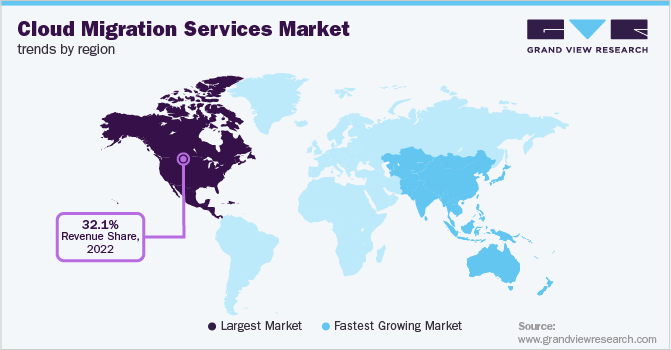
North America dominated the global cloud migration services market with the largest revenue share of 39.4% in 2025. A significant trend in North America is the increasing adoption of hybrid and multi-cloud strategies. Businesses are leveraging a mix of public, private, and multi-cloud deployments to optimize workload performance, improve data governance, and ensure business continuity. This approach allows organizations to balance security, compliance, and operational flexibility while mitigating vendor lock-in risks. The rise of advanced cloud orchestration and management tools further supports this trend, enabling seamless integration and interoperability between diverse cloud environments.
 To learn more about this report, Download Free Sample Report
 U.S. Cloud Migration Services Industry Trends
The cloud migration services market in the U.S. held the largest share in the North America region in 2025. With the rising volume of data and increasing cyber threats, security and compliance are top priorities for U.S. organizations. Cloud migration services offer enhanced security features, such as encryption, identity and access management (IAM), and continuous monitoring, which help businesses secure sensitive data and ensure compliance with stringent regulations like the Health Insurance Portability and Accountability Act (HIPAA), the General Data Protection Regulation (GDPR), and the California Consumer Privacy Act (CCPA).
Europe Cloud Migration Services Industry Trends
The cloud migration services market in Europe is anticipated to register a considerable growth from 2026 to 2033. Cloud platforms are becoming key enablers of big data analytics and business intelligence (BI) tools in Europe. As businesses accumulate vast amounts of data, migrating to the cloud enables them to store and analyze this data with greater efficiency. Cloud services provide powerful data processing and storage capabilities that allow organizations to utilize BI tools and machine learning models to extract actionable insights and make data-driven decisions. The growing use of cloud-based data lakes, analytics platforms, and reporting tools is driving further migration to the cloud, as businesses realize the value of using data analytics to stay ahead of competitors.
The UK cloud migration services market is expected to grow rapidly in the coming years. As cybersecurity becomes a critical concern, businesses in the UK are increasingly turning to cloud migration services that can offer a higher level of protection and ensure compliance with stringent data protection laws. The move to the cloud helps mitigate risks associated with data breaches, system downtimes, and cyberattacks, providing businesses with greater confidence in their IT security.
The Germany cloud migration services market held a substantial market share in 2025. As German businesses increasingly digitize their operations to integrate smart factories, IoT devices, and real-time analytics, they require scalable, flexible cloud infrastructure to support these advanced technologies. Cloud migration is seen as a key enabler of Industry 4.0, allowing companies to optimize production processes, improve supply chain management, and enhance overall operational efficiency. This drive toward automation and digitalization is a key factor driving demand for cloud migration services in Germany.
Asia Pacific Cloud Migration Services Industry Trends
Asia Pacific is expected to register the highest CAGR of 25.0% from 2026 to 2033. Asia Pacific is witnessing rapid digital transformation across various sectors, including manufacturing, retail, finance, and healthcare. Companies in the region are increasingly adopting cloud-based solutions to modernize their IT infrastructure, improve operational efficiency, and enhance customer experience. Cloud migration is a key enabler of this transformation, allowing businesses to transition from legacy systems to more flexible, scalable, and cost-efficient cloud environments. As digitalization becomes a priority for organizations across APAC, the demand for cloud migration services is expected to increase significantly.
The Japan cloud migration services market is expected to grow rapidly in the coming years. Key initiatives such as the "Society 5.0" vision aim to leverage advanced technologies, including cloud computing, IoT, and AI, to modernize industries and improve the quality of life. The government has been providing support for businesses to adopt cloud-based solutions through subsidies, regulations, and public-private partnerships.
The China cloud migration services market held a substantial market share in 2025. China’s enterprises, especially state-owned enterprises (SOEs) and large private companies, are actively seeking to modernize their IT infrastructures. Legacy systems, which have been in place for decades, are often inflexible, costly, and difficult to scale. Cloud computing offers a more agile and scalable solution to replace these outdated infrastructures. The shift from on-premises legacy systems to cloud-based systems is a significant growth driver for cloud migration services, as businesses look for efficient and flexible cloud environments to support business expansion and innovation.
Key Cloud Migration Services Company Insights
Key players operating in the cloud migration services industry are Amazon Web Services, Inc., Capgemini, Google, IBM Corporation, and Hewlett Packard Enterprise Development LP. The companies are focusing on various strategic initiatives, including new product development, partnerships & collaborations, and agreements to gain a competitive advantage over their rivals. The following are some instances of such initiatives.
-
In December 2024, Capgemini completed acquisition of Syniti, a provider of enterprise data management software and services in the U.S. The acquisition supports Capgemini’s data-driven digital transformation offerings, with a focus on large-scale SAP transformations, including migrations to SAP S/4HANA. Syniti’s expertise in managing complex data quality, migration, and governance initiatives is expected enhance Capgemini’s capacity to support in optimizing their data management and enterprise software strategies, particularly for large companies.
-
In March 2024, Accenture collaborated with Microsoft to introduce a Cloud Modernization and Migration Factory on Microsoft Azure Government, designed to fulfill the rigid security demands of national security operations, including the Special Access Program community. This integrated service will support federal agencies and partners securely migrating from any environment.
Key Cloud Migration Services Companies:
The following key companies have been profiled for this study on the cloud migration services market.
- Accenture
- Amazon Web Services, Inc.
- Capgemini
- Google LLC
- Hewlett Packard Enterprise Development LP
- IBM Corporation
- Kyndryl Inc.
- Microsoft
- NTT DATA Americas, Inc.
- SAP SE
- TATA Consultancy Services Limited
- Veritis Group Inc.
- VMware, Inc.
- Vodafone Limited
- Wipro
Competitive Benchmarking
Category
Operating Strategies
Competitive Edge
Weakness
Mature Players (Accenture, Amazon Web Services (AWS), Capgemini, Google Cloud, Hewlett Packard Enterprise (HPE), IBM Corporation, Kyndryl Inc., Microsoft, NTT DATA, SAP SE, Tata Consultancy Services (TCS), VMware, and Vodafone Business)
- Focus on end-to-end cloud transformation services covering cloud assessment, migration, application modernization, multi-cloud management, cybersecurity, and managed cloud operations.
- Strengthening market position through strategic partnerships, hyperscaler ecosystem integration, AI-enabled cloud services, and industry-specific cloud transformation offerings.
- Extensive global delivery networks, strong enterprise client relationships, and deep expertise across public, private, and hybrid cloud environments.
- Comprehensive portfolios combining consulting, cloud platforms, managed services, cybersecurity, AI, analytics, and application modernization capabilities.
- Large organizational structures can increase project complexity and reduce flexibility in addressing highly customized customer requirements.
- Premium pricing and enterprise-focused service models may limit competitiveness in cost-sensitive SME segments.
Emerging Players (Veritis Group Inc.)
- Focus on specialized cloud migration, cloud optimization, DevOps, managed services, and infrastructure modernization engagements for mid-market and enterprise customers.
- Emphasize agile delivery models, personalized consulting, and cloud-native implementation expertise to compete against larger providers.
- Greater operational flexibility and faster decision-making compared to large global consulting and cloud service firms.
- Ability to provide customized solutions and closer client engagement for niche migration and modernization projects.
- Limited global reach, smaller delivery capacity, and lower brand recognition compared to established cloud migration leaders.
- Dependence on partnerships with hyperscalers and technology vendors to compete in large-scale transformation projects.
Cloud Migration Services Report Scope
Report Attribute
Details
Market size value in 2025
USD 42.0 billion
Market size value in 2026
USD 50.5 billion
Revenue forecasts in 2033
USD 224.7 billion
Growth rate
CAGR of 23.8% from 2026 to 2033
Base year for estimation
2025
Historical data
2021 - 2024
Forecasts period
2026 - 2033
Quantitative units
Revenue in USD million/billion, and CAGR from 2026 to 2033
Report coverage
Revenue forecasts, company market share analysis, competitive landscape, growth factors, and trends
Segments covered
Platform, deployment, enterprise size, end-use industry, region
Regional scope
North America; Europe; Asia Pacific; Latin America; MEA
Country scope
U.S.; Canada; Mexico; Germany; UK; France; Italy; Spain; China; Japan; India; South Korea; Australia; Brazil; Saudi Arabia; South Africa; UAE
Key companies profiled
Accenture; Amazon Web Services, Inc.; Capgemini, Google LLC; Hewlett Packard Enterprise Development LP; IBM Corporation; Kyndryl Inc.; Microsoft; NTT DATA Americas, Inc.; SAP SE; TATA Consultancy Services Limited; Veritis Group Inc.; VMware, Inc.; Vodafone Limited; Wipro
Customization scope
Free report customization (equivalent to up to 8 analysts' working days) with purchase. Addition or alteration to country, regional & segment scope.
Pricing and purchase options
Avail customized purchase options to meet your exact research needs. Explore purchase options
Global Cloud Migration Services Market Report Segmentation
This report forecasts revenue growth at global, regional, and country levels and provides an analysis of the latest industry trends in each of the sub-segments from 2021 to 2033. For this study, Grand View Research has segmented the cloud migration services market report based on platform, deployment, enterprise size, end use, and region:
-
Cloud Migration Services Platform Outlook (Revenue, USD Billion, 2021 - 2033)
-
Solution
-
Infrastructure Migration
-
Platform Migration
-
Database Migration
-
Application Migration
-
Storage Migration
-
-
Service
-
Professional Services
-
Managed Services
-
-
-
Cloud Migration Services Deployment Outlook (Revenue, USD Billion, 2021 - 2033)
-
Public
-
Private
-
Hybrid
-
-
Cloud Migration Services Enterprise Size Outlook (Revenue, USD Billion, 2021 - 2033)
-
Large Size Enterprises
-
SMEs
-
-
Cloud Migration Services End Use Outlook (Revenue, USD Billion, 2021 - 2033)
-
IT & Telecommunications
-
BFSI
-
Healthcare
-
Government & Public Sector
-
Manufacturing
-
Automotive
-
Retail & Consumer Goods
-
Media & Entertainment
-
Others
-
-
Cloud Migration Services Regional Outlook (Revenue, USD Billion, 2021 - 2033)
-
North America
-
U.S.
-
Canada
-
Mexico
-
-
Europe
-
UK
-
Germany
-
France
-
Italy
-
Sweden
-
Finland
-
Netherlands
-
-
Asia Pacific
-
China
-
India
-
Japan
-
South Korea
-
Australia
-
-
Latin America
-
Brazil
-
-
Middle East & Africa
-
UAE
-
Saudi Arabia
-
South Africa
-
-
Research Methodology
The cloud migration services market figures in this report are based on a proven research process that combines executive interviews with secondary research from proprietary databases, company filings, and recognized regulatory and institutional sources. Market size is built through value-chain sizing - reconciling supply-side and demand-side estimates - and triangulated with bottom-up and top-down approaches. Every estimate passes multiple levels of expert validation before publication, with each cloud migration services segment quantified using the revenue-capture definitions in the table below.
Segment Definition
Segment - Platform
Revenue Capture Definition
Solution
Revenue is generated through cloud migration software, migration automation tools, workload assessment platforms, cloud management solutions, application modernization platforms, and cloud optimization tools. Revenue is earned through software licensing, subscriptions, and platform usage fees.
Service
Revenue is captured through consulting, migration planning, application migration, infrastructure migration, data migration, cloud integration, testing, training, managed cloud services, and post-migration optimization engagements. Long-term managed services contracts contribute significantly to recurring revenue.
Segment - Deployment
Revenue Capture Definition
Public
Revenue is generated through migration services supporting the transfer of workloads, applications, and data to public cloud environments such as AWS, Microsoft Azure, and Google Cloud. Revenue includes migration consulting, implementation, optimization, and ongoing cloud management services.
Private
Revenue is earned through migration and modernization services involving private cloud environments, including infrastructure design, deployment, security implementation, and compliance-focused cloud transformation projects.
Hybrid
Revenue is captured through services that integrate public and private cloud environments, including workload orchestration, multi-cloud management, application modernization, data synchronization, and hybrid infrastructure optimization. Growing enterprise adoption of hybrid strategies supports significant service demand.
Segment - Enterprise Size
Revenue Capture Definition
Large Size Enterprises
Revenue is generated through large-scale cloud transformation initiatives, multi-year migration projects, application modernization programs, cloud governance implementation, and managed cloud services. Complex enterprise environments and high-value contracts contribute significantly to revenue generation.
Small and Medium Sized Enterprises (SMEs)
Revenue is earned through standardized and cost-effective cloud migration services, SaaS adoption support, cloud infrastructure deployment, and managed cloud solutions. Subscription-based and packaged migration offerings drive growth within this segment.
Segment - End-use Industry
Revenue Capture Definition
IT & Telecommunications
Revenue is captured through migration of data centers, network applications, OSS/BSS platforms, cloud-native infrastructure, and digital service platforms. Ongoing cloud optimization and managed services generate recurring revenue.
BFSI
Revenue is generated through migration of core banking systems, payment platforms, customer relationship management systems, and analytics environments while ensuring regulatory compliance, security, and data governance.
Healthcare
Revenue is earned through migration of electronic health records (EHR), clinical applications, telehealth platforms, healthcare analytics systems, and patient data environments to secure cloud infrastructures.
Government & Public Sector
Revenue is captured through modernization and migration of government applications, citizen service platforms, public sector databases, and digital infrastructure while addressing compliance, sovereignty, and security requirements.
Manufacturing
Revenue is generated through migration of ERP systems, industrial IoT platforms, supply chain applications, production management systems, and analytics workloads to cloud environments.
Automotive
Revenue is earned through migration of connected vehicle platforms, engineering applications, manufacturing systems, mobility services, and automotive data management environments to cloud-based infrastructures.
Retail & Consumer Goods
Revenue is captured through migration of e-commerce platforms, customer analytics systems, inventory management applications, CRM solutions, and omnichannel retail infrastructures.
Media & Entertainment
Revenue is generated through migration of content management systems, streaming platforms, digital asset management solutions, production workflows, and media distribution infrastructure to cloud environments.
Others
Revenue is earned from cloud migration projects across industries such as education, energy & utilities, transportation, and professional services, supporting digital transformation and infrastructure modernization initiatives.
Estimation Model
Layer
Question
Analysis
Enterprise IT Infrastructure Layer (Total Addressable Market)
Who can potentially use cloud migration services?
Estimate the total addressable base of enterprises, government organizations, and SMEs operating on-premise or legacy IT infrastructure that can benefit from cloud migration and modernization initiatives.
Cloud Readiness Layer (Serviceable Market)
Who can technically migrate to the cloud?
Refine the addressable base by evaluating organizations with sufficient digital maturity, cloud adoption intent, IT budgets, and infrastructure readiness to support migration projects.
Migration Adoption Layer (Active Market)
Who actively invests in cloud migration services?
Convert the serviceable base into active users based on cloud transformation initiatives, application modernization projects, multi-cloud adoption, hybrid cloud strategies, and digital transformation programs.
Monetization Layer (Revenue Generation Model)
How is revenue generated?
Estimate revenue from migration consulting, implementation, application and data migration, cloud optimization, managed cloud services, training, support, and recurring post-migration management contracts.
Delivered Customizations
This report has been delivered with the following In-depth customizations
Client Request
Customization Delivered
Value Adds
Cloud adoption & migration readiness assessment
Conducted a detailed analysis of enterprise cloud adoption trends, migration readiness levels, workload migration priorities, application modernization initiatives, and multi-cloud deployment strategies across major industries.
Help stakeholders identify high-potential customer segments, cloud adoption drivers, and future migration opportunities while refining market-entry and investment strategies.
Industry-specific cloud transformation analysis
Delivered a comprehensive assessment of cloud migration demand across BFSI, healthcare, manufacturing, retail, telecom, government, and automotive sectors, highlighting regulatory considerations, modernization requirements, and cloud spending patterns.
Enables targeted go-to-market planning by identifying industry-specific cloud migration requirements, high-growth verticals, and emerging service opportunities.
Regional cloud opportunity & competitive landscape assessment
Analyzed cloud migration opportunities across North America, Europe, Asia Pacific, Latin America, and the Middle East & Africa, including cloud infrastructure investments, hyperscaler expansion, regulatory developments, and competitive dynamics.
Supports expansion and investment decisions by identifying high-growth regions, cloud adoption hotspots, competitive intensity, and long-term market opportunities.
Frequently Asked Questions About This Report
Asia Pacific is the fastest-growing region over the forecast period.
The solution segment led with a 67.3% revenue share in 2025, while service segment is the fastest-growing segment.
The public segment led with a 47.3% revenue share in 2025, while hybrid segment is the fastest-growing segment.
The large-sized enterprises segment led with a 65.3% revenue share in 2025, while the Small and Medium Sized Enterprises (SMEs) segment is the fastest-growing segment.
The global cloud migration services market size was valued at USD 42 billion in 2025 and is estimated at USD 50.5 billion in 2026.
The global cloud migration services market is expected to grow at a CAGR of 23.8% from 2026 to 2033 to reach USD 224.7 billion by 2033.
North America dominated with 39.4% revenue share in 2025.
Some key players operating in the cloud migration services market include Accenture, Amazon Web Services, Inc., Capgemini, Google LLC, Hewlett Packard Enterprise Development LP, IBM Corporation, Kyndryl Inc., Microsoft, NTT DATA Americas, Inc., SAP SE, TATA Consultancy Services Limited, Veritis Group Inc., VMware, Inc., Vodafone Limited, Wipro
The growing adoption of hybrid cloud solutions is fueling the global demand for cloud migration services. The need for greater business agility and the rising implementation of automation solutions are anticipated to be key drivers of market expansion in the coming years.
About the Author(s)
Communications Infrastructure Research Team
Technology · Communications InfrastructureThis report was authored by the communications infrastructure research team at Grand View Research - comprising two research analysts, one senior research analyst, and one industry expert - with specialized expertise in the communications infrastructure segment of the technology industry. All findings are based on proprietary technology databases, executive interviews, and regulatory analysis, subject to internal peer review prior to publication.
Last Updated:
Speak to Analyst

Customize this report to your needs - add regions, segments, or data points, with 20% free customization.
Or view our licence options:


ISO 9001:2015 & 27001:2022 Certified
We are GDPR and CCPA compliant! Your transaction & personal information is safe and secure. For more details, please read our privacy policy.


