
- Home
- »
- Advanced Interior Materials
- »
-
CNC Controller Market Size, Share & Growth Report, 2033GVR Report cover

CNC Controller Market (2026 - 2033)
Size, Share & Trends Analysis Report By Machine Type (Machining Centers, Turning Machines), By Installation Type (New Machine/OEM Installation, Retrofit and Replacement), By End Use (Aerospace, Metal Working), By Region, And Segment Forecasts
Market Size, 2025
$4.2BMarket Estimate, 2026
$4.5BMarket Forecast, 2033
$7.0BCAGR, 2026–2033
6.6%CNC Controller Market Summary
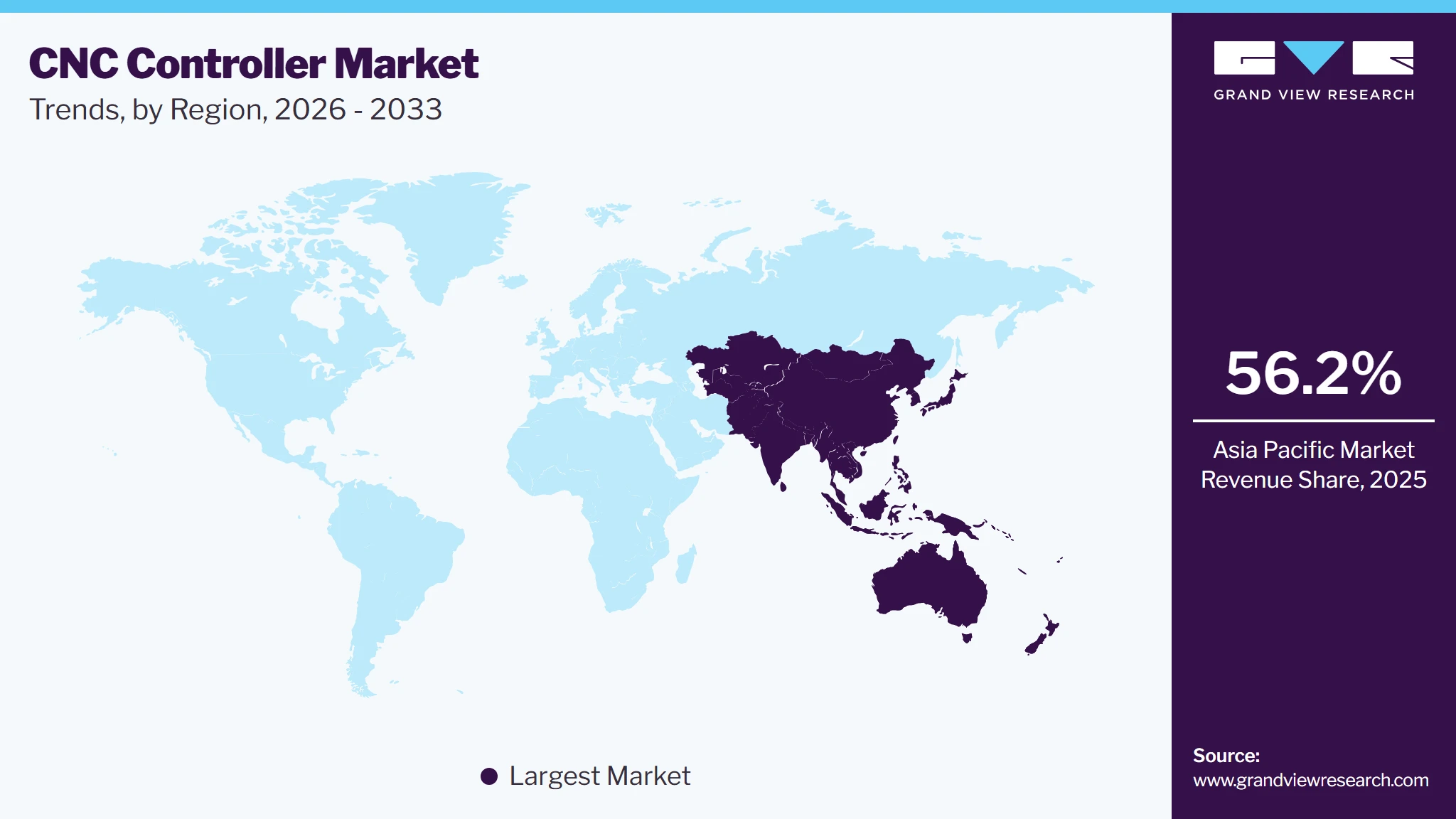
The global CNC controller market size was valued at USD 4.2 billion in 2025 and is projected to grow from USD 4.5 billion in 2026 to USD 7.0 billion by 2033, at a CAGR of 6.6% from 2026 to 2033. Asia Pacific dominated the global market, accounting for the largest revenue share of 56.2% in 2025. The industry is driven by the increasing adoption of automated and computer-controlled machining systems across manufacturing industries.
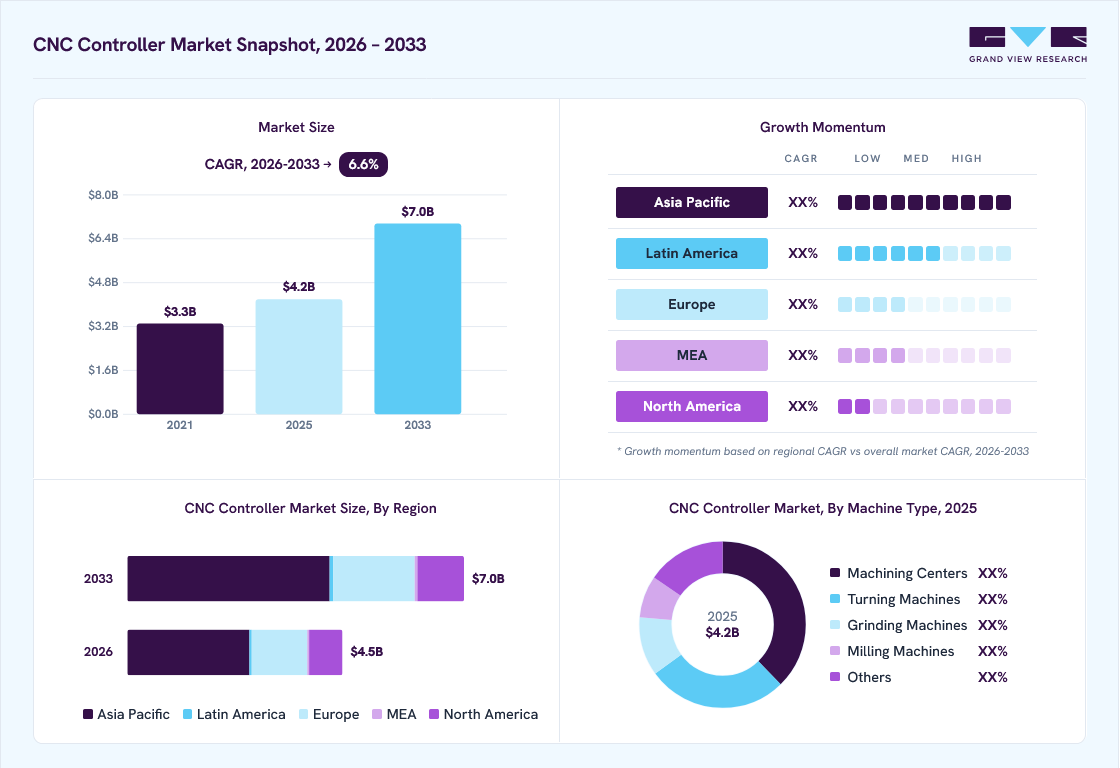 Source: Grand View Research, IR Documents, Primary Interviews, Paid DatabasesTo learn more about this report,
 Download Free Sample Report
 Key Market Trends & Insights
- By machine type: the machining centers segment is projected to grow at 7.1% CAGR during the forecast period.
- Based on installation type: the new machine/OEM installation segment dominated the market in 2025, accounting for 83.3% market share.
- Based on end use: the electrical industry segment is expected to grow at the fastest CAGR of 8.1% from 2026 to 2033.
Regional Highlights
- Largest regional market: Asia Pacific (56.2% revenue share, 2025)
- By country: The CNC controller market in China held the largest share in the Asia Pacific region in 2025.
Market Size & Forecast
- Market Size in 2025: USD 4.2 Billion
- Estimated Market Size in 2026: USD 4.5 Billion
- Projected Market Size by 2033: USD 7.0 Billion
- CAGR (2026-2033): 6.6%
Three ways to get this report
Buy it, customize it, or ask a question.Ask an Analyst
Analyst response in 1 business day
- AccessReport author, directly
- Reply timeWithin 1 working day
- No sales callDirect answer only
- FormatEmail reply
- CostFree, no cost
Get the Full Report
What the study covers
- FormatsPDF · Excel · Dashboard
- Timeline2026–2033 annual, 2025 base
- Coverage20+ countries, 5 regions
- Companies10+ key players profiled
Customize the Report
20% free customization
- IncludeCountries, segments, points
- TailorTo your product definition
- ExtendDeeper competitor detail
- OrA fully bespoke study
- Turnaround5–10 working days
Growing demand for high-precision machining, shorter production cycles, and improved manufacturing consistency is encouraging manufacturers to upgrade conventional machine tools with advanced CNC control systems. Expansion of automotive, aerospace, electronics, and precision engineering production is further generating demand for high-performance controllers.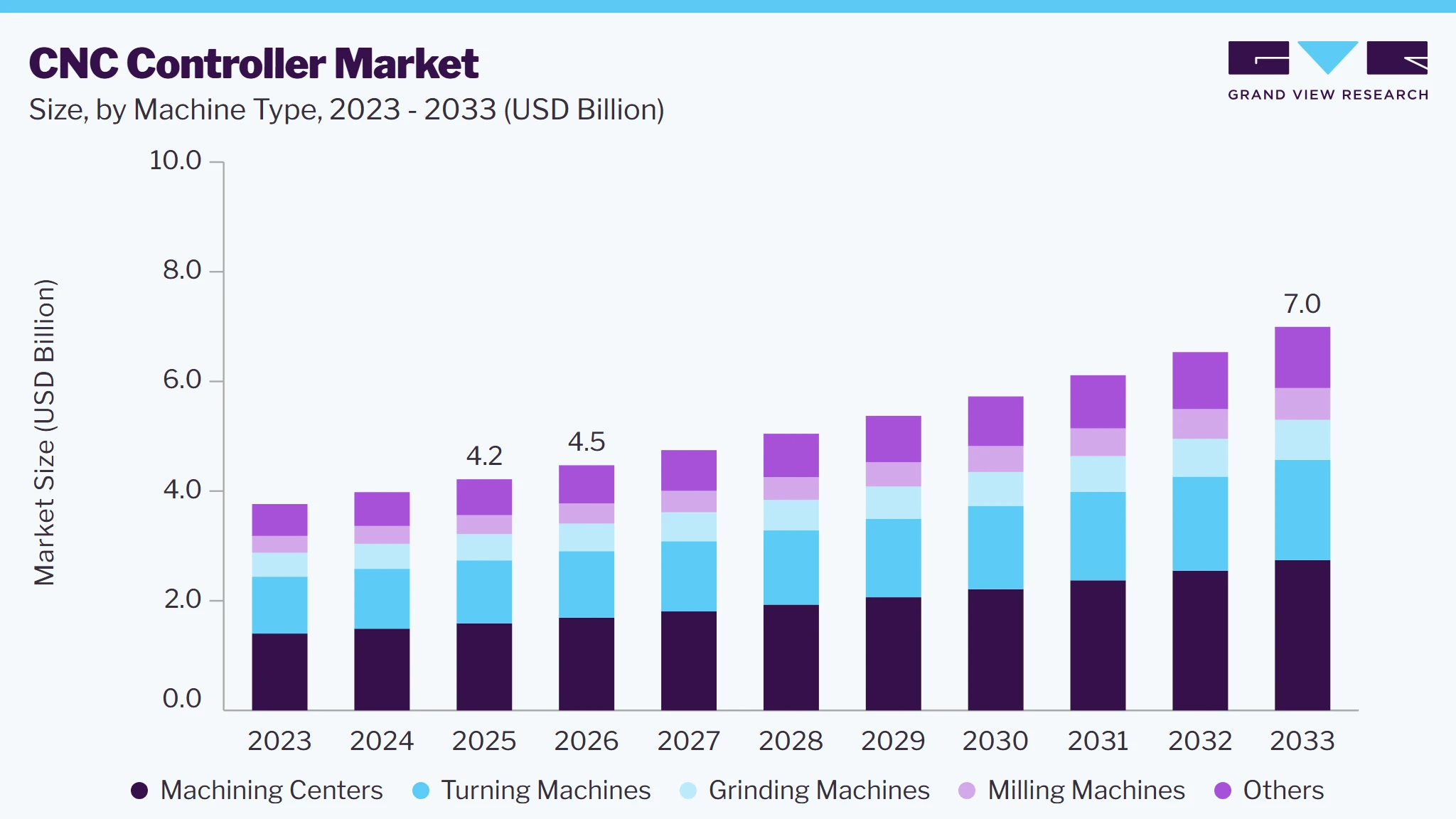 To learn more about this report, Download Free Sample Report
 Additionally, increasing integration of multi-axis machining, digital connectivity, real-time monitoring, and intelligent control functions is supporting the adoption of advanced CNC controllers. Manufacturers are focusing on improving processing speed, accuracy, interoperability, and ease of programming while integrating CNC systems with smart manufacturing platforms. The shift toward flexible production, customized machining, and connected manufacturing environments is further creating opportunities for next-generation CNC controller technologies.
Market Dynamics
The industry is advancing with increased investment in factory automation, machine tool modernization, and high-precision manufacturing. CNC controllers are incorporating faster processing architectures, multi-axis interpolation, industrial networking, real-time monitoring, and integrated automation functions to improve machining accuracy, throughput, and production flexibility. The replacement of legacy control systems and integration of CNC equipment with connected manufacturing environments are also shaping technology development and procurement decisions.
Increasing deployment of automated machine tools across automotive, aerospace, electronics, metalworking, and general manufacturing is strengthening demand for advanced CNC controllers. Manufacturers are adopting controllers with multi-axis synchronization, high-speed processing, advanced motion control, and integrated PLC functionality to achieve tighter machining tolerances, shorter cycle times, and greater production consistency. The expansion of flexible manufacturing systems and automated production lines is further increasing demand for controllers capable of coordinating complex machining operations.
CNC controller installation and replacement can involve substantial expenditure for hardware, software, engineering, machine reconfiguration, commissioning, and operator training. Integration with legacy machine tools, PLCs, servo drives, motors, and proprietary machine architectures can increase project complexity and downtime. Compatibility constraints and the need for specialized technical expertise may delay modernization projects, particularly among small and medium-sized manufacturers operating with constrained capital budgets.
The shift toward smart manufacturing is creating opportunities for CNC controllers equipped with industrial connectivity, real-time machine monitoring, remote diagnostics, data collection, and predictive maintenance capabilities. Integration with manufacturing execution systems, industrial IoT platforms, and factory-level analytics enables manufacturers to monitor machine performance and optimize production processes. Controller manufacturers can capitalize on demand for digitally connected systems that provide greater visibility across machining operations.
Market Concentration & Characteristics
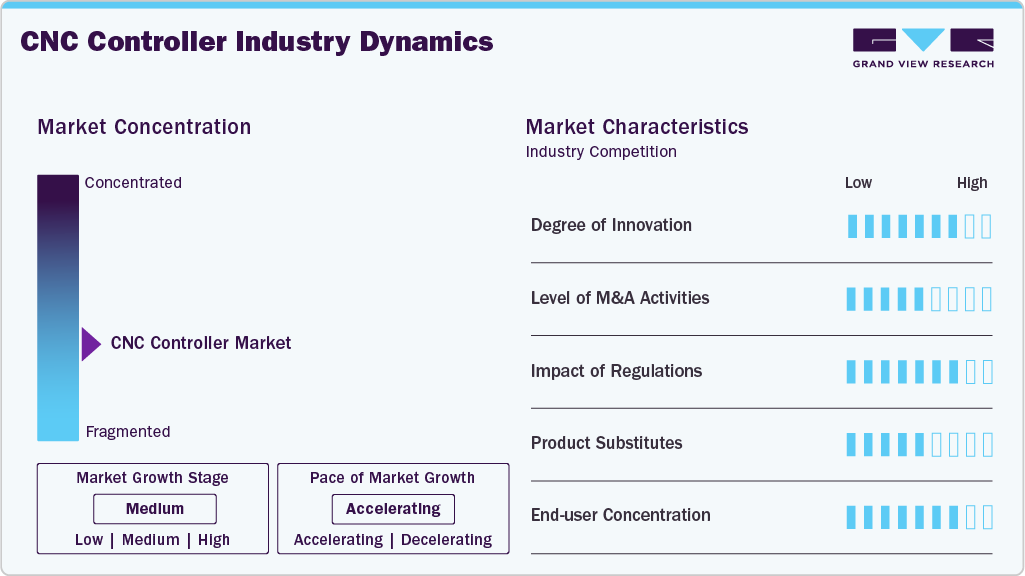
The industry has a moderately concentrated competitive structure, with established manufacturers maintaining strong positions through broad product portfolios, proprietary control technologies, extensive distribution networks, and long-standing relationships with machine tool manufacturers. Competition is shaped by the ability to provide controllers compatible with different machine configurations, axis requirements, and production specifications.
The industry is characterized by high technology intensity and substantial development requirements, particularly for high-speed processing, multi-axis control, precision machining, real-time monitoring, and seamless integration with drives and automation systems. Manufacturers are increasingly enhancing controller architecture, software capabilities, connectivity, and user interfaces to address the evolving requirements of digitally connected manufacturing environments.
 To learn more about this report, Download Free Sample Report
 Regulatory standards, cybersecurity requirements, and machine safety provisions influence product development and commercialization across regional markets. High integration requirements between controllers, servo systems, motors, machine tools, and production software create technical and switching barriers for new entrants. Strategic partnerships, technology investments, regional expansion, and acquisitions remain important approaches for strengthening market presence and expanding application coverage.
Analyst Perspective
The CNC controller market is steadily advancing as manufacturers adopt automated and digitally connected systems to improve precision, productivity, and flexibility. Demand is growing across automotive, aerospace, electronics, metalworking, and machinery manufacturing. Modernization of production facilities is driving the replacement of conventional controllers with advanced systems offering faster processing, connectivity, and real-time monitoring. The growing adoption of Industry 4.0 is further creating opportunities for CNC controllers integrated with automated production and factory management systems.
Machine Type Insights
By machine type, the machine centers segment led the industry and is projected to register the fastest CAGR over the forecast period, driven by increasing demand for multi-axis machining, complex component production, higher process flexibility, and automated manufacturing operations. The integration of advanced CNC controllers with machine centers enables improved motion control, faster processing, and coordinated machining of complex geometries.
The turning machines segment held a revenue share of 27.3% in 2025, supported by their extensive use in precision machining applications across automotive, machinery, metalworking, and general manufacturing sectors. Their ability to perform consistent turning operations with high-dimensional accuracy continues to support CNC controller deployment across production environments.
Installation Type Insights
By installation type, the new machine/OEM installation segment held the largest revenue share in 2025, driven by investments in new CNC machine tools and the integration of advanced controllers into modern manufacturing equipment. OEM-installed controllers provide manufacturers with enhanced automation, precision, connectivity, and machine control capabilities from the initial commissioning stage.
The retrofit & replacement segment is projected to register the fastest CAGR of 7.8% over the forecast period, supported by the modernization of aging CNC machines and the need to improve machining performance without replacing complete machine systems. Upgrading existing controllers enables manufacturers to extend equipment life, enhance productivity, and integrate newer digital and automation capabilities into established production environments.
End Use Insights
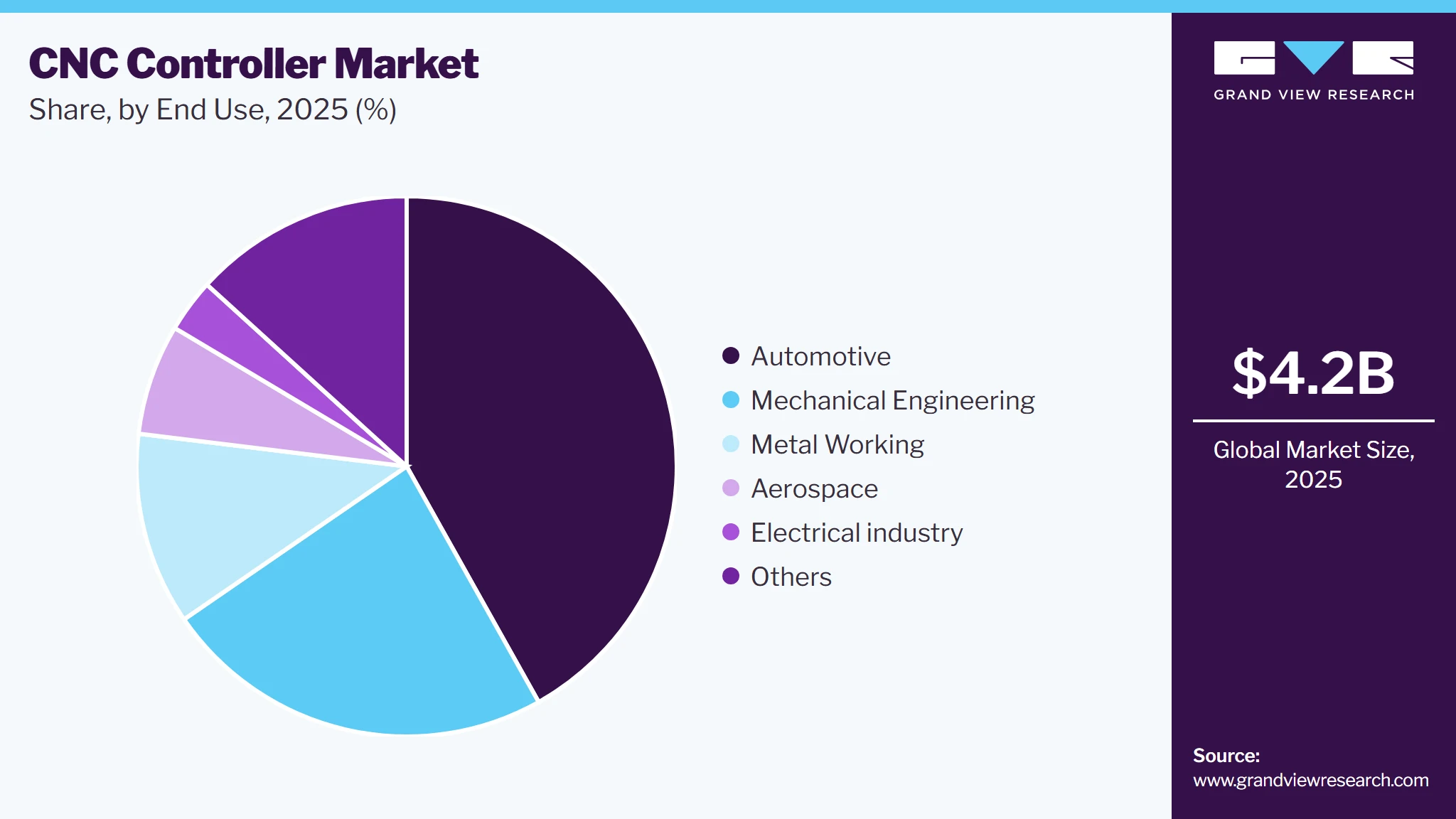
By end use, the automotive segment held a revenue share of 41.9% in 2025, supported by extensive CNC controller deployment in the machining of engine components, transmission parts, chassis components, and other precision-engineered automotive parts. The need for consistent production quality, dimensional accuracy, and automated high-volume manufacturing continues to support controller adoption across automotive production facilities.
 To learn more about this report, Download Free Sample Report
 The electrical industry segment is projected to register the fastest CAGR over the forecast period, driven by increasing demand for precision-machined electrical components, equipment, and related assemblies. Growing manufacturing complexity and the need for flexible, automated machining processes are encouraging electrical industry manufacturers to adopt advanced CNC controllers with improved motion control, connectivity, and production monitoring capabilities.
Regional Insights
The Asia Pacific CNC controller market led in 2025, driven by extensive manufacturing capacity, machine tool production, and investments in industrial automation. China, Japan, South Korea, and India have established strong machining and engineering ecosystems, creating sustained demand for CNC control systems across new machine installations and equipment modernization. The region's shift toward automated production, precision machining, and digitally connected factories is encouraging the adoption of advanced controllers with multi-axis coordination, high-speed processing, and industrial communication capabilities.
 To learn more about this report, Download Free Sample Report
 The CNC controller market in China is supported by its extensive machine tool manufacturing base and large metalworking and automotive industries. Government initiatives focused on manufacturing modernization and greater automation are encouraging manufacturers to upgrade production equipment with sophisticated CNC control systems. Demand from electronics, automotive components, general machinery, and precision engineering is further supporting controller deployment.
The India CNC controller market is projected to register strong growth during the forecast period, supported by expanding manufacturing capacity, increasing automation investments, and the modernization of machine tools. Growth in automotive components, aerospace manufacturing, electronics, and industrial machinery is encouraging manufacturers to adopt CNC systems capable of improving production accuracy and reducing manual intervention. Retrofit and replacement demand are also creating opportunities as manufacturers modernize existing equipment.
North America CNC Controller Market Trends
The CNC controller market in North America is characterized by high automation penetration, established machine tool installations, and continued modernization of manufacturing facilities. Manufacturers are investing in advanced control systems to improve production efficiency, address labor constraints, and enhance the capabilities of existing machining assets. Demand is also being shaped by the reshoring of manufacturing activities and investments in digitally integrated production environments.
The U.S. CNC controller market is supported by investments in aerospace, automotive, defense, industrial machinery, and precision manufacturing, where high-performance machining capabilities are required. Replacement of aging control systems and integration of CNC equipment with connected factory platforms are creating opportunities for both new installations and retrofit solutions.
The CNC controller market in Canada is projected to maintain steady growth during the forecast period, supported by investments in advanced manufacturing, industrial automation, and modernization of production facilities. CNC controller demand is particularly influenced by machinery-intensive industries, including automotive, aerospace, energy equipment, and metal fabrication, where manufacturers are upgrading machining capabilities to improve precision and production flexibility.
Europe CNC Controller Market Trends
The CNC controller market in Europe is supported by a well-established machine tool industry, advanced manufacturing capabilities, and continued emphasis on production efficiency and industrial digitalization. Manufacturers are upgrading CNC machinery to improve precision, automate complex operations, and integrate production equipment with broader factory management systems. Demand for high-performance controllers remains strong across automotive, aerospace, industrial machinery, and precision engineering applications.
The Germany CNC controller market held a prominent share in 2025, reflecting its strong machine tool manufacturing ecosystem and extensive automotive and industrial engineering base. Investment in smart factories, automated production, and high-precision machining is encouraging the deployment of advanced CNC control technologies. Controller replacement and modernization of established machine installations also contribute to market demand.
The CNC controller market in France is expected to register steady growth during the forecast period, supported by investments in aerospace, automotive, industrial equipment, and advanced manufacturing. Manufacturers are adopting modern CNC control systems to enhance machining precision, production flexibility, and automation levels. The development of digitally integrated manufacturing facilities is further creating demand for controllers with enhanced connectivity and monitoring capabilities.
Middle East & Africa CNC Controller Market Trends
The CNC controller market in the Middle East & Africa is developing alongside the diversification of industrial economies and investments in local manufacturing capabilities. Expansion of metalworking, industrial machinery, automotive component production, and energy-related equipment manufacturing is increasing the need for automated machining technologies. Government initiatives aimed at strengthening domestic manufacturing and reducing dependence on imported industrial products are also creating opportunities for CNC equipment and controller suppliers.
The Saudi Arabia CNC controller market accounted for a prominent share of the Middle East & Africa in 2025. Industrial diversification programs are encouraging investments in manufacturing facilities, engineering industries, and localized production of machinery and components. Expansion of industrial clusters and adoption of automated production technologies are supporting demand for CNC controllers across newly established and modernized machining facilities.
Latin America CNC Controller Market Trends
The CNC controller market in Latin America is supported by gradual industrial automation, expansion of manufacturing activities, and modernization of machine tools. Automotive production, metal fabrication, industrial machinery, and general engineering remain important sources of demand as manufacturers seek to improve machining consistency and production efficiency. Increasing integration of automated equipment within manufacturing facilities is also creating opportunities for controller upgrades and replacement systems.
The Brazil CNC controller market is supported by its comparatively large manufacturing base and established automotive, machinery, metalworking, and aerospace industries. Investments in production modernization are encouraging manufacturers to replace conventional control systems and adopt advanced CNC technologies. Growth in automated machining and efforts to improve domestic manufacturing productivity are expected to sustain demand throughout the forecast period.
Key CNC Controller Company Insights
Some of the key players operating in the market include FANUC Corporation and HEIDENHAIN GmbH, among others.
-
FANUC Corporation is a Japan-based manufacturer of factory automation and CNC technologies, with CNC systems, servo motors, and related control technologies forming a core part of its product portfolio. Founded in 1972 and headquartered in Yamanashi, Japan, the company develops and manufactures CNC systems for a broad range of machine tools and machining applications. Its portfolio also includes industrial robots, robomachines, servo drives, and laser systems, enabling integrated automation across manufacturing operations. FANUC continues to enhance its CNC technologies through advancements in control performance, automation, connectivity, and machining capabilities.
-
HEIDENHAIN GmbH is a Germany-based manufacturer of precision measurement and CNC control technologies, serving machine tool and industrial automation applications. Headquartered in Traunreut, Germany, the company offers CNC controls, encoders, touch probes, drive systems, digital readouts, and associated software solutions. Its CNC portfolio supports milling, turning, grinding, and complex multi-axis machining applications, with capabilities focused on precision, high-speed processing, motion control, and process monitoring. The integration of CNC controls with measurement and drive technologies enables HEIDENHAIN to provide coordinated solutions for improving machining accuracy, productivity, and operational reliability.
Key CNC Controller Companies
The following key companies have been profiled for this study on the CNC controller market.
-
FANUC Corporation
-
HEIDENHAIN GmbH
-
Mitsubishi Electric Corporation
-
Fagor Automation
-
SYNTEC Technology, Inc.
-
GSK CNC Equipment Co., Ltd.
-
LNC Technology Co., Ltd.
-
NUM AG
-
HNC Electric Ltd. / HuazhongCNC
-
Beijing KND CNC Technique Co., Ltd.
-
ADTECH (Shenzhen) Technology Co., Ltd.
-
Centroid CNC
-
Accelus Robotics Pvt. Ltd.
-
ECS S.r.l.
-
Weihong Electronic Technology Co., Ltd
Competitive Benchmarking
Category
Operating Strategies
Competitive Edge
Weakness
Established Players (e.g., FANUC Corporation; HEIDENHAIN GmbH; Mitsubishi Electric Corporation; Fagor Automation; SYNTEC Technology, Inc.; GSK CNC Equipment Co., Ltd.; LNC Technology Co., Ltd.)
- Develop advanced CNC controllers with multi-axis control, high-speed processing, motion control, CNC software, connectivity, and automation capabilities.
- Focus on high-precision control, advanced interpolation, machine compatibility, and integrated control architectures.
- Expand through R&D, machine tool OEM partnerships, product upgrades, global distribution, and aftermarket services.
- Differentiate through controller performance, software capabilities, connectivity, customization, and technical support.
- High R&D and product development costs for advanced CNC hardware and software.
- Complex integration requirements, competitive pricing pressure, and the need for continuous technology upgrades.
Emerging & Regional Players (e.g., NUM AG; HNC Electric Ltd. / HuazhongCNC; Beijing KND CNC Technique Co., Ltd.; ADTECH (Shenzhen) Technology Co., Ltd.; Centroid CNC; Accelus Robotics Pvt. Ltd.; ECS S.r.l.; Weihong Electronic Technology Co., Ltd.)
- Focus on application-specific and cost-efficient CNC controllers for milling, turning, machining, engraving, and specialized equipment.
- Develop flexible controller configurations for OEM integration, machine upgrades, and retrofit applications.
- Expand through regional distributors, OEM relationships, customized solutions, and localized technical support.
- Compete through flexible configurations, competitive pricing, faster customization, and retrofit opportunities.
- Limited global service networks and comparatively lower brand recognition.
- Resource constraints for R&D, international expansion, and technical support can limit competition with established suppliers.
Recent Developments
-
In June 2026, Mitsubishi Electric introduced enhanced CNC control functions designed to improve machining productivity by reducing cycle times and extending cutting-tool life. The technology incorporates cutting-load control to optimize machining conditions and minimize unnecessary cutting time, along with tool cutting-point control to improve tool utilization during operations. These capabilities enhance machining efficiency, stabilize processing performance, and reduce tooling costs, supporting the adoption of advanced CNC controllers across automated and high-precision manufacturing environments.
-
In September 2025, HEIDENHAIN expanded its TNC7 CNC controller portfolio with new machining functions covering shaping, cylindrical grinding, and cylinder-surface machining, broadening the range of operations that can be performed on a single machine setup. The company also enhanced simulation capabilities for detailed NC program verification and introduced direct robot operation through the TNC interface. Alongside these upgrades, HEIDENHAIN launched the TNC7 go, a simplified CNC control designed for vocational training and machine modernization, with graphical positioning and manual machining functions aimed at easier operation and programming.
Global CNC Controller Market Report Scope
Report Attribute
Details
Market size value in 2025
USD 4.2 billion
Estimated market size in 2026
USD 4.5 billion
Revenue forecast in 2033
USD 7.0 billion
Growth rate
CAGR of 6.6% from 2026 to 2033
Base year for estimation
2025
Historical data
2021 - 2024
Forecast period
2026 - 2033
Quantitative units
Revenue in USD billion and CAGR from 2026 to 2033
Report coverage
Revenue forecast, company market position analysis, competitive landscape, growth factors, and trends
Segments covered
Machine type, installation type, end use, region
Regional scope
North America; Europe; Asia Pacific; Latin America; Middle East & Africa
Country scope
U.S.; Canada; Mexico; Germany; UK; Italy; Spain; France; China; Japan; India; Australia; South Korea; Brazil; Argentina; Saudi Arabia; UAE; South Africa
Key companies profiled
FANUC Corporation; HEIDENHAIN GmbH; Mitsubishi Electric Corporation; Fagor Automation; SYNTEC Technology, Inc.; GSK CNC Equipment Co., Ltd.; LNC Technology Co., Ltd.; NUM AG; HNC Electric Ltd. / HuazhongCNC; Beijing KND CNC Technique Co., Ltd.; ADTECH (Shenzhen) Technology Co., Ltd.; Centroid CNC; Accelus Robotics Pvt. Ltd.; ECS S.r.l.; Weihong Electronic Technology Co., Ltd.
Customization scope
Free report customization (equivalent up to 8 analysts working days) with purchase. Addition or alteration to country, regional & segment scope.
Pricing and purchase options
Avail customized purchase options to meet your exact research needs. Explore purchase options
Global CNC Controller Market Report Segmentation
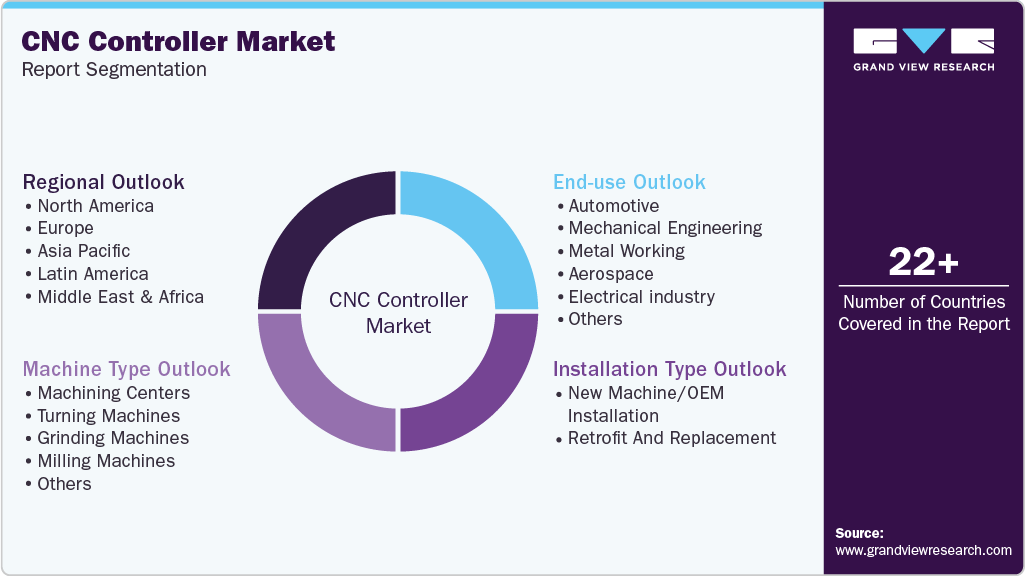
This report forecasts revenue growth at global, regional & country levels and provides an analysis of the industry trends in each of the sub-segments from 2021 to 2033. For this study, Grand View Research has segmented the global CNC controller market report on the basis of machine type, installation type, end use, and region:
 To learn more about this report, Download Free Sample Report
 -
Machine Type Outlook (Revenue, USD Billion, 2021 - 2033)
-
Machining Centers
-
Turning Machines
-
Grinding Machines
-
Milling Machines
-
Others
-
-
Installation Type Outlook (Revenue, USD Billion, 2021 - 2033)
-
New Machine/OEM Installation
-
Retrofit and Replacement
-
-
End Use Outlook (Revenue, USD Billion, 2021 - 2033)
-
Automotive
-
Mechanical Engineering
-
Metal Working
-
Aerospace
-
Electrical industry
-
Others
-
-
Regional Outlook (Revenue, USD Billion, 2021 - 2033)
-
North America
-
U.S.
-
Canada
-
Mexico
-
-
Europe
-
Germany
-
France
-
UK
-
Spain
-
Italy
-
-
Asia Pacific
-
China
-
India
-
Japan
-
South Korea
-
Australia
-
-
Latin America
-
Brazil
-
Argentina
-
-
Middle East & Africa
-
Saudi Arabia
-
UAE
-
South Africa
-
-
Research Methodology
The CNC controller market figures in this report are based on a proven research process that combines executive interviews with secondary research from proprietary databases, company filings, and recognized regulatory and institutional sources. Market size is built through value-chain sizing-reconciling supply-side and demand-side estimates-and triangulated with bottom-up and top-down approaches. Every estimate passes multiple levels of expert validation before publication, with each CNC controller segment quantified using the revenue-capture definitions in the table below.
Segment Definition
Machine Type
Revenue Capture Definition
Machining Centre
Revenue generated from the sale of CNC controllers supplied with or integrated into machining center systems, including controller hardware, software, and associated control modules.
Turning Machines
Revenue generated from CNC controllers sold as part of or for integration with CNC turning and lathe systems, including controller units and related control software.
Grinding Machines
Revenue is generated from the sale of CNC controllers integrated into grinding machine systems, including control hardware, software, and related components.
Installation Type
Revenue Capture Definition
New Machine/OEM Installation
Revenue generated from CNC controllers sold to machine tool manufacturers for installation in newly manufactured CNC machines, including the controller unit, software, and associated components.
Retrofit and Replacement
Revenue generated from the sale of replacement CNC controllers, controller upgrades, retrofit packages, and associated software or hardware installed on existing CNC machines.
End Use
Revenue Capture Definition
Automotive
Revenue generated from CNC controller sales to automotive manufacturers and component producers, including direct end use sales and controller installations through machine tool OEMs.
Mechanical Engineering
Revenue generated from CNC controller sales to mechanical engineering companies and machinery manufacturers, including direct sales and OEM-integrated controller systems.
Metal Working
Revenue generated from CNC controller sales to metalworking companies and machine tool manufacturers for integration into metalworking machinery.
Aerospace
Revenue generated from CNC controller sales to aerospace manufacturers, component producers, and machine tool suppliers serving the aerospace industry.
Electrical Industry
Revenue generated from CNC controller sales to electrical and electronics manufacturers and related machine tool suppliers.
Others
Revenue generated from CNC controller sales across end-use industries not separately classified, including medical, energy, defense, consumer goods, and general manufacturing.
Estimation Model
Layer Name
Key Question
Description
Machine Tool Demand Layer
Where are CNC controllers required?
Analyze demand across machining centers, turning machines, grinding machines, and other CNC machine tools. Assess machine tool production, installations, replacement cycles, and automation requirements to establish the addressable demand for CNC controllers.
Manufacturing Capacity & Automation Layer
Where is new controller demand being created?
Evaluate investments in automotive, aerospace, electronics, metalworking, machinery, and other manufacturing industries. Assess new machine tool installations, factory automation projects, production capacity expansions, and modernization initiatives that drive procurement of new CNC controllers.
Product Adoption Layer
Which CNC controller technologies are being deployed?
Segment demand by controller type, machine type, installation type, axis configuration, and end-use industry. Apply adoption rates based on machining complexity, number of controlled axes, precision requirements, automation level, connectivity, and compatibility with machine tools. Assess adoption of advanced controllers with integrated automation, digital connectivity, real-time monitoring, and multi-axis capabilities.
Revenue Generation Layer
How much market revenue is generated?
Estimate annual shipments of CNC controllers by machine type, installation type, end-use industry, and region. Quantify revenues generated exclusively from the sale of new CNC controllers supplied to machine tool manufacturers, system integrators, distributors, and industrial users.
Delivered Customizations
This report has been delivered with the following In-depth customizations
CLIENT REQUEST
CUSTOMIZATION DELIVERED
VALUE ADDS
Competitive Benchmarking
A competitive benchmarking analysis was conducted by evaluating leading CNC controller manufacturers based on CNC controller portfolios, controller architecture, number of supported axes, processing capabilities, software features, connectivity, automation capabilities, machine compatibility, installed base, aftermarket services, and strategic developments.
The benchmarking provided insights into product differentiation, technological capabilities, customization options, service networks, and competitive positioning, enabling stakeholders to evaluate supplier strengths and formulate informed procurement and market strategies.
Regional Segmentation
A comprehensive regional assessment was conducted by analyzing demand for CNC controllers across new machine installations, OEM machine production, retrofit and replacement activities, and machine tool modernization. The analysis evaluated investments in CNC-controlled machinery and automation across major manufacturing markets.
The regional assessment enabled stakeholders to identify high-growth markets, evaluate demand trends, prioritize regional expansion, and align business strategies with evolving CNC controller requirements.
Opportunity Assessment
A detailed opportunity assessment was conducted by evaluating opportunities arising from replacement of legacy CNC controllers, machine tool modernization, multi-axis machining, digital connectivity, advanced automation, and smart manufacturing adoption. The assessment also analyzed opportunities created by new machine tool investments and upgrades to existing CNC end use.
The assessment enabled stakeholders to identify future revenue opportunities, prioritize technology investments, support product development, and align expansion strategies with the evolving requirements of CNC machine control and automation.
Frequently Asked Questions About This Report
The global CNC controller market is projected to grow at a CAGR of 6.6% from 2026 to 2033, and is projected to reach USD 7.0 billion by 2033.
The global CNC controller market size was valued at USD 4.2 billion in 2025 and is reaching from USD 4.5 billion in 2026.
Asia Pacific dominated the global CNC controller market with the largest revenue share of 56.2% in 2025, supported by extensive manufacturing activity and the adoption of automated machine tools across the region.
The machining centers segment is projected to grow at a CAGR of 7.1% from 2026 to 2033, driven by demand for flexible, automated, and high-precision machining capabilities across industrial manufacturing applications.
The new machine/OEM installation segment dominated the market in 2025, accounting for 83.3% of the market share. Its position reflects the integration of CNC controllers into newly manufactured machine tools and automated production systems.
The electrical industry is projected to grow at the fastest CAGR of 8.1% from 2026 to 2033, supported by increasing requirements for precision machining and automated production of electrical and electronic components.
Key trends include increasing integration of CNC controllers with automated machine tools, greater adoption of multi-axis machining, digital connectivity, real-time process monitoring, and advanced control functions. Manufacturers are also focusing on improving precision, productivity, interoperability, and machine-level automation.
Key players include FANUC Corporation, HEIDENHAIN GmbH, Mitsubishi Electric Corporation, Fagor Automation, SYNTEC Technology, Inc., GSK CNC Equipment Co., Ltd., LNC Technology Co., Ltd., NUM AG, HNC Electric Ltd. / HuazhongCNC, Beijing KND CNC Technique Co., Ltd., ADTECH (Shenzhen) Technology Co., Ltd., Centroid CNC, Accelus Robotics Pvt. Ltd., ECS S.r.l., and Weihong Electronic Technology Co., Ltd.
The market is driven by increasing adoption of automated manufacturing, demand for high-precision machining, expansion of machine tool production, and the modernization of manufacturing facilities. Growing use of connected and digitally controlled production equipment is also encouraging manufacturers to adopt advanced CNC controllers with improved automation, monitoring, and machine coordination capabilities.
About the Author(s)
Advanced Interior Materials Research Team
Advanced Materials · Advanced Interior MaterialsThis report was authored by the advanced interior materials research team at Grand View Research - comprising two research analysts, one senior research analyst, and one industry expert - with specialized expertise in the advanced interior materials segment of the advanced materials industry. All findings are based on proprietary advanced materials databases, executive interviews, and regulatory analysis, subject to internal peer review prior to publication.
Last Updated:
Speak to Analyst

Customize this report to your needs - add regions, segments, or data points, with 20% free customization.
Or view our licence options:


ISO 9001:2015 & 27001:2022 Certified
We are GDPR and CCPA compliant! Your transaction & personal information is safe and secure. For more details, please read our privacy policy.


