
- Home
- »
- Consumer F&B
- »
-
Cold Brew Coffee Market Size & Share Report, 2026 - 2033GVR Report cover

Cold Brew Coffee Market (2026 - 2033)
Size, Share & Trends Analysis Report By Preparation Mode (Drip Coffee Makers, Single Cup Brewers, Cold Brewing, Espresso), By Distribution Channel, By Region, And Segment Forecasts
Market Size, 2025
$693.9MMarket Estimate, 2026
$821.7MMarket Forecast, 2033
$2,597.2MCAGR, 2026–2033
17.9%Cold Brew Coffee Market Summary
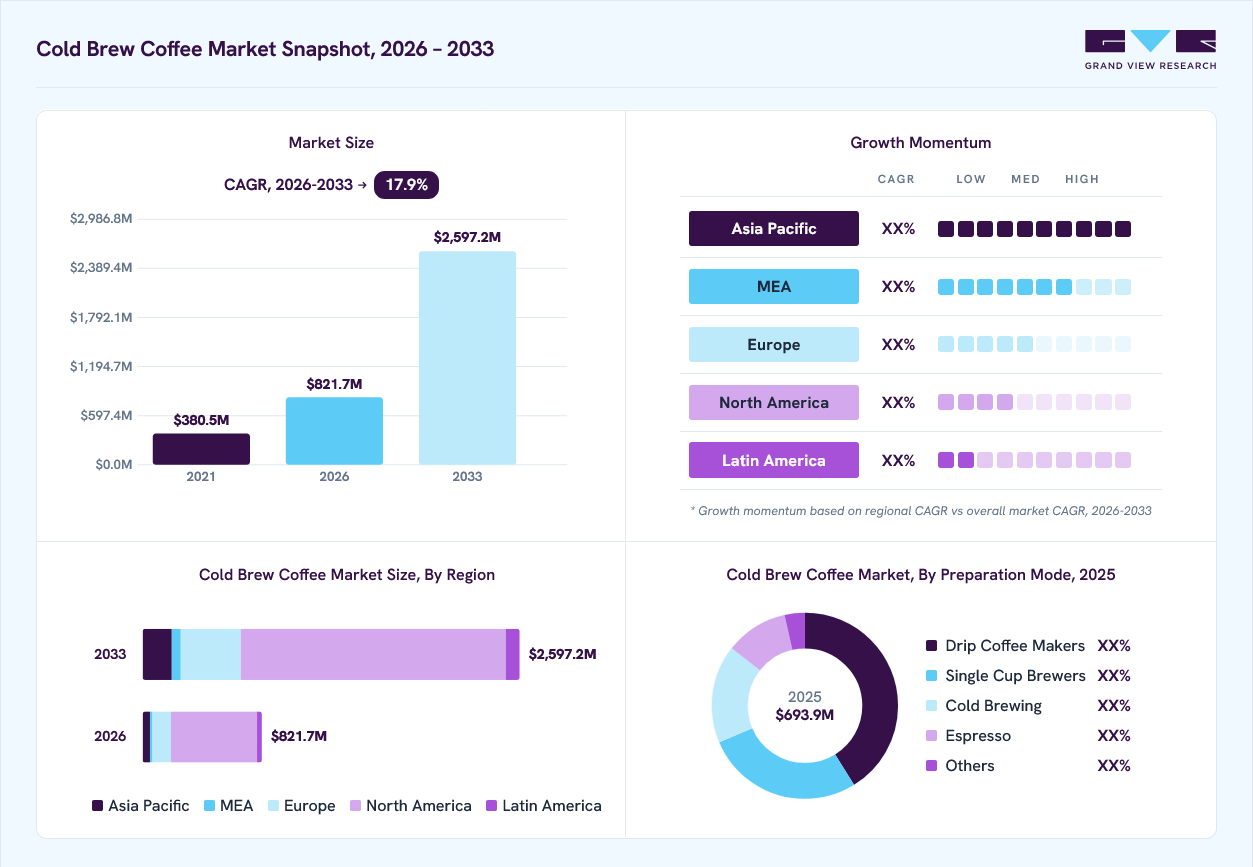
The global cold brew coffee market size was valued at USD 693.9 million in 2025 and is projected to grow from USD 821.7 million in 2026 to USD 2,597.2 million by 2033, growing at a CAGR of 17.9% from 2026 to 2033. North America dominated the market, accounting for the largest global share of 72.4% in 2025. Manufacturers have adopted marketing strategies to expand their global reach and offer opportunities for growth.
 Source: Grand View Research, IR Documents, Primary Interviews, Paid DatabasesTo learn more about this report,
 Download Free Sample Report
 Key Market Trends & Insights
- By preparation mode: Drip coffee makers segment held the largest revenue share of 41.1% in 2025.
- By distribution channel: Company-owned outlets segment held the largest share of 50.7% in 2025.
Regional Highlights
- Largest regional market: North America (72.4% revenue share, 2025)
- Fastest-growing regional market: Asia Pacific (fastest CAGR, 2026-2033)
- By country: The U.S. held the largest share of North America in 2025.
Market Size & Forecast
- Market size in 2025: USD 693.9 Million
- Estimated market size in 2026: USD 821.7 Million
- Projected market size by 2033: USD 2,597.2 Million
- CAGR (2026-2033): 17.9%
GVR research-powered AIAsk Prism AI about the cold brew coffee marketGet cited answers from GVR research on market growth, segments, regulations and forecasts.Start with✓ Source-linked answers ✓ Market-specific context ✓ Traceable figuresExplore Prism AI ↗
Brands leverage social media platforms to engage with consumers and build brand loyalty. Influencer partnerships and targeted digital marketing campaigns have increased demand for cold brew coffee. The demand for ready-to-drink beverages has increased significantly, contributing to the growth of the cold-brew coffee market. Consumers are increasingly adopting ready-to-drink beverages as they provide convenience and ease of consumption. This trend has led to an increase in the sales of cold-brew coffee, as it is often packaged in convenient formats such as cans and bottles. To cater to this demand, manufacturers are launching new product lines. For instance, in July 2024, Bones Coffee Co. introduced its ready-to-drink (RTD) cold brew lattes, including flavors such as Holy Cannoli, Sinn-O-Bun, Smorey Time, French Toast, and Electric Unicorn, which are available in Walmart stores. The products are made with 100% cold-brewed coffee beans sourced from Brazil.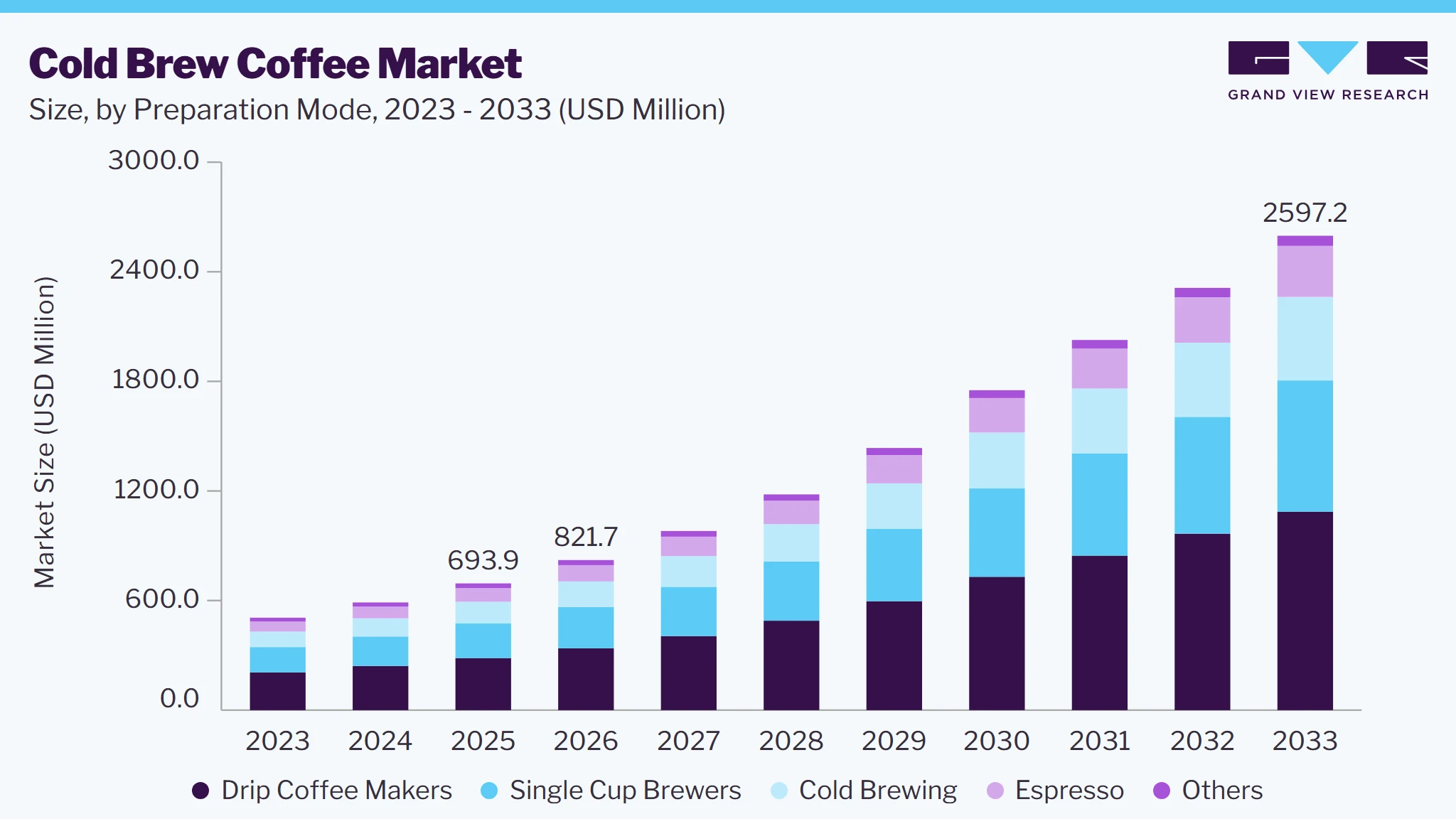 To learn more about this report, Download Free Sample Report
 Consumers increasingly pursue beverages with a smoother, less acidic taste profile, which cold brew coffee provides. Cold brew is made by steeping coffee beans in cold water for an extended period. This process produces a naturally sweeter and more flavor, demanding a wide range of coffee drinkers. Additionally, the versatility of cold brew, enjoyed black, with milk, or flavored, caters to diverse taste preferences and experiences.
As coffee shops expand in urban areas worldwide, they increasingly offer cold brew as a staple menu item. This increases consumer exposure to cold brew and educates them on its unique qualities compared to other coffee beverages. The café experience, often associated with relaxation, socialization, and a premium coffee experience, enhances cold brew consumption. For instance, in February 2024, China's Cotti Coffee launched in Australia with a new outlet in Sydney's Cabramatta district. The outlet is a small-format takeaway site that offers flavored coffee beverages, including Rice Milk and Pampas Blue lattes, coconut-infused coffee, and Grapefruit Sparkling Cold Brew.
Market Dynamics
The cold brew coffee market is experiencing significant growth, driven by increasing consumer demand for premium coffee beverages with smooth taste, lower acidity, and convenient ready-to-drink formats. Growing awareness of specialty coffee products, changing lifestyles, and the rising preference for on-the-go consumption are encouraging wider adoption across diverse consumer segments. Manufacturers are focusing on product innovation through new flavors, organic and functional formulations, and sustainable packaging solutions to enhance customer engagement and brand differentiation.
The rising consumer preference for ready-to-drink (RTD) coffee beverages is a key driver of the cold brew coffee market, as consumers increasingly seek convenient, on-the-go refreshment options that fit busy lifestyles. Cold brew coffee aligns well with this trend due to its smooth taste, premium image, and compatibility with bottled and canned RTD formats. Additionally, growing demand for café-style beverages outside traditional coffee shops has encouraged manufacturers to expand RTD cold brew offerings across retail and e-commerce channels. In January 2026, Royal Cup Coffee and Tea expanded its ready-to-drink (RTD) cold brew portfolio by launching four new flavors: Black, Caramel Latte, Vanilla Latte, and Mocha Latte, to cater to growing consumer demand for convenient cold coffee beverages. The company stated that the expansion was driven by the increasing popularity of RTD cold brew products and consumers' preference for high-quality, on-the-go coffee options.
Higher production costs compared to traditional brewed coffee act as a restraint on the cold brew coffee market. The cold brew preparation process requires longer extraction times, specialized brewing equipment, and larger quantities of coffee beans, increasing overall production expenses. Additionally, maintaining product quality, cold-chain logistics, and premium packaging for ready-to-drink formats further elevates operational costs. These higher costs often translate into premium pricing, which can limit adoption among price-sensitive consumers and constrain market expansion in cost-conscious regions.
The increasing development of innovative cold brew formulations presents a significant opportunity for the cold brew coffee market. Manufacturers are introducing functional variants infused with ingredients such as protein, adaptogens, vitamins, and plant-based additives to appeal to health-conscious consumers seeking enhanced beverage experiences. Growing interest in sustainable and ethically sourced coffee products is also creating opportunities for premium and specialty cold brew offerings. Furthermore, expansion into emerging markets and diversification across foodservice, convenience stores, and online retail channels can help brands reach new consumer segments and strengthen market penetration.
Analyst Perspective
The cold brew coffee market is experiencing steady growth, supported by increasing consumer demand for convenient, premium, and café-style beverages that align with modern on-the-go lifestyles. Rising preference for smoother taste profiles and lower acidity compared to traditional hot coffee is encouraging wider adoption across diverse consumer groups. Additionally, the expansion of ready-to-drink (RTD) formats and continuous product innovation in flavored and functional cold brew variants are strengthening market penetration. Growing retail availability and the rapid expansion of e-commerce channels are further enhancing product accessibility, supporting sustained market development.
Preparation Mode Insights
Based on preparation mode, the drip coffee makers segment led the market with the largest revenue share of 41.1% in 2025. Drip coffee makers allow complete extraction of the aromas and flavors of coffee beans, making them the most prevalent method of brewing coffee and contributing to the growing demand. They automate the coffee brewing process, allowing users to prepare multiple cups of coffee with minimal effort. Many drip coffee makers offer customizable settings, such as strength control and temperature adjustment, allowing users to change the coffee according to their preferences. The combined factors drive the demand for drip coffee makers.
The cold brewing segment is expected to witness the fastest CAGR over the forecast period. Cold brew coffee offers numerous benefits, such as its higher caffeine content, which aids in weight loss, sharpens mental capacity, and keeps consumers alert for extended periods. Additionally, cold brew coffee is an alternative for consumers with acid reflux and sensitive stomachs. Its smooth, low-acid profile makes it suitable for various uses, such as cocktails, desserts, and other recipes. To cater to this demand, manufacturers are introducing new products. For instance, in May 2024, De'Longhi launched the Eletta Explore coffee machine with cold brew capabilities. This machine provides users various hot, cold, and cold brew coffee drinks at home. Its cold extraction technology allows it to prepare cold brew in less than five minutes.
Distribution Channel Insights
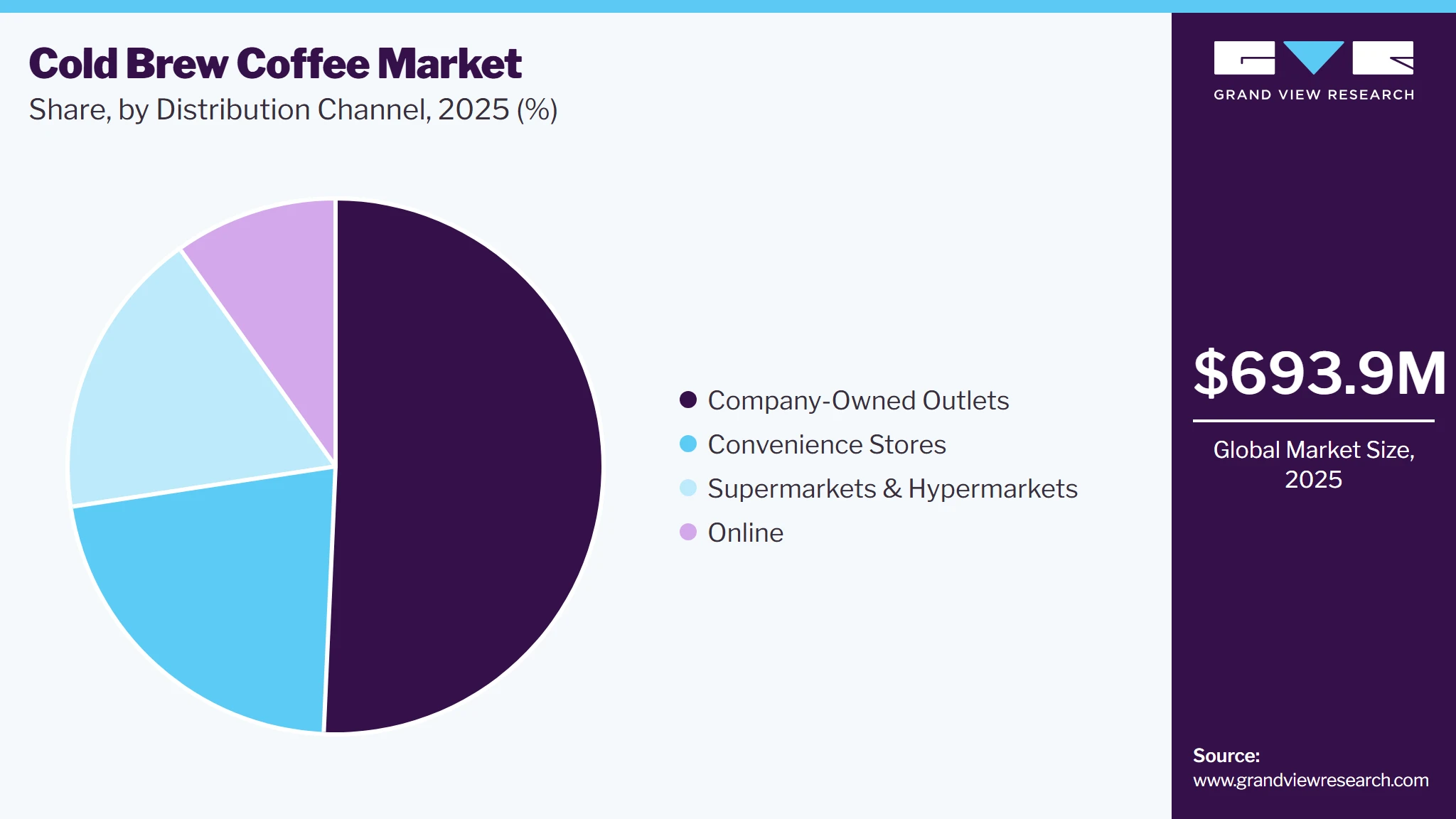
Based on the distribution channel, the company-owned outlets segment led the market with the largest revenue share of 50.7% in 2025. These outlets have the ability to maintain strict control over the brand image, product quality, and customer experience. By owning and operating their outlets, companies ensure that their cold brew coffee is prepared and served to exact specifications, maintaining consistency across all locations. Company-owned outlets produce freshly prepared food and beverages that match consumer preferences for fresh products. This ensures that the cold brew coffee is always fresh and of high quality. These factors combined are fueling the demand for company-owned outlets
 To learn more about this report, Download Free Sample Report
 Online distribution channel is expected to register the fastest CAGR of during the forecast period. Online platforms allow customers to purchase cold brew coffee from the comfort of their homes or workplaces without visiting physical stores. This convenience is especially suitable for busy consumers. Additionally, e-commerce platforms offer an extensive range of brands, flavors, and formats. This wide variety allows consumers to explore and discover new products and options that cater to different tastes and preferences, enhancing the overall shopping experience and driving demand. For instance, in May 2024, Subculture Delta Beverages Inc., a joint venture of Diesel Beverages and Subculture Coffee, launched shelf-stable THC-infused cold brew coffee offered through the Subculture Coffee locations and online website.
Regional Insights
North America dominated the cold brew coffee market with the largest revenue share of 72.4% in 2025. Coffee shops and cafes have become prevalent social hubs where people gather to work, relax, and socialize. These establishments often feature cold brew coffee on their menus, increasing the consumers of the product. Effective marketing and branding efforts have played a crucial role in the growth of the cold brew coffee market in North America. Brands leverage social media, influencer partnerships, and targeted advertising to create awareness and drive consumer interest and demand.
 To learn more about this report, Download Free Sample Report
 U.S. Cold Brew Coffee Market Trends
The cold brew coffee market in the U.S. held the largest share in the North America region in 2025. Cold-brew coffee is a healthier choice due to its lower acidity and ease of digestion on the stomach and teeth. Along with its lower calorie content when consumed without additional sugars or creams, it is essential for health-conscious consumers and fitness enthusiasts who are mindful of their caloric intake. The growing preference for healthier lifestyles has significantly increased the demand for cold brew coffee. For instance, the United States, importing the second-largest amount of coffee beans globally, is expected to increase its imports by 900,000 bags to 24.5 million bags, driven by rising consumption trends.
The Canada cold brew coffee market is expected to witness significant growth over the forecast period. Canadian coffee companies and roasters are innovating with new flavors, brewing techniques, and packaging formats essential to diverse consumer preferences. Innovations such as flavored cold brew varieties, nitro cold brew, and cold brew concentrate options provide consumers with various choices to suit their tastes and lifestyles. This product diversity increases new consumers and encourages existing customers to experiment with different cold brew offerings.
Asia Pacific Cold Brew Coffee Market Trends
Asia Pacific cold brew coffee market is expected to witness the fastest CAGR over the forecast period. Coffee shops and cafes have become prevalent social hubs where consumers gather to socialize, work, and relax. The presence of cold brew coffee on cafe menus, often positioned as a premium offering, has introduced more consumers to the product. Additionally, cold brew coffee manufacturers are innovating with convenient packaging options to cater to consumers busy lifestyles. Ready-to-drink cold brew coffee in cans and bottles is becoming increasingly prevalent, allowing consumers to experience a premium coffee on the go.
China cold brew coffee market is anticipated to witness significant growth over the forecast period. Environmental awareness and sustainability considerations are gaining prominence among Chinese consumers, influencing their purchasing decisions in the cold brew coffee market. Many brands emphasize sustainable sourcing practices, ethical production methods, and eco-friendly packaging for environmentally conscious consumers.
India cold brew coffee market is anticipated to witness significant growth over the forecast period. Coffee companies and roasters are innovating new flavors, brewing techniques, and packaging formats to cater to diverse consumer preferences and regional tastes. Additionally, ready-to-drink cold brew formats in bottles and cans cater to busy urban lifestyles where convenience and quick consumption are essential. The portability and ease of ready-to-drink cold brew coffee make it a prevalent choice among commuters, office workers, and students pursuing convenient refreshment solutions. To cater to this demand, companies are starting new product lines. For instance, in June 2024, Tata Consumer Products launched Tata Coffee Gold- Cold Brew, a Ready to Drink Cold Coffee. It is free from artificial flavors and is available in variants such as Classic, Mocha, and Hazelnut. It is available at selected retail outlets nationwide.
Europe Cold Brew Coffee Market Trends
Europe cold brew coffee market is expected to witness significant growth over the forecast period. Online platforms offer various cold brew coffee products, making it easy for consumers to explore and purchase different brands and flavors. The convenience of online shopping and the possibility to read reviews and compare products have driven the demand for cold brew coffee through e-commerce channels. Additionally, subscription services for cold brew coffee have enabled consumers to receive regular deliveries of their favorite beverages directly to their doorstep.
Germany cold brew coffee market is expected to witness significant growth over the forecast period. Brands leverage social platforms such as Instagram, Facebook, and TikTok to showcase their cold brew products, engage with coffee enthusiasts, and increase brand visibility. Influencers and coffee enthusiasts share their experiences, reviews, and creative recipes featuring cold brew coffee, effectively promoting trends and encouraging the community around the beverage. Social media platforms aid in educating consumers about the brewing process, flavor profiles, and potential health benefits of cold brew coffee through digital platforms, tastings, and promotional events.
Key Cold Brew Coffee Company Insights
Some of the key companies in the cold brew coffee market include Starbucks Coffee Company, Nestlé, Califia Farms, LLC, JAB Holding Company, HighBrewCoffee, and Kohana Coffee. These companies are focusing on increasing their customer base to gain a competitive edge in the industry. Companies are taking several strategic initiatives, such as mergers, acquisitions, and partnerships with other major companies.
-
Starbucks Coffee Company offers an extensive range of beverages and food items. The company has expanded internationally, operating thousands of locations worldwide. Their product offerings include a diverse selection of hot and cold beverages, with a prominent presence in the cold brew coffee market.
-
RISE Brewing Co. specializes in producing nitro cold brew coffee, offering a range of flavors and varieties that cater to health-conscious consumers seeking premium coffee experiences. Their product lineup includes original nitro cold brew, oat milk lattes, and various flavored nitro cold brews, all packaged in eco-friendly cans.
Key Cold Brew Coffee Companies
The following key companies have been profiled for this study on the cold brew coffee market.
-
Starbucks Coffee Company.
-
Nestlé
-
Califia Farms, LLC
-
JAB Holding Company
-
HighBrewCoffee
-
Kohana Coffee
-
La Colombe Coffee Roasters.
-
RISE Brewing Co..
-
Heartland Food Products Group.
-
Sleepy Owl Coffee
Competitive Benchmarking
Operating Strategies
Competitive Edge
Weaknesses
Established Players (Starbucks Coffee Company; Nestlé; Califia Farms, LLC)
- Strong presence across global retail, café chains, convenience stores, and ready-to-drink (RTD) beverage distribution networks with extensive product portfolios and large-scale manufacturing capabilities.
- Strong brand equity, global distribution strength, high investment in product innovation, and strong capability in scaling RTD cold brew and flavored coffee offerings.
- High production and packaging costs, intense competition within RTD coffee segment, and premium positioning limiting penetration in price-sensitive markets.
Emerging Players (High Brew Coffee; Kohana Coffee; La Colombe Coffee Roasters)
- Focus on digital-first strategies, D2C platforms, specialty retail, and café partnerships with emphasis on RTD cold brew innovation and niche coffee experiences.
- Strong innovation in flavor profiles, clean-label positioning, sustainability focus, and ability to quickly respond to evolving consumer preferences.
- Limited global reach, lower marketing budgets compared to multinational players, and dependence on niche premium or urban consumer segments.
Recent Developments
-
In May 2024, Starbucks Coffee Company. launched NEW Starbucks Iced Coffee blends along with the debut of NEW Starbucks Cold Brew Concentrates - Dark Chocolate Hazelnut and Sweetened Black, which is the first at-home blend that allows consumers to enjoy Starbucks café-quality iced coffee at home.
-
In May 2024, Nescafé launched Nescafé Espresso Concentrate, which is available in flavors such as sweet vanilla and Espresso Black. It is customizable with milk, water, or juice.
Cold Brew Coffee Market Report Scope
Report Attribute
Details
Market size value in 2025
USD 693.9 million
Market size value in 2026
USD 821.7 million
Revenue forecast in 2033
USD 2,597.2 million
Growth rate
CAGR of 17.9% from 2026 to 2033
Base year for estimation
2025
Historical data
2021 - 2024
Forecast period
2026 - 2033
Quantitative units
Revenue in USD million/billion and CAGR from 2026 to 2033
Report coverage
Revenue forecast, company ranking, competitive landscape, growth factors, and trends
Segments covered
Product, distribution channel, region
Regional scope
North America; Europe; Asia Pacific; Latin America; MEA
Country scope
U.S.; Canada; Mexico; Germany; UK; France; Italy; Spain; China; India; Japan; Australia & New Zealand; South Korea; Brazil; South Africa
Key companies profiled
Starbucks Coffee Company.; Nestlé; Califia Farms, LLC; JAB Holding Company; HighBrewCoffee; Kohana Coffee; La Colombe Coffee Roasters.; RISE Brewing Co..; Heartland Food Products Group.; Sleepy Owl Coffee
Customization scope
Free report customization (equivalent up to 8 analysts' working days) with purchase. Addition or alteration to country, regional & segment scope.
Pricing and purchase options
Avail customized purchase options to meet your exact research needs. Explore purchase options
Global Cold Brew Coffee Market Report Segmentation
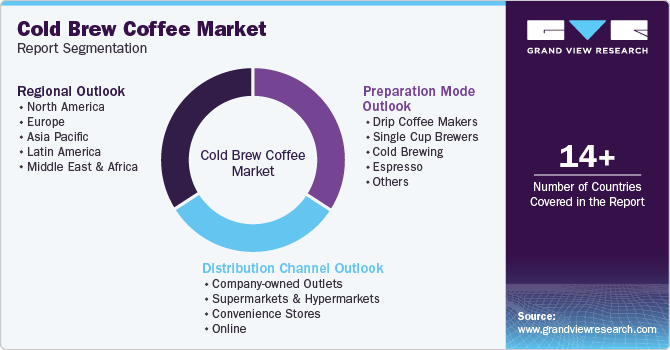
This report forecasts revenue growth at global, regional, and country levels and provides an analysis of the latest industry trends in each of the sub-segments from 2021 to 2033. For this study, Grand View Research has segmented the global cold brew coffee market report based on preparation mode, distribution channel and region.
 To learn more about this report, Download Free Sample Report
 -
Preparation Mode Outlook (Revenue, USD Million, 2021 - 2033)
-
Drip Coffee Makers
-
Single Cup Brewers
-
Cold Brewing
-
Espresso
-
Others
-
-
Distribution Channel Outlook (Revenue, USD Million, 2021 - 2033)
-
Company-owned Outlets
-
Supermarkets & Hypermarkets
-
Convenience Stores
-
Online
-
-
Regional Outlook (Revenue, USD Million, 2021 - 2033)
-
North America
-
U.S.
-
Canada
-
Mexico
-
-
Europe
-
Germany
-
Italy
-
Spain
-
Poland
-
-
Asia Pacific
-
China
-
Japan
-
India
-
-
Latin America
-
Brazil
-
-
Middle East and Africa (MEA)
-
Research Methodology
The cold brew coffee market figures in this report are based on a proven research process that combines executive interviews with secondary research from proprietary databases, company filings, and recognized regulatory and institutional sources. Market size is built through value-chain sizing—reconciling supply-side and demand-side estimates—and triangulated with bottom-up and top-down approaches. Every estimate passes multiple levels of expert validation before publication, with each cold brew coffee segment quantified using the revenue-capture definitions in the table below.
Segment Definition
Segment – Preparation Mode
Revenue capture definition
Drip Coffee Makers
Drip coffee makers brew coffee by passing hot water through ground coffee held in a filter, allowing the liquid to drip into a carafe. This method is widely used for its convenience, consistency, and ability to produce multiple servings at once.
Single Cup Brewers
Single cup brewers prepare one serving of coffee at a time using pre-measured pods or capsules. They are designed for quick preparation, minimal cleanup, and personalized coffee strength and flavor preferences.
Cold Brewing
Cold brewing involves steeping coarsely ground coffee in cold or room-temperature water for an extended period, typically resulting in a smooth, less acidic coffee concentrate. It is commonly used for cold brew coffee beverages served chilled or over ice.
Espresso
Espresso is a concentrated coffee prepared by forcing hot water under high pressure through finely ground coffee. It serves as a base for many coffee beverages and is valued for its strong flavor and rich aroma.
Others
This category includes alternative or less common coffee preparation methods such as French press, pour-over, percolation, and siphon brewing, which vary in technique and flavor extraction profiles.
Estimation Model
Layer Name
Description
Consumption Universe Layer
Who consumes cold brew coffee globally?Represents the global population that consumes coffee beverages, including lifestyle-oriented consumers, café visitors, and individuals seeking energy, refreshment, or functional drink alternatives in daily routines.
Access & Availability Layer
Who can access cold brew coffee?Includes consumers who can access cold brew coffee through retail stores, cafés, convenience outlets, e-commerce platforms, and ready-to-drink packaged beverage channels supported by expanding distribution networks.
Purchase & Usage Layer
Who regularly purchases cold brew coffee?Covers consumers who actively buy and consume cold brew coffee regularly, driven by preference for smooth taste, convenience, low acidity, and premium café-style cold beverages in on-the-go or at-home settings.
Revenue Conversion Layer
How is revenue generated from cold brew coffee consumers?Represents monetization through sales of bottled and canned cold brew products, café-served cold brew, flavored and functional variants, and subscription or premium offerings across retail and foodservice channels.
Delivered Customizations
This report has been delivered with the following In-depth customizations
Client Request
Customization Delivered
Value Adds
Cold brew coffee Market Pricing & Affordability Structure
Examined price sensitivity across consumer groups, including willingness to pay for premium RTD cold brew, impact of café pricing versus packaged alternatives, and role of promotional strategies in driving trial and repeat purchases.
Helps identify optimal pricing strategies, supports margin optimization, and enables positioning across mass and premium consumer segments without losing competitiveness.
Cold brew coffee Market Consumer Segmentation & Behavior Patterns
Analyzed consumption differences among office-goers, students, fitness-focused individuals, and café visitors, along with variations in flavor preference, caffeine strength demand, and purchase frequency behavior.
Enables targeted product positioning, improves customer acquisition strategies, and supports development of personalized cold brew offerings for distinct user groups.
Cold brew coffee Market Sustainability & Supply Chain Practices
Evaluated adoption of eco-friendly sourcing practices, recyclable packaging solutions, and ethical coffee bean procurement trends along with cold chain efficiency improvements in distribution systems.
Supports brand differentiation through sustainability positioning, strengthens supply chain resilience, and aligns products with environmentally conscious consumer expectations.
Frequently Asked Questions About This Report
The global cold brew coffee market size was valued at USD 693.9 million in 2025 and is estimated at USD 821.7 million for 2026.
North America dominated with a 72.4% revenue share in 2025.
The Asia Pacific is the fastest-growing region over the forecast period.
The cold brewing segment is a significantly growing product segment.
The company-owned outlets channel held the largest share (over 50.7%) in 2025, and the online distribution channel is the fastest-growing.
The global cold brew coffee market is expected to grow at a CAGR of 17.9% from 2026 to 2033, reaching USD 2,597.2 million.
The drip coffee makers segment led with a 41.1% revenue share in 2025.
Key players include Starbucks Coffee Company.; Nestlé; Califia Farms, LLC; JAB Holding Company; HighBrewCoffee; Kohana Coffee; La Colombe Coffee Roasters.; RISE Brewing Co..; Heartland Food Products Group.; and Sleepy Owl Coffee.
Key factors driving the cold brew coffee market include the growing consumer preference for premium, ready-to-drink beverages and increasing demand for convenient coffee options. Rising awareness of cold brew’s smoother taste, lower acidity, and perceived health benefits compared to traditional coffee is further fueling adoption.
About the Author(s)
Consumer F&B Research Team
Consumer Goods · Consumer F&BThis report was authored by the consumer f&b research team at Grand View Research - comprising two research analysts, one senior research analyst, and one industry expert - with specialized expertise in the consumer f&b segment of the consumer goods industry. All findings are based on proprietary consumer goods databases, executive interviews, and regulatory analysis, subject to internal peer review prior to publication.
Last Updated:
Speak to Analyst

Customize this report to your needs - add regions, segments, or data points, with 20% free customization.
Or view our licence options:


ISO 9001:2015 & 27001:2022 Certified
We are GDPR and CCPA compliant! Your transaction & personal information is safe and secure. For more details, please read our privacy policy.


