
- Home
- »
- Advanced Interior Materials
- »
-
Cold Isostatic Pressing Market Size & Share Report, 2033GVR Report cover
![Cold Isostatic Pressing Market (2026 - 2033)Report]()
Cold Isostatic Pressing Market (2026 - 2033)
Size, Share & Trend Analysis Report, By Material (Metal Powders, Ceramic Powders, Composite Materials), By Application (Ceramics & Refractories, Powder Metallurgy, Electronics & Semiconductors), By Region, And Segment Forecasts
Market Size, 2025
$575.0MMarket Estimate, 2026
$603.8MMarket Forecast, 2033
$849.5MCAGR, 2026–2033
5.0%Cold Isostatic Pressing Market Summary
The global cold isostatic pressing market size was valued at USD 575.0 million in 2025 and is projected to grow from USD 603.8 million in 2026 to USD 849.5 million by 2033, at a CAGR of 5.0% from 2026 to 2033. Asia Pacific dominated the market, accounting for the largest revenue share of 44.8% in 2025. Cold isostatic pressing (CIP) is a powder compaction process that uses fluid pressure applied uniformly from all directions to consolidate metal, ceramic, and composite powders into dense, near-net-shape green bodies.

Key Market Trends & Insights
- By material: Ceramic powders segment accounted for the largest market revenue share of 55.0% in 2025.
- By application: Ceramics & refractories segment held the largest revenue share of 44.2% in 2025.
Regional Highlights
- Largest regional market: Asia Pacific (44.8% revenue share, 2025)
- Fastest-growing regional market: Europe (highest CAGR, 2026-2033)
- By country: China held the largest market share in 2025.
Market Size & Forecast
- Market size in 2025: USD 575.0 Million
- Estimated market size in 2026: USD 603.8 Million
- Projected market size by 2033: USD 849.5 Million
- CAGR (2026-2033): 5.0%
The growth of the CIP market is driven by increasing demand for advanced materials with high density, uniform properties, and complex geometries across aerospace, automotive, energy, and industrial applications. CIP enables manufacturers to produce components with consistent density and fewer defects than conventional pressing methods, making it suitable for high-performance metal, ceramic, and composite components. The growing use of lightweight materials and advanced ceramics in aerospace and automotive applications is further supporting the adoption of CIP for applications requiring high strength, dimensional stability, and wear resistance.
Another major growth driver is the increasing adoption of CIP for the production of complex-shaped, large-sized components that are difficult to manufacture with conventional compaction techniques. The process applies uniform pressure from multiple directions, enabling efficient consolidation of powders and reducing density variations within components. Growing investments in powder metallurgy, advanced ceramics, additive manufacturing feedstock, and specialized industrial components are therefore creating additional opportunities for CIP equipment and service providers.
Market Dynamics
The increasing demand for high-performance metal, ceramic, and composite components is driving the adoption of CIP across aerospace, automotive, healthcare, energy, and industrial applications. CIP enables uniform compaction and high density, making it suitable for producing components with complex geometries and improved mechanical properties.
The growing use of advanced ceramics and powder metallurgy is further supporting CIP demand. Manufacturers are increasingly using CIP to improve material utilization, reduce defects, and achieve consistent component quality, particularly for applications requiring high strength, dimensional stability, and wear resistance.
The adoption of CIP is constrained by the high initial investment required for specialized pressure vessels, tooling, and auxiliary equipment. The process also requires skilled operators and precise control of powder characteristics, pressure, and processing conditions, which can increase production complexity and limit adoption among smaller manufacturers.
The expansion of aerospace, medical, energy, and advanced manufacturing applications presents significant opportunities for CIP. Rising demand for lightweight, wear-resistant, and high-strength components is encouraging manufacturers to adopt powder-based processing technologies, while advancements in automation, tooling, and material formulations are expected to improve CIP productivity and expand its application scope.
Analyst Perspective
The cold isostatic pressing market is positioned for steady growth as manufacturers increasingly seek advanced processing methods to produce complex, high-density components with consistent mechanical properties. Growing demand from ceramics and refractories, powder metallurgy, aerospace, medical and dental, electronics, and advanced industrial applications is supporting wider adoption of CIP technology. The expansion of additive manufacturing and high-performance materials is creating additional opportunities, particularly for components that require uniform density and improved structural integrity.
Material Insights
The ceramic powders segment held the revenue share of 55.0% in 2025, is driven by rising demand for high-performance ceramic components across aerospace, electronics, medical, automotive, energy, and industrial applications. Ceramic powders such as alumina, zirconia, silicon carbide, and silicon nitride are well-suited for cold isostatic pressing because the process enables uniform compaction and the production of complex, large, and high-density components with reduced defects.
The composite materials segment is expected to see strong growth in the market, driven by increasing demand for lightweight, high-strength, and wear-resistant components across aerospace, automotive, defense, energy, and industrial applications. CIP enables uniform compaction of composite powders and mixtures, supporting the production of components with complex geometries, high density, and consistent mechanical properties.
Application Insights
The ceramics and refractories segment held the revenue share of 44.2% in 2025, is expected to see strong growth in the cold isostatic pressing market, driven by rising demand for high-density, high-performance components that can operate under extreme temperatures, mechanical stress, and corrosive conditions. CIP enables uniform compaction of ceramic and refractory powders, resulting in components with improved density, strength, dimensional consistency, and reduced porosity.
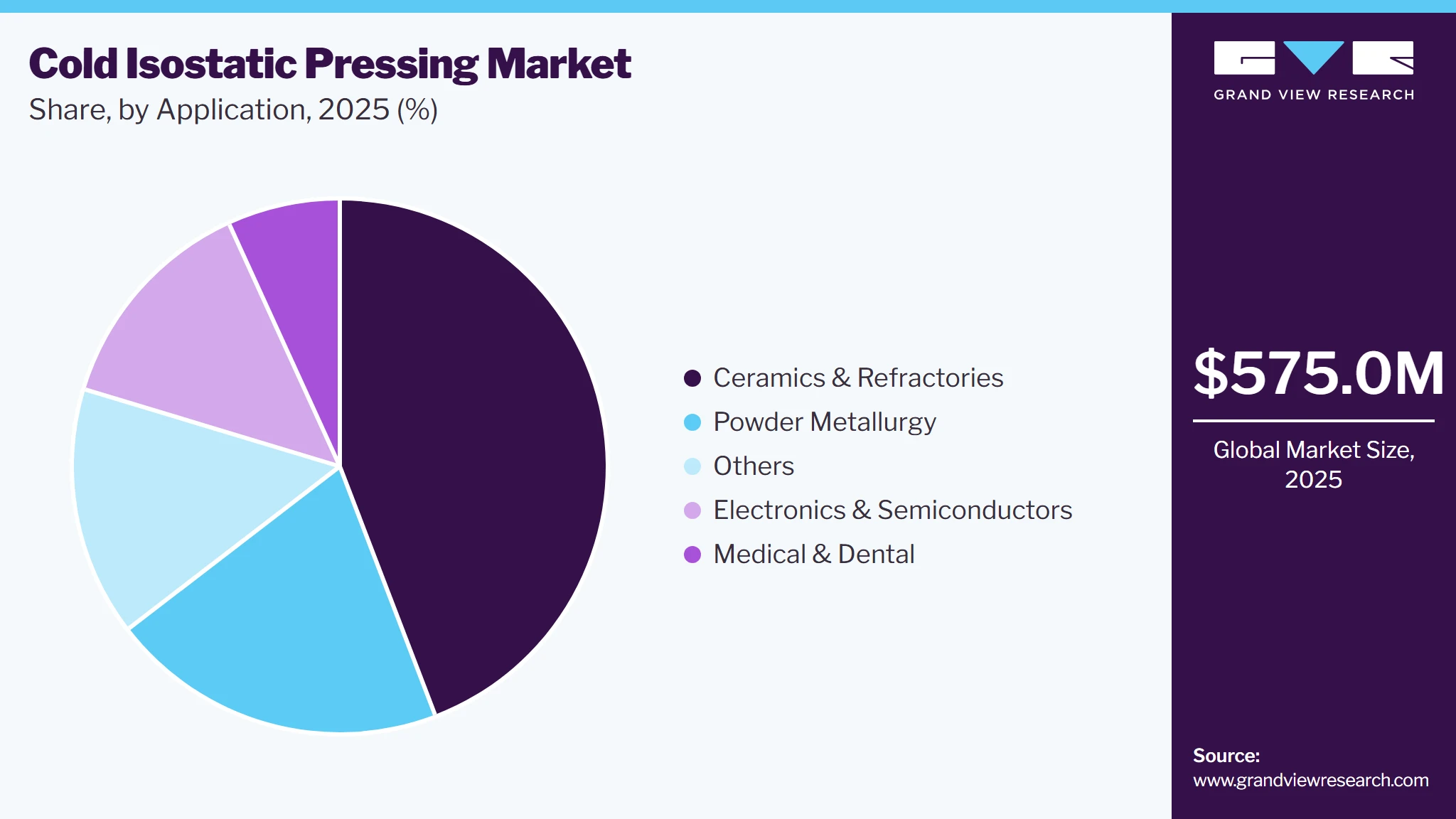
The powder metallurgy segment is expected to see strong growth in the cold isostatic pressing market, driven by increasing demand for high-density metal components with complex geometries and consistent mechanical properties across automotive, aerospace, energy, defense, and industrial applications. CIP enables uniform compaction of metal powders, reducing density variations and supporting the production of large or intricate components with improved strength and dimensional stability.
Regional Insights
The cold isostatic pressing market in the Asia Pacific dominated the global industry with the revenue share of 44.8% in 2025. The dominance is due to the strong presence of advanced manufacturing, powder metallurgy, ceramics, aerospace, automotive, and electronics industries. China, Japan, South Korea, and India are increasingly adopting CIP to manufacture complex components with uniform density and improved mechanical properties. China is a major market because of its large ceramic, refractory, and metal powder manufacturing base, while Japan and South Korea use CIP extensively for precision ceramics, electronic components, and advanced industrial materials. India is also witnessing growing adoption as investments in aerospace, defense, automotive, and powder metallurgy manufacturing increase.

Europe Cold Isostatic Pressing Market Trends
The cold isostatic pressing market in Europe is expected to depict the fastest CAGR over the forecast period. Prominently, Europe has emerged as a technologically advanced industry, supported by established aerospace, automotive, energy, ceramics, and industrial machinery industries. Germany, Italy, France, and the Nordic countries are important markets because manufacturers increasingly use CIP to produce high-performance ceramic components, refractory products, carbide tools, and specialized metal components.
North America Cold Isostatic Pressing Market Trends
The cold isostatic pressing market in North America is experiencing steady growth due to increasing demand for advanced materials across aerospace, defense, medical, automotive, and energy applications. The U.S. accounts for a significant share of regional demand because manufacturers are adopting CIP to produce high-density ceramic and metal components with complex geometries.
The cold isostatic pressing market in the U.S. is supported by its large aerospace, defense, medical, automotive, and energy manufacturing sectors. CIP is increasingly used to produce high-density components from metal, ceramic, and composite powders, where dimensional consistency and material uniformity are essential. Aerospace manufacturers use CIP for specialized components and near-net-shape parts, while the medical sector applies the technology to produce ceramic and metallic components for implants and other precision applications.
Middle East & Africa Cold Isostatic Pressing Market Trends
The cold isostatic pressing market in the Middle East & Africa is at an earlier stage of development, but is gaining opportunities through investments in advanced manufacturing, aerospace, defense, energy, and industrial ceramics. Countries such as Saudi Arabia and the UAE are developing local manufacturing capabilities as part of broader industrial diversification programs, creating potential demand for powder-based manufacturing technologies such as CIP.
Key Cold Isostatic Pressing Company Insights
Some of the key players operating in the market include CDE Group, Eriez, and others.
-
GKN Powder Metallurgy is a global powder metallurgy company that develops engineered metal powders, precision components, and advanced manufacturing solutions for automotive, industrial, aerospace, medical, energy, and other applications. Its operations span GKN Hoeganaes, GKN Sinter Metals, and GKN Additive, covering powder production, conventional powder metallurgy, forged powder metallurgy, metal injection molding, porous metal technology, and metal additive manufacturing.
-
Höganäs is a Swedish global leader in metal powders, with a broad portfolio serving powder metallurgy, pressing and sintering, additive manufacturing, surface coating, brazing, welding, batteries, and other industrial applications. The company offers more than 3,500 powder products and works with customers to develop application-specific materials and processing solutions. In the cold isostatic pressing market, Höganäs contributes primarily through its advanced metal powder technologies, with its portfolio supporting isostatic pressing alongside conventional powder metallurgy and other powder-based processes.
Key Cold Isostatic Pressing Companies
The following key companies have been profiled for this study on the cold isostatic pressing market.
-
Almatis
-
ATI
-
Carpenter Technology
-
CoorsTek
-
Saint Gobain Ceramic Materials
-
GKN Powder Metallurgy
-
Höganäs
-
Kyocera
-
Sandvik
-
Tosoh
Competitive Benchmarking
Category
Operating Strategies
Competitive Edge
Weakness
Established Players (e.g. Höganäs, Sandvik, Carpenter Technology)
- Mature participants in the cold isostatic pressing market primarily focus on providing high-precision CIP equipment, advanced pressure vessels, tooling systems, and integrated powder processing solutions for ceramics, powder metallurgy, aerospace, medical, electronics, and advanced materials applications.
- Established players possess significant competitive advantages through extensive expertise in high pressure equipment, powder processing, and material consolidation technologies. Their ability to manufacture reliable CIP systems capable of achieving uniform pressure distribution and high density across complex shapes enables them to serve demanding applications requiring strict dimensional and mechanical specifications.
- Despite their strong market positions, mature players face challenges related to high equipment costs, complex installation requirements, and lengthy customer qualification processes. CIP systems require sophisticated pressure vessels, pumps, control systems, molds, and safety infrastructure, resulting in substantial capital investment for customers.
Emerging & Regional Players (e.g., Almatis, Kyocera)
- Emerging participants in the cold isostatic pressing market generally focus on specialized CIP equipment, customized processing solutions, and niche applications involving advanced ceramics, additive manufacturing powders, medical components, and high performance metal parts.
- Emerging companies benefit from operational flexibility and the ability to develop modern CIP systems without extensive legacy equipment platforms.
- Their streamlined engineering structures enable faster customization of pressure ranges, chamber configurations, tooling systems, and automation features according to customer requirements.
- Emerging participants face significant challenges related to limited financial resources, smaller manufacturing capacities, and fewer commercial installations.
- Developing high pressure CIP equipment requires substantial engineering expertise, safety validation, testing infrastructure, and investment in specialized components.
Recent Development
-
In January 2025, Canrud introduced its CAN CIP76 0020M manual cold isostatic press for laboratory-scale powder consolidation. The system is designed for ceramic, metal, and composite powders and targets research laboratories, material testing, prototyping, and process optimization. The development reflects the growing demand for compact, economical CIP equipment for research and small-batch applications.
Cold Isostatic Pressing Market Report Scope
Report Attribute
Details
Market Definition
The market size represents the annual value of powdered metal, ceramic, and composite materials consumed in components manufactured using Cold Isostatic Pressing (CIP).
Market size in 2025
USD 575.0 million
Estimated market size in 2026
USD 603.8 million
Projected market size by 2033
USD 849.5 million
Growth rate
CAGR of 5.0% from 2026 to 2033
Base year for estimation
2025
Historical data
2021 - 2024
Forecast period
2026 - 2033
Quantitative Units
Revenue in USD million and CAGR from 2026 to 2033
Report coverage
Revenue forecast, competitive landscape, growth factors, and trends
Segments covered
Material, application, region
Regional scope
North America; Europe; Asia Pacific; Latin America; Middle East & Africa
Country scope
U.S.; Canada; Mexico; Germany; France; UK; China; India; Japan; Brazil
Key companies profiled
Höganäs; Sandvik; Carpenter Technology; ATI; GKN Powder Metallurgy; Tosoh; Saint Gobain Ceramic Materials; CoorsTek; Almatis; Kyocera
Customization scope
Free report customization (equivalent up to 8 analysts working days) with purchase. Addition or alteration to country, regional & segment scope.
Pricing and purchase options
Avail customized purchase options to meet your exact research needs. Explore purchase options
Global Cold Isostatic Pressing Market Report Segmentation
This report forecasts revenue growth at global, regional, and country levels and provides an analysis of the latest industry trends in each of the sub-segments from 2021 to 2033. For this study, Grand View Research has segmented the global cold isostatic pressing market report on the basis of material, application, and region.

-
Material Outlook (Revenue, USD Million, 2021 - 2033)
-
Metal Powders
-
Ceramic Powders
-
Composite Materials
-
-
Application Outlook (Revenue, USD Million, 2021 - 2033)
-
Ceramics & Refractories
-
Powder Metallurgy
-
Electronics & Semiconductors
-
Medical & Dental
-
Others
-
-
Regional Outlook (Revenue, USD Million, 2021 - 2033)
-
North America
-
U.S.
-
Canada
-
Mexico
-
-
Europe
-
Germany
-
France
-
UK
-
-
Asia Pacific
-
China
-
India
-
Japan
-
-
Latin America
-
Brazil
-
-
Middle East & Africa
-
Research Methodology
The cold isostatic pressing market figures in this report are based on a proven research process that combines executive interviews with secondary research from proprietary databases, company filings, and recognized regulatory and institutional sources. Market size is built through value-chain sizing-reconciling supply-side and demand-side estimates-and triangulated with bottom-up and top-down approaches. Every estimate passes multiple levels of expert validation before publication, with each cold isostatic pressing segment quantified using the revenue-capture definitions in the table below.
Segment Definition
Material
Revenue Capture Definition
Metal Powders
The metal powders segment captures revenue generated from metal powders processed through CIP to manufacture dense, near net shape components and billets
Ceramic Powders
The ceramic powders segment represents revenue generated from ceramic powders consolidated through CIP to produce complex and high density ceramic components
Composite Materials
The composite materials segment includes revenue generated from composite powder systems consolidated using CIP to manufacture components with tailored mechanical, thermal, and wear properties.
Application
Revenue Capture Definition
Ceramics & Refractories
The ceramics and refractories segment captures revenue generated from CIP for manufacturing dense ceramic components, refractory shapes, wear resistant parts, and high temperature materials.
Powder Metallurgy
The powder metallurgy segment represents revenue generated from CIP for consolidating metal powders into billets, preforms, and complex components with uniform density and enhanced mechanical properties.
Electronics & Semiconductors
The electronics and semiconductors segment includes revenue generated from CIP used to manufacture ceramic substrates, semiconductor processing components, electronic insulators, targets, and other precision components.
Medical & Dental
The medical and dental segment captures revenue generated from CIP used to manufacture implants, prosthetic components, dental materials, surgical components, and other high performance medical parts.
Others
The others segment represents revenue generated from CIP applications in aerospace, automotive, energy, defense, industrial machinery, and other specialized industries.
Estimation Model
Layer Name
Key Question
Description
Advanced Materials Manufacturing Demand Base Layer
What forms the demand base?
Identify global demand from major industries using CIP, including ceramics & refractories, powder metallurgy, electronics & semiconductors, medical & dental, aerospace, and advanced materials manufacturing. Assess production volumes of ceramic components, powder metallurgy parts, electronic components, medical implants, and other high performance materials to establish the total addressable demand for CIP.
CIP Application Penetration Layer
Where is CIP utilized?
Estimate the penetration of CIP across key applications including ceramic components, refractory products, carbide and metal parts, electronic substrates, medical components, aerospace components, and other complex shaped materials. Analyze the adoption of wet bag and dry bag CIP processes across end use industries and regions based on material requirements and production volumes.
CIP Processing Intensity Layer
How much CIP capacity is utilized?
Analyze CIP processing intensity based on powder consumption, component production volumes, component size, pressing pressure, batch capacity, and production cycles. Evaluate the utilization of CIP equipment according to material type, component geometry, density requirements, and production throughput. Processing intensity varies according to powder characteristics, required green density, component complexity, equipment capacity, and manufacturing specifications.
Revenue Layer
How is market revenue generated?
Revenue generation is driven by demand from ceramics & refractories, powder metallurgy, electronics & semiconductors, medical & dental, aerospace, and advanced materials manufacturers. Market value is influenced by equipment capacity, operating pressure, automation level, material processing requirements, replacement demand, new plant investments, and regional manufacturing activity.
Delivered Customizations
We have successfully delivered the following deep-dive customizations
Client Request
Customization Delivered
Value Adds
Regional Segmentation
Detailed regional analysis of the cold isostatic pressing market across North America, Europe, Asia Pacific, Latin America, and Middle East & Africa. Included evaluation of powder metallurgy production, advanced ceramics manufacturing, aerospace component production, medical and dental applications, electronics and semiconductor manufacturing, and investments in advanced material processing infrastructure.
Identified major manufacturing hubs, high growth application centers, and emerging adoption markets. Enabled strategic expansion planning based on advanced manufacturing investments, powder metallurgy growth, and demand for high performance components. Supported regional demand forecasting and technology adoption analysis.
Opportunity Assessment
Identification of high growth opportunities across advanced ceramics, powder metallurgy, aerospace components, medical implants, dental components, semiconductor manufacturing, electronics, energy systems, and high performance industrial components.
Enabled prioritization of high return growth segments and emerging regional opportunities. Supported long term equipment investments, production capacity expansion, technology development, service diversification, and strategic business development aligned with advanced manufacturing and high performance material applications.
Cross Segmentation
Comprehensive cross segmentation analysis by material, application, and region, including metal powders, ceramic powders, and composite materials across ceramics and refractories, powder metallurgy, electronics and semiconductors, medical and dental, and other industrial applications.
Enabled identification of the most attractive material and application combinations. Supported product portfolio optimization, technology selection, customer targeting, and investment prioritization strategies.
Frequently Asked Questions About This Report
The global cold isostatic pressing market size was estimated at USD 575.0 million in 2025 and is expected to reach USD 603.8 million in 2026.
The global cold isostatic pressing market is expected to grow at a compound annual growth rate of 5.0% from 2026 to 2033 to reach USD 849.5 million by 2033.
Asia Pacific dominated the market with revenue share of 44.8% in 2025.
China dominated the Asia Pacific market with revenue share of 35.9% in 2025.
Based on material, ceramic powders accounted for largest revenue share of 55.0% in 2025.
Ceramics & refractories accounted for largest revenue share of 44.2% in 2025.
Powder metallurgy is anticipated to register the fastest CAGR over the forecast period.
The key factor driving the growth of the global cold isostatic pressing market is the rising demand for high density, complex, and high performance components across ceramics, powder metallurgy, automotive, aerospace, electronics, and medical applications, supported by CIP’s ability to achieve uniform density, improved material properties, and near net shape forming with greater manufacturing efficiency.
Some of the key players of the global cold isostatic pressing market are Höganäs, Sandvik, Carpenter Technology, ATI, GKN Powder Metallurgy, Tosoh, Saint Gobain Ceramic Materials, CoorsTek, Almatis, Kyocera, and others.
About the Author(s)
Advanced Interior Materials Research Team
Advanced Materials · Advanced Interior MaterialsThis report was authored by the advanced interior materials research team at Grand View Research - comprising two research analysts, one senior research analyst, and one industry expert - with specialized expertise in the advanced interior materials segment of the advanced materials industry. All findings are based on proprietary advanced materials databases, executive interviews, and regulatory analysis, subject to internal peer review prior to publication.
Last Updated:
Speak to Analyst


Customize this report to your needs — add regions, segments, or data points, with 20% free customization.
Or view our licence options:


ISO 9001:2015 & 27001:2022 Certified
We are GDPR and CCPA compliant! Your transaction & personal information is safe and secure. For more details, please read our privacy policy.


