
- Home
- »
- Plastics, Polymers & Resins
- »
-
Collapsible Recycled Plastic Packaging Market Report, 2033GVR Report cover
![Collapsible Recycled Plastic Packaging Market (2026 - 2033)Report]()
Collapsible Recycled Plastic Packaging Market (2026 - 2033)
Size, Share & Trends Analysis Report By Material (rHDPE, rPP, rPET), By Product(Collapsible Crates & Foldable Totes, Collapsible Bottles & Tubes, Collapsible Pallets), By End Use, By Region, And Segment Forecasts
Market Size, 2025
$9.9BMarket Estimate, 2026
$10.5BMarket Forecast, 2033
$16.1BCAGR, 2026–2033
6.3%Collapsible Recycled Plastic Packaging Market Summary
The global collapsible recycled plastic packaging market size was estimated at USD 9.9 billion in 2025 and is projected to grow from USD 10.5 billion in 2026 to USD 16.1 billion by 2033, growing at a CAGR of 6.3% from 2026 to 2033. Asia Pacific dominated the collapsible recycled plastic packaging market with the largest revenue share of 36.2% in 2025. The industry is driven by the growing emphasis on sustainability, circular economy initiatives, and the need to reduce logistics and storage costs.

Key Market Trends & Insights
- By material: Recycled high-density polyethylene (rHDPE) segment held the largest market share of 42.1% in 2025.
- By product type: Collapsible crates & foldable totes segment held the largest market share of 43.3% in 2025.
- By end use: Food & beverage logistics segment held the largest market share of 37.6% in 2025.
Regional Highlights
- Largest regional market: Asia Pacific (36.2% revenue share, 2025)
- By country: China held the largest market share in 2025
Market Size & Forecast
- Market size in 2025: USD 9.9 Billion
- Estimated market size in 2026: USD 10.5 Billion
- Projected market size by 2033: USD 16.1 Billion
- CAGR (2026-2033): 6.3%
In addition, rising e-commerce, retail, and industrial supply chain activities are boosting demand for reusable and space-efficient packaging solutions. Governments, corporations, and consumers are increasingly prioritizing the reduction of plastic waste and the use of recycled materials. Recycled collapsible packaging solutions, such as foldable crates, bins, and totes, align perfectly with these objectives as they minimize material waste, reduce carbon emissions, and extend product lifecycles. For instance, companies such as CHEP and ORBIS Corporation have expanded their reusable plastic container programs made from post-consumer recycled (PCR) materials to help clients lower their environmental footprint and achieve sustainability goals. These initiatives reflect how environmental compliance and sustainability commitments are encouraging industries to adopt collapsible recycled packaging solutions.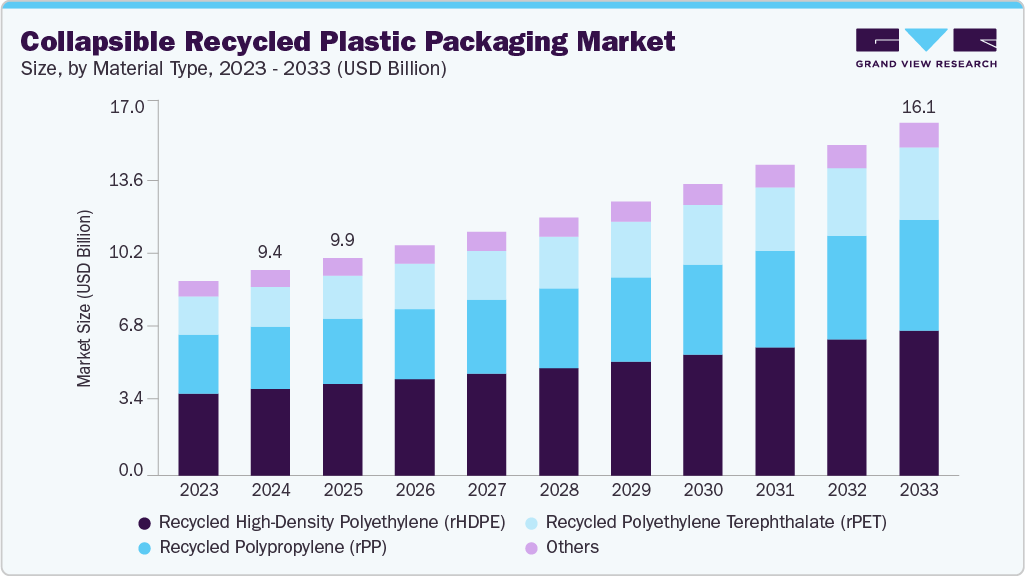
The surge in e-commerce and retail logistics has significantly accelerated the adoption of collapsible recycled plastic packaging due to the sector’s demand for durable, reusable, and space-efficient solutions. Online retail giants such as Amazon, Walmart, and Alibaba handle millions of shipments daily, requiring packaging solutions that are both cost-effective and sustainable. Collapsible recycled plastic containers, crates, and pallets are gaining traction because they reduce volume during reverse logistics and can be reused multiple times, unlike single-use corrugated or stretch-wrapped alternatives. This not only helps reduce operational costs but also aligns with the sustainability mandates increasingly emphasized in e-commerce supply chains. The rapid expansion of e-commerce sales further underscores this trend. According to the U.S. Department of Commerce, U.S. retail e-commerce sales reached USD 304.2 billion in the second quarter of 2025, marking a 1.4% increase from the first quarter and accounting for 16.3% of total retail sales.
In retail logistics, space optimization is critical. Collapsible packaging allows retailers to transport and store goods efficiently by minimizing the volume of empty packaging on return trips. For instance, collapsible plastic crates can reduce storage space by up to 70% when folded, enabling companies to save significantly on warehousing and transportation costs. Retail chains such as Carrefour and Tesco have already incorporated reusable collapsible crates and bins in their distribution centers to handle fresh produce and other fast-moving goods. In Europe, where the e-commerce sector continues to expand despite macroeconomic challenges, the European E-commerce Report 2024 reveals that online retail sales reached USD 965.8 billion in 2023, a 3% increase over 2022. This steady growth, particularly in Southern (14%) and Eastern Europe (15%), reinforces the need for efficient and sustainable packaging systems such as collapsible recycled plastics that can support regional fulfillment networks and cross-border logistics.
The rapid adoption of Returnable Transport Systems (RTS) and pooling models has emerged as a key driver for the growth of the collapsible recycled plastic packaging industry. As global supply chains evolve toward circularity and efficiency, manufacturers, retailers, and logistics providers are seeking packaging solutions that can be reused multiple times without compromising product protection or performance. Collapsible recycled plastic containers, crates, bins, and pallets are ideal for RTS frameworks, as they can be folded flat when empty, reducing backhaul costs and storage space. These systems are gaining traction in industries such as food & beverage, automotive, retail, and pharmaceuticals, where repeated distribution cycles make reusability both environmentally and economically advantageous.
Market Dynamics
The collapsible recycled plastic packaging market is experiencing steady growth, driven by rising demand for sustainable and reusable packaging solutions across industries such as food & beverages, automotive, retail, and industrial logistics. Increasing regulatory focus on plastic waste reduction, growing adoption of circular economy practices, and corporate sustainability initiatives are supporting market expansion. The lightweight, durable, and space-saving nature of collapsible recycled plastic packaging helps reduce transportation and storage costs, further boosting demand. However, challenges related to recycled material quality consistency and feedstock availability may hinder growth. Nevertheless, ongoing advancements in recycling technologies and reusable packaging systems are expected to create new growth opportunities.
The increasing focus on sustainability and circular economy practices is a major driver of the collapsible recycled plastic packaging market. Governments, regulatory bodies, and industry organizations worldwide are implementing stricter regulations to reduce plastic waste and promote the use of recycled materials. Consequently, businesses across sectors such as retail, food & beverages, automotive, and industrial logistics are adopting packaging solutions that support waste reduction, resource efficiency, and environmental compliance. Collapsible recycled plastic packaging aligns with these objectives by enabling repeated use while incorporating recycled content, thereby reducing reliance on virgin plastics.
Companies are further strengthening their sustainability commitments to meet consumer expectations and environmental, social, and governance (ESG) goals. Collapsible recycled plastic packaging offers significant advantages, including lower transportation emissions through space-efficient return logistics, reduced packaging waste, and improved supply chain efficiency. Its durability and reusability help organizations minimize overall packaging consumption and operational costs over time. As businesses continue to prioritize sustainable procurement and circular supply chain strategies, demand for collapsible recycled plastic packaging is expected to increase steadily.
A significant restraint for the collapsible recycled plastic packaging market is the inconsistent availability and quality of recycled plastic feedstock. The performance and durability of collapsible packaging depend heavily on the quality of recycled materials used in production, which can vary due to differences in collection, sorting, and recycling processes. Supply chain disruptions, limited recycling infrastructure in certain regions, and fluctuations in the availability of recyclable plastics can further impact raw material supply and pricing. These challenges may increase production costs and create concerns regarding product consistency, limiting adoption among end users that require high-performance packaging solutions for demanding logistics and industrial applications.
The growing adoption of closed-loop logistics and reusable packaging systems presents a significant opportunity for the collapsible recycled plastic packaging market. Companies across retail, e-commerce, automotive, food distribution, and industrial sectors are increasingly seeking packaging solutions that can be used multiple times to reduce waste and lower long-term operational costs. Collapsible recycled plastic packaging is well suited for these systems due to its durability, space-saving design, and ease of return transportation. As organizations invest in circular supply chains and sustainable logistics networks, demand for reusable packaging solutions made from recycled materials is expected to rise, creating substantial growth opportunities for market participants.
Market Concentration & Characteristics
The industry exhibits moderate to high technological intensity, driven by ongoing material innovations and advancements in recycling. Manufacturers are increasingly incorporating advanced recycling technologies, such as chemical recycling, near-infrared (NIR) sorting, and additive-enhanced resin formulations, to improve the mechanical strength, surface finish, and recyclability of packaging products. The integration of smart features, such as RFID tagging and IoT-based tracking, is further enhancing supply chain transparency and inventory management efficiency.

A key characteristic of the industry is its high functional and operational efficiency. Collapsible recycled plastic packaging is designed for space optimization, reducing storage and transportation costs through easy stacking and return logistics. Its durability and resistance to moisture, impact, and chemicals ensure long service life, making it a cost-effective and sustainable alternative to traditional materials like wood or cardboard.
Analyst Perspective
The collapsible recycled plastic packaging market is expected to witness steady growth, driven by increasing demand for sustainable, reusable, and cost-efficient packaging solutions across logistics, retail, food & beverage, automotive, and industrial sectors. Growing emphasis on reducing packaging waste, improving supply chain efficiency, and meeting circular economy objectives is accelerating the adoption of packaging made from recycled plastics. The market is further supported by stricter environmental regulations and rising corporate sustainability commitments. Furthermore, manufacturers that offer durable, lightweight, and highly recyclable collapsible packaging solutions will be well positioned to capitalize on growth opportunities across both developed and emerging markets.
Material Insights
Based on material, the recycled high-density polyethylene (rHDPE) segment led the market with the largest revenue share of 42.1% in 2025. rHDPE offers high strength, moisture and chemical resistance, and durability-making it ideal for heavy-duty collapsible crates and bulk totes in food & beverage logistics and industrial transport. It’s easily sourced from post-consumer containers and maintains performance through multiple reuse cycles. Strong availability of recycled feedstock, durability for repeated use, and supportive recycled-content mandates drive adoption. Advances in sorting and washing technologies also enhance rHDPE quality and broaden its applications.
The rPET segment is expected to grow at the fastest CAGR of 6.9% during the forecast period. rPET combines high stiffness, transparency, and good barrier properties, making it suitable for clear foldable crates and reusable trays in food and beverage logistics. It also supports strong sustainability branding due to circular economy benefits. Consumer preference for recycled-content packaging, stringent regulations for rPET inclusion, and investment in bottle collection and advanced recycling systems are key growth drivers.
Product Insights
Based on product type, the collapsible crates & foldable totes segment led the market with the largest revenue share of 43.3% in 2025. Collapsible crates and foldable totes are among the most widely used products in the collapsible recycled plastic packaging industry. They are primarily used in food & beverage logistics, retail distribution, and automotive component handling. The growth of this segment is driven by increasing demand for space-efficient and returnable logistics packaging across retail, e-commerce, and grocery supply chains.
The collapsible bottles & tubes segment is expected to grow at the fastest CAGR of 6.7% during the forecast period. Collapsible bottles and tubes are lightweight packaging formats made from recycled polyethylene (rPE), polypropylene (rPP), or post-consumer recycled PET (rPET). They are primarily used in personal care, household cleaning, and food & beverage applications. Their design allows consumers to squeeze out nearly all the product while the packaging gradually compresses.
End Use Insights
Based on end use, the food & beverage logistics segment led the market with the largest revenue share of 37.6% in 2025. The segment represents one of the largest consumers of collapsible recycled plastic packaging. These solutions, such as foldable crates, stackable totes, and returnable bins, are used extensively for the transport and storage of perishable goods, including fruits, vegetables, meat, dairy, and beverages. Collapsible packaging ensures hygienic handling, minimizes contamination risks, and offers superior temperature resistance during cold chain transportation. The key growth drivers include the rising emphasis on sustainable cold chain logistics, stringent food safety regulations, and expanding global trade in fresh and processed foods.
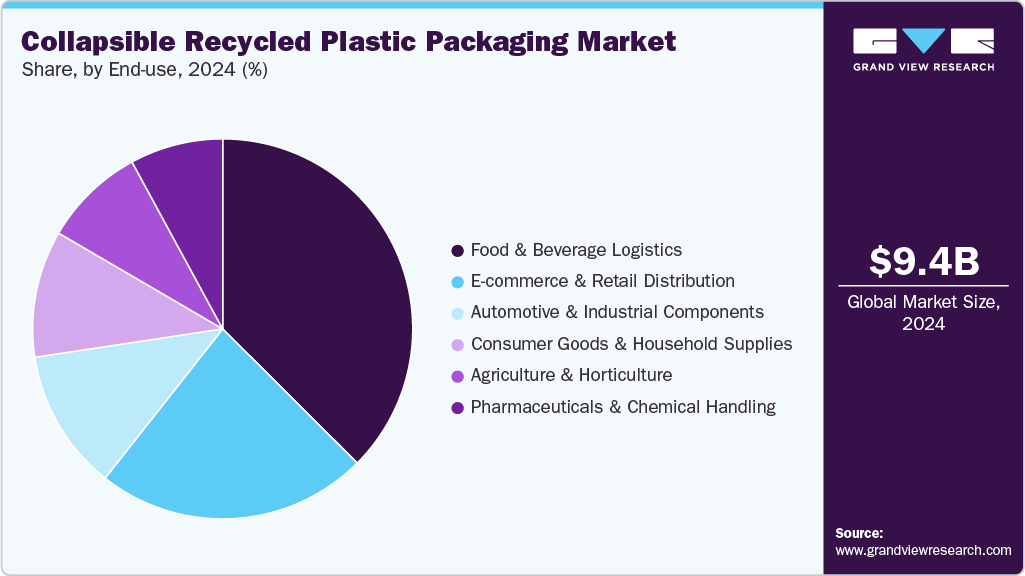
The e-commerce & retail distribution segment is projected to grow at the fastest CAGR of 6.8% during the forecast period. In the e-commerce & retail distribution sector, collapsible recycled plastic packaging is utilized for order fulfillment, warehousing, and last-mile delivery. Online retail giants such as Amazon, Flipkart, and JD.com employ foldable totes and crates to manage high product turnover efficiently within automated logistics centers. These solutions facilitate easy stacking, reduce empty-return freight costs, and maintain product protection during transit. The collapsible nature of these containers helps streamline inventory management and improve operational flexibility across omnichannel retail networks. This segment’s expansion is driven by the rapid growth of e-commerce platforms, increased warehousing automation, and demand for efficient reverse logistics.
Regional Insights
Asia Pacific dominated the collapsible recycled plastic packaging market with the largest revenue share of 36.2% in 2025. The outlook is influenced by rapid industrialization, expanding e-commerce, and growing policy emphasis on sustainability and waste reduction. Countries such as China, Japan, India, and South Korea are witnessing substantial demand growth from logistics, food and beverage, and retail sectors, where efficient and reusable packaging solutions are critical for large-scale operations. The region’s booming e-commerce and manufacturing hubs are propelling the adoption of collapsible recycled plastic pallets, crates, and containers to optimize storage and transport efficiency while meeting sustainability goals
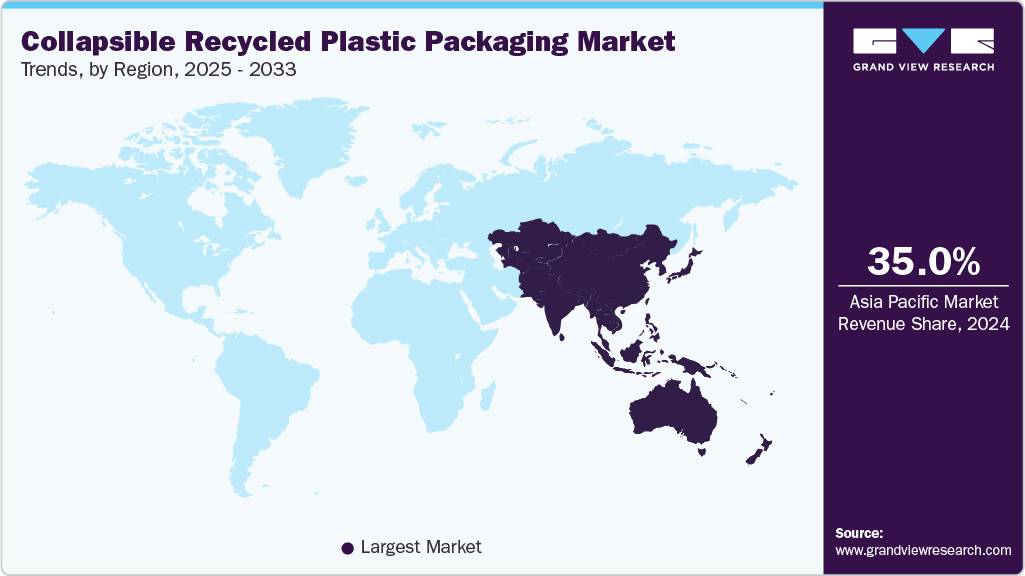
The collapsible recycled plastic packaging market in China held the largest share in the Asia Pacific region in 2025. The collapsible recycled plastic packaging industry in China dominated the revenue share in the regional landscape. This leadership is driven by robust government policies advancing circular economy principles and extensive investments in advanced recycling infrastructure. The country’s 14th Five-Year Plan for Circular Economy Development focuses on reducing plastic waste, improving recycling efficiency, and boosting the utilization of recycled materials across industries. These initiatives have accelerated the adoption of collapsible recycled plastic packaging solutions, such as crates, bins, and pallets, across logistics, e-commerce, and manufacturing sectors seeking to minimize storage requirements and carbon emissions.
North America Collapsible Recycled Plastic Packaging Market Trends
The collapsible recycled plastic packaging industry in North America has received impetus from the rapid growth of e-commerce, retail, and food delivery sectors, creating robust demand for durable, space-saving, and sustainable packaging options. Moreover, growing corporate commitments to ESG (Environmental, Social, and Governance) targets are reinforcing the regional dominance of North America in this market. Leading consumer goods companies, such as Procter & Gamble, PepsiCo, and Walmart, have pledged to use higher percentages of recycled content in their packaging, driving innovation and investment in collapsible recycled plastic packaging. Combined with strong consumer awareness around sustainability, supportive government initiatives, and a mature recycling ecosystem, these factors position North America as a frontrunner in the global collapsible recycled plastic packaging market.
U.S. Collapsible Recycled Plastic Packaging Market Trends
The U.S. collapsible recycled plastic packaging industry dominated the North America market, accounting for over 79.0% of the regional revenue share in 2024. This dominance is primarily attributed to the country’s robust regulatory framework, which promotes sustainable packaging, and its leadership in recycling innovation. Federal and state-level policies, such as the EPA’s National Recycling Strategy and statewide bans on single-use plastics in California, Washington, and New York, are driving the transition toward reusable and recyclable packaging solutions. These initiatives are compelling manufacturers and retailers to adopt collapsible recycled plastic packaging that aligns with waste reduction and carbon mitigation goals.
Europe Collapsible Recycled Plastic Packaging Market Trends
The collapsible recycled plastic packaging industry in the Europe will exhibit growth on the back of the European Green Deal, the EU Circular Economy Action Plan, and the Packaging and Packaging Waste Regulation (PPWR) driving a shift towards reusable and recyclable packaging by setting strict targets for recycling and waste reduction. These policies have accelerated investments in recycled plastic infrastructure and encouraged adoption of collapsible, returnable packaging formats across logistics, retail, and industrial sectors. Countries such as Germany, the Netherlands, and France lead in recycling efficiency, while initiatives such as the USD 41 million investment by ARA, Bernegger, and GreenDot in Austria’s TriPlast facility, capable of processing 41,000 tonnes of waste annually using UPCYCLE technology, underscore the region’s strong commitment to circular economy goals and high-quality recyclate production.
Key Collapsible Recycled Plastic Packaging Company Insights
The competitive environment of the market is characterized by a mix of global and regional players focusing on product innovation, sustainability, and supply chain efficiency. Companies are increasingly investing in advanced recycling technologies and lightweight, durable designs to meet the rising demand for eco-friendly and reusable logistics solutions. Strategic partnerships, mergers, and collaborations are common as firms aim to expand their recycling capabilities and geographic reach. For instance, major packaging and material companies are forming alliances with recycling firms to secure a steady supply of post-consumer recycled (PCR) materials and enhance circular economy practices.
-
In July 2025, IPL, inc., a North American rigid plastic packaging company, merged with Europe’s Schoeller Allibert, a reusable transport packaging specialist, forming a global sustainable packaging powerhouse with over USD 1.4 billion in annual revenue. This merger is expected to combine strengths across food, automotive, and industrial sectors to drive innovation and sustainability.
-
In February 2025, ORBIS Corporation opened a 660,000-square-foot manufacturing plant in Greenville, Texas, to produce reusable totes and pallets. This expansion boosts ORBIS’s production capacity and supports its commitment to sustainability and the circular economy.
Key Collapsible Recycled Plastic Packaging Companies:
The following are the leading companies in the collapsible recycled plastic packaging market.
- Schoeller Allibert
- IFCO SYSTEMS
- ORBIS Corporation
- IPL, Inc.
- DS Smith
- Tosca Services, LLC
- CHEP
- SSI SCHÄFER Plastics GmbH
- 360Eco Packaging
- RPP Containers
Collapsible Recycled Plastic Packaging Market Report Scope
Report Attribute
Details
Market size in 2025
USD 9.9 billion
Estimated market size in 2026
USD 10.5 billion
Projected market size by 2033
USD 16.1 billion
Growth rate
CAGR of 6.3% from 2026 to 2033
Base year for estimation
2025
Historical data
2021 - 2024
Forecast period
2026 - 2033
Quantitative units
Revenue in USD million/billion and CAGR from 2026 to 2033
Report coverage
Revenue forecast, company ranking, competitive landscape, growth factors, and trends
Segments covered
Material, product type, end use, region
Regional scope
North America; Europe; Asia Pacific; Latin America; MEA
Country scope
U.S.; Canada; Mexico; Germany; UK; France; Italy; Spain; China; Japan; India; South Korea; Australia; Brazil; Argentina; Saudi Arabia; South Africa; UAE
Key companies profiled
Schoeller Allibert; IFCO SYSTEMS; ORBIS Corporation; IPL, Inc.; DS Smith; Tosca Services, LLC; CHEP; SSI SCHAFER Plastics GmbH; 360Eco Packaging; RPP Containers
Customization scope
Free report customization (equivalent up to 8 analysts' working days) with purchase. Addition or alteration to country, regional & segment scope.
Pricing and purchase options
Avail customized purchase options to meet your exact research needs. Explore purchase options
Global Collapsible Recycled Plastic Packaging Market Report Segmentation
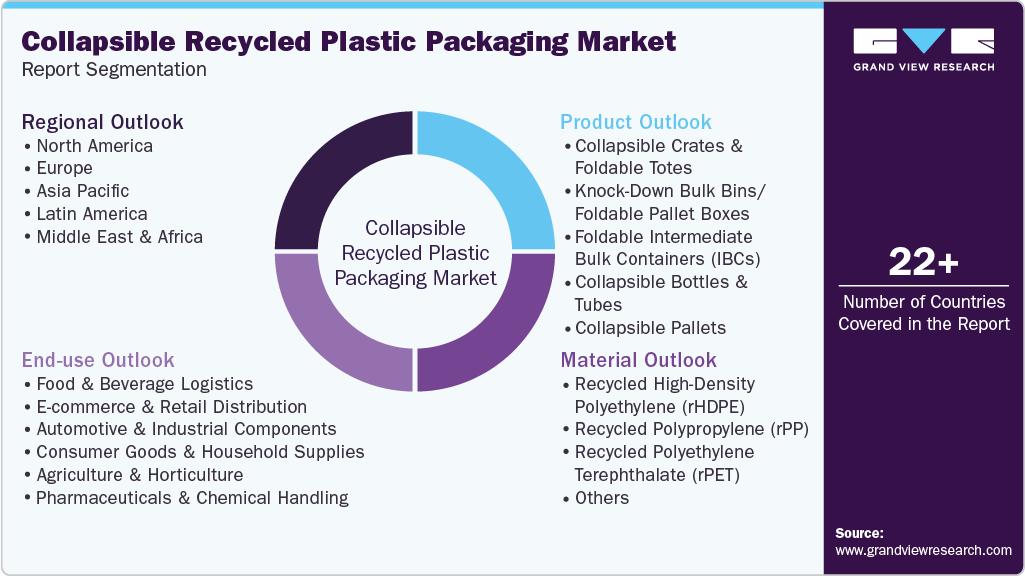
This report forecasts revenue growth at a global level and provides an analysis of the latest industry trends in each of the sub-segments from 2021 to 2033. For this study, Grand View Research has segmented the global collapsible recycled plastic packaging market report based on material, product, end use, and region:
-
Material Outlook (Revenue, USD Million, 2021 - 2033)
-
Recycled High-Density Polyethylene (rHDPE)
-
Recycled Polypropylene (rPP)
-
Recycled Polyethylene Terephthalate (rPET)
-
Others
-
-
Product Outlook (Revenue, USD Million, 2021 - 2033)
-
Collapsible Crates & Foldable Totes
-
Knock-Down Bulk Bins / Foldable Pallet Boxes
-
Foldable Intermediate Bulk Containers (IBCs)
-
Collapsible Bottles & Tubes
-
Collapsible Pallets
-
-
End Use Outlook (Revenue, USD Million, 2021 - 2033)
-
Food & Beverage Logistics
-
E-commerce & Retail Distribution
-
Automotive & Industrial Components
-
Consumer Goods & Household Supplies
-
Agriculture & Horticulture
-
Pharmaceuticals & Chemical Handling
-
-
Regional Outlook (Revenue, USD Million, 2021 - 2033)
-
North America
-
U.S.
-
Canada
-
Mexico
-
-
Europe
-
Germany
-
France
-
UK
-
Italy
-
Spain
-
-
Asia Pacific
-
China
-
India
-
Japan
-
Australia
-
South Korea
-
-
Latin America
-
Brazil
-
Argentina
-
-
Middle East & Africa
-
South Africa
-
Saudi Arabia
-
UAE
-
-
Research Methodology
The collapsible recycled plastic packaging market figures in this report are based on a proven research process that combines executive interviews with secondary research from proprietary databases, company filings, and recognized regulatory and institutional sources. Market size is built through value-chain sizing - reconciling supply-side and demand-side estimates - and triangulated with bottom-up and top-down approaches. Every estimate passes multiple levels of expert validation before publication, with each collapsible recycled plastic packaging segment quantified using the revenue-capture definitions in the table below.
Segment Definition
Segment - Material
Revenue capture definition
Recycled High-Density Polyethylene (rHDPE)
Revenue generated from the sale of collapsible recycled plastic packaging manufactured using recycled high-density polyethylene (rHDPE). This segment includes foldable crates, pallet boxes, totes, and industrial containers utilized in logistics, agriculture, retail distribution, and manufacturing applications requiring durability and impact resistance.
Recycled Polypropylene (rPP)
Revenue generated from the sale of collapsible recycled plastic packaging produced from recycled polypropylene (rPP). This segment includes reusable foldable containers, bins, pallets, and transport packaging used across automotive, industrial, food distribution, and e-commerce supply chains where lightweight construction and chemical resistance are required.
Recycled Polyethylene Terephthalate (rPET)
Revenue generated from the sale of collapsible recycled plastic packaging made from recycled polyethylene terephthalate (rPET). This segment includes collapsible bottles, tubes, containers, and specialized packaging solutions used in consumer goods, food & beverage, and personal care applications requiring transparency, recyclability, and product protection.
Others (rLDPE, rPS, Bio-recycled Plastics)
Revenue generated from the sale of collapsible recycled plastic packaging manufactured using alternative recycled materials, including recycled low-density polyethylene (rLDPE), recycled polystyrene (rPS), and bio-recycled plastics. This segment includes niche packaging formats developed for specialized logistics, retail, industrial, and sustainability-focused applications.
Segment - Product Type
Revenue capture definition
Collapsible Crates & Foldable Totes
Revenue generated from the sale of reusable collapsible crates and foldable totes designed for efficient storage, transportation, and handling of goods. This segment includes packaging solutions used in food distribution, retail logistics, e-commerce fulfillment, and industrial supply chains.
Knock-Down Bulk Bins / Foldable Pallet Boxes
Revenue generated from the sale of large-capacity collapsible bulk bins and foldable pallet boxes used for transporting and storing high-volume materials and products. This segment includes packaging systems utilized in automotive, manufacturing, agriculture, and warehouse operations.
Collapsible Pallets
Revenue generated from the sale of collapsible plastic pallets manufactured from recycled materials. This segment includes reusable pallet solutions designed to optimize storage space, improve return logistics efficiency, and reduce transportation costs across various industries.
Foldable Intermediate Bulk Containers (IBCs)
Revenue generated from the sale of foldable intermediate bulk containers (IBCs) used for the storage and transportation of liquids, semi-solids, and bulk materials. This segment includes reusable packaging solutions deployed in chemical, food processing, pharmaceutical, and industrial applications.
Collapsible Bottles & Tubes (Consumer/Personal Care, Industrial Fluids)
Revenue generated from the sale of collapsible bottles and tubes manufactured using recycled plastics for packaging consumer products, personal care formulations, and industrial fluids. This segment includes packaging solutions designed to improve material efficiency, product dispensing, and sustainability performance.
Segment - End Use
Revenue capture definition
Food & Beverage Logistics
Revenue generated from the sale of collapsible recycled plastic packaging used for the transportation, storage, and distribution of food and beverage products. This segment includes crates, totes, pallet boxes, and reusable containers that support cold-chain and retail logistics operations.
E-commerce & Retail Distribution
Revenue generated from the sale of collapsible recycled plastic packaging utilized in e-commerce fulfillment centers, retail distribution networks, and last-mile logistics. This segment includes reusable transport packaging designed to improve operational efficiency and reduce packaging waste.
Automotive & Industrial Components
Revenue generated from the sale of collapsible recycled plastic packaging used for handling, storing, and transporting automotive parts, industrial components, and manufacturing materials. This segment includes durable reusable containers, pallets, and bulk bins designed for closed-loop logistics systems.
Consumer Goods & Household Supplies
Revenue generated from the sale of collapsible recycled plastic packaging used in the storage, transportation, and distribution of consumer goods and household products. This segment includes reusable packaging solutions that support retail supply chains and inventory management operations.
Agriculture & Horticulture
Revenue generated from the sale of collapsible recycled plastic packaging used for harvesting, handling, storing, and transporting agricultural produce, horticultural products, and related materials. This segment includes foldable crates, bins, and containers designed to improve logistics efficiency and product protection.
Pharmaceuticals & Chemical Handling
Revenue generated from the sale of collapsible recycled plastic packaging used for the storage, transportation, and handling of pharmaceutical products, chemicals, and industrial fluids. This segment includes foldable containers, IBCs, and specialized reusable packaging solutions designed to meet safety, hygiene, and regulatory requirements.
Estimation Model
Layer Name
Key Question
Description
Recycled Plastic Packaging Demand Base Layer
What forms the demand base?
Identify global consumption volumes of collapsible recycled plastic packaging across major end-use industries, including food & beverage logistics, e-commerce & retail distribution, automotive & industrial components, consumer goods, agriculture & horticulture, and pharmaceuticals & chemical handling. This layer establishes the total addressable demand for reusable and sustainable packaging solutions across regional supply chains.
Reusable Packaging Adoption Layer
Where are collapsible recycled plastic packaging solutions utilized?
Estimate the penetration of collapsible recycled plastic packaging relative to conventional rigid, single-use, and non-recycled packaging formats across industries and geographies. Assess adoption levels for collapsible crates, foldable totes, pallet boxes, pallets, IBCs, and collapsible bottles & tubes, considering sustainability initiatives, circular economy practices, and logistics efficiency requirements.
Supply Chain Utilization Layer
How much packaging volume is deployed?
Analyze packaging utilization rates based on transportation cycles, return logistics networks, warehouse operations, storage requirements, product movement frequency, and reusable packaging lifespans. Deployment intensity is influenced by end-use industry requirements, reverse logistics infrastructure, handling conditions, regulatory standards, and operational efficiency objectives.
Revenue Layer
How is market revenue generated?
Market revenue is quantified through the sale and leasing of collapsible recycled plastic packaging products, including collapsible crates & foldable totes, knock-down bulk bins, foldable pallet boxes, collapsible pallets, foldable IBCs, and collapsible bottles & tubes. Revenue is generated from demand across logistics providers, manufacturers, retailers, agricultural producers, food & beverage companies, pharmaceutical firms, and industrial end users seeking sustainable, reusable, and cost-efficient packaging solutions.
Delivered Customizations
This report has been delivered with the following In-depth customizations
Client Request
Customization Delivered
Value Adds
Regional Segmentation Analysis
Detailed analysis of the Collapsible Recycled Plastic Packaging Market across North America, Europe, Asia Pacific, Central & South America, and Middle East & Africa, covering demand trends, regulatory frameworks, recycling infrastructure development, sustainability initiatives, and adoption across key end-use industries including food & beverage logistics, e-commerce, automotive, agriculture, and pharmaceuticals.
Enables identification of region-specific growth opportunities, supports market entry planning, and helps prioritize investments based on regulatory support, recycling capabilities, and end-user demand.
Cross-Segmentation Analysis
Comprehensive assessment of market performance across material types (rHDPE, rPP, rPET, and other recycled plastics), product types (collapsible crates & foldable totes, foldable pallet boxes, collapsible pallets, foldable IBCs, and collapsible bottles & tubes), end-use industries, and regional markets.
Identifies high-growth segment combinations, reveals emerging demand pockets, and supports targeted product development, capacity planning, and customer acquisition strategies.
Opportunity Assessment
Identification of growth opportunities across recycled material innovations, reusable transport packaging solutions, circular economy initiatives, e-commerce logistics expansion, sustainable industrial packaging demand, and emerging regional markets.
Supports strategic investment decisions, highlights high-potential revenue streams, identifies partnership opportunities, and enables long-term growth planning within the market.
Frequently Asked Questions About This Report
Asia Pacific is the fastest-growing region in the collapsible recycled plastic packaging market with a CAGR of 7.4% over the forecast period.
The recycled high-density polyethylene (rHDPE) segment led the collapsible recycled plastic packaging market with a 42.1% revenue share in 2025.
The collapsible crates & foldable totes segment led the collapsible recycled plastic packaging market with a 43.3% revenue share in 2025.
The food & beverage logistics segment led the collapsible recycled plastic packaging market with a 37.6% revenue share in 2025.
Key players in the collapsible recycled plastic packaging market include Schoeller Allibert; IFCO SYSTEMS; ORBIS Corporation; IPL, Inc.; DS Smith; Tosca Services, LLC; CHEP; SSI SCHAFER Plastics GmbH; 360Eco Packaging; RPP Containers.
The global collapsible recycled plastic packaging market size was valued at USD 9.9 billion in 2025 and is estimated at USD 10.5 billion for 2026.
The global collapsible recycled plastic packaging market is expected to grow at a CAGR of 6.3% from 2026 to 2033, reaching USD 16.1 billion by 2033.
: Asia Pacific dominated the collapsible recycled plastic packaging market with a 36.2% revenue share in 2025.
Key factors driving the collapsible recycled plastic packaging market include rising demand for sustainable and reusable packaging, increasing adoption of circular economy practices, stricter regulations on plastic waste, and growing focus on reducing logistics and storage costs through space-efficient packaging solutions.
About the Author(s)
Plastics, Polymers & Resins Research Team
Bulk Chemicals · Plastics, Polymers & ResinsThis report was authored by the plastics, polymers & resins research team at Grand View Research - comprising two research analysts, one senior research analyst, and one industry expert - with specialized expertise in the plastics, polymers & resins segment of the bulk chemicals industry. All findings are based on proprietary bulk chemicals databases, executive interviews, and regulatory analysis, subject to internal peer review prior to publication.
Last Updated:
Speak to Analyst


Customize this report to your needs — add regions, segments, or data points, with 20% free customization.
Or view our licence options:


ISO 9001:2015 & 27001:2022 Certified
We are GDPR and CCPA compliant! Your transaction & personal information is safe and secure. For more details, please read our privacy policy.


