
- Home
- »
- Next Generation Technologies
- »
-
Commercial Lending Market Size, Growth Report, 2026-2033GVR Report cover

Commercial Lending Market (2026 - 2035)
Size, Share & Trends Analysis Report By Loan Type (Term Loans, Trade Finance), By Enterprise Size (SMEs, Large Enterprises), By End Use, By Region, And Segment Forecasts
Market Size, 2025
$11,800.0BMarket Estimate, 2026
$13,000.0BMarket Forecast, 2035
$30,800.0BCAGR, 2026–2035
10.1%Commercial Lending Market Summary
The global commercial lending market size was valued at USD 11,800.0 billion in 2025 and is projected to grow from USD 13,000.0 billion in 2026 to USD 30,800.0 billion in 2035, at a CAGR of 10.1% from 2026 to 2035. North America dominated the global market, accounting for the largest share of revenue in 2025. The market is experiencing steady growth, driven by rising demand for business financing, growing investment by SMEs, and the rapid digital transformation of lending services.
Key Market Trends & Insights
- By loan type: The commercial real estate loans segment held the largest market share in 2025.
- By enterprise size: The large enterprises segment dominated with the largest market share in 2025.
- By end use: The commercial real estate segment accounted for the largest market share in 2025.
Regional Highlights
- Largest regional market: North America
- Fastest-growing regional market: Asia Pacific (highest CAGR, 2026-2035)
Market Size & Forecast
- Market size in 2025: USD 11,800.0 Billion
- Estimated market size in 2026: USD 13,000.0 Billion
- Projected market size by 2035: USD 30,800.0 Billion
- CAGR (2026-2035): 10.1%
Prism AI by Grand View Research Free to tryAsk a question about the commercial lending marketTry asking✓Every figure cited from GVR research Prefer the report? Download free sample →
The growing adoption of AI-powered credit assessment, automated loan processing, and data-driven risk management solutions, coupled with supportive government initiatives to improve access to business credit, is further accelerating market growth. The market is experiencing steady growth as businesses increasingly seek financing to expand operations, invest in new technologies, and manage working capital. Rising demand from small and medium-sized enterprises (SMEs), growing commercial real estate activity, and the recovery of business investment across the manufacturing, healthcare, retail, and technology sectors are key factors driving market growth. At the same time, digital transformation is reshaping the lending landscape, with banks and financial institutions adopting artificial intelligence, machine learning, and automated credit assessment tools to accelerate loan approvals, improve customer experience, and enhance risk management.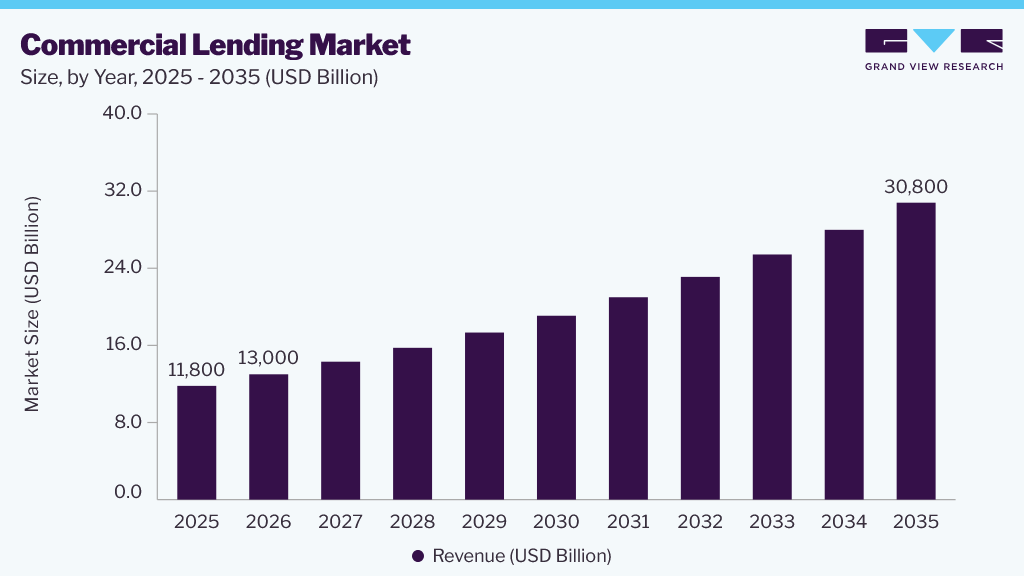 Source: Grand View Research, IR Documents, Primary Interviews, Paid DatabasesTo learn more about this report,
 Download Free Sample Report
Despite this positive outlook, the market faces challenges from high interest rates, tightening credit policies, and economic uncertainty. Financial institutions are becoming more cautious in lending due to concerns over inflation, potential loan defaults, and changing regulatory requirements. In addition, stricter compliance standards and increasing cybersecurity risks associated with digital lending platforms continue to create operational and financial challenges for lenders.
The market offers significant opportunities as embedded finance, open banking, and digital lending platforms become more widely adopted. Increasing government support for SME financing, expanding fintech partnerships, and using alternative data for credit evaluation are improving access to commercial credit for underserved businesses. Furthermore, growing investments in AI-driven underwriting, cloud-based lending solutions, and real-time loan monitoring are expected to enhance lending efficiency, reduce processing time, and create new growth opportunities for commercial lenders over the forecast period.
Analyst Perspective
The market is evolving rapidly as financial institutions accelerate their digital transformation strategies to deliver faster, more efficient, and customer-centric lending services. The growing financing needs of SMEs, expanding commercial real estate investments, and increasing business capital expenditure continue to support market growth. At the same time, lenders are adopting artificial intelligence, data analytics, and automated underwriting to improve credit decisions and reduce operational costs. Although economic uncertainty and tighter regulatory requirements remain key challenges, ongoing innovation in digital lending platforms, embedded finance, and fintech collaborations is expected to enhance credit accessibility and drive sustainable market growth over the forecast period.
Loan Type Insights
The commercial real estate loans segment held the largest market share in 2025. The segment's dominance is driven by rising investments in office buildings, industrial facilities, logistics centers, retail properties, multifamily housing, and mixed-use developments. Increasing urbanization, growing demand for commercial infrastructure, and continued expansion of warehousing and data center projects have encouraged businesses and developers to seek long-term financing. Moreover, favorable lending products, refinancing activities, and the recovery of commercial property investments continue to strengthen demand for commercial real estate loans.
The working capital loans segment is expected to register a notable CAGR over the forecast period. The segment's growth is driven by the increasing financing needs of SMEs and large enterprises to manage cash flow, inventory, payroll, and supply chain operations. Rising adoption of digital lending platforms, AI-powered credit assessment, and embedded finance solutions is enabling faster access to short-term business financing. In addition, growing global trade activities and demand for flexible financing solutions are accelerating the adoption of working capital loans. For instance, in September 2025, HSBC Asset Management launched its Trade and Working Capital Solutions (TWCS) Strategy in collaboration with HSBC’s Global Trade Solutions business, providing institutional investors with access to a diversified portfolio of short-term trade-finance and working-capital assets. The strategy aims to expand institutional participation in trade finance by investing in assets such as receivables finance, payables finance, trade loans, and documentary trade transactions, addressing the growing demand for alternative financing solutions for global trade and supply chains.
Enterprise Size Insights
The large enterprises segment held the largest market share in 2025. The segment's dominance is attributed to the substantial financing requirements of large corporations for capital expansion, commercial real estate investments, mergers and acquisitions, infrastructure development, and global business operations. Large enterprises also benefit from established credit histories, stronger financial positions, and easier access to diversified lending products, enabling them to secure high-value commercial loans at competitive terms. Furthermore, increasing investments in digital transformation, manufacturing expansion, and international trade continue to support demand for commercial lending among large enterprises.
The small & medium enterprises (SMEs) segment is expected to register a significant CAGR from 2026 to 2035. The growth is driven by increasing government initiatives to improve SME access to finance, the rapid expansion of digital lending platforms, and growing collaboration between banks and fintech companies. AI-powered credit assessment, alternative data analytics, and faster loan approval processes are making commercial financing more accessible to small businesses. Rising entrepreneurial activity, business expansion, and the growing need for working capital are further accelerating loan demand among SMEs.
End Use Insights
The commercial real estate segment held the largest market share in 2025. The segment's dominance is driven by the growing demand for financing office buildings, industrial facilities, logistics parks, retail centers, hotels, and mixed-use developments. Increasing urbanization, infrastructure investments, and the expansion of warehousing and data center projects have encouraged developers and businesses to secure long-term commercial financing. In addition, refinancing activities and continued investment in income-generating commercial properties are further supporting the demand for commercial real estate loans.
The information technology & telecommunications segment is expected to register growth at a considerable pace during the forecast period. The segment's growth is fueled by rising investments in cloud infrastructure, artificial intelligence, cybersecurity, data centers, and 5G network deployment. Technology companies increasingly require commercial financing to support product development, infrastructure expansion, acquisitions, and innovation initiatives. Moreover, the rapid growth of digital businesses and enterprise software providers is driving greater demand for flexible lending solutions tailored to the technology sector.
Regional Insights
The North America commercial lending market held the largest market share in 2025. The region's leadership is supported by a mature financial ecosystem, a strong banking infrastructure, and a high concentration of multinational corporations that require commercial financing. Rising investment in commercial real estate, manufacturing, healthcare, technology, and logistics continues to drive strong demand for business loans across the U.S. and Canada. Financial institutions are also accelerating the adoption of AI-powered underwriting, digital loan origination, and automated credit assessment to improve lending efficiency and customer experience. In addition, favorable regulatory frameworks and increasing corporate capital expenditure further strengthen market growth.
Asia Pacific Commercial Lending Market Trends
The commercial lending market in the Asia Pacific is expected to register the fastest CAGR during the forecast period. The region's growth is driven by rapid industrialization, expanding SME sectors, and increasing demand for commercial financing across China, India, Southeast Asia, and other emerging economies. Government initiatives promoting financial inclusion, rising investments in infrastructure, manufacturing, and digital transformation, and the rapid adoption of fintech-enabled lending platforms are improving access to business credit. In addition, growing cross-border trade and supply chain financing needs are encouraging banks to expand their commercial lending capabilities throughout the region.
Key Commercial Lending Company Insights
The market is highly competitive, with global banks, regional financial institutions, fintech lenders, and non-banking financial companies (NBFCs) focusing on expanding their digital lending capabilities. Leading players are strengthening their market positions through strategic partnerships, acquisitions, AI-powered credit assessment, cloud-based lending platforms, and automated loan processing solutions. Continuous investments in digital transformation and customer-centric lending services are enabling companies to improve operational efficiency, enhance risk management, and expand access to commercial financing.
Key Commercial Lending Companies
The following key companies have been profiled for this study on the commercial lending market:
-
JPMorgan Chase & Co.
-
Bank of America Corporation
-
Wells Fargo
-
Citigroup Inc.
-
HSBC Group
-
Standard Chartered
-
The Goldman Sachs Group, Inc.
-
BNP Paribas
-
Barclays PLC
-
Deutsche Bank AG
Recent Developments
-
In December 2025, the International Finance Corporation (IFC) partnered with BBVA Argentina to provide a USD 150 million financing package to expand long-term lending for small and medium-sized enterprises. The initiative strengthens commercial lending capacity and improves access to finance for businesses across Argentina.
-
In August 2025, the National Small Industries Corporation (NSIC) signed Memoranda of Understanding (MoUs) with Axis Bank, Dhanlaxmi Bank, Karnataka Bank, AU Small Finance Bank, and IDFC FIRST Bank under its MSME Credit Facilitation Program. The partnerships aim to improve access to commercial lending, enhance credit availability, and strengthen financial inclusion by connecting more MSMEs with formal banking channels.
-
In July 2025, the Ministry of Finance of the Government of India announced the rollout of a New Digital Credit Assessment Model for MSMEs across Public Sector Banks. The platform uses real-time digital data and automated credit underwriting to considerably reduce loan approval times and improve access to commercial lending for micro, small, and medium-sized enterprises.
-
In June 2025, Punjab National Bank (PNB) strengthened its MSME lending ecosystem by expanding its digital and traditional commercial lending solutions, including Digi MSME Loans, e-GST Express, and MSME Prime Plus. The initiative aims to accelerate business loan approvals and improve access to finance for MSMEs across India.
Commercial Lending Market Report Scope
Report Attribute
Details
Market size in 2025
USD 11,800.0 billion
Estimated market size in 2026
USD 13,000.0 billion
Projected market size by 2035
USD 30,800.0 billion
Growth rate
CAGR of 10.1% from 2026 to 2035
Actual data
2021 – 2025
Forecast period
2026 – 2035
Quantitative units
Revenue in USD billion, and CAGR from 2026 to 2035
Report coverage
Revenue forecast, company ranking, competitive landscape, growth factors, and trends
Segments covered
Loan type, enterprise size, end use, region
Regional scope
North America; Europe; Asia Pacific; Latin America; MEA
Country scope
U.S.; Canada; Mexico; UK; Germany; France; China; Japan; India; Australia; South Korea; Brazil; Argentina; South Africa; Saudi Arabia; UAE
Key companies profiled
JPMorgan Chase & Co.; Bank of America Corporation; Wells Fargo; Citigroup Inc.; HSBC Group; Standard Chartered; The Goldman Sachs Group, Inc.; BNP Paribas; Barclays PLC; Deutsche Bank AG
Customization scope
Free report customization (equivalent to 8 analyst working days) with purchase. Addition or alteration to country, regional & segment scope.
Pricing and purchase options
Avail of customized purchase options to meet your exact research needs. Explore purchase options
Global Commercial Lending Market Report Segmentation
This report forecasts revenue growth at the global, regional, and country levels and provides an analysis of the latest industry trends and opportunities across each sub-segment from 2021 to 2035. For this study, Grand View Research has segmented the global commercial lending market report based on loan type, enterprise size, end use, and region:
-
Loan Type Outlook (Revenue, USD Billion, 2021 - 2035)
-
Term Loans
-
Working Capital Loans
-
Commercial Real Estate Loans
-
Equipment Financing
-
Trade Finance
-
Others
-
-
Enterprise Size Outlook (Revenue, USD Billion, 2021 - 2035)
-
Small & Medium Enterprises (SMEs)
-
Large Enterprises
-
-
End-Use Outlook (Revenue, USD Billion, 2021 - 2035)
-
Manufacturing
-
Commercial Real Estate
-
Retail & E-commerce
-
Healthcare
-
Information Technology & Telecommunications
-
Transportation & Logistics
-
Others
-
-
Regional Outlook (Revenue, USD Billion, 2021 - 2035)
-
North America
-
U.S.
-
Canada
-
Mexico
-
-
Europe
-
UK
-
Germany
-
France
-
Italy
-
Spain
-
-
Asia Pacific
-
China
-
Japan
-
India
-
Australia
-
South Korea
-
-
Latin America
-
Brazil
-
Argentina
-
-
Middle East and Africa (MEA)
-
South Africa
-
Saudi Arabia
-
UAE
-
-
Frequently Asked Questions About This Report
The global commercial lending market size was valued at USD 11,800.0 billion in 2025 and is estimated at USD 13,000.0 billion for 2026.
The global commercial lending market is expected to grow at a CAGR of 10.1% from 2026 to 2035, reaching USD 30,800.0 billion
⮚ The commercial real estate loans segment accounted for the largest revenue share in 2025.
North America dominated with the largest revenue share in 2025.
Key players in the market include JPMorgan Chase & Co., Bank of America Corporation, Wells Fargo, Citigroup Inc., HSBC Group, Standard Chartered, The Goldman Sachs Group, Inc., BNP Paribas, Barclays PLC, and others.
About the Author(s)
Next Generation Technologies Research Team
Technology · Next Generation TechnologiesThis report was authored by the next generation technologies research team at Grand View Research - comprising two research analysts, one senior research analyst, and one industry expert - with specialized expertise in the next generation technologies segment of the technology industry. All findings are based on proprietary technology databases, executive interviews, and regulatory analysis, subject to internal peer review prior to publication.
Last Updated:
Speak to Analyst

Customize this report to your needs - add regions, segments, or data points, with 20% free customization.
Or view our licence options:


ISO 9001:2015 & 27001:2022 Certified
We are GDPR and CCPA compliant! Your transaction & personal information is safe and secure. For more details, please read our privacy policy.


