
- Home
- »
- Next Generation Technologies
- »
-
Competitive Intelligence Tools Market Size Report 2026-2033GVR Report cover

Competitive Intelligence Tools Market (2026 - 2033)
Size, Share, & Trends Analysis Report By Component (Software, Services), By Deployment (Cloud, On-premise), By Enterprise Size (Small & Medium Enterprises), By End Use, By Region, And Segment Forecasts
Market Size, 2025
$691.9MMarket Estimate, 2026
$823.4MMarket Forecast, 2033
$3,004.1MCAGR, 2026–2033
20.3%Competitive Intelligence Tools Market Summary
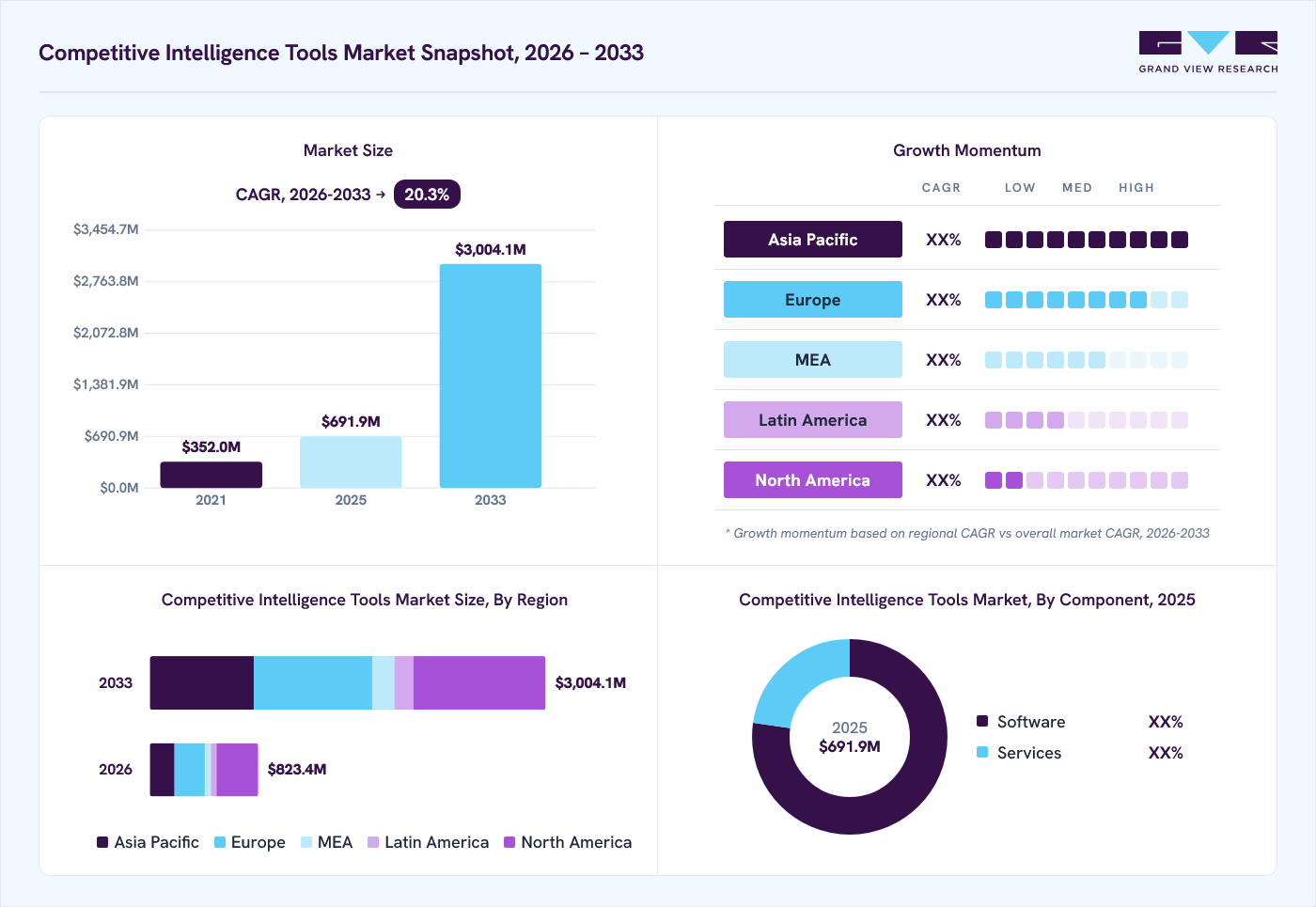
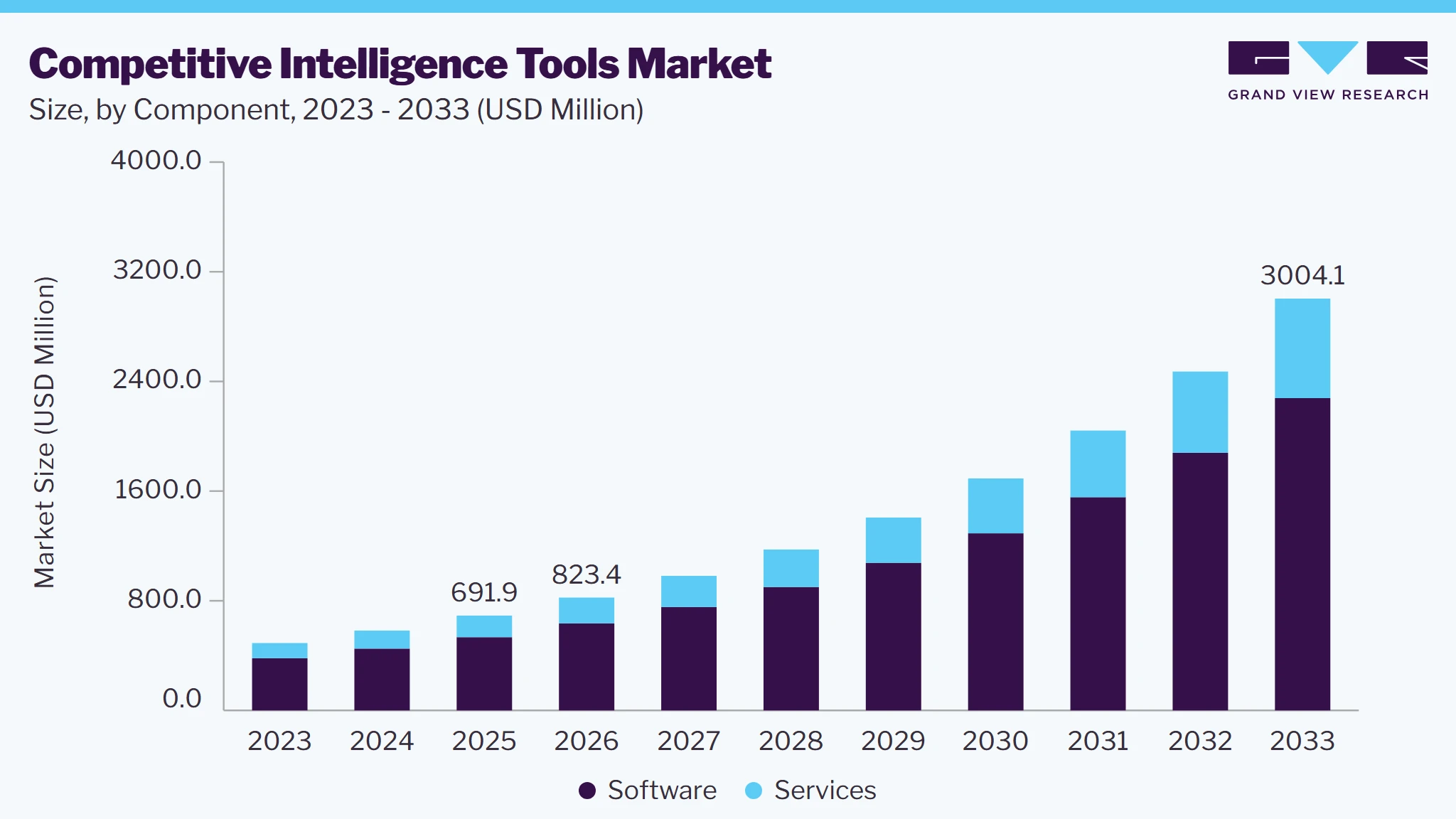
The global competitive intelligence tools market size was valued at USD 691.9 million in 2025 and is projected to grow from USD 823.4 million in 2026 to USD 3,004.1 million by 2033, at a CAGR of 20.3% from 2026 to 2033. The market in North America dominated with a revenue share of 39.2% in 2025. North American enterprises are rapidly integrating AI, machine learning, and generative AI into competitive intelligence platforms. These technologies enable automated competitor monitoring, market trend identification, sentiment analysis, and predictive insights, improving the speed and accuracy of strategic decision-making.
 Source: Grand View Research, IR Documents, Primary Interviews, Paid DatabasesTo learn more about this report,
 Download Free Sample Report
Key Market Trends & Insights
- By component: Software segment held the largest market share of 77.2% in 2025.
- By deployment: Cloud segment held the largest market share of 70.4% in 2025.
- By enterprise size: Large enterprise segment held the largest market share of 69.8% in 2025.
- By end use: IT & telecommunications segment held the largest market share in 2025.
Regional Highlights
- Largest regional market: North America (39.2% revenue share, 2025)
- Fastest-growing regional market: Asia Pacific (highest CAGR, 2026-2033)
- By country: The U.S. held the largest market share in 2025
Market Size & Forecast
- Market size in 2025: USD 691.9 Million
- Estimated market size in 2026: USD 823.4 Million
- Projected market size by 2033: USD 3,004.1 Million
- CAGR (2026-2033): 20.3%
Three ways to get this report
Buy it, customize it, or ask a question.Ask an Analyst
Analyst response in 1 business day
- AccessReport author, directly
- Reply timeWithin 1 working day
- No sales callDirect answer only
- FormatEmail reply
- CostFree, no cost
Get the Full Report
What the study covers
- FormatsPDF · Excel · Dashboard
- Timeline2026–2033 annual, 2025 base
- Coverage20+ countries, 5 regions
- Companies10+ key players profiled
Customize the Report
20% free customization
- IncludeCountries, segments, points
- TailorTo your product definition
- ExtendDeeper competitor detail
- OrA fully bespoke study
- Turnaround5–10 working days
Businesses increasingly require continuous visibility into competitor activities to respond quickly to changing market conditions. Competitor product launches, pricing adjustments, promotional campaigns, partnerships, investments, leadership changes, and strategic initiatives can directly influence market positioning and customer demand. Traditional periodic market research may fail to capture these developments in time, creating information gaps and delayed decision-making.
 To learn more about this report, Download Free Sample Report
Competitive intelligence tools address this challenge by continuously collecting and analyzing data from multiple sources, delivering automated alerts and actionable insights. The growing adoption of cloud-based platforms and AI-powered analytics further enables organizations to monitor competitors at scale. Consequently, businesses are shifting from periodic intelligence gathering toward always-on competitive monitoring, supporting faster strategic, marketing, pricing, and product decisions.
Market Dynamics
The competitive intelligence tools market is experiencing strong growth as organizations increasingly seek real-time visibility into competitor strategies, market developments, pricing, product launches, and customer trends. The growing shift from periodic market research toward continuous, automated intelligence gathering is driving the adoption of AI-powered competitive intelligence platforms. Increasing use of artificial intelligence, machine learning, natural language processing, and predictive analytics is enabling organizations to analyze large volumes of structured and unstructured competitive data more efficiently. The expansion of cloud-based and SaaS solutions is improving scalability, accessibility, and affordability, particularly for SMEs. Integration with CRM, business intelligence, sales enablement, and marketing platforms is further embedding competitive insights into enterprise workflows. Rising competitive intensity across technology, healthcare, BFSI, retail, manufacturing, and telecommunications is increasing demand for automated competitor monitoring and benchmarking. Growing investments in generative AI, real-time analytics, data integration, and enterprise intelligence capabilities are expected to sustain long-term growth in the global Competitive Intelligence Tools Market.
The increasing need for continuous visibility into competitor strategies, pricing, product launches, marketing campaigns, partnerships, investments, and market developments is a key driver of the competitive intelligence tools market. Organizations are shifting from periodic market research toward always-on competitive intelligence to respond faster to market changes. AI-powered monitoring, automated alerts, natural language processing, and predictive analytics enable businesses to collect and analyze large volumes of competitive data efficiently, supporting faster strategic decision-making and improved market positioning.
Data privacy requirements, inconsistent data quality, and the complexity of integrating multiple external information sources remain significant restraints to market growth. Competitive intelligence platforms collect information from websites, social media, financial disclosures, news, marketplaces, and other sources, making data accuracy and consistency difficult to maintain. Additionally, organizations may face challenges integrating CI platforms with existing CRM, BI, sales, and marketing systems. Concerns regarding sensitive data handling, regulatory compliance, and unreliable AI-generated insights can further slow adoption.
The increasing integration of generative AI, machine learning, NLP, and predictive analytics presents significant opportunities for the competitive intelligence tools market. AI enables platforms to automatically identify competitor developments, summarize market signals, detect emerging trends, analyze sentiment, and generate actionable insights. Integration with CRM, sales enablement, business intelligence, and collaboration platforms can further embed competitive intelligence into daily workflows. As enterprises and SMEs increasingly adopt AI-driven decision-making across technology, healthcare, BFSI, retail, manufacturing, and telecommunications, demand for intelligent and automated CI solutions is expected to grow substantially.
Analyst Perspective
The competitive intelligence tools market is becoming an increasingly important component of data-driven strategic decision-making as organizations accelerate investments in AI, automation, cloud technologies, and digital transformation. The growing complexity of competitive environments, rapid product launches, pricing changes, strategic partnerships, and evolving customer preferences is increasing demand for real-time, automated competitor monitoring and market intelligence. Enterprises and SMEs are increasingly adopting AI-powered platforms that combine web monitoring, market research, social listening, pricing intelligence, sentiment analysis, and predictive analytics to convert large volumes of external data into actionable insights. The primary competitive advantage will belong to CI vendors that can combine comprehensive data coverage, advanced AI capabilities, reliable intelligence, intuitive user experiences, and seamless integrations with CRM, BI, sales, marketing, and collaboration platforms.
Component Insights
The software segment dominated the market and accounted for the revenue share of 77.2% in 2025. Businesses increasingly require automated tools to monitor competitor activities continuously across websites, pricing, product launches, marketing campaigns, financial announcements, and strategic developments. Manual monitoring is time-consuming, inconsistent, and often unable to capture market changes promptly. Competitive intelligence software automates data collection, analysis, and alerts, enabling organizations to identify important developments in real time. This shift from periodic research to continuous intelligence gathering improves responsiveness, decision-making, and competitive positioning.
The services segment is anticipated to grow at the highest CAGR during the forecast period. Organizations increasingly require competitive intelligence tailored to their specific business objectives, competitors, markets, products, and geographic priorities. Standardized platforms may not fully address unique intelligence requirements. Consulting and customization services enable businesses to configure monitoring parameters, data sources, analytical frameworks, and reporting structures, helping convert generic CI capabilities into actionable, organization-specific insights.
Deployment Insights
The cloud segment dominated the market and accounted for the largest revenue share of 70.4% in 2025. Cloud-based competitive intelligence solutions reduce the need for organizations to purchase and maintain dedicated servers, hardware, and supporting IT infrastructure. SaaS-based deployment also minimizes upfront capital expenditure by shifting costs toward predictable subscription-based operating expenses. This makes CI platforms financially accessible to SMEs with limited IT budgets, while enabling larger enterprises to deploy solutions faster, reduce maintenance requirements, and allocate resources more efficiently toward strategic intelligence and analytics.
The on-premise segment is expected to grow at a significant CAGR during the forecast period. On-premise competitive intelligence solutions provide organizations with direct control over where sensitive data is stored, accessed, and processed. This reduces reliance on third-party cloud infrastructure and can strengthen internal security measures. Organizations handling proprietary strategies, competitor information, pricing data, customer records, and confidential market intelligence may therefore prefer on-premise deployment for enhanced control and protection.
Enterprise Size Insights
The large enterprise segment dominated the market and accounted for the largest revenue share of 69.8% in 2025. Large enterprises often operate across diverse products, industries, and geographic markets, exposing them to numerous competitors and rapidly changing market conditions. Manually monitoring competitor pricing, product launches, strategic initiatives, partnerships, and customer trends becomes increasingly difficult at this scale. Competitive intelligence platforms centralize data and automate monitoring across markets, enabling enterprises to identify emerging threats, benchmark competitors, and make faster, more informed strategic decisions across business units.
The small & medium enterprises segment is expected to grow at a significant CAGR during the forecast period. AI-powered competitive intelligence tools enable SMEs to automate data collection, competitor tracking, sentiment analysis, and insight generation with minimal manual intervention. By reducing reliance on specialized research teams, these solutions help resource-constrained businesses monitor markets more efficiently. Automated alerts and AI-generated insights also enable SMEs to identify competitive developments faster and make informed decisions with limited resources.
End Use Insights
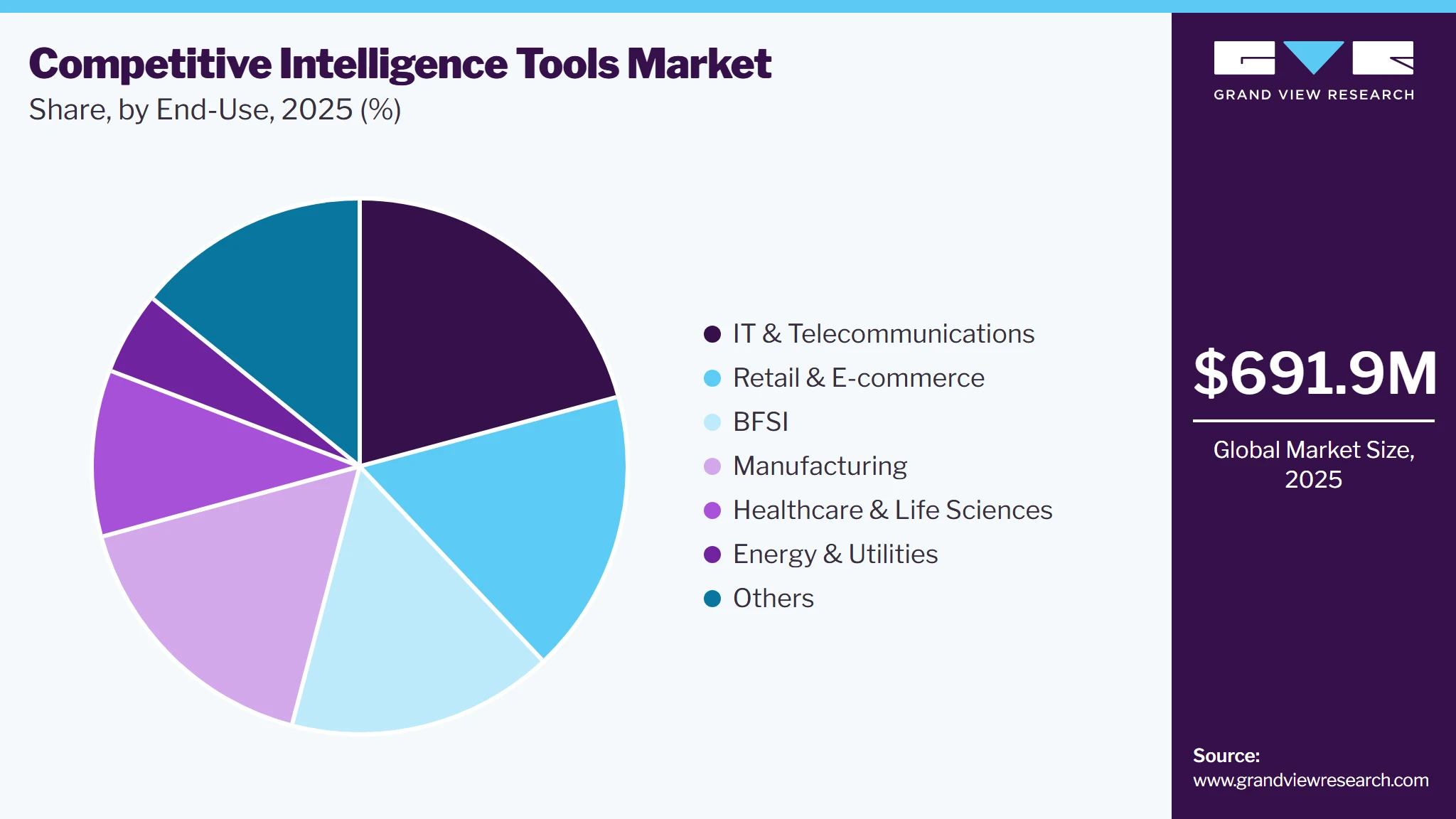
The IT & telecommunications segment dominated the market and accounted for the largest revenue share in 2025. The rapid deployment of 5G, fiber networks, cloud-native infrastructure, edge computing, and emerging 6G technologies is intensifying competition across the IT and telecommunications industry. Companies must continuously track competitors’ network expansions, technology launches, patents, investments, partnerships, and vendor strategies. Competitive intelligence tools provide automated monitoring and analysis of these developments, helping organizations identify technology trends, benchmark competitors, anticipate market shifts, and make informed investment and innovation decisions.
 To learn more about this report, Download Free Sample Report
The healthcare & life sciences segment is expected to grow at a significant CAGR over the forecast period. Pharmaceutical and biotech companies increasingly track competitors’ clinical trials, including trial phases, endpoints, enrollment, locations, results, and development timelines. Such intelligence helps organizations assess competitive intensity across therapeutic areas, benchmark R&D strategies, anticipate competitor milestones, identify potential market opportunities, and optimize their own research priorities, investment decisions, and clinical development programs more effectively.
Regional Insights
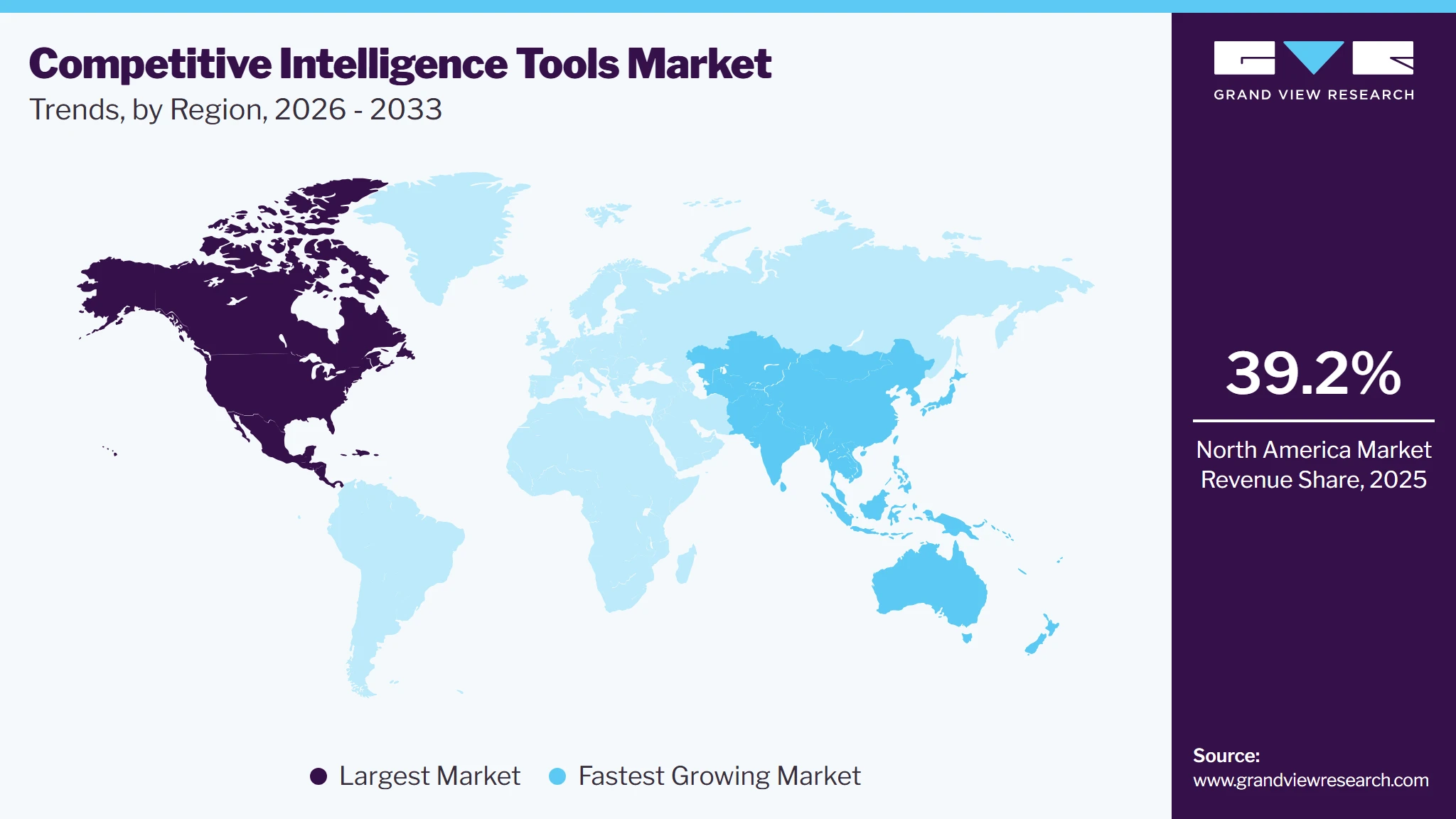
The North America competitive intelligence tools market dominated the global industry with the largest revenue share of 39.2% in 2025. The region’s mature cloud and SaaS ecosystem is accelerating the adoption of cloud-based competitive intelligence platforms. Organizations benefit from scalable infrastructure, faster deployment, remote accessibility, and seamless integration with CRM, BI, sales, and marketing applications. These advantages reduce implementation complexity and infrastructure requirements, making cloud deployment increasingly attractive for enterprises seeking flexible and continuously updated CI capabilities.
 To learn more about this report, Download Free Sample Report
U.S. Competitive Intelligence Tools Market Trends
The competitive intelligence tools market in the U.S. is expected to grow significantly at a CAGR of 17.2% from 2026 to 2033. The U.S. is home to a large concentration of technology, software, cloud, and SaaS companies operating in highly competitive markets. Frequent product launches, pricing changes, acquisitions, partnerships, and technology developments create a strong need for continuous competitor monitoring and benchmarking.
Europe Competitive Intelligence Tools Market Trends
The competitive intelligence tools market in Europe is anticipated to register considerable growth over the forecast period. Europe has highly developed automotive, manufacturing, pharmaceuticals, financial services, telecommunications, and technology industries. Companies operating in these sectors require continuous monitoring of competitor products, pricing, patents, investments, partnerships, and market strategies.
The UK competitive intelligence tools market is expected to grow rapidly in the coming years. The UK's highly developed financial services, telecommunications, healthcare, and professional services sectors create significant demand for competitor monitoring. Companies need to track pricing, product launches, partnerships, investments, customer strategies, and market positioning.
The competitive intelligence tools market in Germany held a substantial market share in 2025. Germany's large automotive, machinery, chemicals, electronics, and industrial sectors operate in highly competitive global markets. Companies need to monitor competitors' product development, technology investments, patents, production capacity, pricing, partnerships, and geographic expansion, creating demand for structured competitive intelligence.
Asia Pacific Competitive Intelligence Tools Market Trends
The competitive intelligence tools market in the Asia Pacific is expected to grow at the fastest CAGR over the forecast period. The region is undergoing rapid digital transformation, with businesses increasingly adopting cloud computing, AI, analytics, and digital platforms. This is expanding the volume of competitive data available online and increasing demand for tools that can monitor competitors, markets, pricing, and customer behavior.
The Japan competitive intelligence tools market is expected to grow rapidly in the coming years. Digital transformation has become a major priority for Japanese companies. IPA's 2025 survey found that approximately 80% of Japanese companies were undertaking DX initiatives. As organizations become more data-driven, competitive intelligence tools can help integrate external competitor and market information into broader digital decision-making processes.
The competitive intelligence tools market in China held a substantial market share in 2025. China has highly competitive automotive, electronics, semiconductor, telecommunications, renewable energy, industrial equipment, and consumer technology industries. Companies increasingly need to track competitors’ product launches, pricing, patents, capacity expansions, R&D investments, and strategic partnerships.
Key Competitive Intelligence Tools Company Insights
Key players operating in the competitive intelligence tools industry are Crayon AS, Klue Labs Inc., AlphaSense Inc., Similarweb Ltd., Semrush, Contify, Kompyte, Zoho Corporation, Owler Inc., and Brandwatch. The companies are focusing on various strategic initiatives, including new product development, partnerships & collaborations, and agreements to gain a competitive advantage over their rivals. The following are some instances of such initiatives.
-
In May 2026, Semrush Holdings partnered with Lovable to embed its search intelligence directly into Lovable’s AI-powered software-building environment. The integration provides access to Semrush’s extensive search data, enabling users to optimize SEO, assess visibility, identify opportunities, and improve discoverability while building applications. This helps founders incorporate search intelligence from product creation through growth.
-
In June 2025, Causaly launched Pipeline Graph, an AI-powered competitive intelligence application for life sciences R&D. It combines competitive intelligence with biomedical research, clinical-trial data, scientific literature, news, and pipeline information. The platform helps researchers identify competitor developments, evaluate drug targets, assess commercial viability, and make faster, evidence-based pipeline decisions.
-
In September 2025, Crayon launched an MCP Server and APIs that connect its competitive intelligence directly with AI tools such as ChatGPT, Glean, Microsoft Copilot, Gemini, Slack, and Teams. The integration enables users to access competitor profiles, battlecards, win/loss insights, and objection-handling content within existing workflows, providing contextual, real-time intelligence for faster sales and strategic decisions.
Key Competitive Intelligence Tools Companies
The following key companies have been profiled for this study on the competitive intelligence tools market.
-
AlphaSense Inc.
-
Brandwatch
-
Contify
-
Crayon AS
-
Klue Labs Inc.
-
Kompyte
-
Owler Inc.
-
Semrush
-
Similarweb Ltd.
-
Zoho Corporation
Competitive Benchmarking
Category
Operating Strategies
Competitive Edge
Weakness
Established Players (Crayon, Klue, AlphaSense, Similarweb, Semrush, Contify)
- Established competitive intelligence and market intelligence providers focus on developing AI-powered competitor monitoring, market research, digital intelligence, pricing intelligence, sales enablement, and analytics platforms. Their strategies emphasize continuous product innovation, AI and generative AI integration, expansion of data sources, platform integrations, subscription-based SaaS models, and partnerships with enterprises, sales teams, and technology platforms.
- These companies benefit from established customer bases, extensive proprietary and third-party data sources, strong brand recognition, mature AI and analytics capabilities, broad integrations, and established enterprise relationships. Their comprehensive platforms enable organizations to monitor competitors, analyze markets, track pricing and products, and convert large volumes of external data into actionable intelligence.
- Established vendors face challenges including high data acquisition and infrastructure costs, increasing competition from AI-native platforms, data privacy and regulatory requirements, integration complexity, and the need for continuous innovation. Maintaining data accuracy and differentiation while incorporating rapidly evolving generative AI capabilities can increase development costs and operational complexity.
Emerging Players (Visualping, Owler, Kompyte/Seismic, Causaly)
- Emerging and specialized providers focus on automated website monitoring, competitor alerts, AI-powered research, industry-specific intelligence, sales intelligence, and specialized competitive monitoring. Their strategies emphasize AI automation, niche use cases, simplified deployment, real-time alerts, API and MCP integrations, and partnerships with CRM, collaboration, sales, and AI platforms to expand distribution.
- Emerging vendors benefit from agile product development, specialized use cases, user-friendly interfaces, automated monitoring, and the ability to rapidly incorporate generative AI and workflow integrations. Their focused solutions can provide faster deployment and lower costs for SMEs and specialized enterprise teams, while enabling real-time competitor monitoring and automated intelligence generation.
- Emerging companies generally have smaller customer bases, limited proprietary data assets, lower brand recognition, and fewer enterprise integrations than established vendors. They may also face challenges in scaling data collection, maintaining data quality, developing comprehensive AI capabilities, expanding globally, and competing against established providers with broader datasets, stronger financial resources, and mature enterprise ecosystems.
Competitive Intelligence Tools Market Report Scope
Report Attribute
Details
Market size in 2025
USD 691.9 million
Estimated market size in 2026
USD 823.4 million
Projected market size by 2033
USD 3,004.1 million
Growth rate
CAGR of 20.3% from 2026 to 2033
Base year for estimation
2025
Historical data
2021 - 2024
Forecast period
2026 - 2033
Quantitative units
Revenue in USD million and CAGR from 2026 to 2033
Report coverage
Revenue forecast, company ranking, competitive landscape, growth factors, and trends
Segments covered
Component, deployment, enterprise size, end use, region
Regional scope
North America; Europe; Asia Pacific; Latin America; MEA
Country scope
U.S.; Canada; Mexico; Germany; UK; France; China; Japan; India; South Korea; Australia; Brazil; Saudi Arabia; South Africa; UAE
Key companies profiled
AlphaSense Inc.; Brandwatch; Contify; Crayon AS; Klue Labs Inc.; Kompyte; Owler Inc.; Semrush; Similarweb Ltd.; Zoho Corporation
Customization scope
Free report customization (equivalent up to 8 analysts' working days) with purchase. Addition or alteration to country, regional & segment scope.
Pricing and purchase options
Avail customized purchase options to meet your exact research needs. Explore purchase options
Global Competitive Intelligence Tools Market Report Segmentation
This report forecasts revenue growth at the global, regional, and country levels and provides an analysis of the latest industry trends in each of the sub-segments from 2021 to 2033. For this study, Grand View Research has segmented the competitive intelligence tools market report based on component, deployment, enterprise size, end use, and region:
-
Component Outlook (Revenue, USD Million, 2021 - 2033)
-
Software
-
Services
-
-
Deployment Outlook (Revenue, USD Million, 2021 - 2033)
-
Cloud
-
On-premise
-
-
Enterprise Size Outlook (Revenue, USD Million, 2021 - 2033)
-
Small & Medium Enterprises
-
Large Enterprise
-
-
End Use Outlook (Revenue, USD Million, 2021 - 2033)
-
IT & Telecommunications
-
BFSI
-
Retail & E-commerce
-
Healthcare & Life Sciences
-
Manufacturing
-
Energy & Utilities
-
Others
-
-
Regional Outlook (Revenue, USD Million, 2021 - 2033)
-
North America
-
U.S.
-
Canada
-
Mexico
-
-
Europe
-
UK
-
Germany
-
France
-
-
Asia Pacific
-
China
-
India
-
Japan
-
South Korea
-
Australia
-
-
Latin America
-
Brazil
-
-
Middle East & Africa
-
UAE
-
Saudi Arabia
-
South Africa
-
-
Research Methodology
The Competitive intelligence tools market figures in this report are based on a proven research process that combines executive interviews with secondary research from proprietary databases, company filings, and recognized regulatory and institutional sources. Market size is built through value-chain sizing-reconciling supply-side and demand-side estimates-and triangulated with bottom-up and top-down approaches. Every estimate passes multiple levels of expert validation before publication, with each Competitive intelligence tools segment quantified using the revenue-capture definitions in the table below.
Segment Definition
Component
Revenue capture definition
Software
Refers to platforms and applications used to collect, monitor, analyze, and visualize competitor and market information. These solutions may include competitor tracking, market monitoring, pricing intelligence, sentiment analysis, alerts, dashboards, AI-powered analytics, and reporting capabilities.
Services
Refers to professional and managed services supporting the implementation, customization, integration, training, consulting, data management, and ongoing operation of competitive intelligence solutions.
Deployment
Revenue capture definition
Cloud
Refers to competitive intelligence solutions hosted on vendor or third-party cloud infrastructure and accessed through the internet. These solutions typically use subscription or SaaS-based models and provide scalability, remote accessibility, automated updates, and lower infrastructure requirements.
On-premise
Refers to competitive intelligence software installed and operated on an organization's own servers and IT infrastructure. The organization is responsible for infrastructure, maintenance, security, updates, and data management, providing greater control over sensitive intelligence data.
Enterprise Size
Revenue capture definition
Large Enterprises
The Large enterprises segment, with respect to the number of employees, typically comprises organizations employing more than 1,000 employees for multinational corporations.
Small & Medium-sized Enterprises (SMEs)
The SMEs segment, with respect to the number of employees, generally includes organizations employing between 10 and 999 employees.
End Use
Revenue capture definition
IT & Telecommunications
Includes software, hardware, cloud, telecommunications, networking, cybersecurity, and digital-service companies using CI tools to monitor technology developments, competitor offerings, pricing, product launches, partnerships, and innovation strategies.
BFSI
Includes banks, financial institutions, insurance companies, fintech firms, investment companies, and other financial-service providers using CI to monitor competitors, products, pricing, customer offerings, investments, and market developments.
Retail & E-commerce
Includes physical retailers, online retailers, marketplaces, brands, and consumer businesses using CI tools to track competitor pricing, promotions, product assortments, customer reviews, advertising, and digital-market activity.
Healthcare & Life Sciences
Includes pharmaceutical companies, biotechnology firms, medical-device manufacturers, healthcare providers, and life-sciences organizations using CI to monitor clinical trials, drug pipelines, patents, product launches, competitors, and R&D developments.
Manufacturing
Includes automotive, electronics, machinery, chemicals, industrial equipment, and other manufacturing companies using CI to monitor competitor products, technologies, pricing, production capabilities, patents, investments, and supply-chain developments.
Energy & Utilities
Includes oil & gas, renewable energy, power generation, electricity and gas utilities, and other energy companies using CI to monitor competitors, projects, investments, technologies, pricing, regulations, and market developments.
Others
Includes industries such as professional services, media & entertainment, travel & hospitality, education, logistics, real estate, construction, and government organizations that use competitive intelligence to monitor market and competitor developments relevant to their operations.
Estimation Model
Layer No.
Layer
Question
Analysis
01
Market Demand Layer
Who drives demand for Competitive Intelligence Tools?
Identify organizations requiring continuous monitoring of competitors, markets, customers, pricing, product launches, marketing activities, partnerships, investments, and strategic developments. Assess demand across large enterprises and SMEs, particularly within IT & telecommunications, BFSI, retail & e-commerce, healthcare & life sciences, manufacturing, and energy & utilities. Evaluate the increasing shift from periodic market research toward real-time, automated competitive intelligence.
02
Competitive Intelligence Adoption Layer
Where is Competitive Intelligence generated and consumed?
Evaluate the number and scale of enterprises adopting CI tools across North America, Europe, Asia Pacific, Latin America, and MEA. Assess adoption of cloud-based and on-premise solutions, enterprise digitalization, AI adoption, data generation, and demand for real-time competitor monitoring. Analyze organizational functions using CI, including strategy, product management, sales, marketing, corporate development, and executive management, to estimate the Total Addressable Market (TAM).
03
Tool Deployment & Technology Adoption Layer
Who adopts Competitive Intelligence Tools and what capabilities are used?
Assess adoption of software and services across large enterprises and SMEs. Evaluate demand for competitor monitoring, market intelligence, pricing intelligence, social listening, website monitoring, battlecards, win/loss analysis, sentiment analysis, predictive analytics, and AI-powered intelligence. Assess adoption of cloud-based versus on-premise deployment and the integration of CI platforms with CRM, BI, sales enablement, marketing automation, and collaboration platforms.
04
Revenue Generation Layer
How is revenue generated?
Estimate revenue generated from competitive intelligence software licenses/subscriptions and associated services. Assess pricing based on number of users, competitors monitored, data sources, features, deployment model, and enterprise scale. Include SaaS subscription revenues, enterprise licenses, implementation, integration, customization, consulting, training, managed intelligence, and support services to estimate the overall market revenue.
Customization Table
Client Request
Customization Delivered
Value Adds
Competitive Intelligence Tool Vendor Competitive Benchmarking
Assessed leading CI tool vendors based on competitor monitoring capabilities, AI/ML functionality, data coverage, market intelligence, pricing intelligence, real-time alerts, analytics, reporting, integrations, deployment models, customization, geographic presence, industry coverage, customer base, partnerships, and product innovation roadmap.
Enables stakeholders to benchmark competitors, identify technology and feature leaders, evaluate product differentiation, assess platform capabilities, and formulate competitive product development, positioning, and go-to-market strategies.
Cloud vs. On-Premise Deployment Assessment
Compared cloud-based and on-premise CI solutions based on scalability, implementation time, accessibility, security, data control, maintenance requirements, customization, and total cost of ownership.
Helps organizations select appropriate deployment models based on security requirements, IT infrastructure, organizational size, regulatory considerations, and budget.
Regional & Country-Level Market Assessment
Evaluated CI adoption across North America, Europe, Asia Pacific, Latin America, and MEA, with country-level analysis based on digitalization, AI adoption, cloud penetration, competitive intensity, enterprise technology spending, and regulatory environment.
Enables stakeholders to identify high-growth markets, prioritize geographic expansion, allocate sales resources, and develop region-specific go-to-market strategies.
Frequently Asked Questions About This Report
North America dominated with 39.2% revenue share in 2025.
Asia Pacific is the fastest-growing region over the forecast period.
The software segment led with a 77.2% revenue share in 2025, and the services segment is the fastest-growing segment.
The cloud segment dominated with a 70.4% revenue share in 2025, and is the fastest-growing segment.
Key players operating in the competitive intelligence tools industry are Crayon AS, Klue Labs Inc., AlphaSense Inc., Similarweb Ltd., Semrush, Contify, Kompyte, Zoho Corporation, Owler Inc., and Brandwatch.
The IT & telecommunications segment held the largest share in 2025, while the healthcare & life sciences segment is the fastest-growing.
The global competitive intelligence tools market size was valued at USD 691.9 million in 2025 and is estimated at USD 823.4 million for 2026.
The global competitive intelligence tools market is expected to grow at a CAGR of 20.3% from 2026 to 2033, reaching USD 3,004.1 million by 2033.
The increasing need for continuous visibility into competitor strategies, pricing, product launches, marketing campaigns, partnerships, investments, and market developments is a key driver of the competitive intelligence tools market.
The large enterprises segment led with a 69.8% revenue share in 2025, and small & medium enterprises (SMEs) segment is the fastest-growing segment.
About the Author(s)
Next Generation Technologies Research Team
Technology · Next Generation TechnologiesThis report was authored by the next generation technologies research team at Grand View Research - comprising two research analysts, one senior research analyst, and one industry expert - with specialized expertise in the next generation technologies segment of the technology industry. All findings are based on proprietary technology databases, executive interviews, and regulatory analysis, subject to internal peer review prior to publication.
Last Updated:
Speak to Analyst

Customize this report to your needs - add regions, segments, or data points, with 20% free customization.
Or view our licence options:


ISO 9001:2015 & 27001:2022 Certified
We are GDPR and CCPA compliant! Your transaction & personal information is safe and secure. For more details, please read our privacy policy.


