
- Home
- »
- Next Generation Technologies
- »
-
Configuration Management Market Size, Share Report, 2033GVR Report cover
![Configuration Management Market (2026 - 2033)Report]()
Configuration Management Market (2026 - 2033)
Size, Share & Trends Analysis Report By Component (Software, Services), By Asset, By Deployment, By Enterprise Size (Small & Medium Enterprises, Large Enterprise), By End-use, By Region, And Segment Forecasts
Market Size, 2025
$3.2BMarket Estimate, 2026
$3.5BMarket Forecast, 2033
$8.0BCAGR, 2026–2033
12.4%Configuration Management Market Summary
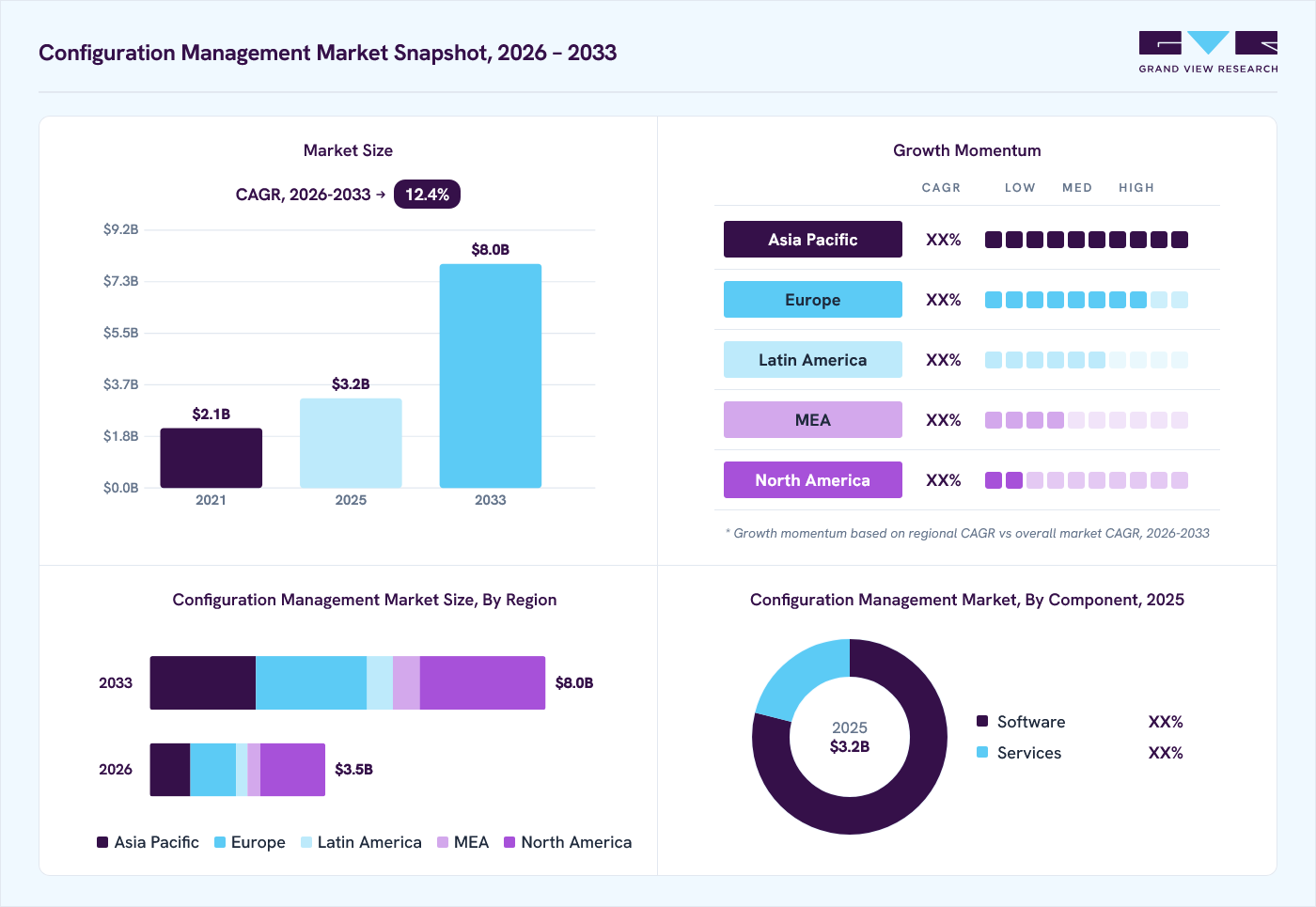
The global configuration management market size was valued at USD 3.2 billion in 2025 and is projected to grow from USD 3.5 billion in 2026 to USD 8.0 billion in 2033, at a CAGR of 12.4% from 2026 to 2033. North America dominated the market, accounting for the largest revenue share of 37.8% in 2025. To improve scalability, flexibility, and operational efficiency, enterprises globally are rapidly adopting public, private, and hybrid cloud environments, driving the need for centralized configuration management to automate provisioning, maintain consistency, detect drift, and ensure compliance across diverse IT infrastructures.
Key Market Trends & Insights
- By component: Software segment dominated the market, with a share of 79.1% in 2025.
- By asset: Server & compute Infrastructure segment held the largest share of 42.5% in 2025
- By organization size: Large enterprises segment held the largest revenue share of 67.1% in 2025
- By deployment: Cloud segment held the largest revenue share of 50.1% in 2025
- By end use: IT & Telecommunications segment held the largest revenue share in 2025
Regional Highlights
- Largest regional market: North America (37.8% revenue share, 2025)
- Fastest-growing regional market: Asia Pacific (highest CAGR, 2026-2033)
- By country: The U.S. held the largest share of North America in 2025.
Market Size & Forecast
- Market size in 2025: USD 3.2 Billion
- Estimated market size in 2026: USD 3.5 Billion
- Projected market size by 2033: USD 8.0 Billion
- CAGR (2026-2033): 12.4%
Enterprises are increasingly adopting continuous configuration monitoring as IT environments become more complex, distributed, and dynamic. Traditional periodic configuration checks may fail to identify unauthorized changes, configuration drift, security weaknesses, or policy violations between assessment cycles. Continuous monitoring enables organizations to track infrastructure configurations in real time across servers, networks, cloud resources, applications, and endpoints.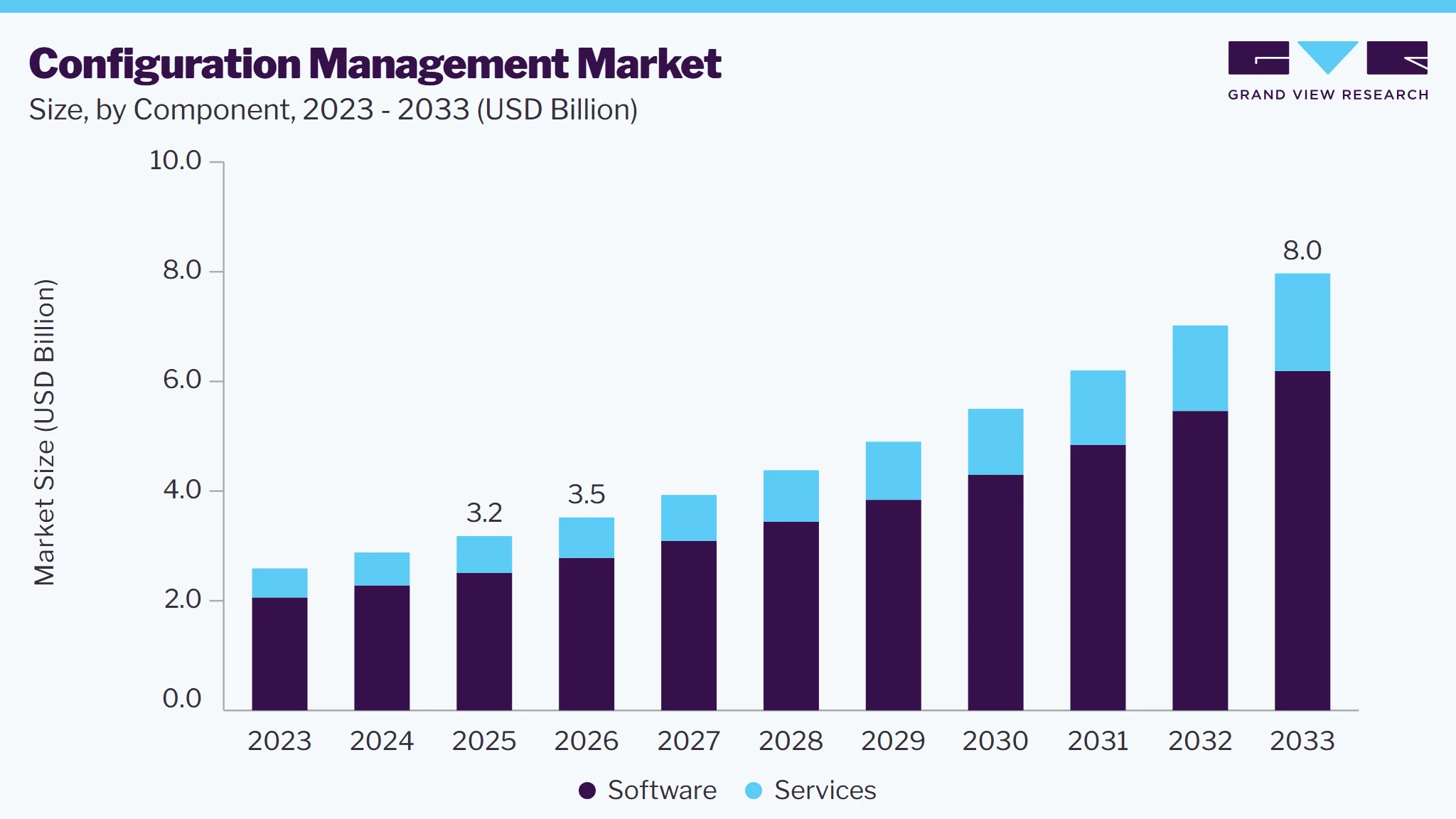
Automated alerts can identify deviations from approved baselines and initiate corrective actions before they lead to security incidents, compliance failures, or operational disruptions. This capability is particularly important in hybrid and multi-cloud environments, where frequent infrastructure changes can make manual oversight challenging. Consequently, organizations are investing in configuration management platforms that provide real-time visibility, automated compliance checks, drift detection, and remediation capabilities.
Market Dynamics
The configuration management market is experiencing steady growth as organizations accelerate digital transformation, cloud adoption, and IT infrastructure modernization to manage increasingly complex and distributed technology environments. The rapid expansion of hybrid and multi-cloud infrastructure, data centers, servers, networks, virtual machines, containers, and edge computing is driving demand for configuration management solutions that provide centralized visibility, standardized configurations, automated provisioning, and continuous monitoring. Growing adoption of DevOps, Infrastructure as Code (IaC), CI/CD, and automated IT operations is further increasing the need to automate configuration deployment, change management, patching, compliance validation, and remediation across dynamic environments. Rising cybersecurity threats, configuration drift, unauthorized changes, and infrastructure vulnerabilities are encouraging enterprises to establish secure configuration baselines and continuously monitor deviations. The increasing integration of configuration management with IT service management (ITSM), CMDB, endpoint management, cloud management, security operations, and observability platforms is creating more unified infrastructure management ecosystems.
The rapid adoption of cloud computing, hybrid IT, and distributed infrastructure is a key driver of the configuration management market. Organizations are increasingly managing complex environments spanning physical servers, virtual machines, public and private clouds, containers, networks, and edge infrastructure. This is driving demand for configuration management solutions that automate provisioning, deployment, patching, configuration validation, and policy enforcement. Growing adoption of DevOps, Infrastructure as Code (IaC), and CI/CD further accelerates the need for standardized and automated infrastructure management. As enterprises scale digital operations, configuration management enables greater consistency, operational efficiency, and reduced manual errors across dynamic IT environments.
The complexity of implementing and integrating configuration management solutions remains a significant restraint to market growth. Enterprises often operate heterogeneous IT environments comprising legacy systems, multiple cloud platforms, different operating systems, networking technologies, and third-party applications. Integrating configuration management tools with existing ITSM, CMDB, security, monitoring, and DevOps platforms can require substantial time, technical expertise, and customization. In addition, organizations may face challenges related to data migration, configuration standardization, employee training, and workflow redesign. These factors can increase deployment costs and implementation timelines, particularly for organizations with highly customized or legacy infrastructure environments.
The increasing integration of artificial intelligence and automation into IT operations presents significant opportunities for the configuration management market. AI-enabled configuration management can analyze infrastructure data, identify configuration anomalies and drift, predict potential failures, recommend corrective actions, and automate remediation. The convergence of configuration management with AIOps, observability, cybersecurity, and IT service management is enabling more proactive and autonomous infrastructure operations. As organizations increasingly adopt cloud-native applications, multi-cloud environments, DevOps, and Infrastructure as Code, demand for intelligent configuration management capabilities is expected to grow. This creates opportunities for vendors to develop AI-powered solutions that improve infrastructure reliability, security, compliance, and operational efficiency.
Analyst Perspective
The configuration management market is expanding rapidly as organizations invest in cloud computing, DevOps, cybersecurity, and infrastructure automation. Complex hybrid, multi-cloud, and edge environments are driving strong demand for centralized visibility, Infrastructure as Code (IaC), and automated drift detection. To gain a competitive edge, vendors must combine core configuration tools with AI automation, real-time monitoring, and seamless integrations across ITSM and DevOps platforms. Long-term growth will favor scalable, security-focused solutions that reduce operational errors and streamline compliance, provided suppliers can navigate implementation complexities and legacy IT integration challenges.
Component Insights
The software segment dominated the market and accounted for the revenue share of 79.1% in 2025. Enterprises are increasingly adopting IT automation to streamline repetitive infrastructure tasks, minimize human errors, and reduce operational costs. Configuration management software automates provisioning, patching, deployment, monitoring, and policy enforcement across IT environments. This enables faster operations, improves configuration consistency, enhances resource utilization, and allows IT teams to focus on higher-value strategic activities.
The services segment is anticipated to grow at the highest CAGR during the forecast period. Enterprises are managing hybrid cloud, multi-cloud, on-premises, containerized, and distributed IT environments, creating significant implementation and integration complexity. Organizations increasingly require professional services to design configuration architectures, integrate CM tools with existing systems, and establish standardized configuration processes.
Asset Insights
The server & compute infrastructure segment dominated the market and accounted for the largest revenue share in 2025. Enterprises are increasingly operating diverse server environments comprising physical servers, virtual machines, private clouds, and public-cloud compute resources. Managing these heterogeneous infrastructures manually can create configuration inconsistencies, operational inefficiencies, and security risks. Configuration management solutions enable centralized visibility, standardized configurations, automated provisioning, and continuous monitoring across server environments. As organizations expand their compute infrastructure, demand for scalable configuration management tools is increasing to ensure reliability, consistency, and operational control.
The security devices segment is anticipated to grow at the significant CAGR during the forecast period. Organizations are increasingly establishing standardized security configurations for firewalls, gateways, intrusion prevention systems, and other security devices to meet regulatory and internal security requirements. Configuration management solutions continuously compare device settings against approved baselines, identify unauthorized deviations, and facilitate remediation. This improves security posture, reduces compliance risks, and supports audit readiness.
Deployment Insights
The cloud segment dominated the market and accounted for the largest revenue share in 2025. Organizations increasingly use multiple cloud providers to improve flexibility, resilience, performance, and cost optimization. However, differences in cloud platforms, tools, APIs, and security policies make configurations harder to manage consistently. Configuration management solutions provide centralized visibility, standardize configurations, enforce policies, and reduce configuration drift across diverse cloud environments.
The hybrid segment is expected to grow at a significant CAGR during the forecast period. Organizations are increasingly combining on-premises infrastructure with public and private clouds to balance flexibility, scalability, security, performance, and cost. As these environments become more interconnected, configuration management solutions help centralize visibility, automate configuration processes, enforce consistent policies, and reduce configuration inconsistencies across heterogeneous IT infrastructure.
Enterprise Size Insights
The large enterprise segment dominated the market and accounted for the largest revenue share in 2025. Large enterprises manage diverse IT environments spanning data centers, servers, networks, virtual machines, cloud platforms, and edge infrastructure. As infrastructure becomes more distributed and dynamic, manual management becomes increasingly difficult. Configuration management solutions provide centralized visibility, automate repetitive tasks, enforce standardized configurations, and improve operational consistency across complex enterprise environments.
The small & medium enterprises segment is expected to grow at a significant CAGR during the forecast period. SMEs often operate with limited IT budgets and lean technical teams, making manual infrastructure management costly and resource-intensive. Configuration management automation reduces repetitive administrative work, minimizes human errors, and improves resource utilization. By automating routine tasks, SMEs can control IT operating expenses, enhance productivity, and scale infrastructure without proportionately increasing staffing costs.
End-use Insights
The IT & Telecommunications segment dominated the market and accounted for the largest revenue share in 2025. Telecom operators and IT organizations are increasingly automating network provisioning, deployment, maintenance, and configuration updates to improve operational efficiency and reduce human errors. As networks become more complex and involve multiple vendors and generations, automation enables faster service activation, standardized configurations, and consistent management, while reducing manual intervention and operational costs.
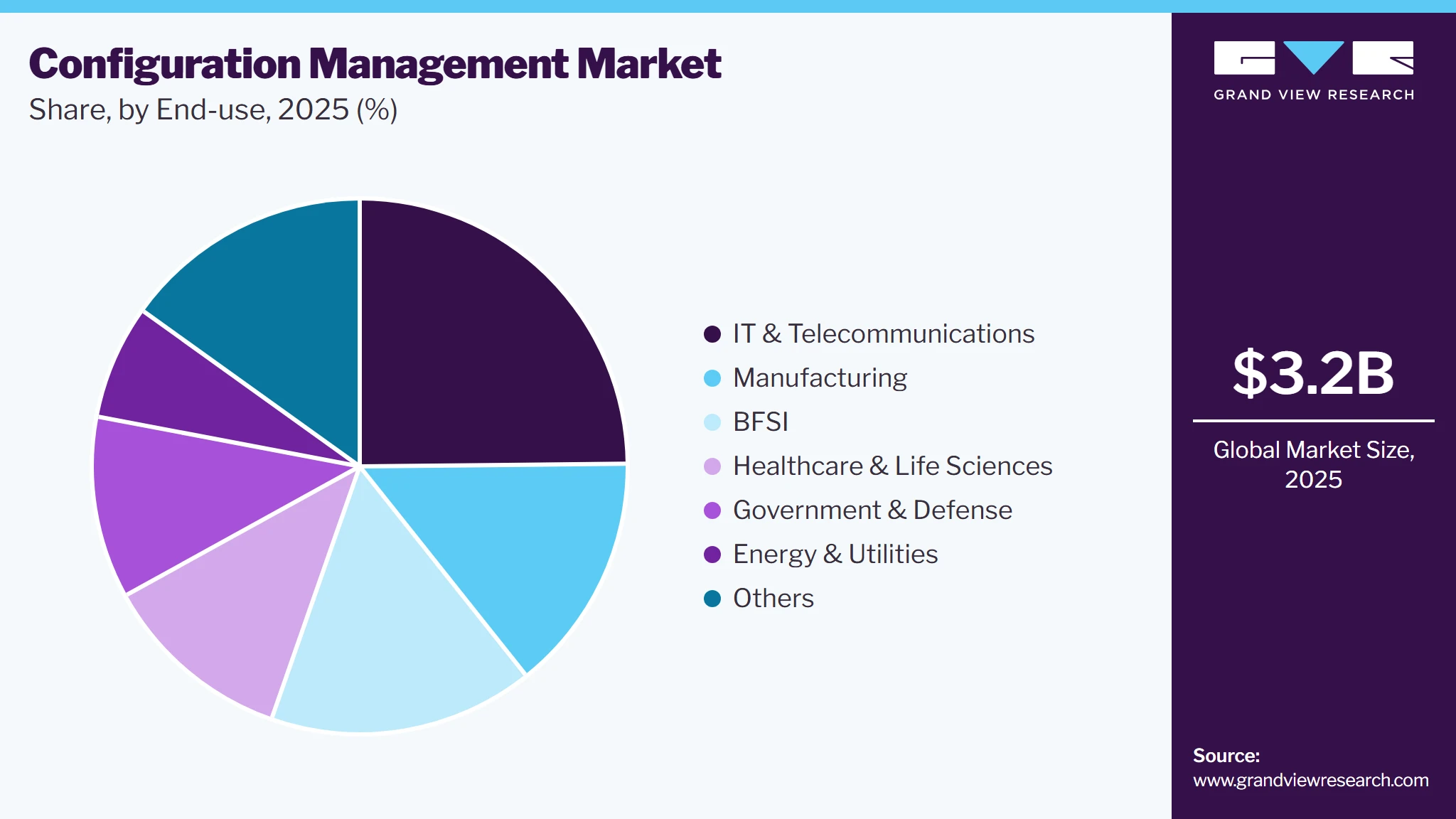
The healthcare & life sciences segment is expected to grow at a significant CAGR over the forecast period. Healthcare providers and life sciences organizations are increasingly adopting EHRs, cloud platforms, connected medical devices, and digital applications. This expanding digital ecosystem increases infrastructure complexity and the need for standardized configurations. Configuration management solutions enable organizations to track changes, maintain consistency, and efficiently manage diverse IT assets throughout their operational lifecycle.
Regional Insights
North America dominated the global market with the largest revenue share of 37.8% in 2025. North American enterprises are increasingly integrating DevOps, CI/CD, and Infrastructure as Code to accelerate software delivery and automate infrastructure operations. Configuration management tools support version-controlled configurations, automated provisioning, testing, and deployment, enabling standardized environments, faster releases, fewer configuration errors, and greater operational efficiency across complex IT infrastructure.

U.S. Configuration Management Market Trends
The configuration management market in the U.S. is expected to grow significantly at a CAGR of 9.4% from 2026 to 2033. Rising cybersecurity risks are encouraging organizations to establish secure configuration baselines, monitor configuration changes, and identify misconfigurations. U.S. organizations are also increasing continuous monitoring and cloud-security controls as cloud adoption expands.
Europe Configuration Management Market Trends
The configuration management market in Europe is anticipated to grow considerably from 2026 to 2033. European organizations face increasingly stringent cybersecurity and operational-resilience requirements, including NIS2, DORA, GDPR, and other national regulations. These requirements are increasing the need for secure configuration baselines, configuration monitoring, audit trails, and automated compliance controls. ENISA reports that compliance is a major driver of cybersecurity investment, while NIS2 is prompting organizations to strengthen their cyber resilience capabilities.
The UK configuration management market is expected to grow rapidly in the coming years. The continued digitalization of UK businesses is increasing the complexity of technology environments, with organizations deploying cloud platforms, connected systems, software applications, and distributed infrastructure. This creates greater demand for configuration management to maintain standardized configurations, track changes, and improve infrastructure visibility. The UK government notes that increasing system integration and technology-stack complexity are creating additional cybersecurity requirements.
The Germany configuration management market held a substantial market share in 2025. Germany's implementation of NIS2 has expanded cybersecurity obligations for organizations, introducing stricter security requirements and incident-reporting requirements. This is increasing demand for configuration management capabilities that establish secure baselines, monitor configuration changes, identify deviations, and support compliance.
Asia Pacific Configuration Management Market Trends
The Asia Pacific configuration management market is projected to grow at the fastest CAGR of 8.0% over the forecast period. Organizations across the Asia Pacific are accelerating digital transformation, modernizing legacy infrastructure, and expanding enterprise applications. This is increasing the number and complexity of IT assets that require standardized configurations, monitoring, and automated management. Asia Pacific is expected to be the fastest-growing regional market for configuration management.
The Japan configuration management market is expected to grow rapidly in the coming years. Increasing cyber threats are encouraging Japanese organizations to strengthen system configurations, software security, and infrastructure controls. METI highlights the growing sophistication of cyberattacks alongside accelerating digitalization, supporting demand for solutions that monitor configurations, identify deviations, and maintain secure baselines.
The China configuration management market held a substantial market share in 2025. The increasing use of cloud computing, virtualization, and distributed infrastructure is creating more complex IT environments. Configuration management solutions help enterprises maintain consistency across on-premises infrastructure, private clouds, and public-cloud resources while reducing configuration drift.
Key Configuration Management Company Insights
Key players operating in the configuration management industry are Amazon Web Services (AWS), Atlassian Corporation Plc, BMC Software, Broadcom Inc., Cavelo, Inc., Cisco Systems, Inc., CloudBees, Inc., Hewlett Packard Enterprise (HPE), IBM Corporation, Microsoft Corporation, Oracle Corporation, Puppet (Perforce Software), Red Hat, Inc., ServiceNow, Inc., VMware, Inc. The companies are focusing on various strategic initiatives, including new product development, partnerships & collaborations, and agreements to gain a competitive advantage over their rivals. The following are some instances of such initiatives.
Key Configuration Management Companies:
The following key companies have been profiled for this study on the configuration management market.
-
Amazon Web Services (AWS)
-
Atlassian Corporation Plc
-
BMC Software
-
Broadcom Inc.
-
Cavelo, Inc.
-
Cisco Systems, Inc.
-
CloudBees, Inc.
-
Hewlett Packard Enterprise (HPE)
-
IBM Corporation
-
Microsoft Corporation
-
Oracle Corporation
-
Puppet (Perforce Software)
-
Red Hat, Inc.
-
ServiceNow, Inc.
-
VMware, Inc.
Competitive Benchmarking
Category
Operating Strategies
Competitive Edge
Weakness
Established Players (IBM, Microsoft, BMC Software, ServiceNow, Red Hat, Broadcom, Cisco, Hewlett Packard Enterprise)
- Established configuration management vendors focus on providing comprehensive infrastructure management, configuration automation, CMDB, IT service management, cloud management, security compliance, and DevOps capabilities. Their strategies emphasize continuous product development, cloud-native transformation, AI-enabled IT operations, platform integration, strategic partnerships, acquisitions, and expansion across large enterprises, government organizations, and regulated industries. These companies increasingly integrate configuration management with ITSM, observability, cybersecurity, Infrastructure as Code (IaC), and AIOps platforms to provide unified infrastructure management.
- These companies benefit from strong brand recognition, extensive enterprise customer bases, broad technology portfolios, global sales and support networks, and established relationships with cloud providers and technology partners. Their ability to integrate configuration management with ITSM, CMDB, security, automation, monitoring, and cloud platforms provides customers with comprehensive solutions. Large R&D investments and extensive partner ecosystems also enable them to support complex, heterogeneous IT environments at enterprise scale.
- Established vendors face challenges including complex product portfolios, relatively high implementation and licensing costs, lengthy deployment cycles, and dependence on enterprise IT budgets. Integration across legacy and modern infrastructure can require significant customization and technical expertise. Large vendors may also face competition from specialized cloud-native and open-source solutions that offer greater flexibility, faster deployment, or lower costs for specific use cases.
Emerging Players (Puppet/Perforce, Chef/Progress Software, CloudBees, Harness, SUSE)
- Emerging and specialized vendors primarily focus on configuration automation, DevOps, Infrastructure as Code, continuous delivery, policy enforcement, infrastructure compliance, and cloud-native automation. Their strategies emphasize open-source technologies, developer-centric workflows, automation-first architectures, flexible deployment models, and integration with Kubernetes, CI/CD, cloud platforms, and modern DevOps toolchains. These companies target organizations seeking specialized configuration automation and faster implementation across dynamic infrastructure environments.
- Emerging vendors offer specialized capabilities, flexible architectures, faster innovation cycles, and strong integration with DevOps and cloud-native ecosystems. Their solutions can provide simplified automation, infrastructure-as-code workflows, configuration drift detection, policy enforcement, and continuous compliance. Their focus on specific use cases enables them to respond rapidly to evolving requirements such as multi-cloud infrastructure, Kubernetes, GitOps, and automated remediation.
- Emerging vendors generally have smaller enterprise customer bases, lower brand recognition, and fewer resources than established technology providers. They may face challenges in scaling global sales and support operations, competing for large enterprise contracts, and integrating with complex legacy environments. Dependence on ecosystem partnerships and open-source communities can also create challenges related to monetization, product differentiation, and long-term customer retention.
Recent Developments
-
In August 2026, PTC strengthened its ALM portfolio with new configuration management and AI capabilities. Codebeamer 3.3 introduces Delta Merge, enabling approved changes to be automatically applied across product variants, while Pure Variants 7.3 streamlines variant transformation. AI Search Assistant also improves information discovery, supporting traceability, change management, governance, and enterprise product complexity.
-
In March 2026, Acsense launched Safe Configuration Management to help enterprises test, validate, and deploy IAM configuration changes without causing outages or compliance failures. The solution uses production-like environments to identify risks before deployment, enables rapid recovery to known-good configurations, and supports continuous compliance with frameworks including NIST CSF, DORA, NIS2, ISO 27001, SOC 2, and SOX.
-
In June 2025, Cavelo launched Automated Configuration Management for MSPs and MSSPs to standardize secure configuration baselines, detect configuration drift, and support compliance across hybrid and multi-cloud environments. The solution provides multitenant management, audit-ready reporting, real-time drift detection, and automated remediation, helping service providers reduce manual effort and improve clients’ security maturity.
Configuration Management Report Scope Table
Report Attribute
Details
Market size in 2025
USD 3.2 billion
Estimated market size in 2026
USD 3.5 billion
Projected market size by 2033
USD 8.0 billion
Growth rate
CAGR of 12.4% from 2026 to 2033
Base year for estimation
2025
Historical data
2021 - 2024
Forecast period
2026 - 2033
Quantitative units
Revenue in USD billion, and CAGR from 2026 to 2033
Report coverage
Revenue forecast, company ranking, competitive landscape, growth factors, and trends
Segments covered
Component, deployment, organization size, asset, end-use, region
Regional scope
North America; Europe; Asia Pacific; Latin America; MEA
Country scope
U.S.; Canada; Mexico; Germany; UK; France; China; Japan; India; South Korea; Australia; Brazil; Saudi Arabia; South Africa; UAE
Key companies profiled
Amazon Web Services (AWS); Atlassian Corporation Plc; BMC Software; Broadcom Inc.; Cavelo, Inc.; Cisco Systems, Inc.; CloudBees, Inc.; Hewlett Packard Enterprise (HPE); IBM Corporation; Microsoft Corporation; Oracle Corporation; Puppet (Perforce Software); Red Hat, Inc.; ServiceNow, Inc.; VMware, Inc
Customization scope
Free report customization (equivalent up to 8 analysts' working days) with purchase. Addition or alteration to country, regional & segment scope.
Pricing and purchase options
Avail customized purchase options to meet your exact research needs. Explore purchase options
Global Configuration Management Market Report Segmentation
This report forecasts revenue growth at the global, regional, and country levels and provides an analysis of the latest industry trends in each of the sub-segments from 2021 to 2033. For this study, Grand View Research has segmented the global configuration management market report based on component, asset, deployment, enterprise size, end-use, and region.
-
Component Outlook (Revenue, USD Billion, 2021 - 2033)
-
Software
-
Services
-
-
Asset Outlook (Revenue, USD Billion, 2021 - 2033)
-
Server & Compute Infrastructure
-
Network Devices
-
Security Devices
-
Edge Infrastructure
-
Others
-
-
Deployment Outlook (Revenue, USD Billion, 2021 - 2033)
-
Public
-
Private
-
Hybrid
-
-
Enterprise Size Outlook (Revenue, USD Billion, 2021 - 2033)
-
Small & Medium Enterprises
-
Large Enterprise
-
-
End-use Outlook (Revenue, USD Billion, 2021 - 2033)
-
BFSI
-
IT & Telecommunications
-
Manufacturing
-
Energy & Utilities
-
Healthcare & Life Sciences
-
Government & Defense
-
Others
-
-
Regional Outlook (Revenue, USD Billion, 2021 - 2033)
-
North America
-
U.S.
-
Canada
-
Mexico
-
-
Europe
-
UK
-
Germany
-
France
-
-
Asia Pacific
-
China
-
India
-
Japan
-
South Korea
-
Australia
-
-
Latin America
-
Brazil
-
-
Middle East & Africa
-
UAE
-
Saudi Arabia
-
South Africa
-
-
Research Methodology
The configuration management market figures in this report are based on a proven research process that combines executive interviews with secondary research from proprietary databases, company filings, and recognized regulatory and institutional sources. Market size is built through value-chain sizing-reconciling supply-side and demand-side estimates—and triangulated with bottom-up and top-down approaches. Every estimate passes multiple levels of expert validation before publication, with each configuration management segment quantified using the revenue-capture definitions in the table below.
Segment Definition
Segment - Component
Revenue capture definition
Software
Configuration management platforms and tools used to automate, monitor, document, standardize, and control the configuration of IT infrastructure, applications, and other technology assets.
Services
Professional and managed services that support the implementation, integration, customization, maintenance, monitoring, and optimization of configuration management solutions.
Segment - Deployment
Revenue capture definition
Cloud
Configuration management solutions hosted or delivered through cloud infrastructure, enabling centralized management, scalability, remote access, and automated configuration across cloud-based resources.
On-Premise
Configuration management solutions deployed within an organization's own data center or IT infrastructure, providing direct control over software, data, security, and configuration processes.
Hybrid
Configuration management solutions that manage and integrate assets across both on-premise and cloud environments, providing unified visibility and configuration control across distributed infrastructure.
Segment - Enterprise Size
Revenue capture definition
Large Enterprises
The Large enterprises segment, with respect to the number of employees, typically comprises organizations employing more than 1,000 employees for multinational corporations.
Small & Medium-sized Enterprises (SMEs)
Organizations with relatively smaller workforces, IT environments, and technology budgets that use configuration management solutions to automate infrastructure administration, reduce operational costs, and improve configuration consistency.
Segment - Asset
Revenue capture definition
Server & Compute Infrastructure
Physical and virtual servers, compute systems, virtual machines, and associated computing resources whose configurations require centralized management, monitoring, and automation.
Network Devices
Networking equipment such as routers, switches, wireless controllers, load balancers, and gateways whose configurations are managed to maintain connectivity, performance, and operational consistency.
Security Devices
Security infrastructure such as firewalls, intrusion prevention systems, VPN gateways, secure web gateways, and other security appliances that require controlled and compliant configurations.
Edge Infrastructure
Distributed computing and networking resources located close to users, devices, or data sources, including edge servers, gateways, and edge nodes requiring remote configuration and centralized management.
Others
Other configurable technology assets not specifically classified under server, network, security, or edge infrastructure, including storage systems, databases, applications, and specialized IT devices.
Segment - End-use
Revenue capture definition
IT & Telecommunications
Includes IT service providers, software companies, cloud providers, data centers, and telecommunications operators using configuration management to automate and standardize complex IT and network infrastructure.
BFSI
Banks, financial institutions, insurance companies, and related organizations using configuration management to maintain secure, compliant, and reliable IT infrastructure supporting financial and customer-facing services.
Healthcare & Life Sciences
Healthcare providers, pharmaceutical companies, biotechnology firms, laboratories, and medical organizations using configuration management to manage IT systems, connected devices, applications, and infrastructure securely and consistently.
Government & Defense
Government agencies, defense organizations, and public-sector institutions using configuration management to secure, standardize, monitor, and maintain complex and mission-critical technology infrastructure.
Manufacturing
Manufacturing and industrial organizations using configuration management to manage servers, networks, connected equipment, industrial IT systems, and digital infrastructure supporting production and operational processes.
Energy & Utilities
Organizations operating electricity, oil & gas, water, renewable energy, and utility infrastructure that use configuration management to maintain secure, reliable, and compliant IT and operational technology environments.
Others
Includes retail, education, transportation and logistics, media and entertainment, hospitality, and other industries adopting configuration management to improve IT infrastructure control, security, automation, and operational efficiency.
Estimation Model
Layer
Question
Analysis
Cloud, Digital Transformation & IT Infrastructure Demand Layer
Who drives demand for Configuration Management?
Identify organizations investing in cloud migration, hybrid and multi-cloud infrastructure, DevOps, Infrastructure as Code (IaC), digital transformation, cybersecurity, and IT automation. Assess cloud service providers, enterprises, government agencies, telecommunications companies, financial institutions, healthcare providers, manufacturers, and other organizations managing complex IT environments. Evaluate adoption of servers, network devices, security devices, edge infrastructure, and cloud resources to estimate the Total Addressable Market (TAM).
IT Infrastructure Expansion & Configuration Complexity Layer
Where is demand for Configuration Management generated?
Evaluate the expansion of physical and virtual servers, cloud resources, network infrastructure, security devices, and edge environments across on-premise, cloud, and hybrid deployments. Assess organizations' investments in configuration monitoring, provisioning, patching, change management, configuration-drift detection, compliance, and automated remediation. Estimate the market opportunity by asset, deployment model, organization size, and end-use industry.
Configuration Management Adoption & Technology Adoption Layer
Who adopts Configuration Management solutions?
Analyze adoption across large enterprises and SMEs and across IT & telecommunications, BFSI, healthcare & life sciences, government & defense, manufacturing, energy & utilities, and other industries. Assess adoption of configuration management software, CMDB, infrastructure automation, policy enforcement, compliance management, configuration monitoring, Infrastructure as Code, and AI-enabled configuration management. Evaluate adoption across cloud, on-premise, and hybrid environments to identify deployment opportunities and end-user demand.
Revenue Generation Layer
How is revenue generated?
Assess revenue generated from configuration management software and associated services. For software, evaluate subscription, license, and usage-based revenues across cloud and on-premise deployments, including configuration monitoring, automation, CMDB, compliance, and infrastructure management capabilities. For services, assess managed services, implementation, integration, consulting, customization, training, maintenance, and support revenues. Analyze vendor revenues, customer deployments, pricing models, average selling prices (ASPs), subscription fees, contract values, and installed customer bases to estimate market revenue.
Delivered Customizations
This report has been delivered with the following In-depth customizations
CLIENT REQUEST
CUSTOMIZATION DELIVERED
VALUE ADDS
Configuration Management Technology & Capability Assessment
Evaluated configuration management capabilities across server and compute infrastructure, network devices, security devices, edge infrastructure, and other configurable assets based on automation capabilities, scalability, configuration visibility, drift detection, policy enforcement, compliance, security, integration, and ease of deployment.
Enables technology providers, enterprises, investors, and IT service providers to evaluate solution capabilities, prioritize technology investments, identify emerging configuration management trends, and align product strategies with evolving cloud, hybrid IT, DevOps, and cybersecurity requirements.
Pricing & Subscription Model Analysis
Assessed pricing structures and cost benchmarks across configuration management software and services based on deployment model, organization size, number of managed assets or nodes, users, features, subscription tiers, enterprise contracts, implementation requirements, and service packages.
Helps stakeholders benchmark competitor pricing, evaluate total cost of ownership (TCO), optimize pricing and packaging strategies, assess revenue potential, and improve market sizing and forecasting accuracy.
Cloud, On-Premise & Hybrid Deployment Assessment
Compared configuration management solutions across cloud, on-premise, and hybrid deployment models based on scalability, flexibility, security, integration capabilities, infrastructure coverage, management requirements, and suitability for different enterprise environments.
Helps organizations identify the most suitable deployment models, assess competitive positioning, understand migration trends, and develop solutions aligned with growing cloud and hybrid IT adoption.
Frequently Asked Questions About This Report
The global configuration market size was estimated at USD 3.2 billion in 2025 and is expected to reach USD 3.5 billion in 2026.
The global configuration market is expected to grow at a compound annual growth rate of 12.4% from 2026 to 2033 to reach USD 8.0 billion by 2033.
The rapid adoption of cloud computing, hybrid IT, and distributed infrastructure is a key driver of the configuration management market.
Asia Pacific is the fastest-growing region over the forecast period.
The software segment led with a 79.1% revenue share in 2025, while services segment is the fastest-growing segment.
The cloud segment led with a 51.0% revenue share in 2025, and is the fastest-growing segment.
The server & compute infrastructure segment led with a 42.5% revenue share in 2025, and edge infrastructure segment is the fastest-growing segment.
Key players operating in the configuration management industry are Amazon Web Services (AWS), Atlassian Corporation Plc, BMC Software, Broadcom Inc., Cavelo, Inc., Cisco Systems, Inc., CloudBees, Inc., Hewlett Packard Enterprise (HPE), IBM Corporation, Microsoft Corporation, Oracle Corporation, Puppet (Perforce Software), Red Hat, Inc., ServiceNow, Inc., VMware, Inc.
North America dominated the global market with the largest revenue share of 37.8% in 2025.
About the Author(s)
Next Generation Technologies Research Team
Technology · Next Generation TechnologiesThis report was authored by the next generation technologies research team at Grand View Research - comprising two research analysts, one senior research analyst, and one industry expert - with specialized expertise in the next generation technologies segment of the technology industry. All findings are based on proprietary technology databases, executive interviews, and regulatory analysis, subject to internal peer review prior to publication.
Last Updated:
Speak to Analyst


Customize this report to your needs — add regions, segments, or data points, with 20% free customization.
Or view our licence options:


ISO 9001:2015 & 27001:2022 Certified
We are GDPR and CCPA compliant! Your transaction & personal information is safe and secure. For more details, please read our privacy policy.


