
- Home
- »
- Communications Infrastructure
- »
-
Containerized Data Center Market Size Report, 2026-2033GVR Report cover

Containerized Data Center Market (2026 - 2033)
Size, Share & Trends Analysis Report By Container Type (20 Feet Container, 40 Feet Container, Customized Container), By Organization Size, By End-use, By Region, And Segment Forecasts
Market Size, 2025
$16.1BMarket Estimate, 2026
$18.3BMarket Forecast, 2033
$62.4BCAGR, 2026–2033
19.2%Containerized Data Center Market Summary
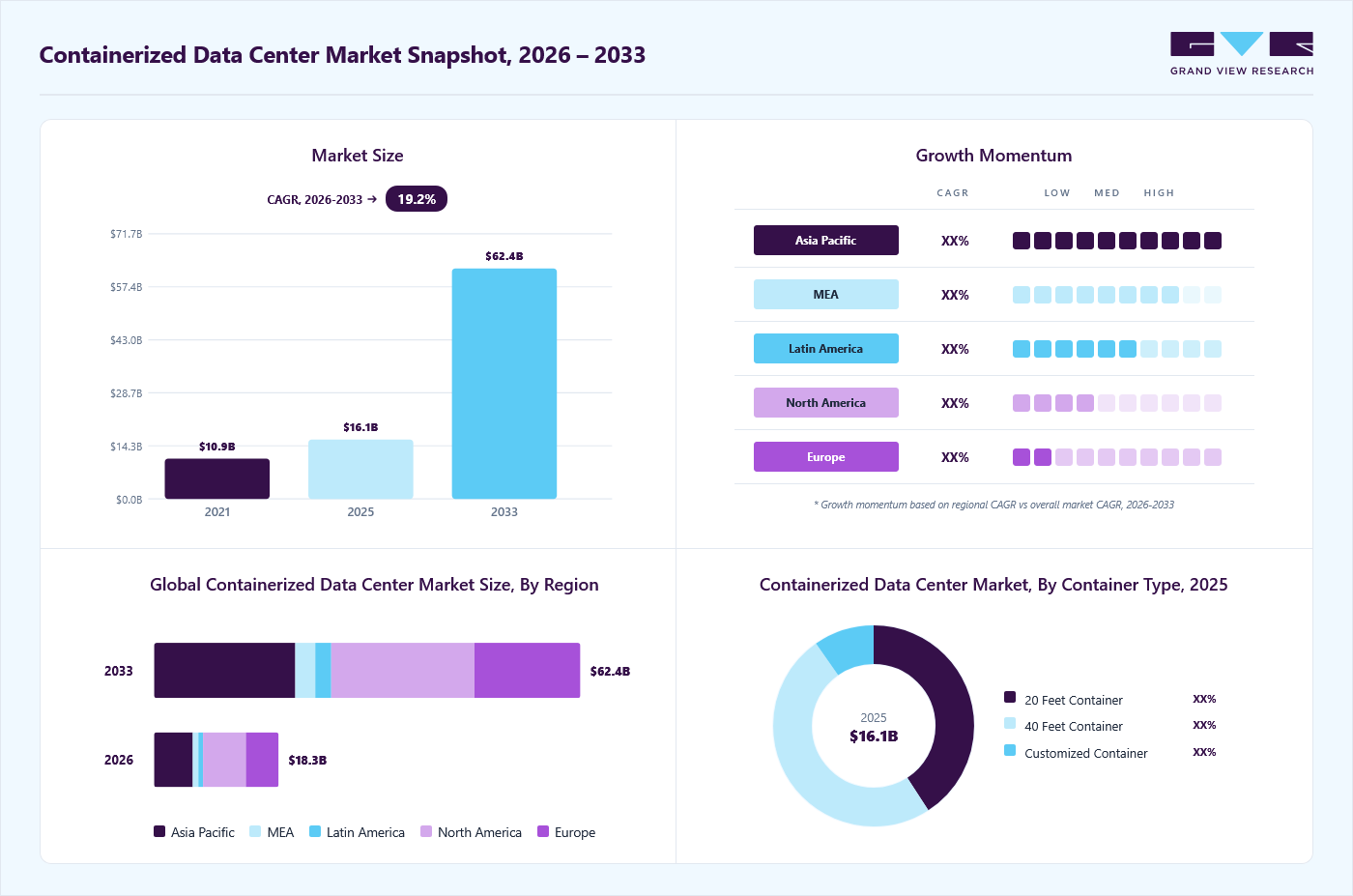
The global containerized data center market size was valued at USD 16.1 billion in 2025 and is projected to grow from USD 18.3 billion in 2026 to USD 62.4 billion by 2033, at a CAGR of 19.2% from 2026 to 2033. The market in North America dominated with a revenue share of 34.4% in 2025. North America's containerized data center market is benefiting from strong investments in AI infrastructure, cloud computing, edge deployments, and 5G expansion. The need for rapid deployment, scalability, energy efficiency, and flexible capacity additions is accelerating adoption across enterprises, telecom operators, and hyperscalers.
 Source: Grand View Research, IR Documents, Primary Interviews, Paid DatabasesTo learn more about this report,
 Download Free Sample Report
 Key Market Trends & Insights
- By organization size: Large organizations segment held the largest market share of 61.9% in 2025.
- By container type: 40 feet container segment held the largest market share of 49.4% in 2025.
- By end-use: IT & telecommunications segment held the largest market share of 28.5% in 2025.
Regional Highlights
- Largest regional market: North America (34.4% revenue share, 2025)
- Fastest-growing regional market: Asia Pacific (highest CAGR, 2026-2033)
- By country: The U.S. held the largest market share in 2025.
Market Size & Forecast
- Market size in 2025: USD 16.1 Billion
- Estimated market size in 2026: USD 18.3 Billion
- Projected market size by 2033: USD 62.4 Billion
- CAGR (2026-2033): 19.2%
Three ways to get this report
Buy it, customize it, or ask a question.Ask an Analyst
Analyst response in 1 business day
- AccessReport author, directly
- Reply timeWithin 1 working day
- No sales callDirect answer only
- FormatEmail reply
- CostFree, no cost
Get the Full Report
What the study covers
- FormatsPDF · Excel · Dashboard
- Timeline2026–2033 annual, 2025 base
- Coverage20+ countries, 5 regions
- Companies10+ key players profiled
Customize the Report
20% free customization
- IncludeCountries, segments, points
- TailorTo your product definition
- ExtendDeeper competitor detail
- OrA fully bespoke study
- Turnaround5–10 working days
As these technologies become more integrated into daily life, the volume of data being created, transmitted, and processed across networks continues to grow at an unprecedented rate. Containerized data centers, with their modular and portable design, provide the capacity to manage this influx of data, offering quicker deployment, improved energy efficiency, and lower operational costs. Technological advancements, cloud computing adoption, and digital services are the factors driving the growth of the data center market.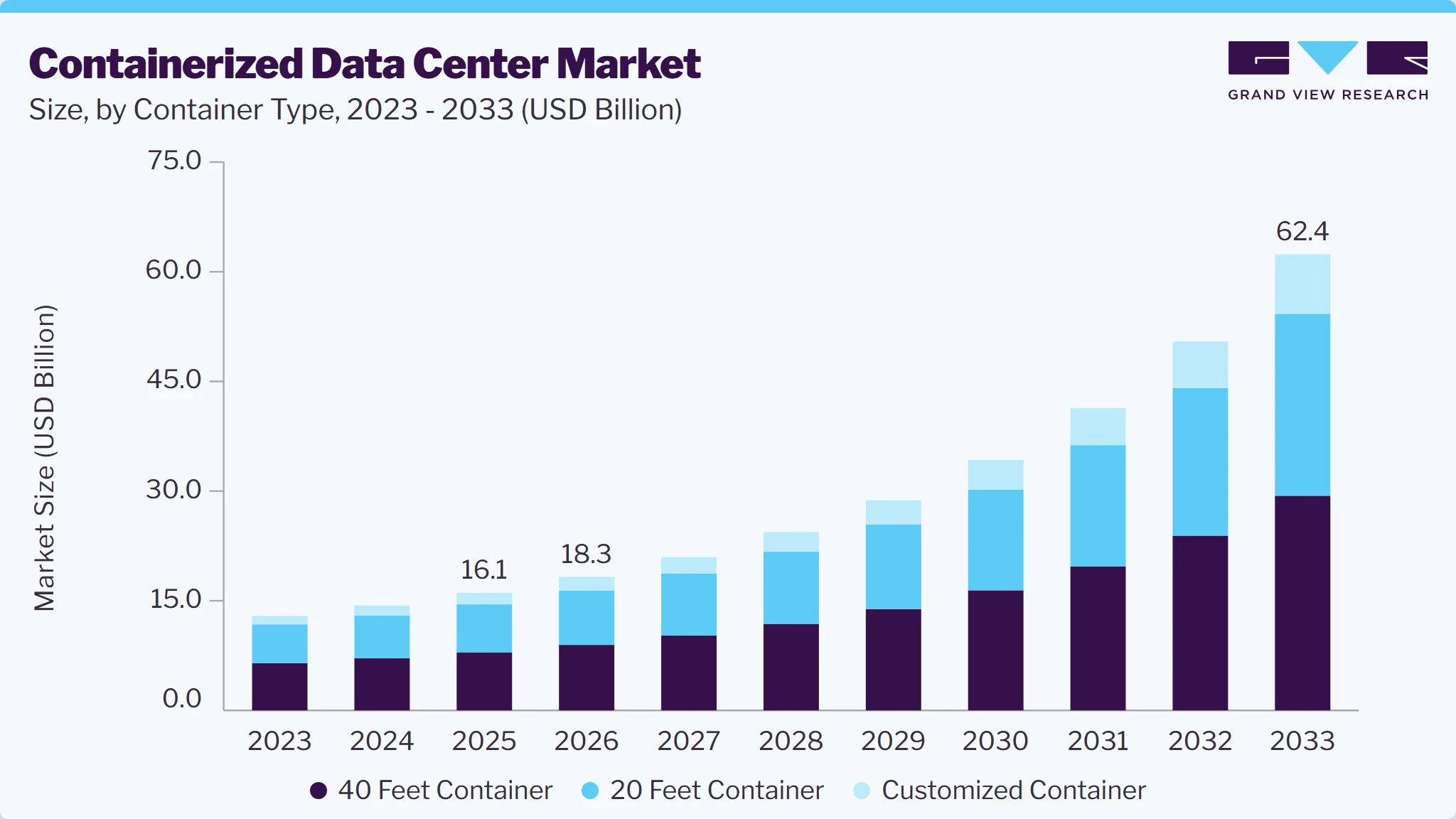 To learn more about this report, Download Free Sample Report
 The rollout of the 5G network has enhanced data transmission speeds and enabled new applications, leading to a surge in demand for data center infrastructure to support the growing volume of data traffic. The technology, with enhanced speed for faster downloads, quicker access, and smoother streaming to online services, generates vast amounts of data, thereby creating demand for high-speed data centers across the world. Moreover, cloud services require robust data centers to manage and host applications and computing resources. Cloud providers are focused on offering edge computing services, which require smaller data centers or edge locations near users, thereby surging demand for modular data centers. The widespread adoption of cloud services across small & medium organizations and large organizations fuels market growth.
With the shift toward decentralized data processing and the need to handle data closer to the source, containerized data centers provide an ideal solution. These centers can be easily deployed in various locations, supporting low-latency applications such as autonomous vehicles, smart cities, and real-time data analytics. The ongoing global digital transformation and the increasing reliance on cloud computing further drive market expansion, as companies seek more agile and efficient ways to manage their IT resources.
Market Dynamics
Containerized data centers are gaining widespread adoption for providing rapid, scalable, and modular IT infrastructure that integrates computing, storage, networking, power, and cooling systems into pre-engineered units. These solutions enable organizations to deploy data center capacity quickly, reduce construction timelines, optimize capital expenditure, and support operations in remote or space-constrained environments. The growing demand for edge computing, cloud services, artificial intelligence workloads, and low-latency data processing is accelerating adoption across telecommunications, manufacturing, energy, defense, healthcare, and enterprise sectors. Furthermore, advancements in high-density cooling technologies, energy-efficient power systems, prefabricated modular designs, and remote infrastructure management platforms are enhancing operational efficiency and deployment flexibility, supporting the continued growth of the containerized data center market.
High initial capital investment and supporting infrastructure requirements remain significant restraints for the containerized data center market, particularly for small and medium-sized enterprises. Although containerized solutions reduce construction timelines, organizations must still invest in IT hardware, cooling systems, power distribution units, networking equipment, security systems, and site preparation. Additionally, deployment locations often require reliable power availability, connectivity infrastructure, and specialized maintenance capabilities. Ongoing operational expenses related to power consumption, equipment upgrades, monitoring, and maintenance can further increase the total cost of ownership. These financial and infrastructure challenges may limit adoption among organizations with constrained budgets or limited technical resources.
High initial capital investment and supporting infrastructure requirements remain significant restraints for the containerized data center market, particularly for small and medium-sized enterprises. Although containerized solutions reduce construction timelines, organizations must still invest in IT hardware, cooling systems, power distribution units, networking equipment, security systems, and site preparation. Additionally, deployment locations often require reliable power availability, connectivity infrastructure, and specialized maintenance capabilities. Ongoing operational expenses related to power consumption, equipment upgrades, monitoring, and maintenance can further increase the total cost of ownership. These financial and infrastructure challenges may limit adoption among organizations with constrained budgets or limited technical resources.
The rapid expansion of artificial intelligence, 5G networks, and edge computing infrastructure presents a significant opportunity for the containerized data center market. Organizations are increasingly deploying containerized facilities to support AI training and inference workloads, real-time data processing, and latency-sensitive applications, bringing them closer to end users. Telecom operators are leveraging modular data centers to support distributed 5G architectures, while enterprises are adopting them for remote industrial sites, smart cities, and digital transformation initiatives. Advances in high-density computing, liquid cooling technologies, remote monitoring platforms, and energy-efficient designs are further enhancing the attractiveness of containerized solutions. As demand for decentralized computing infrastructure grows, the market is expected to witness substantial expansion and new revenue opportunities for solution providers.
Analyst Perspective
The containerized data center market sits at the convergence of several transformative technology trends, including the rapid expansion of edge computing, accelerating adoption of artificial intelligence and machine learning workloads, growing deployment of 5G networks, and increasing demand for agile digital infrastructure. Organizations across telecommunications, cloud services, manufacturing, healthcare, government, defense, energy, and enterprise sectors are increasingly adopting containerized data centers to achieve faster deployment, greater scalability, and improved operational flexibility while reducing the time and complexity associated with traditional data center construction. The central competitive moat, however, will belong to providers that successfully integrate high-density computing infrastructure, advanced cooling technologies, intelligent power management systems, remote monitoring platforms, automation capabilities, and lifecycle services into a unified modular ecosystem. As containerized data centers evolve from simple portable infrastructure units into intelligent, AI-ready, and edge-optimized computing environments, vendors capable of delivering energy efficiency, rapid scalability, operational resilience, and seamless integration with cloud and edge architectures will be best positioned to create long-term value and drive sustained market growth.
Container Type Insights
Based on container type, the 40-foot container segment led the market with the largest revenue share of 49.4% in 2025 and is expected to grow at the significant CAGR over the forecast period. Emerging economies such as the Asia-Pacific and Latin America are experiencing rapid growth in digital services and require scalable data center infrastructure to support it. Containerized data centers are well-positioned to meet this demand, as they can be easily deployed and calibrated to changing business needs. The 40-foot container segment is particularly well-suited for emerging markets, offering a cost-effective and efficient solution.
The customized container segment is expected to grow at a CAGR of 23.4% over the forecast period. Several factors drive the demand for customized containers; various industries and use cases (e.g., edge computing, telecommunications, military, remote operations) have varying and specific requirements that standard containers may not fulfill. Moreover, customized containers can accommodate future growth and expansion by incorporating modular components and infrastructure, ensuring scalability.
End-use Insights
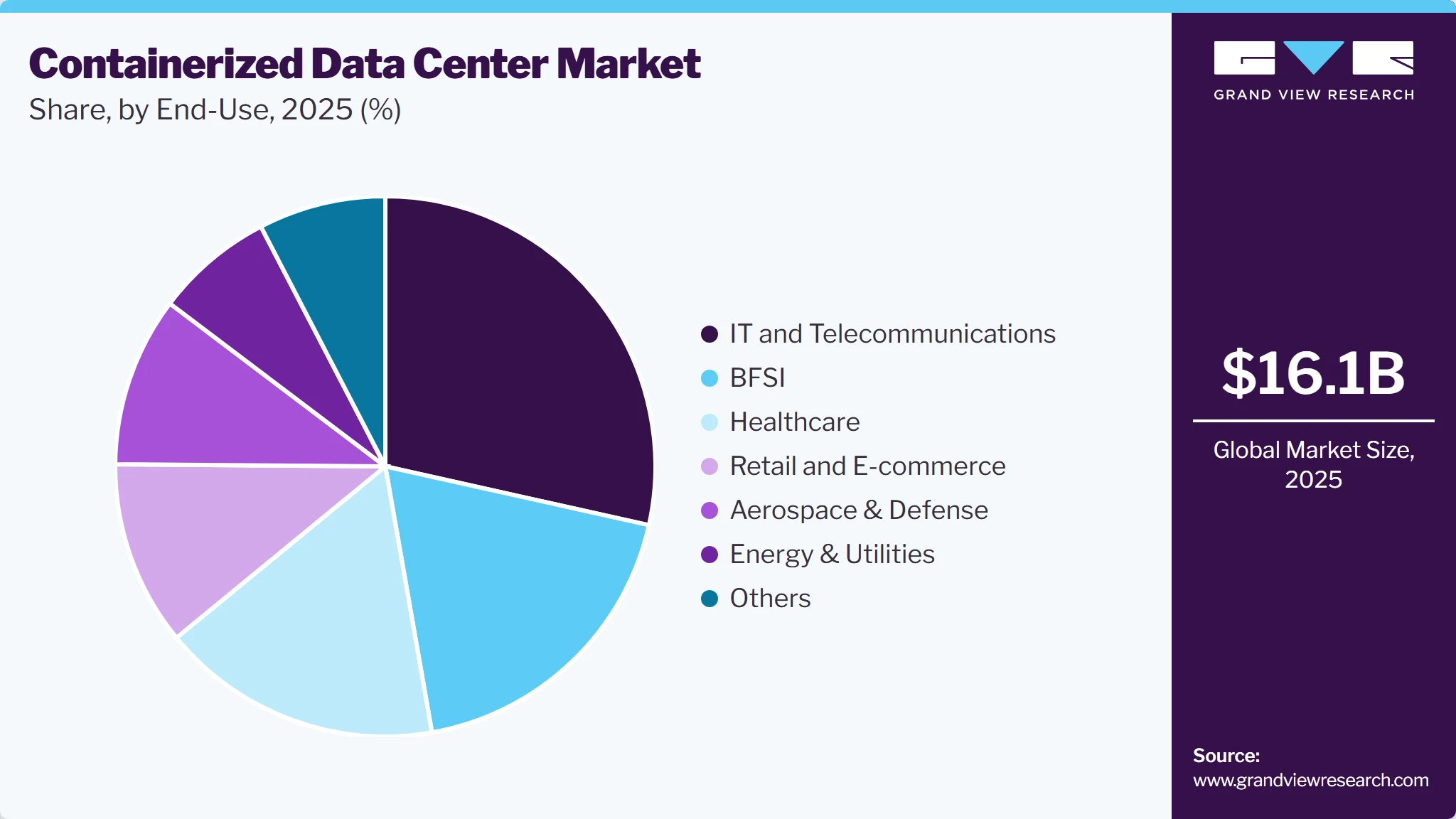
By end use, the IT & Telecommunications segment led the market with the largest revenue share of 28.5% in 2025, driven by the need for rapid deployment and scalability. These modular solutions offer significant cost efficiencies and operational benefits, making them ideal for companies facing fluctuating demand amidst emerging technologies such as 5G.
 To learn more about this report, Download Free Sample Report
 The healthcare segment is expected to grow at a significant CAGR over the forecast period, driven by key trends such as rapid deployment and scalability to manage the growing volume of medical data. These modular data centers offer enhanced data security and regulatory compliance, such as HIPAA, making them suitable for secure, isolated data environments.
Organization Size Insights
Based on organization size, the large organizations segment led the market with the largest revenue share of 61.9% in 2025. Large organizations are increasingly integrating containerized data centers into their hybrid and multi-cloud strategies. These modular data centers enhance hybrid cloud infrastructure by enabling seamless connectivity with public cloud services and extending on-premises capabilities. This approach allows for efficient workload management across both private and public cloud environments, streamlining the data center footprint.
The SMEs segment is expected to grow at a significant CAGR over the forecast period. The growing demand for containerized data centers among small and medium-sized organizations reflects a significant trend in the data center market. These modular data centers offer a scalable and efficient solution, allowing businesses to adjust their infrastructure to meet changing needs without substantial investments in traditional data centers.
Regional Insights
North America dominated the containerized data center market with the largest revenue share of 34.4% in 2025. The rising digitization across various sectors is driving the regional market growth. Digitization is transforming industries in North America, such as healthcare, finance, retail, and manufacturing. Businesses are increasingly relying on digital tools and platforms to enhance their operations, customer engagement, and efficiency. This digital transformation generates vast amounts of data that must be stored, processed, and analyzed.
 To learn more about this report, Download Free Sample Report
 U.S. Containerized Data Center Market Trends
The containerized data center market in the U.S. held the largest share in the North America region in 2025. The increasing need for energy-efficient data center alternatives is driving the U.S. market growth. Many companies in the market are collaborating to reduce energy consumption, achieve carbon neutrality, and discover innovative cooling technologies.
Europe Containerized Data Center Market Trends
The containerized data center market in Europe is growing with a significant CAGR from 2026 to 2033. Governments across Europe are increasingly adopting containerized data centers for various public sector applications, particularly in research and development. Research and development projects often have fluctuating demands for computing power and data storage. Containerized data centers provide a highly scalable and flexible solution, allowing government agencies to quickly adjust their IT infrastructure to meet the changing needs of different projects.
The UK containerized data center market is expected to grow rapidly in the coming years. Companies are increasingly integrating containerized data center solutions into their operations to meet the growing demand for scalable, efficient, and flexible IT infrastructure in the country. As organizations in the country undergo digital transformations, they require robust data center solutions that can keep pace with the rapid growth in data generation and processing needs. The scalability of containerized data centers makes them an ideal choice for such transformations, thereby driving their adoption among businesses in the country.
The containerized data center market in Germany held a substantial market share in 2025. Land scarcity in Germany is a significant factor driving the growth of containerized data centers. As one of Europe's most densely populated countries, Germany faces challenges in finding large, suitable plots of land for traditional data center construction.
Asia Pacific Containerized Data Center Market Trends
Asia Pacific is expected to grow at the highest CAGR, at 20.3%, from 2026 to 2033. Governments across the Asia Pacific region are widely adopting containerized data centers. Numerous smart city initiatives are underway in the Asia-Pacific region, driving the adoption of containerized data centers. Governments are investing in smart infrastructure to enhance urban living, improve public services, and drive economic growth
The Japan containerized data center market is expected to grow rapidly in the coming years. The innovative technology landscape of Japan is driving the growth of containerized data centers in the country. The adoption of these advanced data centers reflects the country's commitment to maintaining its technological edge and addressing the evolving needs of the digital economy. Introducing new containerized data centers showcases the country’s ability to develop advanced solutions that meet the demands of modern IT infrastructure.
The containerized data center market in China held a substantial market share in 2025. The exponential growth of data generated by digital activities, social media, streaming services, and IoT devices in China creates a demand for efficient data storage and processing solutions. Containerized data centers offer a scalable and flexible infrastructure to manage this growing data volume. Their modular design allows for incremental expansion, enabling businesses to scale their IT infrastructure per their data requirements.
Key Containerized Data Center Company Insights
Some of the key companies in the containerized data center market include Alibaba Group Holding Ltd.; Cisco Systems, Inc.; Dell Inc.; Delta Power Solutions; Hewlett Packard Enterprise Development LP; Vertiv Group Corp.; and Fuji Electric Co., Ltd. Organizations are focusing on increasing their customer base to gain a competitive edge in the industry. Therefore, key players are taking several strategic initiatives, such as mergers and acquisitions, as well as partnerships with other major companies.
-
In May 2025, Delta launched an AI containerized data center solution at COMPUTEX 2025. The 20-foot prefabricated unit integrates NVIDIA-accelerated servers, high-speed networking, power systems, battery backup, and an 80 kW liquid-cooling system. Designed for edge computing and enterprise applications, the solution supports rapid deployment and scalable AI infrastructure. The launch strengthened Delta's integrated containerized data center portfolio for high-density computing workloads.
-
In August 2024, NVIDIA Corporation partnered with Sustainable Metal Cloud (SMC), a Singapore-based AI cloud provider, to offer HyperCubes, containerized NVIDIA GPU servers utilizing immersion cooling technology. These servers can reduce energy consumption by 50% compared to traditional air-cooled systems. SMC also claims that this solution is 28% more cost-effective than competing liquid-cooling options. In addition to its energy efficiency and affordability, the containerized design of HyperCubes enables quicker setup, making it easier for data centers to scale their operations efficiently.
-
In July 2024, Vertiv Group Corp. introduced the Vertiv MegaMod CoolChip, a prefabricated modular (PFM) data center solution for efficient and reliable AI computing. Equipped with liquid cooling, this solution is adaptable to the platforms of major AI compute providers and can be scaled to meet specific customer needs. By combining the quality and efficiency of offsite fabrication with cutting-edge, AI-ready technologies, the MegaMod CoolChip significantly accelerates the deployment of AI digital infrastructure, reducing setup time by up to 50%.
Key Containerized Data Center Companies:
The following key companies have been profiled for this study on the containerized data center market.
-
Cisco Systems, Inc.
-
Dell Inc.
-
Delta Power Solutions
-
Fuji Electric Co., Ltd.
-
Hewlett Packard Enterprise Development LP
-
IBM Corporation
-
Rittal GmbH & Co. KG
-
Schneider Electric
-
Shenzhen Kstar Science & Technology Co., Ltd.
-
Vertiv Group Corp.
-
ZTE Corporation
Competitive Benchmarking
Category
Operating Strategies
Competitive Edge
Weakness
Established Players (Schneider Electric, Vertiv, Huawei Technologies, Dell Technologies, Hewlett Packard Enterprise, Rittal)
Mature players focus on delivering end-to-end modular and containerized data center solutions that integrate IT infrastructure, power systems, cooling technologies, monitoring software, and lifecycle services.
Their strategies emphasize large-scale enterprise, telecom, hyperscale cloud, government, and edge computing deployments supported by global service networks and long-term customer contracts.
Established players benefit from strong brand recognition, extensive engineering expertise, global manufacturing capabilities, and comprehensive product portfolios. Their ability to provide turnkey solutions, advanced power and cooling technologies, and worldwide support services enables them to address complex customer requirements.
These companies face high research, manufacturing, and service delivery costs. Large organizational structures may reduce agility in responding to niche customer requirements. They also face increasing competition from regional modular data center providers and must continuously invest in product innovation, sustainability initiatives, and supply chain resilience to maintain market leadership.
Emerging Players (Zella DC, Flexenclosure, Cannon Technologies, PCX Holding, BladeRoom Group)
Emerging players focus on specialized modular and containerized infrastructure solutions for edge computing, remote operations, military applications, industrial facilities, and rapidly deployable data centers. Many emphasize customization, prefabricated designs, energy-efficient architectures, and flexible deployment models to address specific customer requirements
Emerging players offer greater flexibility, faster deployment capabilities, and highly customized solutions tailored to specific industries and operating environments. Their specialized expertise in modular construction, edge infrastructure, and remote-site deployments allows them to compete effectively in niche market segments.
Limited global presence, smaller service networks, and lower financial resources can restrict their ability to compete for large hyperscale and multinational projects. Dependence on third-party IT equipment vendors and supply chain partners may also impact margins, scalability, and delivery timelines.
Containerized Data Center Market Report Scope
Report Attribute
Details
Market size in 2025
USD 16.1 billion
Estimated market size in 2026
USD 18.3 billion
Projected market size by 2033
USD 62.4 billion
Growth rate
CAGR of 19.2% from 2026 to 2033
Base year for estimation
2025
Historical data
2021 - 2024
Forecast period
2026 - 2033
Quantitative units
Revenue in USD billion and CAGR from 2026 to 2033
Report coverage
Revenue forecast, company ranking, competitive landscape, growth factors, and trends
Segments covered
Container Type, Organization Size, End-use, Region
Regional scope
North America; Europe; Asia Pacific; Latin America; MEA
Country scope
U.S.; Canada; Mexico; Germany; UK; France; China; Japan; India; South Korea; Australia; Brazil; Saudi Arabia; South Africa; UAE
Key companies profiled
Cisco Systems, Inc.; Dell Inc.; Delta Power Solutions; Fuji Electric Co., Ltd.; Hewlett Packard Enterprise Development LP; IBM Corporation; Rittal GmbH & Co. KG; Schneider Electric; Shenzhen Kstar Science & Technology Co., Ltd.; Vertiv Group Corp.; ZTE Corporation
Customization scope
Free report customization (equivalent to up to 8 analysts' working days) with purchase. Addition or alteration to country, regional & segment scope.
Pricing and purchase options
Avail customized purchase options to meet your exact research needs. Explore purchase options
Global Containerized Data Center Market Report Segmentation
This report forecasts revenue growth at the global, regional, and country levels and provides an analysis of the latest industry trends across sub-segments from 2021 to 2033. For this study, Grand View Research has segmented the global containerized data center market report based on container type, organization size, end-use, and region.
 To learn more about this report, Download Free Sample Report
 -
Container Type Outlook (Revenue, USD Billion, 2021 - 2033)
-
20 Feet Container
-
40 Feet Container
-
Customized Container
-
-
Organization Size Outlook (Revenue, USD Billion, 2021 - 2033)
-
Large Enterprises
-
Small and Medium-sized Enterprises (SMEs)
-
-
End-use Outlook (Revenue, USD Billion, 2021 - 2033)
-
IT and Telecommunications
-
BFSI
-
Healthcare
-
Retail and E-commerce
-
Aerospace & Defense
-
Energy & Utilities
-
Others
-
-
Regional Outlook (Revenue, USD Billion, 2021 - 2033)
-
North America
-
U.S.
-
Canada
-
Mexico
-
-
Europe
-
UK
-
Germany
-
France
-
-
Asia Pacific
-
China
-
India
-
Japan
-
South Korea
-
Australia
-
-
Latin America
-
Brazil
-
-
Middle East & Africa
-
UAE
-
Saudi Arabia
-
South Africa
-
-
Research Methodology
The containerized data center market figures in this report are based on a proven research process that combines executive interviews with secondary research from proprietary databases, company filings, and recognized regulatory and institutional sources. Market size is built through value-chain sizing - reconciling supply-side and demand-side estimates - and triangulated with bottom-up and top-down approaches. Every estimate passes multiple levels of expert validation before publication, with each containerized data center segment quantified using the revenue-capture definitions in the table below.
Segment Definition
Segment - Container Type
Revenue capture definition
20 Feet Container
A compact containerized data center built within a standard 20-foot shipping container. These solutions are designed for locations with limited space and are commonly deployed for edge computing, remote operations, disaster recovery, and small-scale IT infrastructure requirements.
40-Feet Container
A larger containerized data center housed in a standard 40-foot shipping container, offering greater rack capacity, power infrastructure, and cooling resources. It is widely used by enterprises, telecom operators, and cloud service providers requiring higher computing density and scalability.
Customized Container
A tailor-made containerized data center designed to meet specific customer requirements related to capacity, power, cooling, security, environmental conditions, and application workloads. Customized containers are often deployed in industrial, defense, hyperscale, and specialized edge computing environments.
Segment - Organization Size
Revenue capture definition
Large Enterprises
The Large enterprises segment, with respect to the number of employees, typically comprises organizations employing more than 1,000 employees for multinational corporations.
Small & Medium Enterprises (SMEs)
The SMEs segment, with respect to the number of employees, generally includes organizations employing between 10 and 999 employees.
Segment - End-use
Revenue capture definition
IT and Telecommunications
This segment includes telecom operators, internet service providers, cloud providers, and technology companies that deploy containerized data centers to support network expansion, edge computing, 5G infrastructure, cloud services, and data processing requirements.
BFSI
Banks, financial institutions, and insurance companies use containerized data centers to support secure data storage, transaction processing, disaster recovery, regulatory compliance, and low-latency financial applications.
Healthcare
Healthcare organizations deploy containerized data centers to manage electronic health records, medical imaging, telemedicine platforms, research applications, and other critical healthcare data while ensuring high availability and data security.
Retail and E-commerce
Retailers and e-commerce companies use containerized data centers to support digital commerce platforms, inventory management systems, customer analytics, payment processing, and edge computing applications, enhancing customer experiences.
Aerospace & Defense
Military organizations, defense agencies, and aerospace companies deploy containerized data centers in remote, mobile, and mission-critical environments to support communications, intelligence gathering, surveillance systems, and secure data processing operations.
Energy & Utilities
Energy companies and utility providers use containerized data centers to monitor and control power grids, renewable energy assets, oil and gas operations, and industrial automation systems, and to support real-time operational analytics.
Others
This category includes manufacturing, government, education, transportation, mining, research institutions, and other sectors that leverage containerized data centers for localized computing, disaster recovery, edge deployments, and digital infrastructure modernization.
Estimation Model
Layer
Question
Analysis
Addressable Infrastructure Layer
Who can benefit from containerized data centers?
Identify organizations requiring rapid, scalable, and portable IT infrastructure across telecom networks, cloud service providers, enterprises, government agencies, military operations, healthcare facilities, industrial sites, educational institutions, remote mining locations, and disaster recovery environments to define the total addressable market.
Infrastructure & Deployment Readiness Layer
Who can effectively deploy containerized data centers?
Evaluate availability of power infrastructure, network connectivity, edge computing requirements, digital transformation maturity, cloud adoption, data localization needs, and IT operational capabilities to determine organizations capable of deploying and managing containerized data center solutions.
Adoption & Utilization Layer
Who actively uses containerized data centers?
Analyze adoption of edge computing, AI workloads, cloud services, 5G deployments, disaster recovery solutions, and remote-site computing requirements across industries to convert addressable organizations into active containerized data center users.
Monetization Layer
How much revenue is generated?
Assess spending on containerized data center hardware, IT racks, servers, storage systems, networking equipment, power distribution units, cooling systems, monitoring software, installation services, maintenance contracts, and managed infrastructure services across the active user base.
Delivered Customizations
This report has been delivered with the following In-depth customizations
Client Request
Customization Delivered
Value Adds
Edge Computing & Distributed Infrastructure Trends
Conducted a focused analysis of containerized data center deployments supporting edge computing, industrial IoT, content delivery, smart cities, remote operations, and low-latency applications across telecommunications, manufacturing, energy, and enterprise environments.
Helps stakeholders identify high-growth edge computing opportunities, evaluate infrastructure expansion strategies, and assess demand for rapidly deployable modular data center solutions across emerging digital ecosystems.
Containerized Data Center Ecosystem & Market Opportunity Assessment
Assessed demand for modular data centers across the Middle East & Africa, covering integrated power systems, cooling technologies, prefabricated infrastructure, remote monitoring platforms, and AI-ready computing environments, along with adoption barriers and deployment challenges.
Supports investment and expansion strategies by identifying underserved market segments, evaluating technology readiness, assessing competitive dynamics, and uncovering long-term growth opportunities within modular and edge infrastructure markets.
Sustainable & Energy-Efficient Data Center Strategy Analysis
Assessed adoption of energy-efficient cooling systems, intelligent power management technologies, renewable energy integration, and sustainable modular data center architectures designed to reduce operational costs and support ESG objectives.
Enables stakeholders to evaluate sustainability-driven growth opportunities, optimize infrastructure investments, comply with environmental regulations, and capitalize on increasing demand for green data center solutions.
Frequently Asked Questions About This Report
The global containerized data center market size was valued at USD 16.1 billion in 2025 and is expected to reach USD 18.3 billion in 2026.
North America dominated with 34.4% revenue share in 2025.
The IT and Telecommunications segment held the largest share (over 28%) in 2025, while the healthcare is the fastest-growing segment.
The 40 feet container segment led with a 49.4% revenue share in 2025, while the customized container is the fastest-growing segment.
The large organizations segment led with a 61.9% revenue share in 2025, while the small and medium enterprises (SMEs) is the fastest-growing segment.
Some key players operating in the containerized data center market include Cisco Systems, Inc., Dell Inc., Delta Power Solutions, Fuji Electric Co., Ltd., Hewlett Packard Enterprise Development LP, IBM Corporation, Rittal GmbH & Co. KG, Schneider Electric, Shenzhen Kstar Science & Technology Co., Ltd., Vertiv Group Corp., and ZTE Corporation.
The global containerized data center market is expected to grow at a compound annual growth rate of 19.2% from 2026 to 2033 to reach USD 62.4 billion by 2033.
Key factors driving the market growth include the rapid surge in data traffic due to the proliferation of digital devices, the Internet of Things (IoT), social media platforms, and streaming services.
Asia Pacific is the fastest-growing region over the forecast period.
About the Author(s)
Communications Infrastructure Research Team
Technology · Communications InfrastructureThis report was authored by the communications infrastructure research team at Grand View Research - comprising two research analysts, one senior research analyst, and one industry expert - with specialized expertise in the communications infrastructure segment of the technology industry. All findings are based on proprietary technology databases, executive interviews, and regulatory analysis, subject to internal peer review prior to publication.
Last Updated:
Speak to Analyst

Customize this report to your needs - add regions, segments, or data points, with 20% free customization.
Or view our licence options:


ISO 9001:2015 & 27001:2022 Certified
We are GDPR and CCPA compliant! Your transaction & personal information is safe and secure. For more details, please read our privacy policy.


