
- Home
- »
- Homecare & Decor
- »
-
Contract Furniture Market Size & Share Report, 2026-2033GVR Report cover

Contract Furniture Market (2026 - 2033)
Size, Share & Trends Analysis Report By Product (Chairs & Stools, Tables & Desks, Storage Furniture, Sofa & Couch), By End-user, By Distribution Channel (Offline, Online), By Region, And Segment Forecasts
Market Size, 2025
$78.2BMarket Estimate, 2026
$82.2BMarket Forecast, 2033
$119.7BCAGR, 2026–2033
5.5%Contract Furniture Market Summary
The global contract furniture market size was valued at USD 78.2 billion in 2025 and is projected to grow from USD 82.2 billion in 2026 to USD 119.7 billion by 2033, growing at a CAGR of 5.5% from 2026 to 2033. Asia Pacific dominated the market with the largest revenue share of 36.0% in 2025. The growth of the market is primarily attributed to factors such as increasing disposable incomes, growth of hospitality and housing sectors, developments in the commercial construction industry, and the growing demand for premium and luxury furniture globally.
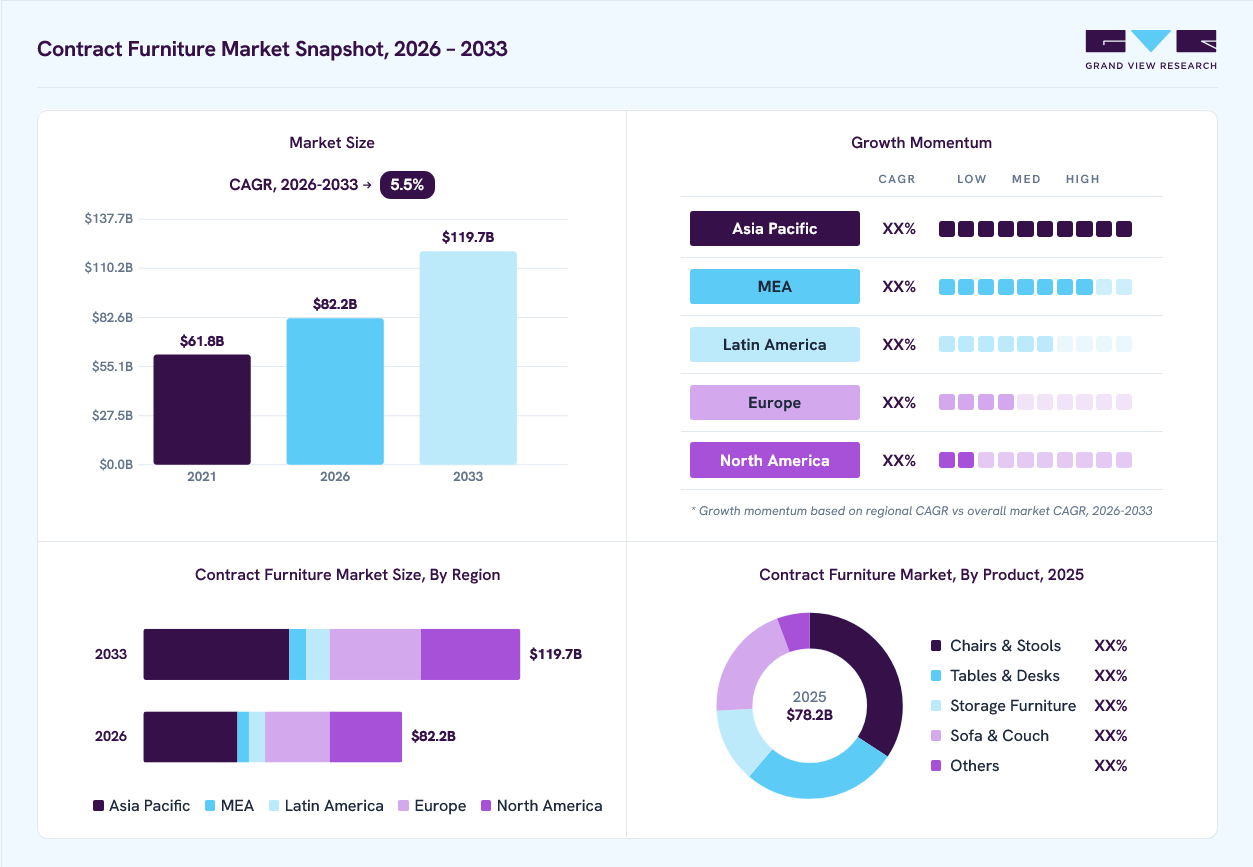 Source: Grand View Research, IR Documents, Primary Interviews, Paid DatabasesTo learn more about this report,
 Download Free Sample Report
Key Market Trends & Insights
- By product: Chairs & stools product segment led the market with the largest revenue share of 34.1% in 2025, and the sofa & couch is expected to grow at the fastest CAGR over the forecast period.
- By end users: Corporate offices segment led the market with the largest revenue share of 41.6% in 2025.
- By distribution channel: Offline distribution channel segment led the market with the largest revenue share of 76.7% in 2025.
Regional Highlights
- Largest regional market: Asia Pacific (36.0% revenue share, 2025)
- By country: The China held the largest market share in 2025.
Market Size & Forecast
- Market size in 2025: USD 78.2 Billion
- Estimated market size in 2026: USD 82.2 Billion
- Projected market size by 2033: USD 119.7 Billion
- CAGR (2026-2033): 5.5%
Three ways to get this report
Buy it, customize it, or ask a question.Ask an Analyst
Analyst response in 1 business day
- AccessReport author, directly
- Reply timeWithin 1 working day
- No sales callDirect answer only
- FormatEmail reply
- CostFree, no cost
Get the Full Report
What the study covers
- FormatsPDF · Excel · Dashboard
- Timeline2026–2033 annual, 2025 base
- Coverage20+ countries, 5 regions
- Companies10+ key players profiled
Customize the Report
20% free customization
- IncludeCountries, segments, points
- TailorTo your product definition
- ExtendDeeper competitor detail
- OrA fully bespoke study
- Turnaround5–10 working days
Moreover, the increasing capital investments in office infrastructure, primarily driven by the development of Information Technology (IT) hubs in various countries, are expected to prompt the need for office furniture during the forecast period.According to the Economic Impact Study commissioned by the Building Owners and Managers Association International (BOMA), the establishment of business offices in the U.S. is increasing. Moreover, government initiatives focusing on the development of the real estate industry will consequently drive the demand for furniture. According to Saudi Arabia’s National Transformation Plan, the country will build more than 555,000 residential units, more than 275,000 hotel keys, over 4.3 million sq m of retail space, and over 6.1 million sq m of new office space by 2030.
 To learn more about this report, Download Free Sample Report
As technology continues to evolve, it has enabled furniture manufacturers to design and produce innovative products that cater to the changing needs of modern workplaces. For example, the integration of smart technologies in furniture, such as adjustable desks with built-in charging stations and sensors for monitoring usage, has become increasingly popular. In addition, advancements in materials science and manufacturing processes have enabled the creation of more durable, sustainable, and aesthetically pleasing furniture designs.
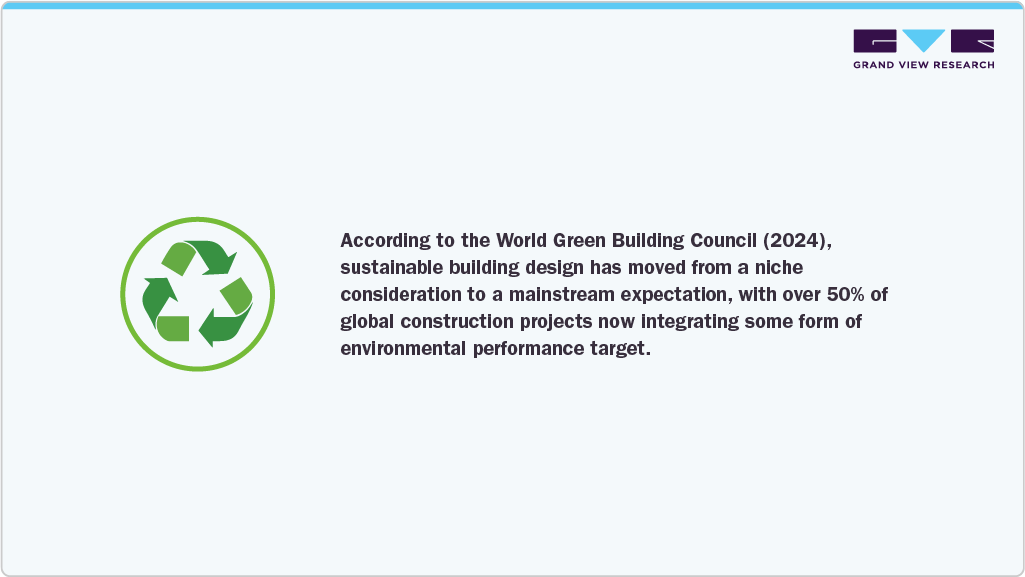
In addition, the growing emphasis on sustainability and green building practices is creating substantial opportunities in the global contract furniture industry. Corporate buyers and real estate developers are increasingly prioritizing products that align with environmental, social, and governance (ESG) objectives and green certification standards such as LEED, BREEAM, and WELL Building. Manufacturers offering FSC-certified wood, recycled materials, and low-emission finishes are gaining a competitive edge in tenders for commercial, hospitality, and institutional projects.
 To learn more about this report, Download Free Sample Report
Parallel to this, the rising focus on circular design and product longevity is reshaping the contract furniture value proposition. The transition toward a circular economy emphasizes repairable, modular, and take-back-ready products, enabling manufacturers to offer furniture-as-a-service (FaaS) or refurbishment programs. European design leaders such as Herman Miller, Steelcase, and Teknion have introduced circular design frameworks that extend product lifecycles while reducing waste, in line with the Ellen MacArthur Foundation’s circular business model principles (2024). This evolution positions contract furniture not just as a capital expenditure, but as a service-driven investment aligned with corporate sustainability goals.
Market Dynamics
The contract furniture market is gaining momentum as businesses, hospitality operators, healthcare facilities, educational institutions, and public infrastructure projects increasingly invest in functional and aesthetically appealing furniture solutions. Contract furniture offers advantages such as customized designs, space optimization, durability, modular configurations, sustainability features, and enhanced user comfort, enabling organizations to create productive and flexible environments. The growing emphasis on workplace modernization, employee well-being, hybrid work models, and premium interior design is accelerating demand across commercial sectors. Furthermore, rising investments in office construction, hospitality developments, healthcare infrastructure, and educational facilities, coupled with increasing adoption of environmentally responsible and technology-integrated furniture solutions, are expected to continue driving growth in the contract furniture market.
The expansion of commercial real estate, corporate offices, hospitality establishments, healthcare facilities, and educational institutions is significantly driving demand for contract furniture. Organizations are increasingly investing in modern furniture solutions to enhance employee productivity, optimize space utilization, improve customer experiences, and support evolving workplace requirements. Factors such as urbanization, rising infrastructure development, increasing office occupancy, and the growing adoption of hybrid work models have accelerated demand for ergonomic, flexible, and collaborative furniture solutions across commercial environments.
The growing emphasis on employee wellness and workplace efficiency further supports market growth. Businesses are replacing traditional office setups with adaptable workspaces featuring ergonomic seating, height-adjustable desks, collaborative furniture systems, and multifunctional layouts designed to improve comfort and engagement. In addition, expanding investments in hotels, co-working spaces, healthcare facilities, and educational campuses are creating substantial opportunities for contract furniture manufacturers. As organizations continue to prioritize sustainability, functionality, and premium interior design, demand for customized and durable contract furniture solutions is expected to increase steadily over the coming years.
High upfront investment requirements and budget limitations remain key restraints for the contract furniture market. Contract furniture solutions are typically designed to meet commercial-grade standards, incorporating durable materials, ergonomic features, customization options, and compliance with industry regulations. As a result, these products often involve significantly higher costs than residential furniture, making large-scale procurement a substantial financial commitment for organizations.
Small and medium-sized enterprises (SMEs), educational institutions, startups, and budget-conscious businesses may delay or reduce furniture investments due to economic uncertainty, fluctuating business performance, and capital expenditure constraints. Additionally, customization, installation, maintenance, and project management services can further increase overall ownership costs. Rising raw material prices, supply chain disruptions, and labor costs also contribute to higher product pricing, creating challenges for both manufacturers and buyers. These financial considerations may limit adoption, particularly in developing markets and among organizations undertaking large-scale furnishing projects with restricted budgets.
The increasing demand for sustainable, technology-enabled, and flexible furniture solutions is creating substantial growth opportunities in the contract furniture market. Organizations across corporate offices, hospitality venues, healthcare facilities, and educational institutions are increasingly prioritizing furniture that supports environmental sustainability, employee well-being, and efficient space utilization. Manufacturers are responding by introducing products made from recycled materials, responsibly sourced wood, low-emission components, and modular designs that align with corporate sustainability goals and green building certifications.
The rapid evolution of modern workplaces further supports this opportunity. Businesses are increasingly adopting hybrid work models and collaborative office environments, driving demand for ergonomic seating, height-adjustable desks, modular workstations, and multifunctional furniture systems. Additionally, the integration of smart technologies such as wireless charging, occupancy sensors, connectivity features, and IoT-enabled workspace management solutions is enhancing the functionality and value proposition of contract furniture. As organizations continue to invest in sustainable infrastructure, employee wellness initiatives, and digitally connected workspaces, demand for innovative contract furniture solutions is expected to expand significantly over the coming years.
Analyst Perspective
The contract furniture market sits at the intersection of workplace transformation, commercial infrastructure expansion, and sustainability-driven procurement. Demand is increasingly shifting from commoditized furniture products toward integrated solutions that combine ergonomics, flexibility, smart functionality, and environmental performance. The key competitive advantage will belong to manufacturers that can offer end-to-end workspace ecosystems spanning offices, healthcare, education, and hospitality environments while leveraging sustainable materials, modular designs, and technology-enabled furniture solutions to build long-term relationships with enterprise customers and capture recurring project opportunities.
Buyer Insights
The expansion of the global hospitality sector serves as a major growth catalyst for the market for contract furniture, as the continuous development of hotels, restaurants, resorts, and mixed-use hospitality spaces necessitates large-scale interior and exterior furnishing solutions. Modern hospitality projects increasingly focus on delivering immersive guest experiences through design-rich interiors that balance aesthetics, functionality, and comfort. This shift has accelerated demand for high-quality contract furniture, including guestroom case goods, lobby seating, dining tables and chairs, modular sofas, and workspace furnishings that align with brand identity and performance standards.
In addition, the recovery in the global tourism sector is further fueling investments in the construction and renovation of resorts, hotels, restaurants, and recreational facilities, thereby generating consistent demand for contract furniture. For instance, global international tourist arrivals reached 1.4 billion in 2024, an approximate 11% increase over 2023, underlining the rebound of resort and hospitality infrastructure worldwide. As tourism operators and property developers compete to attract and retain guests, they are investing in modern, design-driven contract furniture solutions for guestrooms, lobbies, restaurants, lounges, and meeting areas that enhance both comfort and brand identity. This growing emphasis on aesthetic cohesion, durability, and functionality across hospitality spaces continues to strengthen the global demand for contract furniture.
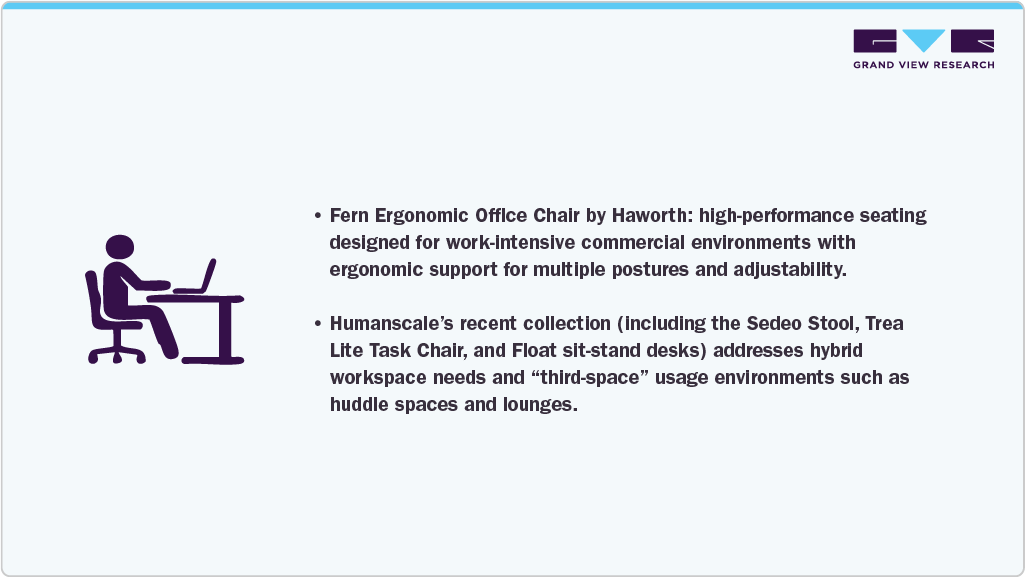
As organizations increasingly embrace hybrid working models and flexible workspace concepts, the demand for furniture that supports multiple postures, movement, and workflow modes has surged. Modern office design now emphasizes ergonomics, wellness, and adaptability factors, which are pivotal in commercial-grade furniture procurement. According to trend analyses, ergonomic seating and sit-stand desks are central features of workspace design in 2025.
 To learn more about this report, Download Free Sample Report
For the market for contract furniture, this translates into strong growth potential in products designed with ergonomic adjustability (for example, sit-stand desks, height-adjustable tables, multi-adjustable chairs) and flexible layout systems (modular workstations, reconfigurable lounge furniture, mobile partitions) that enable rapid transitions between individual focus work, collaboration, and team-based modes.
Contract furniture suppliers are likely to experience a corresponding surge in demand as businesses seek to create dynamic and engaging workspaces to support their growing operations. As stated in a December 2023 news article, ‘Commercial Realty's Strong Performance In 2023 Sets The Pathway For Prosperity In 2024’, published on financialexpress.com, the office space leasing activity experienced strong demand and growth, with a notable 33% increase in gross office space leasing across the top 9 metro cities in India during Q3 2023.
Product Insights
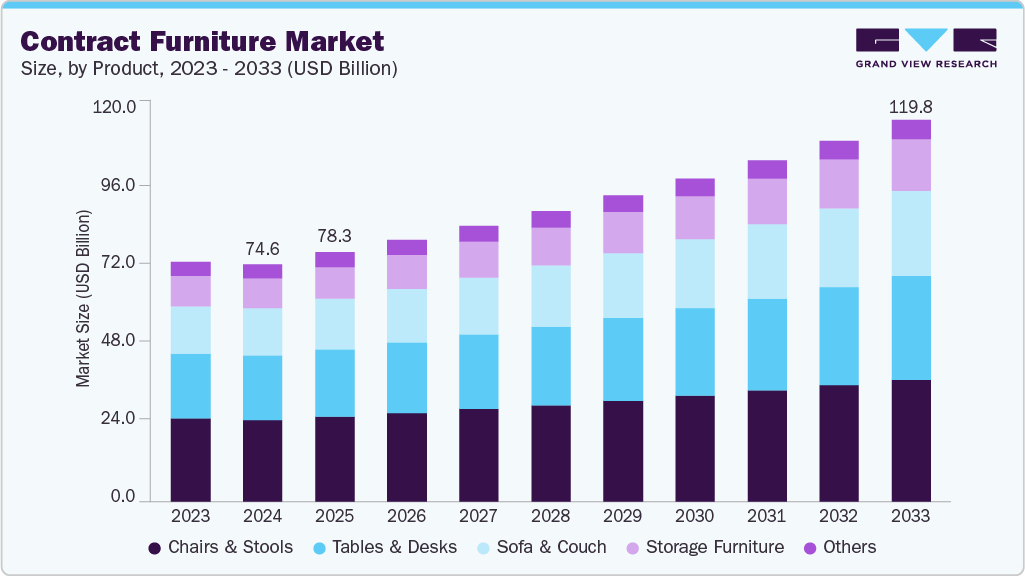
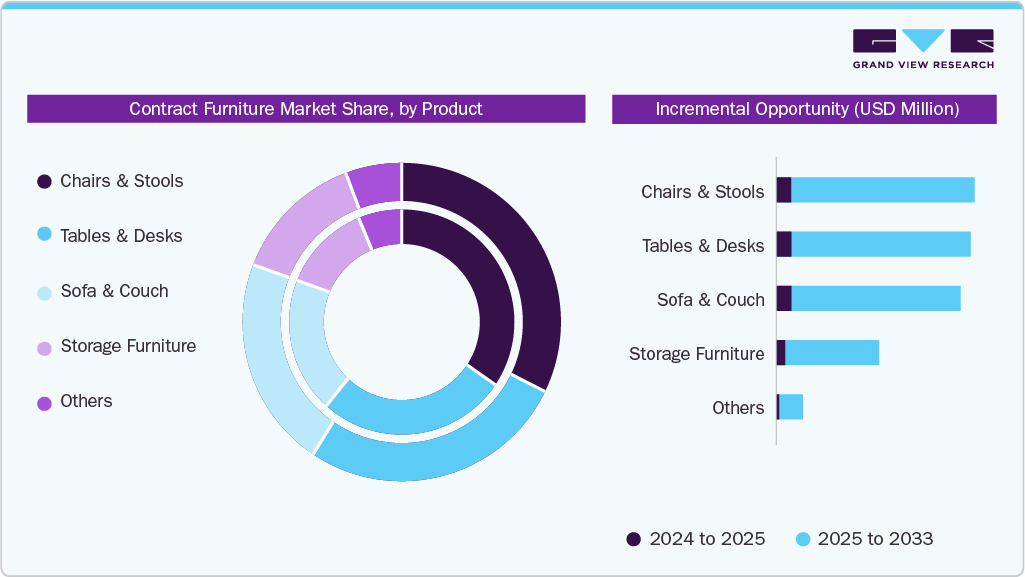
Based on product, the chairs & stools product segment led the market with the largest revenue share of 34.1% in 2025, and the sofa & couch is expected to grow at the fastest CAGR over the forecast period. Contract furniture manufacturers have been thoughtfully creating multipurpose and ergonomic seating options that increase comfort during long workdays, maximize space, and encourage effective employee collaboration to boost productivity. Office interior layouts have changed considerably in recent years, driving the demand for appropriate seating furniture, like chairs and stools.
 To learn more about this report, Download Free Sample Report
Sofa & couch are anticipated to witness a CAGR of 6.8% from 2025 to 2033. Sofas are designed to provide comfortable seating for employees, clients, patients, students, and visitors in a more relaxed and informal setting. Sofas are typically larger and more cushioned than traditional chairs, letting individuals sit or recline comfortably and casually. Sofas ought to enhance the overall feel and appearance of a professional space, encouraging a more pleasant and collaborative work environment. In corporate offices, hotels, and other places, the sofas/couches often feature upholstered cushions. They are available in a variety of styles and patterns to match the general aesthetic of the workplace environment.
Distribution Channel Insights
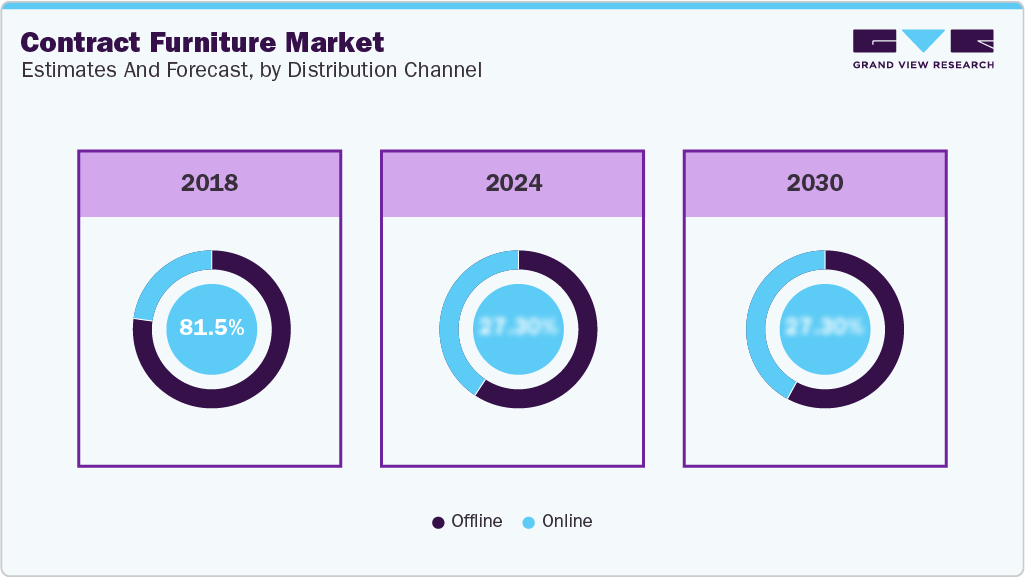
Based on distribution channel, the offline distribution channel segment led the market with the largest revenue share of 76.7% in 2025. The sales of contract furniture through offline sales channels include direct sales, distributors/wholesalers, and contractors. Several businesses prefer direct sales for purchasing contract furniture, as these allow for direct communication and negotiation with the manufacturer or supplier, ensuring a clear understanding of product specifications, customization options, and pricing.
 To learn more about this report, Download Free Sample Report
Sales of contract furniture through online are anticipated to witness a CAGR of 6.3% from 2025 to 2033. Businesses have increasingly turned to online platforms to source contract furniture for B2B due to convenience, wider product selection, and reduced physical interactions. E-commerce offers a streamlined procurement process, enables remote browsing and purchasing, and provides opportunities for cost savings.
Market players in the B2B office furniture industry have responded to the e-commerce and digitalization shift by embracing online platforms, enhancing customer experience through customization and visualization tools, improving supply chain integration, and offering value-added services. This adaptability and focus on digital solutions have allowed them to meet the evolving needs of businesses and thrive in the increasingly digital landscape.
End-use Insights
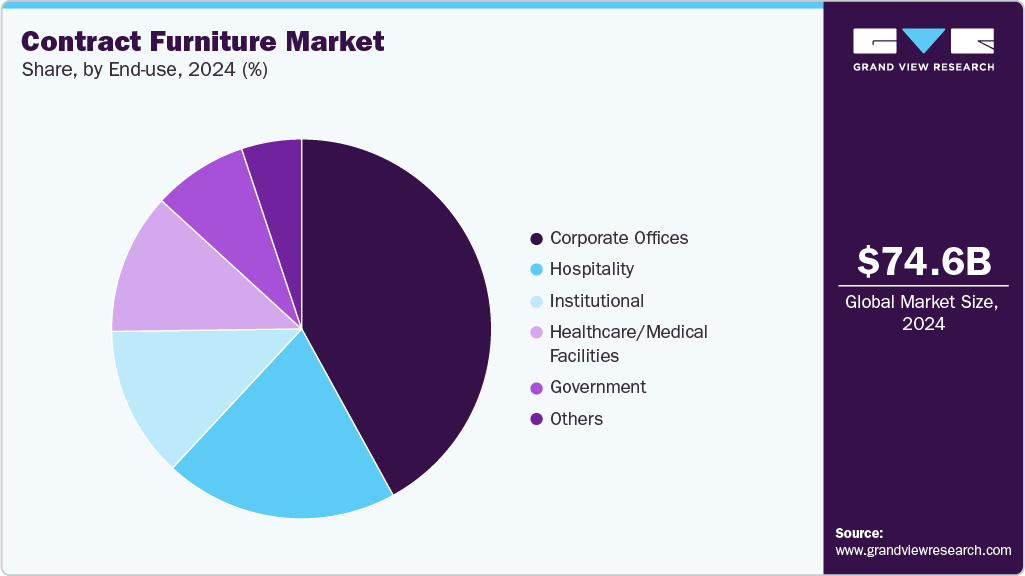
Based on end users, the corporate offices segment led the market with the largest revenue share of 41.6% in 2025. Corporate offices of all sizes employ commercial office furniture for their workspaces, encompassing essential items such as desks, chairs, conference tables, filing cabinets, reception furniture, and ergonomic office accessories. According to Organisation for Economic Co‑operation and Development (OECD) data, the average annual hours actually worked per worker in the United States in 2023 was 1,799 hours. Whether working in a traditional office setting or remotely, people spend most of their time sitting, which can add immense stress to the spine.
 To learn more about this report, Download Free Sample Report
Contract furniture used in hospitality is anticipated to witness a CAGR of 7.0% from 2025 to 2033. In the hospitality industry, contract furniture is used in various settings, including hotel rooms, lobbies, outdoor areas, restaurants, lounges, and conference rooms. This includes a variety of items such as table tops, beds, sofas, dining tables, chair units, and lounge chairs. Hotel furniture serves as a global and aesthetically significant aspect of hotels, setting high-end establishments apart from others to a considerable degree due to its customization and design standards.
The selection of materials and finishes is crucial in shaping the overall aesthetic of furniture. Using premium materials such as solid wood, leather, and steel can impart a luxurious and long-lasting appearance. Furthermore, finishes like lacquer, veneer, and high gloss can enhance the visual appeal of the furniture. These materials and finishes not only enhance the aesthetic appeal of the hotel but also determine the durability and maintenance needs of the furniture.
Regional Insights
The North American contract furniture industry accounted for a share of around 28.5% in 2025. The healthcare sector in North America is undergoing expansion and renovation to meet the needs of the aging population and evolving healthcare delivery models. As new hospitals, clinics, and medical offices are built or renovated, there is a demand for specialized healthcare furniture designed to enhance patient comfort, facilitate care delivery, and comply with regulatory standards, driving the growth of the market.
The new healthcare furniture line provided by GSA Global Supply in its 2024/2025 Supply Catalog is certified by Greenguard and ANSI-BIFMA Level certified, aligning with sustainability standards outlined in Executive Order 13693, Planning for Federal Sustainability.
U.S. Contract Furniture Market Trends
The U.S. contract furniture industry demand is rising as buyers increasingly seek localized insights to guide procurement, facility planning, and post-pandemic workspace investments. Regional variations in construction pipelines, commercial real estate activity, hybrid-work adoption, and public-sector spending are driving distinct demand patterns across the Northeast, Midwest, South, and West.
Europe Contract Furniture Market Trends
The contract furniture industry in Europe is expected to grow at a CAGR of 5.0% from 2026 to 2033. Schools and other educational institutions are in a constant state of evolution, blending interior design trends with ergonomic considerations and elements that enhance creativity and learning. In Europe, there is a growing inclination for flexible classrooms and furniture that encourages movement among children, thereby improving their potential for effective learning and collaboration.
There is a rising demand for furniture that accommodates individual learning processes, recognizing that some students may prefer reading on a soft sofa or rug rather than a traditional wooden chair, while others may benefit from sitting in different types of chairs or require specific seating arrangements.
Asia Pacific Contract Furniture Market Trends
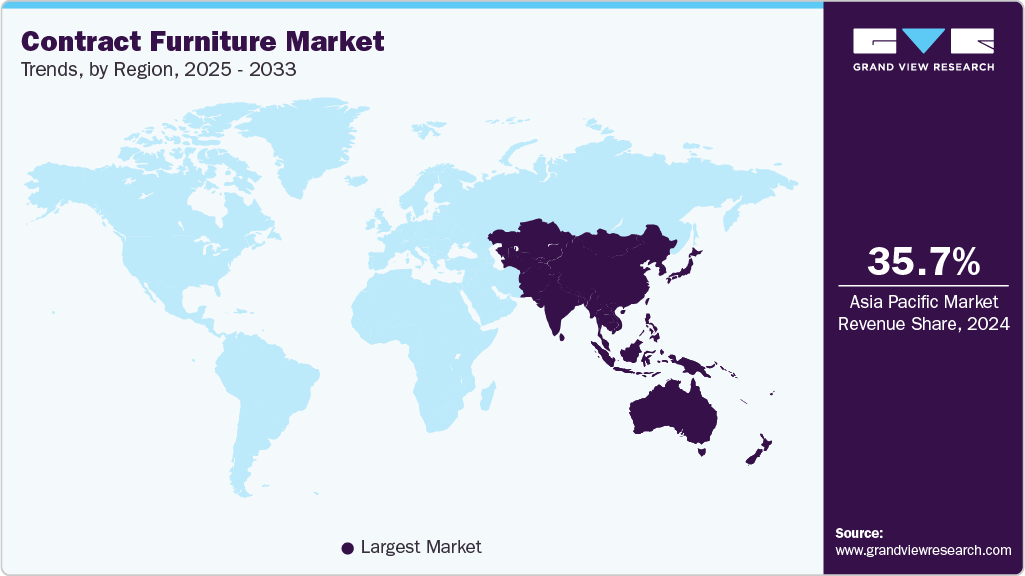
Asia Pacific dominated the contract furniture market with the largest revenue share of 36.0% in 2025. The contract furniture market in China held the largest share in the Asia Pacific region in 2025. The Asia Pacific market for contract furniture is experiencing growth due to factors such as rapid urbanization, increasing commercial construction activities, and rising demand for high-quality furnishings in commercial spaces. Several companies are poised to capitalize on these opportunities. For instance, Warisan (Indonesia) is a globally recognized leader in high-end custom design furniture manufacturing for full-scope contract boutique hotel projects as well as home refurbishments. Its products are mainly represented in 5-star hotels and resorts globally.
 To learn more about this report, Download Free Sample Report
Warisan sources raw materials such as hardwood and plywood from Indonesian plantations. The materials are FSC-certified. The company has also obtained the Sistem Verifikasi Legalitas Kayu (SVLK) certification, ensuring every stage of harvesting, transportation, processing, and sale of timber products originates from forests and plantations managed sustainably. This highlights a growing preference for eco-friendly contract furniture in the region.
Central & South America Contract Furniture Market Trends
The Central & South America contract furniture industry is expected to grow at a CAGR of 5.4% from 2026 to 2033. In Central & South America, there is an emerging trend where consumers are increasingly prioritizing renovations, resulting in higher spending on furniture. Unlike the traditional view of furniture and interiors as long-term investments, there is now a prevalent inclination to replace these items every few years. This shifting consumer behavior is anticipated to drive the growth of the market in the region.
Middle East & Africa Contract Furniture Market Trends
The contract furniture industry in the Middle East and Africa is expected to grow at a CAGR of 5.9% from 2026 to 2033. Key trends in the Middle East & Africa market include a growing demand for sustainable and eco-friendly products and an increasing focus on innovative and customizable designs to cater to diverse customer preferences.
Developments in Dubai's commercial real estate sector are driving the growth of the contract furniture industry. As new commercial buildings are constructed to meet the booming demand for office spaces in sought-after areas like Dubai Hills, there is an increasing need for high-quality and innovative furniture solutions to furnish these spaces.
Key Contract Furniture Company Insights
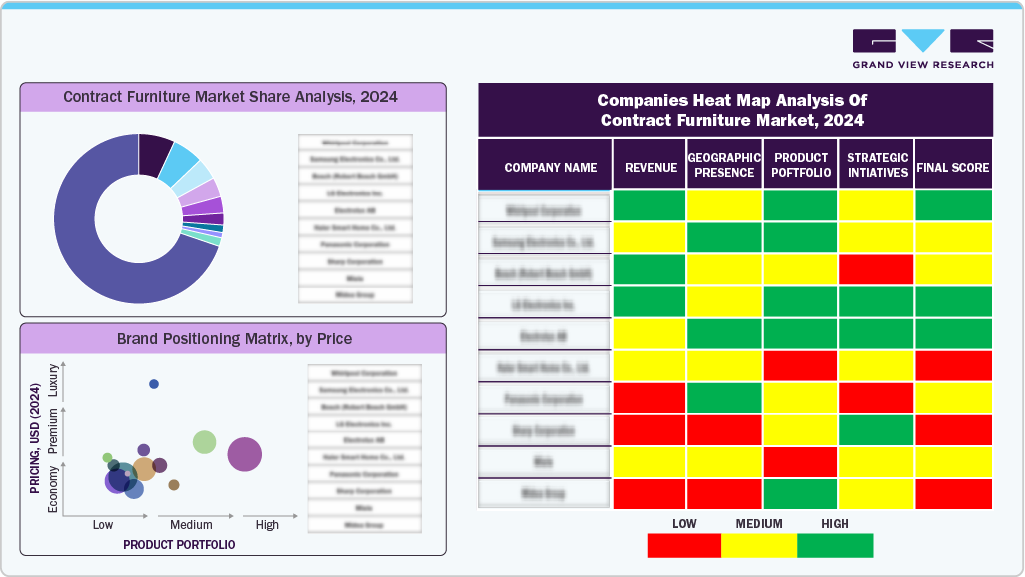
Leading players in the contract furniture industry include MillerKnoll, Inc., Steelcase Inc., Haworth Inc., HNI Corporation, KI, Teknion, and others.
 To learn more about this report, Download Free Sample Report
The market for contract furniture is highly competitive, with companies striving to strengthen their presence across both online and offline distribution channels. Leading brands are investing heavily in design innovation, modular functionality, and material advancements to cater to the evolving needs of commercial, hospitality, and institutional spaces. The growing emphasis on ergonomics, sustainability, and flexible workspace solutions is driving faster adoption, particularly in corporate and co-working environments. In addition, the rising demand for eco-friendly, durable, and customizable furniture, driven by environmental regulations and green-building standards, is shaping long-term growth opportunities for the sector.
Key Contract Furniture Companies:
The following key companies have been profiled for this study on the contract furniture market.
-
MillerKnoll, Inc.
-
Steelcase Inc.
-
Haworth Inc.
-
HNI Corporation
-
KI
-
Teknion
-
Global Furniture Group
-
Kinnarps Group
-
Sedus Stoll AG
-
Martela
Competitive Benchmarking
Category
Operating Strategies
Competitive Edge
Weakness
Established Players (MillerKnoll, Steelcase, Haworth, HNI Corporation, KI)
- Expand global distribution networks and strategic partnerships with architects, designers, real estate developers, and corporate clients. Invest in sustainable materials, ergonomic product innovation, smart furniture technologies, and workplace research. Strengthen project-based solutions and integrated furnishing services for offices, healthcare, education, and hospitality sectors.
- Strong brand recognition and long-standing relationships with enterprise customers. Large-scale manufacturing capabilities, extensive product portfolios, and global supply chains. Ability to deliver customized, large-volume projects while meeting sustainability and compliance standards.
- Higher operational and manufacturing costs due to global operations and premium product positioning. Longer product development cycles and reduced flexibility in addressing niche customer requirements. Exposure to fluctuations in commercial construction and corporate spending.
Emerging Players (Martela, Kinnarps Group, Teknion
- Focus on niche opportunities such as sustainable furniture, flexible workspace solutions, hospitality interiors, and hybrid workplace concepts. Leverage design innovation, customization capabilities, and environmentally responsible materials to differentiate offerings. Expand through regional market penetration, digital sales channels, and collaborations with design firms.
- Faster innovation cycles and greater agility in responding to changing workplace and design trends. Strong focus on sustainability, customization, and customer-specific solutions. Ability to target underserved market segments and emerging commercial spaces.
- More limited financial resources and lower economies of scale compared with global market leaders. Smaller distribution networks and lower brand visibility in international markets. Challenges in competing for large multinational furnishing contracts and complex infrastructure projects.
Recent Developments
-
In August 2025, One Bangkok teamed up with premium furniture retailer CHANINTR Living to launch Twenty & Above, the country’s first full office-furniture rental service. The service offers businesses a subscription-type model (starting at approximately USD 8 per square meter) that covers premium brands (such as Herman Miller and Knoll), as well as installation, maintenance, and replacement. It also emphasizes sustainability by refurbishing and re-deploying furniture.
-
In July 2025, Portica launched a new standalone label aimed specifically at the hospitality contract furniture industry, differentiating it from its previous SunVilla line. The new label features commercial-grade outdoor furniture, including sofas, lounge chairs, dining tables, chaise lounges, and fire tables, designed for both durability and aesthetic appeal in luxury residential and hospitality settings.
-
In October 2024, Visplay launched Omnio Office, a modular office-furniture system designed to support flexible, “agile” work environments by combining static units with mobile modules to enable rapid reconfiguration of workspace layouts. The system includes integrated power and data routing (including USB-C slots and optional 24 V electrification), acoustic panels made of recycled plastic, and plant-box modules, reflecting a focus on sustainability, adaptability, and long-term durability.
Contract Furniture Market Report Scope
Report Attribute
Details
Market size in 2025
USD 78.2 billion
Estimated market size in 2026
USD 82.2 billion
Projected market size by 2033
USD 119.7 billion
Growth rate
CAGR of 5.5% from 2026 to 2033
Base year for estimation
2025
Historical data
2021 - 2024
Forecast period
2026 - 2033
Quantitative units
Revenue in USD million/billion and CAGR from 2026 to 2033
Report coverage
Revenue forecast, company ranking, competitive landscape, growth factors, and trends
Segments covered
Product, end user, distribution channel, region
Regional scope
North America; Europe; Asia Pacific; Latin America; MEA
Country scope
U.S.; Canada; Mexico; Germany; UK; France; Italy; Spain; China; Japan; India; South Korea; Australia & New Zealand; Brazil; South Africa
Key companies profiled
MillerKnoll, Inc.; Steelcase Inc.; Haworth Inc.; HNI Corporation; KI; Teknion; Global Furniture Group; Kinnarps Group; Sedus Stoll AG; Martela
Customization scope
Free report customization (equivalent up to 8 analysts' working days) with purchase. Addition or alteration to country, regional & segment scope.
Pricing and purchase options
Avail customized purchase options to meet your exact research needs. Explore purchase options
Global Contract Furniture Market Report Segmentation
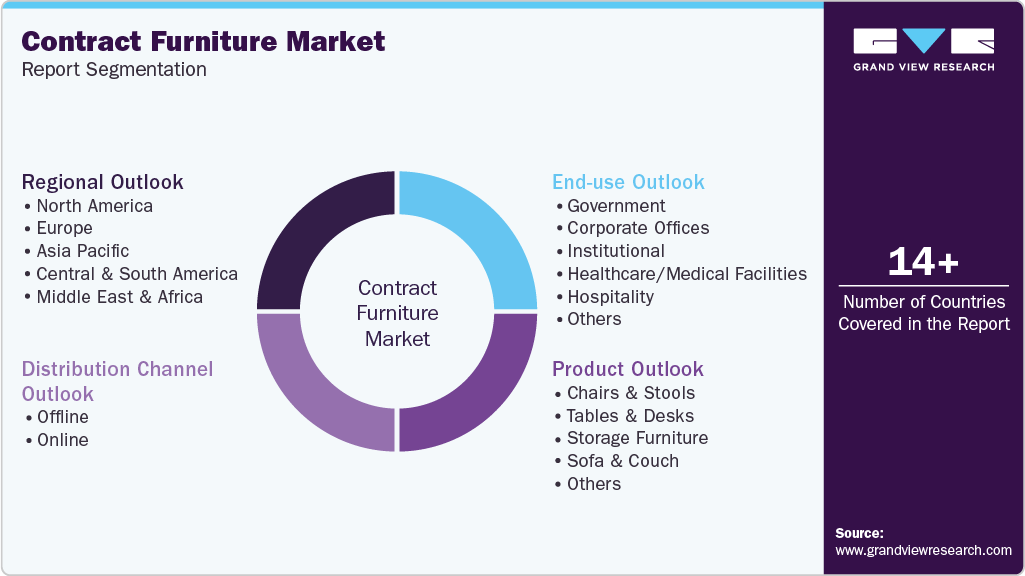
This report forecasts revenue growth at the global, regional, and country levels and provides an analysis of the latest trends and opportunities in each sub-segment from 2021 to 2033. For this study, Grand View Research has segmented the global contract furniture market report by product, end-use, distribution channel, and region:
 To learn more about this report, Download Free Sample Report
-
Product Outlook (Revenue, USD Million, 2021 - 2033)
-
Chairs & Stools
-
Tables & Desks
-
Storage Furniture
-
Sofa & Couch
-
Others
-
-
End-use Outlook (Revenue, USD Million, 2021 - 2033)
-
Government
-
Corporate Offices
-
Institutional
-
Healthcare/Medical Facilities
-
Hospitality
-
Others
-
-
Distribution Channel Outlook (Revenue, USD Million, 2021 - 2033)
-
Offline
-
Online
-
-
Regional Outlook (Revenue, USD Million, 2021 - 2033)
-
North America
-
U.S.
-
Canada
-
Mexico
-
-
Europe
-
Germany
-
UK
-
France
-
Italy
-
Spain
-
-
Asia Pacific
-
China
-
Japan
-
India
-
Australia & New Zealand
-
South Korea
-
-
Central & South America
-
Brazil
-
-
Middle East and Africa (MEA)
-
South Africa
-
-
Research Methodology
The contract furniture market figures in this report are based on a proven research process that combines executive interviews with secondary research from proprietary databases, company filings, and recognized regulatory and institutional sources. Market size is built through value-chain sizing - reconciling supply-side and demand-side estimates - and triangulated with bottom-up and top-down approaches. Every estimate passes multiple levels of expert validation before publication, with each contract furniture segment quantified using the revenue-capture definitions in the table below.
Segment Definition
Segment - Type
Revenue capture definition
Chairs & Stools
This segment covers the revenues generated through the sales of contract furniture market products such as chairs, stools, task seating, executive chairs, conference chairs, visitor chairs, lounge chairs, and ergonomic seating solutions designed for commercial, institutional, and hospitality environments. These products are widely used in offices, healthcare facilities, educational institutions, hotels, restaurants, and public spaces to improve comfort, productivity, and user experience.
Tables & Desks
This segment covers the revenues generated through the sales of contract furniture market products such as office desks, workstations, conference tables, collaborative tables, height-adjustable desks, training tables, and reception desks. These furniture solutions are designed to support workplace efficiency, collaboration, and flexible space utilization across corporate offices, educational facilities, healthcare institutions, and hospitality settings.
Storage Furniture
This segment covers the revenues generated through the sales of contract furniture market products such as filing cabinets, mobile pedestals, lockers, shelving units, credenzas, bookcases, storage walls, and workspace organization systems. These products help organizations optimize storage capacity, improve workplace organization, and maintain efficient operations across commercial and institutional environments.
Sofa & Couch
This segment covers the revenues generated through the sales of contract furniture market products such as sofas, couches, lounge seating, sectional seating, modular soft seating, reception seating, and hospitality lounge furniture. These products are commonly utilized in hotel lobbies, corporate reception areas, collaborative office spaces, healthcare waiting rooms, and educational common areas to enhance comfort and aesthetics.
Others
This segment covers the revenues generated through the sales of contract furniture market products such as partitions, cubicles, office pods, reception furniture, outdoor commercial furniture, hospitality furnishings, classroom furniture, healthcare furniture, and specialty commercial furniture solutions. These products address specific functional, privacy, collaboration, and design requirements across diverse commercial and institutional applications.
Estimation Model
Title
Key Question
Description
Commercial Infrastructure Layer
Which facilities require contract furniture?
Identify the annual additions of commercial spaces, including corporate offices, co-working facilities, hotels, healthcare facilities, educational institutions, government buildings, and public infrastructure projects, to determine the total addressable furnishing base.
Furniture Procurement Layer
Which facilities actively invest in contract furniture?
Apply facility development, renovation, refurbishment, and expansion rates to the commercial infrastructure base. Filter for organizations undertaking workplace modernization, hospitality upgrades, healthcare expansion, or educational facility investments to derive the procurement-ready market.
Specification & Adoption Layer
Which projects purchase premium contract furniture solutions?
Apply adoption rates for ergonomic seating, modular workstations, collaborative furniture systems, sustainable furnishings, customized interiors, and smart furniture technologies to convert procurement opportunities into active contract furniture demand.
Revenue Realization Layer
How much revenue is generated?
Multiply active furnishing projects by average furniture spending per project, facility size, and furnishing intensity. Incorporate revenues from installation, customization, project management, maintenance services, and replacement cycles to estimate total contract furniture market revenue.
Delivered Customizations
This report has been delivered with the following In-depth customizations
Client Request
Customization Delivered
Value Adds
Workplace Transformation & Hybrid Office Trends
Conducted a focused analysis of contract furniture demand across corporate offices, co-working spaces, and hybrid workplaces, covering ergonomic seating, height-adjustable desks, collaborative workstations, modular furniture systems, smart office furniture, and employee wellness-focused workspace design trends.
Helps stakeholders identify high-growth workplace furniture categories, evaluate evolving office design preferences, and assess commercialization opportunities in ergonomic and technology-enabled furniture solutions.
Hospitality, Healthcare & Institutional Furniture Demand Trends
Evaluated procurement trends across hotels, restaurants, healthcare facilities, educational institutions, and public infrastructure projects, including customized furniture solutions, durable commercial-grade products, patient-centric healthcare furniture, and flexible learning environment furnishings.
Provides insights into emerging end-use opportunities, sector-specific furniture requirements, and attractive expansion areas to support product development and market positioning strategies.
Sustainable Furniture & Smart Workspace Opportunity Assessment
Assessed demand for sustainable contract furniture, recycled and responsibly sourced materials, circular economy initiatives, occupancy monitoring solutions, and green building-compliant furnishing systems.
Supports investment and growth strategies by identifying sustainability-driven procurement trends, evaluating technology adoption readiness, and uncovering long-term opportunities in smart and environmentally responsible commercial interiors.
Frequently Asked Questions About This Report
The global contract furniture market is expected to grow at a CAGR of 5.5% from 2026 to 2033, reaching USD 119.8 billion by 2033.
Key factors that are driving the contract furniture market growth include the increasing demand for commercial furniture, the increasing housing & commercial construction, and rising demand for premium and luxury furniture.
The global contract furniture market size was valued at USD 78.2 billion in 2024 and is estimated at USD 82.2 billion for 2026.
Some key players operating in the contract furniture market include MillerKnoll, Inc., Steelcase Inc., Haworth Inc., HNI Corporation, KI, Teknion, Global Furniture Group, Kinnarps Group, and others
Asia Pacific held the largest share in the contract furniture market, accounting for a share of 36.0% in 2025.
The corporate offices end- user segment held the largest share in the contract furniture market, accounting for a share of 41.6% in 2025.
The offline distribution channel segment held the largest share in the contract furniture market, accounting for a share of 76.7% in 2025.
In the Asia Pacific region, which country accounted for the largest contract furniture market share?In the Asia Pacific region, China accounted for the largest share in the contract furniture market, accounting for a share of 27.8% in 2025.
Chairs & Stools held the largest share in the contract furniture market, accounting for a share of 34.1% in 2025. Contract furniture manufacturers have been thoughtfully creating multipurpose and ergonomic seating options that increase comfort during long workdays, maximize space, and encourage effective employee collaboration to boost productivity.
About the Author(s)
Homecare & Decor Research Team
Consumer Goods · Homecare & DecorThis report was authored by the homecare & decor research team at Grand View Research - comprising two research analysts, one senior research analyst, and one industry expert - with specialized expertise in the homecare & decor segment of the consumer goods industry. All findings are based on proprietary consumer goods databases, executive interviews, and regulatory analysis, subject to internal peer review prior to publication.
Last Updated:
Speak to Analyst

Customize this report to your needs - add regions, segments, or data points, with 20% free customization.
Or view our licence options:


ISO 9001:2015 & 27001:2022 Certified
We are GDPR and CCPA compliant! Your transaction & personal information is safe and secure. For more details, please read our privacy policy.


