
- Home
- »
- Advanced Interior Materials
- »
-
Control Valves Market Size, Share & Growth Report, 2033GVR Report cover

Control Valves Market (2026 - 2033)
Size, Share & Trends Analysis Report By Component (Valve Body, Actuators), By Size (Less than 1", Between 1" to 6"), By Product (Linear, Rotary), By Application, By Region, And Segment Forecasts
Market Size, 2025
$7.9BMarket Estimate, 2026
$8.7BMarket Forecast, 2033
$16.3BCAGR, 2026–2033
9.4%Control Valves Market Summary
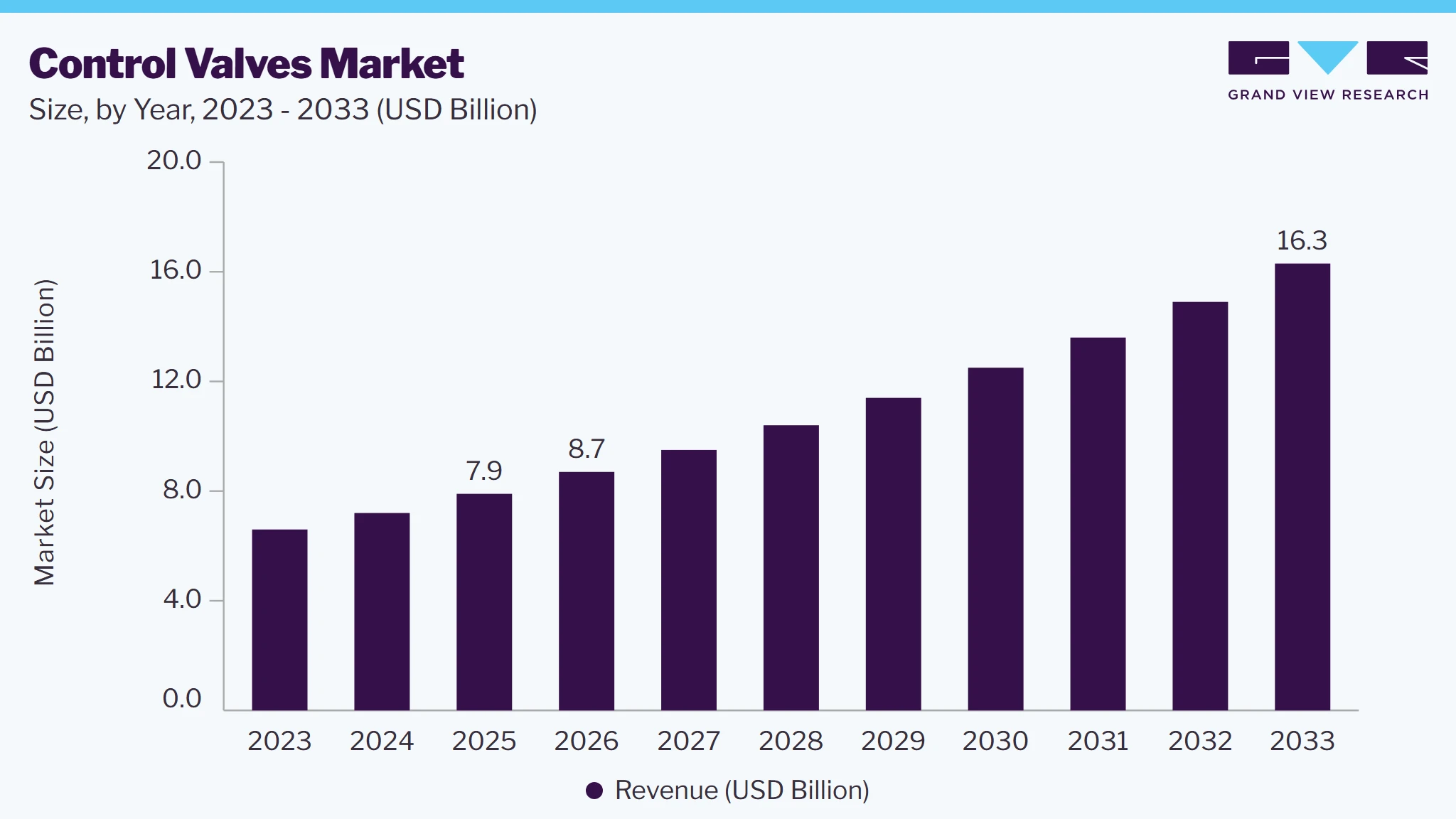
The global control valves market size was valued at USD 7.9 billion in 2025 and is projected to grow from USD 8.7 billion in 2026 to USD 16.3 billion by 2033, at a CAGR of 9.4% from 2026 to 2033. Asia Pacific dominated the market with the largest revenue share of 46.7% in the global market in 2025. The market is driven by rising demand from end-use industries such as water & wastewater treatment, oil & gas, and the energy & power industry.
Key Market Trends & Insights
- By product: The linear segment held the largest market share of approximately 63.9% in 2025.
- By application: The oil & gas segment held the largest market share of around 22.1% in 2025.
- By component: The actuator segment held the largest market share of over 44.5% in 2025.
- By size: The between 1” to 6” segment accounted for the largest revenue share in 2025.
Regional Highlights
- Largest regional market: Asia Pacific (46.7% revenue share, 2025)
- Fastest-growing regional market: North America (highest CAGR, 2026-2033)
Market Size & Forecast
- Market size in 2025: USD 7.9 Billion
- Estimated market size in 2026: USD 8.7 Billion
- Projected market size by 2033: USD 16.3 Billion
- CAGR (2026-2033): 9.4%
Three ways to get this report
Buy it, customize it, or ask a question.Ask an Analyst
Analyst response in 1 business day
- AccessReport author, directly
- Reply timeWithin 1 working day
- No sales callDirect answer only
- FormatEmail reply
- CostFree, no cost
Get the Full Report
What the study covers
- FormatsPDF · Excel · Dashboard
- Timeline2026–2033 annual, 2025 base
- Coverage20+ countries, 5 regions
- Companies10+ key players profiled
Customize the Report
20% free customization
- IncludeCountries, segments, points
- TailorTo your product definition
- ExtendDeeper competitor detail
- OrA fully bespoke study
- Turnaround5–10 working days
Moreover, the increasing adoption of industrial automation is driving the use of smart control valves, which is expected to further drive market growth over the forecast period. A growing number of power generation plants across the world and the increasing need for energy and power from developing economies are driving the demand for control valves.Control valves are also used in nuclear power plants, especially in processes such as chemical treatment, feed water, cooling water, and steam turbine control systems. Moreover, high-pressure, high-temperature, and adverse corrosion conditions experienced with production and refinery platforms have also led to a rise in demand for control valves. These platforms are mainly used in offshore and onshore oil & gas activities. These valves are used in most of the essential mechanisms in the oil & gas industries. It not only controls the flow but also the volume, direction, rate, and pressure of fluids.
 Source: Grand View Research, IR Documents, Primary Interviews, Paid DatabasesTo learn more about this report,
 Download Free Sample Report
 Process industries such as food & beverages, oil & gas, water & wastewater, petrochemicals, energy & power, and pharmaceuticals also have a high demand for control valves to meet growing automation needs. They play a vital role in increasing the end-use industry’s profitability, safety, and efficiency for multiple production processes. Furthermore, the adoption of control valves in industries is constantly rising owing to the benefits they offer in temperature or pressure control throughout downstream, midstream, and upstream activities.
Market Dynamics
Strict rules concerning environmental regulation for end-use sectors in the Asia Pacific, Europe, and North America are helping drive the market considerably. Various governments and regulatory agencies within these regions are introducing regulations to lower greenhouse gas emissions, improve energy efficiency, and decrease industrial pollution. The U.S. EPA has issued a requirement to use standard spring diaphragm actuators, which control the operation of wellhead valves and provide an impetus to use electric actuators and pneumatic ones, which decrease emissions of methane and volatile organic compounds (VOCs).
Regulations associated with fugitive emissions, process safety, and environmental compliance are encouraging different industries, such as oil & gas, chemical and allied industries, power generation, and water & wastewater treatment, to upgrade their flow control infrastructure. These strict regulations are prompting end users to invest in modern control valves with smart monitoring, best-in-class sealing, and automated control mechanisms to comply with the regulations and support sustainability efforts. Increasing environmental regulations and concerns will continue to fuel the demand for control valves.
The high installation and integration costs are the primary restrain in the control valves market, particularly to the companies that need high and specialized flow control solutions. New technologies, including smart control valves with IoT-enabled sensors, digital controllers, and automatic actuators, involve significant initial investment. Also, the oil & gas, power generation, and chemical industries demand valves, which are to be made of special material to withstand high temperatures and high pressure along with highly corrosive fluids, and this further increases the procurement and installation cost.
The process of installation requires skillful technicians and engineers who are used to integrating control valves into the existing pipeline system, reactor, and process streams. Calibration and configuration also take a significant labor force since accuracy in flow control and compatibility with automation and distributed control systems (D.C.S) is mandatory. Calibration errors lead to premature wearing of parts, and also maintenance and inspection are required.
Strict safety regulations and certification play a crucial role in the approval process. Industrial compliance tests and inspections are also carried out before commissioning. All these steps increase labor, engineering, and compliance costs, which put an additional burden of high expenses on the end-user and sometimes limit the growth of the market, especially for SMEs.
The modernization of traditional industrial facilities is one of the key growth opportunities for the control valves industry. Traditional sectors like oil & gas, power generation, chemical industry, water & wastewater treatment, and manufacturing are replacing their existing control valves with the latest automation technology for increased operational efficiency, reliability, and control of process. The demand for digitalized & automated control valves is expected to surge over time as more manufacturers shift to automation.
Analyst Perspective
The global control valve market is transitioning toward a process optimization and asset performance market, where long-term value will increasingly be tied to reliability and lifecycle services rather than hardware sales alone. Though the near-term demand scenario appears relatively stable, with replacement cycles and plant expansions in petrochemicals and LNG market, stricter emissions regulations, industrial decarbonization initiatives, and the expansion of industries such as hydrogen, carbon capture, and advanced chemicals are raising the importance of precision flow control and operational uptime.
Market players with substantial existing infrastructure, engineering expertise, certification capabilities, and strong aftermarket networks will have the competitive advantage, as replacement decisions are often influenced by performance history and operational risk considerations. Overall, manufacturers offering performance guarantee and having the ability to integrate seamlessly into plant-level control architectures will hold the pricing power and retention that pure hardware suppliers cannot match.
Size Insights
The between 1" to 6" segment accounted for the largest market revenue share in 2025, owing to the extensive application scope of this category of valves in the chemical, pharmaceutical, and food & beverage industries.
The less than 1"segment is expected to record at a notable CAGR over the forecast period. Factors such as technological advancements such as miniaturization and smart valve technology, industry regulations focusing on energy efficiency, safety, and environmental compliance, as well as market trends like industrial automation, process optimization, and the expansion of end-use industries is anticipated to drive the market.
Application Insights
The oil & gas segment led the market with the largest revenue share of 22.1% in 2025 and is expected to grow at a fastest CAGR during the forecast period. The wide application scope of control valves in natural gas generation, crude oil extraction, and refining processes primarily contributes to their high demand in these areas. Moreover, owing to the increasing stringency of safety standards, previously installed valves that may need attention are replaced on a yearly basis.
The water & wastewater treatment segment is anticipated to record at a significant CAGR during the forecast period. The water & wastewater industry encompasses various crucial processes, including the provision of water for industrial purposes and the treatment of wastewater generated by different sectors. Worldwide, there are over 90,000 municipal wastewater plants, where control valves play an indispensable role as vital components.
Component Insights
The actuator segment led the market with the largest revenue share of 44.5% in 2025. This is the most important component in control valve architecture, as it makes valve operation automatic. The segment's significant market share is largely a result of the rising adoption of smart factories and Industrial IoT, sectors where automated, highly accurate process control is a critical requirement. Moreover, tightening global mandates targeting emissions and industrial safety are forcing plants to adopt advanced actuators with embedded leak-detection diagnostics and emergency shutdown capabilities, further driving segment growth.
The valve body segment is expected to grow at a significant CAGR during the forecast period. Stringent environmental regulations and increasing industrial automation in emerging economies are poised to drive the growth of the segment over the forecast period. The primary factors influencing the valve body market is the overall demand for valves in various industries. The demand for valve bodies is directly linked to the demand for valves themselves, as valve bodies are an essential component of valves. Industries such as oil and gas, water and wastewater treatment, power generation, chemical processing, and pharmaceuticals heavily rely on valves for controlling fluid flow. The growth or decline in these industries directly impacts the demand for valve bodies.
Product Insights
The linear segment led the market with the largest revenue share of approximately 63.9% in 2025. Linear control valves have been further divided into gate, diaphragm, and others; whereas rotary types have been further segmented into ball, butterfly, and plug. The market is dominated by linear control valves, owing to their surging demand from end-use industries such as oil & gas, chemicals and energy & power in developing economies.
The rotary segment is expected to grow at the fastest CAGR over the forecast period. The market for control valves is witnessing an increase in the use of rotary valves since they can handle corrosive and filthy materials, have higher ratios of compression and rpm, and can aid in reducing emissions. In addition, rotary valves are mostly used in the food, pharmaceutical, water, and wastewater industries for handling powder, granules, and solid materials.
Regional Insights
Asia Pacific Control Valves Market Trends
Asia Pacific dominated the global control valves market with the largest revenue share of 46.7% in 2025 and is expected to record at a notable CAGR during the forecast period, owing to the presence of emerging economies such as China and India. Companies are investing heavily in valve and actuator manufacturing, along with technologies that need to be associated to convert them into smart valves. This is due to the rising demand for automated valve operations in industries such as water & wastewater, food & beverage, energy & power, and pharmaceutical.
North America is anticipated to grow at a significant CAGR during the forecast period. The market is fueled by technological advancements and the escalating demand for energy efficiency and sustainable practices. In addition, the widespread adoption of industrial automation across various sectors has contributed significantly to the control valve market's expansion. Automated systems are increasingly being employed by industries to enhance productivity, reduce operational costs, and improve process control. In this context, control valves play a pivotal role in regulating fluid flow, pressure, temperature, and level in these automated systems. As the trend of process automation continues to grow, the demand for control valves is expected to witness substantial growth in North America.
 To learn more about this report, Download Free Sample Report
 Key Control Valves Company Insights
The global market for control valves is dominated by a large number of small- and medium-scale manufacturers offering control valve products tailored to the requirements of end-use industries. To retain share in such a competitive market, companies continually undertake strategic initiatives such as mergers and acquisitions, joint ventures, product launches, and partnerships. This is aimed at expanding their presence globally and regionally, as well as offering an enhanced product portfolio to their customer base.
Key Control Valves Companies
The following key companies have been profiled for this study on the control valves market.
-
Emerson Electric Co.
-
Flowserve Corporation
-
IMI plc
-
Alfa Laval AB
-
AVK Holding A/S
-
Eaton
-
Honeywell International, Inc.
-
Velan Inc.
-
Burkert Fluid Control System
-
Valvitalia SpA
Recent Developments
-
In February 2026, Flowserve announced that it had completed the acquisition of the Valves Division of Trillium Flow Technologies for nearly USD 490 Billion. This acquisition further complements Flowserve's offerings of mission-critical valves and actuation solutions and enhances its capabilities in power generation, nuclear, industrial, and critical infrastructure markets.
-
In November 2025, the SAMSON Type 251GR control valve was presented with the PRIMUS Award 2025 in the industrial valves category for product innovation. The valve has increased capacity, is modular, reduces maintenance effort, and uses fewer materials, thereby improving operational efficiency and meeting sustainability goals.
-
In March 2025, Emerson acquired the remaining shares of AspenTech, thus creating a wholly owned subsidiary. The move helps further embed Emerson's industrial software, digital transformation, and automation business and enables increased integration among its control systems, intelligent devices, and plant optimization software.
-
In February 2025, Rotork added multi-port selector valve control to the IQ3 Pro actuators platform in Feb 2025, offering enhanced accuracy, dependability, and connectivity for oil & gas, chemical processing, water and wastewater treatment, and pharmaceutical industries.
Control Valves Market Report Scope
Report Attribute
Details
Market size in 2025
USD 7.9 billion
Estimated market size in 2026
USD 8.7 billion
Projected market size by 2033
USD 16.3 billion
Growth rate
CAGR of 9.4% from 2026 to 2033
Base year for estimation
2025
Historical data
2021 - 2024
Forecast period
2026 - 2033
Quantitative units
Revenue in USD million/billion, and CAGR from 2026 to 2033
Report coverage
Revenue forecast, company ranking, competitive landscape, growth factors, and trends
Segments covered
Component, size, product, application, region
Regional Scope
North America; Europe; Asia Pacific; Central & South America; MEA
Country Scope
U.S.; Canada; Mexico; Germany; France; Italy; UK; Spain; Russia; China; India; Japan; South Korea; Singapore; Australia; Brazil; Argentina; Saudi Arabia; UAE; South Africa
Key Companies Profiled
Emerson Electric Co.; Flowserve Corporation; IMI ; Alfa Laval AB; AVK Holding A/S; Eaton; Honeywell International, Inc.; Velan Inc.; Burkert Fluid Control System; Valvitalia SpA
Customization scope
Free report customization (equivalent to up to 8 analysts’ working days) with purchase. Addition or alteration to country, regional & segment scope
Pricing and purchase options
Avail customized purchase options to meet your exact research needs. Explore purchase options
Global Control Valves Market Report Segmentation
This report forecasts revenue growth at global, regional, and country levels and provides an analysis of the latest industry trends in each of the sub-segments from 2021 to 2033. For this study, Grand View Research has segmented the global control valves market report based on component, size, product, application, and region:
-
Component Outlook (Revenue, USD Billion, 2021 - 2033)
-
Valve Body
-
Actuators
-
Others
-
-
Size Outlook (Revenue in USD Billion, 2021 - 2033)
-
Less than 1"
-
Between 1" to 6"
-
Between 6" to 25"
-
Between 25" to 50"
-
More than 50"
-
-
Product Outlook (Revenue in USD Billion, 2021 - 2033)
-
Linear
-
Gate
-
Diaphragm
-
Others
-
-
Rotary
-
Ball
-
Butterfly
-
Plug
-
-
-
Application Outlook (Revenue in USD Billion, 2021 - 2033)
-
Oil & Gas
-
Chemicals
-
Energy & Power
-
Water & Wastewater Treatment
-
Food & Beverages
-
Pharmaceuticals
-
Others
-
-
Regional Outlook (Revenue in USD Billion, 2021 - 2033)
-
North America
-
U.S.
-
Canada
-
Mexico
-
-
Europe
-
Germany
-
France
-
Italy
-
UK
-
Spain
-
Russia
-
-
Asia Pacific
-
China
-
India
-
Japan
-
South Korea
-
Singapore
-
Australia
-
-
Central & South America
-
Brazil
-
Argentina
-
-
Middle East & Africa
-
Saudi Arabia
-
UAE
-
South Africa
-
-
Frequently Asked Questions About This Report
Some of the key players operating in the control valves market include Emerson Electric Co.; Flowserve Corporation; IMI plc; Alfa Laval AB; AVK Holding A/S; Eaton; Honeywell International, Inc.; Velan; Inc., Burkert Fluid Control System; and Valvitalia SpA.
The global control valves market is expected to grow at a CAGR of 9.4% from 2026 to 2036, reaching USD 16.3 billion by 2033.
Asia Pacific dominated with a revenue share of 46.7% in 2025.
The key factors that are driving the control valves market include growing transportation sector and rapid industrialization in developing countries
The global control valves market size was valued at USD 7.9 billion in 2025 and is projected to grow from USD 8.7 billion in 2026
About the Author(s)
Advanced Interior Materials Research Team
Advanced Materials · Advanced Interior MaterialsThis report was authored by the advanced interior materials research team at Grand View Research - comprising two research analysts, one senior research analyst, and one industry expert - with specialized expertise in the advanced interior materials segment of the advanced materials industry. All findings are based on proprietary advanced materials databases, executive interviews, and regulatory analysis, subject to internal peer review prior to publication.
Last Updated:
Speak to Analyst

Customize this report to your needs - add regions, segments, or data points, with 20% free customization.
Or view our licence options:


ISO 9001:2015 & 27001:2022 Certified
We are GDPR and CCPA compliant! Your transaction & personal information is safe and secure. For more details, please read our privacy policy.


