
- Home
- »
- IT Services & Applications
- »
-
Convergent Charging Software Market Size Report, 2033GVR Report cover

Convergent Charging Software Market (2026 - 2033)
Size, Share & Trends Analysis Report By Component (Software, Services), By Deployment Mode (On-Premises, Cloud-Based, Hybrid), By Charging Type, By Organization Size, By End Use, By Region, and Segment Forecasts
Market Size, 2025
$4.3BMarket Estimate, 2026
$4.6BMarket Forecast, 2033
$8.3BCAGR, 2026–2033
8.8%Convergent Charging Software Market Summary
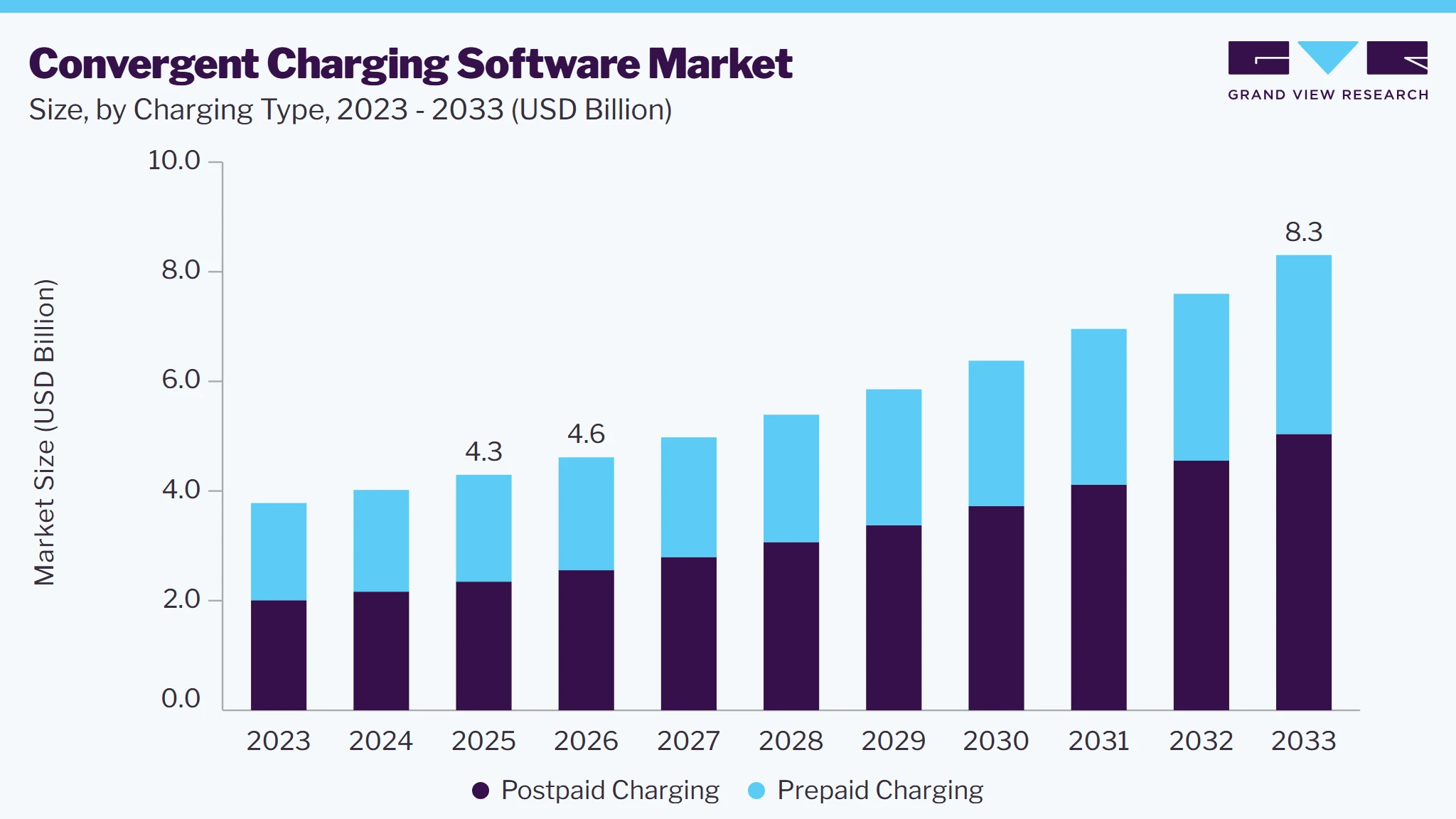
The global convergent charging software market size was valued at USD 4.3 billion in 2025 and is projected to grow from USD 4.6 billion in 2026 to USD 8.3 billion by 2033, at a CAGR of 8.8% from 2026 to 2033. The market in North America dominated with a revenue share of 34.0% in 2025. The global market is evolving as telecommunications operators modernize legacy charging infrastructure to support 5G networks, digital services, and increasingly complex monetization models.
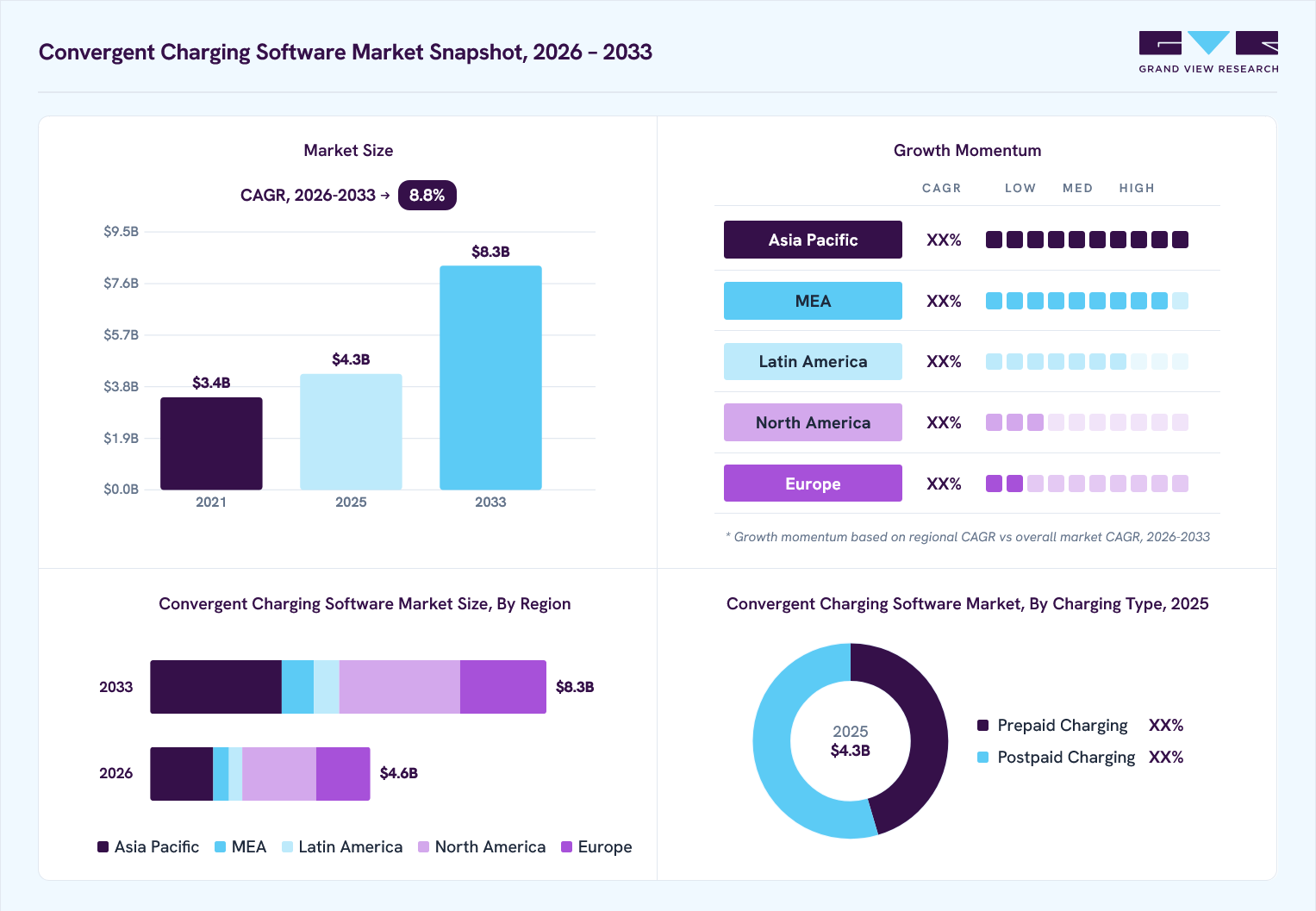 Source: Grand View Research, IR Documents, Primary Interviews, Paid DatabasesTo learn more about this report,
 Download Free Sample Report
Key Market Trends & Insights
- By component: Software segment held the largest market share of 68.3% in 2025.
- By deployment mode: On-premises segment held the largest market share in 2025.
- By charging type: Postpaid charging segment held the largest market share in 2025.
- By organization size: Large enterprises segment held the largest market share in 2025.
- By end use: Telecommunications segment held the largest market share in 2025.
Regional Highlights
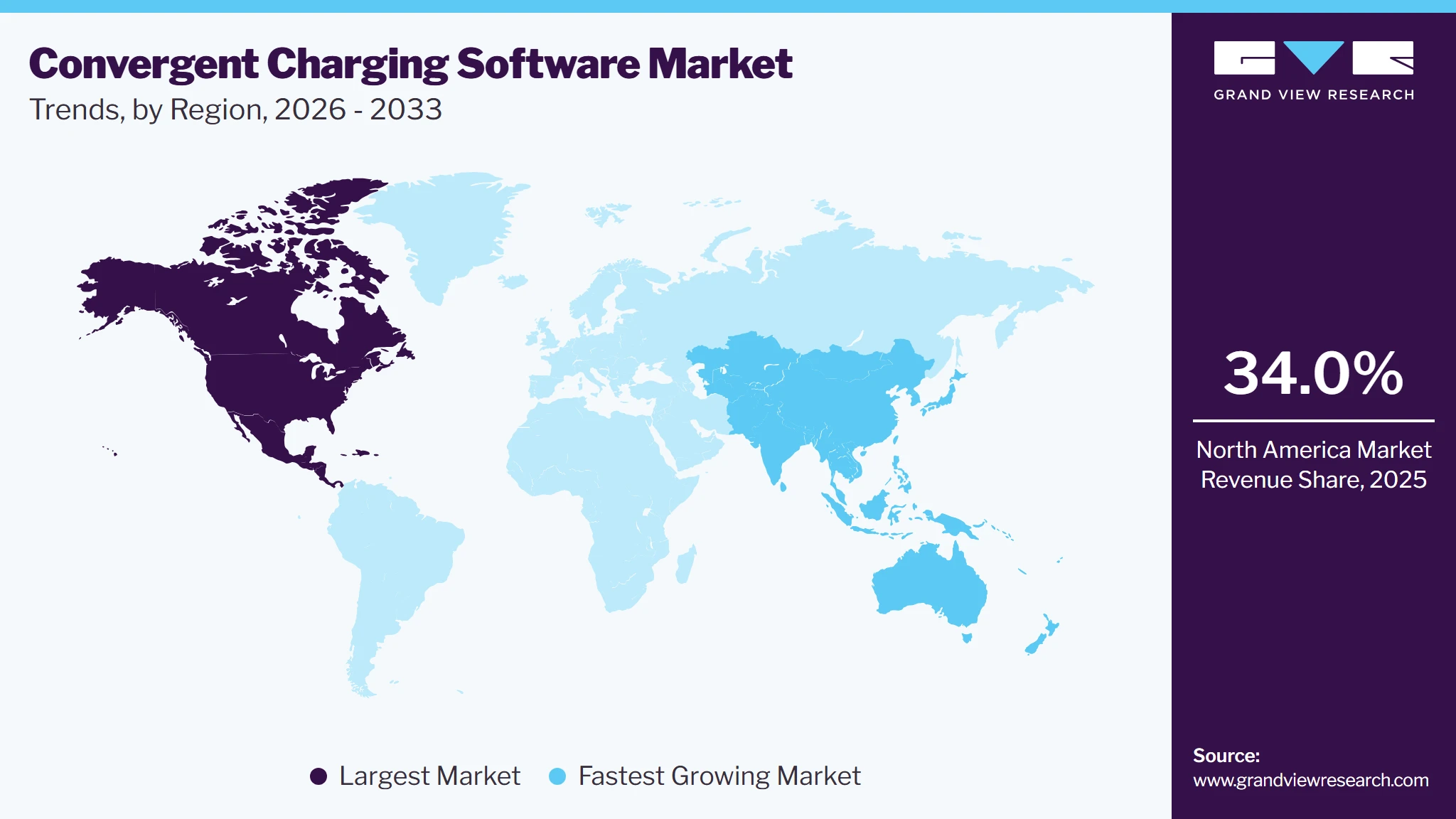
- Largest regional market: North America (34.0% revenue share, 2025)
- Fastest-growing regional market: Asia Pacific (highest CAGR, 2026-2033)
- By country: The U.S. held the largest market share in 2025
Market Size & Forecast
- Market size in 2025: USD 4.3 Billion
- Estimated market size in 2026: USD 4.6 Billion
- Projected market size by 2033: USD 8.3 Billion
- CAGR (2026-2033): 8.8%
Prism AI by Grand View Research Free to tryAsk a question about the convergent charging software marketTry asking✓Every figure cited from GVR research Prefer the report? Download free sample →The transition toward 5G standalone (SA) architecture, real-time charging, and unified online and offline charging capabilities is increasing the importance of flexible platforms that can manage prepaid, postpaid, and hybrid customer accounts. A major trend is the adoption of cloud-native architectures, microservices, and API-driven integration, which enable telecom operators to scale charging capacity, introduce new tariffs, and integrate services with fewer disruptions to existing systems. These architectures are particularly relevant as operators expand 5G connectivity, Internet of Things (IoT) services, private networks, and enterprise connectivity offerings. Charging platforms are also evolving to support more flexible monetization models, including network slicing, quality-of-service-based pricing, usage-based charging, and partner revenue sharing. For instance, in September 2026, Ericsson highlighted the role of cloud-native, API-driven charging and billing platforms in enabling flexible 5G monetization and supporting new enterprise and partner-based revenue models.
 To learn more about this report, Download Free Sample Report
Market Dynamics
The expansion of 5G networks and the increasing complexity of telecommunications services are driving demand for convergent charging software. Telecom operators are transitioning from fragmented legacy charging platforms to unified systems that support prepaid, postpaid, and hybrid payment models across multiple services. These platforms enable real-time usage monitoring, dynamic tariff application, and accurate charging across voice, data, messaging, and enterprise connectivity services. The growing adoption of 5G standalone networks, Internet of Things (IoT) connectivity, and private 5G solutions is further increasing the need for flexible charging infrastructure capable of supporting usage-based pricing and differentiated service offerings. Consequently, telecom operators are investing in convergent charging software to improve operational efficiency, accelerate service launches, and support emerging monetization models.
High implementation costs and the complexity of integrating convergent charging software with existing telecommunications infrastructure can restrain market growth. Telecom operators often rely on legacy billing, customer management, mediation, and network systems that have evolved over several years. Replacing or consolidating these systems requires substantial investment in software deployment, data migration, system integration, testing, and employee training. Furthermore, operators must maintain uninterrupted charging operations during migration to avoid billing inaccuracies, service disruptions, and revenue losses. Compatibility issues between legacy platforms and modern cloud-native architectures can further extend implementation timelines. These challenges may discourage smaller telecom operators from adopting advanced charging solutions and encourage larger operators to implement modernization projects gradually.
The growing adoption of cloud-native charging platforms presents a significant opportunity for the convergent charging software market. Microservices-based architectures, application programming interfaces (APIs), and containerized deployments enable telecom operators to scale charging capabilities, integrate new services, and introduce pricing models with greater flexibility. The expansion of 5G standalone networks, network slicing, private 5G, and Internet of Things (IoT) connectivity creates additional opportunities to monetize services based on data consumption, device connections, latency requirements, and quality of service. For instance, Nokia's converged charging solutions support flexible charging models designed to help communication service providers monetize 5G-enabled services and enterprise use cases. As telecom operators increasingly explore software-as-a-service (SaaS) delivery and automated charging management, vendors offering scalable, interoperable, and cloud-ready platforms are positioned to capture emerging demand.
Market Concentration & Characteristics
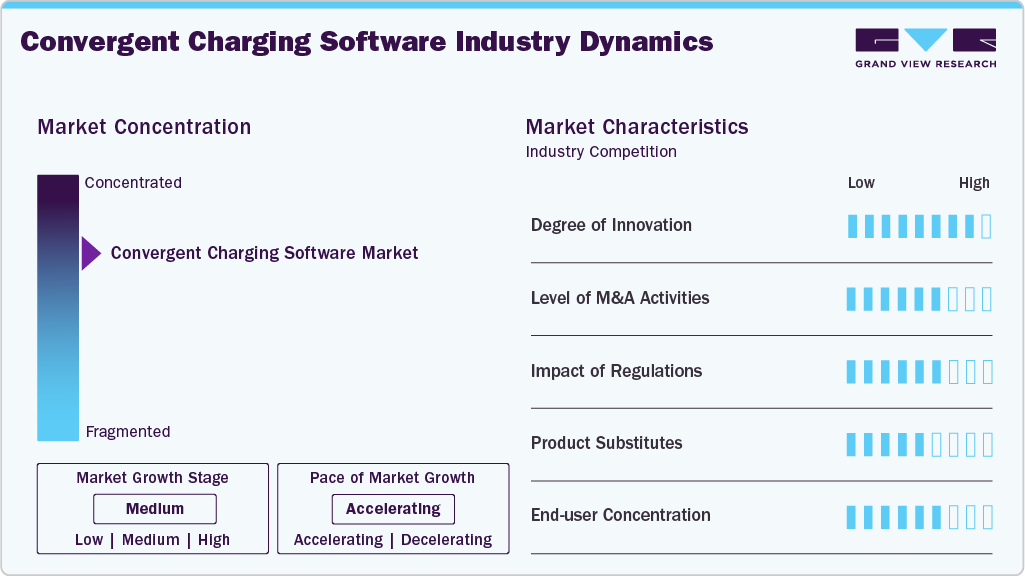
The global convergent charging software market is characterized by moderate to high market concentration, with established telecommunications technology providers and specialized software vendors competing for contracts with mobile network operators and other communication service providers. Key participants include Amdocs, Ericsson, Huawei, Nokia, Oracle, and Netcracker Technology. These companies benefit from established operator relationships, extensive product portfolios, integration expertise, and experience managing complex charging environments. However, specialized vendors such as MATRIXX Software, Optiva, and Cerillion contribute to competition by offering flexible, cloud-native, and specialized charging solutions.
 To learn more about this report, Download Free Sample Report
The market is characterized by high technological complexity, substantial integration requirements, and long-term customer relationships, which create significant entry barriers for new participants. Competition increasingly centers on cloud-native architectures, real-time charging capabilities, 5G monetization, scalability, automation, and integration with existing business support systems (BSS) and operational support systems (OSS). Vendors are also expanding their offerings through strategic partnerships, product innovation, and managed charging services to address evolving operator requirements. While established providers maintain advantages through their installed customer bases and broad portfolios, emerging and specialized vendors can compete by enabling faster deployment, flexible pricing models, and simplified integration. Consequently, product innovation, interoperability, and the ability to support emerging digital services are important factors shaping competitive positioning.
Analyst Perspective
The global convergent charging software market is expected to witness steady growth as telecom operators modernize legacy charging infrastructure and expand 5G-enabled services. The increasing adoption of cloud-native architectures, real-time charging capabilities, and flexible monetization models is expected to create new growth opportunities for market participants. AI-driven automation and integration with next-generation business support systems are likely to strengthen operational efficiency and revenue management. However, high implementation costs and complex legacy system integration may continue to hinder adoption. Vendors offering scalable, interoperable, and flexible charging solutions are expected to gain a competitive advantage.
Component Insights
Software accounted for the largest market share of 68.3% in 2025, supported by the rising shift from legacy offline rating to real-time, cloud-native charging platforms across operators globally. Demand for flexible, API-driven and AI-enabled charging software is rising as operators prepare for 5G Standalone and launch new, personalized offers faster. For instance, in March 2026, Vodafone Idea (Vi) expanded its partnership with Ericsson to deploy cloud-native Ericsson Charging for its postpaid subscribers, replacing legacy offline charging and rating with real-time charging for voice, VoLTE, SMS and data services, and adding new AI applications for anomaly detection and usage analysis. Such deployments highlight that software remains the core spend area in the market, and its dominance is expected to continue as operators modernize charging architectures.
Services are projected to witness the fastest CAGR during the forecast period, as operators move from legacy charging stacks to cloud-native platforms and need integration, migration and ongoing operations support. Operators are increasingly outsourcing charging, rating and billing operations to vendors under long-term managed services contracts, which cuts run costs and lets them focus on launching new offers. For instance, in October 2025, Subex won a USD 6.62 million contract from a leading Netherlands telecom operator to deliver a single platform for MVNO billing and wholesale partner settlement. The six-year contract covers end-to-end managed services for billing, rating and reporting, with a target of 99% SLA compliance. Such multi-year, outcome-based engagements show that recurring services revenue is growing faster than one-time software licensing, and this trend is expected to sustain the services segment’s lead in growth through 2033.
Deployment Mode Insights
On-premises accounted for the largest market share in 2025, as most tier-1 and tier-2 operators still run mission-critical real-time charging on installed, depreciated on-premises stacks that are costly and risky to replace. Data sovereignty rules, low-latency requirements and the need to keep subscriber and balance data inside national boundaries keep operators running core charging on infrastructure they control. Such deployments show that regulatory and reliability requirements keep core charging on-premises in 2025, although its share is expected to decline as operators migrate to cloud-based and hybrid models.
Cloud-based models are projected to witness the fastest CAGR during the forecast period, as operators move from legacy on-premises charging to cloud-native platforms that scale on demand, cut operating costs and support 5G Standalone. Faster launch of new offers through catalogue-driven product configuration and open APIs is also pushing operators toward cloud-native charging, along with pay-as-you-grow pricing. For instance, in March 2026, Vodafone Idea (Vi) chose to deploy cloud-native Ericsson Charging for its postpaid business, replacing legacy offline charging and rating with real-time charging for voice, VoLTE, SMS and data services. Vi expects the new system to be more flexible, scalable, and cost-efficient, with faster service launches and readiness for 5G Standalone. Such migrations show that cloud-native architectures are becoming the default for charging modernization, and this shift is expected to keep cloud-based deployment growing fastest through 2033.
Charging Type Insights
Postpaid charging accounted for the largest market share in 2025, supported by the higher revenue per subscriber of postpaid and converged plans, along with the need for real-time rating on 5G, bundled and enterprise offers. Operators are shifting postpaid from batch-based offline charging to real-time, convergent charging to give customers live balance visibility, launch personalized offers faster and prepare for 5G Standalone. For instance, in March 2026, Vodafone Idea (Vi) selected cloud-native Ericsson Charging to support and expand its postpaid subscriber segment. It will replace its legacy offline charging and rating with real-time charging for voice, VoLTE, SMS, and data services across consumer and enterprise businesses. The move shows that postpaid is where the largest charging modernization spend is being committed, and this is expected to keep postpaid in the lead through 2033.
Prepaid charging is projected to witness a significant CAGR during the forecast period, supported by the large prepaid subscriber base in emerging markets in Asia Pacific, Africa and Latin America, where real-time balance control remains essential. Regulators and operators are also modernizing the wider prepaid ecosystem as mobile usage grows. For instance, in April 2026, Costa Rica’s telecom regulator SUTEL began modernizing its Mobile Prepaid Registration System using a new platform from Tecnotree. Continued investment around prepaid services shows that this segment will keep growing steadily through 2033, although more slowly than postpaid as subscribers move to postpaid and converged plans.
Organization Size Insights
Large enterprises accounted for the largest market share in 2025, as charging spend is concentrated in tier-1 and tier-2 operators that run high-volume, real-time platforms and fund large licensing, integration and migration programs. These operators are also signing long-term, multi-year partnerships with vendors to modernize their charging and monetization stacks with AI and cloud capabilities. For instance, in February 2026, Amdocs announced that it had extended its long-term relationship with T-Mobile under a new multi-year agreement covering managed services, software development and AI innovation, and that it had also signed an expanded multi-year engagement with Vodafone Germany. Such large-scale, multi-year commitments by major operators show that large enterprises remain the primary source of charging demand, and they are expected to retain the largest share through 2033, even as SMEs grow faster.
Small and medium-sized enterprises (SMEs) are projected to witness the fastest CAGR during the forecast period, as smaller operators, MVNOs and MVNEs adopt cloud-native, subscription-based charging platforms with no upfront infrastructure and pay-as-you-grow pricing. For instance, in January 2026, an Africa-based MVNE operating 30 mobile brands with nearly one million subscribers selected Totogi’s Charging-as-a-Service to run its entire multi-brand portfolio on a single multi-tenant, cloud-native platform on AWS. The operator chose the pay-as-you-grow, price-per-transaction model to keep tighter cost control and scale flexibly. Such adoption shows that SaaS charging is lowering the entry barrier for smaller players, and SMEs are expected to grow faster than large enterprises through 2033.
End Use Insights
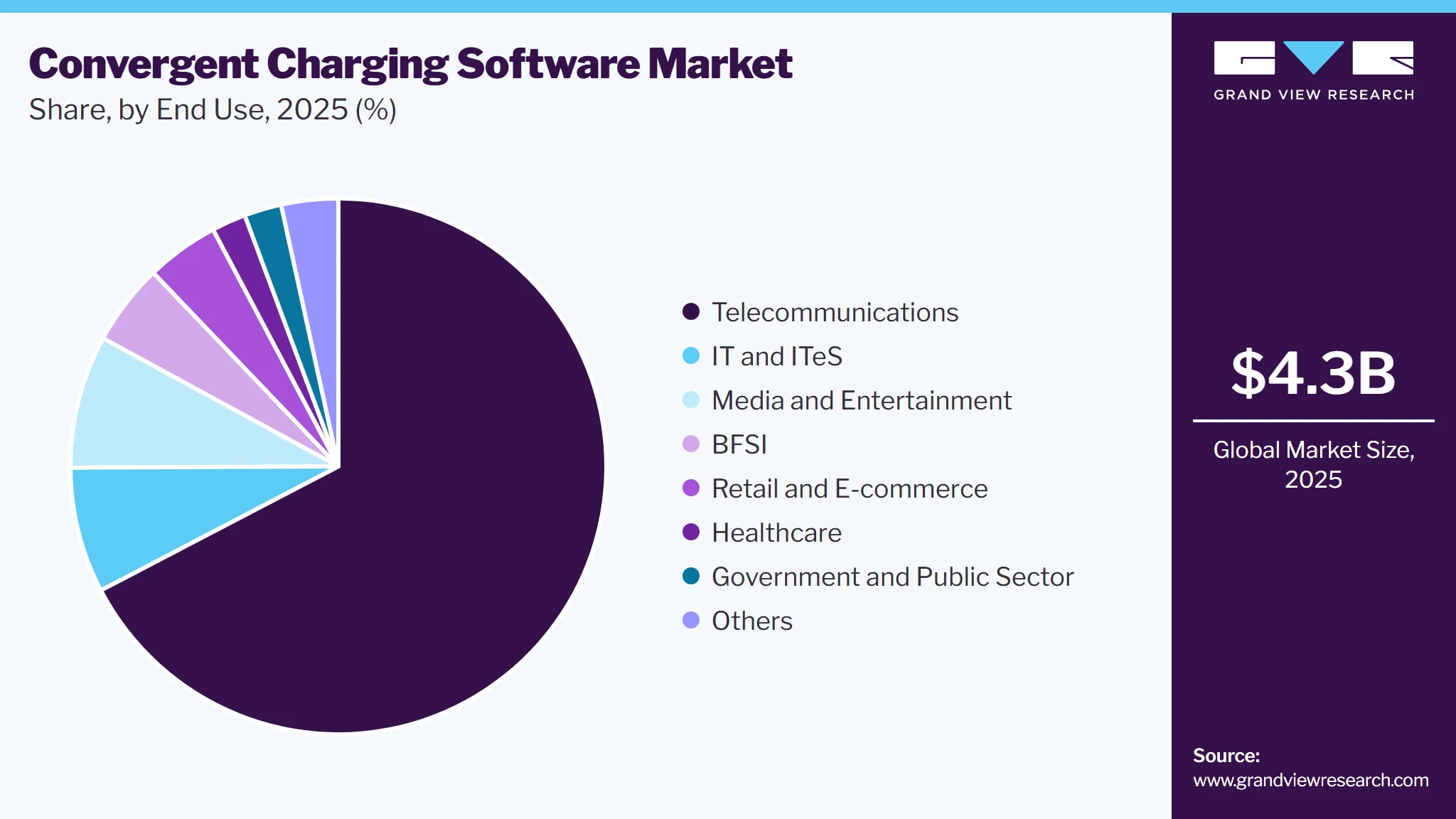
Telecommunications accounted for the largest market share in 2025, as charging systems were built for operators, who run real-time rating, balance management and policy control for every voice, data and messaging session across very large subscriber bases. Operators are also replacing older charging platforms with converged, cloud-native solutions to support 5G monetization and faster launches of new products. For instance, in January 2026, Proximus selected Nokia to modernize its online charging and voice core systems with cloud-based solutions. The agreement migrates Proximus’s entire fixed and mobile customer base, along with more than 1,000 products, to Nokia Converged Charging, replacing a competitor’s existing solution, with the aim of increasing automation and enabling new business models. Such large-scale migrations show that operators remain the core buyers of charging systems, and telecommunications is expected to retain the largest end-use share through 2033, although non-telecom sectors will grow faster from smaller bases.
 To learn more about this report, Download Free Sample Report
Healthcare is projected to witness the fastest CAGR during the forecast period, from a small base, as hospitals, device makers and digital health providers adopt connected care models such as remote patient monitoring, telehealth and connected medical devices. These models need real-time usage tracking, flexible connectivity plans and subscription or usage-based billing, which are core convergent charging capabilities. Such initiatives show that healthcare is becoming a new monetization vertical for charging platforms, and the segment is expected to grow fastest through 2033.
Regional Insights
North America dominated the convergent charging software market with the largest market share of 34.0% in 2025. The market is being shaped by operators’ rollout of 5G standalone cores, where a cloud-native 5G Charging Function (CHF) that scales to tens of millions of subscribers and integrates into multi-vendor environments is becoming a requirement for monetizing new use cases. Operators are using this to move away from siloed prepaid, postpaid, fixed and mobile charging stacks toward a single converged platform, with tier-one carriers among the early adopters of 5G-native charging. Demand is also rising for per-slice and quality-differentiated charging for enterprise offers such as network slicing, private networks and edge services, along with API-based monetization of network capabilities through partner and settlement models. Vendor consolidation is another clear trend, as seen in Amdocs completing its acquisition of Matrixx Software in December 2025 and NEC’s announced USD 2.9 billion deal for CSG, both aimed at building larger cloud-native, SaaS-delivered monetization stacks. In parallel, large carriers are signing multi-year agreements that combine managed services, software development and AI, such as Amdocs’ extended relationship with T-Mobile announced in February 2026, shifting spend toward recurring, outcome-based contracts and embedding AI into charging and customer operations.
 To learn more about this report, Download Free Sample Report
The U.S. convergent charging software market is experiencing robust growth due to the rapid rollout of 5G standalone networks and the need for real-time, cloud-native charging to monetize them. Operators are replacing legacy, siloed prepaid and postpaid charging stacks with converged platforms that support dynamic pricing, bundled and personalized plans, and faster launch of new offers. Growing enterprise demand for network slicing, private networks, edge services and IoT connectivity is also driving the need for usage- and quality-based charging. Strong cloud adoption among large carriers and the shift toward subscription-based and managed services models further support spending on modern charging platforms. In addition, the rising use of AI to automate pricing, usage analytics and revenue assurance is encouraging operators to upgrade their charging architectures. These factors, combined with the presence of leading vendors and tier-one operators, are expected to sustain steady growth through 2033.
Asia Pacific Convergent Charging Software Market Trends
Asia Pacific convergent charging software market is expected to register the fastest CAGR of 11.1% over the forecast period, shaped by the scale of its prepaid-heavy subscriber bases, where operators are replacing legacy online charging systems with cloud-native, real-time platforms that can handle very large transaction volumes. A visible shift is under way from prepaid and offline postpaid charging to real-time convergent charging, as seen in Vodafone Idea’s March 2026 move to cloud-native Ericsson Charging for postpaid and KDDI’s February 2026 selection of Oracle to replace its legacy charging and rating platform. Prepaid-to-postpaid migration in India, Southeast Asia and South Asia is increasing the need for flexible, usage-based and bundled plans. Operators in China, Japan and South Korea are preparing their charging stacks for 5G standalone monetization, including slice-based and quality-differentiated offers for enterprises.
TheChina convergent charging software marketis witnessing steady growth due to the large-scale deployment of 5G standalone networks by its state-owned operators, which requires real-time, cloud-native charging to support new service offers. Operators are upgrading legacy online charging and billing systems to converged platforms that handle massive transaction volumes across voice, data and messaging for a very large subscriber base. Growing enterprise demand for network slicing, private 5G networks, industrial IoT and edge services is also driving the need for usage- and quality-based charging models. Strong government support for digital infrastructure, cloud adoption and domestic technology further encourages operators to modernize their monetization platforms, with local vendors such as Huawei and ZTE playing a central role. In addition, the rise of bundled digital content, data-sharing plans and converged fixed-mobile packages is increasing the complexity of pricing, which pushes operators toward more flexible charging software.
TheIndia convergent charging software marketis at an emerging stage due to the rapid shift from legacy prepaid-dominated charging to real-time, convergent platforms as operators roll out 5G and prepare for standalone architectures. Very high mobile data consumption and one of the world’s largest subscriber bases are pushing operators to upgrade charging systems that can handle massive transaction volumes at low average revenue per user. Gradual prepaid-to-postpaid migration is increasing the need for flexible, usage-based and bundled plans, while growing fixed wireless access, broadband and enterprise connectivity demand is adding new charging use cases. Operators are also modernizing from offline and siloed charging to cloud-native platforms to cut costs and launch offers faster, with postpaid transformation programs at major carriers an example of this shift. Government-backed digital infrastructure initiatives and the growth of IoT and digital services are further widening the addressable base.
Europe Convergent Charging Software Trends
The Europe convergent charging software market is being shaped by operators replacing older, competitor-supplied charging platforms with converged, cloud-native solutions that cover fixed and mobile customers on one platform, as seen in Proximus’s January 2026 move to migrate its entire customer base and over 1,000 products to Nokia Converged Charging. Fixed-mobile convergence is a clear driver, since bundled broadband, TV and mobile offers need a single real-time view of customer usage and balances. Operators are also preparing for 5G standalone monetization, including tiered, quality-based and slice-based offers for enterprise customers and IoT use cases. Data residency and sovereignty requirements under EU rules keep demand for on-premises and hybrid deployments higher than in other regions, even as cloud migration accelerates. Growth in MVNOs and wholesale partnerships is increasing demand for charging and settlement platforms, with long-term managed services contracts becoming common, such as the six-year Subex contract with a Netherlands operator in October 2025. In addition, cost pressure from low-growth, saturated markets is pushing operators to outsource charging operations and use AI to automate pricing, usage analytics and revenue assurance.
Key Convergent Charging Software Company Insights
Key players operating in the Convergent Charging Software market include Alepo Technologies Inc.; Amdocs Limited; Cerillion plc; Comviva Technologies Limited; CSG Systems International, Inc.; Huawei Technologies Co., Ltd.; Mavenir Systems, Inc.; Netcracker Technology Corporation; Nokia Corporation; Optiva Inc.; Oracle Corporation; SAP SE; Tecnotree Corporation; Telefonaktiebolaget LM Ericsson; ZTE Corporation.
-
Alepo offers convergent charging and billing solutions through its Digital BSS and 5G core platforms, supporting real-time rating, online and offline charging, and balance management across voice, data, IoT, and digital services. Its cloud-native, microservices-based architecture enables telecom operators to modernize legacy systems and introduce flexible pricing and 5G monetization models.
-
Amdocs provides convergent charging and monetization solutions, including Amdocs Matrixx Charging, which supports real-time charging across mobile and fixed networks. Its cloud-native platform enables telecom operators to unify prepaid and postpaid charging, introduce flexible pricing models, and monetize 5G, IoT, and emerging digital services.
-
Cerillion offers a 3GPP-compliant Convergent Charging System that integrates online and offline charging, real-time authorization, rating, and balance management within a unified platform. Its support for 5G charging functions, network slicing, and flexible deployment enables communication service providers to simplify charging operations and develop new service monetization opportunities.
Key Convergent Charging Software Companies
The following key companies have been profiled for this study on the Convergent Charging Software market.
-
Alepo Technologies Inc.
-
Amdocs Limited
-
Cerillion plc
-
Comviva Technologies Limited
-
CSG Systems International, Inc.
-
Huawei Technologies Co., Ltd.
-
Mavenir Systems, Inc.
-
Netcracker Technology Corporation
-
Nokia Corporation
-
Optiva Inc.
-
Oracle Corporation
-
SAP SE
-
Tecnotree Corporation
-
Telefonaktiebolaget LM Ericsson
-
ZTE Corporation
Competitive Benchmarking
Operating Strategies
Competitive Edge
Weaknesses
Mature Players: Amdocs Limited, Huawei Technologies Co., Ltd., Netcracker Technology Corporation, Nokia Corporation, Oracle Corporation, Telefonaktiebolaget LM Ericsson, ZTE Corporation
- Modernizing convergent charging portfolios through cloud-native architectures, microservices, and 5G converged charging capabilities to support real-time monetization across prepaid, postpaid, and hybrid services.
- Strengthening end-to-end telecommunications software portfolios by integrating charging with billing, customer experience management, policy control, and broader business support systems (BSS) and operational support systems (OSS).
- Established relationships with major telecommunications operators, extensive global delivery capabilities, and experience implementing complex charging platforms across diverse network environments.
- Broad BSS/OSS and network technology portfolios enable integration of charging software with complementary systems, supporting unified service monetization and end-to-end operator transformation.
- High implementation and integration complexity can extend deployment timelines and increase total ownership costs for telecommunications operators.
- Large installed bases of legacy products and extensive portfolios can complicate platform modernization and increase the effort required to maintain interoperability across existing systems.
Emerging Players: Alepo Technologies Inc., Cerillion plc, Comviva Technologies Limited, CSG Systems International, Inc., Mavenir Systems, Inc., Optiva Inc.
- Focusing on flexible, modular, and cloud-native charging solutions that support rapid deployment, simplified integration, and flexible management of prepaid, postpaid, and hybrid customer accounts.
- Developing charging capabilities for 5G, IoT, digital services, and enterprise connectivity, with emphasis on real-time rating, automated balance management, and usage-based monetization.
- Specialized expertise in charging, billing, and telecom monetization enables targeted solutions for operators seeking alternatives to extensive end-to-end infrastructure transformation.
- Modular architectures and focused product portfolios can offer greater deployment flexibility, faster implementation, and tailored functionality for specific operator requirements.
- Comparatively narrower product portfolios and smaller global implementation ecosystems may limit competitiveness in large-scale transformation projects requiring extensive network and IT integration.
- Dependence on telecom operator modernization budgets and lengthy vendor qualification processes can affect sales cycles and revenue predictability.
Recent Developments
-
In August 2026, Amdocs announced the successful deployment of Amdocs Charging, Amdocs Billing, and Amdocs Catalog for A1 Austria, with the charging and catalog platforms deployed on Microsoft Azure. The modernization aims to improve system performance, simplify operations, and reduce operating costs while supporting the migration of Bob mobile virtual network operator customers to A1's main brand.
-
In April 2026, Cerillion introduced version 26.1 of its integrated BSS/OSS suite, incorporating Agent2Agent (A2A) capabilities that enable AI agents to coordinate tasks across systems. The release also enhances charging and policy control through flexible quota management, quality-of-service-based rating, and discounting capabilities.
-
In March 2026, Ericsson expanded its partnership with Vodafone Idea (Vi) to deploy cloud-native Ericsson Charging for postpaid services, building on the migration of Vi's prepaid subscribers to the platform. The convergent charging system will support real-time charging for voice, VoLTE, SMS, and data services across consumer and enterprise segments.
Convergent Charging Software Market Report Scope
Report Attribute
Details
Market size in 2025
USD 4.3 billion
Estimated market size in 2026
USD 4.6 billion
Projected market size by 2033
USD 8.3 billion
Growth rate
CAGR of 8.8% from 2026 to 2033
Base year for estimation
2025
Historical data
2021 - 2024
Forecast period
2026 - 2033
Quantitative units
Revenue in USD Million and CAGR from 2026 to 2033
Report coverage
Revenue forecast, company share, competitive landscape, growth factors, and trends
Segments covered
Component, Deployment Mode, Charging Type, Organization Size, End Use, and Region
Regional scope
North America; Europe; Asia Pacific; Latin America; Middle East and Africa
Country scope
U.S.; Canada; Mexico; U.K.; Germany; France; China; Japan; India; South Korea; Australia; Brazil; UAE; KSA; South Africa
Key companies profiled
Alepo Technologies Inc.; Amdocs Limited; Cerillion plc; Comviva Technologies Limited; CSG Systems International, Inc.; Huawei Technologies Co., Ltd.; Mavenir Systems, Inc.; Netcracker Technology Corporation; Nokia Corporation; Optiva Inc.; Oracle Corporation; SAP SE; Tecnotree Corporation; Telefonaktiebolaget LM Ericsson; ZTE Corporation
Customization scope
Free report customization (equivalent to up to 8 analyst working days) with purchase. Addition or alteration to country, regional & segment scope.
Pricing and purchase options
Avail customized purchase options to meet your exact research needs. Explore purchase options
Global Convergent Charging Software Market Report Segmentation
This report forecasts revenue growth at global, regional, and country levels and provides an analysis of the latest industry trends in each of the sub-segments from 2021 to 2033. For this study, Grand View Research has segmented the global convergent charging software market report based on component, deployment mode, charging type, organization size, end use, and region.
-
Component Outlook (Revenue, USD Million, 2021 - 2033)
-
Software
-
Services
-
Professional Services
-
Managed Services
-
-
-
Deployment Mode Outlook (Revenue, USD Million, 2021 - 2033)
-
On-Premises
-
Cloud-Based
-
Hybrid
-
-
Charging Type Outlook (Revenue, USD Million, 2021 - 2033)
-
Prepaid Charging
-
Postpaid Charging
-
-
Organization Size Outlook (Revenue, USD Million, 2021 - 2033)
-
Large Enterprises
-
Small and Medium-sized Enterprises (SMEs)
-
-
End Use Outlook (Revenue, USD Million, 2021 - 2033)
-
Telecommunications
-
IT and ITeS
-
Media and Entertainment
-
BFSI
-
Retail and E-commerce
-
Healthcare
-
Government and Public Sector
-
Others
-
-
Regional Outlook (Revenue, USD Million, 2021 - 2033)
-
North America
-
U.S.
-
Canada
-
Mexico
-
-
Europe
-
U.K.
-
Germany
-
France
-
-
Asia Pacific
-
China
-
Japan
-
India
-
South Korea
-
Australia
-
-
Latin America
-
Brazil
-
-
Middle East and Africa
-
UAE
-
KSA
-
South Africa
-
-
Research Methodology
The global convergent charging software market figures in this report are based on a proven research process that combines executive interviews with secondary research from proprietary databases, company filings, and recognized regulatory and institutional sources. Market size is built through value-chain sizing-reconciling supply-side and demand-side estimates-and triangulated with bottom-up and top-down approaches. Every estimate passes multiple levels of expert validation before publication, with each convergent charging software segment quantified using the revenue-capture definitions in the table below.
Segment Definition
Component
Revenue Capture Definition
Software
Revenue generated from software platforms supporting real-time charging, usage rating, balance management, tariff application, and prepaid and postpaid charging across telecommunications and digital services.
Services
Revenue generated from implementation, integration, customization, consulting, maintenance, technical support, and managed services related to convergent charging software.
Deployment Mode
Revenue Capture Definition
On-Premises
Revenue generated from charging software deployed and operated on customer-owned or privately managed infrastructure.
Cloud-Based
Revenue generated from charging software hosted on cloud infrastructure and delivered through subscription or SaaS models.
Hybrid
Revenue generated from charging software deployed across a combination of on-premises infrastructure and cloud environments.
Charging Type
Revenue Capture Definition
Prepaid Charging
Revenue generated from software managing prepaid balances, real-time usage deductions, quotas, and service authorization.
Postpaid Charging
Revenue generated from software tracking service usage, calculating charges, managing allowances, and supporting subsequent billing.
Organization Size
Revenue Capture Definition
Large Enterprises
Revenue generated from charging software deployed by large telecom operators and enterprises managing extensive subscriber bases, high transaction volumes, and complex service portfolios.
Small and Medium-sized Enterprises (SMEs)
Revenue generated from charging software adopted by smaller operators and service providers requiring scalable, cost-effective charging and usage management solutions.
End Use
Revenue Capture Definition
Telecommunications
Revenue generated from charging software used by mobile, fixed-line, broadband, and virtual network operators to manage voice, data, messaging, roaming, and connectivity services.
IT and ITeS
Revenue generated from charging software used to manage usage-based charges for cloud communications, enterprise connectivity, and digital technology services.
Media and Entertainment
Revenue generated from charging software supporting subscriptions, premium content, pay-per-use services, and bundled digital offerings.
BFSI
Revenue generated from charging software used to manage charges for communication services, enterprise connectivity, and related digital services in financial institutions.
Retail and E-commerce
Revenue generated from charging software supporting connected retail infrastructure, IoT connectivity, and usage-based digital services.
Healthcare
Revenue generated from charging software managing charges for connected medical devices, telehealth communications, and remote patient monitoring connectivity.
Government and Public Sector
Revenue generated from charging software used for public communication networks, broadband services, public safety communications, and government-managed connectivity.
Others
Revenue generated from charging software used in manufacturing, energy and utilities, transportation, education, and other industries requiring usage-based connectivity charging.
Estimation Model
Layer Name
Key Questions
Description
Convergent Charging Software Infrastructure Layer (TAM)
Who might require convergent charging software?
Telecommunications operators, mobile virtual network operators (MVNOs), fixed-line and broadband providers, and digital service providers requiring systems to manage charging, usage rating, and customer balances across multiple communication services.
Convergent Charging Software Addressable Market Layer (SAM)
Who can technically and commercially adopt convergent charging software?
Service providers requiring unified charging platforms to support prepaid and postpaid services, real-time usage management, flexible tariffs, and integration with business support systems (BSS), operational support systems (OSS), and 4G/5G network infrastructure.
Active Convergent Charging Software Adoption Layer (SOM)
Who actively uses or purchases relevant solutions today?
Telecommunications operators and service providers actively purchasing, deploying, upgrading, or subscribing to convergent charging software, including organizations modernizing legacy charging systems or expanding into 5G, IoT, and enterprise connectivity services.
Revenue Realization Layer
How is revenue generated?
Revenue generated from convergent charging software licenses, subscriptions, cloud-based deployments, and associated implementation, integration, customization, maintenance, and managed services. Revenue from standalone billing, payment processing, and general-purpose BSS/OSS solutions should be excluded unless directly attributable to convergent charging functionality.
Delivered Customizations
This report has been delivered with the following in-depth customizations
Client Request
Customization Delivered
Value Adds
Convergent Charging Software Market Assessment and Industry Adoption Analysis
- Assessment of global demand for convergent charging software used to manage real-time charging, usage rating, balance management, and tariff application across prepaid and postpaid telecommunications services.
- Evaluation of market adoption across telecommunications, IT and ITeS, media and entertainment, BFSI, retail and e-commerce, healthcare, and government and public sector.
- Developed a market assessment framework covering software and services, deployment modes, charging types, organization sizes, and end-use industries.
- Identified growth opportunities driven by 5G network expansion, cloud-native charging adoption, increasing demand for real-time charging, and emerging connectivity monetization models.
Convergent Charging Software Technology and Vendor Benchmarking
- Comparative assessment of key industry participants, including Alepo Technologies Inc., Amdocs Limited, Cerillion plc, Comviva Technologies Limited, Ericsson, Huawei Technologies Co., Ltd., and Nokia Corporation, based on product portfolios, charging capabilities, deployment models, and technology offerings.
- Evaluation of product differentiation across real-time charging, prepaid and postpaid management, cloud-native architectures, 5G monetization, and integration with BSS/OSS platforms.
- Delivered a structured vendor benchmarking framework to assess product capabilities, technological differentiation, deployment flexibility, and competitive positioning.
- Identified differentiation opportunities based on scalability, interoperability, automation, flexible tariff management, and support for emerging digital services.
Convergent Charging Software Application, Deployment, and Regional Adoption Assessment
- Assessment of key applications, including prepaid and postpaid charging, usage-based pricing, balance management, service authorization, and monetization of 5G, IoT, and enterprise connectivity services.
- Evaluation of regional demand across North America, Europe, Asia Pacific, Latin America, and the Middle East and Africa, considering telecommunications infrastructure investments, digital transformation initiatives, and charging system modernization.
- Identified high-potential growth areas based on cloud-native deployments, 5G standalone adoption, real-time charging requirements, and emerging enterprise connectivity services.
- Assessed regional opportunities, with emphasis on telecommunications modernization in North America, 5G infrastructure expansion in Asia Pacific, and growing demand for flexible charging platforms across emerging digital service markets.
Frequently Asked Questions About This Report
The global convergent charging software market size was valued at USD 4.3 billion in 2025 and is estimated at USD 4.6 billion for 2026.
The software segment led with a 68.3% revenue share in 2025, while the services segment is the fastest-growing.
The on-premises segment led with a 43.6% revenue share in 2025, while cloud-based segment is the fastest-growing segment.
The large enterprises segment led with a 73.5% revenue share in 2025, while Small and Medium-sized Enterprises (SMEs) segment is the fastest-growing segment.
The global convergent charging software market is expected to grow at a CAGR of 8.8% from 2026 to 2033, reaching USD 8.3 billion by 2033.
Asia Pacific is the fastest-growing region over the forecast period.
North America dominated with 34.0% revenue share in 2025.
Key players operating in the convergent charging software market include Alepo Technologies Inc.; Amdocs Limited; Cerillion plc; Comviva Technologies Limited; CSG Systems International, Inc.; Huawei Technologies Co., Ltd.; Mavenir Systems, Inc.; Netcracker Technology Corporation; Nokia Corporation; Optiva Inc.; Oracle Corporation; SAP SE; Tecnotree Corporation; Telefonaktiebolaget LM Ericsson; ZTE Corporation.
Key factors include as telecommunications operators modernize legacy charging infrastructure to support 5G networks, digital services, and increasingly complex monetization models. The transition toward 5G standalone (SA) architecture, real-time charging, and unified online and offline charging capabilities is increasing the importance of flexible platforms that can manage prepaid, postpaid, and hybrid customer accounts.
About the Author(s)
IT Services & Applications Research Team
Technology · IT Services & ApplicationsThis report was authored by the it services & applications research team at Grand View Research - comprising two research analysts, one senior research analyst, and one industry expert - with specialized expertise in the it services & applications segment of the technology industry. All findings are based on proprietary technology databases, executive interviews, and regulatory analysis, subject to internal peer review prior to publication.
Last Updated:
Speak to Analyst

Customize this report to your needs - add regions, segments, or data points, with 20% free customization.
Or view our licence options:


ISO 9001:2015 & 27001:2022 Certified
We are GDPR and CCPA compliant! Your transaction & personal information is safe and secure. For more details, please read our privacy policy.


