
- Home
- »
- Advanced Interior Materials
- »
-
Copper Wire Market Size And Share Report, 2026-2033GVR Report cover

Copper Wire Market (2026 - 2033)
Size, Share & Trend Analysis Report, By Voltage (Low, Medium, High), By Application (Building Wire, Power Distribution, Automotive, Communication, Renewable Energy), By Region, And Segment Forecasts
Market Size, 2025
$153.2BMarket Estimate, 2026
$160.7BMarket Forecast, 2033
$241.5BCAGR, 2026–2033
6.0%Copper Wire Market Summary
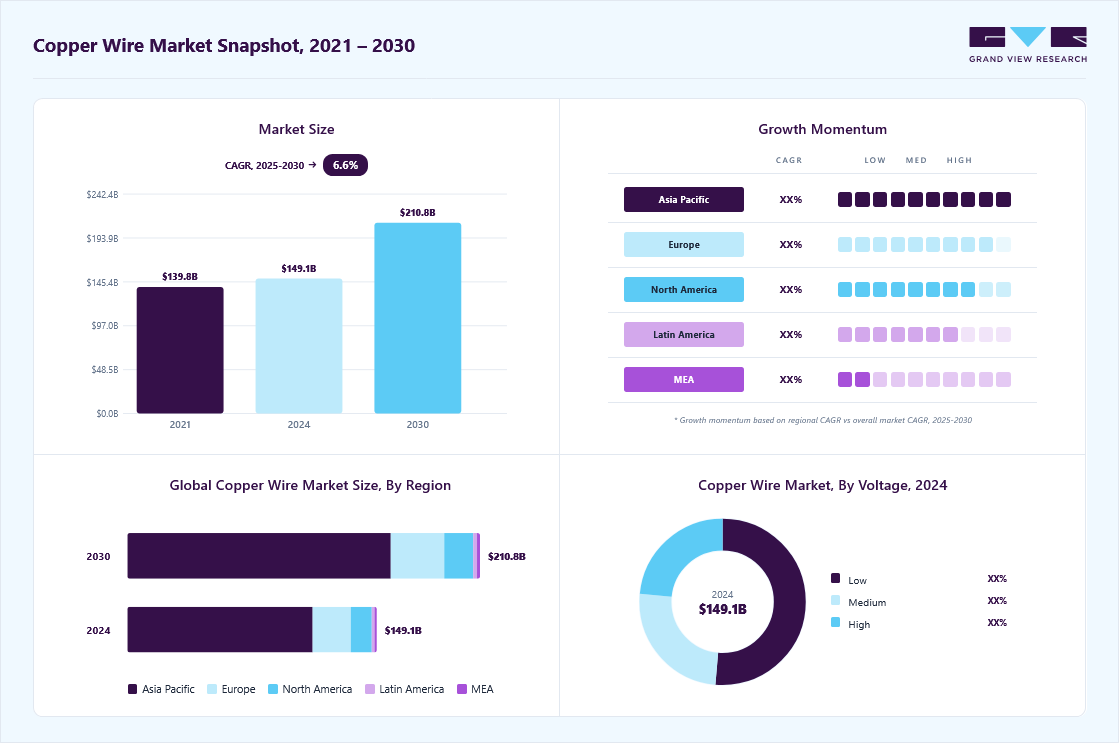
The copper wire market size was valued at USD 153.2 billion in 2025 and is projected to grow from USD 160.7 billion in 2026 to USD 241.5 billion by 2033, at a CAGR of 6.0% from 2026 to 2033. Asia Pacific dominated the copper wire market with the largest revenue share of 74.3% in 2025. The copper wire market is growing rapidly due to the global shift toward renewable energy.
 Source: Grand View Research, IR Documents, Primary Interviews, Paid DatabasesTo learn more about this report,
 Download Free Sample Report
 Key Market Trends & Insights
- By voltage: Low voltage segment held the largest market share of 51.2% in 2025.
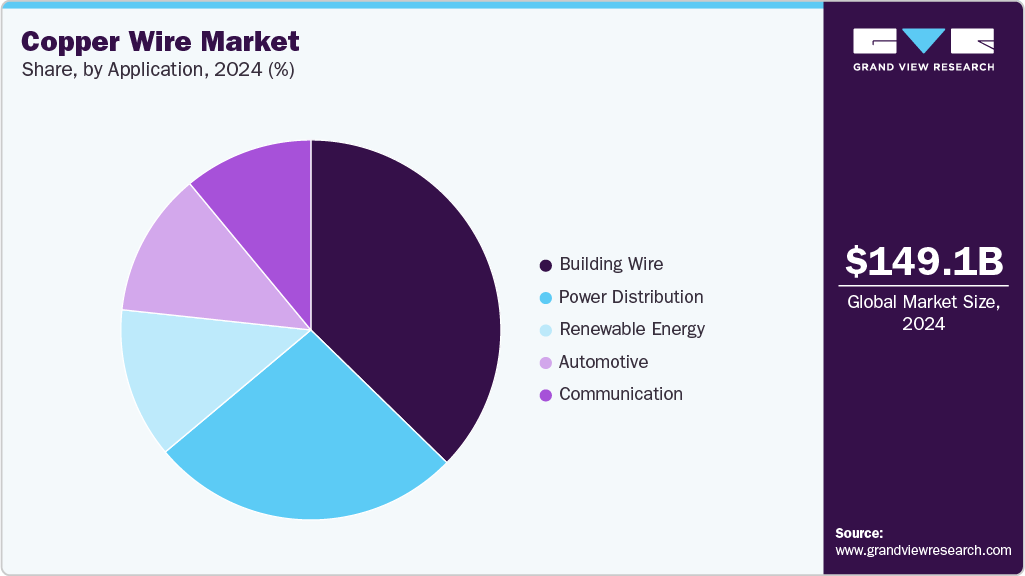
- By application: Building wire segment held the largest market share of 37.3% in 2025.
Regional Highlights
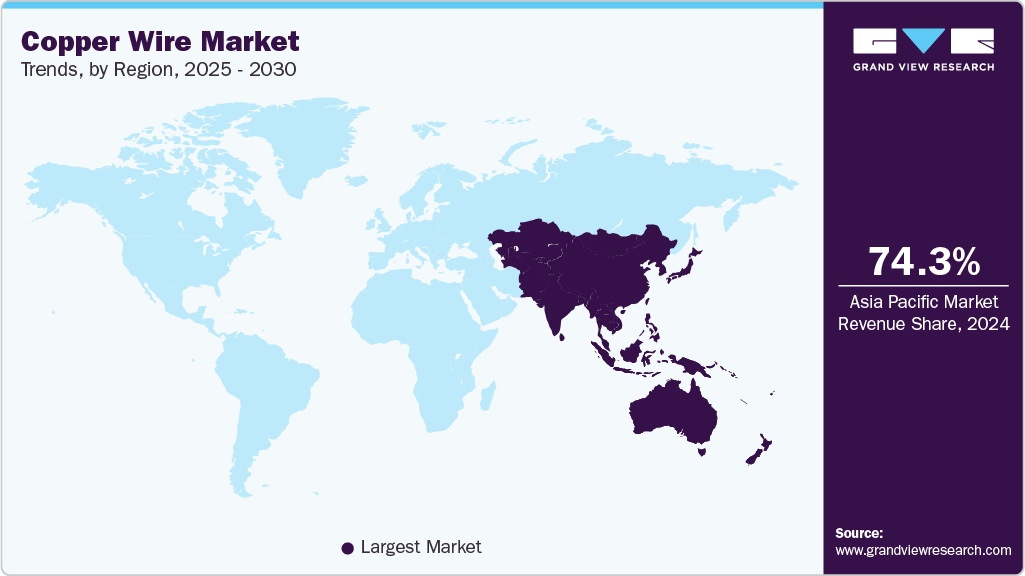
- Largest regional market: Asia Pacific (74.3% revenue share, 2025)
- By country: China held the largest market share in 2025
Market Size & Forecast
- Market size in 2025: USD 153.2 Billion
- Estimated market size in 2026: USD 160.7 Billion
- Projected market size by 2033: USD 241.5 Billion
- CAGR (2026-2033): 6.0%
Three ways to get this report
Buy it, customize it, or ask a question.Ask an Analyst
A direct answer, usually in 1 working day
- AccessReport author, directly
- Reply timeWithin 1 working day
- No sales callDirect answer only
- FormatEmail reply
- CostFree, no cost
Get the Full Report
What the study covers
- FormatsPDF · Excel · Dashboard
- Timeline2026–2033 annual, 2025 base
- Coverage20+ countries, 5 regions
- Companies10+ key players profiled
Customize the Report
20% free customization
- IncludeCountries, segments, points
- TailorTo your product definition
- ExtendDeeper competitor detail
- OrA fully bespoke study
- Turnaround5–10 working days
Solar panels and wind turbines need a lot of copper wiring to function efficiently, especially for transmitting electricity from the source to the grid. This demand is rising as countries invest more in clean energy to reduce their carbon emissions and become less dependent on fossil fuels.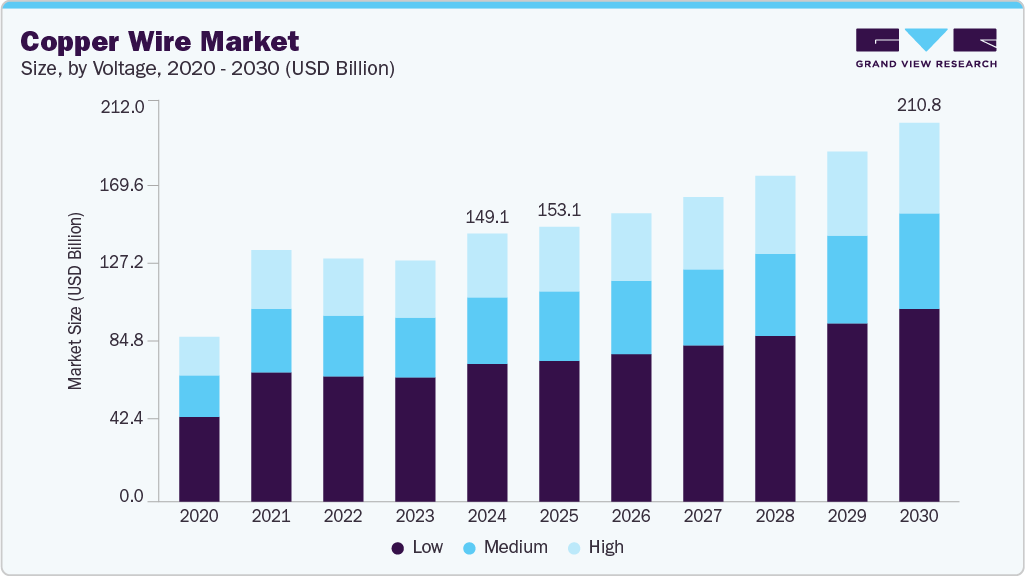 To learn more about this report, Download Free Sample Report
 The global copper wire market is witnessing robust growth driven by its indispensable role in the electrical and electronics industry. As the backbone of electrical conductivity, copper wires are used extensively in power transmission, distribution systems, circuit wiring, and various electronic devices. The surging demand for consumer electronics, including smartphones, tablets, and home appliances, is fueling the consumption of copper wires. In addition, the growth in global data centers and increasing digitalization further propel demand, as copper wires form critical components in network infrastructure and high-performance servers.
 To learn more about this report, Download Free Sample Report
 Rapid urbanization and infrastructure development in emerging economies such as India, China, and Southeast Asia are major contributors to copper wire market expansion. These regions are experiencing significant investments in smart cities, transportation networks, commercial buildings, and industrial parks. Government-led initiatives focusing on rural electrification and grid expansion projects stimulate demand for copper conductors. Moreover, copper's reliability, longevity, and superior conductivity make it the preferred material in overhead and underground power cables used in large-scale infrastructure projects.
The transition toward renewable energy sources is another powerful growth catalyst. Solar power systems, wind turbines, and energy storage units require extensive copper wiring for efficient power generation and transmission. With global climate goals pushing for renewable integration, copper wire is increasingly critical in connecting energy production units to the main grid and ensuring minimal energy losses. Furthermore, as smart grid technologies and energy-efficient solutions gain traction, advanced copper wiring systems are required for grid modernization and load management.
Electric vehicles (EVs) represent a fast-emerging application segment for copper wires, significantly boosting market prospects. Due to its high conductivity and thermal performance, copper is used extensively in EV motors, batteries, inverters, and charging infrastructure. The proliferation of EV manufacturing and the rollout of EV charging stations across North America, Europe, and Asia are creating substantial new avenues for copper wire consumption. As the world shifts toward electrified transportation, this trend is expected to become a long-term driver of copper wire demand.
Market Dynamics
The continuous expansion and modernization of power transmission and distribution infrastructure are major growth drivers for the copper wire market. Rising electricity demand driven by urbanization, industrialization, and increasing electrification has encouraged governments and utility providers to invest in new transmission lines, substations, and smart grid projects. Copper wire remains the preferred conductor for these applications because of its excellent electrical conductivity, high tensile strength, corrosion resistance, and long service life. The replacement of aging electrical networks across developed economies, combined with large-scale grid expansion in emerging countries, continues to generate sustained demand for copper wire across low-, medium-, and high-voltage applications.
The accelerating electrification of the automotive and industrial sectors is significantly driving global demand for copper wire. Electric vehicles, hybrid vehicles, charging infrastructure, industrial automation systems, robotics, and advanced manufacturing equipment require extensive wiring for efficient power transmission and signal communication. Electric vehicles contain substantially more copper than conventional internal combustion engine vehicles due to their motors, battery systems, inverters, and charging components. As global automotive manufacturers increase production of electric mobility solutions, copper wire consumption continues to rise across the transportation value chain.
Industrial digitalization and the adoption of Industry 4.0 technologies are creating additional opportunities for the copper wire market. Factories are increasingly deploying automated production lines, sensors, control systems, and high-efficiency electric motors that rely on reliable copper wiring to ensure uninterrupted performance. The expansion of data centers, telecommunications infrastructure, and commercial construction projects further supports demand for high-quality copper wire. These long-term trends, combined with increasing investments in energy-efficient industrial equipment and smart infrastructure, are expected to sustain robust growth for the copper wire market throughout the forecast period.
Volatility in copper raw material prices remains a significant restraint for the copper wire market, as fluctuations in global copper prices directly affect manufacturing costs and profit margins. Copper prices are influenced by factors such as mining output disruptions, geopolitical tensions, trade policies, currency fluctuations, energy costs, and changing demand from key sectors, including construction, power, automotive, and electronics. These unpredictable price movements make it difficult for wire manufacturers to maintain stable pricing and long-term supply contracts, often resulting in increased production costs that are passed on to end users. Small and medium-sized manufacturers are particularly vulnerable to these fluctuations due to limited procurement flexibility and lower bargaining power.
The rapid expansion of electric vehicle charging infrastructure presents a significant growth opportunity for the copper wire market. Governments and private sector companies are investing heavily in public, residential, workplace, and commercial charging networks to support the accelerating adoption of electric vehicles. Every charging station requires substantial amounts of copper wire for power distribution, electrical connections, grounding systems, and grid integration, owing to copper's superior electrical conductivity, durability, and reliability. In addition, the deployment of fast and ultra-fast charging stations requires higher-capacity cables capable of handling greater electrical loads, further increasing copper consumption.
Analyst Perspective
The copper wire market is well-positioned for sustained growth as global economies accelerate investments in electrification, renewable energy, electric vehicles, and modern power infrastructure. Copper wire remains the preferred conductor across power transmission, building construction, telecommunications, industrial automation, and automotive applications because of its superior electrical conductivity, durability, and long service life. The rising deployment of EV charging networks, smart grids, data centers, and renewable energy projects is creating new opportunities for demand, while ongoing urbanization and infrastructure development continue to strengthen consumption in emerging markets.
Voltage Insights
Low voltage segment led the market with the largest revenue share of 51.2% in 2025. Low voltage copper wires are primarily used in electrical systems operating below 1,000 volts, including building wiring, lighting systems, household appliances, and control circuits. Rapid urbanization, increasing housing demand, and rising disposable incomes have led to a surge in residential construction projects across the Asia Pacific, the Middle East, and Africa, thereby driving demand for low voltage copper wiring. In addition, retrofitting older buildings with modern, energy-efficient electrical infrastructure-especially in Europe and North America-further supports the segment’s expansion.
High voltage is anticipated to register the fastest CAGR over the forecast period. The high voltage segment of the copper wire market is driven by the growing demand for efficient long-distance power transmission and utility infrastructure expansion. High voltage copper wires, typically used for systems above 35 kV, are essential in transmitting electricity from generation plants to substations and large industrial facilities. With increasing investments in grid modernization and cross-border interconnection projects, particularly in regions such as Europe, North America, and China, the use of high voltage copper conductors is rising. These wires are preferred for their excellent conductivity, reliability, and ability to minimize transmission losses over large distances. This is crucial as electricity demand continues to grow in line with industrial development and urbanization.
Application Insights
Based on application, building wire segment led the market with the largest revenue share of 37.3% in 2025. Due to their excellent conductivity, durability, and fire-resistance properties, copper wires are widely used in buildings for power distribution, lighting, HVAC systems, and control wiring. The demand is particularly high in emerging economies such as India, China, Indonesia, and Vietnam, where government-backed affordable housing schemes, smart city projects, and urban infrastructure developments are accelerating the installation of new electrical systems that rely heavily on copper building wires.
 To learn more about this report, Download Free Sample Report
 Renewable energy is anticipated to register the fastest CAGR over the forecast period. Copper's superior electrical and thermal conductivity makes efficient energy transmission in renewable systems indispensable. In solar photovoltaic (PV) installations, copper is used extensively in wiring, inverters, transformers, and grounding systems. Similarly, wind turbines use copper for generator coils, power cables, and control systems. Notably, renewable energy systems require four to six times more copper per megawatt (MW) than conventional fossil fuel or nuclear power plants due to the decentralized nature of renewable installations and the need for extensive cabling to connect dispersed components.
Regional Insights
Asia Pacific dominated the copper wire market with the largest revenue share of 74.3% in 2025. Countries such as China, India, Indonesia, and Vietnam invest heavily in power generation, transmission, and distribution networks to support growing urban populations and industrial clusters. Government-led initiatives such as China’s Belt and Road Initiative, India’s Smart Cities Mission, and electrification schemes across Southeast Asia fuel demand for copper wires in high- and low-voltage applications. In addition, the strong presence of local copper smelters and wire manufacturers supports regional self-sufficiency and cost-effective supply.
 To learn more about this report, Download Free Sample Report
 China Copper Wire Market Trends
The copper wire market in the China held the largest share in the Asia Pacific region in 2025.
North America Copper Wire Market Trends
The North American copper wire market is experiencing robust growth, driven by substantial investments in infrastructure modernization, renewable energy expansion, and transportation electrification. The U.S. Infrastructure Investment and Jobs Act has allocated USD 11 billion to upgrade the national power grid, enhancing its capacity to integrate renewable energy sources. This initiative is expected to bring 35 gigawatts of renewable energy online by 2030, necessitating extensive copper wiring for transmission and distribution. In addition, the surge in EV adoption propels the demand for copper in charging infrastructure, with each EV charger requiring significant amounts of copper for efficient operation.
U.S. Copper Wire Market Trends
The U.S. copper wire market is experiencing robust growth, driven by several key factors, such as the increasing electricity demand, which necessitates extensive use of copper wire in power generation, transmission, and distribution systems. In addition, substantial investments in building construction contribute to the market's expansion, as copper wire is essential for electrical wiring in residential, commercial, and industrial buildings. The development of smart grids and the modernization of power infrastructure further boost the demand for copper wire, as these initiatives require advanced wiring solutions to enhance efficiency and reliability.
Europe Copper Wire Market Trends
The copper wire market in Europe is growing steadily, driven by the region’s ambitious renewable energy targets and widespread adoption of sustainable infrastructure. Countries such as Germany, the Netherlands, and Denmark invest heavily in wind and solar power projects, requiring extensive copper wiring for energy generation, transmission, and grid integration. The European Union’s Green Deal and Fit for 55 package aim to significantly reduce carbon emissions, further encouraging the deployment of copper-intensive technologies.
Latin America Copper Wire Market Trends
The Latin American copper wire market is experiencing significant growth, propelled by expanding electrical infrastructure, renewable energy investments, and urban development. Countries such as Brazil, Mexico, Argentina, and Colombia are investing in power transmission and distribution networks to enhance energy reliability and support economic growth. These initiatives increase the demand for copper wire, which is essential for efficient electricity transmission.
Middle East & Africa Copper Wire Market Trends
The Middle East and Africa (MEA) copper wire market is experiencing robust growth, driven by large-scale infrastructure development, renewable energy investments, and urbanization. In the Middle East, government-led initiatives such as Saudi Arabia’s Vision 2030 and the UAE’s Energy Strategy 2050 propel copper wire demand through extensive investments in smart cities, transportation, and energy infrastructure.
Key Copper Wire Company Insights
Some of the key players operating in the market include Belden Inc, Cords Cable Industries Ltd., and others.
- Belden Inc., headquartered in the U.S., is a global leader in designing, manufacturing, and marketing networking, connectivity, and cable products for various industries, including industrial automation, smart buildings, and broadcast markets. The company offers a wide range of products designed for diverse applications. Their offerings include high-performance copper cabling systems that provide the bandwidth and scalability required for modern networking challenges.
- Cords Cable Industries Ltd., based in India, manufactures control and instrumentation cables for various industries, such as power, steel, cement, fertilizers, chemicals, and refineries. The company offers a diverse portfolio, including power cables, control cables, instrumentation cables, thermocouple extension/compensating cables, and communication cables. These products ensure efficient and reliable signal transmission in various industrial applications.
Key Copper Wire Companies:
The following key companies have been profiled for this study on the copper wire market.
-
Belden Inc
-
Cords Cable Industries Ltd.
-
Fujikura Ltd.
-
Furukawa Electric Co., Ltd.
-
KEI Industries Ltd
-
LS Cable & System
-
Nexans
-
Prysmian Group
-
Southwire Company
-
Sumitomo Corporation
Competitive Benchmarking
Category
Operating Strategies
Competitive Edge
Weakness
Established Players (e.g. Prysmian Group, Southwire Company)
- Mature participants in the copper wire market primarily focus on large scale manufacturing, vertically integrated operations, and long term supply agreements with customers across power transmission, construction, automotive, telecommunications, and industrial sectors.
- These companies operate integrated facilities covering copper refining, rod production, wire drawing, insulation, and cable manufacturing to ensure consistent quality and cost efficiency.
- Established players possess significant competitive advantages through their integrated production capabilities, large manufacturing capacities, and extensive distribution networks.
- Their ability to procure refined copper efficiently and produce high volumes of copper wire enables lower production costs and greater pricing competitiveness.
- Despite their strong market positions, mature players face challenges related to fluctuations in copper prices and energy costs.
- Since copper represents the primary raw material, price volatility can significantly impact production costs, profit margins, and contract pricing.
Emerging & Regional Players (e.g., Cords Cable Industries Ltd., KEI Industries Ltd.)
- Emerging participants in the copper wire market generally focus on specialized products, regional market expansion, and flexible manufacturing operations.
- Rather than competing directly with established manufacturers on production volume, these companies target niche opportunities such as fine copper wire, high performance conductors, renewable energy applications, and electric vehicle wiring systems.
- Emerging companies benefit from operational flexibility and the ability to respond quickly to changing customer requirements and technological developments.
- Their smaller organizational structures support faster decision making, shorter product development cycles, and greater customization capabilities.
- Emerging participants face significant challenges related to limited production capacity, lower economies of scale, and restricted financial resources.
- Competing against established manufacturers with integrated supply chains and global distribution networks can be difficult, particularly in highly competitive commodity wire segments.
Recent Developments
-
In April 2024, Prysmian, a global leader in energy and telecom cable systems, signed a long-term agreement with Aurubis, one of the world’s largest copper recyclers and non-ferrous metals providers, to supply copper wire rods. Under this deal, Aurubis will deliver a significant and increasing volume of copper wire rods annually, primarily to Prysmian’s European plants. This partnership builds on a strategic relationship spanning over 25 years and aims to support Prysmian’s current operations and future growth, especially as copper becomes more crucial for energy transition and digitalization.
Copper Wire Report Scope
Report Attribute
Details
Market definition
The market represents the apparent consumption of copper wire-in various applications.
Market size in 2025
USD 153.2 billion
Estimated market size in 2026
USD 160.7 billion
Projected market size by 2033
USD 241.5 billion
Growth rate
CAGR of 6.0% from 2026 to 2033
Base year for estimation
2025
Historical data
2021 - 2024
Forecast period
2026 - 2033
Quantitative units
Revenue in USD million, volume in kilotons, and CAGR from 2026 to 2033
Report coverage
Revenue forecast, volume forecast, company ranking, competitive landscape, growth factors, and trends
Segments covered
Voltage, application, and region.
Regional scope
North America; Europe; Asia Pacific; Latin America; Middle East & Africa
Country scope
U.S., Canada, Mexico, Germany, France, Italy, Russia, India, China, Japan, South Korea, Brazil, Saudi Arabia, UAE
Key companies profiled
Prysmian Group; Southwire Company; Nexans; Furukawa Electric Co., Ltd.; Fujikura Ltd.; Sumitomo Corporation; Belden Inc; LS Cable & System; KEI Industries Ltd; Cords Cable Industries Ltd.
Customization scope
Free report customization (equivalent up to 8 analysts' working days) with purchase. Addition or alteration to country, regional & segment scope.
Pricing and purchase options
Avail customized purchase options to meet your exact research needs. Explore purchase options
Global Copper Wire Market Report Segmentation
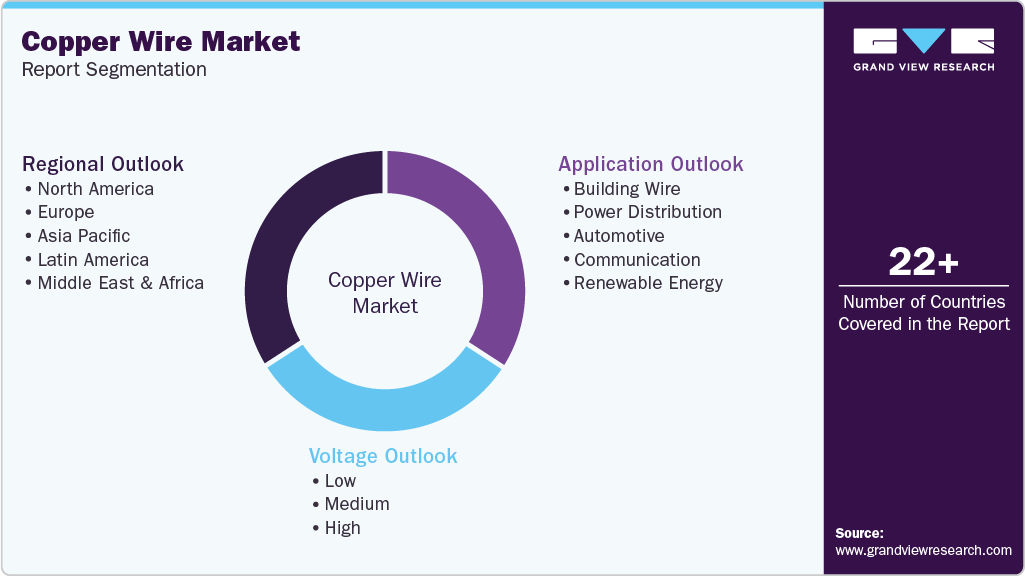
This report forecasts revenue and volume growth at global, regional, and country levels and provides an analysis of the latest industry trends in each of the sub-segments from 2021 to 2033. For the purpose of this study, Grand View Research has segmented the global copper wire market report on the basis of voltage, application, and region.
 To learn more about this report, Download Free Sample Report
 -
Voltage Outlook (Volume, Kilotons; Revenue, USD Million, 2021 - 2033)
-
Low
-
Medium
-
High
-
-
Application Outlook (Volume, Kilotons; Revenue, USD Million, 2021 - 2033)
-
Building Wire
-
Power Distribution
-
Automotive
-
Communication
-
Renewable Energy
-
-
Regional Outlook (Volume, Kilotons; Revenue, USD Million, 2021 - 2033)
-
North America
-
U.S.
-
Canada
-
Mexico
-
-
Europe
-
Germany
-
France
-
Italy
-
Russia
-
-
Asia Pacific
-
China
-
India
-
Japan
-
South Korea
-
-
Latin America
-
Brazil
-
Middle East
-
Saudi Arabia
-
UAE
-
-
Research Methodology
The copper wire market figures in this report are based on a proven research process that combines executive interviews with secondary research from proprietary databases, company filings, and recognized regulatory and institutional sources. Market size is built through value-chain sizing - reconciling supply-side and demand-side estimates - and triangulated with bottom-up and top-down approaches. Every estimate passes multiple levels of expert validation before publication, with each copper wire segment quantified using the revenue-capture definitions in the table below.
Segment Definition
Voltage
Revenue Capture Definition
Low
The low voltage segment comprises revenue generated from copper wires and cables used in electrical systems operating up to 1 kV. It includes products supplied for residential buildings, commercial establishments, industrial facilities, and low voltage distribution applications.
Medium
The medium voltage segment consists of revenue earned from copper wires and cables designed for power distribution systems operating between 1 kV and 36 kV. Demand is primarily driven by utility networks, renewable energy projects, industrial plants, and commercial infrastructure.
High
The high voltage segment encompasses revenue derived from copper wires and cables used in transmission systems operating above 36 kV. The market includes products deployed across transmission lines, substations, large scale utility projects, and other high capacity electrical infrastructure.
Application
Revenue Capture Definition
Building Wire
The building wire segment comprises revenue generated from copper wires installed in residential, commercial, and institutional buildings for electrical distribution, lighting, outlets, and other internal wiring applications. The market includes both new construction and renovation projects.
Power Distribution
The power distribution segment includes revenue earned from copper wires and cables used in utility distribution networks, substations, industrial facilities, and commercial power systems. Demand is driven by grid expansion, modernization, and electrification projects.
Automotive
The automotive segment captures revenue from copper wires supplied for vehicle wiring harnesses, battery systems, electric motors, sensors, infotainment systems, and other electrical components in conventional, hybrid, and electric vehicles.
Communication
The communication segment consists of revenue generated from copper wires used in telecommunications, networking infrastructure, broadband connectivity, and data transmission systems. It includes products deployed in both public and private communication networks.
Renewable Energy
The renewable energy segment encompasses revenue derived from copper wires used in solar photovoltaic systems, wind power installations, battery energy storage systems, and related clean energy infrastructure. The segment reflects demand from power generation, transmission, and grid integration applications.
Estimation Model
Layer Name
Key Question
Description
Electrical & Infrastructure Demand Base Layer
What forms the demand base?
Identify global demand from major copper wire consuming industries including power generation & transmission, construction, automotive, telecommunications, consumer electronics, industrial manufacturing, and renewable energy. Assess electricity infrastructure investments, building construction activity, and electrical equipment production to establish the total addressable demand for copper wire.
Copper Wire Application Penetration Layer
Where is copper wire utilized?
Estimate the penetration of copper wire across key applications including building wiring, power distribution, automotive wiring harnesses, communication cables, renewable energy systems, industrial machinery, and consumer electronics. Analyze the adoption of bare, insulated, enameled, and specialty copper wires across end use industries and regions.
Copper Wire Consumption Intensity Layer
How much copper wire is consumed?
Analyze copper wire consumption intensity based on electrical infrastructure expansion, construction area, vehicle production, renewable energy installations, and electronics manufacturing. Evaluate copper wire usage by voltage class, conductor size, and application requirements. Consumption intensity varies according to electrification trends, grid modernization projects, and technological advancements.
Revenue Layer
How is market revenue generated?
Market revenue is quantified through the sale of copper wire products including bare copper wire, insulated wire, magnet wire, communication wire, and specialty conductors. Revenue generation is driven by demand from construction, power transmission & distribution, automotive, telecommunications, renewable energy, and industrial sectors. Market value is influenced by copper prices, wire specifications, insulation materials, manufacturing costs, and regional demand dynamics.
Delivered Customizations
This report has been delivered with the following In-depth customizations
CLIENT REQUEST
CUSTOMIZATION DELIVERED
VALUE ADDS
Regional Segmentation
Detailed regional analysis of the copper wire market across North America, Europe, Asia Pacific, Latin America, and Middle East & Africa. Included evaluation of electrical infrastructure investments, power transmission and distribution projects, construction activity, automotive production, renewable energy deployment, telecommunications expansion, and industrial manufacturing trends influencing copper wire demand.
Identified high growth demand centers and emerging manufacturing hubs. Enabled strategic expansion planning based on electrification trends, infrastructure investments, and industrial development. Supported regional demand forecasting and supply chain optimization.
Cross Segmentation
Comprehensive cross segmentation analysis by voltage, application, and region, including low, medium, and high voltage copper wire demand across building wire, power distribution, automotive, communication, and renewable energy applications. Evaluated consumption patterns, product specifications, regional demand variations, technology adoption, and end use growth across major industries.
Enabled identification of the most attractive voltage application combinations and emerging market opportunities. Supported product portfolio optimization, customer targeting, and investment prioritization strategies.
Opportunity Assessment
Identification of high growth opportunities across grid modernization, renewable energy projects, electric vehicle charging infrastructure, smart grids, data centers, telecommunications networks, industrial automation, and residential electrification. Assessed future demand potential driven by clean energy investments, urbanization, increasing electricity consumption, and expansion of digital infrastructure worldwide.
Enabled prioritization of high return growth segments and emerging regional opportunities. Supported long term investment planning, capacity expansion decisions, and strategic business development initiatives aligned with global electrification and energy transition trends.
Frequently Asked Questions About This Report
The copper wire market size was estimated at USD 153.2 billion in 2025 and is expected to reach USD 160.7 billion in 2026.
The copper wire market is expected to grow at a compound annual growth rate of 6.0% from 2026 to 2033 to reach USD 241.5 billion by 2033.
Asia Pacific is anticipated to register the fastest CAGR over the forecast period.
Low voltage accounted for largest revenue share of 51.2% in 2025.
Based on application, building wire segment accounted for a market revenue share of 37.3% in 2025.
The key players operating in the copper wire market are Prysmian Group; Southwire Company; Nexans; Furukawa Electric Co., Ltd.; Fujikura Ltd.; Sumitomo Corporation; Belden Inc; LS Cable & System; KEI Industries Ltd; Cords Cable Industries Ltd.
The key factor that is driving the growth of the global copper wire market is the growing demand for efficient and reliable electrical conductivity solutions across sectors such as construction, telecommunications, power generation, and automotive—particularly with the rising adoption of electric vehicles and renewable energy systems.
Asia Pacific dominated the market with revenue share of 74.3% in 2025.
China dominated the Asia Pacific market with revenue share of 54.2% in 2025.
About the Author(s)
Advanced Interior Materials Research Team
Advanced Materials · Advanced Interior MaterialsThis report was authored by the advanced interior materials research team at Grand View Research - comprising two research analysts, one senior research analyst, and one industry expert - with specialized expertise in the advanced interior materials segment of the advanced materials industry. All findings are based on proprietary advanced materials databases, executive interviews, and regulatory analysis, subject to internal peer review prior to publication.
Last Updated:
Speak to Analyst

Customize this report to your needs - add regions, segments, or data points, with 20% free customization.
Or view our licence options:


ISO 9001:2015 & 27001:2022 Certified
We are GDPR and CCPA compliant! Your transaction & personal information is safe and secure. For more details, please read our privacy policy.


