
- Home
- »
- Food Additives & Nutricosmetics
- »
-
Cresol Market Size, Share And Growth Report, 2026-2033GVR Report cover

Cresol Market (2026 - 2033)
Size, Share & Trends Analysis Report By Product (m-Cresol, p-Cresol, o-Cresol), By Application (Agrochemicals & Pesticides, Vitamin E Supplements, Chemical Intermediates), By Region, And Segment Forecasts
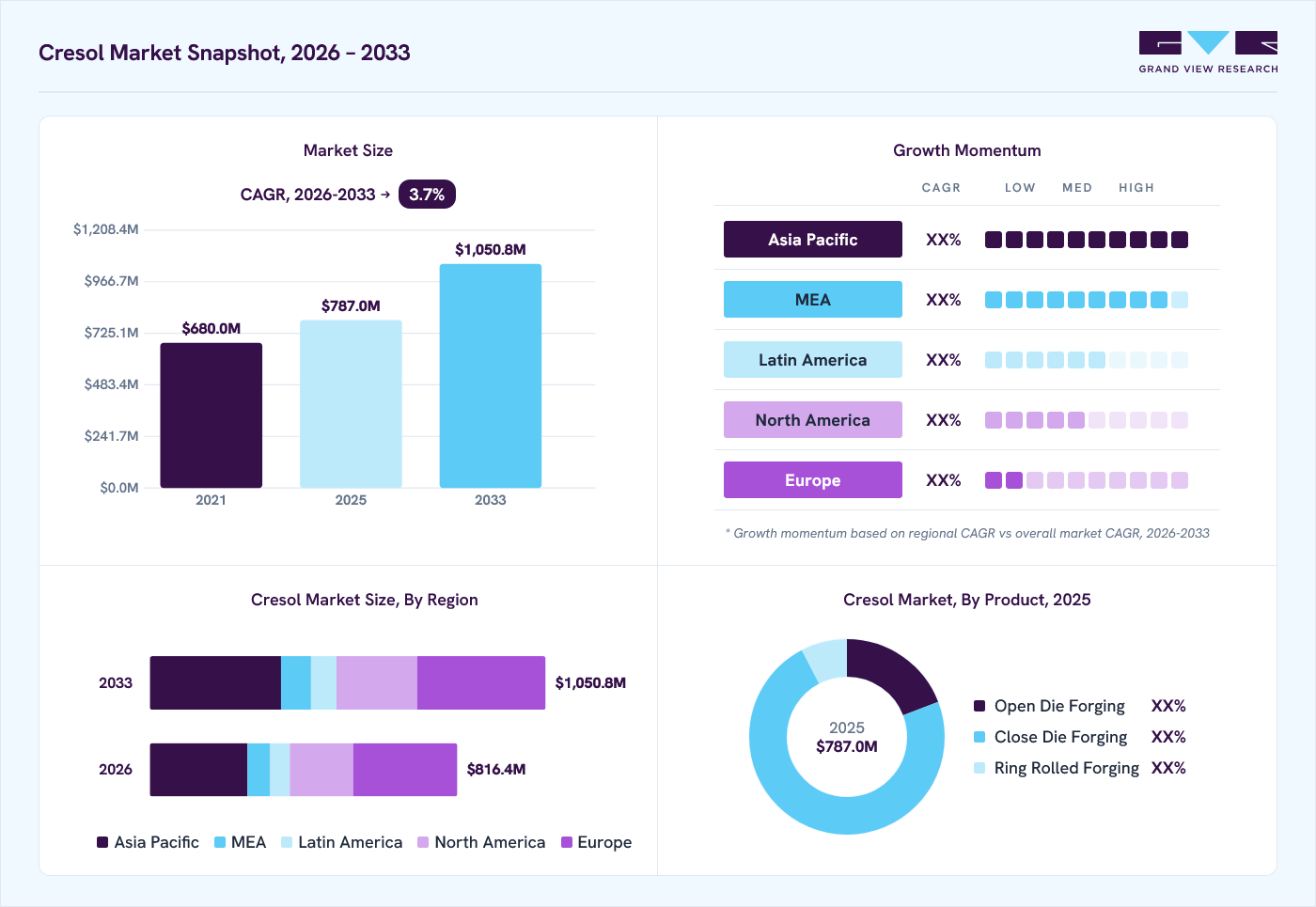
Market Size, 2025
$787.0MMarket Estimate, 2026
$816.4MMarket Forecast, 2033
$1,050.8MCAGR, 2026–2033
3.7%Cresol Market Size & Trends
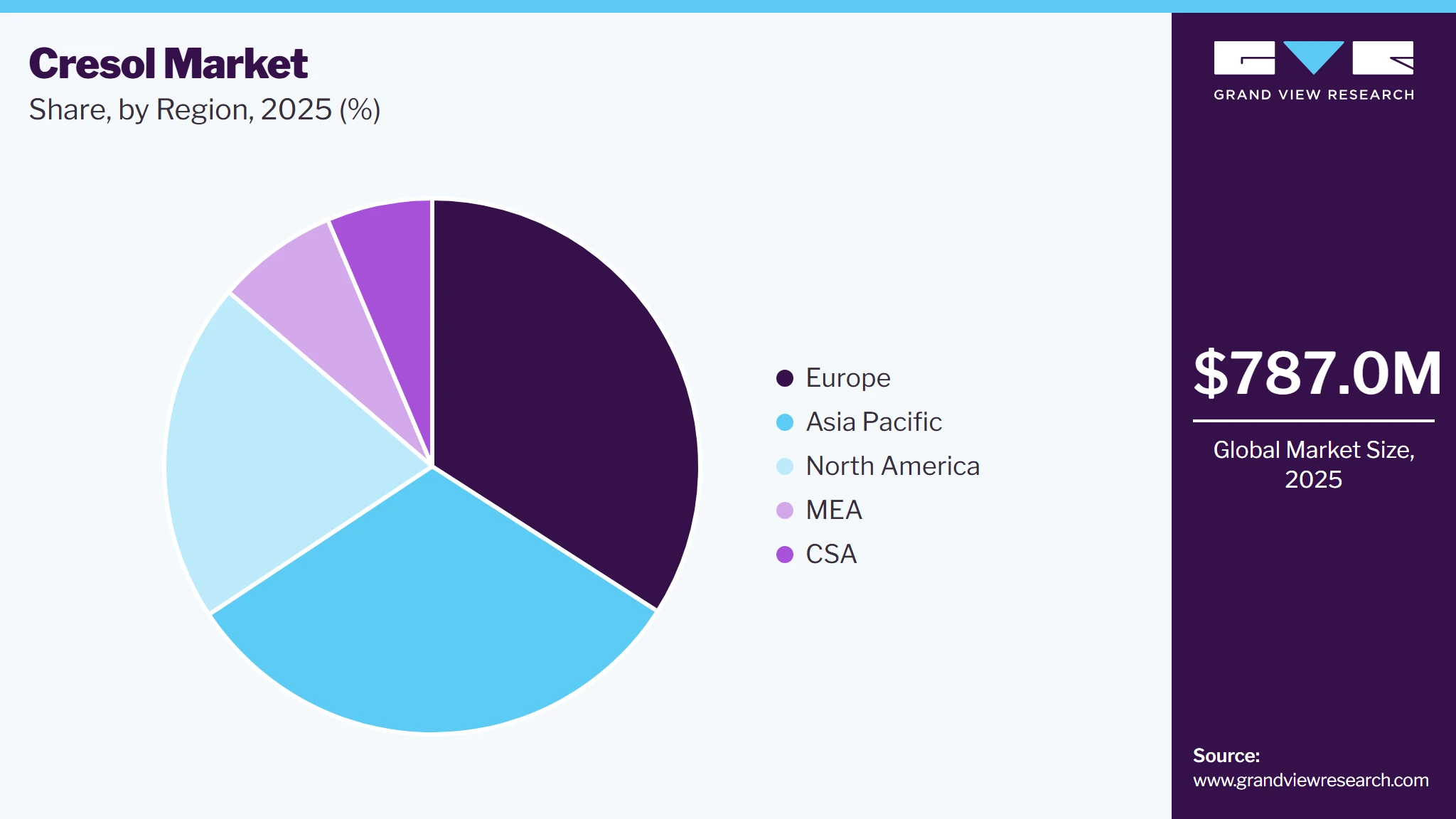
The global cresol market size was valued at USD 787.0 million in 2025 and is projected to grow from USD 816.4 million in 2026 to USD 1,050.8 million by 2033, at a CAGR of 3.7% from 2026 to 2033. Europe dominated the market, accounting for a revenue share of 34.1% in 2025. The market revenue growth is driven by a growing demand for chemicals in different industries such as pharmaceuticals, flavors & fragrances, and resins.
 Source: Grand View Research, IR Documents, Primary Interviews, Paid DatabasesTo learn more about this report,
 Download Free Sample Report
Key Market Trends & Insights
- By product: p-cresol held a dominant position, contributing 37.9% of total revenue in 2025.
Regional Highlights
- Largest regional market: Europe (34.1% revenue share, 2025)
- Fastest regional market: Asia Pacific (highest CAGR, 2026-2033)
- By country: Germany dominated the Europe cresol market in 2025.
Market Size & Forecast
- Market size in 2025: USD 787.0 Million
- Estimated market size in 2026: USD 816.4 Million
- Projected market size by 2033: USD 1,050.8 Million
- CAGR (2026-2033): 3.7%
Prism AI by Grand View Research Free to tryAsk a question about the cresol marketTry asking✓Every figure cited from GVR research Prefer the report? Download free sample →In addition, increased usage of cresol for producing solvents, resins, insecticides, and other related products, are key drivers of market revenue expansion. Furthermore, industries, such as textile, rubber, and pharmaceutical, commonly use cresol as a solvent. It acts as both a detergent and a dissolvent for different substances. The increasing need for cresol in the pharmaceutical industry to produce salicylic acid medications like antiseptics, anesthetics, and disinfectants is driving the market growth.
An important driver of the market is the increasing use of products in the making of pesticides and disinfectants to protect crops against insects and pests, as well as enhancing overall cleanliness and hygiene. Moreover, the positive market outlook is driven by the rapid expansion of industries like chemicals, agrochemicals, and pharmaceuticals. Moreover, cresol, known as hydroxytoluene, refers to a group of aromatic organic compounds categorized as phenols which can be found naturally or synthesized. Cresol, which has meta, para, and ortho isomers, is employed as a disinfectant and antiseptic and has excellent antioxidant properties. Moreover, cresol is utilized as a preservative in the food and beverage industry to prevent the proliferation of bacteria and fungi. Additionally, it acts as a preservative within the cosmetics industry.
 To learn more about this report, Download Free Sample Report
The paint and coatings industry are also a major user of cresol. It is utilized in creating specific coatings and paints to improve their performance and durability. Cresol plays a part in creating long-lasting coatings of excellent quality that may withstand environmental elements like UV light and moisture. It helps create varnishes and protective coatings used in a wide range of industries such as automotive and industrial coatings.
Market Dynamics
The global cresol market is driven by steady demand from agrochemicals, phenolic resins, pharmaceuticals, disinfectants, and specialty chemical applications. Market growth is supported by increasing industrialization, expanding chemical manufacturing, and rising consumption of high-performance intermediates across developed and emerging economies. However, stringent environmental regulations governing the handling of hazardous chemicals, fluctuations in feedstock prices, and increasing compliance costs pose challenges to market expansion. Despite these constraints, advancements in production technologies, growing investments in downstream specialty chemicals, and rising demand from high-value industrial applications are expected to create favorable growth opportunities over the forecast period.
The increasing utilization of cresol as a critical intermediate in the production of specialty chemicals is a major driver of the global cresol market. Cresol is widely used in the manufacture of phenolic resins, antioxidants, vitamins, dyes, disinfectants, and chemical intermediates, making it an essential raw material across multiple industrial value chains. The continued expansion of the construction, automotive, electronics, and industrial manufacturing sectors is driving demand for high-performance resins and specialty chemicals, thereby supporting cresol consumption worldwide.
The growing agrochemical industry is significantly contributing to market growth, as cresol serves as an important feedstock in the synthesis of herbicides, insecticides, fungicides, and other crop protection chemicals. Rising global food demand, increasing focus on agricultural productivity, and expanding investments in modern farming practices are encouraging the development and production of advanced agrochemical formulations. These trends, coupled with increasing chemical manufacturing capacity in Asia Pacific and the Middle East, are expected to sustain long-term demand for cresol across global markets.
The global cresol market faces significant challenges due to stringent environmental regulations governing the production, transportation, storage, and disposal of hazardous chemicals. Cresol is classified as a toxic chemical that requires strict compliance with occupational health, environmental protection, and chemical safety standards across major markets. Manufacturers are required to invest in advanced emission control systems, waste treatment facilities, and regulatory compliance measures, resulting in higher operational and capital costs.
Increasing regulatory scrutiny on hazardous chemical emissions and worker safety has encouraged end-use industries to evaluate alternative raw materials where technically feasible. Compliance with evolving regulations related to chemical handling, labeling, and environmental impact can lengthen product approval timelines and increase administrative complexity, particularly for manufacturers operating across multiple jurisdictions. These factors may limit production expansion and affect the overall growth potential of the global cresol market.
The increasing industrialization of emerging economies presents a significant growth opportunity for the global cresol market. Rapid expansion of the chemical, automotive, construction, electronics, and pharmaceutical industries is driving demand for high-performance specialty chemicals, where cresol serves as a key intermediate in the production of phenolic resins, antioxidants, plastic additives, and other value-added chemical products. Rising investments in downstream chemical manufacturing are further strengthening the commercial potential of cresol across developing markets.
Ongoing capacity expansions in petrochemical and specialty chemical production, particularly across Asia Pacific and the Middle East, are creating new opportunities for cresol manufacturers to enhance production capabilities and strengthen regional supply chains. Increasing emphasis on product innovation, high-purity cresol grades, and advanced industrial applications is expected to support long-term market growth while enabling manufacturers to diversify their product portfolios and improve profitability.
Analyst Perspective
The global cresol market is expected to experience steady growth, supported by its indispensable role as a chemical intermediate in the production of agrochemicals, phenolic resins, antioxidants, pharmaceuticals, and specialty chemicals. Rising industrialization, expanding downstream chemical manufacturing, and increasing investments in high-value specialty chemical applications are expected to sustain long-term demand across key regions. Although stringent environmental regulations, hazardous chemical handling requirements, and feedstock price volatility continue to pose challenges, manufacturers focusing on process optimization, high-purity product development, regulatory compliance, and strategic capacity expansion are well positioned to strengthen their competitive advantage and capitalize on emerging growth opportunities.
Product Insights
p-cresol held a dominant position, contributing 37.9% of total revenue in 2025. p-cresol is the most commonly utilized form of cresol, mainly used in the production of pharmaceuticals and agricultural chemicals, and as a solvent in different chemical processes. It is highly used for its function as a key player in the creation of insecticides and herbicides, as well as in the development of disinfectants and antiseptics. The essential role of p-cresol in the agrochemical sector and the increasing demand for advanced healthcare products are driving the need for it.
m-Cresol is projected to grow at the fastest CAGR over the forecast period. It acts as a precursor in the production of antioxidants, essential for maintaining the stability of rubber and plastic items. Meta-cresol is also used to manufacture dyes and as a solvent in specific chemical processes. The increasing need for meta-cresol is affected by the growth of the automotive and consumer goods industries, where its importance in improving material durability is greatly appreciated. Moreover, a major catalyst is its use in creating important compounds such as Butylated hydroxytoluene (BHT), an antioxidant commonly utilized in food and skincare products. Furthermore, the growing pharmaceutical industry depends heavily on m-Cresol to produce vital drugs and intermediates, playing a key role in its market growth.
o-Cresol finds significance as a building block to produce herbicides, sealing material for electronics, and precursor for dye intermediates. Major derivatives obtained by chlorination of ortho-cresol are used in plant protection agents. o-Cresol derivatives form a significant component in pesticides. Growing concerns regarding crop protection in major agricultural sectors such as cereals and vegetables are anticipated to drive product demand.
Regional Insights
North America's cresol market is anticipated to witness significant growth in the coming years. The region's growth can be mostly attributed to the high demand for cresol in different products, including chemical disinfectants, intermediates, and preservatives. Additionally, the increasing production of herbicides, resins, and pesticides with cresol is expected to drive market revenue growth in this region.
 To learn more about this report, Download Free Sample Report
U.S. Cresol Market Trends
The U.S. cresol market dominated North America cresol market in 2023. The region's strong aerospace and defense industries use cresol derivatives for a variety of purposes, such as composites and advanced materials. Furthermore, the increasing emphasis on renewable energy and energy efficiency has resulted in a higher need for insulation materials containing cresol.
Asia Pacific Cresol Market Trends
Asia Pacific cresol market dominated the market in 2023 on account of growing product demand in the agrochemicals, vitamin E, and electronics sectors in the region. The region's rapid growth is also attributed to its large consumer population and increasing need for personal care products.
The India cresol market held a substantial market share in 2023 driven by the increasing pharmaceutical, agrochemical, automotive sectors, which rely on cresol-based processes. The increasing focus on infrastructure development in the country drives the need for epoxy resins derived from cresol, while the cosmetic industry's use of cresol-based preservatives, thereby enhancing market opportunities.
The China cresol market is expected to grow rapidly in the coming years due to the country's role as a major global center for producing pharmaceuticals, chemicals, and agrochemicals.
Europe Cresol Market Trends
Europe dominated the cresol market with the highest revenue share of 34.1% in 2025. This is attributed to the growing need for Cresol in various industries such as pharmaceutical, chemical, and personal care. Additionally, the increasing need for cresol in the construction and automotive sectors in the region is driving market growth.
The U.K. cresol market is expected to grow rapidly in the coming years driven by the emphasis on protecting the environment which has led to the advancement of cresol-derived water treatment substances, fueling market expansion. Germany dominated the Europe cresol market in 2025.
Key Cresol Company Insights
Some of the key companies in the cresol market include KANTO KAGAKU TCI AMERICA, Dorf Ketal and other companies. To obtain a competitive advantage in the market, businesses are concentrating on growing their customer base.
-
KANTO KAGAKU offers a wide range of products derived from cresol, including individual cresol isomers and mixtures, as well as various cresol derivatives like cresol sulfonic acids, cresol ethers, and cresol formaldehyde resins.
Key Cresol Companies
The following key companies have been profiled for this study on the cresol market.
-
Merck KGaA
-
KANTO KAGAKU
-
Mitsui Chemicals, Inc.
-
Dorf Ketal
-
LANXESS
-
Vigon International, LLC.
-
TCI AMERICA
-
RICCA Chemical Company
-
nacalai.com
Competitive Benchmarking
Category
Operating Strategies
Competitive Edge
Weakness
Established Players (Merck KGaA, Mitsui Chemicals, Inc., LANXESS, Dorf Ketal)
- Focus on large-scale integrated manufacturing, global distribution networks, continuous investment in R&D, high-purity cresol production, strategic partnerships, and expansion of specialty chemical portfolios to serve diverse industrial applications.
- Strong global brand recognition, extensive manufacturing capabilities, diversified product portfolios, robust regulatory compliance, advanced process technologies, and long-standing relationships with multinational customers across chemical, pharmaceutical, and industrial sectors.
- High capital investment requirements, significant compliance and environmental costs, and comparatively slower adaptation to niche or low-volume customized applications due to large organizational structures.
Emerging Players (KANTO KAGAKU, Vigon International, LLC., TCI America, RICCA Chemical Company, Nacalai Tesque, Inc.)
- Focus on niche product offerings, laboratory-grade and specialty chemicals, customized solutions, regional market expansion, contract manufacturing, and strengthening distribution channels to increase market penetration.
- High operational flexibility, ability to address specialized customer requirements, faster response to niche demand, competitive pricing in regional markets, and strong expertise in research-grade and specialty chemical products.
- Limited global manufacturing footprint, lower production capacities, comparatively weaker brand recognition, and greater dependence on regional demand and third-party distribution networks for business expansion.
Cresol Market Report Scope
Report Attribute
Details
Market size in 2025
USD 787.0 million
Estimated market size in 2026
USD 816.4 million
Projected market size by 2033
USD 1,050.8 million
Growth rate
CAGR of 3.7% from 2026 to 2033
Base year for estimation
2025
Historical data
2021 - 2024
Forecast period
2026 - 2033
Quantitative units
Volume in tons, Revenue in USD billion and CAGR from 2026 to 2033
Report coverage
Volume forecast, Revenue forecast, company ranking, competitive landscape, growth factors, and trends
Segments covered
Product, region
Regional scope
North America; Europe; Asia Pacific; Latin America; MEA
Country scope
U.S.; Canada; Mexico; Germany; UK; France; Spain; China; Japan; India; South Korea; Brazil; Argentina; Saudi Arabia; UAE; Oman; Kuwait; Qatar
Key companies profiled
Merck KGaA; KANTO KAGAKU; Mitsui Chemicals, Inc.; Dorf Ketal; LANXESS; Vigon International, LLC;TCI AMERICA;RICCA Chemical Company; and nacalai.com;
Customization scope
Free report customization (equivalent up to 8 analysts' working days) with purchase. Addition or alteration to country, regional & segment scope.
Pricing and purchase options
Avail customized purchase options to meet your exact research needs. Explore purchase options
Global Cresol Market Report Segmentation
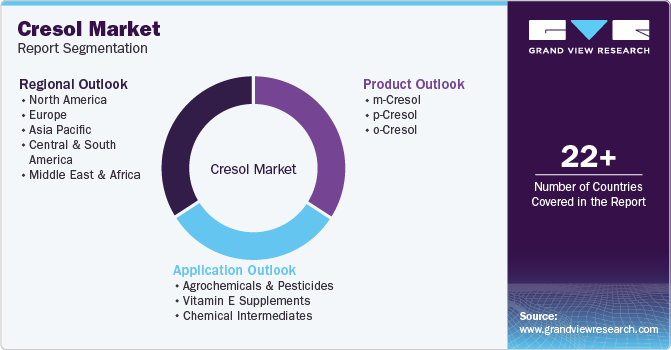
This report forecasts revenue growth at global, regional, and country levels and provides an analysis of the latest industry trends in each of the sub-segments from 2021 to 2033. For this study, Grand View Research has segmented the global cresol market report based on product, application, and region:
 To learn more about this report, Download Free Sample Report
-
Product Outlook (Revenue, USD Million, Kilo Tons, 2021 - 2033)
-
m-Cresol
-
p-Cresol
-
o-Cresol
-
-
Application Outlook (Revenue, USD Million, Kilo Tons, 2021 - 2033)
-
m-Cresol
-
Agrochemicals & Pesticides
-
Vitamin E Supplements
-
Chemical Intermediates
-
Electronics Manufacturing
-
Others
-
-
p-Cresol
-
Butylated Hydroxytoluene (BHT)
-
Antioxidants
-
Fragrance
-
Specialty Resins
-
Others
-
-
o-Cresol
-
Agrochemicals and Pesticides
-
Antioxidants
-
Dyes
-
Electronics Manufacturing
-
Others
-
-
-
Regional Outlook (Revenue, USD Million, Kilo Tons,2021 - 2033)
-
North America
-
U.S.
-
Canada
-
Mexico
-
-
Europe
-
Germany
-
UK
-
France
-
Italy
-
Spain
-
-
Asia Pacific
-
China
-
Japan
-
India
-
South Korea
-
-
Latin America
-
Brazil
-
Argentina
-
-
Middle East and Africa (MEA)
-
Saudi Arabia
-
UAE
-
Oman
-
Kuwait
-
Qatar
-
-
Research Methodology
The cresol market figures in this report are based on a proven research process that combines executive interviews with secondary research from proprietary databases, company filings, and recognized regulatory and institutional sources. Market size is built through value-chain sizing - reconciling supply-side and demand-side estimates - and triangulated with bottom-up and top-down approaches. Every estimate passes multiple levels of expert validation before publication, with each cresol segment quantified using the revenue-capture definitions in the table below.
Segment Definition
Segment – Product
Revenue capture definition
m-cresol
Revenue generated from the sale of meta-cresol (m-cresol) used as a key chemical intermediate in the production of antioxidants, agrochemicals, pharmaceuticals, vitamin E, specialty chemicals, and phenolic resin formulations.
p-cresol
Revenue derived from the sale of para-cresol (p-cresol) utilized in the manufacture of antioxidants, fragrances, dyes, pharmaceuticals, plastic additives, and other specialty chemical intermediates across industrial applications.
o-cresol
Revenue generated from the sale of ortho-cresol (o-cresol) used in the production of disinfectants, herbicides, synthetic resins, dyes, solvents, and pharmaceutical intermediates for various industrial and chemical processing applications.
Estimation Model
Layer No.
Layer Name
Key Question
Description
01
Feedstock & Production Assessment
What are the primary feedstocks and production routes for cresol?
Evaluates the availability of feedstocks such as toluene and phenol, production technologies, manufacturing capacities, and supply chain dynamics influencing global cresol production.
02
Product-Level Market Estimation
Which cresol product type contributes the highest revenue?
Segments the market by product type, including m-cresol, p-cresol, and o-cresol, based on production volumes, demand, and revenue contribution.
03
Application-Level Market Estimation
Which industries consume cresol?
Assesses demand across agrochemicals, pharmaceuticals, phenolic resins, antioxidants, disinfectants, dyes, solvents, and other specialty chemical applications.
04
Country-Level Analysis
Which countries are the major producers and consumers of cresol?
Assesses key country markets based on domestic production, imports, exports, industrial demand, downstream chemical manufacturing, and consumption trends.
Delivered Customizations
This report has been delivered with the following In-depth customizations
Client Request
Customization Delivered
Value Adds
Cross-Segmentation Analysis
The relationship between cresol product types and their downstream applications was assessed to determine consumption trends across m-cresol, p-cresol, and o-cresol value chains. The analysis examined product utilization in agrochemicals, vitamin E production, BHT manufacturing, antioxidants, electronics, specialty resins, fragrances, and dyes to identify application-specific demand dynamics.
Enables identification of high-value product-application combinations and evolving demand patterns. Supports portfolio optimization, product positioning, and targeted commercialization strategies across specialty chemical markets.
Competitive Benchmarking
Leading cresol manufacturers were benchmarked based on production capacity, product portfolio, manufacturing integration, technology capabilities, geographic presence, distribution network, downstream integration, and strategic developments. The assessment also evaluated competitive positioning across pharmaceutical, agrochemical, electronics, and specialty chemical supply chains.
Helps identify competitive strengths, operational advantages, and market positioning gaps. Facilitates strategic differentiation, partnership evaluation, and long-term business planning.
Opportunity Assessment
Emerging growth opportunities were assessed across high-purity chemical intermediates, vitamin E manufacturing, advanced agrochemical formulations, specialty antioxidants, electronics chemicals, and performance resin applications. The study also evaluated opportunities arising from increasing demand for high-value specialty chemicals and expanding downstream industrial production.
Enables identification of high-growth application segments and attractive investment opportunities. Supports innovation planning, portfolio expansion, and long-term strategic growth initiatives.
Frequently Asked Questions About This Report
The global cresol market size was valued at USD 731.6 million in 2023 and is estimated at USD 822.9 million for 2026.
The global cresol market is expected to grow at a CAGR of 3.8% from 2024 to 2030, reaching USD 952.1 million by 2030.
Asia Pacific dominated the market with the largest revenue share in 2023.
Key players include Merck KGaA, KANTO KAGAKU, Mitsui Chemicals, Inc., Dorf Ketal, LANXESS, Vigon International, LLC, TCI AMERICA, RICCA Chemical Company, and nacalai.com
The market revenue growth is driven by rising demand for chemicals across industries such as pharmaceuticals, flavors & fragrances, and resins. In addition, increased use of cresol to produce solvents, resins, insecticides, and other related products is a key driver of market revenue expansion.
About the Author(s)
Food Additives & Nutricosmetics Research Team
Specialty & Chemicals · Food Additives & NutricosmeticsThis report was authored by the food additives & nutricosmetics research team at Grand View Research - comprising two research analysts, one senior research analyst, and one industry expert - with specialized expertise in the food additives & nutricosmetics segment of the specialty & chemicals industry. All findings are based on proprietary specialty & chemicals databases, executive interviews, and regulatory analysis, subject to internal peer review prior to publication.
Last Updated:
Speak to Analyst

Customize this report to your needs - add regions, segments, or data points, with 20% free customization.
Or view our licence options:


ISO 9001:2015 & 27001:2022 Certified
We are GDPR and CCPA compliant! Your transaction & personal information is safe and secure. For more details, please read our privacy policy.


