
- Home
- »
- Next Generation Technologies
- »
-
Cross Border Payments Market Size Report, 2026-2033GVR Report cover

Cross Border Payments Market (2026 - 2033)
Size, Share & Trends Analysis Report By Transaction Type (B2B, C2B, B2C, C2C), By Channel (Bank Transfer, Money Transfer Operator, Card Payment), By Enterprise Size, By End-use, By Region, And Segment Forecasts
Market Size, 2025
$187.7BMarket Estimate, 2026
$193.5BMarket Forecast, 2033
$312.1BCAGR, 2026–2033
7.1%Cross Border Payments Market Summary
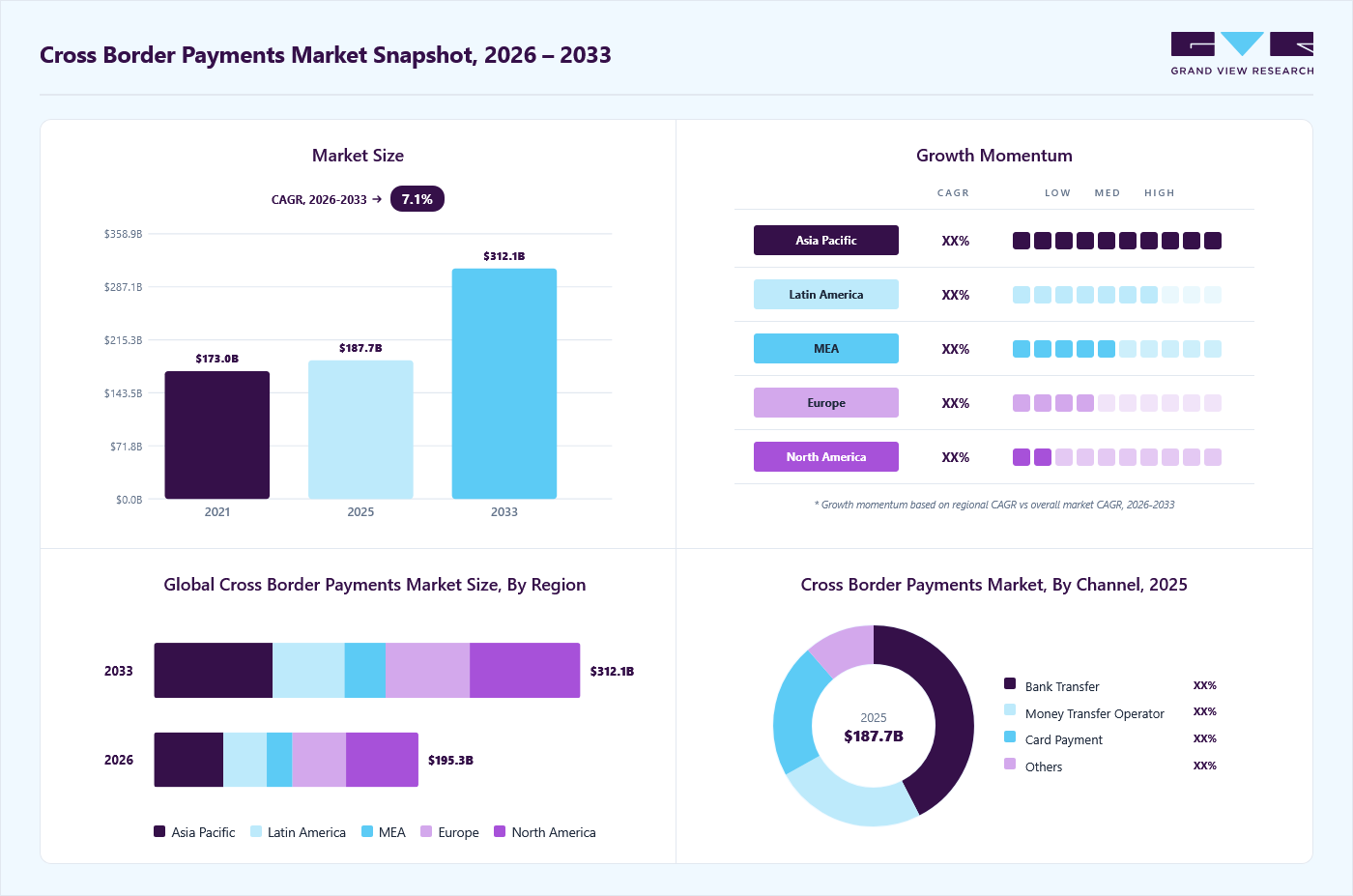
The global cross border payments market size was valued at USD 187.7 billion in 2025 and is projected to grow from USD 193.5 billion in 2026 to USD 312.1 billion by 2033, at a CAGR of 7.1% from 2026 to 2033. North America dominated the global market with a revenue share of 27.6% in 2025. Cross-border payments remain high-cost and slow, driving reforms.
 Source: Grand View Research, IR Documents, Primary Interviews, Paid DatabasesTo learn more about this report,
 Download Free Sample Report
 Key Market Trends & Insights
- By transaction type: Business to business (B2B) segment led the market with the largest revenue share of 72.8% in 2025.
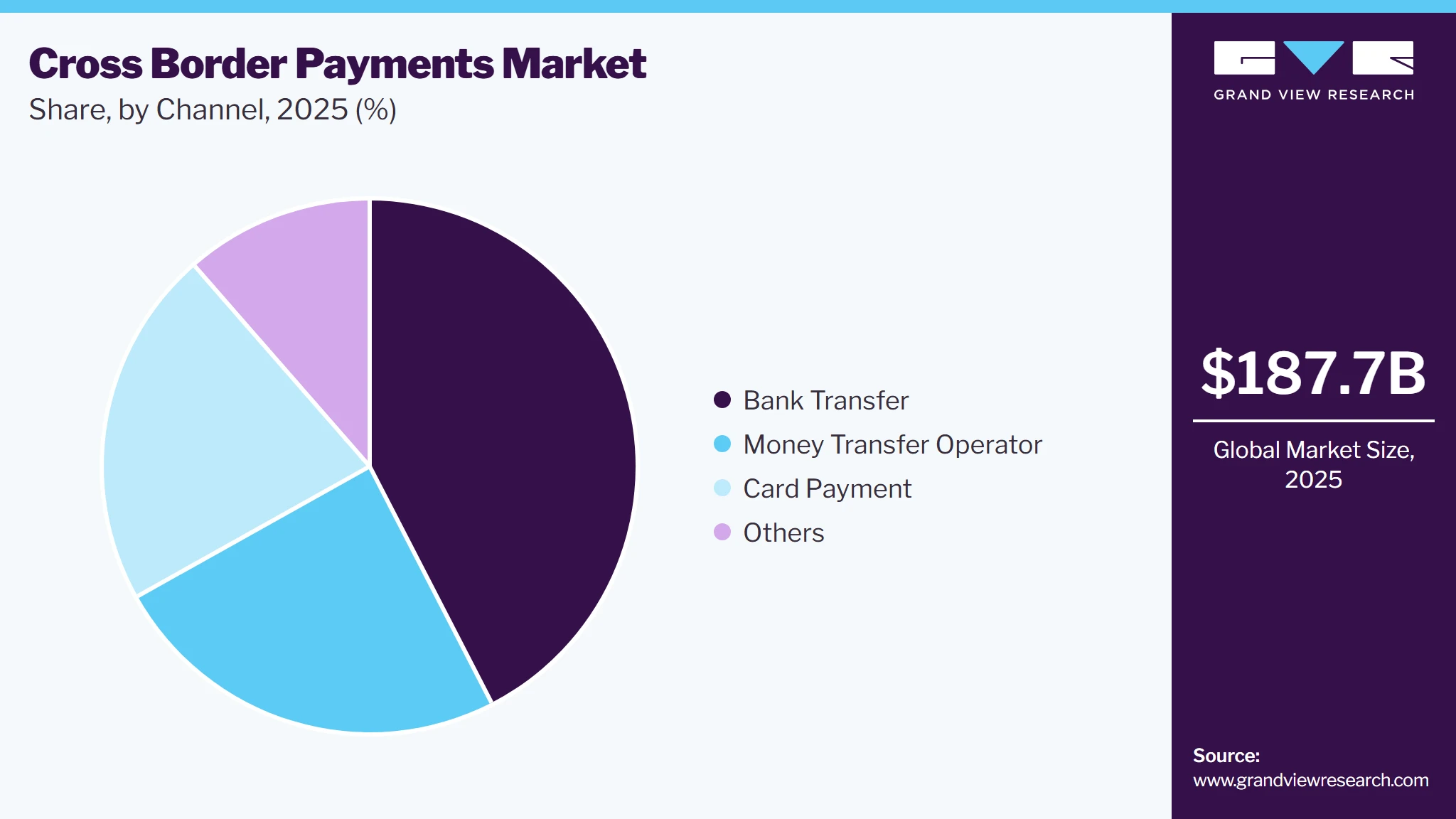
- By channel: Bank transfer segment led the market with the largest revenue share of 42.4% in 2025.
- By enterprise size: Large enterprise segment led the market with the largest revenue share of 64.0% in 2025.
- By end-use: Businesses segment led the market with the largest revenue share of 74.8% in 2025.
Regional Highlights
- Largest regional market: North America (27.6% revenue share, 2025)
- By country: The cross-border payments market in the U.S. held the largest share in the North America region in 2025.
Market Size & Forecast
- Market Size in 2025: USD 187.7 Billion
- Estimated Market Size in 2026: USD 193.5 Billion
- Projected Market Size by 2033: USD 312.1 Billion
- CAGR (2026-2033): 7.1%
Three ways to get this report
Buy it, customize it, or ask a question.Ask an Analyst
Analyst response in 1 business day
- AccessReport author, directly
- Reply timeWithin 1 working day
- No sales callDirect answer only
- FormatEmail reply
- CostFree, no cost
Get the Full Report
What the study covers
- FormatsPDF · Excel · Dashboard
- Timeline2026–2033 annual, 2025 base
- Coverage20+ countries, 5 regions
- Companies10+ key players profiled
Customize the Report
20% free customization
- IncludeCountries, segments, points
- TailorTo your product definition
- ExtendDeeper competitor detail
- OrA fully bespoke study
- Turnaround5–10 working days
The World Bank reports an average cost of about 6.2-6.3% for sending USD 200 in 2023, far above the 3% Sustainable Development Goal. Even within regions, costs vary widely. For example, the World Bank notes remittance fees to South Asia averaged 6-7% in 2023, while fees into Africa often exceed 7%. These inefficiencies are due to multiple correspondent steps and manual checks, which have prompted G20/FSB initiatives setting targets for “faster, cheaper, more transparent, and more inclusive” cross-border payments. Central banks and institutions are analyzing corridor-level fees (e.g., Turkey-Bulgaria at >50%) and tracking progress on G20 Roadmap goals. In short, reducing friction and costs is a major trend. International bodies like the IMF and FSB stress lowering remittance and trade payment fees as a priority.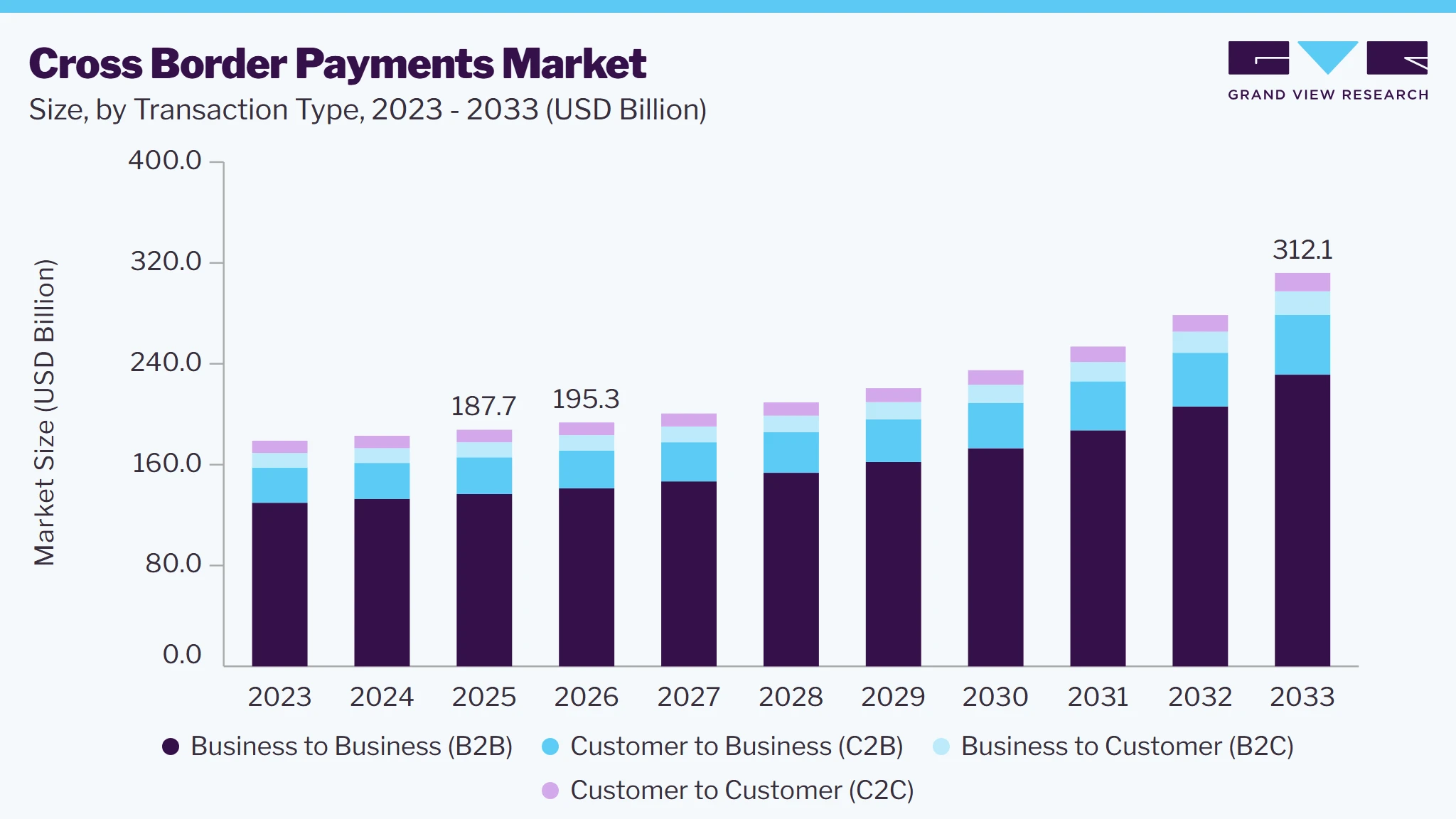 To learn more about this report, Download Free Sample Report
 To meet cost/speed goals, industries are upgrading systems. The adoption of the ISO 20022 messaging standard for payments is accelerating. For instance, in 2023, the UK’s CHAPS system completed ISO 20022 migration, and the Bank of England confirmed plans to harmonize CHAPS with the BIS/CPMI ISO 20022 “data requirements” by 2025. Globally, the consistent ISO 20022 message formats streamline processing and straight-through processing, reducing delays and errors. Another modernization is real-time payment connectivity; more than 70 national fast-payment systems (FPS) now operate worldwide, and interlinking them is seen as highly promising. This states that the cross-border linking of FPS enables near-instant transfers between countries. In sum, upgrading rails and messaging (ISO 20022, RTGS/FPS interlinking) is a key trend driving the growth of the cross border payments industry, backed by central bank initiatives and FSB/CPMI guidance.
Central banks and the private sector are actively exploring digital currencies. The Federal Reserve notes that over 90% of central banks are researching Central Bank Digital Currencies (CBDCs), and pilot projects are underway in many jurisdictions. CBDCs, in theory, provide new secure settlement rails for cross-border flows. Alongside CBDCs, interest in stablecoins and tokenized payments is rising, though official bodies urge caution. The stablecoins are considered a “future scenario” for cross-border payments, but none yet meet regulatory standards. Some jurisdictions (China, some EMDEs) are actively piloting stablecoin or digital yuan cross-border use, while others (e.g. EU) regulate stablecoins tightly to safeguard financial stability. In practice, digital innovation from blockchain-based remittance networks to cross-border mobile money is a major focus, even as policymakers work to align regulations internationally.
Addressing cross-border frictions has become a global priority. In late 2024, the FSB launched a Forum on Cross-Border Payments Data to align regulations and data frameworks across jurisdictions. The Forum will tackle issues like inconsistent KYC/AML requirements and data privacy rules that slow payments. For example, the Bank of England highlights that mismatched compliance rules cause payouts to stall at beneficiary banks. The FSB forum (Mar 2025) and CPMI guidance aim to harmonize these standards. In essence, a trend is greater global coordination, G20/FSB roadmaps, OECD, and FATF work, and shared guidance are being developed so that cross-border chains are smoother and more interoperable.
Cross-border payments aren’t just big banks and corporations - consumer use is exploding. Remittance alone was around USD 669 billion to developing countries in 2023, and money sent via online platforms and mobile wallets is growing. The World Bank reports that remittances now exceed the sum of foreign direct investment and foreign aid for many countries. This underlines financial inclusion as a driver, migrants and diaspora rely on efficient remittances. At the same time, cross-border e-commerce and travel drive consumer-to-business (C2B) payments worldwide. The Bank of England notes that cross-border payments span wholesale and retail (including person-to-person and person-to-business) and are integral as goods/services flow globally. Overall, expanding volume and diversity of cross-border transactions from gig economy transfers to SME trade payments is a key trend prompting service innovation and boosting market growth.
Market Dynamics
The cross-border payments market is undergoing a transformation driven by increasing globalization, rising international trade activity, the expansion of cross-border e-commerce, and the growing adoption of digital payment technologies. Increasing demand for faster, transparent, and cost-efficient international transactions is encouraging businesses and consumers to shift toward digital-first payment solutions and real-time payment networks. Growth in remittance flows, expansion of fintech ecosystems, and increasing participation of small and medium-sized enterprises in international commerce are further accelerating market expansion.
The rapid expansion of cross-border e-commerce and digital marketplaces is contributing to the growth of the cross-border payments market by increasing the volume and frequency of international transactions. Consumers are purchasing products and services from overseas merchants more frequently due to greater internet penetration, wider product availability, and improved access to global online platforms. This shift has created strong demand for payment systems that support multiple currencies, enable fast settlement, and reduce transaction friction for international purchases. Growth in direct-to-consumer brands, international online retail, and digital service exports is further increasing the requirement for efficient payment infrastructure capable of handling high transaction volumes across different geographies.
Digital marketplaces, subscription-based business models, online freelancing platforms, and app-based services are further accelerating demand for seamless international payment processing. Businesses operating globally increasingly require payment solutions that offer localized payment options, transparent foreign exchange conversion, and secure transaction processing to improve customer experience and reduce cart abandonment rates. Merchants are also expanding acceptance of digital wallets, account-to-account payments, and alternative payment methods to support international customers better. Growing participation of small and medium-sized enterprises in international commerce continues to expand the user base for cross-border payment providers, creating sustained momentum for market growth.
High transaction costs and foreign exchange expenses restrain growth of the cross-border payments market by increasing the overall cost of international transactions for businesses and consumers. Traditional cross-border payment processes often involve multiple intermediaries such as correspondent banks, payment processors, and settlement institutions, each adding service fees and processing charges throughout the transaction chain. These additional costs can significantly increase the cost of sending money internationally, particularly for businesses managing high transaction volumes or operating across multiple countries. Cost-sensitive users frequently seek alternatives or reduce transaction frequency when payment costs become too high, creating a barrier to broader market adoption.
Foreign exchange conversion expenses and pricing complexity further add pressure on cross-border payment users by reducing transparency and increasing uncertainty around final transaction values. Businesses involved in international trade often experience fluctuating exchange rates that affect margins, budgeting accuracy, and overall profitability. Small and medium-sized enterprises are particularly impacted because they typically have lower negotiating power and limited access to sophisticated treasury management tools. Consumers sending remittances and low-value transfers may also experience reduced transfer amounts after currency conversion and service fees, discouraging the use of formal payment channels.
The increasing development of real-time payment infrastructure across multiple countries is creating significant opportunities for the cross-border payments market. Financial institutions and payment providers are working toward linking domestic instant payment systems with international networks to reduce settlement times and improve transaction efficiency. Faster settlement capabilities can improve liquidity management, enhance the customer experience, and support time-sensitive international transactions. The growing adoption of interoperable payment frameworks and open banking initiatives is expected to create new revenue opportunities for payment providers offering faster, more transparent international payment services.
Analyst Perspective
The cross-border payments market is poised for sustained growth driven by increasing globalization, expanding international trade networks, rising cross-border e-commerce activity, and accelerating digital transformation across financial ecosystems. Growing demand for faster, more transparent, and cost-efficient international transactions is driving the shift away from traditional correspondent banking models toward fintech-enabled platforms, real-time payment systems, and API-driven payment infrastructure. Increasing remittance volumes, expansion of SME participation in international commerce, and rising adoption of embedded finance solutions are further strengthening market momentum. Competitive dynamics are shifting as established financial institutions and payment networks compete with fintech firms offering lower-cost, technology-driven solutions.
Transaction Type Insights
Based on transaction type, the business to business (B2B) segment led the market with the largest revenue share of 72.8% in 2025 and is expected to grow at the fastest CAGR over the forecast period. Corporate cross-border payments represent the vast majority of total value. Multinational companies pay suppliers, service providers, and subsidiaries through global treasury networks and SWIFT messaging. Growth drivers include expanding international trade and supply-chain finance. Much of recent cross-border growth has been driven by B2B transactions, due to global trade expansion and improved payments infrastructure. Large banks (Citi, HSBC, JPMorgan, etc.) dominate this segment via correspondent banking and treasury portals, but new entrants (like Visa B2B Connect) are entering the space.
The Customer to Business (C2B) segment is expected to grow at a significant CAGR during the forecast period. This retail-oriented segment covers consumers paying foreign merchants (e.g., online shopping, subscriptions) and travelers paying abroad. C2B flows have surged with global e-commerce. It is prominent that consumer-initiated cross-border payments will grow rapid pace in the coming years. Fintech and card networks facilitate most of these payments, and digital wallets and card schemes allow consumers to pay overseas businesses in their home currency. For instance, PayPal, Apple Pay, and Alipay enable shoppers worldwide to buy from international vendors with one click.
Channel Insights
Based on channel, the bank transfer segment led the market with the largest revenue share of 42.4% in 2025. Traditional banks remain the backbone channel for cross-border payments, especially for large transactions. Most high-value corporate and retail payments still route through SWIFT-based wire transfers and domestic clearing systems. Banks are modernizing these flows; for example, SWIFT’s GPI network now allows many banks to track transfers in real time. These bank channels benefit from global reach and regulatory trust, but are being challenged on cost and speed. Many institutions are investing in newer standards (ISO 20022 messaging) and partnerships (e.g., linking SWIFT with instant-payment systems) to upgrade their cross-border offerings.
 To learn more about this report, Download Free Sample Report
 The Money Transfer Operator (MTO) segment is expected to grow at a significant CAGR during the forecast period. MTOs specialize in consumer remittances and small-value transfers. They combine agent networks with digital interfaces. These providers have large existing customer bases and infrastructure (Western Union has 500,000+ agent locations worldwide). To stay competitive, MTOs are aggressively digitizing and partnering. For example, Western Union’s 2024 agreement with Visa lets U.S. customers send money directly to Visa cards and bank accounts in 40 countries. MoneyGram has joined Mastercard’s Move cross-border platform for 38 markets and has launched blockchain-based wallets for remittances. Overall, the MTO channel is evolving to offer faster, online-friendly services while leveraging its global cash-out network.
Enterprise Size Insights
Based on enterprise size, the large enterprise segment led the market with the largest revenue share of 64.0% in 2025. Large enterprises hold a significant share of the cross-border payments. Multinational firms use innovative treasury systems and have access to premium banking services (e.g., dedicated payment platforms, multi-currency accounts, liquidity pools). These customers demand integrations with ERP and cash-management tools. Significantly, large enterprises’ cross-border payment volumes will grow faster than those of smaller companies. Many global banks now provide real-time FX pricing and instant payment options to corporates. Partnerships like Visa and Mastercard linking with remitters also target large merchants and payroll disbursements.
The Small & Medium Enterprises (SMEs) segment is projected to grow at the fastest CAGR over the forecast period. SMEs have historically been underserved in cross-border payments due to cost and complexity. However, they are now a focus of fintech innovation. E-commerce platforms (e.g., Shopify, eBay) and fintech providers (Wise Business, PayPal for Business) enable small exporters and importers to transact internationally easily. Some of the SME pain points: for instance, Mexicans lost about $446 million in hidden fees on cross-border transfers in 2024. Fintechs are addressing this by offering transparent fees and local currency accounts tailored to SMEs. While large firms still dominate value, SME cross-border trade is a rapidly growing segment as global supply chains democratize.
End Use Insights
Based on end-use, the businesses segment led the market with the largest revenue share of 74.8% in 2025. On the business side, cross-border payments include B2B transactions, cross-border e-commerce by merchants, and branch/shareholder transfers, due to which this segment is growing rapidly. Notably, cross-border B2C and B2B differ mainly in the sender; even when a small business pays a foreign supplier or gets paid by a foreign customer, the payment infrastructure is similar. Providers are responding with business-focused accounts (multi-currency wallets, API payment solutions) to capture this growing corporate use case.
The Individuals segment is projected to grow at a significant CAGR over the forecast period. Cross-border payments for personal use include remittances to family, foreign tuition, healthcare, travel, and online purchases. Despite economic headwinds, migration and diaspora flows keep remittances resilient. Consumers expect low-cost, on-demand services. Hence, many migrants now use apps (Remitly, WorldRemit, Xoom) or banks’ transfer services on mobile. However, costs are still high: the global average cost to send $200 was 6.4% in late 2023. This has driven the uptake of cheaper digital channels, which cost about 5% on average.
Regional Insights
North America dominated the cross-border payments market with a revenue share of 27.6% in 2025. North America is focusing on modernizing its cross-border payment systems to enhance efficiency and reduce costs. The U.S. Federal Reserve has been exploring improvements in payment infrastructures, including initiatives like the FedNow Service, aimed at facilitating instant payments. These efforts are part of a broader strategy to address the challenges associated with traditional cross-border payment methods.
 To learn more about this report, Download Free Sample Report
 U.S. Cross Border Payments Market Trends
The cross-border payments market in the U.S. held the largest share in the North America region in 2025. The United States is prioritizing the development of faster and more transparent cross-border payment solutions. The Federal Reserve's initiatives, such as the FedNow Service, are designed to provide real-time payment capabilities, which can significantly improve the speed and reliability of cross-border transactions. These advancements aim to address the inefficiencies and high costs associated with traditional correspondent banking systems.
Europe Cross Border Payments Market Trends
The Europe cross border payments industry was identified as a lucrative region in 2025. European countries are working towards integrating their cross-border payment systems to facilitate seamless transactions across borders. The European Central Bank (ECB) has been involved in initiatives to enhance the interoperability of payment systems within the Eurozone, aiming to reduce fragmentation and improve the efficiency of cross-border payments.
Germany cross border payments market is expected to witness growth during the forecast period. Germany is adopting real-time cross-border payment solutions to meet the growing demand for faster and more efficient international transactions. The Deutsche Bundesbank has been participating in initiatives to modernize payment infrastructures, focusing on enhancing the speed and reliability of cross-border payments.
Cross border payments market in the UK is anticipated to register growth over the forecast period. The United Kingdom is developing innovative frameworks to improve cross-border payment processes. The Bank of England has been exploring the use of new technologies and regulatory approaches to enhance the efficiency and security of international payments, aiming to position the UK as a leader in the global payments landscape.
Asia Pacific Cross Border Payments Market Trends
The APAC region is witnessing increased collaboration among countries to integrate cross-border payment systems. Initiatives like the linkage between Thailand's PromptPay and Singapore's PayNow enable instant, low-cost mobile transfers between the countries. Such collaborations aim to create a more interconnected and efficient payment ecosystem across the region.
China cross border payments market is expected to grow over the forecast period. China is expanding the international use of the yuan by promoting its Cross-Border Interbank Payment System (CIPS). CIPS facilitates yuan-denominated cross-border transactions, offering an alternative to the SWIFT system. As of March 2025, CIPS has connected financial institutions in 119 countries, processing significant volumes of international payments.
Cross border payments market in India is anticipated to witness growth during the forecast period. India is expanding its Unified Payments Interface (UPI) globally and promoting rupee-based cross-border transactions. The Reserve Bank of India (RBI) has eased forex regulations to facilitate international trade in rupees. India has also established UPI linkages with countries like Singapore, enabling real-time cross-border transactions.
Key Cross Border Payments Company Insights
Some of the major players in the cross border payments market include PayPal, Western Union Holdings, Wise Payments Limited, MoneyGram, Visa, and Mastercard. They are major players in the global market due to their vast global networks, high transaction volumes, and strong brand trust. They offer diversified services from digital wallets and instant transfers to multi-currency accounts, catering to both individuals and businesses. Their leadership is further reinforced by continuous innovation, regulatory compliance across markets, and strategic investments or acquisitions. These strengths allow them to provide fast, secure, and scalable cross-border solutions across multiple regions and use cases.
-
PayPal is a global digital payments leader, and its Xoom service is a top platform for remittances and small cross-border transfers. With over 400 million users worldwide, PayPal’s network effects and brand trust make it highly relevant. Strategically, PayPal leverages both consumer wallets and enterprise rails (it recently launched PayPal Complete Payments in China to serve businesses’ cross-border needs). Its senior management emphasizes blockchain too. In 2024, Xoom began settling transfers via PayPal USD (a stablecoin) to speed up remittances. PayPal’s positioning is as an integrated payments platform, consumers can hold multiple currencies, and merchants use PayPal for global e-commerce. This broad footprint from micro-remittances to online marketplaces keeps PayPal at the forefront of cross-border payments.
-
Wise Payments Limited is a fintech specialist in low-cost international money transfers and multi-currency accounts. It has processed hundreds of billions of dollars in global payments to date. The company’s appeal lies in transparent pricing (typically 0.5-1% fee) and direct local currency settlement. Wise has aggressively expanded its network: in 2024, it obtained direct access to Japan’s clearing system (Zengin), cutting fees for Japan-bound transfers. In early 2025, Wise Payments Limited launched services in Mexico, tapping into a massive remittance corridor. Financially, Wise Payments Limited continues to grow, and it reported +22% cross-border volume growth to USD 185.2 Bn (£145 Bn) in FY2025 and is targeting double-digit profit margins by 2026. Wise Payments Limited’s strategic positioning is as the “borderless” account for individuals and businesses, capturing customers frustrated with high bank FX rates.
Key Cross Border Payments Companies
The following key companies have been profiled for this study on the cross border payments market.
-
PayPal
-
Western Union Holdings
-
Wise Payments Limited
-
MoneyGram
-
Visa
-
Mastercard
-
Stripe, Inc.
-
Payoneer Inc.
-
Worldpay LLC
-
Airwallex
-
Rapyd Financial Network Ltd.
Competitive Benchmarking
Category
Operating Strategies
Competitive Edge
Weakness
Established Players (PayPal, Western Union Holdings, Wise Payments Limited)
Expand international payment ecosystems through partnerships with banks, merchants, financial institutions, payment processors, and enterprise platforms to strengthen global payment corridors.
Invest in modernizing payment infrastructure, enabling multi-currency capabilities, and expanding embedded finance offerings to improve transaction efficiency and customer reach.
Strong global payment networks, extensive customer bases, established regulatory expertise, and broad geographic coverage provide significant scale advantages.
Advanced compliance frameworks, strong foreign exchange capabilities, established banking relationships, and mature fraud-prevention systems support greater transaction reliability and trust.
High operational complexity and regulatory compliance costs across multiple jurisdictions increase expenses.
Dependence on legacy infrastructure in some markets and exposure to foreign exchange volatility may limit flexibility and slow implementation of newer technologies.
Emerging Players (Airwallex, Rapyd Financial Network Ltd.)
Focus on technology-driven international payment solutions, including API-based payments, embedded finance, digital wallets, SME-focused cross-border services, and cloud-native payment infrastructure.
Leverage fintech partnerships, developer ecosystems, and platform integrations to expand payment acceptance and payout capabilities across global markets.
Faster innovation cycles, flexible technology stacks, and API-first architectures enable rapid deployment and easier enterprise integration. Digital-first operating models and specialized solutions for SMEs, marketplaces, and international businesses create differentiation in underserved segments.
Limited scale compared to established payment networks may restrict market penetration and geographic expansion.
Dependence on third-party partnerships, evolving regulatory frameworks, and lower brand recognition can create operational and customer acquisition challenges.
Recent Developments
-
In September 2024, PayPal launched PayPal Complete Payments in China, which is a one-stop cross-border platform for businesses, marking its formal entry into the Chinese market. PayPal has also pursued crypto, and it integrated with Yellow Card in Africa to support PYUSD, and formed a partnership with Yellow Card and Cebuana Lhuillier for blockchain remittances. These moves demonstrate PayPal’s push to accelerate and diversify cross-border rails with blockchain and global expansion.
-
In October 2024, Wise Payments Limited became the first foreign firm authorized on Japan’s domestic Zengin payment system, enabling cheaper yen transfers. In January 2025, Wise Payments Limited launched services in Mexico, targeting a large remittance corridor, and Mexico is the world’s 2nd-largest remittance recipient. Financially, Wise Payments Limited reported rapid growth, and preliminary FY2025 figures (announced April 2025) showed active customers up 21% to 15.5 million and cross-border volumes up 22% to USD 185.2 Bn (£145 Bn). In early 2025, Wise Payments Limited set profit targets (double-digit margins by 2026) on the strength of these expansions. Wise also continues to align with industry initiatives (e.g., contributing remittance fee data to G20 efforts).
Cross Border Payments Market Report Scope
Report Attribute
Details
Market size in 2025
USD 187.7 billion
Estimated Market Size in 2026
USD 193.5 billion
Projected Market Size by 2033
USD 312.1 billion
Growth rate
CAGR of 7.1% from 2026 to 2033
Base year for estimation
2025
Historical data
2021 - 2024
Forecast period
2026 - 2033
Quantitative units
Revenue in USD million/billion and CAGR from 2026 to 2033
Report coverage
Revenue forecast, company ranking, competitive landscape, growth factors, and trends
Segments covered
Transaction type, channel, enterprise size, end-use, region
Regional scope
North America; Europe; Asia Pacific; Latin America; MEA
Country scope
U.S.; Canada; Mexico; Germany; UK; France; China; Japan; India; South Korea; Australia; Brazil; Saudi Arabia; South Africa; UAE
Key companies profiled
PayPal; Western Union Holdings; Wise Payments Limited; MoneyGram; Visa; Mastercard; Stripe, Inc.; Payoneer Inc.; Worldpay LLC; Airwallex
Customization scope
Free report customization (equivalent up to 8 analysts' working days) with purchase. Addition or alteration to country, regional & segment scope.
Pricing and purchase options
Avail customized purchase options to meet your exact research needs. Explore purchase options
Global Cross Border Payments Market Report Segmentation
This report forecasts revenue growth at the global, regional, and country levels and provides an analysis of the latest industry trends in each of the sub-segments from 2021 to 2033. For this study, Grand View Research has segmented the global cross border payments market report based on transaction type, channel, enterprise size, end use, and region:
-
Transaction Type Outlook (Revenue, USD Million, 2021 - 2033)
-
Business to Business (B2B)
-
Customer to Business (C2B)
-
Business to Customer (B2C)
-
Customer to Customer (C2C)
-
-
Channel Outlook (Revenue, USD Million, 2021 - 2033)
-
Bank Transfer
-
Money Transfer Operator
-
Card Payment
-
Others
-
-
Enterprise Size Outlook (Revenue, USD Million, 2021 - 2033)
-
Large Enterprises
-
Small & Medium Enterprises (SMEs)
-
-
End Use Outlook (Revenue, USD Million, 2021 - 2033)
-
Individuals
-
Businesses
-
-
Regional Outlook (Revenue, USD Million, 2021 - 2033)
-
North America
-
U.S.
-
Canada
-
Mexico
-
-
Europe
-
Germany
-
UK
-
France
-
-
Asia Pacific
-
China
-
Japan
-
India
-
South Korea
-
Australia
-
-
Latin America
-
Brazil
-
-
Middle East and Africa (MEA)
-
KSA
-
UAE
-
South Africa
-
-
Research Methodology
Segment Definition
Segment - Transaction Type
Revenue capture definition
Business to Business (B2B)
Revenue is generated from fees and charges for international transactions between businesses, including supplier payments, import-export settlements, cross-border procurement payments, corporate treasury transactions, invoice payments, and international payroll processing.
Customer to Business (C2B)
Revenue is captured from international payments initiated by consumers to businesses for the purchase of goods, services, subscriptions, education fees, travel bookings, digital content, and other commercial transactions.
Business to Customer (B2C)
Revenue is captured from payments made by businesses to individuals across international borders, including payroll disbursements, freelance payments, insurance payouts, refunds, affiliate payments, and gig economy transactions.
Customer to Customer (C2C)
Revenue is generated from international peer-to-peer money transfers between individuals, including remittances, family support payments, personal transfers, and social payments.
Segment - Channel
Revenue capture definition
Bank Transfer
Bank transfer refers to cross-border payments processed through traditional banking networks where funds are transferred directly between bank accounts across different countries.Transactions are typically facilitated through correspondent banking systems, wire transfers, SWIFT networks, and account-to-account payment infrastructure.
Money Transfer Operator
Money Transfer Operators are specialized service providers that facilitate international money transfers outside traditional banking systems. These providers enable consumers and businesses to send and receive funds through agent networks, digital platforms, mobile applications, and cash pickup locations.
Card Payment
Card payment refers to cross-border transactions conducted using debit cards, credit cards, prepaid cards, and virtual cards for international purchases, payments, or fund transfers. Transactions are processed through card networks and payment processors that support multi-currency transactions and international merchant acceptance.
Others
Others include digital wallets, mobile payment applications, cryptocurrency-enabled transfers, account-to-account fintech platforms, real-time payment systems, and embedded finance solutions.
Segment - Enterprise Size
Revenue capture definition
Large Enterprises
Large enterprises refer to multinational corporations, large domestic companies, and organizations with extensive operational scale, high transaction volumes, and geographically diversified business activities that require frequent cross-border payment capabilities. These organizations typically conduct international supplier payments, global payroll processing, trade settlements, treasury operations, and multi-currency transactions across multiple markets.
Small & Medium Enterprises (SMEs)
Small and medium enterprises refer to businesses with relatively smaller operational scale and lower transaction volumes that engage in international trade, supplier payments, cross-border e-commerce, service exports, and global customer transactions. Organizations within this segment generally require cost-effective, simplified, and flexible payment solutions that support multi-currency transactions, faster settlements, and lower foreign exchange costs.
Segment - End Use
Revenue capture definition
Individuals
Individuals refer to consumers and personal users who conduct cross-border transactions for non-commercial purposes, including remittances, peer-to-peer transfers, overseas education payments, travel-related payments, family support transfers, online purchases, and international bill payments.
Businesses
Businesses refer to organizations that use cross-border payment solutions to support commercial activities across international markets. This segment includes enterprises of varying sizes conducting supplier payments, international trade settlements, payroll disbursements, procurement transactions, e-commerce payments, vendor payments, and business-to-business financial operations.
Estimation Model
Addressable Transaction Base Layer
Digital Payment Access Layer
Cross-Border Payment Adoption Layer
Revenue Monetization Layer
Who forms the potential cross-border payment ecosystem?
Who can access cross-border payment infrastructure?
Who actively conducts international transactions?
How much revenue is generated from cross-border payment activity?
Identify the total addressable pool of users and entities participating in international financial transactions. This includes individuals sending remittances, enterprises engaged in international trade, SMEs conducting overseas business, e-commerce merchants, multinational corporations, financial institutions, gig economy platforms, and consumers making international purchases.
Apply region-specific metrics related to banking penetration, internet access, smartphone usage, digital wallet penetration, payment gateway availability, and financial inclusion levels to estimate the digitally reachable market. Filter the addressable ecosystem based on access to international banking systems, payment networks, fintech platforms, and others.
Apply adoption metrics across consumer and enterprise segments to estimate the number of active cross-border payment users and transaction participants. Incorporate indicators such as e-commerce penetration, remittance activity, international trade participation, fintech adoption rates, business globalization levels, and others.
Estimate market revenue generation by applying transaction volumes, average transaction values, foreign exchange spreads, payment processing fees, transfer charges, settlement fees, interchange revenues, subscription income, platform fees, and value-added financial services to the active payment ecosystem.
Delivered Customizations
This report has been delivered with the following In-depth customizations
CLIENT REQUEST
CUSTOMIZATION DELIVERED
VALUE ADDS
Regional Adoption & Regulatory Landscape Assessment
Examined cross-border payment adoption trends across developed and emerging markets by analyzing financial regulations, payment infrastructure maturity, foreign exchange frameworks, compliance requirements, financial inclusion initiatives, and payment interoperability developments.
Enables market prioritization by identifying regulatory barriers, infrastructure gaps, high-opportunity regions, and favorable markets for geographic expansion and investment planning.
Enterprise & SME Payment Adoption Analysis
Evaluated international payment usage patterns across large enterprises and SMEs by analyzing trade participation, international supplier relationships, digital payment adoption, transaction preferences, and cross-border payment pain points including settlement speed and transaction costs.
Supports customer targeting strategies by identifying high-potential enterprise segments, payment needs, and adoption drivers across different business sizes and industries.
Technology & Payment Infrastructure Assessment
Analyzed adoption of real-time payments, API-based payment platforms, digital wallets, embedded finance solutions, blockchain-enabled payment infrastructure, and payment orchestration technologies shaping international transaction ecosystems.
Enables stakeholders to identify emerging technologies, evaluate infrastructure modernization opportunities, and align product development with evolving payment trends.
Frequently Asked Questions About This Report
The business to business (B2B) segment lead with the 72.8% revenue share in 2025, while customer to business (C2B) segment is expected to grow at a significant CAGR over the forecast period.
The global cross border payments market size was estimated at USD 187.7 billion in 2025 and is expected to reach USD 193.5 billion in 2026.
The global cross border payments market size is expected to grow at a significant CAGR of 7.1% from 2026 to 2033 reaching USD 312.1 billion in 2033.
Some of the key players in the cross border payment market include PayPal ; Western Union Holdings; Wise Payments Limited, MoneyGram International, Inc, Visa, Mastercard, Stripe, Inc., Payoneer Inc., Worldpay LLC, Airwallex , Rapyd Financial Network Ltd.
The cross-border payments market is driven by rising demand for real-time, low-cost, and digitally-enabled international transactions fueled by fintech innovations and e-commerce growth.
The bank transfer segment held the largest revenue share in 2025, while card payment is the fastest growing area.
The businesses held the largest revenue share 74.8% revenue share in 2025, while individual segment is expected to grow at a significant CAGR over the forecast period.
Large enterprise segment led the market with the largest revenue share of 64.0% in 2025.
North America dominant with a 27.6% market share in 2025.
About the Author(s)
Next Generation Technologies Research Team
Technology · Next Generation TechnologiesThis report was authored by the next generation technologies research team at Grand View Research - comprising two research analysts, one senior research analyst, and one industry expert - with specialized expertise in the next generation technologies segment of the technology industry. All findings are based on proprietary technology databases, executive interviews, and regulatory analysis, subject to internal peer review prior to publication.
Last Updated:
Speak to Analyst

Customize this report to your needs - add regions, segments, or data points, with 20% free customization.
Or view our licence options:


ISO 9001:2015 & 27001:2022 Certified
We are GDPR and CCPA compliant! Your transaction & personal information is safe and secure. For more details, please read our privacy policy.


