
- Home
- »
- Renewable Chemicals
- »
-
Crude Sulfate Turpentine Market Size Report, 2026-2033GVR Report cover

Crude Sulfate Turpentine Market (2026 - 2033)
Size, Share & Trends Analysis Report By Product (Beta-Pinene, Pure alpha-pinene, Carene, Terpineol, Camphor, Pinane Hydro peroxide), By Application (Aroma Chemicals, Solvents, Additives), By Region, And Segment Forecasts
Market Size, 2025
$736.3MMarket Estimate, 2026
$752.9MMarket Forecast, 2033
$956.9MCAGR, 2026–2033
3.5%Crude Sulfate Turpentine Market Summary
The global crude sulfate turpentine market size was valued at USD 736.3 million in 2025 and is projected to grow from USD 752.9 million in 2026 to USD 956.9 million by 2033, at a CAGR of 3.5% from 2026 to 2033. The market in North America dominated with a revenue share of 59.3% in 2025. The market growth is primarily driven by the steady availability of Crude Sulfate Turpentine (CST) as a by-product of kraft pulp production and its increasing utilization in bio-based chemical manufacturing, where aroma chemicals, resins, and industrial solvents are key downstream applications.
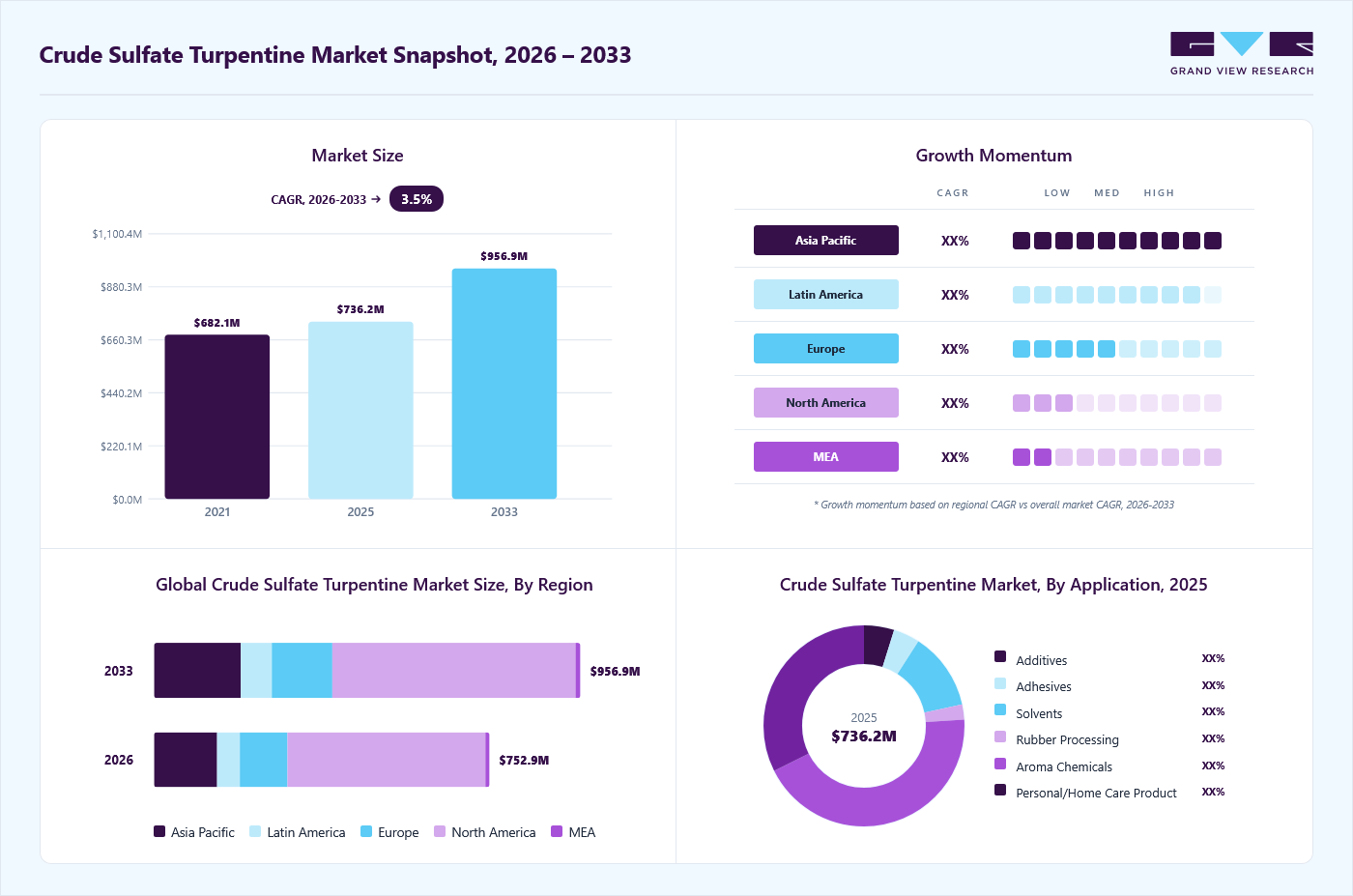 Source: Grand View Research, IR Documents, Primary Interviews, Paid DatabasesTo learn more about this report,
 Download Free Sample Report
Key Market Trends & Insights
- By application: Aroma chemicals segment held the largest market share of 43.5% in 2025.
- By product: Beta-pinene segment held the largest market share of 30.8% in 2025.
Regional Highlights
- Largest regional market: North America (59.3% revenue share, 2025)
- Fastest-growing regional market: Asia Pacific (highest CAGR, 2026-2033)
- By country: The U.S. held the largest market share in 2025
Market Size & Forecast
- Market size in 2025: USD 736.3 Million
- Estimated market size in 2026: USD 752.9 Million
- Projected market size by 2033: USD 956.9 Million
- CAGR (2026-2033): 3.5%
Prism AI by Grand View Research Free to tryAsk a question about the crude sulfate turpentine marketTry asking✓Every figure cited from GVR research Prefer the report? Download free sample →
The growing adoption of CST-derived terpenes, such as beta-pinene, in fragrance and specialty chemical formulations, along with the shift toward renewable, bio-based feedstocks, is further driving market expansion. A key factor driving the growth of the global crude sulfate turpentine industry is its strong linkage with the pulp and paper industry, where CST is generated as a by-product of kraft pulping and increasingly utilized as a bio-based feedstock in aroma chemicals, resins, and specialty chemical manufacturing, where performance, consistency, and availability are critical. These applications often require CST-derived terpenes with enhanced characteristics, including chemical purity, stability, and suitability for downstream conversion into high-value intermediates such as beta-pinene and camphor, to ensure efficient processing and end-use performance. To learn more about this report, Download Free Sample Report
Rising awareness of sustainable chemicals, bio-based alternatives, and high-performance fragrance and industrial formulations, along with growing adoption of CST in aroma chemicals and additives applications, is further supporting market expansion. However, challenges such as feedstock dependency on pulp production, price volatility, and supply chain constraints continue to influence the competitive dynamics of the global market.
Market Concentration & Characteristics
The crude sulfate turpentine market is moderately fragmented, with market share distributed among pulp and paper companies, specialty chemical manufacturers, and regional bio-based feedstock suppliers. Key participants, including major players such as DSM-Firmenich, Ingevity, Kraton Corporation, and among others, play a significant role in shaping the competitive landscape. These companies leverage integrated access to pulp-derived feedstock, refining and separation capabilities, proprietary terpene processing technologies, and established distribution networks, enabling them to meet the rising demand across applications such as aroma chemicals, additives, resins, and industrial solvents in the downstream chemical sector.
 To learn more about this report, Download Free Sample Report
At the same time, emerging players in Asia Pacific, Latin America, and Europe are steadily expanding their presence in the global market by leveraging integrated pulp production capacity, cost-efficient manufacturing, and rising regional demand for bio-based chemicals, aroma intermediates, and industrial solvents. These regional suppliers are supported by increasing investments in pulp and paper infrastructure, terpene recovery systems, and downstream chemical processing capabilities to enhance product yield and consistency.
Product Insights
The beta-pinene segment generated the highest revenue share in 2025, accounting for 30.8% of the crude sulfate turpentine industry. Its leading position is supported by widespread use as a key terpene derivative across aroma chemicals, resin intermediates, and specialty chemical applications, due to its cost-effectiveness, high availability, and ability to provide essential functional properties, including chemical reactivity, stability, and suitability for downstream conversion. The segment benefits from strong demand in fragrance and industrial chemical production, where consistent quality and performance are critical.
The camphor segment is expected to grow robustly at a CAGR of 6.2% between 2026 and 2033. Increasing demand for high-performance, multifunctional CST-derived chemicals, capable of delivering enhanced stability, aromatic functionality, and industrial applicability, is accelerating adoption across fragrance formulations, pharmaceutical intermediates, and specialty chemical applications, particularly in emerging markets and high-demand downstream industries.
Application Insights
The aroma chemicals segment remained the primary application segment in 2025, accounting for 43.5% of overall revenue. The segment’s dominance is supported by the widespread use of crude sulfate turpentine as a key bio-based feedstock for terpene derivatives, where properties such as fragrance intensity, chemical reactivity, and suitability for conversion into high-value aroma intermediates are critical. Rising demand for natural and bio-based fragrance ingredients, along with growing preference for sustainable chemical sourcing, is further driving segment growth.
 To learn more about this report, Download Free Sample Report
The additives segment is forecast to grow at a CAGR of 5.2% through 2033. The growing demand for high-performance crude sulfate turpentine derivatives, which offer improved stability, functional versatility, and compatibility across industrial formulations, is driving adoption in resins, coatings, and specialty chemical applications. Additionally, innovations in terpene processing, bio-refining, and value-added chemical conversion are enabling enhanced product efficiency and new application development across downstream industries.
Regional Insights
The North America crude sulfate turpentine market accounted for the largest revenue share of 59.3% in 2025, driven by strong pulp and paper production capacity and steady availability of Crude Sulfate Turpentine as a by-product. The market benefits from well-established kraft pulp manufacturing infrastructure, advanced terpene recovery technologies, and increasing downstream utilization of Crude Sulfate Turpentine in aroma chemicals, resins, and specialty chemical applications. The presence of both major global players and integrated pulp producers, along with rising use of beta-pinene and other terpene derivatives in fragrance and industrial formulations, continues to support substantial market growth throughout the region.
 To learn more about this report, Download Free Sample Report
U.S. Crude Sulfate Turpentine Market Trends
The U.S. accounted for 76.9% of the North America crude sulfate turpentine industry in 2025, driven by strong pulp and paper production and well-established kraft pulping operations. The country’s advanced recovery infrastructure, integrated manufacturing capabilities, and focus on value-added utilization of bio-based by-products continue to support market growth. Both domestic manufacturers and global chemical companies are actively investing in refining and processing technologies to develop high-value terpene derivatives to meet evolving demand across key applications, including aroma chemicals, additives, and specialty chemical intermediates.
Asia Pacific Crude Sulfate Turpentine Market Trends
The Asia Pacific crude sulfate turpentine industry accounted for 18.6% of the regional share in 2025, driven by strong pulp and paper production capacity and increasing availability of Crude Sulfate Turpentine as a by-product. The region benefits from expanding kraft pulping infrastructure, rising integration of bio-based feedstocks, and growing downstream chemical manufacturing capabilities. The increasing demand for aroma chemicals, resins, and industrial solvents is further driving the use of Crude Sulfate Turpentine across key applications, particularly for beta-pinene and camphor derivatives.
The China crude sulfate turpentine market accounted for 41.3% of Asia Pacific in 2025, driven by strong pulp and paper production capacity and large-scale availability of Crude Sulfate Turpentine as a by-product. Growth is supported by the country’s rapidly expanding kraft pulping infrastructure, growing chemical manufacturing capabilities, and increasing integration of bio-based feedstocks into downstream industries. The growing use of beta-pinene and camphor derivatives enables manufacturers to deliver enhanced chemical performance, versatility, and efficiency across key applications.
Europe Crude Sulfate Turpentine Market Trends
The Europe crude sulfate turpentine industry is fueled by strong pulp and paper production capacity and steady availability of Crude Sulfate Turpentine as a by-product, supported by a mature kraft pulping infrastructure and a strong focus on innovation and product quality. Rising adoption of bio-based and multifunctional Crude Sulfate Turpentine derivatives is driving growth across sectors such as aroma chemicals, resins, and specialty chemical manufacturing, where chemical stability, performance efficiency, and sustainable sourcing are key priorities.
The Germany crude sulfate turpentine market is a key country within Europe, driven by strong pulp and paper production capacity and steady availability of Crude Sulfate Turpentine as a by-product. Growth is supported by the country’s focus on technological innovation, high-quality chemical production, and compliance with strict environmental and sustainability standards. Manufacturers are increasingly adopting advanced bio-based terpene processing and specialty chemical formulations to improve performance efficiency, chemical stability, and value addition across applications such as aroma chemicals, resins, and industrial solvents, reinforcing Germany’s position as a leading market within the region.
Latin America Crude Sulfate Turpentine Market Trends
The Latin America crude sulfate turpentine industry is experiencing robust growth, driven by increasing pulp and paper production capacity and steady availability of Crude Sulfate Turpentine as a by-product. The expansion of kraft pulping infrastructure, adoption of bio-based chemical technologies, and increased focus on the value-added utilization of terpene derivatives are supporting regional market development. Key countries with growing industrial and chemical manufacturing activities are providing new opportunities for the use of Crude Sulfate Turpentine in aroma chemicals, resins, and specialty chemical applications across a range of downstream industries.
Middle East and Africa Crude Sulfate Turpentine Market Trends
The Middle East & Africa crude sulfate turpentine industry is witnessing steady growth, driven by increasing pulp and paper production capacity and steady availability of Crude Sulfate Turpentine as a by-product across key industrial hubs. Rising adoption of bio-based and high-performance Crude Sulfate Turpentine derivatives, particularly in downstream chemical manufacturing, is fueling regional market expansion. Also, ongoing investments in chemical processing capabilities, bio-refining technologies, and distribution networks are supporting broader market penetration and strengthening the region’s position in the global market.
Key Crude Sulfate Turpentine Company Insights
The crude sulfate turpentine market features a mix of pulp and paper companies, specialty chemical producers, and bio-based materials manufacturers. Leading participants focus on developing high-value terpene derivatives and downstream chemical intermediates while incorporating sustainable production practices and efficient resource utilization. Companies are increasingly investing in terpene recovery systems, refining technologies, and value-added chemical processing to enhance competitiveness and comply with evolving sustainability and industrial requirements.
Prominent players in the crude sulfate turpentine industry include DSM-Firmenich, Ingevity, and Kraton Corporation. These companies leverage extensive pulp integration, advanced separation and refining capabilities, and global distribution networks to deliver bio-based chemical solutions across applications such as aroma chemicals, resins, additives, and industrial solvent manufacturing worldwide.
Key Crude Sulfate Turpentine Companies:
The following key companies have been profiled for this study on the crude sulfate turpentine market.
- DSM-Firmenich
- Ingevity
- Kraton Corporation
- ORGKHIM Biochemical Holding
- Pine Chemical Group
- International Flavors & Fragrances, Inc. (IFF)
- Symrise
- WestRock Company
- Stora Enso
- Harting Technology Group
- Pinova, Inc.
- Weyerhaeuser Company
Recent Developments
- In April 2024, Kraton Corporation expanded its partnership with Nordmann to strengthen the distribution of pine-based resin products across multiple European countries, targeting applications in paints, coatings, and adhesives. This development enhances the accessibility of Crude Sulfate Turpentine (CST)-derived specialty resins in key downstream markets, supporting wider commercial adoption. By leveraging bio-based feedstocks such as CST and crude tall oil, Kraton continues to offer sustainable alternatives with lower carbon footprints compared to fossil-based materials. Such initiatives are driving market growth by expanding application scope, improving product availability, and accelerating the shift toward bio-based chemical solutions.
Crude Sulfate Turpentine Market Report Scope
Report Attribute
Details
Market size in 2025
USD 736.3 million
Estimated market size in 2026
USD 752.9 million
Projected market size by 2033
USD 956.9 million
Growth rate
CAGR of 3.5% from 2026 to 2033
Base year for estimation
2025
Historical data
2021 - 2024
Forecast period
2026 - 2033
Quantitative units
Revenue in USD million, volume in kilotons, and CAGR from 2026 to 2033
Report coverage
Revenue forecast, volume forecast, company ranking, competitive landscape, growth factors, and trends
Segments covered
Product, application, region
Regional scope
North America; Europe; Asia Pacific; Middle East & Africa; Latin America
Country scope
U.S.; Canada; Mexico; Germany; UK; France; Italy; Spain; China; India; Japan; South Korea; Brazil; Argentina; South Africa; Saudi Arabia
Key companies profiled
DSM-Firmenich; Ingevity; Kraton Corporation; ORGKHIM Biochemical Holding; Pine Chemical Group; International Flavors & Fragrances, Inc. (IFF); Symrise; WestRock Company; Stora Enso; Harting Technology Group; Pinova, Inc.; Weyerhaeuser Company
Customization scope
Free report customization (equivalent up to 8 analysts’ working days) with purchase. Addition or alteration to country, regional & segment scope.
Pricing and purchase options
Avail customized purchase options to meet your exact research needs. Explore purchase options
Global Crude Sulfate Turpentine Market Report Segmentation
This report forecasts revenue & volume growth at the global, regional, and country levels and provides an analysis of the latest industry trends in each of the sub-segments from 2021 to 2033. For this study, Grand View Research has segmented the global crude sulfate turpentine market report based on product, application, and region:
 To learn more about this report, Download Free Sample Report
-
Product Outlook (Volume, Kilotons; Revenue, USD Million, 2021 - 2033)
-
Carene
-
Terpineol
-
Camphor
-
Pinane Hydro peroxide
-
Pure alpha-pinene
-
Beta-Pinene
-
Terpene Resins
-
Limonene
-
-
Application Outlook (Volume, Kilotons; Revenue, USD Million, 2021 - 2033)
-
Additives
-
Adhesives
-
Solvents
-
Rubber Processing
-
Aroma Chemicals
-
Personal/Home Care Product
-
-
Regional Outlook (Volume, Kilotons; Revenue, USD Million, 2021 - 2033)
-
North America
-
U.S.
-
Canada
-
Mexico
-
-
Europe
-
Germany
-
UK
-
France
-
Italy
-
Spain
-
-
Asia Pacific
-
China
-
India
-
Japan
-
South Korea
-
-
Latin America
-
Brazil
-
Argentina
-
-
Middle East & Africa
-
Saudi Arabia
-
South Africa
-
-
Frequently Asked Questions About This Report
North America dominated with a 59.3% revenue share in 2025.
Asia Pacific is the fastest-growing region over the forecast period.
The aroma chemicals segment led with a 43.5% revenue share in 2025.
The beta-pinene segment held the largest share of 30.8% in 2025 within the Global Crude Sulfate Turpentine Market. This dominant position is largely due to its strong availability as a key terpene derivative, high conversion efficiency, and ability to serve as a primary intermediate in aroma chemicals, resin production, and specialty chemical applications.
Key players include DSM-Firmenich; Ingevity; Kraton Corporation; ORGKHIM Biochemical Holding; Pine Chemical Group; International Flavors & Fragrances, Inc. (IFF); Symrise; WestRock Company; Stora Enso; Harting Technology Group; Pinova, Inc.; Weyerhaeuser Company.
Key factors driving the growth of the Global Crude Sulfate Turpentine Market include increasing availability of Crude Sulfate Turpentine as a by-product from kraft pulp production, along with a growing emphasis on value-added utilization of bio-based feedstocks. Rising adoption of Crude Sulfate Turpentine derivatives such as beta-pinene and camphor across aroma chemicals, resins, and specialty chemical applications is further supporting overall market expansion, driven by demand for sustainable, high-performance, and cost-efficient chemical alternatives.
The global crude sulfate turpentine market size was valued at USD 736.3 million in 2025 and is estimated at USD 752.9 million for 2026.
The global crude sulfate turpentine market is expected to grow at a CAGR of 3.5% from 2026 to 2033, reaching USD 956.9 million by 2033.
About the Author(s)
Renewable Chemicals Research Team
Specialty & Chemicals · Renewable ChemicalsThis report was authored by the renewable chemicals research team at Grand View Research - comprising two research analysts, one senior research analyst, and one industry expert - with specialized expertise in the renewable chemicals segment of the specialty & chemicals industry. All findings are based on proprietary specialty & chemicals databases, executive interviews, and regulatory analysis, subject to internal peer review prior to publication.
Last Updated:
Speak to Analyst

Customize this report to your needs - add regions, segments, or data points, with 20% free customization.
Or view our licence options:


ISO 9001:2015 & 27001:2022 Certified
We are GDPR and CCPA compliant! Your transaction & personal information is safe and secure. For more details, please read our privacy policy.


