
- Home
- »
- Next Generation Technologies
- »
-
Cryptocurrency Payment Apps Market Report, 2026-2033GVR Report cover

Cryptocurrency Payment Apps Market (2026 - 2033)
Size, Share & Trends Analysis Report By Cryptocurrency Type (Bitcoin, Ethereum, Litecoin), By Payment Type (In-Store Payment, Online Payment), By Type, By End User, By Region, And Segment Forecasts
Market Size, 2025
$646.3MMarket Estimate, 2026
$752.6MMarket Forecast, 2033
$2,404.1MCAGR, 2026–2033
18.0%Cryptocurrency Payment Apps Market Summary
The global cryptocurrency payment apps market size was valued at USD 646.3 million in 2025 and is projected to grow from USD 752.6 million in 2026 to USD 2,404.1 million by 2033, at a CAGR of 18.0% from 2026 to 2033. North America dominated the market, accounting for a revenue share of 34.7% in 2025. The emergence of Web3 and blockchain technology created the need for cryptocurrency payment apps to enable individuals to conduct seamless transactions.
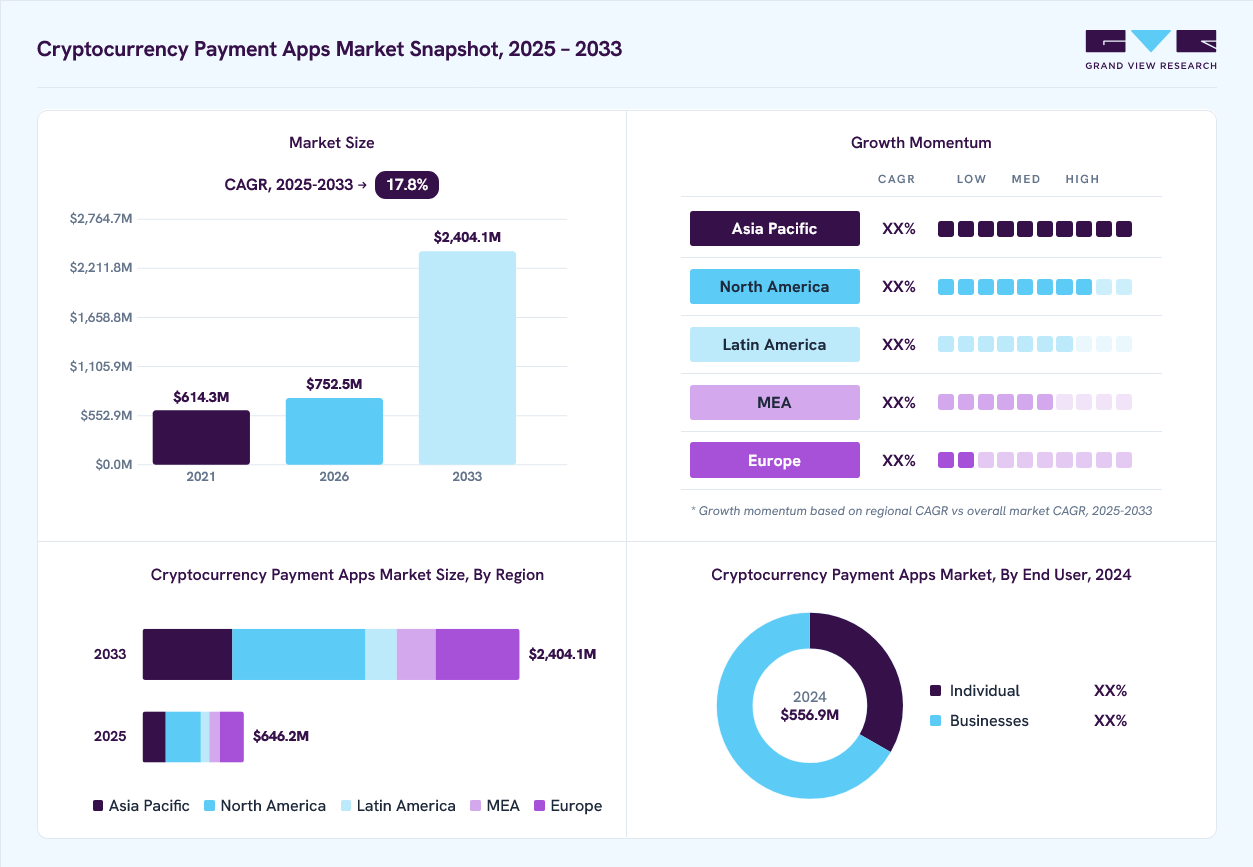 Source: Grand View Research, IR Documents, Primary Interviews, Paid DatabasesTo learn more about this report,
 Download Free Sample Report
 Key Market Trends & Insights
- By cryptocurrency type: Bitcoin segment dominated the market, with a revenue share of 40.1% in 2025.
- By payment type: In-store payment segment held the largest market share of 66.6% in 2025.
- By operating system: Android segment held the largest revenue share in 2025.
Regional Highlights
- Largest regional market: North America (34.7% revenue share, 2025)
- Fastest-growing regional market: Asia Pacific (highest CAGR, 2026-2033)
- By country: The U.S. held the largest revenue share in the North America.
Market Size & Forecast
- Market size in 2025: USD 646.3 Million
- Estimated market size in 2026: USD 752.6 Million
- Projected market size by 2033: USD 2,404.1 Million
- CAGR (2026-2033): 18.0%
Three ways to get this report
Buy it, customize it, or ask a question.Ask an Analyst
Analyst response in 1 business day
- AccessReport author, directly
- Reply timeWithin 1 working day
- No sales callDirect answer only
- FormatEmail reply
- CostFree, no cost
Get the Full Report
What the study covers
- FormatsPDF · Excel · Dashboard
- Timeline2026–2033 annual, 2025 base
- Coverage20+ countries, 5 regions
- Companies10+ key players profiled
Customize the Report
20% free customization
- IncludeCountries, segments, points
- TailorTo your product definition
- ExtendDeeper competitor detail
- OrA fully bespoke study
- Turnaround5–10 working days
The growing adoption of cryptocurrencies globally is the key driver for the market's expansion. People are encouraged to use cryptocurrency payment platforms owing to the decentralized nature of the blockchain, which eliminates mediators such as banks from the payment processing system. It reduces the processing time and accelerates the transaction speed, consequently adding to the increasing popularity of such platforms. In addition, the growing prevalence of cryptocurrencies as an investment option among millennials is also fueling the growth of the cryptocurrency payment apps industry. To learn more about this report, Download Free Sample Report
 One of the most transformative trends in the market is the increasing interoperability between crypto payment platforms and traditional banking systems. Crypto apps now allow users to seamlessly convert digital assets into fiat currencies and vice versa, enabling easier withdrawals, direct-to-bank transfers, and debit card functionalities. This fusion is bridging the gap between old and new financial infrastructures, encouraging a smoother transition for users hesitant to move entirely into decentralized finance (DeFi). Thus, increasing integration of cryptocurrency payment apps with traditional financial systems can be attributed to the market’s growth.
The proliferation of mobile payment adoption and advancements in cybersecurity are further propelling the market. Cryptocurrency payment apps are leveraging biometric authentication, multi-signature wallets, and hardware-based security modules to enhance transaction safety. Coupled with the increasing global smartphone penetration, especially in emerging economies, these innovations are making digital asset payments more accessible and secure for a broader audience. In addition, the continual developments and innovations to enhance the consumer’s experience in the blockchain space are expected to create a positive outlook for the market.
The expansion of the DeFi and Web3 ecosystem is playing a pivotal role in advancing cryptocurrency payment apps. However, a lack of awareness about the benefits offered by cryptocurrency payment apps is expected to restrain the growth of the market over the forecast period. In addition, the lack of trust among the users, as no centralized regulator is authenticating this transaction, is one of the major obstacles to the market’s growth. However, the significant efforts taken by some of the market players are anticipated to establish market growth.
Market Dynamics
The cryptocurrency payment apps market is driven by increasing digital asset adoption, growing blockchain integration in financial services, and rising demand for efficient cross-border transactions. While regulatory uncertainty, compliance requirements, and cryptocurrency price volatility continue to present challenges, the market is benefiting from technological advancements, expanding merchant acceptance, and increasing consumer interest in decentralized financial ecosystems. Growing adoption of stablecoins and blockchain-based payment infrastructure is expected to further support long-term market growth.
The increasing acceptance of cryptocurrencies as a legitimate asset class and medium of exchange is a driving the growth of the cryptocurrency payment apps market. Rising awareness of digital assets among consumers and businesses, coupled with the growing popularity of blockchain technology, has encouraged users to adopt cryptocurrency payment applications for transactions, remittances, and peer-to-peer transfers. The expansion of cryptocurrency ecosystems, including exchanges, digital wallets, and decentralized finance (DeFi) platforms, is further accelerating demand for convenient and secure payment applications that enable seamless crypto transactions.
Businesses are also increasingly integrating cryptocurrency payment options to attract digitally savvy consumers and expand payment flexibility. The ability to facilitate cross-border transactions with lower intermediary costs and faster settlement times compared to traditional payment systems is enhancing the appeal of cryptocurrency payment apps. As blockchain infrastructure matures and institutional participation in digital assets continues to increase, the adoption of cryptocurrency payment applications is expected to grow significantly.
Regulatory uncertainty is restraining the growth of the cryptocurrency payment apps market. Governments and regulatory authorities across different jurisdictions continue to develop evolving frameworks governing cryptocurrency transactions, taxation, anti-money laundering (AML), and know-your-customer (KYC) requirements. Variations in regulatory approaches create compliance complexities for cryptocurrency payment app providers operating across multiple regions, increasing operational risks and limiting market expansion.
In addition, concerns related to financial crime, consumer protection, and transaction transparency have prompted stricter regulatory oversight in many countries. Frequent changes in cryptocurrency regulations can create uncertainty for businesses and users, discouraging broader adoption of crypto payment solutions. Compliance costs associated with licensing, reporting requirements, and security controls may further challenge smaller market participants and slow the pace of innovation within the industry.
The growing demand for efficient cross-border payment and remittance solutions presents a significant opportunity for the cryptocurrency payment apps market. Traditional international payment systems often involve multiple intermediaries, high transaction fees, and lengthy settlement periods. Cryptocurrency payment applications leverage blockchain technology to facilitate real-time transfers across borders, reducing transaction costs and improving payment efficiency for individuals and businesses.
This opportunity is particularly relevant in regions with large migrant populations, underdeveloped banking infrastructure, or high remittance volumes. Cryptocurrency payment apps can provide financial access to underserved populations while enabling businesses to conduct international transactions more efficiently. As stablecoins and blockchain-based payment networks gain traction, cryptocurrency payment providers are increasingly positioned to capitalize on the growing need for faster, more transparent, and cost-effective global payment solutions.
Analyst Perspective
The cryptocurrency payment apps market is evolving from a niche digital asset ecosystem into a broader alternative payments landscape, driven by growing cryptocurrency ownership, increasing merchant acceptance, and demand for faster cross-border transactions. The market is benefiting from advancements in blockchain infrastructure, stablecoin adoption, and the integration of cryptocurrency payment capabilities into mainstream financial services. While regulatory uncertainty and digital asset price volatility continue to pose challenges, ongoing improvements in security, compliance frameworks, and user experience are strengthening market confidence.
Cryptocurrency Type Insights
Based on cryptocurrency type, the bitcoin segment led the market with the largest revenue share of 40.1% in 2025. Dominance is attributable to Bitcoin being the pioneer of the industry. In addition, it guarantees the uncompromised security of the payment systems owing to the proof-of-work mechanism ensured by the users of the decentralized Bitcoin network. Bitcoin, as a blockchain-based currency, needs volunteers to sign hashes that use cryptography to verify transactions over the bitcoin network. This method ensures that transactions are typically irreversible; as a result, Bitcoin has high data security, driving the segment’s growth.
The Ethereum segment is expected to witness a significant CAGR over the forecast period. The major factor of growth is that Ethereum paved the way for Non-Fungible Tokens (NFTs) and laid the foundation for the digital asset revolution. It was the earliest smart-contract-enabled network. In addition, it has become considerably easier to define ownership and control transferability of NFTs due to smart contracts, which is expected to create further opportunities for the market.
Payment Type Insights
Based on payment type, the in-store payment segment led the market with the largest revenue share of 66.6% in 2025. The demand for digital payment methods is increasing owing to digitalization and the acceptance of contactless payments. Cryptocurrency payment apps provide a platform to transact in cryptocurrencies, and retailers can accept payments just by installing a QR code or NFC terminal in the POS. Moreover, the transaction fees are comparably lower than the traditional payment platform, which is estimated to attract more consumers to opt for cryptocurrency payment apps.
The online payment segment is expected to grow at the fastest CAGR of 18.3% during the forecast period. One of the major reasons for the segment’s growth is the rising prevalence of e-commerce platforms. Moreover, the recognition of cryptocurrencies and technology globally is driving the segment's growth. In addition, the ease of performing transactions across borders is also promoting growth.
Type Insights
The Android segment dominated the cryptocurrency payment apps market in 2024. The segment’s growth can be attributed to its widespread global adoption and open-source flexibility. With a strong user base in emerging markets, Android serves as a vital platform for reaching unbanked and underbanked populations seeking alternative financial solutions. Its customizable nature also allows developers to integrate blockchain technologies and optimize crypto apps for a broader range of device specifications and price points. Furthermore, Android’s integration with decentralized browsers and support for third-party app stores facilitates innovation and faster deployment of new crypto features.
The iOS segment is expected to witness a notable CAGR over the forecast period. iOS users tend to engage more with digital financial services, including cryptocurrency wallets and payment apps, due to higher disposable income and greater exposure to fintech innovations. Apple’s robust privacy and security architecture also appeals to users concerned about safeguarding their digital assets, making iOS an attractive platform for premium and enterprise-level crypto app solutions. In addition, recent support for blockchain development tools within the Apple ecosystem is gradually fostering more compliant and user-friendly crypto app experiences on iOS.
End User Insights
Based on end user, the businesses segment led the market with the largest revenue share of 66.9% in 2025. Businesses are increasingly adopting cryptocurrency payment apps to cater to evolving customer preferences and tap into global markets with lower transaction costs and faster settlement times. From e-commerce platforms and retail outlets to SaaS providers and freelancers, a growing number of enterprises are accepting cryptocurrencies to enhance payment flexibility and improve customer experience. In addition, crypto payments provide an edge in cross-border trade by eliminating the need for traditional intermediaries and reducing currency conversion complexities.
 To learn more about this report, Download Free Sample Report
 The individual segment is expected to witness the fastest CAGR over the forecast period. The growing preference and rapid adoption of digital payment methods are fueling the segment’s growth. In addition, social media campaigns to promote the utilization of cryptocurrencies as an investment alternative are also propelling the growth of the segment. Moreover, cryptocurrencies can be kept in a physical wallet or in a digital wallet that you can access from a computer, a phone, or another device, which makes them a reliable alternative to fiat currencies.
Regional Insights
North America dominated the global cryptocurrency payment apps market with the largest revenue share of 34.7% in 2025. The presence of several prominent players in the region stimulates market growth. In addition, the collaborative efforts that have been made by some of the market players toward the acceptance of cryptocurrency payments are expected to create further opportunities for regional growth.
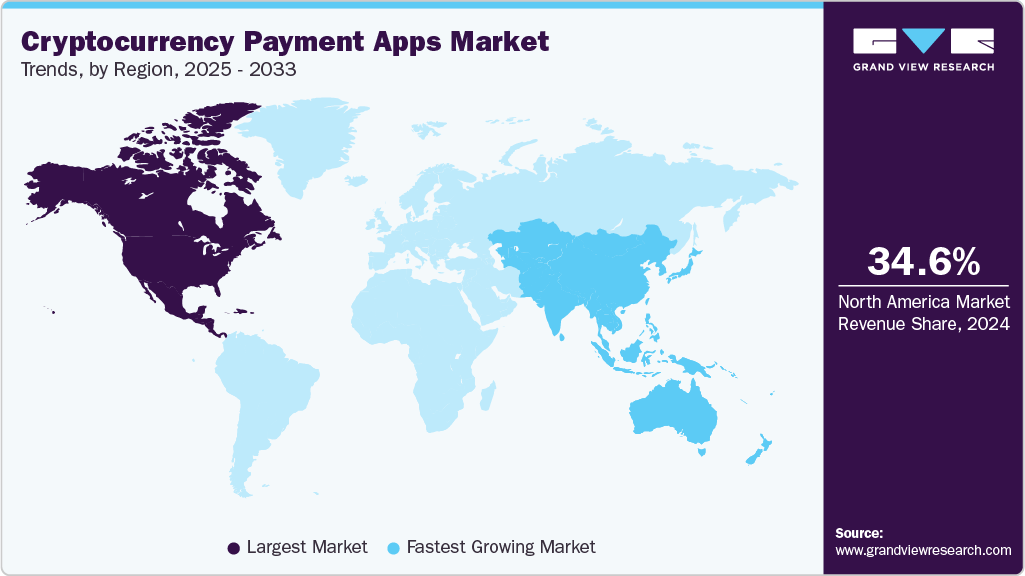 To learn more about this report, Download Free Sample Report
 U.S. Cryptocurrency Payment Apps Market Trends
U.S. cryptocurrency payment apps held the largest revenue share in the North America. A key growth driver is the increasing adoption of cryptocurrencies as a payment method by both consumers and businesses. Leading corporations and retailers are beginning to accept digital currencies, significantly enhancing their practical value. This shift is largely fueled by the growing demand for faster, more flexible, and efficient payment solutions-needs that cryptocurrencies are well-positioned to meet.
Europe Cryptocurrency Payment Apps Market Trends
The Europe cryptocurrency payment apps industry is expected to register a notable CAGR from 2025 to 2033. The use of cryptocurrencies for buying goods and services is gaining significant traction in Europe, primarily driven by supportive national regulatory frameworks. Several EU member states are proactively promoting blockchain innovation through grants, tax incentives, and regulatory sandboxes. The growing integration of crypto wallets with e-commerce platforms and neobanks is helping drive adoption across the continent.
The UK cryptocurrency payment apps market is expected to grow at a significant CAGR from 2025 to 2033. The country’s market growth is driven by its position as a major global fintech hub. Regulatory agencies such as the Financial Conduct Authority (FCA) are actively engaging with crypto firms to ensure compliance while fostering innovation. Consumer adoption is gaining momentum, particularly among tech-savvy millennials and digital entrepreneurs who prefer fast and flexible payment options.
The cryptocurrency payment apps market in Germany held a substantial market share in 2024, owing to its early regulatory clarity and strong consumer trust in licensed financial services. As the first country in the EU to officially recognize crypto assets as financial instruments, Germany has enabled banks and fintech firms to integrate digital currencies into their offerings legally. Adoption is rising among both individuals and businesses, supported by a robust economy, high smartphone usage, and growing merchant acceptance of crypto payments.
Asia Pacific Cryptocurrency Payment Apps Market Trends
The Asia Pacific cryptocurrency payment apps industry is expected to grow at a CAGR of 13.1% during the forecast period.The growth is attributable to the rapid technological advancements and growing acceptance of digital currency across the region. The efforts being pursued by several organizations across Asia Pacific to promote the use of cryptocurrency payment apps are also expected to contribute to the growth of the segment. Additionally, an increase in alliances and cooperative efforts among the industry participants in this region is promoting market expansion.
India’s cryptocurrency payment apps market is expected to grow at the fastest growth rate during the forecast period. The market growth is supported by a booming digital economy and one of the world’s largest bases of mobile internet users. While regulatory clarity around crypto assets remains a challenge, rising interest among retail investors and the proliferation of crypto exchanges have significantly driven wallet app downloads and usage.
The cryptocurrency payment apps market in Japan held a substantial market share in 2024. Japan represents one of the most mature and regulated markets for cryptocurrency payment apps globally. Digital currencies, particularly Bitcoin and altcoins, have seen widespread popularity across the country. Japan is well-known for its strong embrace of cryptocurrencies, with a growing number of individuals and businesses actively investing in or utilizing them for a range of financial and transactional purposes. A well-developed fintech ecosystem, high smartphone penetration, and a tech-savvy population have contributed to the growth in the use of crypto payment applications in the country.
Key Cryptocurrency Payment Apps Company Insights
Some of the key companies in the cryptocurrency payment apps industry include Coinbase, Binance, and BitPay, among others. These players are competing on the basis of user experience, transaction speed, security, and the breadth of supported assets. These companies are continuously expanding their service offerings, including integrated wallets, rewards programs, and fiat-to-crypto conversion tools, to retain and grow their user base.
-
Coinbase is one of the most prominent cryptocurrency platforms globally. Initially established as a digital asset exchange, Coinbase has significantly expanded its offerings to include a robust mobile payment app that enables users to buy, sell, store, and use cryptocurrencies for transactions. With a user-friendly interface, institutional-grade security, and support for a wide range of digital currencies, Coinbase is widely used by both individual and institutional investors.
-
Binance offers Binance Pay, a contactless, borderless, and secure crypto payment application. Binance Pay enables users to send and receive payments in cryptocurrency with zero fees, supporting a wide array of tokens. The platform is integrated within the broader Binance ecosystem, which includes trading, savings, NFTs, and DeFi products, offering a seamless experience for users looking to utilize digital assets beyond investment.
Key Cryptocurrency Payment Apps Companies
The following key companies have been profiled for this study on the cryptocurrency payment apps market.
-
Coinbase
-
BitPay
-
Coinomi
-
Paytomat
-
Apirone OÜ
-
SecuX Technology Inc.
-
Circle Internet Financial Limited
-
Binance
-
CoinJar UK Limited
-
Cryptopay Ltd.
Competitive Benchmarking
Operating Strategies
Competitive Edge
Weaknesses
Established Players (Coinbase, BitPay, Binance)
- Focus on expanding cryptocurrency payment ecosystems through wallet services, merchant payment solutions, crypto-fiat conversion services, cross-border payment capabilities, and regulatory compliance initiatives.
- These companies invest heavily in platform security, user acquisition, merchant and financial institution partnerships, and global market expansion.
- Strong brand recognition, large user bases, extensive cryptocurrency support, established regulatory frameworks, high transaction volumes, and broad geographic presence.
- Their integrated ecosystems enable seamless trading, payments, custody, and digital asset management services.
- Large-scale operations may face challenges related to maintaining profitability during periods of reduced trading and transaction activity.
Emerging Players (Coinomi, Paytomat)
- Focus on niche payment solutions, self-custody wallets, merchant-focused cryptocurrency payment tools, hardware wallet integration, and blockchain-based payment innovations.
- These companies often target specific customer segments and emphasize flexibility, privacy, and specialized functionality.
- Greater agility, faster product innovation, specialized cryptocurrency payment features, and the ability to serve niche user communities with tailored solutions.
- Smaller customer bases, lower brand visibility, limited financial resources, and narrower geographic reach compared to established competitors.
Recent Developments
-
In June 2025, Kraken introduced a new all-in-one global financial app called Krak, designed to offer users a faster, more cost-effective, and flexible way to manage their money worldwide. The Krak app seamlessly integrates the advantages of cryptocurrencies with traditional financial services. It allows users to send money to over 110 countries, manage a portfolio of more than 300 fiat and digital assets, and earn rewards on their holdings, all within a single, unified platform.
-
In May 2025, Ripple launched cross-border blockchain payment services in the UAE to accelerate cryptocurrency adoption in the region. The system will be primarily utilized by Zand Bank, the UAE’s first fully digital bank, and fintech company Mamo. Ripple’s platform, Ripple Payments, combines stablecoins, cryptocurrencies, and fiat currencies to deliver faster transaction settlements and significantly lower fees compared to traditional cross-border payment systems.
Cryptocurrency Payment Apps Market Report Scope
Report Attribute
Details
Market size in 2025
USD 646.3 million
Estimated market size in 2026
USD 752.6 million
Projected market size by 2033
USD 2,404.1 million
Growth rate
CAGR of 18.0% from 2026 to 2033
Base year for estimation
2025
Historical data
2021 - 2024
Forecast period
2026 - 2033
Quantitative units
Revenue in USD million/billion and CAGR from 2026 to 2033
Report coverage
Revenue forecast, company ranking, competitive landscape, growth factors, and trends
Segments covered
Cryptocurrency type, payment type, operating system, end user, region
Regional scope
North America; Europe; Asia Pacific; Latin America; MEA
Country scope
U.S.; Canada; Mexico; U.K.; Germany; France; China; Japan; India; Australia; South Korea; Brazil; Saudi Arabia ; UAE; South Africa
Key companies profiled
Coinbase, BitPay, Coinomi, Paytomat, Apirone OÜ, SecuX Technology Inc., Circle Internet Financial Limited, Binance, CoinJar UK Limited, Cryptopay Ltd.
Customization scope
Free report customization (equivalent up to 8 analysts' working days) with purchase. Addition or alteration to country, regional & segment scope.
Pricing and purchase options
Avail customized purchase options to meet your exact research needs. Explore purchase options
Global Cryptocurrency Payment Apps Market Report Segmentation
This report forecasts revenue growth at global, regional, and country levels and provides an analysis of the latest industry trends in each of the sub-segments from 2021 to 2033. For this study, Grand View Research has segmented the global cryptocurrency payment apps market report based on cryptocurrency type, payment type, type, end user, and region:
-
Cryptocurrency Type Outlook (Revenue, USD Million, 2021 - 2033)
-
Bitcoin
-
Ethereum
-
Litecoin
-
DAI
-
Ripple
-
Others
-
-
Payment Type Outlook (Revenue, USD Million, 2021 - 2033)
-
In-Store Payment
-
Online Payment
-
-
Type Outlook (Revenue, USD Million, 2021 - 2033)
-
Android
-
iOS
-
Others
-
-
End User Outlook (Revenue, USD Million, 2021 - 2033)
-
Individuals
-
Businesses
-
-
Regional Outlook (Revenue, USD Million, 2021 - 2033)
-
North America
-
U.S.
-
Canada
-
Mexico
-
-
Europe
-
Germany
-
UK
-
France
-
Nordic Countries
-
-
Asia Pacific
-
Japan
-
India
-
South Korea
-
Australia
-
-
Latin America
-
Brazil
-
-
Middle East and Africa (MEA)
-
KSA
-
UAE
-
South Africa
-
-
Research Methodology
The cryptocurrency payment apps market figures in this report are based on a proven research process that combines executive interviews with secondary research from proprietary databases, company filings, and recognized regulatory and institutional sources. Market size is built through value-chain sizing-reconciling supply-side and demand-side estimates-and triangulated with bottom-up and top-down approaches. Every estimate passes multiple levels of expert validation before publication, with each cryptocurrency payment apps segment quantified using the revenue-capture definitions in the table below.
Segment Definition
Segment – Cryptocurrency type
Revenue capture definition
Bitcoin
Bitcoin refers to cryptocurrency payment transactions conducted using Bitcoin (BTC), the world's first and most widely adopted cryptocurrency.
Ethereum
Ethereum refers to cryptocurrency payment transactions conducted using Ether (ETH), the native cryptocurrency of the Ethereum blockchain.
Litecoin
Litecoin refers to payments made with Litecoin (LTC), a cryptocurrency designed to provide faster transaction confirmation times and lower transaction fees than Bitcoin.
DAI
DAI refers to payment transactions conducted using DAI, a decentralized stablecoin designed to maintain a value approximately equivalent to one U.S. dollar.
Ripple
Ripple refers to cryptocurrency payment transactions utilizing XRP, the digital asset associated with Ripple's payment network.
Others
The others segment includes all other cryptocurrencies supported by payment applications beyond Bitcoin, Ethereum, Litecoin, DAI, and Ripple.
Segment – Payment Type
Revenue capture definition
In-Store Payment
In-store payment refers to cryptocurrency transactions conducted at physical merchant locations using cryptocurrency payment applications. In this payment type, customers use mobile apps or digital wallets to pay for goods and services by scanning QR codes, utilizing Near Field Communication (NFC) technology, or authorizing payments directly through supported cryptocurrency payment platforms.
Online Payment
Online payment refers to cryptocurrency transactions conducted through digital channels such as e-commerce websites, online marketplaces, subscription platforms, gaming portals, travel booking websites, and digital service providers. Cryptocurrency payment apps enable users to make purchases, transfer funds, and settle invoices online using supported cryptocurrencies without relying on traditional banking networks or card payment systems.
Segment – Operating System
Revenue capture definition
iOS
iOS refers to cryptocurrency payment applications designed to operate on Apple's iOS operating system, including iPhones and iPads. These applications enable users to store, send, receive, and manage cryptocurrencies while facilitating digital payments through mobile devices.
Android
Android refers to cryptocurrency payment applications developed for devices operating on Google's Android operating system. These apps allow users to conduct cryptocurrency transactions, manage digital assets, make merchant payments, transfer funds, and access blockchain-based financial services through Android smartphones and tablets.
Others
The others segment includes cryptocurrency payment applications operating on alternative platforms beyond iOS and Android. This category may include applications designed for Windows-based mobile devices, HarmonyOS, Linux-based mobile platforms, and web-based cryptocurrency payment applications.
Segment – End User
Revenue capture definition
Individual
Individuals are consumers who use cryptocurrency payment applications for personal financial transactions, including peer-to-peer transfers, online purchases, in-store payments, remittances, bill payments, and digital asset management. These users leverage cryptocurrency payment apps to store, send, receive, and manage cryptocurrencies on mobile devices or in digital wallets, while benefiting from blockchain-based transaction security and global accessibility.
Businesses
Businesses use cryptocurrency payment applications to accept, process, and manage transactions with customers, suppliers, and business partners. This segment includes retailers, e-commerce companies, hospitality providers, travel operators, gaming platforms, financial institutions, and other enterprises that integrate cryptocurrency payment solutions into their payment infrastructure.
Estimation Model
Layer Name
Description
Cryptocurrency Ecosystem & Digital Asset Adoption Layer
Evaluates the broader cryptocurrency ecosystem, including cryptocurrency ownership, blockchain adoption, digital wallet penetration, internet accessibility, smartphone usage, and regulatory developments. This layer assesses the overall user base and market environment supporting the adoption of cryptocurrency payment applications across regions and countries.
Cryptocurrency Payment App Adoption Layer
Assesses the penetration of cryptocurrency payment apps among consumers and businesses. The analysis includes user registrations, active wallet users, merchant acceptance levels, transaction frequency, mobile payment adoption, and integration of cryptocurrency payment functionality within digital commerce ecosystems.
Payment Type, Cryptocurrency Type & End-User Demand Layer
Evaluates demand across payment types such as in-store and online payments, cryptocurrency types including Bitcoin, Ethereum, Litecoin, DAI, Ripple, and others, and end-user categories comprising individuals and businesses. This layer analyzes transaction volumes, payment behavior, merchant acceptance, and cryptocurrency usage trends that influence market growth.
Revenue Monetization Layer
Estimates revenue generated through cryptocurrency payment app platforms and related services. Revenue streams include transaction fees, payment processing charges, currency conversion fees, merchant service fees, wallet subscriptions, premium features, custody services, cross-border transfer fees, and value-added financial services. Revenue contributions are aggregated across payment app providers, crypto wallet operators, exchanges, fintech companies, and blockchain payment service providers.
Delivered Customizations
This report has been delivered with the following In-depth customizations
Client Request
Customization Delivered
Value Adds
Merchant Acceptance and Ecosystem Assessment
Analysis of cryptocurrency payment acceptance across retail, e-commerce, travel, gaming, hospitality, and service industries using secondary sources such as company announcements, merchant databases, and industry reports.
Provides insights into industry-specific adoption trends and merchant expansion opportunities.
Competitive Landscape and Company Benchmarking
Comprehensive profiling and benchmarking of leading cryptocurrency payment app providers based on product portfolio, supported cryptocurrencies, geographic presence, partnerships, funding activities, acquisitions, and recent developments derived from company disclosures and public databases.
Supports competitive intelligence, partnership evaluation, and strategic market positioning.
Blockchain and Digital Asset Ecosystem Mapping
Analysis of key ecosystem participants, including exchanges, wallet providers, payment processors, stablecoin issuers, blockchain networks, and merchant service providers using publicly available information.
Enhances understanding of the value chain, partnership opportunities, and competitive dynamics.
Frequently Asked Questions About This Report
Asia Pacific is the fastest growing region over the forecast period.
The bitcoin segment lead with the 40.1% revenue share in 2025, while Ethereum segment is expected to grow at a significant CAGR over the forecast period.
The in-store payment segment held the largest revenue share in 2025, while online payment represents significant growing area.
The businesses held the largest revenue share (66.9)% revenue share in 2025, while individual segment is expected to grow at significant CAGR over the forecast period.
The global cryptocurrency payment apps market size was estimated at USD 646.3 million in 2025 and is expected to reach USD 752.6 million in 2026.
The global cryptocurrency payment apps market is expected to grow at a compound annual growth rate of 18.0% from 2026 to 2033 to reach USD 2,404.1 million by 2033
The increasing acceptance of cryptocurrencies as a legitimate asset class and medium of exchange is a driving the growth of the cryptocurrency payment apps market.
Some key players operating in the cryptocurrency payment apps market include Coinbase, BitPay, Coinomi, Paytomat, Apirone OÜ, SecuX Technology Inc., Circle Internet Financial Limited, Binance, CoinJar UK Limited, Cryptopay Ltd.
North America dominant with a 34.7% market share in 2025.
About the Author(s)
Next Generation Technologies Research Team
Technology · Next Generation TechnologiesThis report was authored by the next generation technologies research team at Grand View Research - comprising two research analysts, one senior research analyst, and one industry expert - with specialized expertise in the next generation technologies segment of the technology industry. All findings are based on proprietary technology databases, executive interviews, and regulatory analysis, subject to internal peer review prior to publication.
Last Updated:
Speak to Analyst

Customize this report to your needs - add regions, segments, or data points, with 20% free customization.
Or view our licence options:


ISO 9001:2015 & 27001:2022 Certified
We are GDPR and CCPA compliant! Your transaction & personal information is safe and secure. For more details, please read our privacy policy.


