
- Home
- »
- Next Generation Technologies
- »
-
CubeSat Market Size, Share, Trends & Growth Report, 2033GVR Report cover

CubeSat Market (2026 - 2033)
Size, Share & Trends Analysis Report By Size (1 To 3U, 6 To 9U), By Application (Earth Observation, Meteorology), By Subsystem (Payloads, Attitude Determination & Control System), By End Use, By Region and Segment Forecasts
Market Size, 2025
$517.0MMarket Estimate, 2026
$617.3MMarket Forecast, 2033
$1,649.3MCAGR, 2026–2033
15.1%CubeSat Market Summary
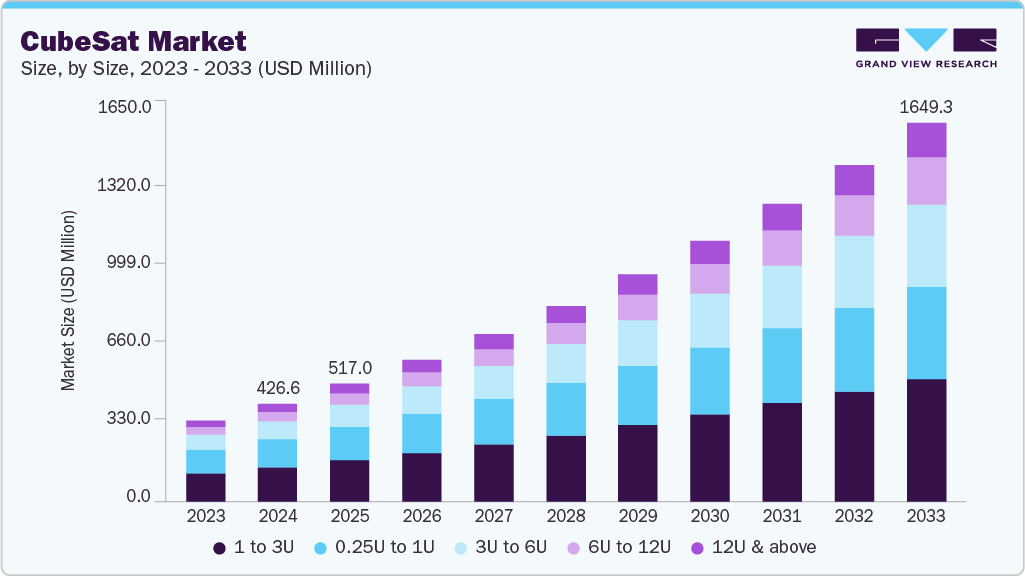
The global CubeSat market size was valued at USD 517.0 million in 2025 and is projected to grow from USD 617.3 million in 2026 to USD 1,649.3 million by 2033, at a CAGR of 15.1% from 2026 to 2033. North America dominated the global market, accounting for a revenue share of 41.0% in 2025. The CubeSat market is driven by the increasing demand for cost-effective satellite missions, the growing investment in commercial space programs, and the rising adoption of miniaturized satellite technologies.
 Source: Grand View Research, IR Documents, Primary Interviews, Paid DatabasesTo learn more about this report,
 Download Free Sample Report
 Key Market Trends & Insights
- By size: The 1 to 3U segment dominated the market, with a share of 33.9% in 2025.
- By subsystem: Payloads segment accounted for the largest market share of 28.9% in 2025.
- By application: Earth observation segment dominated the market in 2025.
- By end use: Government & defense segment accounted for the largest market share in 2025.
Regional Highlights
- Largest regional market: North America (41.0% revenue share in 2025)
- Fastest growing regional market: Asia Pacific (highest CAGR, 2026-2033)
- By Country: The U.S. held the largest market share in 2025.
Market Size & Forecast
- Market size in 2025: USD 517.0 Million
- Estimated market size in 2026: USD 617.3 Million
- Projected market size by 2033: USD 1,649.3 Million
- CAGR (2026-2033): 15.1%
Three ways to get this report
Buy it, customize it, or ask a question.Ask an Analyst
Analyst response in 1 business day
- AccessReport author, directly
- Reply timeWithin 1 working day
- No sales callDirect answer only
- FormatEmail reply
- CostFree, no cost
Get the Full Report
What the study covers
- FormatsPDF · Excel · Dashboard
- Timeline2026–2033 annual, 2025 base
- Coverage20+ countries, 5 regions
- Companies10+ key players profiled
Customize the Report
20% free customization
- IncludeCountries, segments, points
- TailorTo your product definition
- ExtendDeeper competitor detail
- OrA fully bespoke study
- Turnaround5–10 working days
The expanding deployment of CubeSats for Earth observation, communications, scientific research, technology demonstration, and defense applications is significantly accelerating market growth. The increasing use of advanced onboard processors, miniaturized sensors, high-speed communication payloads, and electric propulsion systems is enhancing mission capabilities, extending operational lifespans, and enabling rapid constellation deployment, thereby creating growth opportunities in the market.
The surge in demand for earth observation and remote sensing is unlocking new revenue streams for the CubeSat industry. Government agencies and private firms are investing in compact satellites to monitor agricultural patterns, climate change, and urban development. These missions require cost-effective deployment without compromising data accuracy. The CubeSat industry is capitalizing on this momentum through high-resolution payload integration and rapid constellation launches.
 To learn more about this report, Download Free Sample Report
 Rising interest in space-based Internet of Things (IoT) applications is accelerating the development of CubeSat constellations. Industries like agriculture, maritime, and energy are increasingly relying on satellite connectivity for asset tracking in remote locations. The need for low-latency communication and persistent coverage is pushing innovation in networked CubeSat architectures. This shift is enabling the CubeSat industry to play a pivotal role in the global IoT infrastructure expansion.
Military and defense sectors are scaling their reliance on CubeSats for rapid-response surveillance and tactical intelligence. The demand for agile, deployable systems that enhance situational awareness and secure communications is shaping procurement strategies. Governments are allocating dedicated budgets toward space-based ISR (Intelligence, Surveillance, and Reconnaissance) capabilities through CubeSat platforms. Consequently, the CubeSat industry is becoming integral to national security frameworks and modern defense infrastructure.
Regulatory evolution and frequency allocation policies are shaping operational norms in the CubeSat industry. Global regulatory bodies are streamlining licensing and orbital debris mitigation frameworks to accommodate the rapid growth in small satellite deployments. Improved governance is fostering investor confidence and long-term scalability. The CubeSat industry is responding with enhanced compliance protocols and sustainable deployment strategies.
Market Dynamics
The CubeSat market is experiencing strong growth, driven by rising demand for low-cost satellite missions, increasing commercialization of the space industry, and the rapid expansion of small satellite constellations across commercial, government, and defense sectors. Rising investments in Earth observation, satellite communications, space research, and national security programs are accelerating the deployment of CubeSats for cost-efficient and rapid mission execution. The growing use of miniaturized payloads, advanced onboard computers, high-resolution imaging sensors, and electric propulsion systems is enhancing mission performance and operational flexibility. The integration of artificial intelligence, inter-satellite communication links, autonomous mission management, cloud-based ground station networks, and advanced data analytics enables real-time data processing, improved mission reliability, faster deployment cycles, reduced operational costs, and enhanced satellite performance, creating significant long-term growth opportunities for the global CubeSat market.
The increasing deployment of low-cost satellite constellations is a primary factor accelerating CubeSat adoption across commercial, government, and defense missions. Organizations are utilizing CubeSats to establish scalable constellations for Earth observation, communication services, weather monitoring, maritime surveillance, and scientific research. Their standardized design, shorter development cycles, and compatibility with rideshare launches significantly reduce mission costs while enabling frequent satellite replenishment and rapid technology upgrades.
Advancements in miniaturized electronics, high-performance payloads, onboard processing units, and software-defined communication systems are further strengthening CubeSat capabilities. These improvements enable operators to achieve higher imaging resolution, enhanced data transmission, and greater mission flexibility without relying on large conventional satellites. Demand for persistent global coverage and real-time data services increases, CubeSat constellation deployments continue to expand across diverse space applications.
CubeSats face operational limitations due to their compact size, which limits onboard power generation, thermal management, propulsion capacity, and payload volume. These constraints reduce mission duration and limit the ability to perform complex orbital maneuvers or support high-power instruments. CubeSats are less suitable for long-duration deep-space missions or applications requiring extensive onboard resources.
The absence of redundant subsystems in many CubeSat platforms also increases vulnerability to radiation exposure, component failures, and harsh environmental conditions in space. Limited shielding and restricted battery capacity can affect operational reliability throughout the mission lifecycle. These technical limitations require continuous innovation in miniaturized components, energy-efficient systems, and lightweight materials to improve mission endurance and overall satellite performance.
The increasing number of deep-space exploration initiatives is creating new opportunities for CubeSat deployment beyond low Earth orbit. Space agencies and commercial organizations are incorporating CubeSats into lunar, planetary, and asteroid missions for scientific investigations, technology demonstrations, navigation support, and communication relay functions. Their affordability enables multiple spacecraft to be launched simultaneously, reducing mission costs while expanding scientific capabilities.
Continuous advancements in miniaturized propulsion systems, autonomous navigation software, radiation-tolerant electronics, and deep-space communication technologies are enabling CubeSats to undertake increasingly sophisticated missions. These innovations allow small satellites to operate farther from Earth while supporting larger exploration missions through distributed sensing and data collection. International investment in space exploration expands, CubeSats are expected to play a more prominent role in future interplanetary missions.
Market Concentration & Characteristics:
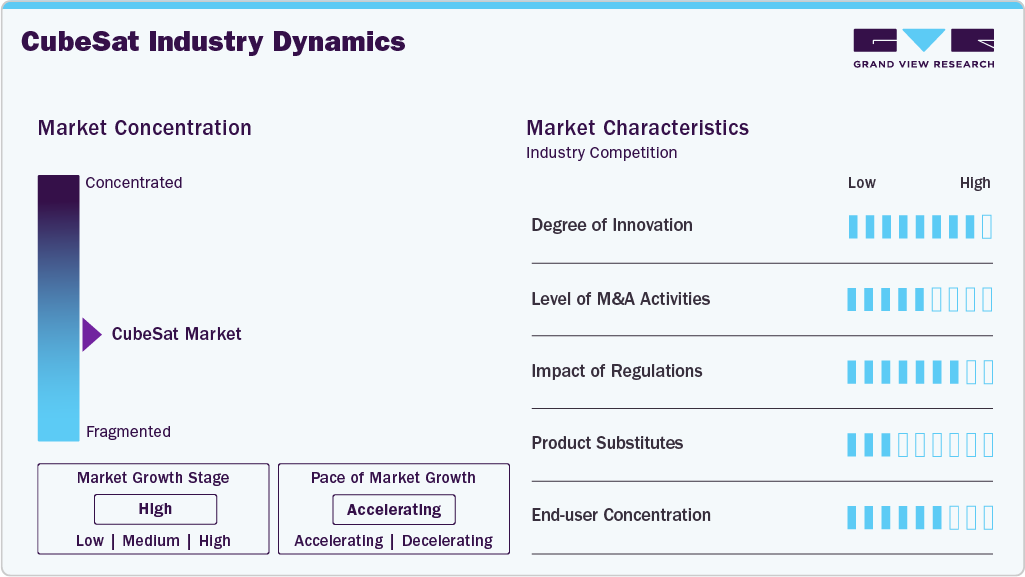
The CubeSat market is moderately fragmented, with leading satellite manufacturers, subsystem suppliers, launch service providers, payload developers, and space technology companies competing across Earth observation, satellite communications, scientific research, technology demonstration, and defense applications. Rising investments in commercial space programs, increasing deployment of low-cost satellite constellations, and growing demand for rapid, cost-efficient space missions are driving market expansion. Companies are strengthening their competitive positions through strategic partnerships, launch collaborations, technology acquisitions, and continuous investments in advanced miniaturized satellite platforms, onboard electronics, propulsion systems, and high-performance payload technologies.
 To learn more about this report, Download Free Sample Report
 The market is characterized by a high degree of innovation, supported by rapid advancements in miniaturized sensors, software-defined radios, onboard artificial intelligence, electric propulsion systems, inter-satellite communication technologies, and autonomous mission management software. Merger and acquisition activity remains moderate as companies expand satellite manufacturing capabilities and strengthen end-to-end space technology portfolios. Regulatory impact is significant due to launch licensing requirements, spectrum allocation policies, export control regulations, orbital debris mitigation guidelines, and satellite registration frameworks. The threat of substitutes remains low because conventional large satellites cannot match the affordability, rapid deployment, scalability, and mission flexibility offered by CubeSat platforms for many space applications.
Analyst Perspective
The CubeSat market is experiencing significant expansion, driven by rising investments in commercial space programs, rapid advances in satellite miniaturization technologies, and the growing adoption of low-cost satellite constellations, autonomous mission management, and high-performance payloads across diverse space applications. The expanding implementation of advanced onboard processors, software-defined radios, electric propulsion systems, inter-satellite communication links, and cloud-connected ground station networks is improving mission efficiency, operational flexibility, data transmission, and satellite reliability. Organizations increasingly prioritize rapid deployment, cost-effective mission execution, and real-time Earth observation capabilities to meet evolving commercial, scientific, and defense requirements. Technology providers are positioned to capitalize on emerging opportunities, thereby reinforcing long-term market expansion and sustainable revenue generation across the global space technology ecosystem.
Size Insights
Based on size, the 1 to 3U segment led the market with the largest revenue share of 33.9% in 2025 and is expected to grow at a considerable CAGR over the forecast period, owing to its balance between compact size and functional capability. This size of CubeSat segment has remained a preferred choice for a wide range of Low-Earth orbit missions. This form factor is widely adopted for Earth observation, scientific experiments, and communication applications due to its lower launch costs and quicker development timelines. Advancements in miniaturized payloads and integrated subsystems are enhancing mission versatility within this size class. However, as demand shifts toward higher-performance and multi-payload missions, the segment may face increasing competition from larger CubeSat configurations.
The 6U to 12U segment is expected to register the fastest CAGR of over 19% from 2025 to 2033, driven by the increasing demand for high-performance payloads and multi-functional mission capabilities. The 6U to 12U CubeSat segment is experiencing rapid growth. This size class offers greater power, onboard storage, and space for advanced instruments, making it ideal for high-resolution imaging, secure communications, and autonomous operations. Government agencies and commercial operators are adopting 6U to 12U platforms for more complex and longer-duration missions. The segment is emerging as a strategic choice for next-generation CubeSat deployments that require enhanced functionality without transitioning to full microsatellite platforms.
Application Insights
Based on application, the Earth observation segment accounted for the largest market share of 29.0% in 2025, driven by growing demand for real-time environmental intelligence. This application segment remains the largest application area in the CubeSat market. Governments, commercial enterprises, and NGOs are increasingly leveraging CubeSats for monitoring climate change, agriculture, urban development, and disaster response. The miniaturization of imaging sensors and advancements in onboard data processing are enabling more frequent, cost-effective Earth observation missions. Nevertheless, as other applications like communication and space situational awareness gain traction, the segment's overall market share is expected to decline, despite continued growth in absolute terms gradually.
The communication segment is expected to grow at the fastest CAGR in the coming years, fueled by the rising need for global connectivity and low-latency data services. This segment is emerging as the fastest-growing application in the CubeSat market. Operators are deploying CubeSat constellations to deliver broadband internet, IoT connectivity, and secure communication links in underserved and remote regions. Advancements in miniaturized antennas, software-defined radios, and inter-satellite links are making CubeSats increasingly viable for mission-critical communication infrastructure. As the demand for real-time data transmission and resilient networks accelerates, the Communication segment is set to play a central role in the future of space-based services.
Subsystem Insights
Based on subsystem, the payloads segment dominated the market with the largest revenue share of 28.9% in 20254, driven by the need for advanced sensing, imaging, and communication capabilities. The segment continues to hold a dominant position in the CubeSat market. As missions become more specialized, demand is increasing for high-performance payloads such as hyperspectral cameras, AI-based processors, and radar systems. Technological advancements are enabling miniaturization without compromising functionality, allowing more complex payloads to be integrated into smaller form factors. With CubeSats being deployed across diverse sectors-from Earth observation to national security-the Payloads segment remains critical to unlocking mission value and return on investment.
The attitude determination & control systems (ADCS) segment is expected to grow at the fastest CAGR in the coming years, owing to the increasing need for precise satellite orientation and stabilization. This segment is gaining strong traction in the CubeSat market. Accurate attitude control is essential for high-resolution imaging, laser communication, and scientific payload alignment, making ADCS a critical subsystem in mission success. Advancements in miniaturized sensors, gyroscopes, and control algorithms enable CubeSats to perform complex maneuvers with greater autonomy. As mission sophistication grows across commercial, research, and defense applications, demand for robust and scalable ADCS solutions is expected to accelerate.
End Use Insights
Based on end use, the government & defense segment dominated the market with a revenue share of 51.5% in 2025, driven by the increasing demand for rapid, cost-effective, and mission-flexible space assets in this sector. Defense and space agencies are turning to CubeSats for applications such as reconnaissance, early warning systems, and secure communications. These compact satellites offer accelerated deployment timelines and enhanced adaptability for evolving national security objectives. With rising geopolitical tensions and growing interest in space-based situational awareness, government investment in CubeSat programs is set to expand significantly.
 To learn more about this report, Download Free Sample Report
 The commercial segment is expected to grow at the fastest CAGR in the coming years, primarily driven by the surge in demand for real-time data services, Earth observation, and global connectivity. This segment is emerging as the fastest-growing end-user in the CubeSat market. Startups and private space companies are leveraging CubeSats for applications ranging from precision agriculture and asset tracking to broadband delivery and IoT integration. Lower launch costs, standardization, and scalable manufacturing have made CubeSats a commercially viable platform for space-based innovation. As commercial space ecosystems mature and investor interest accelerates, this segment is expected to lead the next wave of CubeSat deployments.
Regional Insights
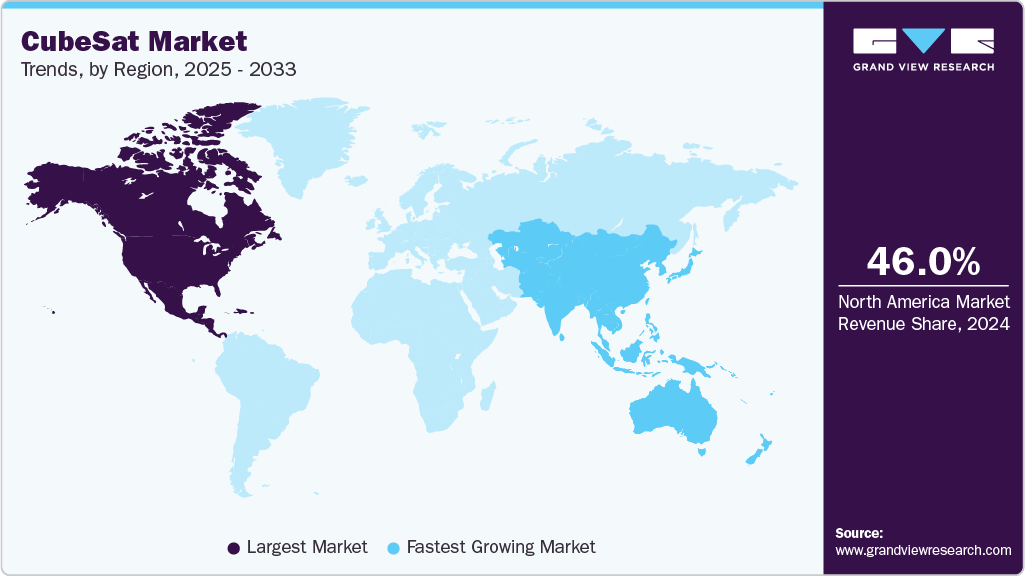
North America dominated CubeSat market with the largest revenue share of 41.0% in 2025, owing to the maturity of its space infrastructure and growing demand for low-orbit connectivity solutions. Companies are developing advanced payload integration systems to support use cases ranging from wildfire detection to maritime surveillance. Demand for resilient communication architecture is prompting the deployment of multi-orbit constellations. This level of mission diversity is positioning North America as a critical hub for both innovation and global CubeSat deployment.
 To learn more about this report, Download Free Sample Report
 U.S. CubeSat Market Trends
The CubeSat market in the U.S. held the largest share in the North America region in 2025, as collaboration between tech startups and research institutions continues to expand. Educational institutions are securing NASA grants and DARPA contracts to test CubeSat payloads for interplanetary navigation and AI-driven analytics. This academic-commercial synergy is fast-tracking innovation in propulsion, miniaturized sensors, and autonomous mission capabilities. The resulting IP generation and commercialization pipeline is reinforcing U.S. dominance in advanced space tech.
Europe CubeSat Market Trends
The Europe CubeSat market is expected to grow at a CAGR of 14.0% from 2025 to 2033, fueled by climate-focused satellite missions and pan-European collaborative programs. ESA-backed projects are prioritizing data gathering for sustainability goals, ranging from biodiversity mapping to carbon emission monitoring. Increased availability of rideshare launches from Ariane and Vega carriers is making deployment more feasible. These initiatives are reinforcing Europe's push toward digital sovereignty in space-based.
The Germany CubeSat market is expected to grow at a significant rate in the coming years, with increased interest from industrial players aiming to monitor logistics, infrastructure, and environmental assets. Innovation in thermal and power management systems is becoming a focal point for satellite developers. The rise of tech incubators and cross-border alliances is strengthening Germany’s role in collaborative space missions. These developments are creating long-term commercial pathways for satellite scalability and export.
The UK CubeSat market is expected to grow at a significant rate in the coming years, driven by government-backed spaceport initiatives and funding accelerators. The UK Space Agency is expanding support for CubeSat-centric missions in defense, maritime tracking, and precision agriculture. The nation is also investing in orbital debris mitigation and mission insurance frameworks to support sustainable satellite operation. These enablers are transforming the UK into a preferred launch site and R&D base for small satellite ventures.
Asia Pacific CubeSat Market Trends
The Asia Pacific CubeSat market is expected to grow at the fastest CAGR of 20.1% from 2025 to 2033, owing to rapidly advancing national space programs and increasing commercial launch frequency. Countries like India and South Korea are scaling indigenous satellite development while also serving as low-cost launch hubs. The demand for real-time agricultural data, disaster monitoring, and national defense applications is propelling deployment. Regional alliances and public-private partnerships are further accelerating innovation timelines.
China CubeSat market is driven by strategic investments in national defense and private-sector space exploration. State-sponsored companies are deploying low-Earth orbit constellations for encrypted communications and wide-area surveillance. Universities and commercial ventures are also contributing to mission diversity through dual-use technologies. This alignment between state priorities and private innovation is significantly scaling launch frequency and system complexity.
Japan CubeSat market is witnessing strong momentum, fueled by growing interest in deep-space missions and asteroid exploration. Leading research institutions are actively launching CubeSats for interplanetary navigation, leveraging advanced propulsion systems and thermal control technologies. Government policies are promoting mission versatility and fostering international partnerships to expand scientific and commercial reach. These developments are establishing Japan as a key player in next-generation space exploration initiatives.
Key CubeSat Company Insights
Some of the key players operating in the market include Planet Labs Inc., GomSpace, and others.
-
Planet Labs Inc. is a global leader in Earth observation, operating one of the largest commercial fleets of CubeSats in orbit. The company specializes in high-resolution imaging and daily data capture for sectors like agriculture, defense, climate monitoring, and disaster response. Its “Dove” and “SuperDove” CubeSats are known for delivering continuous, near-real-time insights at scale. Planet Labs is a dominant force in the market, pioneering the use of CubeSats for large-scale commercial satellite constellations.
-
GomSpace, headquartered in Denmark, is a prominent manufacturer and integrator of CubeSat platforms and advanced subsystems. The company specializes in propulsion systems, attitude determination and control systems (ADCS), radios, and power systems. GomSpace serves both governmental and commercial clients across Europe, Asia, and North America. Its strong portfolio and technical capabilities have positioned it as a go-to supplier for reliable CubeSat solutions.
EnduroSat and Space Inventor are some emerging market participants in the CubeSat market.
-
EnduroSat is an emerging European company known for its modular CubeSat platforms and integrated subsystems. It specializes in shared satellite services, allowing multiple clients to fly their payloads on a single mission-an approach that reduces cost and increases accessibility. The company has rapidly gained traction for its mission flexibility and simplified satellite operations interface. EnduroSat is becoming a preferred partner for academic, commercial, and IoT-focused space missions.
-
Space Inventor is a Danish startup making waves in the CubeSat and small satellite ecosystem through its high-performance modular platforms. It focuses on subsystems such as EPS (Electrical Power Systems), structures, and ADCS, targeting both commercial and governmental applications. The company emphasizes mission reliability, scalability, and rapid customization. With a growing international footprint, Space Inventor is quickly gaining recognition as a trusted provider of advanced nanosatellite technologies.
Key CubeSat Companies:
The following key companies have been profiled for this study on the CubeSat market.
-
Blue Canyon Technologies
-
CU Aerospace L.L.C.
-
EnduroSat
-
GomSpace
-
Innovative Solutions In Space B.V.
-
L3Harris Technologies Inc.
-
Planet Labs Inc.
-
Pumpkin Space Systems
-
Space Inventor
-
SpaceX
Competitive Benchmarking
Category
Operating Strategies
Competitive Edge
Weakness
Established Players (GomSpace, L3Harris Technologies Inc., Planet Labs Inc.)
- Focus on expanding integrated CubeSat capabilities through partnerships in launch, payload, subsystems, and ground stations.
- Invest heavily in R&D and manufacturing to deliver reliable, mission-ready CubeSat platforms for a range of applications.
- Ability to provide end-to-end CubeSat solutions, including design, integration, launch, operations, and support services.
- Strong global presence, proven flight heritage, and diversified customer base strengthen long-term market leadership.
- Dependence on established development processes can slow the adoption of rapidly evolving satellite technologies.
- Large organizational structures may reduce flexibility in quickly addressing customized CubeSat mission requirements.
Emerging Players (EnduroSat, Pumpkin Space Systems, Space Inventor)
- Emerging players focus on developing innovative CubeSat platforms through agile engineering, strategic collaborations, and rapid mission execution.
- Invest in miniaturized technologies and specialized payloads to address niche commercial and research applications.
- Agile development capabilities enable faster CubeSat customization and shorter mission deployment timelines for customers.
- Strong innovation focus supports advanced payload integration and cost-effective satellite solutions for emerging applications.
- Limited manufacturing scale and financial resources can constrain large-constellation deployment capabilities.
- A smaller customer base and limited flight heritage may reduce competitiveness in government procurement programs.
Recent Developments
-
In April 2025, KULR Technology Group partnered with AstroForge to develop a custom 500Wh KULR ONE Space (K1S) battery pack for space missions. The K1S battery integrates NASA-approved cells and architectures to deliver high energy density and mission-specific performance. It also features KULR’s advanced Battery Management System and marks the third format of the KULR ONE Space design. This collaboration strengthens KULR’s position in the growing space battery market, supporting applications from CubeSats to deep-space missions.
-
In March 2025, Exolaunch expands its global customer base, providing cost-effective launch solutions for Canada's CUBICS student-led satellite projects. The company was selected by the Canadian Space Agency to deploy nine 3U CubeSats developed by Canadian universities. The mission is set to launch no earlier than mid-2026 using Exolaunch’s EXOpod Nova separation system. This collaboration supports STEM education and strengthens Exolaunch’s presence in the North American space market.
-
In January 2025, NASA launched the Technology Education Satellite 22 (TES-22) CubeSat to study Earth's thermosphere. The satellite features key technologies including a deployable Exo-Brake, a radiation detector, and a solid-state battery test. TES-22 aims to reduce deorbit time and gather data on atmospheric drag and solar effects. This mission is part of NASA’s CubeSat Launch Initiative, supporting cost-effective space research for educational institutions.
CubeSat Market Report Scope
Report Attribute
Details
Market size in 2025
USD 517.0 Million
Estimated market size in 2026
USD 617.3 Million
Projected market size by 2033
USD 1,649.3 Million
Growth rate
CAGR of 15.1% from 2026 to 2033
Base year for estimation
2025
Historical data
2021 - 2024
Forecast period
2026 - 2033
Quantitative units
Revenue in USD Million, and CAGR from 2026 to 2033
Report coverage
Revenue forecast, company ranking, competitive landscape, growth factors, and trends
Segments covered
Size, application, subsystem, end use, region
Regional scope
North America; Europe; Asia Pacific; Latin America; MEA
Country scope
U.S.; Canada; Mexico; U.K.; Germany; France; China; Japan; India; South Korea; Australia; Brazil; Saudi Arabia; UAE; South Africa
Key companies profiled
Blue Canyon Technologies; CU Aerospace L.L.C.; EnduroSat; GomSpace; Innovative Solutions In Space B.V.; L3Harris Technologies Inc.; Planet Labs Inc.; Pumpkin Space Systems; Space Inventor; SpaceX.
Customization scope
Free report customization (equivalent up to 8 analysts' working days) with purchase. Addition or alteration to country, regional & segment scope.
Pricing and purchase options
Avail customized purchase options to meet your exact research needs. Explore purchase options
Global CubeSat Market Report Segmentation
This report forecasts revenue growth at global, regional, and country levels and provides an analysis of the latest industry trends in each of the sub-segments from 2021 to 2033. For this study, Grand View Research has segmented the global CubeSat market report based on size, application, subsystem, end use, and region:
-
Size Outlook (Revenue, USD Million, 2021 - 2033)
-
0.25U to 1U
-
1 to 3U
-
3U to 6U
-
6U to 12U
-
12U & above
-
-
Application Outlook (Revenue, USD Million, 2021 - 2033)
-
Earth Observation
-
Meteorology
-
Space Observation
-
Communication
-
Scientific Research
-
-
Subsystem Outlook (Revenue, USD Million, 2021 - 2033)
-
Structures
-
Payloads
-
Power Systems
-
Command & Data Handling (C&DH)
-
Attitude Determination & Control Systems (ADCS)
-
Propulsion Systems
-
Others
-
-
End Use Outlook (Revenue, USD Million, 2021 - 2033)
-
Government & Defense
-
Commercial
-
Research Institutions and Non-Profit Organizations
-
-
Regional Outlook (Revenue, USD Million, 2021 - 2033)
-
North America
-
U.S.
-
Canada
-
Mexico
-
-
Europe
-
Germany
-
UK
-
France
-
-
Asia Pacific
-
China
-
Japan
-
India
-
South Korea
-
Australia
-
-
Latin America
-
Brazil
-
-
Middle East and Africa (MEA)
-
UAE
-
Saudi Arabia
-
South Africa
-
-
Research Methodology
The CubeSat market figures in this report are based on a proven research process that combines executive interviews with secondary research from proprietary databases, company filings, and recognized regulatory and institutional sources. Market size is built through value-chain sizing - reconciling supply-side and demand-side estimates - and triangulated with bottom-up and top-down approaches. Every estimate passes multiple levels of expert validation before publication, with each CubeSat segment quantified using the revenue-capture definitions in the table below.
Segment Definition
Segment - Size
Revenue capture definition
0.25U to 1U
Revenue is generated through ultra-small CubeSats ranging from 0.25U to 1U deployed for technology demonstrations, educational missions, scientific experiments, and basic Earth observation. This segment is driven by low development costs, standardized designs, and increasing adoption by universities, research institutions, and emerging space companies.
1 to 3U
Revenue is captured through CubeSats sized between 1U and 3U used for Earth observation, communication, scientific research, and technology validation missions. This segment is propelled by their balance of affordability, payload capacity, and compatibility with commercial rideshare launch opportunities.
3U to 6U
Revenue is generated through medium-sized CubeSats that support advanced Earth observation, defense surveillance, communications, and scientific exploration missions. This segment is driven by growing demand for higher payload capacity, improved onboard processing, longer mission duration, and enhanced operational capabilities.
6U to 12U
Revenue is captured through large CubeSat platforms designed for high-performance imaging, communication payloads, deep-space technology demonstrations, and defense applications. This segment is supported by increasing integration of propulsion systems, high-speed data transmission, and sophisticated onboard subsystems.
12U & above
Revenue is generated through high-capacity CubeSat platforms exceeding 12U, enabling complex scientific research, commercial communication, defense intelligence, and interplanetary exploration missions. This segment is driven by increasing demand for larger payloads, extended mission lifetimes, and advanced autonomous satellite operations.
Segment - Application
Revenue capture definition
Earth Observation
Revenue is generated through CubeSats deployed for environmental monitoring, agriculture, disaster management, infrastructure assessment, maritime surveillance, and natural resource management. This segment is driven by growing demand for high-frequency satellite imagery and cost-effective geospatial intelligence solutions.
Meteorology
Revenue is captured through CubeSats supporting weather forecasting, atmospheric monitoring, climate analysis, and environmental data collection. This segment is propelled by increasing investments in climate research, disaster preparedness, and continuous global weather observation capabilities.
Space Observation
Revenue is generated through CubeSats utilized for astronomical observation, planetary science, solar monitoring, and deep-space exploration missions. This segment is supported by rising investments in scientific research and affordable space exploration initiatives.
Communication
Revenue is captured through CubeSats providing broadband connectivity, Internet of Things (IoT) services, remote communications, and satellite networking. This segment is driven by expanding satellite constellations and increasing demand for global, low-latency communication coverage.
Scientific Research
Revenue is generated through CubeSats supporting academic research, technology demonstrations, microgravity experiments, and space science missions. This segment is fueled by growing participation from universities, research organizations, and government-funded space exploration programs.
Segment - Subsystem
Revenue capture definition
Structures
Revenue is generated through structural frames, deployable mechanisms, mounting assemblies, and protective enclosures that provide mechanical support for CubeSat subsystems. This segment is driven by demand for lightweight, durable, and standardized satellite structures.
Payloads
Revenue is generated through solar panels, batteries, power management units, and energy distribution components supplying electrical power to CubeSat operations. This segment is supported by advancements in energy efficiency and extended satellite mission requirements.
Power Systems
Revenue is generated through solar panels, batteries, power management units, and energy distribution components supplying electrical power to CubeSat operations. This segment is supported by advancements in energy efficiency and extended satellite mission requirements.
Command &
Data Handling (C&DH)
Revenue is captured through onboard computers, data storage devices, flight software, and processing units responsible for mission control and satellite operations. This segment is driven by increasing demand for autonomous satellite management and real-time onboard data processing.
Attitude Determination &
Control Systems (ADCS)
Revenue is generated through sensors, reaction wheels, magnetorquers, star trackers, and control algorithms that maintain satellite orientation and pointing accuracy. This segment is driven by the need for precise imaging, aligned communications, and mission stability.
Propulsion Systems
Revenue is captured through electric, cold gas, chemical, and other propulsion technologies, enabling orbit adjustment, collision avoidance, formation flying, and deorbiting operations. This segment is driven by increasing demand for longer mission lifetimes and orbital maneuverability.
Others
Revenue is generated through communication antennas, thermal control systems, cabling, software modules, deployment mechanisms, and supporting electronic components that enhance CubeSat functionality. This segment is supported by continuous advancements in satellite integration and mission reliability.
Segment - End Use
Revenue capture definition
Government & Defense
Revenue is generated through CubeSats deployed by government agencies and defense organizations for intelligence, surveillance, reconnaissance, secure communications, navigation support, and national security missions. This segment is driven by increasing investment in resilient, cost-effective space capabilities.
Commercial
Revenue is captured through CubeSats utilized by commercial operators for Earth observation, satellite communications, IoT connectivity, data analytics, and space-based service delivery. This segment is propelled by expanding private space investments and growing deployment of satellite constellations.
Research Institutions and
Non-Profit Organizations
Revenue is generated through CubeSats developed by universities, research institutes, and non-profit organizations for scientific experiments, educational programs, technology demonstrations, and collaborative space missions. This segment is supported by increasing research funding and international academic partnerships.
Estimation Model
Layer Name
Key Question
Description
Satellite Mission Adoption Layer
Who are the potential adopters?
Identifies the primary organizations adopting CubeSat platforms, including government space agencies, defense organizations, commercial satellite operators, telecommunications companies, Earth observation service providers, research institutions, universities, and emerging space startups seeking cost-effective satellite missions, rapid deployment, technology demonstration, scientific research, and global connectivity capabilities.
Space Technology Enablement Layer
Who can deploy CubeSat solutions?
Deployment depends on the availability of standardized CubeSat platforms, miniaturized payloads, onboard computers, power systems, propulsion technologies, launch service providers, ground station networks, satellite integration expertise, mission management software, skilled aerospace professionals, and reliable space communications infrastructure to support efficient satellite operations.
Mission Application Layer
Where are CubeSat solutions actively utilized?
CubeSat solutions are deployed across Earth observation missions, satellite communication networks, weather monitoring programs, scientific research projects, technology demonstration missions, defense surveillance operations, maritime tracking, environmental monitoring, space exploration initiatives, and academic research programs supporting data collection, remote sensing, navigation, and secure communications.
Revenue Generation Layer
How is revenue generated?
Revenue is generated through CubeSat platform manufacturing, subsystem integration, payload development, launch services, satellite deployment, mission management software, ground station services, satellite data analytics, maintenance and operational support, consulting services, technology licensing, and recurring revenue from satellite communication, Earth observation, and data subscription services.
Delivered Customizations
This report has been delivered with the following In-depth customizations
Client Request
Customization Delivered
Value Adds
CubeSat Constellation Deployment Strategy & Mission Architecture Assessment
Conducted detailed evaluation of CubeSat constellation architectures across Earth observation, communications, defense, scientific research, and IoT missions, integrating launch strategies, orbital configurations, payload optimization, and ground station connectivity to improve mission efficiency and operational performance.
Improves mission efficiency, reduces deployment costs, enhances coverage capabilities, and supports scalable satellite constellation planning.
Advanced CubeSat Payload Integration & Subsystem Performance Assessment
Assessed integration of high-resolution imaging payloads, communication modules, propulsion systems, ADCS, onboard processors, and power management technologies across CubeSat platforms to optimize satellite functionality, mission reliability, and in-orbit operational performance.
Enhances payload performance, improves mission reliability, enables advanced capabilities, and strengthens long-term satellite operations.
Commercial Space Mission Optimization & Ground Infrastructure Strategy
Evaluated commercial CubeSat deployment strategies by analyzing launch service selection, ground station networks, satellite operations, mission planning software, and data delivery frameworks to improve communication efficiency, mission execution, and lifecycle management across satellite programs.
Optimizes mission execution, improves communication reliability, reduces operational complexity, and supports sustainable commercial space initiatives.
Frequently Asked Questions About This Report
The global CubeSat market size was estimated at USD 517.0 million in 2025 and is expected to reach USD 617.3 million in 2026.
Some key players operating in the CubeSat market include Blue Canyon Technologies, CU Aerospace L.L.C., EnduroSat, GomSpace, Innovative Solutions In Space B.V., L3Harris Technologies Inc., Planet Labs Inc., Pumpkin Space Systems, Space Inventor, and SpaceX.
Key factors that are driving the market growth include rapid advancements in miniaturized electronics and propulsion systems, enhancing capabilities, growing adoption for commercial applications like Earth observation and IoT communication, and increasing availability of cost-effective launch services, enabling wider access and deployment.
Earth observation segment dominated the market in 2025.
Government & defense segment accounted for the largest market share in 2025.
Asia Pacific is the fastest-growing region over the forecast period.
The 1 to 3U segment dominated with a 33.9% revenue share in 2025.
The global CubeSat market is expected to grow at a compound annual growth rate of 15.1% from 2026 to 2033 to reach USD 1,649.3 million by 2033.
North America dominated the CubeSat market with a share of over 41.0% in 2025.
About the Author(s)
Next Generation Technologies Research Team
Technology · Next Generation TechnologiesThis report was authored by the next generation technologies research team at Grand View Research - comprising two research analysts, one senior research analyst, and one industry expert - with specialized expertise in the next generation technologies segment of the technology industry. All findings are based on proprietary technology databases, executive interviews, and regulatory analysis, subject to internal peer review prior to publication.
Last Updated:
Speak to Analyst

Customize this report to your needs - add regions, segments, or data points, with 20% free customization.
Or view our licence options:


ISO 9001:2015 & 27001:2022 Certified
We are GDPR and CCPA compliant! Your transaction & personal information is safe and secure. For more details, please read our privacy policy.


