
- Home
- »
- Organic Chemicals
- »
-
Custom Chemical Manufacturing Market Size Report, 2033GVR Report cover

Custom Chemical Manufacturing Market (2026 - 2033)
Size, Share & Trends Analysis Report By Product (Specialty Chemicals, Fine Chemicals), By Production Process (Batch Production, Continuous Production), By Manufacturing Model, By Application, By Region, Forecasts
Market Size, 2025
$37.7BMarket Estimate, 2026
$40.7BMarket Forecast, 2033
$69.5BCAGR, 2026–2033
7.9%Custom Chemical Manufacturing Market Summary
The global custom chemical manufacturing market size was valued at USD 37.7 billion in 2025 and is projected to grow from USD 40.7 billion in 2026 to USD 69.5 billion by 2033, at a CAGR of 7.9% from 2026 to 2033. Asia Pacific dominated the market, accounting for the largest revenue share of 34.0% in 2025. The expansion is being supported by increasing outsourcing of specialized chemical production, growing demand for application-specific chemicals, and rising investments in advanced manufacturing capabilities and supply-chain diversification.
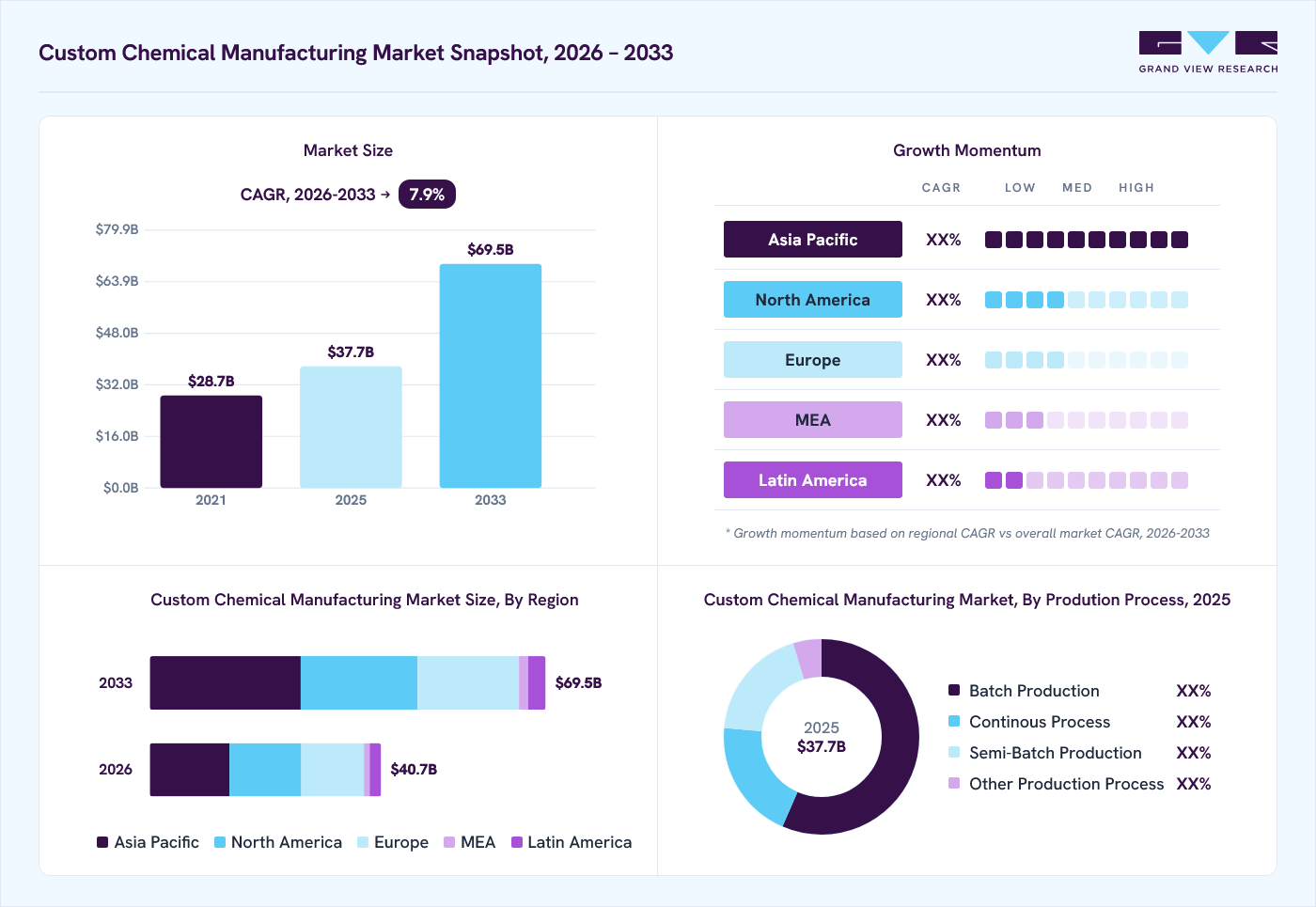 Source: Grand View Research, IR Documents, Primary Interviews, Paid DatabasesTo learn more about this report,
 Download Free Sample Report
Key Market Trends & Insights
- By product: The specialty chemicals segment held the largest revenue share of 30.7% in 2025.
- Based on production process: The batch production segment dominated with a share of 56.5% in 2025.
- For the manufacturing model: The contract manufacturing segment held the largest revenue share of 32.9% in 2025.
- In terms of application: The pharmaceuticals segment dominated with a revenue share of 23.7% in 2025.
Regional Highlights
- Largest Region: Asia Pacific (34.0% revenue share, 2025)
- Fastest-growing region: Asia Pacific (fastest CAGR, 2026-2033)
Market Size & Forecast
- Market size in 2025: USD 37.7 billion
- Estimated market size in 2026: USD 40.7 Billion
- Projected market size by 2033: USD 69.5 Billion
- CAGR (2026-2033): 7.9%
GVR research-powered AIAsk Prism AI about the custom chemical manufacturing marketGet cited answers from GVR research on market growth, segments, regulations and forecasts.Start with✓ Source-linked answers ✓ Market-specific context ✓ Traceable figuresExplore Prism AI ↗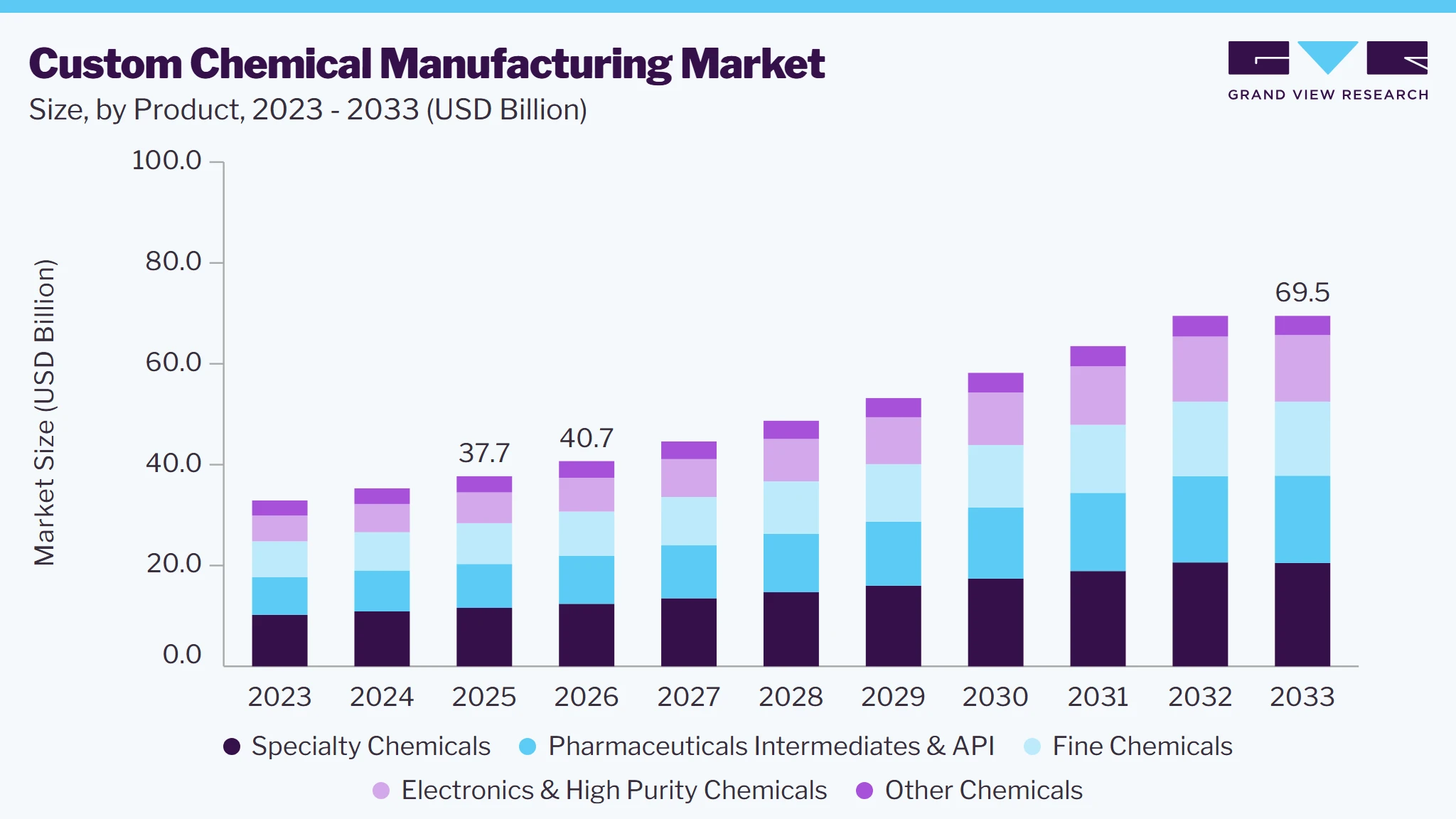 To learn more about this report, Download Free Sample Report
Market Dynamics
The chemical producers are increasingly outsourcing specialized synthesis to improve cost efficiency, access advanced technical capabilities, and optimize capital allocation. Demand is supported by growing requirements for application-specific chemicals across the pharmaceutical, agrochemical, electronics, and specialty materials sectors. Supply-chain regionalization is also creating opportunities for manufacturers as customers seek reliable processing partners closer to key markets. SOCMA reports that more than half of surveyed manufacturers are balancing domestic and offshore sourcing to strengthen supply security while maintaining cost competitiveness. Manufacturers are simultaneously increasing investments in automation, digital infrastructure, reliability, and process safety to enhance operational performance; 63% of surveyed companies reported investments in reliability improvements and 57% in digital infrastructure. However, regulatory complexity, skilled labor shortages, raw material cost volatility, and uncertainty in demand forecasting continue to pressure margins and investment decisions.
The increasing adoption of outsourcing among pharmaceutical, agrochemical, specialty chemical, and other industrial companies is a key growth driver. Companies are increasingly relying on external manufacturers for complex molecules, intermediates, and application-specific chemicals to reduce capital expenditure, access specialized process expertise, and avoid investing in dedicated infrastructure. Manufacturing is particularly attractive when synthesis involves multistep synthesis, specialized equipment, stringent quality requirements, or relatively limited volumes.
This model enables chemical companies to concentrate internal resources on research, product development, commercialization, and customer relationships while transferring selected manufacturing activities to technically qualified partners. The outsourcing trend is also being reinforced by the growing complexity of customer requirements and the need for flexible manufacturing capacity. Manufacturers with established chemistry capabilities, scalable assets, regulatory expertise, and quality systems can support customers from process development through commercial processing.
Regulatory complexity is a significant constraint because custom chemical manufacturers must navigate increasingly stringent requirements related to product safety, environmental protection, worker safety, emissions, waste management, quality systems, and chemical registration. Unlike standardized manufacturing, custom processing frequently involves different molecules, processes, raw materials, and customer specifications, requiring manufacturers to maintain extensive documentation and adapt compliance procedures across projects. For manufacturers serving pharmaceutical and other highly regulated applications, additional requirements such as GMP, FDA expectations, process safety management, and stringent quality controls can substantially increase operating expenditure and lengthen the time required to qualify synthesis processes.
Supply-chain regionalization is creating significant opportunities for custom manufacturers as companies seek to reduce dependence on concentrated synthesis networks and establish more resilient sourcing structures. Geopolitical uncertainty, trade-policy changes, transportation disruptions, and regional differences in manufacturing costs are encouraging chemical companies to diversify their supplier bases across multiple geographies. Deloitte identifies decentralization and supplier diversification as increasingly important strategies for improving supply-chain resilience, while emerging processing hubs such as India, Southeast Asia, and the Middle East are gaining greater relevance within global chemical value chains. This shift creates opportunities for manufacturers that can offer reliable synthesis, competitive economics, regulatory compliance, and proximity to customers.
Market Concentration & Characteristics
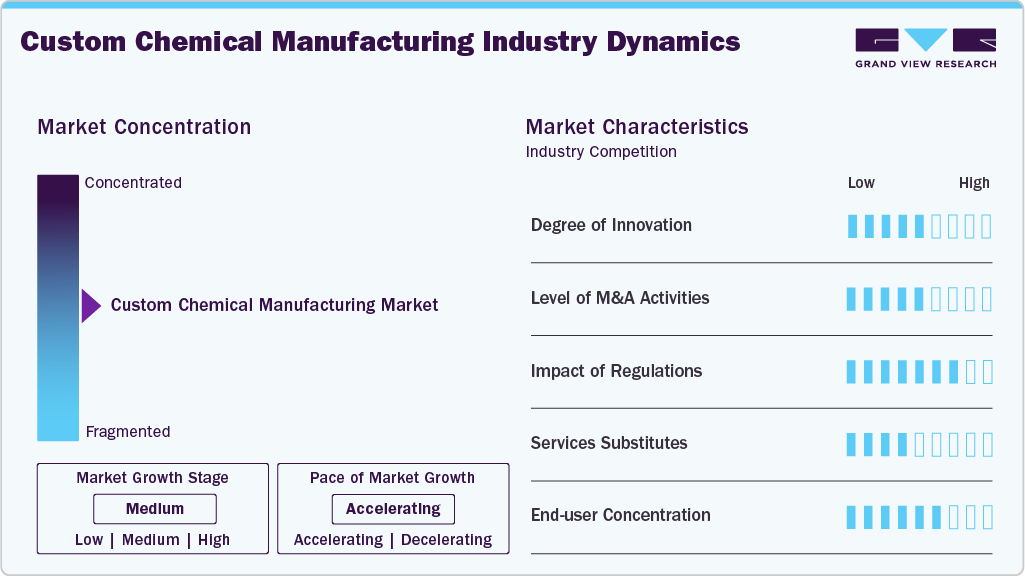
The industry is moderately consolidated, with competition centered on chemical synthesis capabilities, scalability, process development expertise, regulatory compliance, manufacturing flexibility, and long-term customer relationships. Leading companies are expanding their product portfolios across pharmaceutical intermediates, agrochemicals, specialty chemicals, performance chemicals, and electronic materials to address increasingly complex customer requirements. Investments in advanced process technologies, multipurpose manufacturing assets, automation, quality systems, and integrated development-to-commercial capabilities have become important competitive differentiators. Manufacturers with broad chemistry expertise and flexible infrastructure are particularly positioned to serve customers requiring complex molecules, specialized processes, and customized volumes.
 To learn more about this report, Download Free Sample Report
Participants are also strengthening their market positions through strategic acquisitions, capacity expansions, technology investments, and geographic diversification. Companies are increasingly establishing or expanding manufacturing capabilities in Asia, Europe, and North America to support customers seeking supply-chain resilience and alternative sourcing options. In addition, manufacturers are collaborating closely with customers during process development, scale-up, optimization, and commercial to create longer-term outsourcing relationships. Investments in digital manufacturing, process intensification, environmental performance, and advanced quality-control systems are further enabling companies to improve efficiency while meeting increasingly stringent customer and regulatory requirements.
Analyst Perspective
The industry is positioned for expansion as companies increasingly prioritize outsourcing, supply-chain resilience, and access to specialized capabilities. Demand is shifting toward manufacturers that can offer reliable execution, flexible capacity, regulatory expertise, and capabilities in complex chemistry, rather than competing on cost alone. Regionalization is creating opportunities for suppliers with strategically located manufacturing assets and diversified customer bases. At the same time, investments in automation, digital infrastructure, and operational reliability are becoming important for improving productivity and maintaining competitiveness. Going forward, manufacturers that combine technical depth with dependable delivery and strong customer partnerships are likely to capture a greater share of outsourced chemical processing.
Product Insights
The specialty chemicals segment dominated, with a revenue share of 30.7% in 2025, as it encompasses a broad range of application-specific compounds, intermediates, additives, performance materials, and functional chemicals that often require customized synthesis and specialized processing. Their relatively complex formulations and differentiated performance requirements make external manufacturing attractive to companies that do not want to maintain dedicated facilities for every product. In addition, specialty chemical applications span multiple industries, creating a diversified customer base for custom manufacturers.
The electronics & high purity chemicals segment is expected to exhibit the fastest growth with a CAGR of 10.1% over the forecast period. The segment is benefiting from increasing requirements for ultra-high-purity materials and tightly controlled chemical specifications in semiconductor and advanced electronics manufacturing. As chip architectures become more sophisticated, manufacturers require greater precision in cleaning, etching, deposition, lithography, and other wafer-processing steps. SEMI notes that advances in process technology and increasing device complexity are driving stronger demand for wet chemicals and other wafer-fabrication materials; advanced-node capacity of 7 nm and below is also expanding rapidly, further supporting specialized chemical requirements.
Production Process Insights
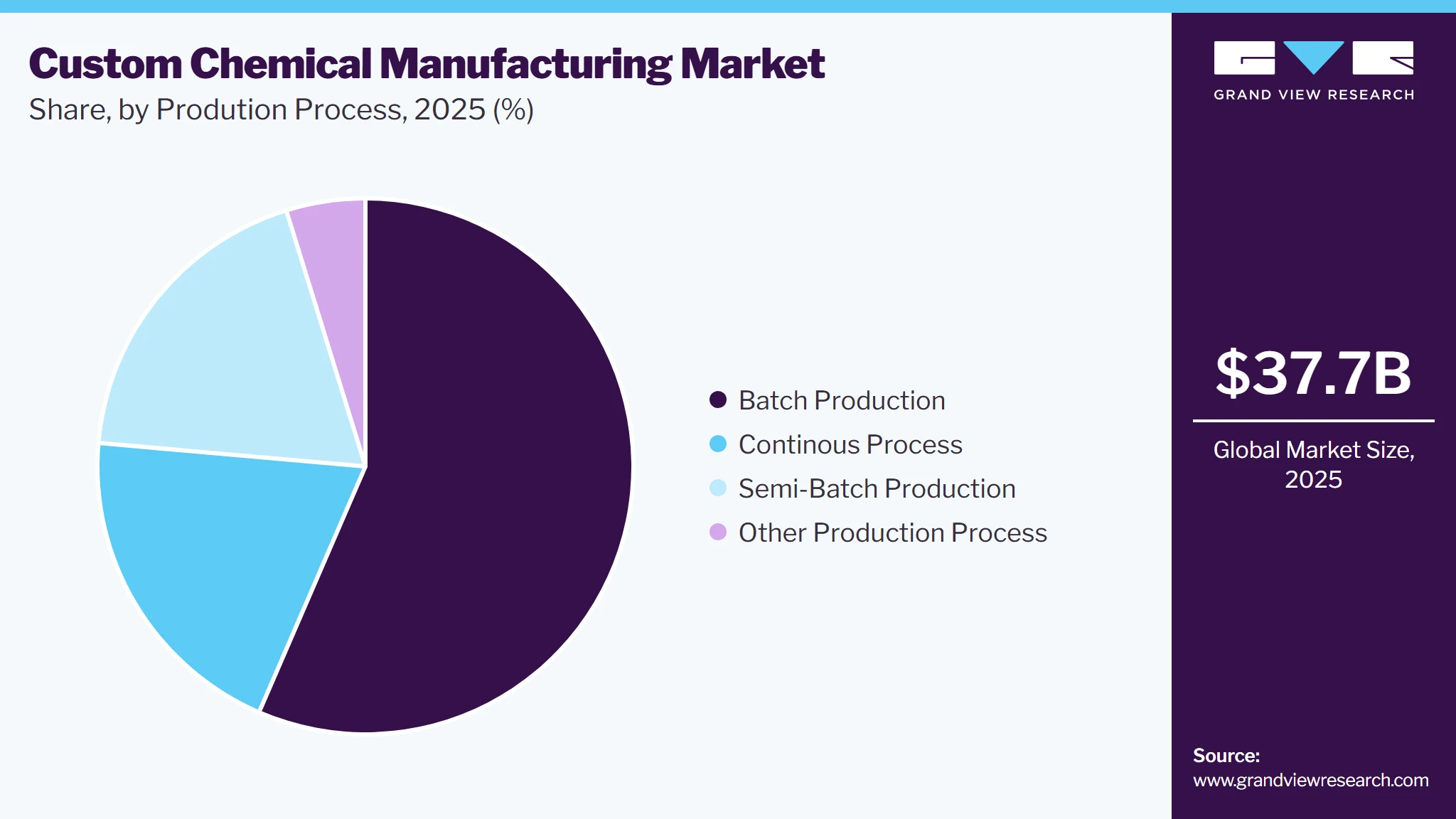
The batch production segment held the largest share of 56.5% in 2025. Custom chemical manufacturing requires high flexibility in handling different molecules, formulations, reaction conditions, and production quantities. Batch facilities allow manufacturers to accommodate multiple customer programs within the same plant and are particularly suitable for specialty chemicals, pharmaceutical intermediates, and other products manufactured in relatively varied or moderate volumes. This flexibility makes batch processing particularly well-suited to customized manufacturing compared with highly standardized continuous operations.
 To learn more about this report, Download Free Sample Report
The continuous process segment is projected to depict the fastest growth with a CAGR of 9.6% from 2026 to 2033, because it can improve process consistency, throughput, resource utilization, and production efficiency while reducing certain operating costs. Greater adoption of automation and advanced process-control technologies is making continuous manufacturing increasingly viable for chemicals with stable demand and well-defined production routes. In pharmaceutical manufacturing, continuous processing is also gaining attention because of its potential to improve efficiency, cost performance, and product quality.
Manufacturing Model Insights
The contract manufacturing segment held the largest revenue share of 32.9% in 2025, as it represents the core outsourcing arrangement through which customers transfer actual chemical manufacturing activities to external specialists. Pharmaceutical, agrochemical, specialty chemical, and industrial companies can utilize established third-party facilities without committing substantial capital toward dedicated plants, equipment, workforce, and compliance infrastructure. This model also enables customers to access existing manufacturing capacity and technical expertise while concentrating internal resources on product development and commercialization. The continued shift toward outsourcing complex manufacturing is supporting this segment.
The contract development & manufacturing segment is projected to grow at the fastest CAGR of 11.1% from 2026 to 2033, as customers increasingly prefer integrated partners capable of managing both process development and subsequent commercial manufacturing. Rather than transferring a fully developed process to a separate manufacturer, companies can work with a single provider for route selection, process optimization, scale-up, analytical development, validation, and commercial production. This integrated model reduces technology-transfer risks and shortens the transition from development to manufacturing, particularly for complex pharmaceutical and specialty chemical programs.
Application Insights
The pharmaceuticals segment held the largest revenue share of 23.7% in 2025, driven by drug manufacturers increasingly outsourcing the synthesis of APIs, advanced intermediates, and complex molecules to specialized chemical manufacturers. Outsourcing helps pharmaceutical companies access specialized chemistry, reduce investment in dedicated facilities, and manage increasingly stringent manufacturing and quality requirements. The complexity of drug development and increasing reliance on external manufacturing partners are supporting this trend.
The electronics & semiconductors segment is expected to witness the fastest CAGR of 10.9% from 2026 to 2033. The growth is attributed to the rapid expansion of advanced semiconductor manufacturing, which is increasing demand for specialized and high-purity chemical inputs. Smaller process geometries, advanced lithography, multi-layer architectures, and growing AI and high-performance computing applications require tighter chemical specifications and greater process-material intensity.
Regional Insights
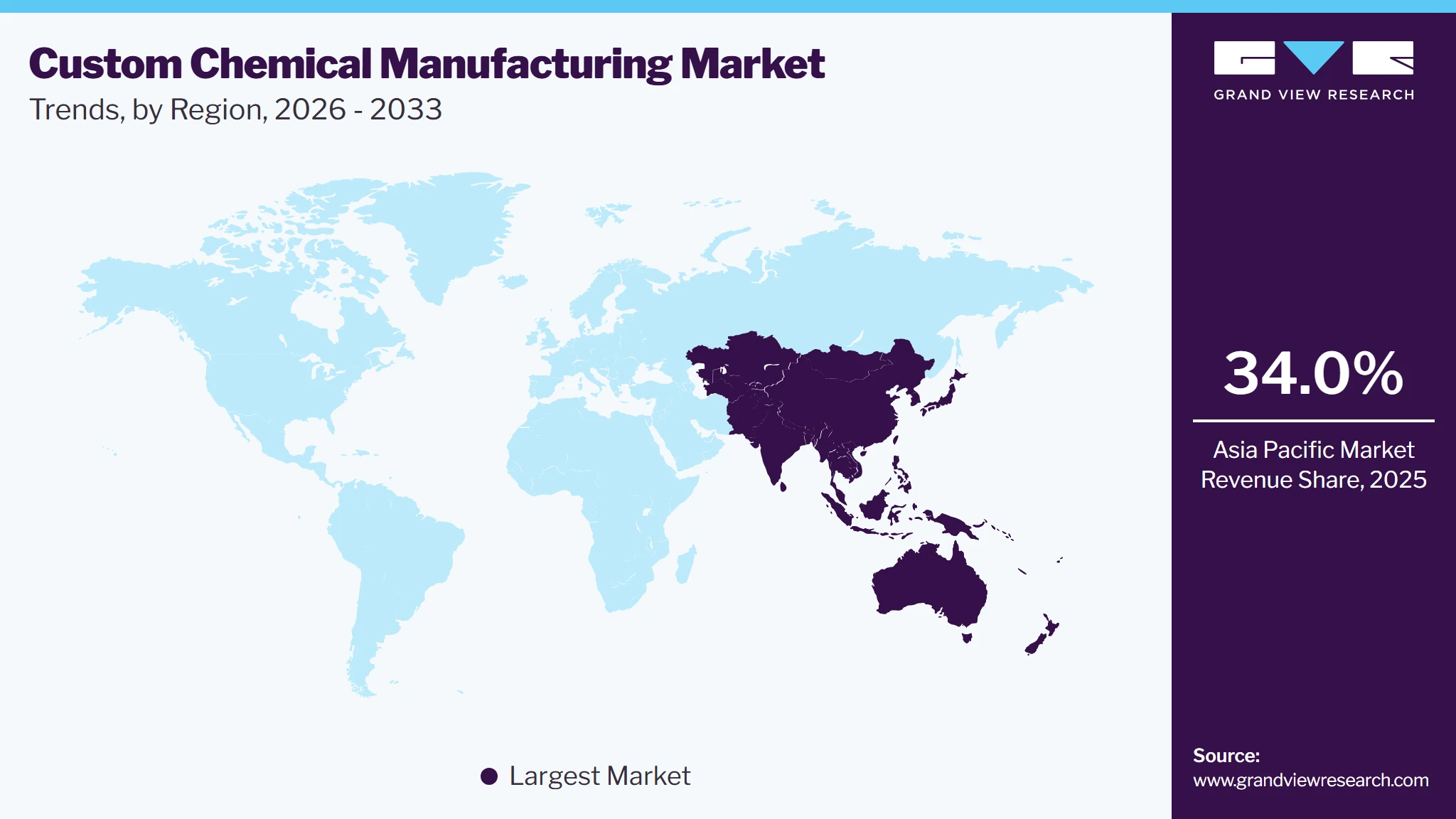
The Asia Pacific custom chemical manufacturing market accounted for the largest revenue share of 34.0% in 2025, and it is expected to exhibit the fastest CAGR over the forecast period. The dominance is largely due to the region’s large-scale chemical manufacturing infrastructure, competitive operating costs, abundant technical talent, and a strong base of pharmaceutical, agrochemical, electronics, and specialty chemical producers. China and India have become important outsourcing destinations as global companies seek flexible manufacturing capacity and alternative supply sources. The region is also attracting investment in advanced chemical and pharmaceutical manufacturing, while its expanding domestic markets provide an additional demand base.
 To learn more about this report, Download Free Sample Report
The custom chemical manufacturing market in China grew significantly in the Asia Pacific industry in 2025, as it is a major market because of its extensive chemical production ecosystem, integrated raw-material supply chains, large manufacturing capacity, and availability of skilled chemical engineers. Its position is particularly strong in specialty chemicals, pharmaceutical intermediates, electronic materials, and other complex chemical products. China's continuing investment in advanced manufacturing and high-technology industries, including semiconductors, batteries, and electric vehicles, is also creating demand for increasingly sophisticated chemical inputs.
North America Custom Chemical Manufacturing Market Trends
The custom chemical manufacturing market in North America is expected to grow robustly as the region remains an important hub due to its well-developed pharmaceutical and specialty chemical industries, strong R&D ecosystem, advanced manufacturing infrastructure, and stringent quality standards. The region benefits from high outsourcing penetration among pharmaceutical and biotechnology companies, while supply-chain diversification is encouraging customers to establish production relationships closer to end markets. Companies are also investing in specialized and GMP manufacturing capabilities to support increasingly complex customer requirements.
U.S. Custom Chemical Manufacturing Market Trends
The custom chemical manufacturing market in the U.S. represents the principal contributor to North America's custom chemical manufacturing activity, supported by its large pharmaceutical industry, sophisticated R&D base, extensive customer ecosystem, and strong demand for specialized chemical inputs. The increasing outsourcing of complex small molecules, APIs, and advanced materials is driving demand for third-party manufacturing, while efforts to strengthen domestic supply chains are encouraging investment in local manufacturing capacity. For example, BASF opened a new GMP Solution Center in Michigan in June 2025 to expand customized chemistry and GMP manufacturing capabilities for pharmaceutical and biopharmaceutical applications.
Europe Custom Chemical Manufacturing Market Trends
The custom chemical manufacturing market in Europe remains important because of its large specialty-chemical base, advanced process technologies, established chemical parks, and strong pharmaceutical and industrial customer network. The region has more than 60 major chemical parks, providing integrated infrastructure for raw materials, utilities, processing, and logistics, which supports flexible manufacturing arrangements. Europe also has a particularly strong position in higher-value specialty chemicals, with the European chemical industry generating USD 635 billion in turnover and employing 1.2 million people. Furthermore, the European Commission's 2025 Chemicals Industry Action Plan is focused on maintaining critical production capacity, strengthening supply-chain resilience, encouraging innovation, and improving the competitiveness of European chemical manufacturing.
The Germany custom chemical manufacturing market is a particularly significant market because it combines Europe's largest chemical manufacturing base with a well-established pharmaceutical industry, extensive industrial infrastructure, and specialized chemical expertise. The country has a highly developed chemical ecosystem supported by numerous manufacturers, skilled professionals, research capabilities, and integrated industrial clusters. Its chemical parks provide established infrastructure for utilities, logistics, waste management, and production, supporting custom, contract, and toll manufacturing models. Germany's strong pharmaceutical sector further contributes to demand for APIs, intermediates, specialty chemicals, and other application-specific products, while its emphasis on innovation and process technology strengthens its position in complex chemical manufacturing.
Middle East & Africa Custom Chemical Manufacturing Market Trends
The custom chemical manufacturing market in the Middle East & Africa region offers growth potential through downstream chemical diversification, petrochemical integration, industrial localization, and increasing investment in pharmaceutical and specialty manufacturing. In the GCC, chemical producers are increasingly encouraged to move beyond bulk petrochemicals toward specialty chemicals, performance products, and downstream applications to capture greater value from existing feedstock advantages. Africa also presents opportunities for localized pharmaceutical and chemical manufacturing; UNIDO highlights the potential to develop API, excipient, and finished-drug production, although infrastructure, financing, energy costs, and technical capabilities remain constraints.
Latin America Custom Chemical Manufacturing Market Trends
The custom chemical manufacturing market in Latin America presents an emerging opportunity for custom chemical manufacturers, as industrial development, foreign investment, pharmaceutical localization, and supply-chain diversification create demand for additional regional manufacturing capacity. The region received USD 194.2 billion in FDI in 2025, with Brazil and Mexico accounting for approximately 62% of total inflows, providing an important investment base for industrial expansion. Although manufacturing accounted for 31% of regional FDI in 2025 and declined year over year, continued investment in productive sectors and the need to strengthen domestic industrial capabilities present opportunities for outsourced chemical manufacturing.
Key Custom Chemical Manufacturing Company Insights
Companies are strengthening their market positions by expanding capacity, investing in advanced manufacturing technologies, and broadening their custom synthesis capabilities to address increasingly complex customer requirements. They are also pursuing strategic acquisitions, geographic expansion, and long-term customer partnerships to strengthen technical expertise, improve supply-chain reach, and secure recurring manufacturing programs.
-
WeylChem Group is a prominent global partner, offering integrated capabilities spanning research and development, process development, scale-up, and commercial operations. The company operates seven custom manufacturing sites across Europe, the U.S., and India, enabling it to serve customers with flexible requirements across multiple geographies. Its expertise in complex, multi-step synthesis, advanced reaction technologies, and specialty chemicals supports applications across pharmaceuticals, agrochemicals, electronics, and other chemical industries.
-
Lonza Group Ltd. is a leading global CDMO with strong capabilities in advanced synthesis and custom manufacturing, particularly for pharmaceutical applications. Its Advanced Synthesis business provides integrated development and manufacturing services for small molecules, APIs, highly potent APIs, antibody-drug conjugates, and other complex compounds. Lonza combines extensive chemistry expertise with a global manufacturing network spanning more than 30 sites, allowing customers to progress projects from early development through clinical and commercial processing. Its focus on complex chemistry, high-containment manufacturing, and specialized technologies positions the company strongly in higher-value custom manufacturing programs where technical expertise, regulatory compliance, and consistent performance are critical.
Key Custom Chemical Manufacturing Companies
The following key companies have been profiled for the study on the custom chemical manufacturing market.
-
Evonik Industries AG
-
WeylChem Group
-
Saltigo GmbH (LANXESS)
-
Lonza Group Ltd.
-
CABB Group GmbH
-
Cambrex Corporation
-
Minakem
-
Axplora
-
Piramal Pharma Solutions
-
Aagam Global Chemicals
Company Categorization:
Operating Strategies
Competitive Edge
Weaknesses
Mature Players: Evonik Industries AG, WeylChem Group, Saltigo GmbH (LANXESS), Lonza Group Ltd., CABB Group GmbH, Cambrex Corporation, Minakem
- Mature companies are strengthening end-to-end capabilities from process development and scale-up through commercial production to capture a larger share of customer outsourcing programs.
- Companies are upgrading multipurpose plants, automation, specialized reactors, high-containment facilities, and process technologies to handle complex chemical requirements on a commercial scale.
- Established players maintain production footprints across major chemical and pharmaceutical regions to improve supply reliability and support multinational customers.
- Long-term partnerships, technical collaboration, and early involvement in process development are used to increase customer retention and secure recurring manufacturing contracts.
- Large production assets allow mature players to handle projects ranging from development quantities to high-volume commercial manufacturing.
- Established technical teams possess capabilities across numerous complex and multistep synthesis routes, allowing them to address technically demanding projects.
- Established quality systems, regulatory experience, and inspection records create confidence among pharmaceutical, agrochemical, and other highly regulated customers.
- Multiregional operations enable these companies to offer supply-chain redundancy, local support, and access to multiple production markets.
- Large facilities, extensive compliance systems, skilled labor requirements, and sophisticated infrastructure can result in higher fixed and operating costs.
- Large multinational structures can make decision-making, project prioritization, and customer-specific modifications slower than at smaller specialist manufacturers.
- Large-scale assets may be less economically attractive for very small or highly customized production requirements.
- Broad geographic and end-use exposure can make mature players more vulnerable to fluctuations across pharmaceuticals, agrochemicals, specialty chemicals, and other customer industries.
Emerging Players: Axplora, Piramal Pharma Solutions, Aagam Global Chemicals
- Emerging companies are concentrating on high-value chemistries, specialty intermediates, APIs, and technically challenging synthesis where specialized expertise can offset differences in scale.
- Smaller and growth-oriented manufacturers emphasize flexible production, rapid project evaluation, customized process development, and faster scale-up to respond to customer-specific requirements.
- Emerging players are selectively adding capacity and capabilities in attractive locations or high-growth product categories.
- Companies are extending beyond manufacturing into R&D, process optimization, pilot production, commercialization, and technical support to establish deeper customer relationships.
- Emerging manufacturers can adapt production processes, schedules, and customer specifications relatively quickly because of leaner organizational structures.
- Concentration on specific chemistries or product categories enables these companies to develop strong expertise in targeted niches.
- Manufacturing bases in countries such as India can provide competitive production economics while supporting access to skilled chemical talent.
- Smaller manufacturers can provide more direct technical interaction, customized project management, and closer collaboration throughout development and commercialization.
- Compared with global incumbents, emerging players generally have fewer facilities, smaller production capacities, and less geographic redundancy.
- Greater specialization can limit their ability to serve customers requiring multiple chemistries, product categories, or very large-scale manufacturing programs.
- Newer or smaller organizations may face challenges in establishing the same level of trust and credibility as long-established multinational manufacturers.
- A concentrated customer or product portfolio can expose emerging companies to greater revenue volatility when individual projects are delayed, discontinued, or shifted to competing suppliers.
Recent Developments
-
In February 2026: Axplora announced a multi-million-euro investment to expand lyophilization capabilities at its Le Mans, France facility. The investment will introduce commercial scale lyophilization from early 2027, strengthening Axplora's ability to provide integrated manufacturing for complex payload and linker intermediates and ADC applications.
-
In February 2026, CABB completed the sale of its Jayhawk Fine Chemicals facility in the U.S. to Anupam Rasayan for USD 150 million. Jayhawk specializes in custom manufacturing of advanced intermediates, active ingredients, and high-performance materials; CABB stated that the transaction supports its strategic shift toward higher-margin life sciences and pharmaceutical activities.
Custom Chemical Manufacturing Market Report Scope
Report Attribute
Details
Market size in 2025
USD 37.7 billion
Estimated Market size in 2026
USD 40.7 billion
Revenue forecast in 2033
USD 69.5 billion
Growth rate
CAGR of 7.9% from 2026 to 2033
Base year for estimation
2025
Historical data
2021 - 2024
Forecast period
2026 - 2033
Quantitative units
Revenue in USD billion and CAGR from 2026 to 2033
Report coverage
Revenue forecast, volume forecast, company ranking, competitive landscape, growth factors, and trends
Segments covered
Product, production process, manufacturing model, application, region
Regional Scope
North America; Europe; Asia Pacific; Latin America; Middle East & Africa
Country scope
U.S.; Canada; Mexico; Germany; UK; France; Italy; Spain; China; India; Japan; South Korea; Brazil; Argentina; Saudi Arabia; South Africa
Key companies profiled
Evonik Industries AG; WeylChem Group; Saltigo GmbH (LANXESS); Lonza Group Ltd.; CABB Group GmbH; Cambrex Corporation; Minakem; Axplora; Piramal Pharma Solutions; Aagam Global Chemicals
Customization scope
Free report customization (equivalent up to 8 analysts’ working days) with purchase. Addition or alteration to country, regional & segment scope.
Pricing and purchase options
Avail customized purchase options to meet your exact research needs. Explore purchase options
Global Custom Chemical Manufacturing Market Report Segmentation
This report forecasts volume & revenue growth at the global, regional, and country levels and provides an analysis of the latest industry trends in each of the sub-segments from 2021 to 2033. For this study, Grand View Research has segmented the global custom chemical manufacturing market report based on product, production process, manufacturing model, application, and region:
-
Product Outlook (Revenue, USD Billion, 2021 - 2033)
-
Specialty Chemicals
-
Fine Chemicals
-
Pharmaceutical Intermediates & APIs
-
Electronics & High-Purity Chemicals
-
Other Chemicals
-
-
Production Process Outlook (Revenue, USD Billion, 2021 - 2033)
-
Batch Production
-
Continuous Production
-
Semi-Batch Production
-
Other Production Process
-
-
Manufacturing Model Outlook (Revenue, USD Billion, 2021 - 2033)
-
Custom Synthesis
-
Contract Manufacturing
-
Toll Manufacturing
-
Contract Development & Manufacturing
-
Other Models
-
-
Application Outlook (Revenue, USD Billion, 2021 - 2033)
-
Agrochemicals
-
Pharmaceuticals
-
Food & Beverages
-
Cosmetics & Personal Care
-
Electronics & Semiconductors
-
Textiles
-
Paints & Coatings
-
Adhesives & Sealants
-
Cleaning Products
-
Other Applications
-
-
Regional Outlook (Revenue, USD Billion, 2021 - 2033)
-
North America
-
U.S.
-
Canada
-
Mexico
-
-
Europe
-
UK
-
Germany
-
France
-
Italy
-
Spain
-
-
Asia Pacific
-
China
-
Japan
-
India
-
South Korea
-
-
Latin America
-
Brazil
-
Argentina
-
-
Middle East and Africa (MEA)
-
South Africa
-
Saudi Arabia
-
-
Research Methodology
The custom chemical manufacturing marketfigures in this report are based on a proven research process that combines executive interviews with secondary research from proprietary databases, company filings, and recognized regulatory and institutional sources. Market size is built through value-chain sizing—reconciling supply-side and demand-side estimates—and triangulated with bottom-up and top-down approaches. Every estimate passes multiple levels of expert validation before publication, with eachcustom chemical manufacturingsegment quantified using the revenue-capture definitions in the table below.
Segment Definition
Segment - Product
Revenue capture definition
Specialty Chemicals
Customer spending is associated with tailored specialty compounds, additives, intermediates, and performance materials developed to meet specific functional, purity, or formulation requirements.
Fine Chemicals
Value accrues from high-purity and structurally sophisticated compounds produced in smaller or medium-scale quantities for pharmaceutical, agrochemical, and other specialized applications.
Pharmaceutical Intermediates & APIs
Outsourcing expenditure stems from the development and manufacture of APIs, advanced intermediates, and complex molecules subject to stringent quality, validation, and regulatory specifications.
Electronics & High-Purity Chemicals
Sales are supported by ultra-pure chemicals and specialized materials requiring tight impurity controls for semiconductor fabrication, electronic components, and advanced material applications.
Other Chemicals
Demand encompasses customer-specific compounds serving industrial, automotive, energy, personal care, food, and other applications not classified within the principal product groups.
Segment - Production Process
Revenue capture definition
Batch Production
Contract value reflects flexible manufacturing suited to multi-step synthesis, varied product specifications, different production volumes, and frequent product changeovers.
Continuous Production
Economic benefits arise from sustained throughput, consistent reaction conditions, process automation, and efficient output for products requiring stable, recurring production.
Semi-Batch Production
Commercial activity benefits from combining controlled batch additions with continuous operations, providing process flexibility while maintaining greater consistency and resource efficiency.
Other Production Process
Specialist manufacturing revenues stem from alternative processing technologies selected for unusual chemistries, sensitive materials, demanding reaction conditions, or technically distinctive customer programs.
Segment - Manufacturing Model
Revenue capture definition
Custom Synthesis
Fees are earned by designing and producing molecules according to customer-defined structures, performance parameters, purity levels, and quantity requirements.
Contract Manufacturing
Outsourcing expenditure covers production performed on behalf of customers under predefined specifications, volumes, quality standards, and delivery schedules.
Toll Manufacturing
Earnings primarily reflect the provision of plant capacity, equipment, workforce, and operational expertise for processing customer-owned raw materials or intermediates.
Contract Development & Manufacturing
Higher-value engagements encompass route selection, process optimization, analytical development, scale-up, validation, and subsequent commercial production within a single service relationship.
Other Models
Additional commercial arrangements include technology-transfer projects, strategic manufacturing alliances, joint production structures, and customer-specific outsourcing agreements.
Segment - Application
Revenue capture definition
Agrochemicals
Outsourcing demand centers on active ingredients, advanced intermediates, and specialty compounds required for crop-protection formulations and agricultural input development.
Pharmaceuticals
Customer expenditure is concentrated on APIs, intermediates, complex molecules, and development programs requiring specialized chemistry, stringent quality systems, and regulatory compliance.
Food & Beverages
Procurement encompasses customized ingredients, additives, processing aids, and functional compounds manufactured to meet formulation, purity, stability, and performance specifications.
Cosmetics & Personal Care
Demand arises for tailor-made active ingredients, specialty additives, functional compounds, and intermediates supporting differentiated formulations and targeted product characteristics.
Electronics & Semiconductors
Industry requirements center on high-purity materials and specialty chemicals where exceptionally low contamination levels, precise specifications, and consistent manufacturing quality are critical.
Textiles
External production covers dyes, finishing agents, auxiliaries, specialty polymers, and other chemical inputs engineered for particular processing conditions and textile-performance characteristics.
Paints & Coatings
Customer requirements encompass customized resins, curing agents, additives, intermediates, and performance modifiers designed around specific coating properties and application conditions.
Adhesives & Sealants
Spending is directed toward polymers, reactive intermediates, curing components, and functional additives formulated to achieve targeted adhesion, flexibility, durability, and resistance characteristics.
Cleaning Products
Outsourcing requirements include surfactants, solvents, builders, specialty additives, and formulation components tailored to specific cleaning performance and application requirements.
Other Applications
Additional demand originates from automotive, construction, energy, water treatment, industrial processing, and other sectors requiring specialized compounds or dedicated production capabilities.
Estimation Model
Layer No.
Layer Name
Key Question
Description
01
Raw Material & Production Layer
What forms the supply base?
Identify the conventional and specialized feedstocks, intermediates, solvents, catalysts, reagents, and other inputs required for custom chemical production. Assess raw-material availability, supplier networks, chemical synthesis routes, reaction technologies, batch and continuous processing capabilities, multipurpose facilities, production capacity, quality-control systems, regulatory infrastructure, and major manufacturing clusters supporting global operations.
02
Application Adoption Layer
Where is custom chemical manufacturing utilized?
Evaluate the adoption of outsourced and customized chemical production across pharmaceuticals, agrochemicals, specialty chemicals, electronics and semiconductors, personal care and cosmetics, food and nutrition, automotive, and other industrial applications. Demand is influenced by increasing outsourcing, complex molecule requirements, specialized chemistry needs, capital-efficiency objectives, regulatory standards, and the growing preference for flexible external manufacturing partnerships.
03
Consumption Intensity Layer
How extensively are custom chemicals consumed?
Analyze demand intensity by examining the volume and frequency of externally manufactured APIs, intermediates, specialty chemicals, performance chemicals, electronic chemicals, and other application-specific products. The assessment considers downstream production volumes, outsourcing penetration, customer requirements, manufacturing complexity, production scale, supplier qualification, contract duration, and the availability of internal versus third-party production capabilities.
04
Revenue Layer
How is market revenue generated?
Market revenue is generated through custom synthesis, process development, scale-up, pilot production, contract manufacturing, and commercial-scale production of customer-specific chemicals. Revenue expansion is supported by outsourcing complex manufacturing activities, capacity additions, technology upgrades, geographic diversification, strategic customer agreements, higher-value specialty products, and increasing demand for integrated development-to-commercialization services.
Delivered Customizations
This report has been delivered with the following In-depth customizations
Client Request
Customization Delivered
Value Adds
Regional segmentation
The assessment provides country-level market sizing and forecasts, supported by demand analysis across custom chemical categories, manufacturing capabilities, and end-use industries. It evaluates the development of outsourced chemical production across pharmaceuticals, agrochemicals, specialty chemicals, electronics and semiconductors, personal care and cosmetics, food and nutrition, automotive, and other industrial sectors. The analysis also considers raw material availability, manufacturing infrastructure, production capacities, import-export activity, regulatory frameworks, outsourcing penetration, supplier ecosystems, and investment trends across individual countries.
Supports geographic expansion, manufacturing-site selection, sourcing strategies, and investment prioritization by identifying markets with strong chemical manufacturing ecosystems, skilled technical resources, established customer bases, competitive production economics, and favorable conditions for outsourced production.
Opportunity Assessment
Comprehensive evaluation of emerging opportunities across custom synthesis, complex intermediates, pharmaceutical APIs, agrochemical ingredients, specialty chemicals, electronic materials, high-potency compounds, and advanced manufacturing processes. The assessment examines increasing outsourcing penetration, supply-chain diversification, China+1 strategies, regulatory requirements, technological advancements, capacity additions, and growing demand for specialized production services across major downstream industries.
Helps identify high-growth applications, attractive manufacturing locations, technology areas, and outsourcing opportunities by assessing changes in customer requirements, production economics, technical complexity, and supply-chain priorities. The findings support capacity expansion, service diversification, technology investments, strategic partnerships, and market-entry planning.
Competitive Benchmarking
Comparative assessment of leading manufacturers based on custom synthesis capabilities, chemistry expertise, product portfolios, manufacturing capacity, process-development capabilities, geographic presence, regulatory compliance, quality infrastructure, R&D strength, strategic partnerships, acquisitions, and capacity expansion initiatives. The benchmarking also evaluates production flexibility, scale-up capabilities, customer relationships, vertical integration, technological specialization, and ability to deliver complex chemicals at commercial scale.
Enables companies to evaluate their market positioning, capability advantages, operational gaps, and differentiation potential against established and emerging competitors. The insights support decisions related to capacity enhancement, portfolio diversification, technology adoption, geographic expansion, strategic acquisitions, customer retention, and long-term competitive positioning.
Frequently Asked Questions About This Report
Contract manufacturing held the largest revenue share of 32.9% in 2025, because it represents the core outsourcing arrangement through which customers transfer actual chemical manufacturing activities to external specialists.
Pharmaceuticals held the largest revenue share of 23.7% in 2025 because drug manufacturers increasingly outsource the synthesis of APIs, advanced intermediates, and complex molecules to specialized chemical manufacturers
Specialty chemicals dominated with a revenue share of 30.7% in 2025, because they encompass a broad range of application-specific compounds, intermediates, additives, performance materials, and functional chemicals that often require customized synthesis and specialized processing.
The custom chemical manufacturing market size was estimated at USD 37.7 billion in 2025 and is expected to reach USD 40.7 billion in 2026.
The custom chemical manufacturing market is expected to grow at a compound annual growth rate of 7.9% from 2026 to 2033 to reach USD 69.5 million by 2033.
Batch production held the largest share of 56.5% in 2025, custom chemical manufacturing requires high flexibility in handling different molecules, formulations, reaction conditions, and production quantities.
Asia Pacific represented 34.0% of revenue in 2025, because the region combines large-scale chemical manufacturing infrastructure, competitive operating costs, abundant technical talent, and a strong base of pharmaceutical, agrochemical, electronics, and specialty chemical producers
Supply-chain diversification and regionalization are encouraging companies to establish multiple manufacturing sources, while growing product complexity and stringent quality requirements favor specialized custom manufacturing partners.
Some of the key players operating in the custom chemical manufacturing market include Evonik Industries AG; WeylChem Group; Saltigo GmbH (LANXESS); Lonza Group Ltd.; CABB Group GmbH; Cambrex Corporation; Minakem; Axplora; Piramal Pharma Solutions; Aagam Global Chemicals.
About the Author(s)
Organic Chemicals Research Team
Bulk Chemicals · Organic ChemicalsThis report was authored by the organic chemicals research team at Grand View Research - comprising two research analysts, one senior research analyst, and one industry expert - with specialized expertise in the organic chemicals segment of the bulk chemicals industry. All findings are based on proprietary bulk chemicals databases, executive interviews, and regulatory analysis, subject to internal peer review prior to publication.
Last Updated:
Speak to Analyst

Customize this report to your needs - add regions, segments, or data points, with 20% free customization.
Or view our licence options:


ISO 9001:2015 & 27001:2022 Certified
We are GDPR and CCPA compliant! Your transaction & personal information is safe and secure. For more details, please read our privacy policy.


