
- Home
- »
- Plastics, Polymers & Resins
- »
-
Cyanate Ester Resin Market Size, Growth Report, 2026-2033GVR Report cover

Cyanate Ester Resin Market (2026 - 2033)
Size, Share & Trends Analysis Report By Type (Bisphenol Derivatives, Novolac), By Application (Composites, Adhesives, Coatings), By End-use, By Region, And Segment Forecasts
Market Size, 2025
$442.3MMarket Estimate, 2026
$487.9MMarket Forecast, 2033
$969.0MCAGR, 2026–2033
10.3%Cyanate Ester Resin Market Summary
The global cyanate ester resin market size was valued at USD 442.3 million in 2025 and is projected to grow from USD 487.9 million in 2026 to USD 969.0 million in 2033, at a CAGR of 10.3% from 2026 to 2033. North America dominated the market, accounting for a revenue share of more than 34.0% in 2025. The increased use of composites due to superior characteristics such as heat and chemical resistance, high mechanical strength, and low dielectric is likely to fuel market growth in the coming years.
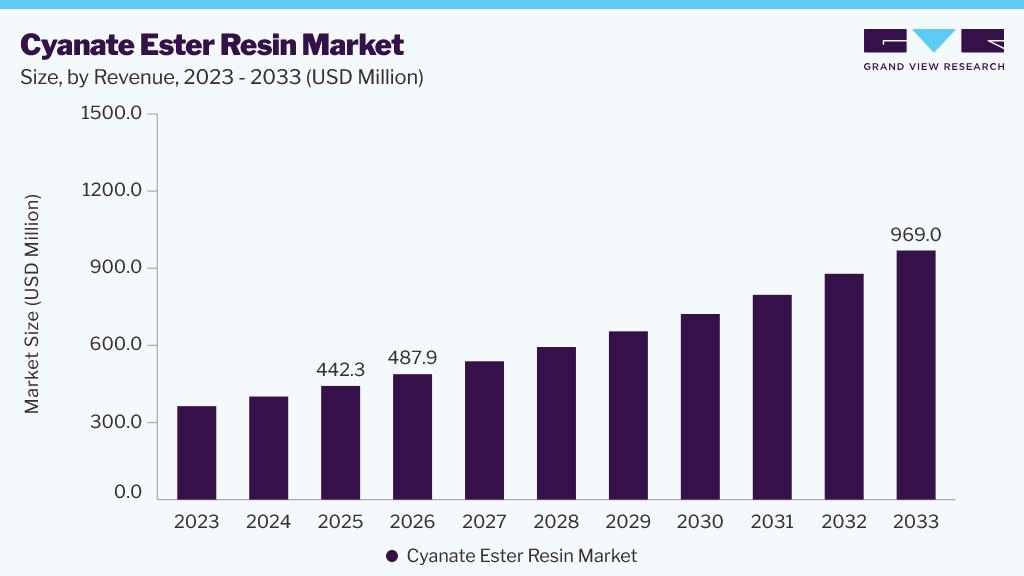 Source: Grand View Research, IR Documents, Primary Interviews, Paid DatabasesTo learn more about this report,
 Download Free Sample Report
Key Market Trends & Insights
- By type: The Bisphenol segment held the largest market share of approximately 53.0% in 2025.
- By end use: The aircraft segment held the largest market share of approximately 43.5% in 2025.
- By application: The composite segment held the largest market share of approximately 50.0% in 2025.
Regional Highlights
- Largest regional market: North America (34.0% revenue share, 2025)
- Fastest-growing regional market: Asia Pacific (highest CAGR, 2026-2033)
Market Size & Forecast
- Market size in 2025: USD 442.3 Million
- Estimated market size in 2026: USD 487.9 Million
- Projected market size by 2033: USD 969.0 Million
- CAGR (2026-2033): 10.3%
Prism AI by Grand View Research Free to tryAsk a question about the cyanate ester resin marketTry asking✓Every figure cited from GVR research Prefer the report? Download free sample →The growth of various end-use industries, such as cyanate ester, electrical & electronics, and automotive, fuels the demand for virgin Cyanate Ester. Moreover, with an increasing emphasis on fuel efficiency and environmental sustainability, there's a continuing demand for lightweight materials, which propels the usage of cyanate esters.
Cyanate esters are widely used in the aerospace sector due to their ability to tolerate severe temperatures and harsh environments. Cyanate esters are utilized as matrix resins in the production of composite materials for airplane structures. These composite material offers strong fatigue resistance, high strength-to-weight ratio, and dimensional stability, making them ideal for critical aerospace components such as empennage, wings, fuselage panels, and engine components.
One of the major challenges faced by the market includes the high cost of the material compared to traditional resins. Raw material costs, synthesis procedures, and specific production techniques are expected to impact on the cost of the material, thus restraining the growth of cyanate ester market growth.
Analyst Perspective
The cyanate ester resin market is poised for sustained growth, driven by increasing demand for high-performance materials across aerospace, defense, electronics, and satellite applications. Thermal stability, minimal dielectric loss, dimensional stability, and high strength have made cyanate ester resins more appealing in the production of composite structures and electronic substrates at high frequency levels. Advancements in areas such as lightweight airplanes, space technology, and fifth-sixth generation technology is expected to drive the usage of cyanate ester resins. Continued product innovations and prepreg developments by leading manufacturers further strengthen the market's long-term growth outlook despite relatively high material costs.
Type Insights
Based on type, the bisphenol derivatives segment led the market with the largest revenue share of approximately 53.0% in 2025. Bisphenol a (BPA) cyanate esters are a type of cyanate ester that is manufactured with bisphenol A as a primary raw material. BPA-type cyanate esters offer high thermal stability, mechanical strength, and electrical properties, making them ideal for several applications in industries such as electronics, aerospace & defense, and automobiles. According to research studies & literatures, Bisphenol A acts as a component in epoxy resins that are very good coating agents and therefore is used for the protective coating of pipelines and to cover the inner surface of food cans. This helps the food and beverages to last long without any decay.
Moreover, ongoing scientific research and development aimed at increasing the performance and characteristics of BPA-type cyanate esters. BPA-type cyanate esters find employment in a wide range of industries and end uses. They are used to produce composite materials for airplane constructions, electronic packaging and encapsulation, antenna systems, automotive components, and other applications.
The novolac segment is expected to grow to a significant CAGR over the forecast period. Novolac-type cyanate esters are a subclass of cyanate esters derived from novolac resins, which are phenolic resins formed by the condensation of phenol and formaldehyde. Novolac-type cyanate esters provide exceptional thermal stability, with glass transition temperatures (Tg) that frequently surpass 250°C. These characteristics make it suitable for several applications such as semiconductor manufacturing, electronic packaging, and composite structures.
End Use Insights
Based on end-use, the aerospace & defense segment led the market with the largest revenue share of approximately 43.5% in 2025. Cyanate esters have a unique combination of lightweight qualities and high strength, making them ideal for applications demanding weight reduction, such as aircraft structures, missiles, and spacecraft.
In addition, the electrical & electronics segment is anticipated to grow at a substantial CAGR of over 10.0% during the forecast period. Cyanate esters exhibit good dielectric properties, such as low dielectric constants, low dissipation factors, and high breakdown voltage. The trend toward reduction and performance enhancement of electronic equipment fuels the demand for innovative materials such as cyanate ester with superior properties. For instance, in June 2025, HighChem Co., Ltd. announced the commercialization of its proprietary Bismaleimide-Cyanate (BMI-Cyanate) resin for high-performance laminate materials used in printed circuit boards (PCBs) and semiconductor packaging
Application Insights
Based on application, the composites segment led the market with the largest revenue share of approximately 50.0% in 2025. The segment is also expected to grow at a significant CAGR over the forecast period, due to several factors, including the unique features and benefits of cyanate esters as matrix resins in composite materials. Cyanate ester composites allow for significant weight reduction while maintaining structural integrity and performance. In April 2024, Hyundai Motor Group signed a master agreement with Toray Group to jointly develop lightweight and high-strength composite materials, including carbon fiber-reinforced polymer parts to improve mobility performance and ensure safety
The adhesives segment is projected to grow to a significant CAGR of over 10.2% over the forecast period. Cyanate ester adhesives have great strength, stiffness, and toughness, resulting in long-lasting and reliable bonds between substrates. These adhesives offer mechanical loads such as vibration, impact, and fatigue, making them ideal for structural bonding applications in several industries including aerospace and electrical & electronics.
Regional Insights
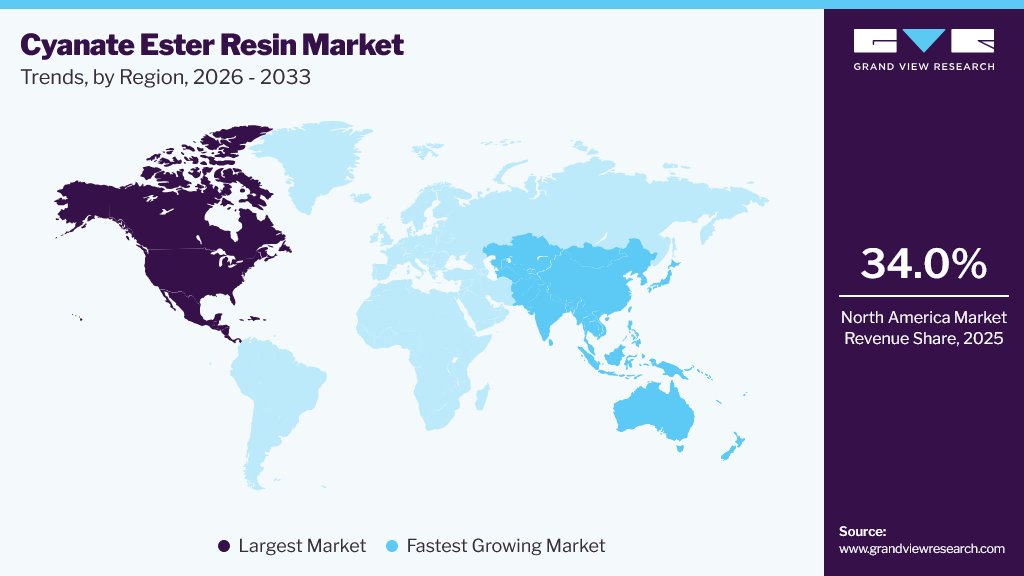
North America cyanate ester resin market accounted for a revenue share of over 34.0% in 2025. The rising need for high-performance materials in the aerospace and military industries is propelling the expansion of the North American market.
 To learn more about this report, Download Free Sample Report
U.S. Cyanate Ester Resin Market Trends
The cyanate ester resin market in U.S. is expected to grow at the fastest CAGR over the forecast period. The electronics and semiconductor industries in the U.S. are advanced, requiring high-performance materials for applications such as semiconductor packaging, microelectronics, printed circuit boards (PCBs), and electronic packaging. This is expected to create demand for cyanate ester in the country.
Asia Pacific Cyanate Ester Resin Market Trends
Asia Pacific dominated the cyanate ester resin market with a revenue share of approximately 29.0% in 2025. Asia-Pacific countries, particularly China, Japan, South Korea, and India, have made considerable investments in their aerospace and defense industries. The rapid development and manufacturing of aircraft components are expected to drive market growth.
The China cyanate ester resin market held a significant share in the Asia Pacific region. The market is anticipated to register the fastest CAGR over the forecast period. The growing demand for lightweight, high-performance materials across the country is driving the use of cyanate esters in applications such as composite materials for aircraft construction, thermal protection systems, radomes, and electronic packaging.
The cyanate ester resin market in Japan is expected to grow at a significant CAGR over the forecast period. Japan has a well-established aerospace and defense industry that focuses on technological innovation and product development. The demand for lightweight, high-performance materials in applications such as satellites, aircraft structures, missiles, and military systems promotes cyanate ester consumption in Japan.
Europe Cyanate Ester Resin Market Trends
The cyanate ester resin market in Europe is expected to witness a significant CAGR over the forecast period. European automakers value innovation, quality, and sustainability. Cyanate esters are utilized in lightweight composite materials for automotive components, which aid in reducing weight, fuel efficiency, and toxins in European-made vehicles.
The German cyanate ester resin market held a significant share in Europe. The market is anticipated to register the fastest CAGR over the forecast period. Germany is well-known for its research institutions, universities, and corporations specializing in materials science, polymer chemistry, and innovative manufacturing technology. The rise in R&D activities across the country in the production of high-performance materials is expected to propel market growth.
Central & South America Cyanate Ester Resin Market Trends
The cyanate ester resin market in Central & South America is expected to witness a significant CAGR over the forecast period. Central and South American governments are investing in infrastructure development projects, such as transportation, electricity, telecommunications, and construction. Cyanate esters are employed in structural components, electronic systems, and insulating materials in many infrastructure projects across the region.
Middle East & Africa Cyanate Ester Resin Market Trends
The ester resin market in the Middle East & Africa is expected to witness at a significant CAGR over the forecast period. Several factors influence the cyanate ester market growth in the Middle East and Africa (MEA) region, including industrialization, economic expansion, technological advancements, and market dynamics.
Key Cyanate Ester Resin Company Insights
Key companies are adopting several organic and inorganic growth strategies, such as new product development, mergers & acquisitions, and joint ventures, to maintain and expand their market share.
Key Cyanate Ester Resin Companies:
The following are the leading companies in the cyanate ester resin market. These companies collectively hold the largest market share and dictate industry trends.
-
Huntsman International LLC
-
Arxada Ltd.
-
Toray Advanced Composites
-
Hexcel Corporation
-
MITSUBISHI GAS CHEMICAL COMPANY, INC
-
Henkel AG & Company
-
Novoset, LLC
-
Solvay
-
Syensqo
-
TenCate Advanced Composites
Key Cyanate ester resin Companies:
The following are the leading companies in the cyanate ester resin market. These companies collectively hold the largest market share and dictate industry trends.
-
IBM Corporation
-
Microsoft Corporation
-
Salesforce
-
SAP
-
Broadcom
-
Okta
-
Akamai Technologies
-
Ping Identity
-
ForgeRock
-
LoginRadius
-
HID Global
Recent Developments
-
In 2026, researchers developed cyanate ester composites for 5G/6G copper-clad laminates. Excellent dielectric properties (low dielectric constant of 3.3 and low loss) are achieved, which can effectively reduce high-frequency signal transmission delay and insertion loss, supporting the development of 5G/6G communications.
-
In October 2025, Hyundai Motor Group and Toray Industries, Inc. (Toray Group) signed a Strategic Joint Development Agreement to collaborate on advanced materials and components innovation, aiming to set new standards in future mobility. The newly signed agreement represents a major step forward in their collaboration, accelerating the development of advanced materials and components for future mobility.
Cyanate Ester Resin Market Report Scope
Report Attribute
Details
Market size in 2025
USD 442.3 million
Estimated market size in 2026
USD 487.9 million
Projected market size by 2033
USD 969.0 million
Growth rate
CAGR of 10.3% from 2026 to 2033
Base year for estimation
2025
Historical data
2021 – 2024
Forecast period
2026 – 2033
Quantitative units
Volume in kilotons, Revenue in USD million, and CAGR from 2026 to 2033
Report coverage
Revenue forecast, company ranking, competitive landscape, growth factors, and trends
Segments covered
Type, application, end use, and region
Regional scope
North America; Europe; Asia Pacific; Central & South America; Middle East & Africa
Country scope
U.S.; Canada; Mexico; Germany; UK; France; Italy; China; India; Japan; Brazil; Argentina; GCC Countries; South Africa
Key companies profiled
Huntsman International LLC; Arxada Ltd.; Toray Advanced Composites; Hexcel Corporation; MITSUBISHI GAS CHEMICAL COMPANY, INC.; Henkel AG & Company;Novoset; LLC; Solvay; Syensqo; TenCate Advanced Composites
Customization scope
Free report customization (equivalent to up to 8 analysts working days) with purchase. Addition or alteration to country, regional & segment scope.
Pricing and purchase options
Avail of customized purchase options to meet your exact research needs. Explore purchase options
Global Cyanate ester resin Market Report Segmentation
This report forecasts revenue growth at global, regional, and country levels and provides an analysis of the latest industry trends and opportunities in each of the sub-segments from 2021 to 2033. For this study, Grand View Research has segmented the global cyanate ester resin (CIAM) market report based on type, application, end use, and region:
-
Type Outlook (Volume, Kilotons; Revenue, USD Million, 2021 - 2033)
-
Bisphenol derivatives
-
Novolac
-
Others
-
-
Application Outlook (Volume, Kilotons; Revenue, USD Million, 2021 - 2033)
-
Composites
-
Adhesives
-
Coatings
-
Others
-
-
End Use Outlook (Volume, Kilotons; Revenue, USD Million, 2021 - 2033)
-
Aerospace & Defense
-
Electrical & electronics
-
Automotive
-
Others
-
-
Regional Outlook (Volume, Kilotons; Revenue, USD Million, 2021 - 2033)
-
North America
-
U.S.
-
Canada
-
Mexico
-
-
Europe
-
Germany
-
France
-
UK
-
Italy
-
-
Asia Pacific
-
China
-
Japan
-
India
-
-
Central & South America
-
Brazil
-
Argentina
-
-
Middle East & Africa
-
GCC Countries
-
South Africa
-
-
Frequently Asked Questions About This Report
The cyanate ester resin market size was valued at USD 442.3 million in 2025 and is estimated at USD 487.9 million for 2026.
The cyanate ester resin market is expected to grow at a CAGR of 10.3% from 2026 to 2033, reaching USD 969.0 million.
North America dominated with a 34.0% revenue share in 2025.
Key players in the market include Huntsman International LLC, Arxada Ltd., Toray Advanced Composites, Hexcel Corporation, MITSUBISHI GAS CHEMICAL COMPANY, INC., Henkel AG & Company,Novoset, LLC, Solvay, Syensqo, TenCate Advanced Composites, and others
The bisphenol derivatives segment accounted for the largest revenue share of approximately 53.0% in 2025.
About the Author(s)
Plastics, Polymers & Resins Research Team
Bulk Chemicals · Plastics, Polymers & ResinsThis report was authored by the plastics, polymers & resins research team at Grand View Research - comprising two research analysts, one senior research analyst, and one industry expert - with specialized expertise in the plastics, polymers & resins segment of the bulk chemicals industry. All findings are based on proprietary bulk chemicals databases, executive interviews, and regulatory analysis, subject to internal peer review prior to publication.
Last Updated:
Speak to Analyst

Customize this report to your needs - add regions, segments, or data points, with 20% free customization.
Or view our licence options:


ISO 9001:2015 & 27001:2022 Certified
We are GDPR and CCPA compliant! Your transaction & personal information is safe and secure. For more details, please read our privacy policy.


