
- Home
- »
- Network Security
- »
-
Cybersecurity Mesh Market Size & Share Report, 2026-2033GVR Report cover

Cybersecurity Mesh Market (2026 - 2033)
Size, Share & Trends Analysis Report By Offering (Solution, Services), By Deployment (Cloud, On-Premise), By Enterprise Size (Small & Medium Enterprises, Large Enterprises), By End Use, By Region, And Segment Forecasts
Market Size, 2025
$2.9BMarket Estimate, 2026
$3.2BMarket Forecast, 2033
$6.5BCAGR, 2026–2033
10.8%Cybersecurity Mesh Market Summary
The global cybersecurity mesh market size was valued at USD 2.9 billion in 2025 and is projected to grow from USD 3.2 billion in 2026 to USD 6.5 billion by 2033, at a CAGR of 10.8% from 2026 to 2033. The market in North America dominated with a revenue share of 38.6% in 2025. This growth is driven by rapid enterprise adoption of Zero Trust architectures, expanding hybrid and multi-cloud environments, and increasing demand for AI-powered, identity-centric security frameworks to manage complex and distributed cyber threat landscapes.
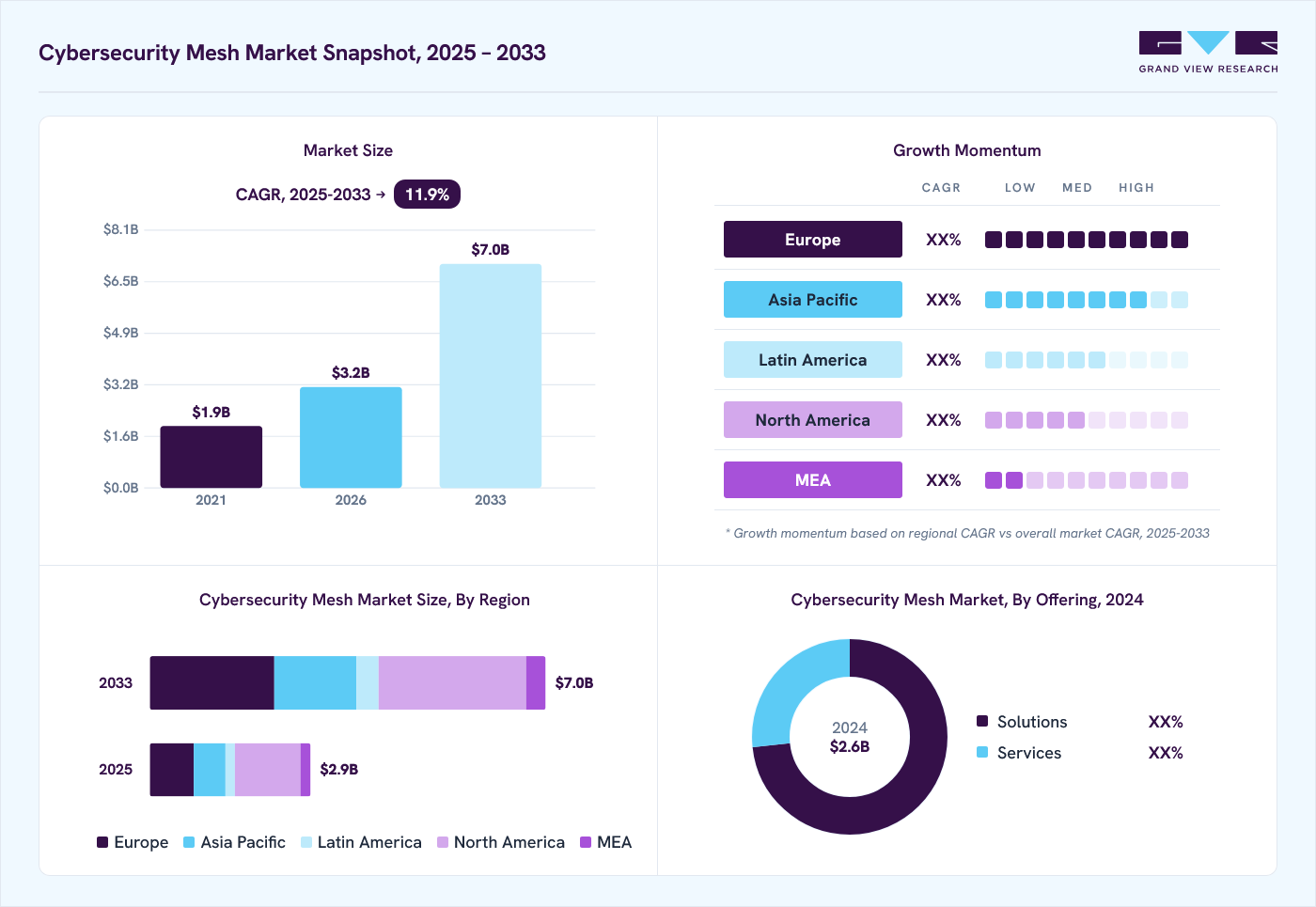 Source: Grand View Research, IR Documents, Primary Interviews, Paid DatabasesTo learn more about this report,
 Download Free Sample Report
 Key Market Trends & Insights
- By offering: Solution segment dominated the market, with a revenue share of 72.8% in 2025.
- By deployment: Cloud segment held the largest market share of 65.9% in 2025.
- By enterprise size: Large enterprise segment dominated the market, with a revenue share of 65.2% in 2025.
- By end use: IT and telecom segment held the largest revenue share in 2025.
Regional Highlights
- Largest regional market: North America (38.6% revenue share, 2025)
- Fastest-growing regional market: Europe (highest CAGR, 2026-2033)
- By country: The U.S. held the largest market share in 2025.
Market Size & Forecast
- Market size in 2025: USD 2.9 Billion
- Estimated market size in 2026: USD 3.2 Billion
- Projected market size by 2033: USD 6.5 Billion
- CAGR (2026-2033): 10.8%
Three ways to get this report
Buy it, customize it, or ask a question.Ask an Analyst
Analyst response in 1 business day
- AccessReport author, directly
- Reply timeWithin 1 working day
- No sales callDirect answer only
- FormatEmail reply
- CostFree, no cost
Get the Full Report
What the study covers
- FormatsPDF · Excel · Dashboard
- Timeline2026–2033 annual, 2025 base
- Coverage20+ countries, 5 regions
- Companies10+ key players profiled
Customize the Report
20% free customization
- IncludeCountries, segments, points
- TailorTo your product definition
- ExtendDeeper competitor detail
- OrA fully bespoke study
- Turnaround5–10 working days
The increasing adoption of zero-trust principles is driving demand for cybersecurity mesh frameworks. Zero trust emphasizes continuous verification of users, devices, and network traffic, regardless of where they originate. Cybersecurity mesh provides the architectural support for zero trust by allowing context-aware, identity-centric access control to be extended across dynamic and distributed environments. By enabling security to be applied closer to the identity and asset in question, mesh architectures make zero-trust implementations more practical and scalable. As regulatory frameworks and industry best practices increasingly recommend or mandate zero-trust adoption, organizations are turning to cybersecurity mesh as a way to operationalize these policies effectively. To learn more about this report, Download Free Sample Report
 Cybersecurity mesh architecture is a scalable and modular solution to extending security controls, even to widely dispersed assets. Because of its versatility, it is particularly well suited for more modular strategies that are compatible with hybrid multi-cloud systems. A more modular, adaptable, and robust security ecosystem is made possible by Cybersecurity Mesh Architecture (CSMA). A cybersecurity mesh allows technologies to communicate with one another through a number of supporting layers, such as security intelligence, centralized policy management, and identity fabric, as opposed to each security tool operating in a separate silo. These beneficial factors are expected to propel the demand of the market in future years.
Further, with the help of CSMA, people and machines can securely communicate from various places, across channels, different generations of apps, and hybrid and multi-cloud settings. At the same time, all the company's digital assets are protected. This promotes a more constant security posture to support more agility for the composable company. In order to facilitate the integration of security solutions, CSMA offers a number of enabling services, including security analytics, distributed identity fabric, intelligence, automation, and triggers, as well as centralized policy administration and orchestration.
The identity and security architectures cannot meet the continuously shifting needs at present, as they currently stand. All assets, whether they are on-premises, in data centers, or the cloud, may be secured with the help of CSMA, which helps to offer a standard, integrated security structure and posture. By standardizing how the tools link, CSMA enables standalone solutions to cooperate in complementary ways to enhance the overall security posture. For instance, it helps shift control points closer to the assets intended to safeguard and centralizes policy management. The above aspects are expected to fuel the demand for the cybersecurity mesh industry across regions during the forecast period.
Market Dynamics
The global cybersecurity mesh market is witnessing strong growth as enterprises increasingly adopt distributed, identity-centric security architectures to protect complex hybrid and multi-cloud environments. Organizations are shifting away from traditional perimeter-based security models toward a cybersecurity mesh approach that enables modular, scalable, and interoperable security controls across users, devices, applications, and workloads. This architecture enhances real-time threat detection, centralized policy orchestration, and adaptive access management, improving overall security posture in highly dynamic IT ecosystems. The growing adoption of cloud computing, remote work models, IoT ecosystems, and edge computing is further accelerating demand for cybersecurity mesh solutions, as enterprises seek unified visibility and consistent enforcement of security policies across fragmented digital environments.
The growing adoption of distributed enterprise architectures, coupled with the rapid expansion of AI-driven workloads and Zero Trust security models, is a key driver of the global Cybersecurity Mesh market. Organizations are increasingly shifting toward cybersecurity mesh frameworks to enable identity-centric, modular, and interoperable security controls across hybrid cloud, multi-cloud, edge, and SaaS environments. Enterprises are integrating AI-powered threat intelligence, identity and access management (IAM), security orchestration, and continuous risk monitoring to ensure real-time visibility and adaptive protection across fragmented IT ecosystems. For instance, in April 2026, Cloudflare announced Cloudflare Mesh, a secure networking and connectivity fabric designed to unify humans, AI agents, and multicloud environments into a single governed security layer, enabling enterprises to encrypt and secure every connection point across distributed systems and AI-driven workflows. This reflects a broader industry transition toward mesh-based security architectures capable of securing autonomous agents, API-driven ecosystems, and dynamic workloads at scale.
The complexity of integrating cybersecurity mesh architectures across fragmented IT environments acts as a significant restraint for market growth. Many enterprises operate heterogeneous security stacks comprising legacy firewalls, endpoint protection systems, cloud security tools, and identity platforms, making unified orchestration technically challenging. The lack of standardized frameworks across vendors further complicates interoperability and increases dependency on customization and middleware integration. Additionally, security tool sprawl leads to operational inefficiencies, alert fatigue, and higher total cost of ownership. Small and medium-sized enterprises often face budget constraints, limited cybersecurity expertise, and difficulty in consolidating security operations, which can slow down adoption of cybersecurity mesh solutions and delay full-scale deployment.
The emergence of AI-driven autonomous security operations presents a major growth opportunity for the global Cybersecurity Mesh market. Organizations are increasingly investing in intelligent security ecosystems that combine machine learning, behavioral analytics, and automated response mechanisms to detect and mitigate threats in real time. Cybersecurity mesh architectures are evolving to support autonomous threat hunting, self-healing security policies, and adaptive access controls across distributed environments. The growing adoption of Security Operations Center (SOC) automation, Extended Detection and Response (XDR), and Security Orchestration, Automation and Response (SOAR) platforms is further accelerating this shift. Additionally, enterprises focused on improving cyber resilience, regulatory compliance, and digital trust are driving demand for scalable, AI-enabled cybersecurity mesh frameworks capable of dynamically responding to evolving threat landscapes.
Analyst Perspective
The cybersecurity mesh market sits at the intersection of accelerating enterprise digital transformation, expanding hybrid and multi-cloud adoption, and the rising complexity of modern cyber threat landscapes. Organizations are increasingly required to secure highly distributed digital environments spanning users, devices, applications, APIs, and workloads, driving strong demand for identity-centric, interoperable, and scalable security architectures. Traditional perimeter-based security models are becoming insufficient, prompting enterprises to adopt cybersecurity mesh frameworks that enable decentralized yet unified security enforcement, continuous threat monitoring, adaptive access control, and real-time risk-based decision-making across fragmented IT ecosystems.
Offering Insights
Based on offering, the solution segment led the market with the largest revenue share of 72.8% in 2025. Cybersecurity mesh solutions have been made possible by the emergence of technologies like edge computing, machine learning, and artificial intelligence. These technologies boost the entire security posture by enabling intelligent threat detection, behavior analytics, and automated responses at the edge. Strict regulatory and compliance standards relating to data security and privacy are applicable to many businesses. By applying security controls at the device level, cybersecurity mesh solutions allow organizations to prove compliance with these standards more thoroughly and granularly. This is expected to boost the demand for cybersecurity mesh solutions among the end-use industries over the forecast period.
The services segment is anticipated to grow at the fastest CAGR during the forecast period. The adoption of cybersecurity mesh services has been affected by the move towards a zero-trust architecture. Zero trust strongly emphasizes every person and device being verified and authorized, regardless of their location or network. Cybersecurity mesh services reduce dependency on network-level security by offering security protections at the individual device level, which aligns with the zero-trust philosophy.
Deployment Insights
Based on deployment, the cloud segment led the market with the largest revenue share of 65.9% in 2025, owing to the scalability, flexibility, and affordability of cloud computing, businesses are adopting it with increasing frequency. Strong security measures become increasingly important as more vital corporate operations and data are moved to the cloud. With the help of a cybersecurity mesh in the cloud, cloud environments may be secured in a distributed and scalable manner, ensuring that security measures are uniformly applied to all cloud resources.
The on-premise segment is anticipated to grow significantly during the forecast period. Critical resources and sensitive data are kept in on-premises environments by many organizations. It is essential to safeguard these assets against unauthorized access, data breaches, and insider threats. Cybersecurity mesh in on-premises deployments enables businesses to apply security rules directly to specific endpoints and devices, offering granular protection for vital assets and reducing risks.
Enterprise Size Insights
Based on enterprise size, the large enterprise segment led the market with the largest revenue share of 65.2% in 2025. Large businesses are frequent targets of cyberattacks because they may contain significant data and resources. Enterprises must employ cutting-edge security measures due to the growing complexity and sophistication of cyberattacks. Cybersecurity mesh systems provide improved security by putting security controls in place directly on individual devices, allowing for in-the-moment threat detection, reaction, and containment.
The small & medium enterprises (SMEs) segment is anticipated to grow at the significant CAGR during the forecast period. SMEs are not immune to cyberattacks, and they are frequently singled out since it is speculated that they may have less robust security measures than bigger companies. SMEs now understand the need for strong cybersecurity measures due to the rising frequency and sophistication of cyberattacks, such as ransomware, phishing, and data breaches. SMEs may protect their digital assets and sensitive data with the help of cybersecurity mesh solutions, which provide them with sophisticated security capabilities.
End Use Insights
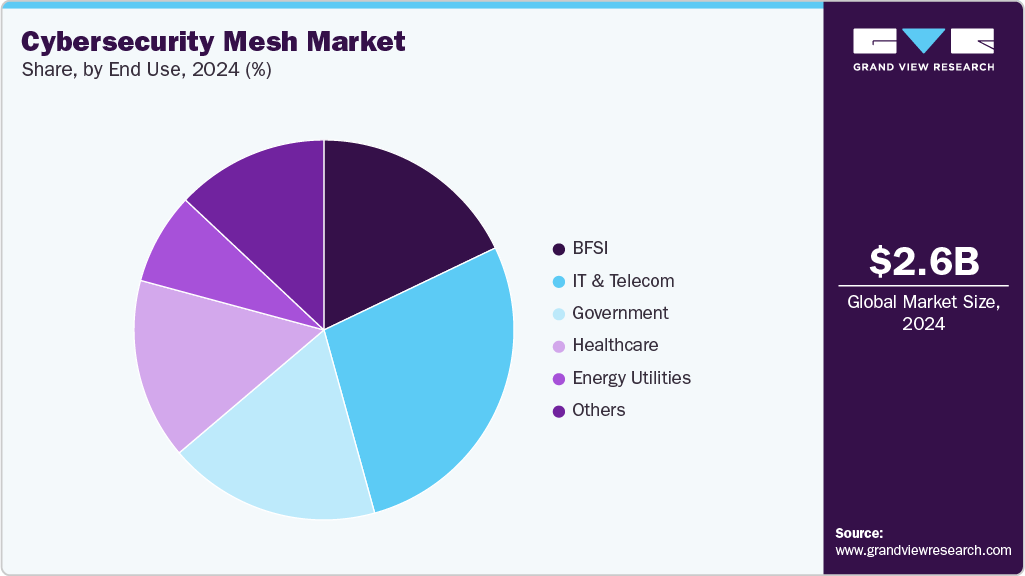
Based on end use, IT and telecom segment led the market with the largest revenue share of 28.3% in 2025. The IT and telecom sectors have quickly adopted cloud computing and virtualization technologies to improve agility, scalability, and cost-effectiveness. However, these technologies pose particular security issues, like data privacy, multi-tenancy, and virtual machine vulnerabilities. Cybersecurity mesh solutions offer an integrated security framework to the IT & Telecom sector that covers virtualized infrastructure and cloud environments, enabling consistent security controls and policies to safeguard data and applications. This is expected to increase the demand for the cybersecurity mesh industry across the IT and telecom sectors.
 To learn more about this report, Download Free Sample Report
 The healthcare segment is anticipated to grow at the significant CAGR during the forecast period, owing to the importance of securing patient health records and the healthcare industry's vulnerability to cyberattacks. Ransomware, data breaches, and targeted attacks are just a few examples of rising cyber threats. Organizations in the healthcare industry are aware of the importance of having strong security measures in place to safeguard patient information, vital infrastructure, and treatment continuity. Cybersecurity mesh offers an adaptive and distributed security method to reduce the growing dangers in this area.
Regional Insights
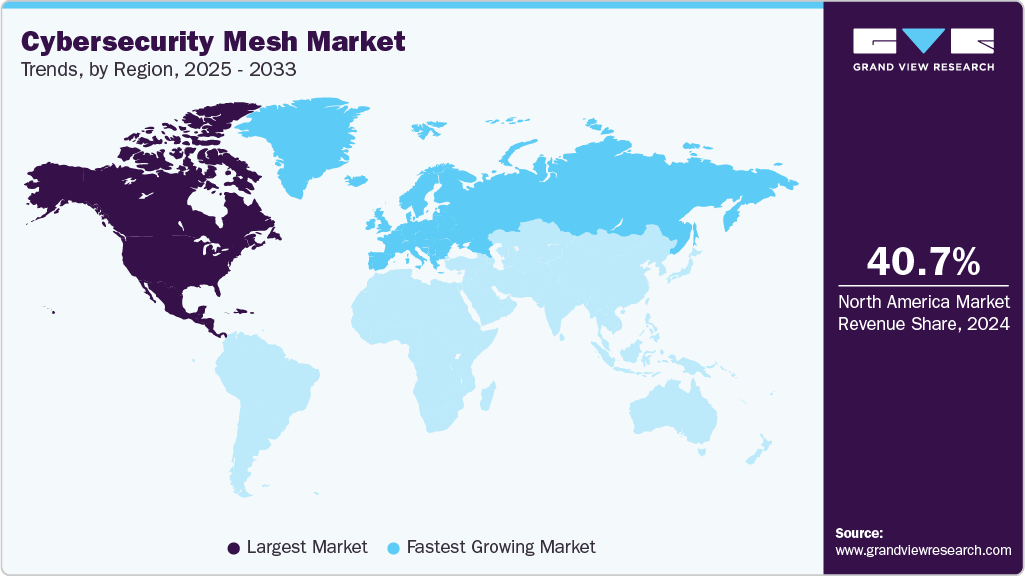
North America dominated the global cybersecurity mesh market with the largest revenue share of 38.6% in 2025. The cyber threat landscape in North America is complex and constantly changing. Attacks on key infrastructure, corporations, government agencies, and people are all increasingly being conducted via cyberspace. Strong cybersecurity measures are essential to safeguard sensitive data, vital systems, and infrastructure. In North America, data breaches have grown to be a big problem, with many high-profile events affecting both corporations and people. The disclosure of private data undermines confidence and causes privacy concerns. Through granular security controls and encryption techniques, cybersecurity mesh solutions assist organizations in protecting sensitive data, assuring data privacy, and ensuring regulatory compliance.
 To learn more about this report, Download Free Sample Report
 U.S. Cybersecurity Mesh Market Trends
The cybersecurity mesh market in the U.S. held the largest share in the North America region in 2025. The growing use of smart technologies and connected devices in sectors like manufacturing, healthcare, and critical infrastructure is further accelerating demand for mesh-based cybersecurity solutions in the U.S. As the number of endpoints increases, ranging from industrial sensors and medical devices to autonomous systems and smart building controls, so too does the need for distributed, device-level security. Cybersecurity mesh, by contrast, enables localized policy enforcement and identity-based security controls that can be deployed close to the edge. This capability is crucial for securing operational technology (OT) environments that cannot tolerate high latency or downtime.
Europe Cybersecurity Mesh Market Trends
The cybersecurity mesh market in Europe is expected to grow at the fastest growing CAGR of 12.3% over the forecast period. Ransomware assaults, data breaches, and targeted attacks are some of the sophisticated cyber dangers that Europe is facing on a regular basis. Government agencies, healthcare providers, financial organizations, and essential infrastructure are just a few organizations that are increasingly targeted. Cybersecurity mesh offers improved security capabilities by offering dispersed security controls, threat intelligence sharing, and incident response coordination to counter these changing threats.
The UK cybersecurity mesh market is expected to grow at a substantial CAGR during the forecast period. The increasing adoption of cloud-native and edge technologies by UK enterprises is further boosting demand for cybersecurity mesh solutions. As more businesses migrate workloads to cloud platforms and deploy applications closer to users and devices, whether through IoT, 5G, or edge computing, they need security models that can protect digital assets outside traditional perimeters. Mesh frameworks deliver identity-based, adaptive security at the point of access, allowing UK companies to maintain control over sensitive data and systems in a highly decentralized architecture. This is particularly valuable in industries such as finance, healthcare, and manufacturing, where operational integrity and regulatory compliance must be balanced with rapid digital innovation.
Asia Pacific Cybersecurity Mesh Trends
The cybersecurity mesh market in Asia Pacific is expected to register at a moderate CAGR during the forecast period. The expansion of 5G networks across countries like China, South Korea, and India is also accelerating cybersecurity challenges. The ultra-low latency and high-speed connectivity offered by 5G are unlocking new possibilities for smart cities, autonomous systems, and industrial automation. However, these advancements also open new attack surfaces and increase the complexity of securing networked environments. Cybersecurity mesh frameworks offer adaptive policy enforcement and scalable monitoring mechanisms that are ideal for 5G-enabled architectures, helping enterprises secure both core and edge assets more effectively.
The China cybersecurity mesh market is projected to grow at the fastest CAGR during the forecast period. The rapid development of smart cities and IoT infrastructure is also stimulating the market growth in China. With a rising number of connected devices deployed in urban infrastructure, manufacturing plants, and logistics networks, there is an immense need for real-time data processing and intelligent analytics. These applications require distributed computing models where edge, regional, and core cloud platforms work in tandem. Cybersecurity mesh acts as the enabler of this architecture, providing the agility and scalability necessary to interlink diverse computing nodes and cloud services across large geographical areas, all while meeting latency, security, and reliability requirements.
Key Cybersecurity Mesh Company Insights
Some of the key companies operating in the market, include Fortinet, Inc., and Check Point Software Technologies Ltd., among others, are some of the leading participants in the cybersecurity mesh industry.
-
Fortinet, Inc., is a cybersecurity and network security solutions provider. The company’s flagship technology, FortiOS, is its proprietary operating system, which powers its FortiGate next-generation firewalls (NGFWs) and related security appliances. FortiOS converges networking and security functions such as SD-WAN, secure Wi-Fi (FortiSwitch and FortiAP), VPN, and advanced threat analytics within a unified management framework. Fortinet also develops custom-built ASICs (Security Processing Units), enabling high-performance throughput and industry-leading efficiency across its product portfolio.
-
Check Point Software Technologies Ltd. is a cybersecurity firm. The company operates with a strong focus on threat prevention, offering unified security management through its Infinity architecture. This architecture provides consolidated security across multiple environments, including networks, cloud, mobile, and endpoints through a single, integrated platform. Check Point’s portfolio includes advanced threat prevention tools, such as intrusion prevention systems (IPS), antivirus, anti-bot, zero-day protection, and advanced sandboxing technologies. These offerings are designed not just to detect threats but to proactively prevent them, ensuring minimal disruption to an organization’s operations.
AppNovi and SonicWall are some of the emerging market participants in the cybersecurity mesh industry.
-
Aryaka Networks, Inc. is a privately held technology firm. It specializes in delivering a cloud-first Unified Secure Access Service Edge (SASE) offering, combining software-defined wide-area networking (SD-WAN), application acceleration, global private network connectivity, and security-as-a-service into a single integrated platform.
-
SonicWall is a cybersecurity company offering advanced network security solutions such as next-generation firewalls, secure remote access, and unified threat management (UTM). SonicWall operates globally and supports a vast partner ecosystem that includes managed service providers (MSPs), value-added resellers, and system integrators. SonicWall has been actively transforming its product strategy to align with the emerging cybersecurity mesh architecture. This transformation is largely driven by a shift in enterprise IT environments toward distributed, cloud-based, and hybrid models, as well as the growing threat landscape.
Key Cybersecurity Mesh Companies
The following key companies have been profiled for this study on the cybersecurity mesh market.
-
appNovi
-
ARYAKA NETWORKS, INC.
-
Cato Networks
-
Check Point Software Technologies Ltd.
-
Exium
-
Forcepoint
-
Fortinet, Inc.
-
Ivanti
-
Mesh Security ltd.
-
Naoris Protocol
-
Palo Alto Networks
-
Quasius Investment Corp. GCA
-
SailPoint Technologies, Inc.
-
SonicWall
-
Zscaler
Competitive Benchmarking
Category
Operating Strategies
Competitive Edge
Weakness
Established Players (Palo Alto Networks, Fortinet, Inc., Zscaler, Check Point Software Technologies Ltd.)
- Established players in the cybersecurity mesh market focus on building integrated security platforms that combine Zero Trust architecture, SASE, XDR, identity security, cloud workload protection, and AI-driven threat intelligence.
- Their strategy emphasizes end-to-end security orchestration across users, devices, applications, APIs, and workloads in hybrid and multi-cloud environments. These vendors prioritize platform consolidation, continuous threat monitoring, and real-time policy enforcement across distributed enterprise ecosystems.
- Established players benefit from strong global enterprise penetration, mature security ecosystems, and highly scalable cloud-native and hybrid security platforms. Their solutions offer advanced capabilities such as AI-powered threat detection, behavioral analytics, unified policy orchestration, and deep integration across network, endpoint, cloud, and identity layers.
- Strong partner ecosystems, MSSP networks, and integration with hyperscalers further strengthen their leadership in enabling cybersecurity mesh architectures.
- These platforms often involve high deployment complexity, significant integration effort across heterogeneous security stacks, and substantial operational costs.
- Enterprises may face vendor lock-in concerns, lengthy migration cycles from legacy systems, and challenges in unifying fragmented security tools under a single mesh architecture, particularly in highly customized IT environments.
Emerging Players (Cato Network, ARYAKA NETWORKS, INC., SailPoint Technologies, Inc., Ivanti, Exium)
- Small and niche players typically focus on specialized cybersecurity capabilities such as distributed mesh security concepts, experimental Zero Trust frameworks, automation-driven security controls, or early-stage decentralized trust technologies.
- Their strategy is centered on innovation-led differentiation, targeted use cases, and niche security problem-solving rather than full-stack platform offerings.
- These players often demonstrate high innovation agility, early adoption of emerging cybersecurity paradigms, and strong specialization in niche use cases such as decentralized trust, lightweight security orchestration, or experimental mesh-based architectures.
- Their solutions can be highly adaptable for specific environments or pilot deployments.
- Key weaknesses include limited scalability, low enterprise penetration, constrained R&D budgets, and lack of comprehensive security portfolios.
- They also face challenges in building global trust, meeting enterprise-grade compliance requirements, and competing with integrated platforms offered by larger cybersecurity vendors.
Recent Developments
-
In May 2025, Check Point Software Technologies Ltd. acquired Veriti Cybersecurity, marking a major milestone in advancing its hybrid mesh security vision. This acquisition, along with the recently launched External Risk Management (ERM) solution, strengthens Check Point’s capabilities to offer comprehensive risk lifecycle management. It enables the company to proactively address both internal and external threats across the entire attack surface.
-
In April 2025, Fenix24 acquired appNovi. By combining Fenix24’s proprietary software with appNovi’s advanced application dependency analysis, Fenix24 customers will benefit from enhanced mapping and visualization of physical assets, providing deeper insight into network exposure and vulnerabilities.
-
In April 2025, Fortinet launched the FortiGate 700G series, a next-generation firewall (NGFW) to expand its hybrid mesh firewall Portfolio. The FortiGate 700G offers significant performance improvements and also features support for advanced networking capabilities, FortiGuard AI-Powered Security Services, and the latest FortiOS upgrades, such as post-quantum cryptography readiness, AI-based threat detection through FortiAI-Protect, and generative AI (GenAI) risk assessment.
-
In April 2025, Forcepoint acquired Getvisibility, enhancing its Data Security Everywhere platform with advanced capabilities for real-time data risk visibility and control across hybrid cloud and generative AI environments. This strategic acquisition enables Forcepoint to strengthen its AI Mesh and risk insight technologies, allowing organizations to proactively understand, adapt to, and protect their data before it is compromised or misused. By integrating Getvisibility’s AI-powered Data Security Posture Management and Data Detection and Response solutions, Forcepoint provides a unified, foundational layer for its security architecture, empowering customers to adopt innovation securely and confidently.
Cybersecurity Mesh Market Report Scope
Report Attribute
Details
Market size in 2025
USD 2.9 billion
Estimated market size in 2026
USD 3.2 billion
Projected market size by 2033
USD 6.5 billion
Growth rate
CAGR of 10.8% from 2026 to 2033
Base year for estimation
2025
Historical data
2021 - 2024
Forecast period
2026 - 2033
Quantitative units
Revenue in USD million/billion and CAGR from 2026 to 2033
Report coverage
Revenue forecast, company market share analysis, competitive landscape, growth factors, and trends
Segments covered
Offering, deployment, enterprise size, end use, region
Regional scope
North America; Europe; Asia Pacific; Latin America; MEA
Country scope
U.S.; Canada; Mexico; Germany; UK; France; China; Japan; India; South Korea; Australia; Brazil; Saudi Arabia; South Africa; UAE
Key companies profiled
appNovi; ARYAKA NETWORKS, INC.; Cato Networks; Check Point Software Technologies Ltd.; Exium; Forcepoint; Fortinet, Inc.; Ivanti; Mesh Security ltd.; Naoris Protocol; Palo Alto Networks; Quasius Investment Corp. GCA; SailPoint Technologies, Inc.; SonicWall; and Zscaler
Customization scope
Free report customization (equivalent up to 8 analysts' working days) with purchase. Addition or alteration to country, regional & segment scope.
Pricing and purchase options
Avail customized purchase options to meet your exact research needs. Explore purchase options
Global Cybersecurity Mesh Market Report Segmentation
This report forecasts revenue growth at global, regional, and country levels and provides an analysis of the latest industry trends in each of the sub-segments from 2021 to 2033. For this study, Grand View Research has segmented the global cybersecurity mesh market report based on offering, deployment, enterprise size, end use, and region.
-
Offering Outlook (Revenue, USD Million, 2021 - 2033)
-
Solution
-
Services
-
-
Deployment Outlook (Revenue, USD Million, 2021 - 2033)
-
Cloud
-
On-Premise
-
-
Enterprise Size Outlook (Revenue, USD Million, 2021 - 2033)
-
Small & Medium Enterprises
-
Large Enterprises
-
-
End Use Outlook (Revenue, USD Million, 2021 - 2033)
-
BFSI
-
IT and Telecom
-
Healthcare
-
Government
-
Energy & Utilities
-
Others
-
-
Regional Outlook (Revenue, USD Million, 2021 - 2033)
-
North America
-
U.S.
-
Canada
-
Mexico
-
-
Europe
-
Germany
-
UK
-
France
-
Italy
-
Spain
-
-
Asia Pacific
-
China
-
India
-
Japan
-
South Korea
-
Australia
-
-
Latin America
-
Brazil
-
Argentina
-
-
Middle East & Africa
-
UAE
-
Saudi Arabia
-
South Africa
-
-
Research Methodology
The cybersecurity mesh market figures in this report are based on a proven research process that combines executive interviews with secondary research from proprietary databases, company filings, and recognized regulatory and institutional sources. Market size is built through value-chain sizing - reconciling supply-side and demand-side estimates - and triangulated with bottom-up and top-down approaches. Every estimate passes multiple levels of expert validation before publication, with each cybersecurity mesh segment quantified using the revenue-capture definitions in the table below.
Segment Definition
Segment - Offering
Revenue capture definition
Solution
The solution segment generates revenue from cybersecurity mesh platforms that provide distributed, identity-centric, and policy-driven security across hybrid, multi-cloud, and edge environments. Vendors monetize through subscriptions for core mesh security platforms, identity and access management (IAM), Zero Trust enforcement layers, AI-driven threat detection, security analytics, extended detection and response (XDR), and security orchestration capabilities.
Services
The services segment generates revenue from consulting, implementation, integration, and managed security services required to deploy and optimize cybersecurity mesh architectures. This includes security architecture design, Zero Trust transformation consulting, system integration across legacy and cloud environments, continuous threat monitoring, incident response, and managed detection and response (MDR).
Segment - Deployment
Revenue capture definition
On-premise
The on-premise segment generates revenue from cybersecurity mesh solutions deployed within enterprise-controlled data centers, primarily used by organizations with strict regulatory, compliance, and data sovereignty requirements.
Cloud
The cloud deployment segment drives revenue through SaaS-based cybersecurity mesh platforms hosted on public, private, or hybrid cloud environments. Vendors monetize via subscription-based pricing models that scale with usage, number of users, workloads, and protected assets.
Segment - Enterprise Size
Revenue capture definition
Large Enterprise
The large enterprise segment, with respect to the number of employees, typically comprises organizations employing more than 1,000 employees for multinational corporations.
Small & Medium Enterprises (SMEs)
The SMEs segment, with respect to the number of employees, generally includes organizations employing between 10 and 999 employees.
Segment - Application
Revenue capture definition
BFSI
The BFSI segment generates revenue from cybersecurity mesh deployments that secure digital banking platforms, payment systems, core banking infrastructure, and financial transaction ecosystems.
Healthcare
The healthcare segment generates revenue from securing electronic health records (EHR), connected medical devices, telemedicine platforms, and hospital IT systems. Cybersecurity mesh solutions are monetized through compliance-driven security frameworks that ensure data privacy, patient protection, and uninterrupted healthcare service delivery.
Energy Utilities
This segment drives revenue through protection of critical infrastructure, including smart grids, energy distribution networks, and industrial control systems (ICS). Vendors monetize through advanced threat detection, OT security integration, and resilience-focused cybersecurity deployments.
IT and Telecom
The IT and telecom segment generates revenue from securing cloud infrastructure, data centers, 5G networks, and large-scale digital service platforms. Cybersecurity mesh adoption is driven by API security, network visibility, and distributed workload protection across global infrastructure.
Government
The government segment generates revenue through national cybersecurity programs, defense infrastructure protection, public sector digital transformation, and citizen data security initiatives. Revenue is primarily driven by compliance mandates, sovereign cloud security requirements, and national cyber defense investments.
Others
The Others segment includes retail, manufacturing, education, logistics, and emerging digital-native industries. Revenue is generated through adoption of cybersecurity mesh solutions for securing digital commerce platforms, supply chain systems, industrial IoT environments, and enterprise digital ecosystems.
Estimation Model
Layer
Question
Analysis
Security Exposure & Risk Opportunity Layer
Who can benefit from cybersecurity mesh solutions?
Identify organizations operating in highly distributed, hybrid, and multi-cloud environments with expanding attack surfaces across users, devices, applications, APIs, and workloads. These include enterprises exposed to evolving cyber threats, ransomware, identity-based attacks, and supply-chain vulnerabilities. Stakeholders such as BFSI, healthcare, government, IT & telecom, and energy utilities require cybersecurity mesh architectures to enable unified security enforcement, continuous threat monitoring, Zero Trust implementation, and adaptive risk-based access control across decentralized digital ecosystems.
Cybersecurity Maturity & Architecture Readiness Layer
Who can access cybersecurity mesh solutions?
Evaluate organizations based on cybersecurity maturity, Zero Trust adoption, cloud-native security readiness, identity and access management (IAM) sophistication, and integration capability across security tools. Enterprises with established SOC operations, SIEM/XDR deployments, cloud security platforms, and API-driven infrastructure represent the primary addressable market. Organizations undergoing digital modernization, multi-cloud migration, and remote workforce expansion are increasingly capable of adopting cybersecurity mesh architectures.
Adoption & Utilization Layer
Who actively uses cybersecurity mesh solutions?
Analyze actual deployment of cybersecurity mesh frameworks for identity-centric access control, distributed threat detection, real-time security analytics, security orchestration, endpoint and workload protection, and automated incident response. Active users include large enterprises, critical infrastructure operators, financial institutions, healthcare systems, and government agencies that leverage mesh-based security to unify fragmented security tools, improve situational awareness, and enable continuous, adaptive protection across hybrid environments.
Monetization Layer
How much revenue is generated?
Assess revenue generation through subscription-based cybersecurity platforms, Zero Trust security suites, identity and access management (IAM) solutions, XDR/SIEM integration, cloud security services, and AI-driven threat intelligence platforms. Additional revenue streams include managed detection and response (MDR), security operations center (SOC) services, consulting, integration, compliance management, and ongoing security optimization services. Vendors also capture recurring revenue through cloud-native security APIs, modular security components, and enterprise-wide multi-year security transformation contracts supporting distributed and autonomous enterprise architectures.
Delivered Customizations
This report has been delivered with the following In-depth customizations
Client Request
Customization Delivered
Value Adds
AI-Driven Threat Detection & Autonomous Security Operations Trends
Conducted a structured analysis of cybersecurity mesh capabilities focused on AI-powered threat detection, behavioral analytics, automated incident response, security orchestration, and extended detection and response (XDR) integration across distributed enterprise environments.
Helps stakeholders understand evolving cyber threat response requirements, identify high-demand AI-enabled security capabilities, and evaluate commercialization opportunities in autonomous security operations and real-time threat mitigation across hybrid and multi-cloud infrastructures.
Identity-Centric Security & Zero Trust Adoption Trends
Conducted a comprehensive analysis of cybersecurity mesh solutions integrating identity and access management (IAM), Zero Trust enforcement, continuous authentication, risk-based access control, and adaptive policy enforcement across users, devices, applications, and workloads.
Helps stakeholders identify emerging demand for identity-first security architectures, evaluate Zero Trust monetization opportunities, and assess enterprise investments in continuous verification and least-privilege access models across distributed digital ecosystems.
Edge Security & IoT/OT Convergence Trends
Conducted a comprehensive analysis of cybersecurity mesh deployment across edge computing environments, IoT networks, and operational technology (OT) systems, focusing on distributed threat detection, device identity management, and localized security enforcement.
Helps stakeholders understand growing demand for edge-native security architectures, evaluate monetization opportunities in IoT/OT protection, and assess enterprise adoption of decentralized security controls for industrial systems, smart infrastructure, and real-time edge workloads.
Frequently Asked Questions About This Report
Key players operating in the cybersecurity mesh market include appNovi; ARYAKA NETWORKS, INC.; Cato Networks; Check Point Software Technologies Ltd.; Exium; Forcepoint; Fortinet, Inc.; Ivanti; Mesh Security ltd.; Naoris Protocol; Palo Alto Networks; Quasius Investment Corp. GCA; SailPoint Technologies, Inc.; SonicWall; and Zscaler
Key factors include enterprises increasingly adopting distributed, identity-centric security architectures to protect complex hybrid and multi-cloud environments
Europe is the fastest-growing region over the forecast period.
The large enterprise segment led with a 65.2% revenue share in 2025.
The solution segment led with a 72.8% revenue share in 2025, while the services segment is the fastest-growing offering.
The cloud segment led with a 65.9% revenue share in 2025.
IT and telecom segment held the largest share (over 28.0%) in 2025.
The global cybersecurity mesh market size was valued at USD 2.9 billion in 2025 and is estimated at USD 3.2 billion for 2026.
The global cybersecurity mesh market is expected to grow at a CAGR of 10.8% from 2026 to 2033, reaching USD 6.5 billion by 2033.
North America dominated with a 38.6% revenue share in 2025.
About the Author(s)
Network Security Research Team
Technology · Network SecurityThis report was authored by the network security research team at Grand View Research - comprising two research analysts, one senior research analyst, and one industry expert - with specialized expertise in the network security segment of the technology industry. All findings are based on proprietary technology databases, executive interviews, and regulatory analysis, subject to internal peer review prior to publication.
Last Updated:
Speak to Analyst

Customize this report to your needs - add regions, segments, or data points, with 20% free customization.
Or view our licence options:


ISO 9001:2015 & 27001:2022 Certified
We are GDPR and CCPA compliant! Your transaction & personal information is safe and secure. For more details, please read our privacy policy.


