
- Home
- »
- Food Additives & Nutricosmetics
- »
-
Cytosine Market Size, Share And Trends Report, 2026-2033GVR Report cover
![Cytosine Market (2026 - 2033)Report]()
Cytosine Market (2026 - 2033)
Size, Share & Trends Analysis Report By End-use (Pharmaceutical, Chemical Industry, Agriculture), By Region (North America, Europe, Asia Pacific, Central & South America, Middle East & Africa), And Segment Forecasts
Market Size, 2025
$408.1MMarket Estimate, 2026
$446.6MMarket Forecast, 2033
$816.9MCAGR, 2026–2033
9.0%Cytosine Market Size & Trends
The global cytosine market size was valued at USD 408.1 million in 2025 and is projected to grow from USD 446.6 million in 2026 to USD 816.9 million by 2033, at a CAGR of 9.0% from 2026 to 2033. North America dominated the market, accounting for a revenue share of 40.2% in 2025. This is attributed to the growing product utilization in major end-use industries, such as agriculture, pharmaceuticals, and chemicals.

Key Market Trends & Insights
- By end use: pharmaceutical segment accounted for the largest revenue share of 67.6% in 2025.
Regional Highlights
- Largest regional market: North America (40.2% revenue share, 2025)
- By country: The U.S. held the largest market share in 2025.
Market Size & Forecast
- Market size in 2025: USD 408.1 Million
- Estimated market size in 2026: USD 446.6 Million
- Projected market size by 2033: USD 816.9 Million
- CAGR (2026-2033): 9.0%
The pharmaceutical industry plays a significant role in shaping the demand and trends in the global cytosine industry. Pharmaceutical companies are constantly seeking new molecules and compounds with therapeutic potential. It is utilized in the synthesis of various pharmaceutical products, including antiviral drugs, anticancer agents, and nucleoside analogues. The emphasis on genomics and personalized medicine within the pharmaceutical industry has further increased product demand.
Cytosine has significant demand in the pharmaceutical industry in the U.S. Its applications range from drug discovery to the development of targeted therapies. Cytosine-based compounds and nucleoside analogs are used to modulate genetic processes, target specific diseases, and improve treatment outcomes. In the U.S., pharmaceutical companies are actively researching and developing cytosine-based nucleoside analogs to combat viral infections, such as HIV and hepatitis, and to target cancer cells selectively. Regulatory agencies, such as the European Medicines Agency (EMA) in Europe, and the Food and Drug Administration (FDA) in the U.S., enforce strict guidelines for pharmaceutical products.
Compliance with safety standards and quality control measures impacts the sourcing & utilization of raw materials. Regulatory expectations and quality control standards play a significant role in shaping market trends. The demand for cytosine, a nucleotide base found in DNA and RNA, has been increasing in both domestic and foreign markets. With growing product demand, there has been a general increase in production capacity and output. This indicates that manufacturers are scaling up their operations to meet rising demands. For instance, Reno Pharmaceuticals added 1,200 tons of cytosine to their production capacity in 2020.
Market Dynamics
Cytosine is a pyrimidine nucleobase widely used as an essential intermediate in pharmaceutical manufacturing, biotechnology, molecular biology research, and specialty chemical synthesis. It plays a vital role in the production of antiviral drugs, anticancer therapies, nucleic acid derivatives, and diagnostic reagents. Growing pharmaceutical innovation and expanding biotechnology research continue to drive demand for cytosine across global markets.
The rapid growth of the pharmaceutical and biotechnology industries is a major factor driving the cytosine market. Cytosine serves as a key raw material in the synthesis of nucleoside analogs, active pharmaceutical ingredients, and various therapeutic compounds used in antiviral, oncology, and genetic disorder treatments. Increasing investments in drug discovery and life science research continue to strengthen market demand.
Furthermore, rising prevalence of chronic diseases, expanding biologics development, and growing demand for advanced diagnostic technologies are encouraging greater utilization of nucleotide intermediates. Continuous innovation in molecular biology and genomic medicine is expected to further support long-term market growth.
Cytosine production requires highly controlled manufacturing processes to achieve the purity standards demanded by pharmaceutical and biotechnology applications. Strict quality control measures, regulatory compliance requirements, and specialized production technologies contribute to higher manufacturing costs.
Additionally, stringent regulatory approvals and extensive validation requirements for pharmaceutical-grade intermediates may extend commercialization timelines and increase operational complexity for manufacturers.
The expanding development of nucleic acid therapeutics, gene therapies, and mRNA-based technologies is creating significant opportunities for cytosine manufacturers. Increasing research involving nucleotides, oligonucleotides, and advanced genetic medicines is expected to accelerate demand for high-purity nucleobases. The continued advancements in precision medicine, molecular diagnostics, and biotechnology manufacturing are likely to broaden cytosine applications across healthcare and life sciences over the forecast period.
Analyst Perspective
The cytosine market is steadily evolving alongside advancements in pharmaceutical innovation, molecular diagnostics, and biotechnology research. While pharmaceutical intermediates remain the primary demand contributor, emerging opportunities are arising from gene therapy, nucleic acid therapeutics, synthetic biology, and precision medicine applications. Manufacturers are emphasizing high-purity production technologies, regulatory compliance, and capacity expansion to strengthen their market position. Increasing global investments in genomics and life sciences research are expected to support sustainable long-term growth across both commercial and research applications.
End-use Insights
Based on end use, the pharmaceutical segment accounted for the largest revenue share of 67.6% in 2025 due to extensive usage of cytosine bases in genetic testing and analysis. Its role in DNA sequencing and genomics enables the identification of specific genetic variations and mutations that can influence an individual's response to certain medications. It is involved in drug discovery & development. Pharmaceutical companies use it along with other nucleotide bases in target identification, lead optimization, and preclinical studies. Agriculture is another major product end-user where it is one of the four nucleotide bases in DNA and plays a crucial role in crop improvement and breeding programs.

Genetic variations and mutations in cytosine & other nucleotide bases are essential for traditional crop breeding, allowing the development of improved crop varieties with desirable traits, such as disease resistance, increased yield, and enhanced nutritional content. Polymerase chain reaction (PCR), a widely used technique in molecular biology and genetics, allows for the amplification of specific DNA segments. Cytosine and other nucleotide bases play a crucial role in PCR-based strategies. In the field of in vitro diagnostics, cytosine is significant for developing nucleic acid-based tests. These tests use specific pairing of cytosine with guanine & adenine with thymine to detect & analyze genetic information.
Regional Insights
North America dominated the cytosine market with the highest revenue share of 40.2% in 2025. This is attributed to the high product usage in various industries located in this region including agriculture and pharmaceuticals. The pharmaceutical industry in North America has recognized the potential of cytosine in drug discovery, development, and personalized medicine. Europe holds a significant position in the global industry, with countries, such as Germany, the UK, and France, driving its growth. The region’s share can be attributed to the growing pharmaceutical industry in Europe due to the increasing geriatric population, resulting in higher demand for healthcare services and medications.

U.S. Cytosine Market Trends
The U.S. accounted for the dominant revenue share of the North America cytosine market in 2025.
Europe Cytosine Market Trends
In addition, Europe has a robust R&D foundation in the pharmaceutical sector, with various universities, research centers, and biotech companies contributing to innovation and development of new drugs. The Asia Pacific regional market is anticipated to register a significant growth rate from 2024 to 2030 on account of favorable government regulations and the availability of low-cost labor and raw materials. Moreover, various government initiatives aimed at providing affordable prescription drugs to citizens and enabling a favorable environment for foreign investments support region’s growth. This regional market is distinguished from Western markets on account of the presence of several small-scale players having in-line manufacturing capabilities.
Key Companies & Market Share Insights
Majority of the manufacturing companies and suppliers are based in Asia Pacific, especially in India and China. Abundant availability of raw materials, cheap labor, rapid industrialization, and economic progress contribute to market growth in this region. Companies are focusing on new product development to meet rising consumer needs.Global industry is currently dominated by key leaders, such as Spectrum Chemical, Tuoxin Pharmaceutical, and Kanto Chemical Industry Co., Ltd. Manufacturers are undertaking various strategy initiatives, such as new product launches, expansions, partnerships, and mergers & acquisitions, to cater to increasing product demand. For instance, in May 2023, HuidaGene Therapeutics, a genome editing firm, announced its success in converting guanine into cystosine or G-to-Y. The company applied for an international patent for the guanine base editor (gGBE) and has exclusive rights to the underlying patent around the globe.
Key Cytosine Companies
The following key companies have been profiled for this study on the cytosine market.
-
Spectrum Chemical
-
Tuoxin Pharmaceutical
-
VIVAN Life Sciences
-
KANTO KAGAKU
-
Tokyo Chemical Industry Co., Ltd.
-
SIELC Technologies
-
Santa Cruz Biotechnology, Inc.
-
FUJIFILM Wako Pure Chemical Corporation
Competitive Benchmarking
Category
Operating Strategies
Competitive Edge
Weakness
Established Players (FUJIFILM Wako Pure Chemical Corporation, Tokyo Chemical Industry Co., Ltd., Spectrum Chemical, Santa Cruz Biotechnology, Inc., KANTO KAGAKU)
- Expanding high-purity specialty chemical portfolios for pharmaceutical manufacturing and advanced life science research.
- Strengthening global distribution channels to improve product availability across biotechnology and laboratory markets.
- Established quality systems ensure reliable supply for pharmaceutical and research-grade applications.
- Strong technical expertise supports consistent production of high-purity nucleic acid intermediates.
- Strict regulatory compliance requirements increase production and operational costs.
- Premium product positioning may limit competitiveness in price-sensitive regional markets.
Emerging Players (Tuoxin Pharmaceutical, VIVAN Life Sciences, SIELC Technologies)
- Expanding regional manufacturing capabilities to support growing pharmaceutical and biotechnology demand.
- Developing specialized products for research laboratories and nucleic acid synthesis applications.
- Flexible manufacturing operations enable faster response to evolving customer requirements.
- Competitive pricing strengthens market presence across emerging pharmaceutical and research sectors
- Limited international market presence restricts access to large global pharmaceutical customers.
- Smaller production capacities may reduce competitiveness against established multinational suppliers
Cytosine Market Report Scope
Report Attribute
Details
Market size in 2025
USD 408.1 million
Estimated market size in 2026
USD 446.6 million
Projected market size by 2033
USD 816.9 million
Growth rate
CAGR of 9.0% from 2026 to 2033
Base year for estimation
2025
Historical data
2021 - 2024
Forecast period
2026 - 2033
Quantitative units
Revenue in USD million/billion, Volume in Kilotons and CAGR from 2026 to 2033
Report coverage
Revenue forecast, company ranking, competitive landscape, growth factors, and trends
Segments covered
End use, region
Regional scope
North America; Europe; Asia Pacific; Central & South America; MEA
Country scope
U.S.; Canada; Mexico; Germany; UK; France; China; Japan; India;
Key companies profiled
Spectrum Chemical; Tuoxin Pharmaceutical; VIVAN Life Sciences; KANTO KAGAKU; Tokyo Chemical Industry Co., Ltd.; SIELC Technologies; Santa Cruz Biotechnology, Inc.; FUJIFILM Wako Pure Chemical Corporation
Customization scope
Free report customization (equivalent up to 8 analysts' working days) with purchase. Addition or alteration to country, regional & segment scope.
Pricing and purchase options
Avail customized purchase options to meet your exact research needs. Explore purchase options
Global Cytosine Market Report Segmentation
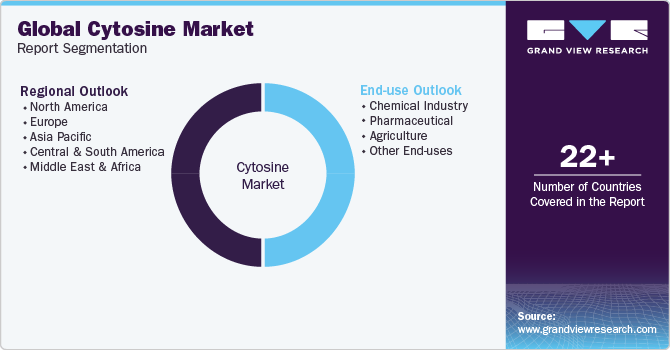
This report forecasts revenue and volume growth at global, regional, and country levels and provides an analysis of the latest trends in each of the sub-segments from 2021 to 2033. For this study, Grand View Research has segmented the cytosine market report on the basis of end-use and region:
-
End-use Outlook (Volume, Tons; Revenue, USD Thousand, 2021 - 2033)
-
Chemical Industry
-
Pharmaceutical
-
Agriculture
-
Other End-uses
-
-
Regional Outlook (Volume, Tons; Revenue, USD Thousand, 2021 - 2033)
-
North America
-
U.S.
-
Canada
-
Mexico
-
-
Europe
-
Germany
-
U.K.
-
France
-
-
Asia Pacific
-
China
-
India
-
Japan
-
South Korea
-
-
Central & South America
-
Middle East & Africa
-
Research Methodology
The cytosine market figures in this report are based on a proven research process that combines executive interviews with secondary research from proprietary databases, company filings, and recognized regulatory and institutional sources. Market size is built through value-chain sizing - reconciling supply-side and demand-side estimates - and triangulated with bottom-up and top-down approaches. Every estimate passes multiple levels of expert validation before publication, with each cytosine segment quantified using the revenue-capture definitions in the table below.
Segment Definition
Segment - End Use
Revenue capture definition
Chemical Industry
Revenue is generated through the use of cytosine as an intermediate in specialty chemical synthesis, laboratory reagents, and research chemicals supporting industrial and scientific applications.
Pharmaceutical
As the dominant end-use segment, revenue is captured through the supply of pharmaceutical-grade cytosine for manufacturing antiviral drugs, anticancer therapies, nucleoside analogs, active pharmaceutical ingredients, and advanced therapeutic formulations.
Agriculture
Revenue is supported by cytosine utilization in agricultural research, biotechnology applications, and specialty formulations associated with crop science and biological innovation.
Other End Uses
This segment captures revenue from academic research institutions, molecular biology laboratories, diagnostic reagent manufacturers, biotechnology companies, and other specialized life science applications utilizing cytosine.
Estimation Model
Layer Name
Key Question
Description
Research and Manufacturing Layer
What forms the addressable base?
Identify global pharmaceutical manufacturers, biotechnology companies, research laboratories, and diagnostic facilities utilizing nucleobases and nucleotide intermediates.
Application Adoption Layer
Where is cytosine utilized?
Estimate the proportion of cytosine consumed across pharmaceutical synthesis, biotechnology research, molecular diagnostics, chemical manufacturing, and agricultural biotechnology applications.
Consumption Intensity Layer
How much cytosine is consumed?
Analyze production volumes, formulation requirements, research activity, and manufacturing demand across end-use industries to determine annual cytosine consumption.
Revenue Layer
How is market revenue generated?
Revenue is generated through the sale of pharmaceutical-grade and research-grade cytosine supplied to pharmaceutical manufacturers, biotechnology companies, research laboratories, diagnostic developers, and specialty chemical producers worldwide.
Delivered Customizations
This report has been delivered with the following In-depth customizations
Client Request
Customization Delivered
Value Adds
Regional Segmentation
The study delivers additional country-level insights covering Switzerland, Singapore, and Australia, evaluating cytosine demand across pharmaceutical manufacturing, biotechnology research, molecular diagnostics, and nucleic acid synthesis applications.
Enables stakeholders to identify emerging pharmaceutical and biotechnology hubs, assess country-specific demand trends, and formulate targeted expansion strategies across innovation-driven life sciences markets.
Cross-Segmentation Analysis
The study delivers detailed cross-segmentation analysis assessing cytosine demand across major applications by purity grade, highlighting consumption patterns, quality requirements, and growth opportunities across pharmaceutical, biotechnology, and research sectors.
Helps companies identify high-value grade-application combinations, optimize product portfolios, and prioritize investments toward rapidly expanding pharmaceutical and biotechnology applications.
Opportunity Assessment
The study delivers comprehensive assessment of emerging opportunities across gene therapy, precision medicine, synthetic biology, molecular diagnostics, and next-generation sequencing technologies requiring high-purity nucleic acid intermediates.
Supports strategic planning by identifying future revenue opportunities, evaluating high-growth research applications, and aligning product development with evolving pharmaceutical and biotechnology industry trends.
Frequently Asked Questions About This Report
The global cytosine market size was estimated at USD 408.1 million in 2025 and is expected to reach USD 446.6 million in 2026.
The global cytosine market is expected to grow at a compound annual growth rate of 9.0% from 2026 to reach USD 816.9 million by 2033.
North America dominated the global cytosine market with a share of 40.2% in 2025.
The key players in the cytosine market include Spectrum Chemical; Tuoxin Pharmaceutical; VIVAN Life Sciences; KANTO KAGAKU; Tokyo Chemical Industry Co., Ltd.; SIELC Technologies; Santa Cruz Biotechnology, Inc.; FUJIFILM Wako Pure Chemical Corporation.
Surging demand for APIs in the industry due to the need for a high quantity and variety of patented and generic medicines is anticipated to contribute to cytosine market growth shortly.
Pharmaceutical segment accounted for the largest revenue share of 67.6% in 2025.
About the Author(s)
Food Additives & Nutricosmetics Research Team
Specialty & Chemicals · Food Additives & NutricosmeticsThis report was authored by the food additives & nutricosmetics research team at Grand View Research - comprising two research analysts, one senior research analyst, and one industry expert - with specialized expertise in the food additives & nutricosmetics segment of the specialty & chemicals industry. All findings are based on proprietary specialty & chemicals databases, executive interviews, and regulatory analysis, subject to internal peer review prior to publication.
Last Updated:
Speak to Analyst


Customize this report to your needs — add regions, segments, or data points, with 20% free customization.
Or view our licence options:


ISO 9001:2015 & 27001:2022 Certified
We are GDPR and CCPA compliant! Your transaction & personal information is safe and secure. For more details, please read our privacy policy.


