
- Home
- »
- Next Generation Technologies
- »
-
Dark Factories Market Size & Share Report, 2025-2030GVR Report cover

Dark Factories Market (2025 - 2030)
Size, Share & Trends Analysis Report By Technology Type (Industrial Robotics, Industrial Internet Of Things (IIoT), Additive Manufacturing), By End Use Industry, By Region, And Segment Forecasts
Market Size, 2024
$119.2BMarket Estimate, 2026
$138.7BMarket Forecast, 2030
$194.6BCAGR, 2025–2030
8.7%Dark Factories Market Size & Trends
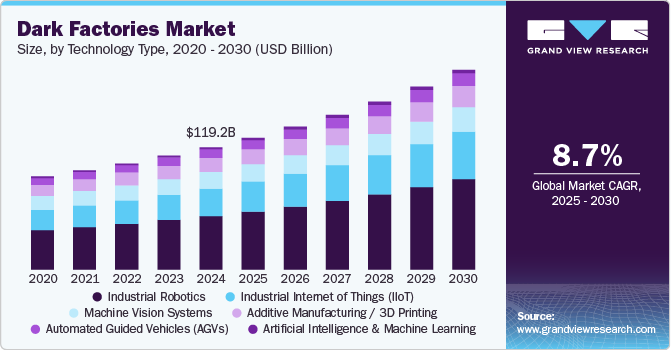
The global dark factories market size was valued at USD 119.2 billion in 2024 and is projected to grow from USD 138.7 billion in 2026 to USD 194.6 billion by 2030, at a CAGR of 8.7% from 2025 to 2030. Europe dominated the market, accounting for a revenue share of 50.0% in 2024. This growth is primarily driven by the increasing adoption of industrial robotics and automated guided vehicles (AGVs), which enable continuous manufacturing with minimal human intervention. In addition, the expansion of the Industrial Internet of Things (IIoT) allows for real-time data monitoring and predictive maintenance, significantly improving operational efficiency.
 Source: Grand View Research, IR Documents, Primary Interviews, Paid DatabasesTo learn more about this report,
 Download Free Sample Report
 The integration of AI and machine learning into manufacturing processes is further enhancing decision-making and self-optimization capabilities in dark factory environments. The demand for faster, more precise production in industries such as automotive, electronics, and pharmaceuticals is also driving the adoption of machine vision systems and additive manufacturing technologies. Furthermore, the global shift towards digital transformation and Industry 4.0 initiatives is accelerating the implementation of fully automated smart factories, fueling further growth in the dark factories industry
The growing adoption of industrial robotics in the dark factories enables continuous automated production with minimal human intervention. These robots enhance precision, speed, and consistency in manufacturing, helping companies reduce costs and improve efficiency. As demand for scalable and error-free production grows, industrial robotics continues to reshape the future of the dark factory industry.
 To learn more about this report, Download Free Sample Report
 In addition, the ongoing digital transformation is playing a key role in boosting industry growth, as businesses across industries are increasingly integrating advanced technologies such as IoT, AI, and cloud computing into their manufacturing ecosystems. This integration enables real-time monitoring, predictive analytics, and autonomous decision-making, helping manufacturers achieve greater efficiency, lower downtime, and improved product consistency, thereby boosting industry growth.
Furthermore, machine vision systems are becoming essential in enabling dark factories to maintain high levels of quality and precision without human oversight. These systems provide advanced inspection, guidance, and identification capabilities, allowing for real-time quality control and error detection throughout the production process. The ability to detect defects instantly and make immediate adjustments helps minimize waste, enhance productivity, and ensure consistent product standards, making machine vision a critical enabler in fully automated manufacturing environments.
Moreover, the demand for faster, more precise production in sectors such as automotive, electronics, and pharmaceuticals is pushing the adoption of additive manufacturing technologies. In addition, global shifts toward digital innovation and Industry 4.0 initiatives are accelerating the implementation of fully automated smart factories, further propelling the market growth.
Technology Type Insights
The industrial robotics segment led the market with the largest revenue share of 43.8% in 2024, owing to the rising complexity of product designs, the need for rapid time-to-market, and the demand for innovation in features and functionality. As industries move toward fully automated manufacturing environments, industrial robots are being widely adopted for their precision, speed, and ability to operate continuously without human intervention. These robots enhance production efficiency, reduce operational errors, and ensure consistent quality across complex tasks such as assembly, welding, and material handling. In addition, the integration of AI and machine learning into robotics systems is enabling predictive maintenance and adaptive control, further driving the adoption of industrial robotics in the dark factories industry and solidifying the dominance of this segment.
The Industrial Internet of Things (IIoT) segment is expected to witness at a significant CAGR of 9.6% from 2025 to 2030. This growth is attributed to the rising integration of industrial robotics in manufacturing processes, enabling continuous, precise, and high-speed operations with minimal human intervention. As industries such as automotive, electronics, and pharmaceuticals shift toward fully automated production environments, industrial robots are playing a pivotal role in enhancing productivity, reducing operational errors, and improving workplace safety. In addition, advancements in robotics technology, such as collaborative robots, AI-driven automation, and adaptive robotics, are expanding the application scope of dark factories. These innovations support greater flexibility in production lines and enable rapid adaptation to changing product demands, thereby driving the growth of the IIoT segment within the dark factories industry.
End Use Industry Insights
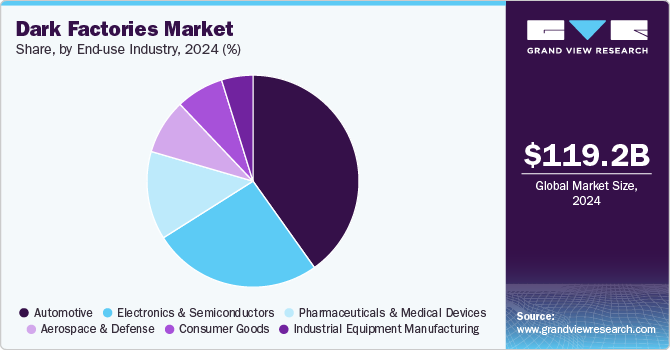
The automotive segment accounted for the largest market revenue share in 2024, owing to the significant investments in industrial robotics to enhance precision, speed, and operational efficiency. Automotive manufacturers rely on robotic systems for repetitive, high-volume tasks, reducing labor costs and errors. These robots enable continuous production, rapid scalability, and high-quality output. The industry’s push toward automation and its capacity to fund advanced robotics significantly contribute to its leadership in the dark factories industry, thereby driving segmental growth.
 To learn more about this report, Download Free Sample Report
 The pharmaceuticals & medical devices segment is expected to witness at the fastest CAGR from 2025 to 2030. With increasing demand for precision, sterility, and efficiency in manufacturing, companies in this sector are rapidly adopting industrial robotics to automate repetitive and sensitive tasks. Robotic systems enable consistent high-speed production, reduce the risk of contamination, and ensure compliance with stringent regulatory standards. The growing need to streamline operations while maintaining product integrity drives investments in robotics. In addition, advancements in robotic flexibility and integration capabilities make it easier for pharmaceutical manufacturers to adapt to product variations and scale production efficiently, fueling this segment's rapid growth.
Regional Insights
The dark factories market in North America accounted for a significant share in 2024, primarily driven by the region’s strong emphasis on automation and smart manufacturing across key industries such as automotive, aerospace, electronics, and healthcare. The widespread adoption of dark factory concepts is fueled by the push for operational efficiency, labor cost reduction, and enhanced production quality. Moreover, the region’s robust infrastructure for AI, IoT, and robotics, combined with supportive government initiatives and investments in Industry 4.0 technologies, is accelerating the deployment of fully automated, lights-out manufacturing facilities.
U.S. Dark Factories Market Trends
The dark factories market in the U.S. is expected to grow at a significant CAGR from 2025 to 2030, driven by the country’s strong focus on innovation and technological advancement. The increasing demand for fully automated, round the clock manufacturing systems is encouraging U.S. based industries to invest in industrial robotics, AI, and IoT-powered solutions. In addition, the reshoring of manufacturing operations, aimed at reducing reliance on overseas production and improving supply chain resilience, is accelerating the deployment of dark factory models. The government's support for smart manufacturing initiatives and increased funding for automation R&D are further fueling the adoption of advanced, lights-out production facilities across various sectors.
Europe Dark Factories Market Trends
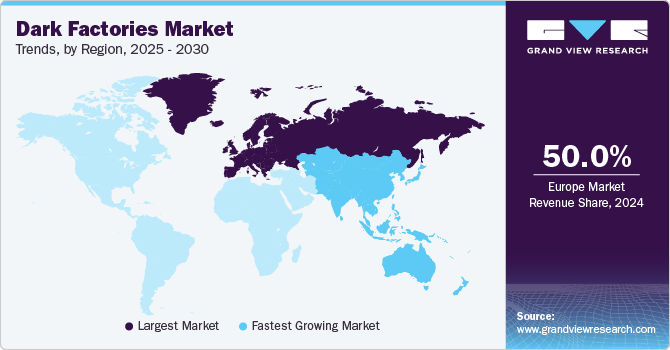
Europe dominated the dark factories market with the largest market revenue share of 50.0% in 2024, owing to the region’s strong manufacturing base, combined with labor shortages and high operational costs, which is driving the shift toward automation. Government support for smart manufacturing and energy-efficient production is accelerating adoption. Industry 4.0 policies further encourage integration of robotics, AI, and IIoT, positioning Europe as a leader in the dark factories industry.
 To learn more about this report, Download Free Sample Report
 The dark factories market in the UK is expected to grow at a significant CAGR during the forecast period. Growth is fueled by the nation's strong commitment to automation, smart manufacturing, and Industry 4.0 initiatives. With increasing labor shortages and rising operational costs, companies are turning to dark factories to boost productivity, maintain competitiveness, and meet evolving regulatory and environmental standards across key sectors like automotive, aerospace, and electronics.
The Germany dark factories market is driven by the country’s advanced manufacturing sectors, including automotive, electronics, and robotics. Germany's focus on innovation and precision engineering fuels demand for automation solutions. At the same time, the growing need for energy efficiency and sustainability accelerates the adoption of smart, environmentally friendly production methods, opening new avenues for the dark factories industry's growth.
Asia Pacific Dark Factories Market Trends
The dark factories market in Asia Pacific is expected to grow at the fastest CAGR from 2025 to 2030. This growth is primarily driven by advancements in automation, robotics, and artificial intelligence, which are transforming manufacturing processes. Increased demand for efficient, cost-effective, and scalable production solutions further accelerates the adoption of dark factories in the region.
The Japan dark factories market is gaining traction fueled driven by advancements in automation and artificial intelligence. These fully automated lights facilities are transforming industries like manufacturing, automotive, and electronics. With minimal human intervention, dark factories enhance operational efficiency, reduce labor costs, and increase production capacity. As demand for high-quality, cost-effective products grows, dark factories offer innovative solutions that meet the needs of modern industries while boosting competitiveness.
The dark factories market in China is rapidly expanding, propelled by groundbreaking innovations in automation, robotics, and AI. As industries seek enhanced productivity, reduced labor costs, and seamless continuous operations. Dark factories are becoming a strategic solution. Coupled with the increasing demand for sustainable, high-efficiency production, this market is poised for significant growth, reshaping manufacturing landscapes worldwide.
Key Dark Factories Companies Insights
Some of the key players operating in the market include FANUC CORPORATION and Amazon.com, Inc.
-
FANUC Corporation is a manufacturer of factory automation and industrial robotics. The company specializes in CNC systems, robotic arms, and automated machining tools, playing a pivotal role in advancing dark factory capabilities. With a strong emphasis on innovation, FANUC integrates artificial intelligence, machine learning, and advanced sensor technologies into its automation solutions. These innovations enable fully autonomous production lines that operate with minimal human intervention. FANUC’s commitment to reliability, precision, and continuous operation positions it as a crucial enabler in the global shift toward dark factories, particularly in sectors like automotive, electronics, and heavy machinery manufacturing.
-
Amazon.com, Inc. technology and e-commerce giant headquartered in the United States, with significant investments in automation, robotics, and AI-driven logistics. The company has pioneered the concept of dark warehouses, highly automated fulfillment centers operating with minimal human intervention. Through its subsidiary Amazon Robotics, it deploys thousands of robots and AI systems to streamline sorting, picking, and packing processes. Amazon’s focus on operational efficiency, data analytics, and cloud integration through AWS enables its dark factory model to function seamlessly, reducing delivery times, lowering costs, and enhancing customer satisfaction in a competitive global market.
Simplifyber, Inc. and DeepHawk Inc. are some of the emerging market participants in the dark factories industry.
-
Simplifyber's proprietary technology enables the production of 3D-shaped soft goods in a single step, aligning with the principles of dark factories by minimizing human intervention and maximizing efficiency. With recent Series A funding led by Suzano Ventures, the company aims to scale its operations and further integrate AI-driven automation into its manufacturing processes. Simplifyber's commitment to sustainable, automated production positions it as a key player in the evolving landscape of the dark factories industry.
-
DeepHawk Inc. is a pioneering AI company specializing in real-time visual quality control and predictive maintenance solutions for dark factories. DeepHawk develops edge AI systems that enable autonomous manufacturing environments to operate with minimal human intervention. Their product, the DeepHawk Cognitive Agent (DCA), integrates seamlessly with industrial cameras to detect defects and anomalies in as little as 15 milliseconds, significantly reducing downtime and enhancing production efficiency. By leveraging advanced machine learning algorithms, DeepHawk empowers manufacturers to achieve higher operational performance and frictionless deployment, positioning itself as a key player in the evolution of fully automated, lights-out production facilities.
Key Dark Factories Companies:
The following are the leading companies in the dark factories market. These companies collectively hold the largest market share and dictate industry trends.
- FANUC CORPORATION
- Amazon.com, Inc.
- Xiaomi.
- Hon Hai Precision Industry Co., Ltd.
- Simplifyber, Inc.
- DeepHawk Inc.
- Xaba Inc.
- A3D Manufacturing
- Geofabrica Inc.
- STILRIDE
- BYD Company Ltd.
Three ways to get this report
Buy it, customize it, or ask a question.Ask an Analyst
Analyst response in 1 business day
- AccessReport author, directly
- Reply timeWithin 1 working day
- No sales callDirect answer only
- FormatEmail reply
- CostFree, no cost
Get the Full Report
What the study covers
- FormatsPDF · Excel · Dashboard
- Timeline2025–2030 annual, 2024 base
- Coverage20+ countries, 5 regions
- Companies10+ key players profiled
Customize the Report
20% free customization
- IncludeCountries, segments, points
- TailorTo your product definition
- ExtendDeeper competitor detail
- OrA fully bespoke study
- Turnaround5–10 working days
Recent Developments
-
In April 2025, FANUC CORPORATION announced its participation in the Manufacturing Technologies Series East Show, showcasing advanced CNC and robotics innovations. The exhibit featured collaborative robots (cobots) and IoT solutions designed to enhance fully automated manufacturing environments. These developments align with the growing demand for dark factories by enabling smarter, safer, and more autonomous production systems that operate with minimal human intervention.
-
In April 2025, BYD Company Ltd. signed a joint development agreement with Saudi Aramco Technologies Company (SATC) to explore collaboration in the development of advanced manufacturing technologies for dark factories. The partnership aims to enhance the efficiency and sustainability of automated production processes in the electric vehicle (EV) industry. The collaboration focuses on integrating advanced AI and automation systems into production lines to optimize vehicle assembly and reduce environmental impact.
-
In March 2025, Hon Hai Precision Industry Co., Ltd.(Foxconn) announced significant progress in its dark factory initiatives, revealing a strategic focus on AI-driven automation and electric vehicle (EV) platforms. The company plans to expand its investment in robotics and AI to enhance its fully automated manufacturing operations further, improving efficiency and scaling production for global markets.
Dark Factories Market Report Scope
Report Attribute
Details
Market size in 2024
USD 119.2 billion
Estimated market size in 2026
USD 138.7 billion
Projected market size by 2030
USD 194.6 billion
Growth rate
CAGR of 8.7% from 2025 to 2030
Base year for estimation
2024
Historical data
2018 - 2023
Forecast period
2025 - 2030
Quantitative units
Revenue in USD million/billion and CAGR from 2025 to 2030
Report Product
Revenue forecast, company ranking, competitive landscape, growth factors, and trends
Segments covered
Technology type, end-use industry, region
Regional scope
North America; Europe; Asia Pacific; Latin America; MEA
Country scope
U.S.; Canada; Mexico; UK; Germany; France; China; Japan; India; South Korea; Australia; Brazil; South Africa; UAE; Saudi Arabia
Key companies profiled
FANUC CORPORATION; Amazon.com, Inc.; Xiaomi.; Hon Hai Precision Industry Co., Ltd.; Simplifyber, Inc.; DeepHawk Inc.; Xaba Inc.; A3D Manufacturing; Geofabrica Inc.; TILRIDE; BYD Company Ltd.
Customization scope
Free report customization (equivalent to up to 8 analyst’s working days) with purchase. Addition or alteration to country, regional & segment scope.
Pricing and purchase options
Avail customized purchase options to meet you exact research needs. Explore purchase options
Global Dark Factories Market Report Segmentation
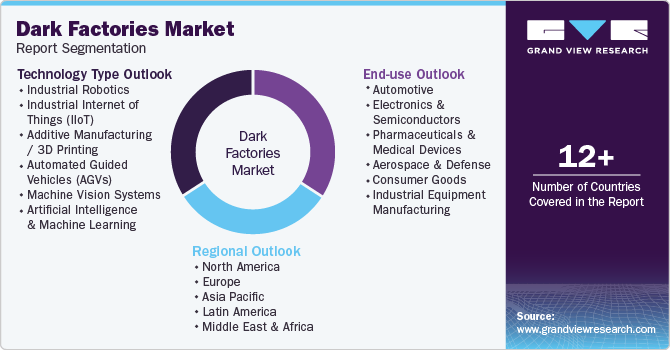
This report forecasts revenue growth at global, regional, and country levels and provides an analysis of the latest technological trends in each of the sub-segments from 2018 to 2030. For this study, Grand View Research has segmented the global dark factories market report based on technology type, end-use industry, and region:
 To learn more about this report, Download Free Sample Report
 -
Technology Type Outlook (Revenue, USD Million, 2018 - 2030)
-
Industrial Robotics
-
Industrial Internet of Things (IIoT)
-
Additive Manufacturing / 3D Printing
-
Automated Guided Vehicles (AGVs)
-
Machine Vision Systems
-
Artificial Intelligence & Machine Learning
-
-
End-Use Industry Outlook (Revenue, USD Million, 2018 - 2030)
-
Automotive
-
Electronics & Semiconductors
-
Pharmaceuticals & Medical Devices
-
Aerospace & Defense
-
Consumer Goods
-
Industrial Equipment Manufacturing
-
-
Regional Outlook (Revenue, USD Million, 2018 - 2030)
-
North America
-
U.S.
-
Canada
-
Mexico
-
-
Europe
-
UK
-
Germany
-
France
-
-
Asia Pacific
-
China
-
Japan
-
India
-
South Korea
-
Australia
-
-
Latin America
-
Brazil
-
-
Middle East & Africa
-
South Africa
-
UAE
-
Saudi Arabia
-
-
Frequently Asked Questions About This Report
The global dark factories market size was valued at USD 119.2 billion in 2024 and is estimated at USD 138.7 billion for 2026.
The global dark factories market is expected to grow at a CAGR of 8.7% from 2025 to 2030, reaching USD 194.6 billion by 2030.
Europe dominated with a 50.0% revenue share in 2024.
The key players in the dark factories market include FANUC CORPORATION; Amazon.com, Inc.; Xiaomi.; Hon Hai Precision Industry Co., Ltd.; Simplifyber, Inc.; DeepHawk Inc.; Xaba Inc.; A3D Manufacturing; Geofabrica Inc.; TILRIDE; BYD Company Ltd.
Key drivers of dark factory market growth include rising adoption of industrial robotics, AGVs, IIoT, AI, machine learning, machine vision systems, additive manufacturing, and the acceleration of digital transformation and Industry 4.0 initiatives.
About the Author(s)
Next Generation Technologies Research Team
Technology · Next Generation TechnologiesThis report was authored by the next generation technologies research team at Grand View Research - comprising two research analysts, one senior research analyst, and one industry expert - with specialized expertise in the next generation technologies segment of the technology industry. All findings are based on proprietary technology databases, executive interviews, and regulatory analysis, subject to internal peer review prior to publication.
Last Updated:
Speak to Analyst -

Customize this report to your needs - add regions, segments, or data points, with 20% free customization.
Or view our licence options:


ISO 9001:2015 & 27001:2022 Certified
We are GDPR and CCPA compliant! Your transaction & personal information is safe and secure. For more details, please read our privacy policy.


