
- Home
- »
- Next Generation Technologies
- »
-
Dark Store Market Size, Share & Trends Report, 2024-2030GVR Report cover

Dark Store Market (2024 - 2030)
Size, Share & Trends Analysis Report By Category (Meat, Dairy, Groceries), By Age Group, By Distribution Channel (In-Store Pickup, Curbside Pickup, Home Delivery), By Region, And Segment Forecasts
Market Size, 2023
$15.3BMarket Estimate, 2026
$34.9BMarket Forecast, 2030
$129.2BCAGR, 2024–2030
36.6%Dark Store Market Summary
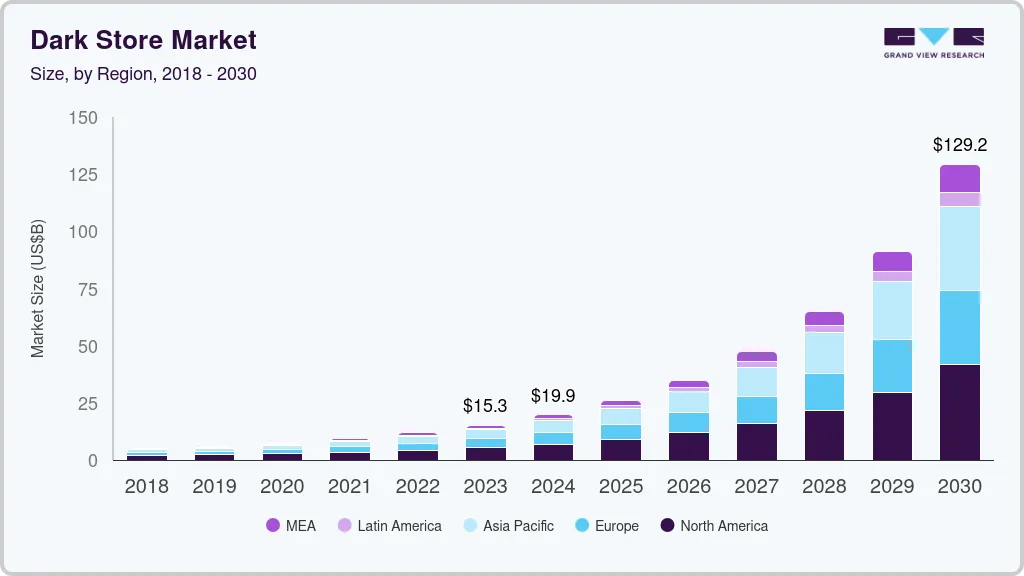
The global dark store market size was valued at USD 15.3 billion in 2023 and is projected to grow from USD 34.9 billion in 2026 to USD 129.2 billion by 2030, at a CAGR of 36.6% from 2024 to 2030. The market in North America dominated with a revenue share of 35% in 2023. The growing demand for quick and efficient online shopping experiences is driving the growth of the market.
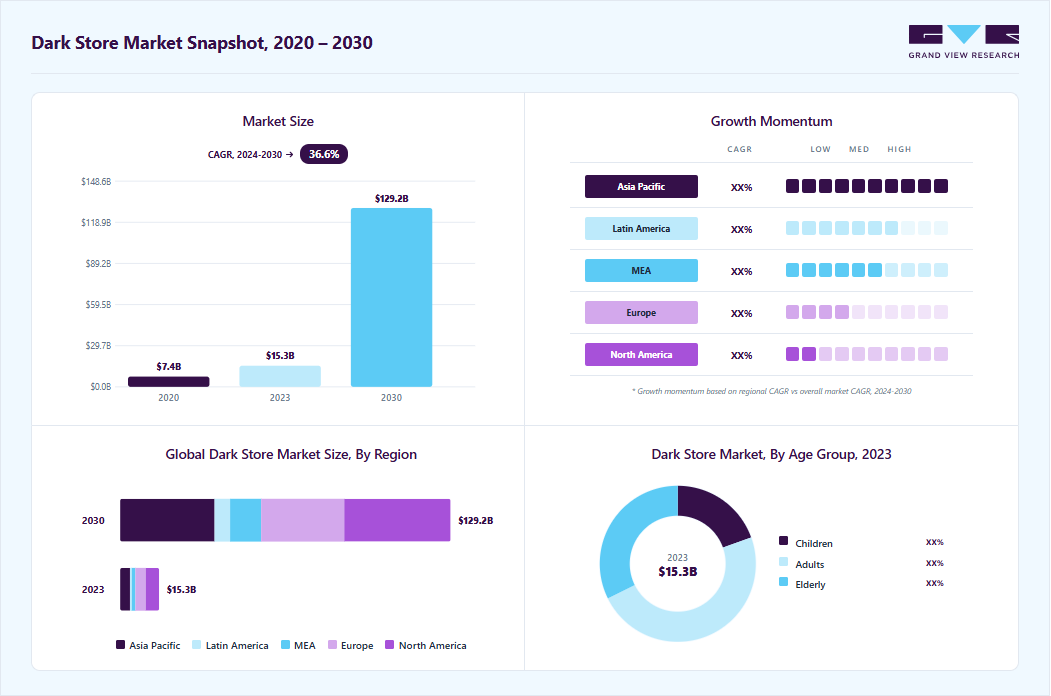 Source: Grand View Research, IR Documents, Primary Interviews, Paid DatabasesTo learn more about this report,
 Download Free Sample Report
 Key Market Trends & Insights
- In terms of region, North America dominated the global dark store market and accounted for a revenue share of over 35% in 2023.
- The dark store market in the U.S. is expected to grow at a CAGR of 33.9% from 2024 to 2030.
- In terms of age group, The adults segment dominated the market in 2023 and accounted for more than 48.0% share of global revenue.
- In terms of category, The groceries segment dominated the market in 2023 and account for more than 56% share of global revenue.
Market Size & Forecast
- 2023 Market Size: USD 15.27 Billion
- 2030 Projected Market Size: USD 129.25 Billion
- CAGR (2024-2030): 36.6%
- North America: Largest market in 2023
- Asia Pacific: Fastest growing market
Three ways to get this report
Buy it, customize it, or ask a question.Ask an Analyst
Analyst response in 1 business day
- AccessReport author, directly
- Reply timeWithin 1 working day
- No sales callDirect answer only
- FormatEmail reply
- CostFree, no cost
Get the Full Report
What the study covers
- FormatsPDF · Excel · Dashboard
- Timeline2024–2030 annual, 2023 base
- Coverage20+ countries, 5 regions
- Companies10+ key players profiled
Customize the Report
20% free customization
- IncludeCountries, segments, points
- TailorTo your product definition
- ExtendDeeper competitor detail
- OrA fully bespoke study
- Turnaround5–10 working days
Furthermore, the increasing adoption of online shopping, the rise of quick commerce, and ongoing investment in automation and technology by retailers are anticipated to drive the demand for the dark store market. Companies are leveraging sophisticated supply chain networks to ensure that their dark stores are stocked with the right products at the right time. This has been facilitated by the growing availability of real-time data and analytics, which allow for more precise inventory management and demand forecasting.As real estate in the city centers becomes increasingly expensive, retailers are opting for smaller, strategically located dark stores. These micro-fulfillment centers are designed to optimize delivery times in densely populated urban areas, where customers expect faster delivery. Furthermore, some retailers are experimenting with hybrid models that combine traditional retail with dark store operations. This model allows stores to serve both walk-in customers and online orders from the same location, optimizing inventory management and reducing operational costs. Such factors are driving the demand for dark stores in the marketspace.
 To learn more about this report, Download Free Sample Report
 Modern consumers expect quick, often same-day delivery. Dark stores are strategically located to reduce delivery times, and meeting this consumer demand is further driving the market growth. For instance, according to a survey conducted by the U.S. Department of Commerce found that around 73% of online shoppers are willing to pay extra for faster delivery options, underscoring the importance of efficient fulfillment networks.
Dark stores allow retailers to optimize their inventory by centralizing order fulfillment, reducing the need for multiple inventories across different locations. This consolidation leads to better stock management and reduced costs associated with overstocking or stockouts. Moreover, retailers are increasingly adopting omnichannel strategies that integrate online and offline channels to provide a seamless shopping experience. Dark stores are a key component of this strategy, enabling retailers to fulfill online orders more efficiently while maintaining in-store inventory for walk-in customers. Such factors are driving the demand for dark stores in the marketspace.
Dark stores are increasingly integrated with last-mile delivery platforms to ensure quick and efficient delivery. Technologies such as route optimization algorithms and real-time tracking are being used to streamline the delivery process. However, dark stores, particularly in urban areas, often face regulatory challenges related to zoning laws and community pushback. As these stores are not open to the public, they can sometimes conflict with local zoning regulations that prioritize retail spaces serving the community.
Age Group Insights
The adults segment dominated the market in 2023 and accounted for more than 48.0% share of global revenue. A significant trend is the growing popularity of health-conscious and eco-friendly products. Adults are increasingly opting for organic foods, sustainable packaging, and environmentally friendly products. Dark stores are responding by offering a wide range of these items, catering to the rising demand for ethical consumption.
The elderly segment is projected to register a notable growth rate from 2024 to 2030. The elderly population has shown an uptick in online shopping, particularly in the aftermath of the COVID-19 pandemic. Dark stores have begun catering to this age group by offering senior-friendly services such as simplified online interfaces, telephone order placements, and specialized product ranges that focus on health and wellness. Furthermore, many dark stores now offer easy-to-use apps and websites designed with larger text and straightforward navigation to accommodate the elder population. Such factors are driving the growth of the elderly segment in the market.
Category Insights
In terms of category, the market is classified into meat, dairy, and groceries. The groceries segment dominated the market in 2023 and account for more than 56% share of global revenue. The COVID-19 pandemic has accelerated the shift towards online grocery shopping, with more consumers opting for the convenience of home delivery. Government initiatives aimed at improving digital infrastructure, such as the expansion of high-speed internet, have facilitated the growth of the online grocery market.
The dairy segment is projected to witness the highest CAGR of 38.0% from 2024 to 2030. The growing awareness of health and wellness has led to increasing demand for organic and non-GMO dairy products. Dark stores cater to the demand by offering a variety of healthier options that are often difficult to find in regular supermarkets. Additionally, advancements in cold chain logistics have played a crucial role in driving the growth of the dairy segment in dark stores.
Distribution Channel Insights
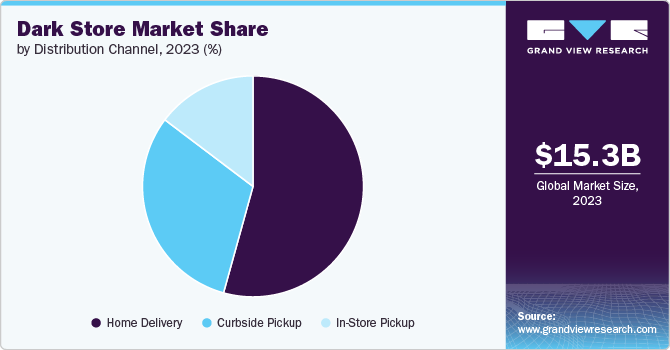
The home delivery segment dominated the market in 2023 and accounted for more than 54.0% share of global revenue. As people lead busier lives, the ability to shop from home and have items delivered quickly has driven the growth of the home delivery segment. Furthermore, the expansion of e-commerce has made a wider range of products available for home delivery, further driving the adoption of home delivery. Technological advancements in logistics and inventory management are also significant drivers. Additionally, the use of data analytics and artificial intelligence to optimize delivery routes and predict consumer behavior has enhanced the efficiency of home delivery services.
 To learn more about this report, Download Free Sample Report
 The curbside pickup segment is anticipated to register a considerable growth rate from 2024 to 2030. Curbside pickup aligns with the broader trend of contactless shopping. As consumers become increasingly health-conscious and time-sensitive, services that minimize physical contact and reduce shopping time are in high demand. The ease of placing an order and having it delivered directly to one’s vehicle appeals to busy customers, particularly those with young children or mobility issues are several factors driving the demand for curbside pickup segment in the market.
Regional Insights
North America dominated the global dark store market and accounted for a revenue share of over 35% in 2023. The growing demand for faster delivery times has pushed retailers to explore innovative solutions to reduce delivery windows. Furthermore, the increasing urbanization in North America has led to a shift towards smaller, more efficient fulfillment centers located closer to urban centers is driving the demand for dark store market in North America.
U.S. Dark Store Market Trends
The dark store market in the U.S. is expected to grow at a CAGR of 33.9% from 2024 to 2030. The market in the U.S. is heavily reliant on cutting-edge technologies, including machine learning and AI algorithms that optimize inventory levels and predict consumer demand. Moreover, the U.S. government’s emphasis on improving digital infrastructure has played a significant role in supporting the dark store market.
Asia Pacific Dark Store Market Trends
The dark store market in Asia Pacific is expected to grow at the highest CAGR of 39.0% from 2024 to 2030. This growth can be attributed to a surge in online shopping, with consumers demanding faster and more convenient delivery options. The region is also seeing a rise in the use of robotics and automation in dark stores, particularly in countries like Japan, where labor shortage is a significant challenge.
Europe Dark Store Market Trends
The dark store market in Europe is expected to grow at a notable CAGR of 36.1% from 2024 to 2030. The market in the region is witnessing significant developments, characterized by a strong emphasis on sustainability and technological innovation. Countries like the U.K., Germany, and France are leading the charge, with retailers in these regions adopting dark store models to enhance their e-commerce operations.
Key Dark Store Company Insights
Some of the key companies operating in the dark store market include Amazon.com, Inc., Auchan, Dunzo Digital Private Limited, Flipkart Private Limited, Instacart, Swiggy, Target Corporation, Walmart, Inc., Grab, and Zepto.
-
Walmart, Inc., the U.S. based retailer corporation that operates a chain of grocery stores, hypermarkets, and discount department stores. The company heavily invests in technology to enhance its e-commerce and logistics operations. The company uses advanced inventory management systems, robotics, and AI in its dark stores to optimize picking, packing, and delivery processes.
Swiggy and Zepto are some of the emerging companies in the target market.
-
Swiggy, a food delivery platform, has rapidly expanded its quick commerce arm, Swiggy Instamart, which relies heavily on the dark store model. This expansion leverages Swiggy’s robust delivery network and large customer base, making it a formidable player in the dark stores market.
Key Dark Store Companies:
The following are the leading companies in the dark store market. These companies collectively hold the largest market share and dictate industry trends.
- Amazon.com, Inc.
- Auchan
- Dunzo Digital Private Limited
- Flipkart Private Limited
- Instacart
- Swiggy
- Target Corporation
- Walmart, Inc.
- Grab
- Zepto
Recent Developments
-
In August 2024, Blinkit, a subsidiary of Zomato Ltd. announced to open 2,000 dark stores by end of 2026 within top ten cities in India. The new dark stores would help the company to expand its presence primarily in top cities.
-
In July 2024, Flipkart Private Limited is planning to open 100 dark stores in India for Flipkart Minutes service. Through the service the company will deliver vegetables, groceries, fruits, and electronics in 10-15 minutes.
Dark Store Market Report Scope
Report Attribute
Details
Market size in 2023
USD 15.3 billion
Estimated market size in 2026
USD 34.9 billion
Projected market size by 2030
USD 129.2 billion
Growth rate
CAGR of 36.6% from 2024 to 2030
Historical data
2017 - 2023
Forecast period
2024 - 2030
Quantitative units
Revenue in USD Million and CAGR from 2024 to 2030
Report coverage
Revenue forecast, company ranking, competitive landscape, growth factors, and trends
Segments covered
Category, age group, distribution channel, region
Regional scope
North America; Europe; Asia Pacific; Latin America; MEA
Country scope
U.S.; Canada; Mexico; U.K.; Germany; France; India; China; Japan; South Korea; Australia; Brazil; Kingdom of Saudi Arabia (KSA); UAE; South Africa
Key companies profiled
Amazon.com Inc.; Auchan; Dunzo Digital Private Limited; Flipkart Private Limited; Instacart; Swiggy; Target Corporation; Walmart Inc.; Grab; Zepto
Customization scope
Free report customization (equivalent up to 8 analysts working days) with purchase. Addition or alteration to country, regional & segment scope.
Pricing and purchase options
Avail customized purchase options to meet your exact research needs. Explore purchase options
Global Dark Store Market Report Segmentation
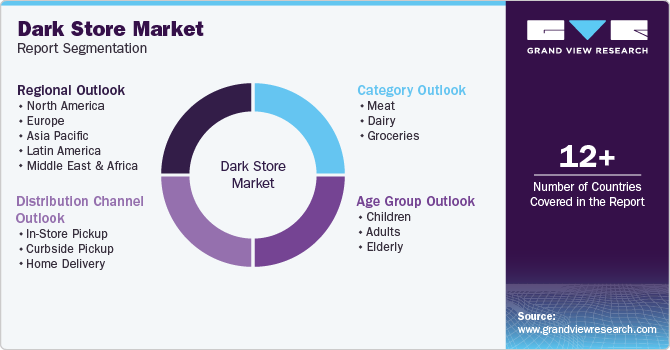
This report forecasts revenue growth at global, regional, and country levels and provides an analysis of the latest industry trends in each of the sub-segments from 2017 to 2030. For this study, Grand View Research has segmented the global dark store market report based on category, age group, distribution channel, and region.
 To learn more about this report, Download Free Sample Report
 -
Category Outlook (Revenue, USD Million, 2017 - 2030)
-
Meat
-
Dairy
-
Groceries
-
-
Age Group Outlook (Revenue, USD Million, 2017 - 2030)
-
Children
-
Adults
-
Elderly
-
-
Distribution Channel Outlook (Revenue, USD Million, 2017 - 2030)
-
In-Store Pickup
-
Curbside Pickup
-
Home Delivery
-
-
Regional Outlook (Revenue, USD Million, 2017 - 2030)
-
North America
-
U.S.
-
Canada
-
Mexico
-
-
Europe
-
UK
-
Germany
-
France
-
-
Asia Pacific
-
India
-
China
-
Japan
-
South Korea
-
Australia
-
-
Latin America
-
Brazil
-
-
Middle East and Africa (MEA)
-
Kingdom of Saudi Arabia (KSA)
-
UAE
-
South Africa
-
-
Frequently Asked Questions About This Report
The global dark store market size was valued at USD 15.3 billion in 2023 and is estimated at USD 34.9 billion for 2026.
The global dark store market is expected to grow at a CAGR of 36.6% from 2024 to 2030, reaching USD 129.2 billion by 2030.
North America dominated with a 35% revenue share in 2023.
Key players include Amazon.com, Inc., Auchan, Dunzo Digital Private Limited, Flipkart Private Limited, Instacart, Swiggy, Target Corporation, Walmart, Inc., Grab, and Zepto
The growing demand for quick and efficient online shopping experiences is driving the growth of the dark store market. Furthermore, increasing adoption of online shopping, the rise of quick commerce and ongoing investment in automation and technology by retailers are anticipated to drive the demand for dark store market.
About the Author(s)
Next Generation Technologies Research Team
Technology · Next Generation TechnologiesThis report was authored by the next generation technologies research team at Grand View Research - comprising two research analysts, one senior research analyst, and one industry expert - with specialized expertise in the next generation technologies segment of the technology industry. All findings are based on proprietary technology databases, executive interviews, and regulatory analysis, subject to internal peer review prior to publication.
Last Updated:
Speak to Analyst

Customize this report to your needs - add regions, segments, or data points, with 20% free customization.
Or view our licence options:


ISO 9001:2015 & 27001:2022 Certified
We are GDPR and CCPA compliant! Your transaction & personal information is safe and secure. For more details, please read our privacy policy.


