
- Home
- »
- Network Security
- »
-
Data Centric Security Market Size & Share Report, 2033GVR Report cover

Data Centric Security Market (2026 - 2033)
Size, Share & Trends Analysis Report By Solution (Software, Services), By Deployment (Cloud, On-premise), By Enterprise Size, By Vertical (BFSI, IT & Telecommunications), By Region, And Segment Forecasts
Market Size, 2025
$8.0BMarket Estimate, 2026
$9.8BMarket Forecast, 2033
$39.7BCAGR, 2026–2033
22.2%Data Centric Security Market Summary
The data centric security market size was valued at USD 8.0 billion in 2025 and is projected to grow from USD 9.8 billion in 2026 to USD 39.7 billion in 2033, at a CAGR of 22.2% from 2026 to 2033. North America dominated the market, accounting for a revenue share of 38.0% in 2025. The increasing volume of data stored, processed, and accessed across distributed business environments is driving the demand for data-centric security solutions to protect sensitive information throughout its lifecycle.
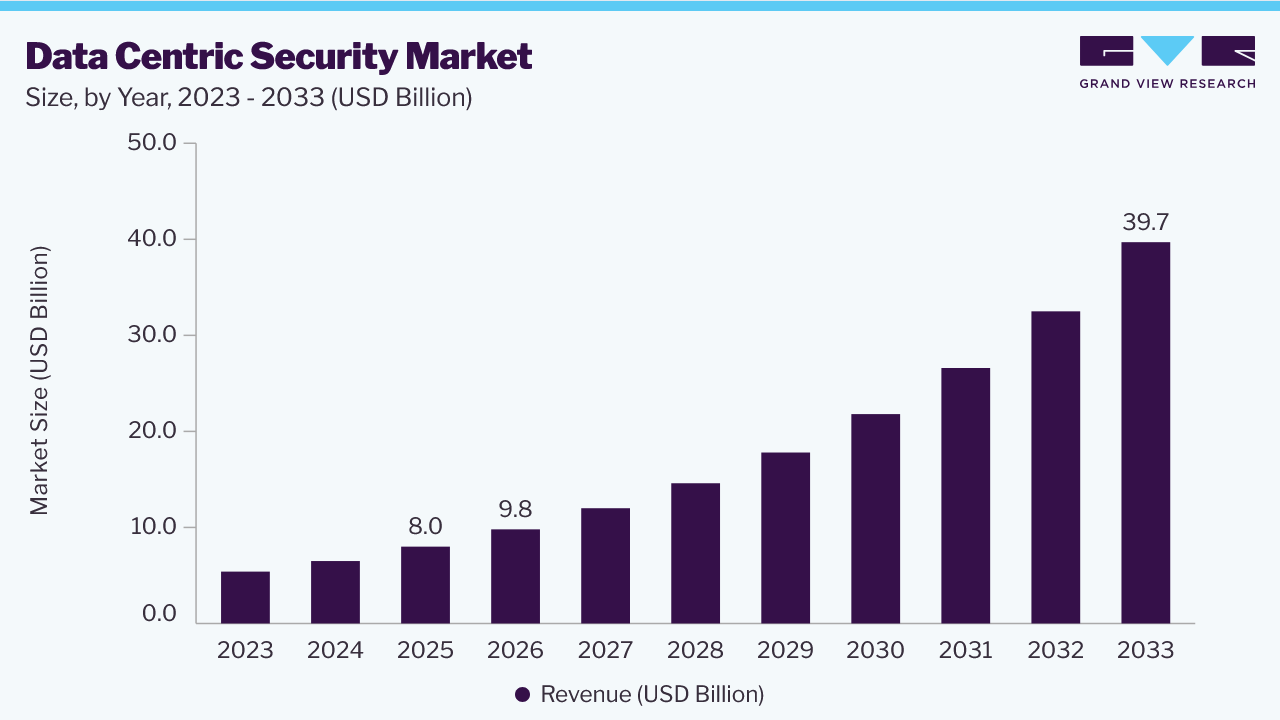 Source: Grand View Research, IR Documents, Primary Interviews, Paid DatabasesTo learn more about this report,
 Download Free Sample Report
 Key Market Trends & Insights
- By solution: The software segment held the largest market share of around 67.0% in 2025.
- By deployment: The on-premise segment accounted for a market share of around 42.0% in 2025.
- By enterprise size: The large enterprise segment held the largest market share of over 54.0% in 2025.
- By vertical: The BFSI segment accounted for the largest market share of around 26.0% in 2025.
Regional Highlights
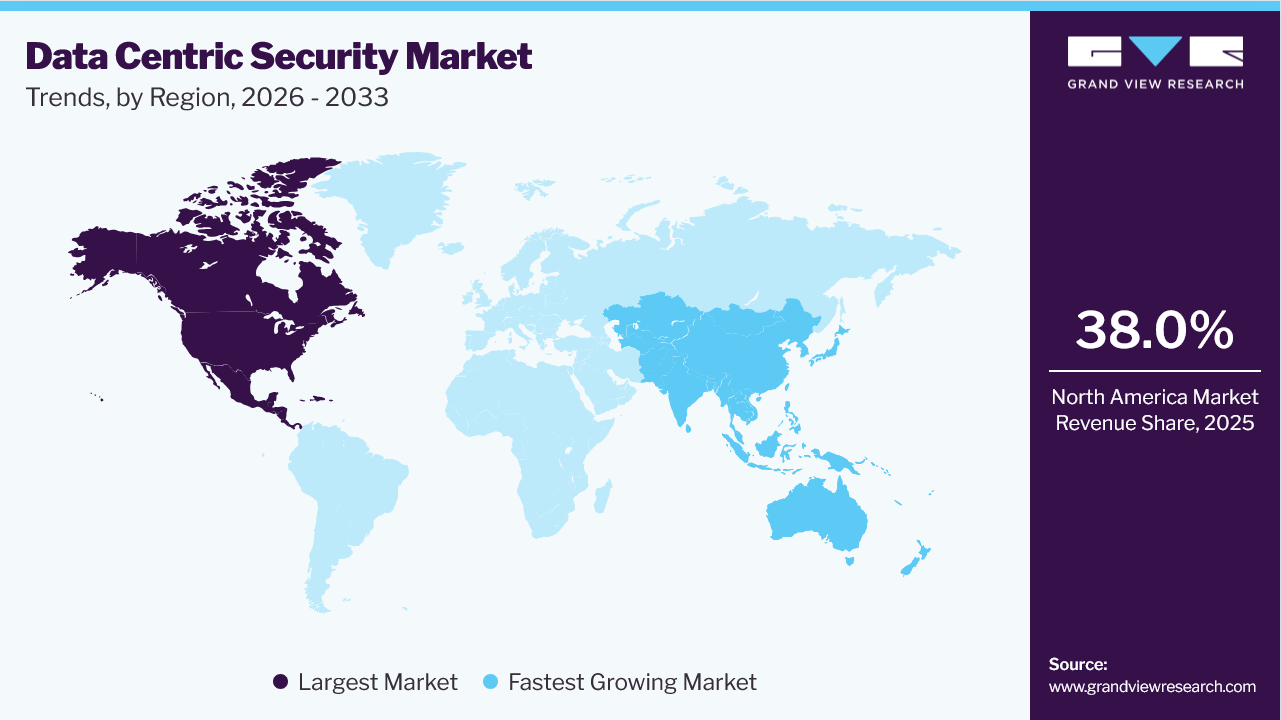
- Largest regional market: North America (38.0% revenue share, 2025)
- Fastest-growing regional market: Asia Pacific (highest CAGR, 2026-2033)
Market Size & Forecast
- Market Size in 2025: USD 8.0 Billion
- Market Size in 2026: USD 9.8 Billion
- Projected Market Size in 2033: USD 39.7 Billion
- CAGR (2026-2033): 22.2%
Three ways to get this report
Buy it, customize it, or ask a question.Ask an Analyst
Analyst response in 1 business day
- AccessReport author, directly
- Reply timeWithin 1 working day
- No sales callDirect answer only
- FormatEmail reply
- CostFree, no cost
Get the Full Report
What the study covers
- FormatsPDF · Excel · Dashboard
- Timeline2026–2033 annual, 2025 base
- Coverage20+ countries, 5 regions
- Companies10+ key players profiled
Customize the Report
20% free customization
- IncludeCountries, segments, points
- TailorTo your product definition
- ExtendDeeper competitor detail
- OrA fully bespoke study
- Turnaround5–10 working days
The increasing importance of data-centric security across organizations is mainly due to the insufficient security across network servers and business applications, and the need to secure sensitive information shared by administrators with users across the organization. Network servers and enterprise applications have inherent security vulnerabilities, making the highly secure network subject to internal threats. Employees accessing the organization’s databases and systems can share confidential access or data with other employees. However, they are not directly related to external parties or job duties, and they have no authorized access, thereby increasing the risk of data leakage.
This threat increases with the deployment of hybrid environments across organizations, where employees work remotely or in the cloud. This highlights the need for direct data protection to create additional barriers that deter unauthorized data distribution. Data-centric security technology protects confidential and sensitive data from threats, employee errors, and theft or leakage by unauthorized parties. Furthermore, data-centric approaches are essential for dynamic data protection, as they provide businesses with greater flexibility in managing networks and systems than traditional access controls. Implementing the least privileged access among organizations allows the administration to provide the user with access to sensitive information of their files without providing them with complete access to every other data on the server. This framework is effective when access to different functional data within the department is prohibited to the user.
Data-centric security must be layered on top of existing systems to avoid additional large-scale changes. It is required for companies to restructure their privacy policies with the evolution of their security landscape to create strong authentication and encryption approaches. Data-centric security technology enables the organization to protect the company’s data from cyber threats and increase the availability of resources for other purposes. Technology helps protect data stored on hard disks, accessed, or manipulated by applications, and transmitted over the network. This benefit has enabled organizations to deploy data-centric solutions across verticals, thereby driving the demand.
Despite the growing need for robust data protection, many organizations still underestimate the importance of addressing the vulnerabilities and risks associated with deploying data-centric security solutions, which may limit market growth. In addition, the high costs of implementation and deployment pose a significant challenge, particularly for small and medium-sized enterprises (SMEs) with limited budgets. The substantial investments required for advanced technologies, infrastructure, and skilled personnel increase the overall cost of adoption, thereby restraining the growth of the data-centric security industry.
Market Dynamics
The data-centric security industry is experiencing significant growth, driven by the increasing frequency of cyberattacks, stringent data privacy regulations, the rapid adoption of cloud computing and AI-driven workloads, and the growing need to protect sensitive data across hybrid IT environments. Organizations are increasingly shifting from traditional perimeter-based security models to data-centric approaches that safeguard data throughout its lifecycle, regardless of where it resides. Furthermore, the growing adoption of generative AI, evolving data governance requirements, and the emergence of Data Security Posture Management (DSPM) solutions are further accelerating market growth.
The rising financial and reputational impact of data breaches is a key driver of the market. Organizations across industries recognize that perimeter-based security alone is insufficient when sensitive data itself remains vulnerable. Regulatory frameworks such as GDPR, CCPA, HIPAA, and emerging data sovereignty laws are mandating stricter controls over sensitive information, prompting enterprises to adopt security models that protect data at its source rather than relying solely on infrastructure-level defenses. For instance, in April 2026, Rock Flow Dynamics announced that it had achieved ISO 27001 (Information Security Management) and ISO 9001 (Quality Management Systems) certifications in Europe, reinforcing its commitment to information security, regulatory compliance, and operational integrity as it expands its high-performance computing capabilities. The growing adoption of hybrid and multi-cloud environments has further accelerated demand for data-centric security, as sensitive data is increasingly distributed across multiple platforms where traditional network-centric security approaches cannot provide consistent protection. Consequently, organizations are investing in encryption, tokenization, data masking, and granular access controls to strengthen regulatory compliance and minimize the risk of data breaches.
The market faces challenges due to the complexity of implementing data-centric controls across heterogeneous IT environments. Many organizations continue to operate legacy systems that were not designed to support modern data classification, encryption, or granular access control frameworks. Retrofitting these systems requires significant investments in technology modernization, infrastructure upgrades, workflow redesign, and workforce training. For instance, in June 2026, IBM reported that 77% of organizations said AI adoption is already outpacing their governance capabilities, while only 11% of CIOs and CTOs considered themselves fully prepared for the scale of AI deployment expected over the following year. The study further highlighted that many organizations continue to rely on IT architectures optimized for stability and governance models dependent on manual review, making it difficult to integrate modern security, governance, and data protection mechanisms into existing environments.
The rapid adoption of containerized applications, Kubernetes orchestration, and AI-powered workloads is creating significant opportunities for the market. As organizations increasingly deploy microservices architectures and automate software delivery through CI/CD pipelines, the attack surface continues to expand, reducing the effectiveness of traditional security models. Consequently, data-centric security solutions that embed protection directly into data assets, regardless of where they are processed, transmitted, or stored, are becoming increasingly essential.
Emerging security platforms are integrating container security with data-centric protection capabilities to secure sensitive data across AI applications and software supply chains while maintaining development agility. Furthermore, the convergence of data-centric security with DevSecOps practices, automated Software Bill of Materials (SBOM) generation, and real-time CVE management is expected to create substantial growth opportunities as enterprises prioritize regulatory compliance, cyber resilience, and secure AI adoption.
Analyst Perspective
The global data-centric security industry is experiencing strong growth as organizations increasingly prioritize protecting sensitive data across clouds, on-premises, and hybrid environments amid escalating cyber threats, evolving regulatory requirements, and the rapid proliferation of AI-driven workloads. Enterprises are transitioning from traditional perimeter-based security models to data-centric approaches that focus on securing data throughout their lifecycle using technologies such as encryption, tokenization, data loss prevention (DLP), Data Security Posture Management (DSPM), and granular access controls. The expanding adoption of cloud computing, remote and hybrid work environments, generative AI, and stringent data privacy regulations, including GDPR, CCPA, and other regional compliance frameworks, continues to drive market demand.
Solution Insights
The software segment accounted for the largest market share of around 67.0% in 2025. The increasing frequency of cyberattacks and data breaches has significantly driven demand for data-centric security software. High-profile cybersecurity incidents have encouraged organizations across industries such as BFSI, IT & telecommunications, and retail to strengthen their data protection capabilities. In addition, governments worldwide continue to strengthen data privacy regulations, further supporting market growth. For instance, in July 2024, Microsoft announced the general availability of Microsoft Purview Data Governance, noting that platform usage had increased by more than 400% since its April 2024 launch. Microsoft attributed this growth to the increasing sophistication of cyber threats, the expansion of enterprise data estates, evolving regulatory requirements, and growing AI adoption, reflecting the rising demand for unified data security and governance platforms.
The services segment is expected to register the fastest CAGR during the forecast period. Growing demand for effective user access management and the protection of confidential and regulated information is driving the adoption of data-centric security services. These services play a critical role in implementing zero-trust architectures by enabling organizations to secure sensitive datasets in real time while enforcing least-privilege access across diverse storage environments. For instance, in December 2024, Microsoft introduced new Microsoft Purview Data Security Posture Management (DSPM) capabilities for AI, stating that more than 95% of organizations were either implementing or developing AI strategies. As AI adoption continues to accelerate, organizations are increasingly relying on specialized security services to strengthen data governance, ensure regulatory compliance, and continuously monitor sensitive information.
Deployment Insights
The on-premise segment accounted for the largest market share of 42.0% in 2025. Organizations operating in highly regulated industries or under stringent governance requirements often prefer to retain complete control over their critical data assets. On-premises data-centric security solutions enable organizations to maintain sensitive data within their own infrastructure while providing greater control over data storage, access, and security. This continues to support demand for on-premises deployments. For instance, in May 2025, IBM introduced IBM LinuxONE 5, designed to secure mission-critical workloads through confidential computing, pervasive encryption, cyber resilience, and advanced data protection capabilities, highlighting the continued demand for secure on-premises infrastructure among highly regulated enterprises.
The cloud segment is projected to register a significant CAGR during the forecast period. As organizations increasingly migrate workloads and sensitive data to cloud environments, demand for cloud-based data-centric security solutions continue to rise. These solutions enable organizations to implement advanced encryption, data masking, and granular access controls to protect sensitive information across cloud platforms. In addition, the growing need for secure collaboration and cross-organizational data sharing is accelerating adoption. For instance, in November 2024, Snowflake introduced new cross-cloud collaboration capabilities that enable organizations to securely share data, AI models, applications, and analytics across multiple cloud environments while maintaining centralized governance and security controls.
Enterprise Size Insights
The large enterprise segment accounted for the largest share, at over 54.0% in 2025. Large enterprises manage enormous volumes of sensitive data across complex hybrid and multi-cloud environments, making them attractive targets for increasingly sophisticated cyberattacks. As cybersecurity threats continue to evolve, organizations are increasingly investing in advanced data-centric security solutions that provide enhanced visibility into sensitive data, enable consistent policy enforcement, and facilitate faster detection and response to security incidents. For instance, in July 2024, IBM reported that the global average cost of a data breach reached USD 4.9 million, representing a 10% increase from the previous year and the largest annual increase since the pandemic.
The small and medium-sized enterprise (SME) segment is expected to register healthy growth during the forecast period. Growing awareness of cybersecurity risks and the increasing frequency of phishing attacks, ransomware incidents, and data breaches are encouraging SMEs to adopt stronger data protection strategies. Although SMEs often have limited cybersecurity resources, they are increasingly investing in data-centric security solutions to safeguard sensitive business and customer information. For instance, in October 2024, Microsoft highlighted that SMEs face growing cybersecurity threats and often lack the financial resources and security expertise available to larger organizations, underscoring the need for scalable, cost-effective, data-centric security solutions.
Vertical Insights
The BFSI segment accounted for the largest market share of around 26.0% in 2025. The BFSI sector manages vast amounts of highly sensitive customer information, financial records, and confidential business data, making it a prime target for cyberattacks. The increasing sophistication and frequency of cyber threats have intensified the need for robust data protection strategies, driving the adoption of data-centric security solutions. Furthermore, the growing deployment of cloud infrastructure to improve scalability, operational efficiency, and cost optimization has introduced additional cybersecurity challenges. As financial institutions seek to address data privacy and regulatory compliance requirements across cloud environments, demand for data-centric security solutions is expected to continue increasing.
The IT & telecommunications segment is projected to register the fastest CAGR from 2026 to 2033. Rapid growth in enterprise data volumes and increasing demand for secure access to sensitive information are driving adoption across the sector. Industry participants are also introducing AI-focused security solutions to strengthen their competitive positioning and expand their service portfolios. For instance, in March 2025, Cloudflare launched Cloudflare for AI, providing organizations with tools to secure AI applications, prevent the leakage of personally identifiable information (PII), monitor AI usage, and maintain visibility into data flows. As IT and telecommunications companies increasingly deploy AI-enabled services and manage expanding volumes of sensitive data, demand for data-centric security solutions that protect information across distributed digital environments is expected to grow significantly.
Regional Insights
The data centric security industry in North America dominated the market in 2025, accounting for 38.0% of global revenue. The increasing frequency and sophistication of cyberattacks targeting government agencies, enterprises, critical infrastructure, and consumers continue to drive demand for advanced data protection solutions across the region. As organizations increasingly adopt hybrid cloud environments and AI-powered applications, traditional perimeter-based security approaches have become insufficient, accelerating the adoption of data-centric security solutions.
 To learn more about this report, Download Free Sample Report
 The presence of leading market participants, including Microsoft, IBM, Musarubra US LLC, and others, further supports regional market growth through continuous product innovation and strategic investments. In addition, stringent data privacy regulations, including the California Consumer Privacy Act (CCPA), the California Privacy Rights Act (CPRA), HIPAA, and other industry-specific compliance requirements, are encouraging organizations to strengthen their data protection strategies and reduce regulatory risks. For instance, in March 2025, the Federal Bureau of Investigation (FBI) reported that cybercrime losses in the U.S. exceeded USD 16 billion in 2024, highlighting the growing financial impact of cyber threats and reinforcing the need for advanced data-centric security solutions.
Asia Pacific Data Centric Security Market Trends
The data centric security industry in Asia Pacific is expected to register the fastest CAGR during the forecast period. Rapid digital transformation, expanding cloud adoption, and the increasing deployment of artificial intelligence (AI), machine learning (ML), and Internet of Things (IoT) technologies across countries such as China, India, South Korea, Australia, and Southeast Asian economies have resulted in the generation of vast volumes of sensitive data that require robust protection against ransomware, malware, insider threats, and data breaches.
Governments across the region are also strengthening cybersecurity and data protection regulations to improve national cyber resilience and safeguard critical information infrastructure. For instance, in January 2025, the Cyber Security Agency of Singapore (CSA) reaffirmed its commitment to securing the nation's digital ecosystem by monitoring cyber threats, protecting critical information infrastructure, issuing cybersecurity advisories, and collaborating with enterprises and public-sector organizations to enhance cyber resilience. Such government-led cybersecurity initiatives are encouraging organizations across the Asia-Pacific region to invest in advanced data-centric security solutions to protect sensitive information and comply with evolving regulatory requirements.
Key Data Centric Security Company Insights
The data-centric security industry is highly competitive, with leading players including Egnyte, Forcepoint, IBM, Imperva, Precisely, Salesforce, Musarubra US LLC, and others. Market participants continue to strengthen their competitive positions through strategic partnerships, mergers and acquisitions, product innovations, and portfolio expansion initiatives.
Key Data Centric Security Companies:
The following key companies have been profiled for this study on the data centric security market:
-
Egnyte, Inc.
-
Forcepoint
-
IBM
-
Imperva, Inc.
-
Precisely
-
Salesforce, Inc.
-
Musarubra US LLC
-
OpenText Corporation.
-
Microsoft
-
NetApp
-
Netwrix Corporation
-
Orange Cyberdefense
-
Seclore
-
Gen Digital Inc.
-
Thales
-
Varonis
Recent Developments
- In March 2025, IGEL introduced more than 20 innovations focused on secure endpoint operating systems, Zero Trust readiness, compliance, and endpoint resilience. The enhancements are designed to strengthen enterprise security against evolving cyber threats while supporting hybrid work environments and modern data protection strategies.
- In February 2024, Infineon Technologies introduced the OPTIGA Trust M MTR, a Matter-certified secure element that simplifies security integration for smart home and smart building devices. The solution enhances device authentication, interoperability, and hardware-based protection for sensitive data, supporting secure IoT deployments across connected ecosystems.
Data Centric Security Market Report Scope
Report Attribute
Details
Market size in 2025
USD 8.0 billion
Market size in 2026
USD 9.8 billion
Revenue forecast in 2033
USD 39.7 billion
Growth rate
CAGR of 22.2% from 2026 to 2033
Base year for estimation
2025
Historical data
2021 – 2024
Forecast period
2026 – 2033
Quantitative units
Revenue in USD billion and CAGR from 2026 to 2033
Report coverage
Revenue forecast, company ranking, competitive landscape, growth factors, and trends
Segments covered
Solution, deployment, enterprise size, vertical, region
Regional Scope
North America; Europe; Asia Pacific; Latin America; MEA
Country Scope
U.S.; Canada; Germany; UK; France; Italy; Spain; China; India; Japan; South Korea; Australia; Brazil; Mexico; Argentina; UAE; Saudi Arabia; South Africa
Key companies profiled
Egnyte, Inc.; Forcepoint; IBM; Imperva, Inc.; Precisely; Salesforce, Inc.; Musarubra US LLC; OpenText Corporation.; Microsoft; NetApp; Netwrix Corporation; Orange Cyberdefense; Seclore; Gen Digital Inc.; Thales.; Varonis
Customization scope
Free report customization (equivalent to 8 analyst working days) with purchase. Addition or alteration to country, regional & segment scope.
Pricing and purchase options
Avail of customized purchase options to meet your exact research needs. Explore purchase options
Global Data Centric Security Market Report Segmentation
This report forecasts revenue growth at global, regional, and country levels and analyzes the latest industry trends in each sub-segment from 2021 to 2033. For this study, Grand View Research has segmented the global data-centric security market report based on solution, deployment, enterprise size, vertical, and region:
-
Solution Outlook (Revenue, USD Billion, 2021 - 2033)
-
Software
-
Services
-
-
Deployment Outlook (Revenue, USD Billion, 2021 - 2033)
-
Cloud
-
On-premise
-
-
Enterprise Size Outlook (Revenue, USD Billion, 2021 - 2033)
-
Small and Medium-sized Enterprises
-
Large Enterprises
-
-
Vertical Outlook (Revenue, USD Billion, 2021 - 2033)
-
BFSI
-
Government and Public Sector
-
Healthcare
-
IT and Telecom
-
Retail
-
Others
-
-
Regional Outlook (Revenue, USD Billion, 2021 - 2033)
-
North America
-
U.S.
-
Canada
-
-
Europe
-
UK
-
Germany
-
France
-
Italy
-
Spain
-
-
Asia Pacific
-
China
-
India
-
Japan
-
Australia
-
South Korea
-
-
Latin America
-
Brazil
-
Mexico
-
Argentina
-
-
Middle East & Africa
-
UAE
-
Saudi Arabia
-
South Africa
-
-
Frequently Asked Questions About This Report
North America dominated with an approximately 38.0% revenue share in 2025.
The global data centric security market size was valued at USD 8.0 billion in 2025 and is estimated at USD 9.8 billion in 2026.
The global data centric security market is expected to grow at a CAGR of 22.2% from 2026 to 2033, reaching USD 39.7 billion by 2033.
Key players in the market include Egnyte, Inc., Forcepoint, IBM, Imperva, Inc., Precisely, Salesforce, Inc., Musarubra US LLC, OpenText Corporation, Microsoft, NetApp, Netwrix Corporation, Orange Cyberdefense, Seclore, Gen Digital Inc., Thales, Varonis, and others.
The BFSI segment accounted for the largest market share of around 26.0% in 2025
About the Author(s)
Network Security Research Team
Technology · Network SecurityThis report was authored by the network security research team at Grand View Research - comprising two research analysts, one senior research analyst, and one industry expert - with specialized expertise in the network security segment of the technology industry. All findings are based on proprietary technology databases, executive interviews, and regulatory analysis, subject to internal peer review prior to publication.
Last Updated:
Speak to Analyst

Customize this report to your needs - add regions, segments, or data points, with 20% free customization.
Or view our licence options:


ISO 9001:2015 & 27001:2022 Certified
We are GDPR and CCPA compliant! Your transaction & personal information is safe and secure. For more details, please read our privacy policy.


