
- Home
- »
- Next Generation Technologies
- »
-
Data Lakehouse Market Size & Share Report, 2025-2033GVR Report cover

Data Lakehouse Market (2025 - 2033)
Size, Share & Trends Analysis Report By Component (Solution, Services) By Organization Size (SMEs, Large Enterprises), By Application (Operations, Finance, Marketing, HR), By Deployment, By End Use, By Region, And Segment Forecasts
Market Size, 2024
$11.4BMarket Estimate, 2026
$17.1BMarket Forecast, 2033
$74.0BCAGR, 2025–2033
23.2%Data Lakehouse Market Summary
The global data lakehouse market size was valued at USD 11.4 billion in 2024 and is projected to grow from USD 17.1 billion in 2026 to USD 74.0 billion by 2033, at a CAGR of 23.2% from 2025 to 2033. North America dominated the market, accounting for a revenue share of 34.0% in 2024. The growth of the market is driven by the rising demand for unified data platforms that combine the scalability of data lakes with the structure and performance of data warehouses to support advanced analytics and AI workloads.
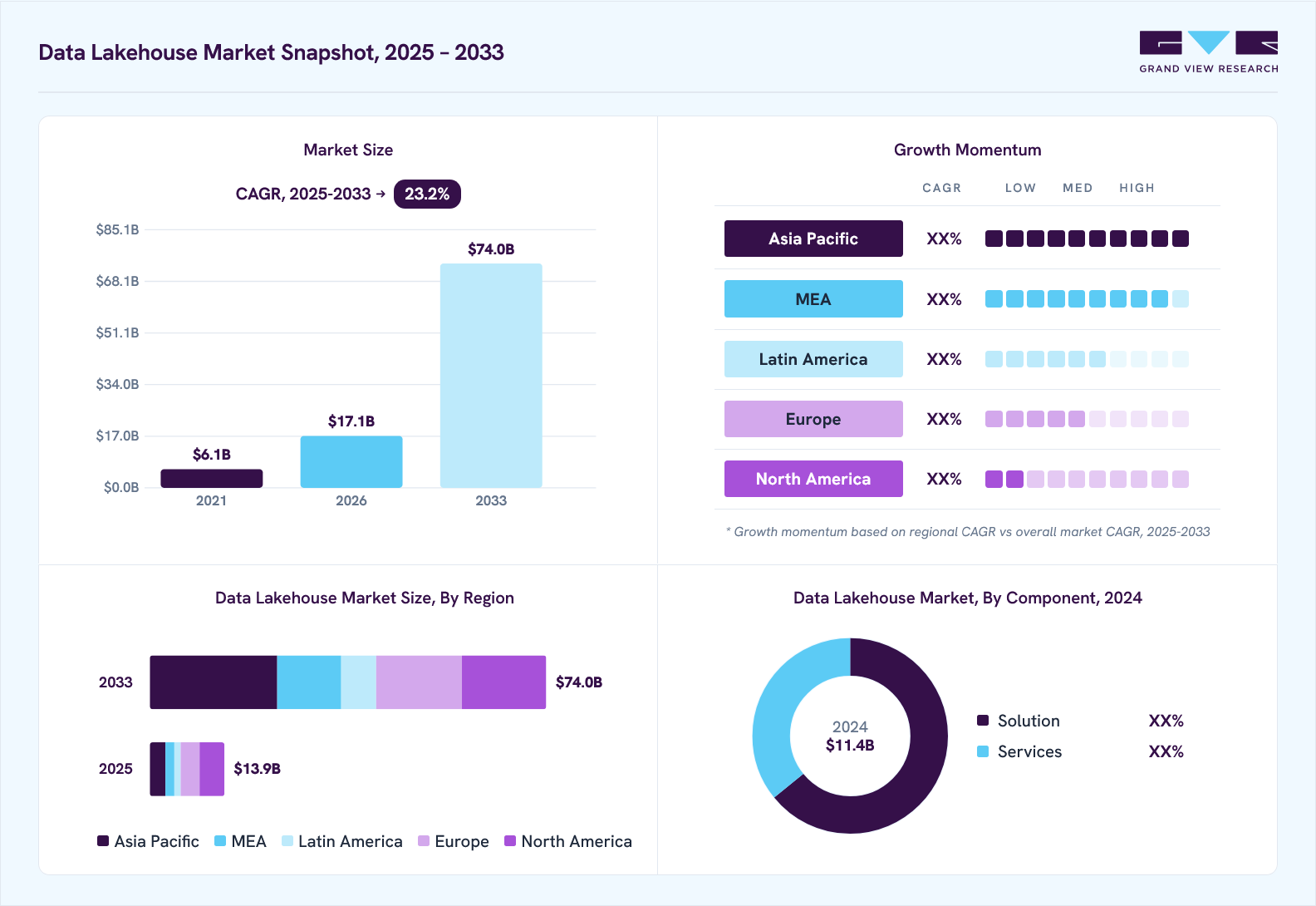 Source: Grand View Research, IR Documents, Primary Interviews, Paid DatabasesTo learn more about this report,
 Download Free Sample Report
 Key Market Trends & Insights
- The data lakehouse industry in the U.S. led the North America market and held the largest revenue share in 2024.
- By organization size, large enterprises led the market, holding the largest revenue share of 71.4% in 2024.
- By component, the solution segment held the dominant position in the market.
- By deployment, the cloud segment held the dominant position in the market.
Market Size & Forecast
- 2024 Market Size: USD 11.4 Billion
- 2033 Projected Market Size: USD 74.0 Billion
- CAGR (2025-2033): 23.2%
- North America: Largest market in 2024
- Asia Pacific: Fastest growing market
Three ways to get this report
Buy it, customize it, or ask a question.Ask an Analyst
Analyst response in 1 business day
- AccessReport author, directly
- Reply timeWithin 1 working day
- No sales callDirect answer only
- FormatEmail reply
- CostFree, no cost
Get the Full Report
What the study covers
- FormatsPDF · Excel · Dashboard
- Timeline2025–2033 annual, 2024 base
- Coverage20+ countries, 5 regions
- Companies10+ key players profiled
Customize the Report
20% free customization
- IncludeCountries, segments, points
- TailorTo your product definition
- ExtendDeeper competitor detail
- OrA fully bespoke study
- Turnaround5–10 working days
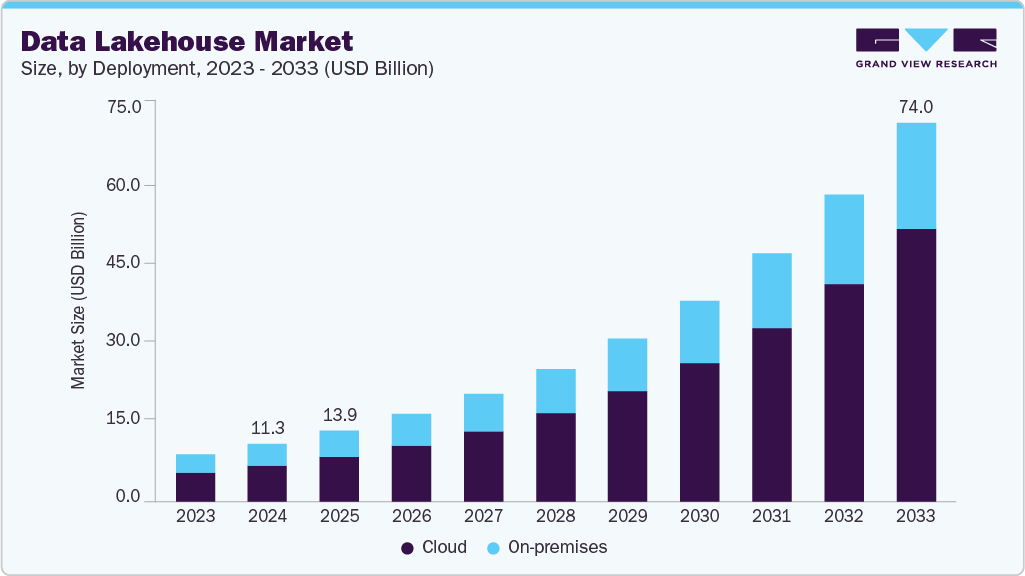
The market for data lakehouse is experiencing growth, driven by a convergence of technological and business factors. Increasing adoption of cloud technologies enables organizations to implement flexible, scalable data infrastructure capable of handling growing volumes of structured and unstructured data. The rise in demand for real-time data processing supports business needs for immediate insights, expanding use of internet of things (IoT) devices contributes to large data influxes requiring efficient management, and growing requirements for advanced analytics push the need for integrated platforms. This combination of evolving data storage needs and analytics use cases shapes the current market landscape.Moreover, the market is driven by escalating investments in data infrastructure, emphasizing data security amid rising concerns over privacy and regulatory compliance. The increasing call for data democratization empowers users across organizations to access and analyze data without strong technical barriers, enhancing decision-making speed and quality. Demand for data lineage and governance solutions also rises, reflecting the need for transparency and traceability in data workflows. These factors collectively enable organizations to leverage data lakehouse architectures to unify data management, compliance, and analytics across complex environments.
 To learn more about this report, Download Free Sample Report
 Furthermore, expansion is driven by ongoing technological advancements, including enhancements in machine learning integration, real-time analytics capabilities, and data virtualization techniques. Hybrid data architectures blend on-premises and cloud resources to offer flexible, optimized performance tailored to enterprise needs. Innovations in automation, natural language query interfaces, and self-service analytics continue to simplify user interaction with data lakehouses, promoting broader adoption. Together, these trends ensure the market’s continual evolution as organizations seek comprehensive, efficient platforms to unlock greater value from their data assets.
Organization Size Insights
The large enterprises segment accounted for the largest market revenue share in 2024 owing to their extensive data volumes and advanced analytics needs across multiple departments and geographies. These organizations invest in comprehensive data lakehouse architectures to unify disparate data sources, support real-time analytics, and improve decision-making. Their capacity to allocate significant budgets and prioritize digital transformation initiatives bolsters adoption. Large enterprises also benefit from deploying scalable, multi-cloud solutions that accommodate complex regulatory and security requirements.
The SMEs segment is expected to grow at the fastest CAGR during the forecast period. SMEs are increasingly adopting data lakehouse technologies to improve agility and competitiveness by leveraging advanced data analytics without the cost and complexity of traditional data warehouses. Cloud-based lakehouse platforms offer SMEs scalable, cost-effective access to enterprise-grade data management and AI capabilities. Growing awareness of data-driven decision-making benefits, along with availability of simplified, self-service analytics tools, propels market expansion among SMEs. Flexible pricing models and vendor partnerships further support this growth.
Application Insights
The marketing segment accounted for the largest market revenue share in 2024 due to the extensive need for unified, real-time access to large and diverse datasets to power customer analytics, campaign optimization, and personalized engagement strategies. Organizations rely on data lakehouses to seamlessly integrate structured and unstructured data from multiple digital channels, enabling marketing teams to analyze buyer journeys, predict customer behavior, and execute targeted campaigns with higher accuracy. The ability to consolidate disparate sources such as web traffic, social media, CRM systems, and transaction records within a scalable analytics environment drives deeper insights and faster experimentation. As a result, marketing stakeholders gain actionable intelligence that supports quick decision making, improved return on advertising spend, and enhanced customer experiences, fueling segment dominance within the data lakehouse industry.
The finance segment is expected to grow at the fastest CAGR over the forecast period. Financial departments increasingly adopt data lakehouse solutions for risk management, fraud detection, regulatory compliance, and real-time financial reporting. The platforms’ ability to integrate diverse data types supports complex analytics and machine learning models essential for financial forecasting and anomaly detection. Growing regulatory scrutiny and demand for transparency push institutions toward more agile, compliant data infrastructures. Continuous innovation in AI-powered finance analytics enhances the segment’s growth prospects.
Deployment Insights
The cloud segment accounted for a prominent market revenue share in 2024, driven by offering unmatched scalability, flexibility, and cost-efficiency, allowing organizations to handle fluctuating data volumes and analytics workloads effortlessly. Cloud providers support integrated services including storage, compute, and AI, enabling enterprises to reduce capital investments and streamline operations. Hybrid cloud and multi-cloud strategies enhance data sovereignty and compliance, while cloud platforms continuously evolve with innovative features such as auto-tiering and serverless analytics. Ease of access and rapid provisioning make the cloud the preferred deployment model.
The on-premises segment is anticipated to grow significantly during the forecast period. On-premises deployment gains traction among organizations requiring stringent control over sensitive data and compliance with industry or regional regulations. It allows customization and integration with existing legacy systems, reducing latency and ensuring uninterrupted operations for mission-critical workloads. Advances in hybrid architectures are enabling seamless interoperability between on-premises and cloud environments. Organizations with significant data residency concerns invest in secure local infrastructure to balance performance with governance requirements.
End Use Insights
The retail & e-commerce segment accounted for the largest market revenue share in 2024. These businesses require high-performance analytics platforms to process massive volumes of transactional, behavioral, and inventory data from both online and physical channels. By leveraging a data lakehouse, retailers and e-commerce firms integrate structured data such as sales records and customer profiles with unstructured sources like product reviews, web logs, and social media interactions. This unified architecture enables advanced use cases, including personalized recommendations, dynamic pricing, inventory optimization, and real-time fraud detection, all of which are central to maintaining competitiveness and operational agility. The ability to rapidly consolidate, analyze, and act on complex datasets empowers the retail sector to deliver tailored customer experiences, adapt quickly to market trends, and streamline supply chain decisions, solidifying its leading position within the data lakehouse ecosystem.
The healthcare segment is anticipated to grow at the fastest CAGR during the forecast period. Healthcare organizations increasingly utilize data lakehouse architectures to manage large volumes of patient records, medical imaging, and genomic data supporting personalized medicine and research. Real-time analytics improve clinical decision-making, patient outcomes, and operational efficiency. Compliance with privacy regulations such as HIPAA drives demand for secure, auditable data platforms. Integrating AI and machine learning accelerates disease diagnosis, treatment planning, and healthcare administration, fueling rapid adoption in the sector.
Component Insights
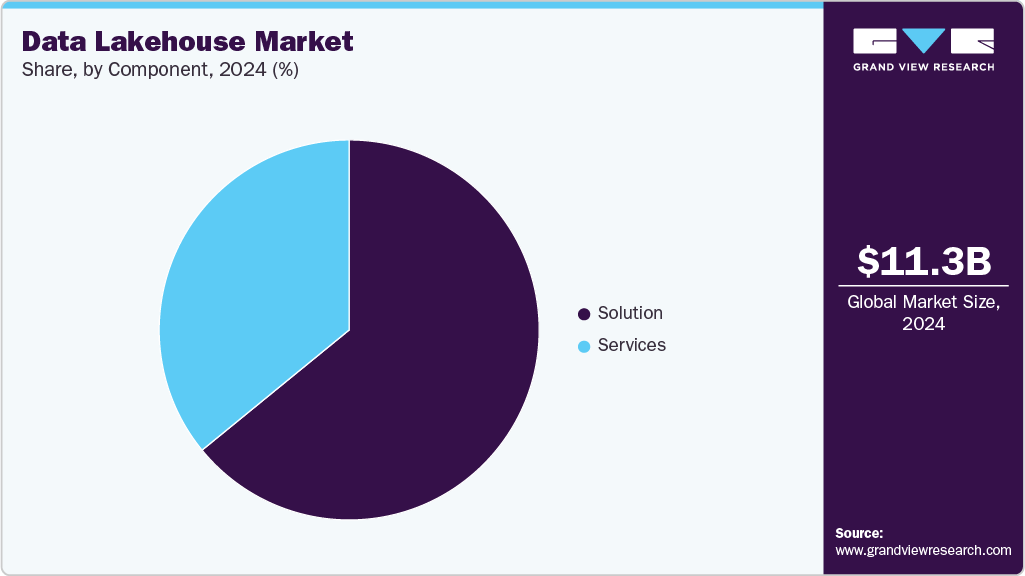
The solution segment led the market in 2024, accounting for over 63% of global revenue due to enterprises adopting integrated data lakehouse platforms that offer comprehensive storage, management, and analytics capabilities. These solutions provide unified environments combining data lakes and warehouses, enabling seamless structured and unstructured data handling. Vendors bundle core features such as query acceleration, data governance, and automation tools that support evolving workloads and AI integration. The preference for end-to-end, scalable solutions simplifies deployment and operations, driving significant revenue share in this segment.
 To learn more about this report, Download Free Sample Report
 The services segment is predicted to experience the fastest growth in the forecast years. Services related to data lakehouses, including consulting, migration, implementation, and managed operations, are expanding rapidly as organizations seek expert support to optimize complex data environments. Many enterprises require tailored migration plans from legacy systems, performance tuning, and continuous support to maximize investment returns. The shortage of in-house technical skills fuels demand for professional services. Additionally, ongoing cloud and hybrid deployments increase reliance on service providers for maintenance, security, and compliance management.
Regional Insights
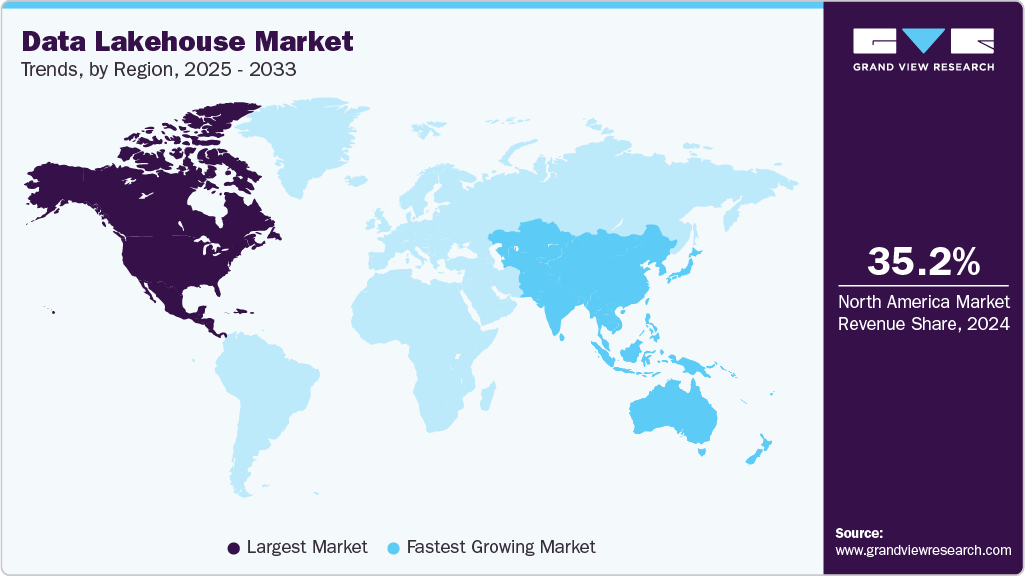
North America data lakehouse industry dominated with a revenue share of over 34% in 2024 due to widespread cloud adoption, large-scale digital transformation initiatives, and the presence of major cloud service providers and lakehouse technology vendors. Strong investments in AI, big data analytics, and advanced security solutions support growing lakehouse deployments across industries. Regulatory frameworks promoting data privacy and innovation create a mature market. Additionally, well-established IT infrastructure and a tech-savvy workforce contribute to the region’s commanding share.
 To learn more about this report, Download Free Sample Report
 U.S. Data Lakehouse Market Trends
The U.S. data lakehouse industry is expected to grow significantly in the coming years, driven by government and commercial sector emphasis on AI and analytics for competitive advantage. Initiatives promoting cloud migration, data democratization, and digital modernization highlight strong demand. Technology innovation hubs foster rapid development of lakehouse solutions tailored to diverse enterprise needs. The evolving regulatory landscape encourages data governance and privacy investments, supporting adoption across finance, healthcare, and manufacturing sectors.
Europe Data Lakehouse Market Trends
The data lakehouse industry in Europe is expected to grow significantly over the forecast period, driven by increasing regulatory focus on data privacy, cross-border data flow compliance, and digital transformation initiatives across multiple countries. Investments in AI and big data technologies to enhance economic competitiveness and public sector efficiency drive adoption. Multilingual and multicultural needs encourage the development of localized, compliant lakehouse platforms. Strategic partnerships, government funding programs, and growing cloud infrastructure lead to steady market expansion.
Asia Pacific Data Lakehouse Market Trends
The data lakehouse industry in the Asia Pacific region is anticipated to grow at the fastest CAGR over the forecast period, driven by rising digital economy investments, large-scale cloud adoption, and expanding data generation from IoT and mobile platforms. Emerging economies focus on building scalable, cost-effective data infrastructures to support smart cities, e-commerce, and healthcare innovation. Government initiatives promoting AI adoption and digital skills development contribute to market momentum. The region’s diverse industries leverage lakehouse architectures to improve analytics capabilities and streamline operations amid increasing data complexity.
Key Data Lakehouse Company Insights
Some key companies in the data lakehouse industry are Databricks, Google LLC, Snowflake, Inc., and Microsoft.
-
Databricks offers a unified Data Intelligence Platform built on an open lakehouse architecture that combines the strengths of data lakes and data warehouses. It provides enterprises with a single framework for data storage, governance, analytics, and AI integration, enabling seamless handling of structured and unstructured data. The platform emphasizes scalability, open standards, and interoperability across major cloud providers, facilitating real-time data processing, collaborative analytics, and AI-driven decision making.
-
Snowflake Inc. delivers a cloud-native data platform that unifies data storage, processing, and analytic solutions, focusing on data sharing and scalability. Its architecture enables organizations to integrate diverse data types into a single source of truth, optimize performance, and efficiently handle concurrent workloads. Snowflake Inc. supports seamless data collaboration across departments and external partners while maintaining strong governance and security features. The platform’s elasticity and multi-cloud deployment capabilities help businesses accelerate data-driven insights, fueling analytics, reporting, and advanced AI applications within modern data ecosystems.
Key Data Lakehouse Companies:
The following are the leading companies in the data lakehouse market. These companies collectively hold the largest market share and dictate industry trends.
- Databricks
- Snowflake Inc.
- Microsoft
- Amazon Web Services, Inc.
- Google LLC
- IBM Corporation
- Cloudera, Inc.
- Teradata
- Dremio
- Starburst Data, Inc.
Recent Developments
-
In July2025, StarTree Inc., provider of a real-time analytics platform and cloud service powered by Apache Pinot, announced full support for Apache Iceberg. StarTree Cloud will now utilize Iceberg as the analytic and serving layer on top of its data lakehouse, enabling interactive, external-facing analytics with low latency and high concurrency across thousands of simultaneous users. This integration transforms Iceberg from a passive storage format into a real-time backend capable of powering customer-facing applications and AI agents directly from the lakehouse without requiring complex, multi-step data pipelines or data duplication.
-
In July 2025, Tietoevry Create commenced a collaboration with EVN AG, a prominent energy sector company, to modernize and optimize its complex reporting and data infrastructure. The project involved developing a scalable Data Lakehouse on the Microsoft Azure platform, incorporating IoT integration alongside a Data Mesh architecture design, and implementing a comprehensive data governance framework. This initiative aims to enhance scalability and future-proof EVN AG’s data landscape to support sustainable growth.
-
In July 2025, QlikTech International AB expanded its data integration, management, and analytics portfolio by launching a fully managed data lakehouse service based on the Apache Iceberg standard. This new offering is designed to deliver faster query performance and reduce infrastructure costs, addressing the scalability and efficiency requirements of enterprise-level AI and data analytics workloads. By leveraging Iceberg’s open table format, QlikTech International AB’s service enables simplified data management, improved consistency, and enhanced support for real-time analytical use cases, positioning it as a competitive solution for organizations seeking to modernize their data architecture.
Data Lakehouse Market Report Scope
Report Attribute
Details
Market size in 2024
USD 11.4 billion
Estimated market size in 2026
USD 17.1 billion
Projected market size by 2033
USD 74.0 billion
Growth Rate
CAGR of 23.2% from 2025 to 2033
Actual data
2021 - 2024
Forecast period
2025 - 2033
Quantitative units
Revenue in USD billion/million and CAGR from 2025 to 2033
Report coverage
Revenue forecast, company ranking, competitive landscape, growth factors, and trends
Segments covered
Deployment, end use, application, component, organization size, region
Regional scope
North America; Europe; Asia Pacific; Latin America; MEA
Country scope
U.S.; Canada; Mexico; Germany; UK; France; China; India; Japan; Australia; South Korea; Brazil; UAE; South Africa; KSA
Key companies profiled
Databricks; Snowflake Inc.; Microsoft; Amazon Web Services, Inc.; Google LLC; IBM Corporation; Cloudera, Inc.; Teradata; Dremio; Starburst Data, Inc.
Customization scope
Free report customization (equivalent up to 8 analysts working days) with purchase. Addition or alteration to country, regional & segment scope.
Pricing and purchase options
Avail customized purchase options to meet your exact research needs. Explore purchase options
Global Data Lakehouse Market Report Segmentation
This report forecasts revenue growth at the global, regional, and country levels and provides an analysis of the latest industry trends in each of the sub-segments from 2021 to 2033. For this study, Grand View Research has segmented the global data lakehouse market report based on component, organization size, application, deployment, end use, and region.
-
Component Outlook (Revenue, USD Million, 2021 - 2033)
-
Solution
-
Data Storage & Management
-
Data Integration & ETL
-
Data Governance
-
Others
-
-
Services
-
-
Organization Size Outlook (Revenue, USD Million, 2021 - 2033)
-
SMEs
-
Large Enterprises
-
-
Application Outlook (Revenue, USD Million, 2021 - 2033)
-
Operations
-
Finance
-
Marketing
-
HR
-
Others
-
-
Deployment Outlook (Revenue, USD Million, 2021 - 2033)
-
On-premises
-
Cloud
-
-
End Use Outlook (Revenue, USD Million, 2021 - 2033)
-
BFSI
-
IT & Telecom
-
Healthcare
-
Energy & Utilities
-
Retail & E-commerce
-
Manufacturing
-
Others
-
-
Regional Outlook (Revenue, USD Million, 2021 - 2033)
-
North America
-
U.S.
-
Canada
-
Mexico
-
-
Europe
-
Germany
-
UK
-
France
-
-
Asia Pacific
-
China
-
Japan
-
India
-
South Korea
-
Australia
-
-
Latin America
-
Brazil
-
-
Middle East and Africa (MEA)
-
UAE
-
KSA
-
South Africa
-
-
Frequently Asked Questions About This Report
The global data lakehouse market size was valued at USD 11.4 billion in 2024 and is estimated at USD 17.1 billion for 2026.
The global data lakehouse market is expected to grow at a CAGR of 23.2% from 2025 to 2033, reaching USD 74.0 billion by 2033.
Some key players operating in the data lakehouse market include Databricks; Snowflake Inc.; Microsoft; Amazon Web Services, Inc.; Google LLC; IBM Corporation; Cloudera, Inc.; Teradata; Dremio; Starburst Data, Inc.
Key factors driving market growth include the rising demand for unified data platforms that combine the scalability of data lakes with the structure and performance of data warehouses to support advanced analytics and AI workloads.
North America dominated with a 34.0% revenue share in 2024, due to widespread cloud adoption, large-scale digital transformation initiatives, and the presence of major cloud service providers and lakehouse technology vendors.
About the Author(s)
Next Generation Technologies Research Team
Technology · Next Generation TechnologiesThis report was authored by the next generation technologies research team at Grand View Research - comprising two research analysts, one senior research analyst, and one industry expert - with specialized expertise in the next generation technologies segment of the technology industry. All findings are based on proprietary technology databases, executive interviews, and regulatory analysis, subject to internal peer review prior to publication.
Last Updated:
Speak to Analyst

Customize this report to your needs - add regions, segments, or data points, with 20% free customization.
Or view our licence options:


ISO 9001:2015 & 27001:2022 Certified
We are GDPR and CCPA compliant! Your transaction & personal information is safe and secure. For more details, please read our privacy policy.


