
- Home
- »
- Next Generation Technologies
- »
-
Database Security Market Size, Share & Trends Report 2033GVR Report cover

Database Security Market (2026 - 2033)
Size, Share, & Trends Analysis Report By Component (Software, Services), By Application, By Deployment Mode (Cloud, On-premises), By End Use, By Region, And Segment Forecasts
Market Size, 2025
$8.6BMarket Estimate, 2026
$9.6BMarket Forecast, 2033
$22.2BCAGR, 2026–2033
12.6%Database Security Market Summary
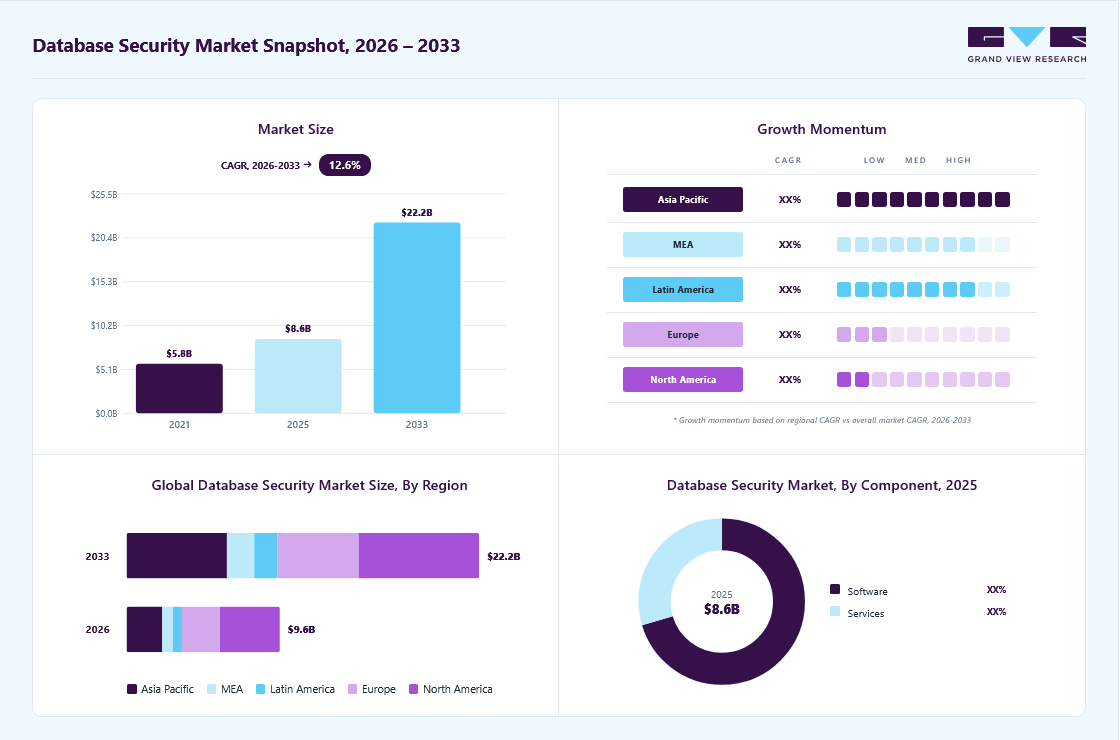
The global database security market size was valued at USD 8.6 billion in 2025 and is projected to grow from USD 9.6 billion in 2026 to USD 22.2 billion by 2033, at a CAGR of 12.6% from 2026 to 2033. North America dominated the market, accounting for a revenue share of 39.8% in 2025. The industry is growing as organizations face increasing cyberattacks, data breaches, and stricter data protection regulations. The rising adoption of cloud databases and digital services is increasing the need for database encryption, access control, and real-time threat monitoring. Additionally, growing investments in cybersecurity and the protection of sensitive business and customer information are supporting market growth.
 Source: Grand View Research, IR Documents, Primary Interviews, Paid DatabasesTo learn more about this report,
 Download Free Sample Report
Key Market Trends & Insights
- By Component: The Software segment held the largest market share of around 70.3% in 2025.
- By Application: Database Activity Monitoring & Threat Detection segment held the largest market revenue share in 2025.
- By Deployment Mode: Cloud segment led the market with the largest revenue share in 2025.
- By End Use: BFSI segment held the largest market revenue share in 2025.
Regional Highlights
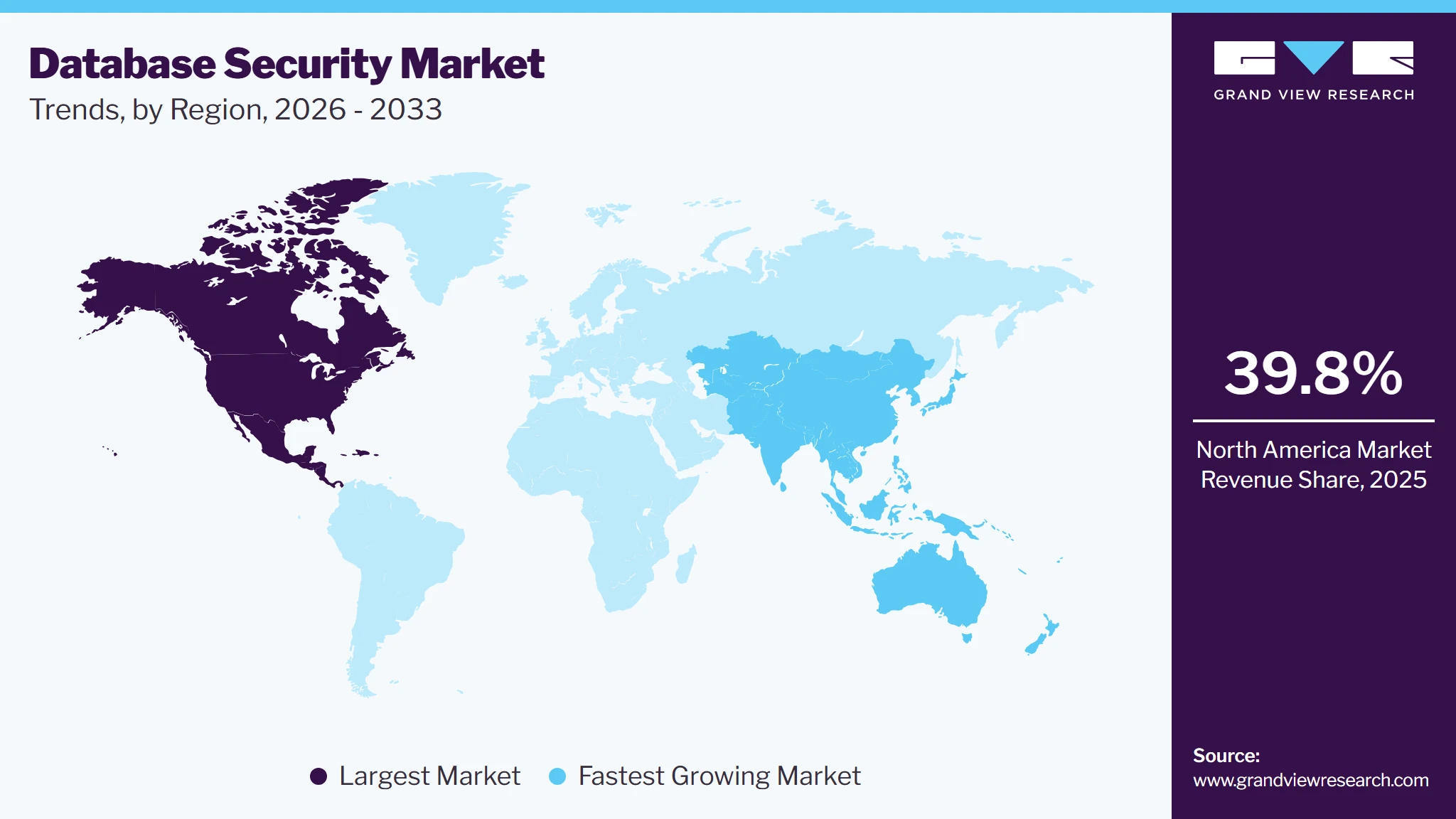
- Largest regional market: North America (39.8% revenue share, 2025)
- Fastest-growing regional market: Asia Pacific (highest CAGR, 2026-2033)
- Leading country: U.S. held the largest share in 2025
Market Size & Forecasts
- Market size in 2025: USD 8.6 Billion
- Estimated market size in 2026: USD 9.6 Billion
- Projected market size by 2033: USD 22.2 Billion
- CAGR (2026-2033): 12.6%
Three ways to get this report
Buy it, customize it, or ask a question.Ask an Analyst
Analyst response in 1 business day
- AccessReport author, directly
- Reply timeWithin 1 working day
- No sales callDirect answer only
- FormatEmail reply
- CostFree, no cost
Get the Full Report
What the study covers
- FormatsPDF · Excel · Dashboard
- Timeline2026–2033 annual, 2025 base
- Coverage20+ countries, 5 regions
- Companies10+ key players profiled
Customize the Report
20% free customization
- IncludeCountries, segments, points
- TailorTo your product definition
- ExtendDeeper competitor detail
- OrA fully bespoke study
- Turnaround5–10 working days
Centralized database security management is gaining traction as organizations seek to manage and secure multiple databases through a unified platform. These solutions provide centralized visibility into user access, sensitive data exposure, security risks, and compliance requirements across diverse database environments. They also streamline security operations, improve threat detection, and support consistent policy enforcement. For instance, in August 2026, Oracle Corporation announced Oracle Database Security Central, which combines database risk visibility, access monitoring, sensitive data discovery, and AI-powered security analysis on a single platform. The growing adoption of such solutions shows the shift toward integrated security management across on-premises, hybrid, and multicloud database environments.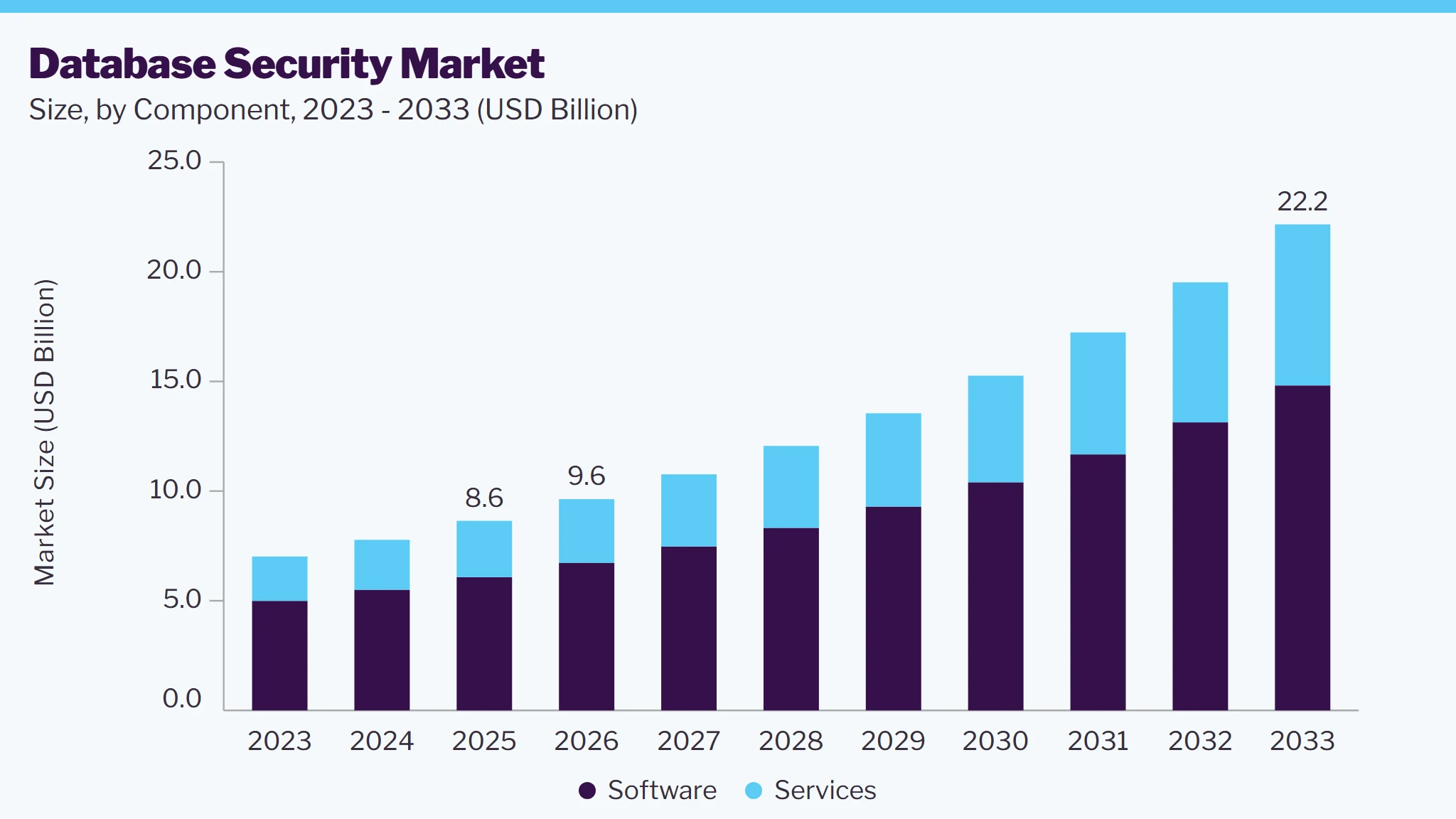 To learn more about this report, Download Free Sample Report
Database security providers are increasingly developing advanced activity-monitoring solutions to enhance visibility into database access, detect suspicious user behavior, and prevent unauthorized data access. The growing adoption of cloud-based databases and distributed data environments is increasing the need for scalable monitoring tools that can track database activities across multiple environments without adding significant operational complexity. These solutions also help organizations investigate security incidents, monitor privileged users, identify potential data exfiltration, and maintain compliance with data protection regulations. For instance, in July 2025, Varonis Systems, Inc. launched its Next-Gen Database Activity Monitoring solution, offering cloud-native, agentless database monitoring for security and compliance. This development highlights the growing demand for scalable database security solutions that support modern cloud environments and evolving data protection requirements.
The growing adoption of data security services is an important trend in the database security market, as organizations seek to identify, classify, and protect sensitive information across complex database environments. Companies such as Oracle Corporation, IBM Corporation, Microsoft, and Thales S.A. offer solutions that help businesses discover confidential data and apply appropriate security controls. Automated data classification enables organizations to categorize information according to sensitivity and prioritize protection measures. The increasing adoption of cloud-based databases is also creating demand in the cloud database security market, particularly for tools that improve data visibility and control access across distributed environments. Stringent data protection regulations are encouraging businesses to strengthen data governance and compliance practices. Integration of discovery, classification, and access control capabilities is further enhancing the functionality of the database security solution market. These developments are increasing the importance of comprehensive database security solutions that help organizations manage the exposure of sensitive data and reduce security risks.
Market Dynamics
The global database security market is evolving with the growing adoption of cloud-based databases and advanced security solutions. The market is characterized by increasing demand for data protection, rising cybersecurity threats, and continuous advancements in encryption and access management technologies. Organizations are also adopting data security services to protect sensitive information and strengthen database protection across on-premises, cloud, and hybrid environments. Competition among established cybersecurity providers and specialized vendors is shaping the market landscape.
Organizations are increasingly facing cyberattacks, unauthorized access to databases, and data breaches, creating a greater need for database security solutions. Businesses store sensitive customer information, financial records, and confidential operational data in databases, making them attractive targets for cybercriminals. Database security solutions help organizations protect this information through encryption, access controls, activity monitoring, and threat detection. The growing complexity of cyber threats is encouraging businesses to strengthen database protection measures and adopt advanced data security services.
The increasing adoption of cloud databases and digital business applications is further expanding the need for database security. Organizations are implementing solutions to identify vulnerabilities, monitor suspicious activities, and prevent unauthorized access across their database environments. Regulatory requirements related to data privacy and protection are also encouraging businesses to strengthen security controls. These developments are driving demand across the database security solutions market, as organizations seek effective ways to protect sensitive information and reduce data breach risk.
Implementing database security solutions can be complex because organizations operate multiple databases across on-premises, cloud, and hybrid environments. These solutions may require integration with existing database management systems, identity management platforms, and cybersecurity tools. Deployment can also involve database configuration, security policy development, and system testing, increasing implementation time and operational complexity.
Organizations must also allocate resources for software licensing, system maintenance, security updates, and skilled personnel. Small and medium-sized businesses may face budget constraints when adopting advanced database security platforms. Compatibility issues with legacy databases can further increase integration requirements and maintenance expenses. These financial and technical challenges may limit adoption across some organizations and restrain growth in the database security market, particularly among businesses with limited cybersecurity budgets.
The increasing migration of enterprise databases to cloud and hybrid environments is creating opportunities for database security providers. Organizations require solutions that can protect sensitive data, manage user permissions, and monitor database activities across distributed infrastructure. Cloud-based security platforms can provide centralized monitoring, automated policy management, and scalable protection across multiple database environments. These capabilities are supporting the expansion of the cloud database security market as businesses increasingly move their data and applications to cloud platforms.
Organizations are also seeking security solutions that integrate with existing cloud infrastructure and support multiple database technologies. Providers can address this demand by developing flexible platforms with automated threat detection, data discovery, encryption, and compliance monitoring capabilities. The expansion of multicloud deployments is further increasing the need for consistent security controls across different environments. These developments are creating opportunities for vendors in the database security solution market to expand their offerings and provide integrated data security services that address the evolving security requirements of enterprise customers.
Market Concentration & Characteristics
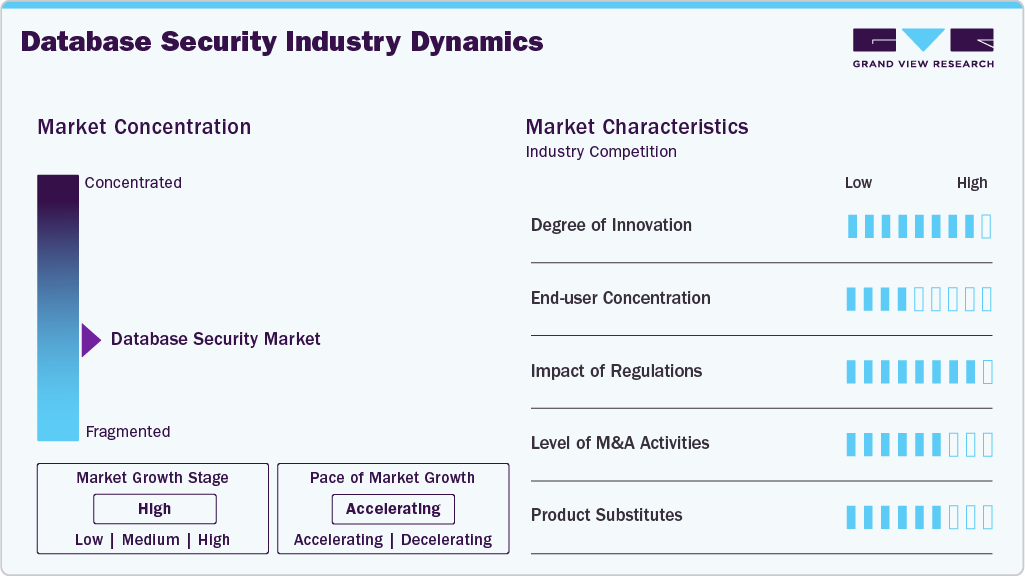
The global database security market is moderately fragmented, with the presence of established technology companies and specialized cybersecurity providers. Key participants include Oracle Corporation, IBM Corporation, Microsoft Corporation, Thales S.A., Fortinet, Inc., and Protegrity, Inc. These companies offer a range of solutions covering database encryption, access control, activity monitoring, and threat detection. Market participants compete based on product capabilities, integration with existing database systems, and deployment flexibility. The competitive landscape includes both comprehensive security platforms and specialized database protection solutions. This diversity of offerings creates opportunities for vendors to address the varying security requirements of enterprise customers.
 To learn more about this report, Download Free Sample Report
Competition in the database security industry is shaped by the growing adoption of cloud databases, increasing cybersecurity risks, and evolving data protection requirements. Established technology providers leverage their existing database ecosystems and enterprise relationships to strengthen their market presence. Specialized vendors compete by offering focused capabilities in data protection, database monitoring, and security compliance. Product innovation and integration with cloud infrastructure are important areas of competitive differentiation. Companies are also expanding their security offerings to address complex hybrid and multicloud environments, creating opportunities in the cloud database security market. The growing demand for advanced database protection and integrated data security services is prompting providers to enhance their offerings in the database security solutions market. These developments contribute to a competitive market structure in which several providers serve different customer needs and database security requirements.
Analyst Perspective
The database security market is expected to grow with the rising frequency of cyberattacks and increasing focus on data protection. Cloud adoption and multicloud deployments are creating demand for scalable database security solutions. Established technology providers and specialized vendors are competing through product innovation and advanced threat detection capabilities. The growing need for regulatory compliance and secure data management is creating opportunities for data security services. Cloud integration, automated monitoring, and comprehensive protection capabilities are expected to remain important competitive factors in the market.
Component Insights
The software segment dominated the database security market, accounting for a 70.3% share in 2025. Organizations are increasingly adopting database security software to protect sensitive information and prevent unauthorized access. Integration with existing database management systems enables businesses to strengthen data protection across their IT infrastructure. Growing cybersecurity risks and regulatory requirements are encouraging enterprises to adopt advanced solutions within the database security solution market. Continuous advancements in automated monitoring and cloud integration are expected to support demand for database security software.
The services segment is expected to grow as organizations seek specialized expertise to manage complex database security requirements. Data security services include implementation, integration, consulting, monitoring, and maintenance to help businesses protect sensitive information. The growing adoption of cloud and hybrid database environments is increasing demand for services that support secure database deployment and ongoing protection. Organizations are also seeking professional assistance to identify vulnerabilities, manage access controls, and maintain regulatory compliance. These requirements are creating opportunities in the cloud database security market, particularly as enterprises migrate databases to cloud platforms. Increasing demand for specialized security expertise and continuous database protection is expected to support growth in the services segment.
Application Insights
The database activity monitoring & threat detection segment dominated the industry due to the increasing need to identify suspicious database activities and prevent unauthorized access. Organizations are adopting these solutions to monitor database operations and detect potential security threats in real time. Growing cyberattacks and data breach incidents are encouraging enterprises to strengthen database monitoring capabilities. These solutions help track user activities, identify abnormal behavior, and support compliance with data protection regulations. Integration with existing cybersecurity platforms enables centralized monitoring across complex database environments. The growing focus on proactive threat detection is supporting demand for these solutions within the database security solution market.
The data discovery, classification & vulnerability assessment segment is expected to grow as organizations seek better visibility into sensitive data stored across databases. These solutions help identify critical information, classify data based on sensitivity, and detect database vulnerabilities. Increasing adoption of cloud and hybrid database environments is creating demand for tools that support consistent data protection across distributed infrastructure. Organizations are also using these capabilities to strengthen compliance with data privacy regulations and reduce exposure to security risks. The growing need to protect sensitive information is creating opportunities for data security services and advanced database protection technologies. These developments are expected to support growth in the cloud database security market.
Deployment Mode Insights
The cloud segment dominated the database security market due to the increasing adoption of cloud-based databases across enterprises. The scalability and flexibility of cloud platforms enable businesses to manage security across growing data volumes. Rising cybersecurity threats and regulatory requirements are further encouraging the adoption of cloud database security solutions. Integration with cloud infrastructure supports automated monitoring, encryption, and access management.
The hybrid segment is expected to grow as organizations increasingly combine on-premises databases with cloud-based infrastructure. This deployment model enables businesses to maintain control over sensitive data while using cloud resources for scalability and operational flexibility. However, managing security across multiple environments increases the need for unified monitoring, access controls, and threat detection. Organizations are adopting database security solutions to maintain consistent protection across distributed database systems. The growing complexity of hybrid infrastructure is creating opportunities for the database security solution market and related data security services. These developments are expected to support demand for hybrid database security solutions.
End Use Insights
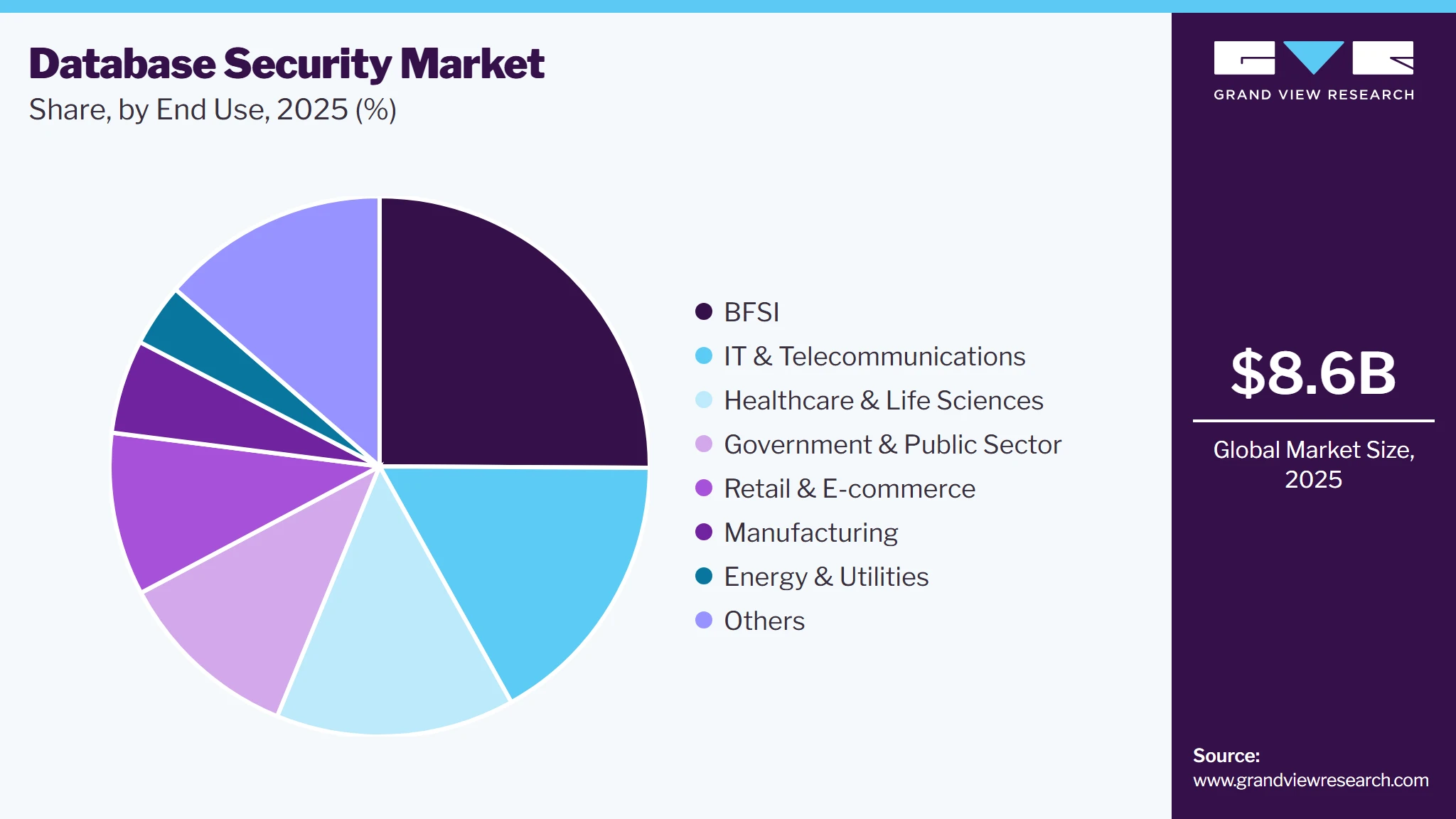
The BFSI segment dominated the market due to the large volume of sensitive financial and customer data handled by banks, insurance companies, and financial institutions. The increasing frequency of cyberattacks and financial fraud is encouraging organizations to strengthen database protection. These institutions are adopting database security solutions to secure financial records, monitor database activities, and prevent unauthorized access. Strict regulatory requirements related to data privacy and financial information protection further support adoption. Encryption, access management, and real-time threat detection remain important security capabilities in this sector. Financial institutions are also prioritizing continuous database monitoring to minimize security risks and protect critical financial information.
 To learn more about this report, Download Free Sample Report
The healthcare & life sciences segment is expected to grow as healthcare providers and life sciences companies increasingly digitize patient records, clinical data, and research information. The growing use of electronic health records and cloud-based healthcare applications is increasing the need for secure database environments. Organizations are adopting database security solutions to protect confidential patient information and prevent unauthorized access to sensitive medical data. Compliance with healthcare data protection requirements is further encouraging investment in database security technologies. The expansion of connected healthcare systems and digital research platforms is increasing the need for data discovery, encryption, and vulnerability assessment. These developments are encouraging healthcare organizations to strengthen database protection as their digital data environments expand.
Regional Insights
North America dominated the database security market, accounting for 39.8% of the revenue share in 2025. The region benefits from the strong presence of established technology companies and cybersecurity providers. Organizations across industries are adopting database security solutions to protect sensitive information across cloud and on-premises environments. The growing focus on data protection and regulatory compliance further supports regional market development.
 To learn more about this report, Download Free Sample Report
U.S. Database Security Market Trends
The database security market in the U.S. represents a significant share of the North American industry. Enterprises are increasingly integrating database security solutions into their existing IT infrastructure to protect sensitive business and customer information. The presence of major cybersecurity vendors and the growing adoption of cloud databases support the use of encryption, access management, and threat monitoring technologies.
Europe Database Security Market Trends
The database security market in Europe is growing with organizations focusing on data protection and regulatory compliance. Enterprises are adopting security solutions across cloud, hybrid, and on-premises database environments. The increasing integration of database monitoring, encryption, and vulnerability assessment tools is shaping regional market development.
Asia Pacific Database Security Market Trends
The database security market in the Asia Pacific is expected to witness strong growth as businesses expand their digital infrastructure. Organizations across China, India, and Japan are adopting cloud databases and advanced security technologies to manage and protect enterprise data. The growing presence of technology providers and expanding digital operations are creating opportunities for database security vendors across the region.
Key Database Security Company Insights
Key players operating in the database security market include Amazon Web Services, Inc. (AWS), Broadcom Inc., and Check Point Software Technologies Ltd., among others.
-
Check Point is strengthening its database security capabilities through identity-based access controls, database activity monitoring, and audit tracking. Its solutions focus on securing database access, managing user permissions, and reducing the risk of unauthorized activities. These capabilities help organizations improve visibility and control over database environments.
-
Oracle Corporation is advancing its database security portfolio through improvements in data encryption, access management, activity monitoring, and sensitive data protection. The company is also developing security capabilities to manage data access by applications and AI agents. These developments focus on strengthening database protection, supporting regulatory compliance, and securing enterprise data across cloud and on-premises environments.
Key Database Security Companies
The following key companies have been profiled for this study on the database security market.
-
Amazon Web Services, Inc. (AWS)
-
Broadcom Inc.
-
Check Point Software Technologies Ltd.
-
Cisco Systems, Inc.
-
Fortinet, Inc.
-
IBM Corporation
-
Microsoft
-
Oracle Corporation
-
Protegrity, Inc.
-
Thales S.A.
Competitive Benchmarking
Operating Strategies
Competitive Edge
Weaknesses
Mature Players: Oracle Corporation, IBM Corporation, Microsoft, Thales S.A.
Expand integrated database security portfolios through encryption, access controls, activity monitoring, threat detection, and compliance management. Strengthen integration with existing database platforms and enterprise security ecosystems.
Established customer relationships, broad product portfolios, strong enterprise presence, and integration with widely deployed database and cloud platforms.
Complex deployment across heterogeneous database environments, higher implementation and maintenance requirements, and potential dependence on specific technology ecosystems.
Emerging Players: Check Point Software Technologies Ltd., Protegrity, Inc.
Focus on AI-driven threat detection, cloud-native database protection, automated data discovery, data security posture management, and real-time risk prioritization.
Greater specialization, cloud-native architectures, faster adoption of emerging technologies, and flexible approaches to identifying data exposure and security risks.
Limited brand recognition and enterprise reach, challenges in building customer trust, integration requirements with legacy systems, and competition with established cybersecurity vendors.
Recent Developments
-
In August 2026, Oracle Corporation and Amazon Web Services, Inc. expanded their long-term strategic collaboration to accelerate enterprise migration to Oracle AI Database@AWS, which is now available across 22 AWS Regions. The collaboration also introduced Oracle Exadata Database Service on Exascale Infrastructure on AWS, enabling scalable database performance, flexible pricing, and integration with AWS AI and analytics services.
-
In March 2026, Check Point Software Technologies Ltd. launched its AI Factory Security Architecture Blueprint, designed to protect AI infrastructure, including GPU servers, data centers, and large language model (LLM) applications. Developed in collaboration with NVIDIA, the solution integrates firewall and threat prevention capabilities to protect against AI-specific threats, data leakage, and unauthorized access.
-
In March 2026, Oracle Corporation updated its database cryptographic roadmap, outlining plans to introduce quantum-resistant key exchange mechanisms and further TLS security enhancements. These developments aim to strengthen database encryption and secure communications, although some of the announced capabilities remain planned rather than generally available.
Database Security Market Report Scope
Report Attribute
Details
Market size in 2025
USD 8.6 billion
Estimated market size in 2026
USD 9.6 billion
Projected market size by 2033
USD 22.2 billion
Growth rate
CAGR of 12.6% from 2026 to 2033
Actual data
2021 - 2025
Forecast period
2026 - 2033
Quantitative units
Revenue in USD billion and CAGR from 2026 to 2033
Report coverage
Revenue forecast, company share, competitive landscape, growth factors, and trends
Segments covered
Component, application, deployment mode, end use, region
Regional scope
North America; Europe; Asia Pacific; Latin America; Middle East and Africa
Country scope
U.S.; Canada; Mexico; UK; Germany; France; China; Japan; India; South Korea; Australia; Brazil; UAE; KSA; South Africa
Key companies profiled
Amazon Web Services, Inc. (AWS); Broadcom Inc.; Check Point Software Technologies Ltd.; Cisco Systems, Inc.; Fortinet, Inc.; IBM Corporation; Microsoft; Oracle Corporation; Protegrity, Inc.; Thales S.A.
Customization scope
Free report customization (equivalent to up to 8 analyst working days) with purchase. Addition or alteration to country, regional & segment scope.
Pricing and purchase options
Avail customized purchase options to meet your exact research needs. Explore purchase options
Global Database Security Market Report Segmentation
This report forecasts revenue growth at global, regional, and country levels and provides an analysis of the latest industry trends in each of the sub-segments from 2021 to 2033. For this study, Grand View Research has segmented the global database security market report based on component, application, deployment mode, end use, and region.
-
Component Outlook (Revenue, USD Billion, 2021 - 2033)
-
Software
-
Services
-
-
Application Outlook (Revenue, USD Billion, 2021 - 2033)
-
Database Activity Monitoring & Threat Detection
-
Data Encryption, Tokenization & Masking
-
Access Control & Authorization
-
Data Discovery, Classification & Vulnerability Assessment
-
Others
-
-
Deployment Mode Outlook (Revenue, USD Billion, 2021 - 2033)
-
Cloud
-
On-premises
-
Hybrid
-
-
End Use Outlook (Revenue, USD Billion, 2021 - 2033)
-
BFSI
-
IT & Telecommunications
-
Healthcare & Life Sciences
-
Government & Public Sector
-
Retail & E-commerce
-
Manufacturing
-
Energy & Utilities
-
Others
-
-
Regional Outlook (Revenue, USD Billion, 2021 - 2033)
-
North America
-
U.S.
-
Canada
-
Mexico
-
-
Europe
-
UK
-
Germany
-
France
-
-
Asia Pacific
-
China
-
Japan
-
India
-
South Korea
-
Australia
-
-
Latin America
-
Brazil
-
-
Middle East and Africa
-
UAE
-
KSA
-
South Africa
-
-
Research Methodology
The database security marketfigures in this report are based on a proven research process that combines executive interviews with secondary research from proprietary databases, company filings, and recognized regulatory and institutional sources. Market size is built through value-chain sizing—reconciling supply-side and demand-side estimates—and triangulated with bottom-up and top-down approaches. Every estimate passes multiple levels of expert validation before publication, with eachdatabase security segment quantified using the revenue-capture definitions in the table below.
Segment Definition
Component
Revenue Capture Definition
Software
Revenue generated from database security software licenses, subscriptions, and platform usage fees for monitoring, protecting, and managing database environments.
Services
Income earned through database security consulting, implementation, integration, managed security, maintenance, and technical support services.
Application
Revenue Capture Definition
Database Activity Monitoring & Threat Detection
Revenue from solutions that track database activities, identify suspicious behavior, detect threats, and generate security alerts to prevent unauthorized access.
Data Encryption, Tokenization & Masking
Revenue derived from software and solutions that encrypt database contents, replace sensitive data with tokens, or conceal confidential information to reduce exposure.
Access Control & Authorization
Revenue earned from tools that authenticate users, enforce database permissions, manage privileged access, and restrict unauthorized data operations.
Data Discovery, Classification & Vulnerability Assessment
Revenue generated by solutions that locate sensitive database information, classify data according to its risk level, identify security weaknesses, and assess database vulnerabilities.
Others
Revenue from database security applications not covered above, including database auditing, compliance management, security policy enforcement, and related protection capabilities.
Deployment Mode
Revenue Capture Definition
Cloud
Revenue from database security solutions hosted and delivered through cloud platforms, typically under subscription, usage-based, or managed-service pricing models.
On-premises
Revenue generated from security software deployed on customer-owned infrastructure, including perpetual or term licenses, maintenance, and associated support.
Hybrid
Revenue attributable to solutions that secure databases distributed across on-premises infrastructure and cloud environments through integrated security management and protection capabilities.
End Use
Revenue Capture Definition
BFSI
Revenue from database security solutions purchased by banks, financial institutions, insurance companies, and other financial service providers to protect customer records, financial transactions, and confidential information.
IT & Telecommunications
Revenue generated by IT service providers, software companies, telecom operators, and data center businesses to secure operational databases, customer information, and digital service platforms.
Healthcare & Life Sciences
Revenue earned from database security deployments across hospitals, healthcare providers, pharmaceutical companies, biotechnology firms, and research organizations to safeguard patient records and sensitive research data.
Government & Public Sector
Revenue associated with database security solutions adopted by government departments, public agencies, and public institutions to protect citizen information, administrative records, and sensitive government databases.
Retail & E-commerce
Revenue from retailers, online marketplaces, and e-commerce businesses using database security tools to protect customer profiles, payment-related information, order records, and transaction databases.
Manufacturing
Revenue generated by manufacturers adopting database security solutions to safeguard production records, supply chain information, product designs, operational databases, and proprietary business data.
Energy & Utilities
Revenue from energy producers, utility providers, and related companies deploying database security solutions to protect operational records, customer data, billing systems, and critical infrastructure information.
Others
Revenue contributed by sectors not separately listed, including education, transportation, media, hospitality, and professional services, for securing their databases and sensitive organizational information.
Estimation Model
Layer No.
Layer Name
Key Question
Description
01
End-user Industry Layer
Who creates demand for database security solutions?
Identifies the base of organizations generating demand across BFSI, IT & telecommunications, healthcare & life sciences, government & public sector, retail & e-commerce, manufacturing, energy & utilities, and other industries that store and process sensitive data in databases.
02
Adoption / Usage Layer
Who actively adopts database security solutions?
Estimates the addressable market based on database usage, sensitive data storage, regulatory and compliance requirements, cyber threat exposure, cloud database adoption, and the need to prevent unauthorized access, data breaches, and misuse of database information.
03
Technology & Infrastructure Layer
Which technologies and infrastructure are deployed?
Estimates adoption across database activity monitoring and threat detection, data encryption and tokenization, access control and authorization, data discovery and classification, vulnerability assessment, and other database security technologies deployed across cloud, on-premises, and hybrid environments.
04
Revenue Capture Layer
How is revenue generated in the database security ecosystem?
Calculates revenue generated from software licenses, subscriptions, usage-based fees, and services associated with database security solutions, including monitoring, threat detection, encryption, access management, data discovery, vulnerability assessment, implementation, integration, maintenance, and managed security services.
Delivered Customizations
This report has been delivered with the following in-depth customizations
Client Objective
Custom Research Modules Delivered
Strategic Value / Business Impact
Technology & Security Capability Assessment
Analysis of database security technologies and architecture trends; assessment of cloud, on-premises, and hybrid database security solutions; evaluation of database activity monitoring, threat detection, data encryption, tokenization, access control, data discovery, classification, and vulnerability assessment capabilities; mapping of database security vendors and technology partnerships.
Identified emerging database security technology opportunities, supported security solution adoption planning, evaluated database infrastructure protection requirements, and strengthened technology partnership and solution development decisions.
Product Positioning & Competitive Intelligence
Benchmarking of database security product portfolios; comparison of threat detection, encryption, access management, auditing, and compliance capabilities; analysis of pricing models, licensing structures, and product value propositions; evaluation of competitive strategies, deployment options, and vendor service portfolios.
Improved product differentiation, supported pricing and licensing strategy optimization, identified customer security requirements and product capability gaps, and strengthened competitive positioning.
Market Entry & Growth Assessment
Regional market sizing and forecasting; component, application, deployment mode, and end-use segmentation analysis; assessment of cloud database adoption, data protection requirements, regulatory compliance, and cybersecurity demand; evaluation of the competitive landscape and emerging security technologies.
Identified regional and application opportunities, supported go-to-market strategy development, highlighted market opportunities and adoption barriers, and enabled data-driven expansion planning.
Frequently Asked Questions About This Report
Cloud segment led the market with the largest revenue share in 2025.
Database Activity Monitoring & Threat Detection segment held the largest market revenue share in 2025.
The global database security market size was estimated at USD 8.6 billion in 2025 and is expected to reach USD 9.6 billion in 2026.
The global database security market is expected to grow at a compound annual growth rate of 12.6% from 2026 to 2033 to reach USD 22.2 billion by 2033.
North America dominated the database security market with a share of 39.8% in 2025, driven by stringent regulations such as CCPA, high cloud adoption, the presence of leading cybersecurity providers, and strong enterprise spending on data protection across the U.S. and Canada.
Asia Pacific is the fastest-growing region over the forecast period.
Key factors driving market growth include rising cyber threats and data breaches, stringent data protection regulations, increasing adoption of cloud databases, and growing demand for advanced security solutions to protect sensitive data.
Some key players operating in the database security market include Amazon Web Services, Inc. (AWS); Broadcom Inc.; Check Point Software Technologies Ltd.; Cisco Systems, Inc.; Fortinet, Inc.; IBM Corporation; Microsoft; Oracle Corporation; Protegrity, Inc.; Thales S.A.
The software segment led with a 70.3% revenue share in 2025, while services is the fastest-growing segment.
About the Author(s)
Next Generation Technologies Research Team
Technology · Next Generation TechnologiesThis report was authored by the next generation technologies research team at Grand View Research - comprising two research analysts, one senior research analyst, and one industry expert - with specialized expertise in the next generation technologies segment of the technology industry. All findings are based on proprietary technology databases, executive interviews, and regulatory analysis, subject to internal peer review prior to publication.
Last Updated:
Speak to Analyst

Customize this report to your needs - add regions, segments, or data points, with 20% free customization.
Or view our licence options:


ISO 9001:2015 & 27001:2022 Certified
We are GDPR and CCPA compliant! Your transaction & personal information is safe and secure. For more details, please read our privacy policy.


