
- Home
- »
- Advanced Interior Materials
- »
-
Decanter Centrifuge Market Size And Share Report, 2033GVR Report cover

Decanter Centrifuge Market (2026 - 2033)
Size, Share & Trends Analysis Report By Type (Two Phase Centrifuge, Three Phase Centrifuge), By Design (Vertical, Horizontal), By End-use (Chemical, Oil & Gas, Petrochemical, Pharmaceutical), By Region, And Segment Forecasts
Market Size, 2025
$2.3BMarket Estimate, 2026
$2.4BMarket Forecast, 2033
$3.3BCAGR, 2026–2033
4.7%Decanter Centrifuge Market Summary
The global decanter centrifuge market size was valued at USD 2.3 billion in 2025 and is projected to grow from USD 2.4 billion in 2026 to USD 3.3 billion by 2033, at a CAGR of 4.7% from 2026 to 2033. Asia Pacific dominated the market, accounting for a revenue share of 36.0% in 2025. Decanter centrifuges are experiencing strong demand across several industries, including wastewater treatment, oil & gas, food & beverage, and chemical processing, due to their ability to separate solid and liquid phases efficiently.
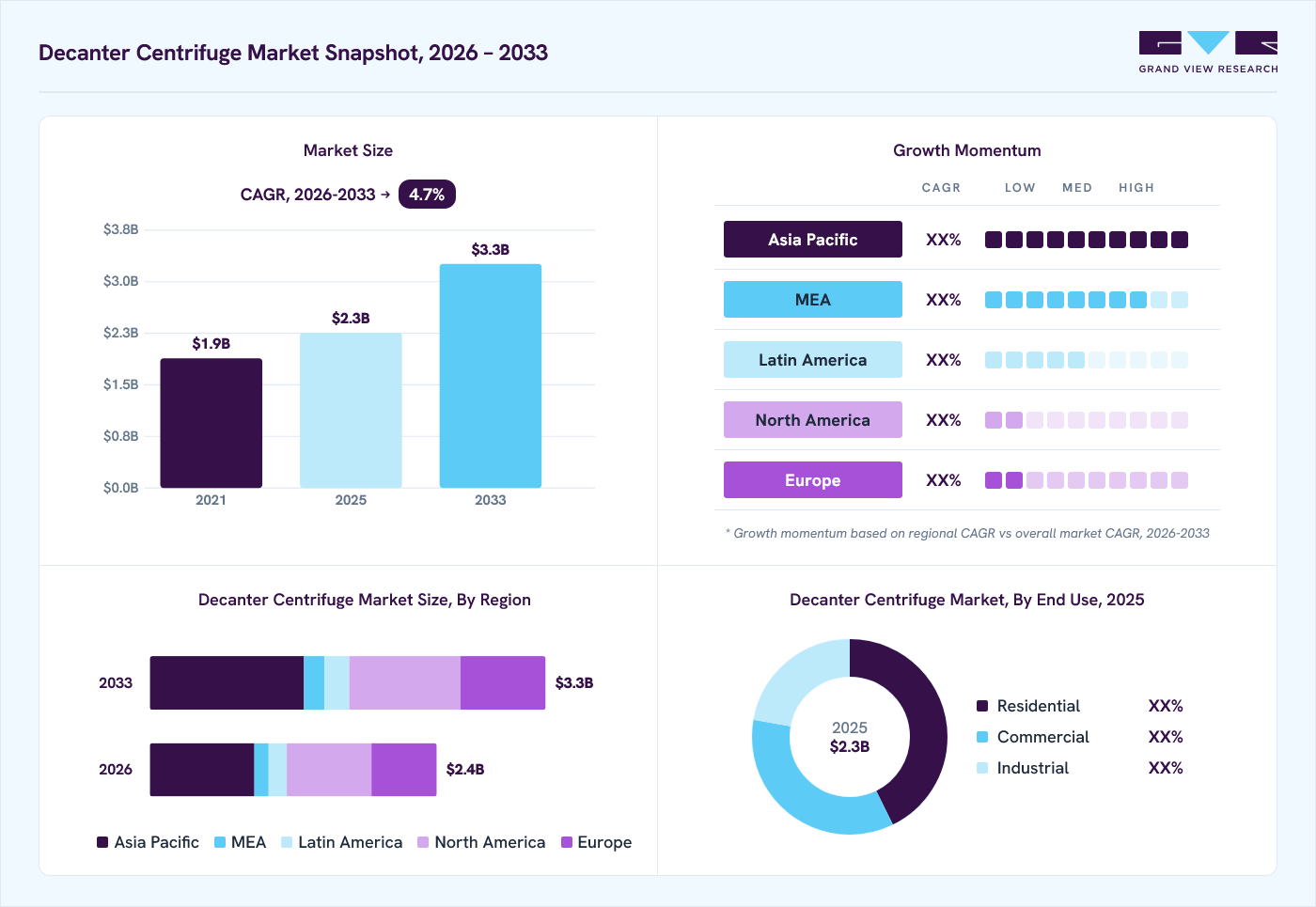 Source: Grand View Research, IR Documents, Primary Interviews, Paid DatabasesTo learn more about this report,
 Download Free Sample Report
Key Market Trends & Insights
- By type: Three phase centrifuge segment led the market with the largest revenue share of 54.5% in 2025.
- By design: The horizontal segment led the market with the largest revenue share of 69.4% in 2025.
- By end use: The oil & gas segment led the market with the largest revenue share of 25.3% in 2025.
Regional Highlights
- Largest regional market: Asia Pacific (36.0% revenue share, 2025)
- By country: China held the largest market share in 2025.
Market Size & Forecast
- Market size in 2025: USD 2.3 Billion
- Estimated market size in 2026: USD 2.4 Billion
- Projected market size by 2033: USD 3.3 Billion
- CAGR (2026-2033): 4.7%
Prism AI by Grand View Research Free to tryAsk a question about the decanter centrifuge marketTry asking✓Every figure cited from GVR research Prefer the report? Download free sample →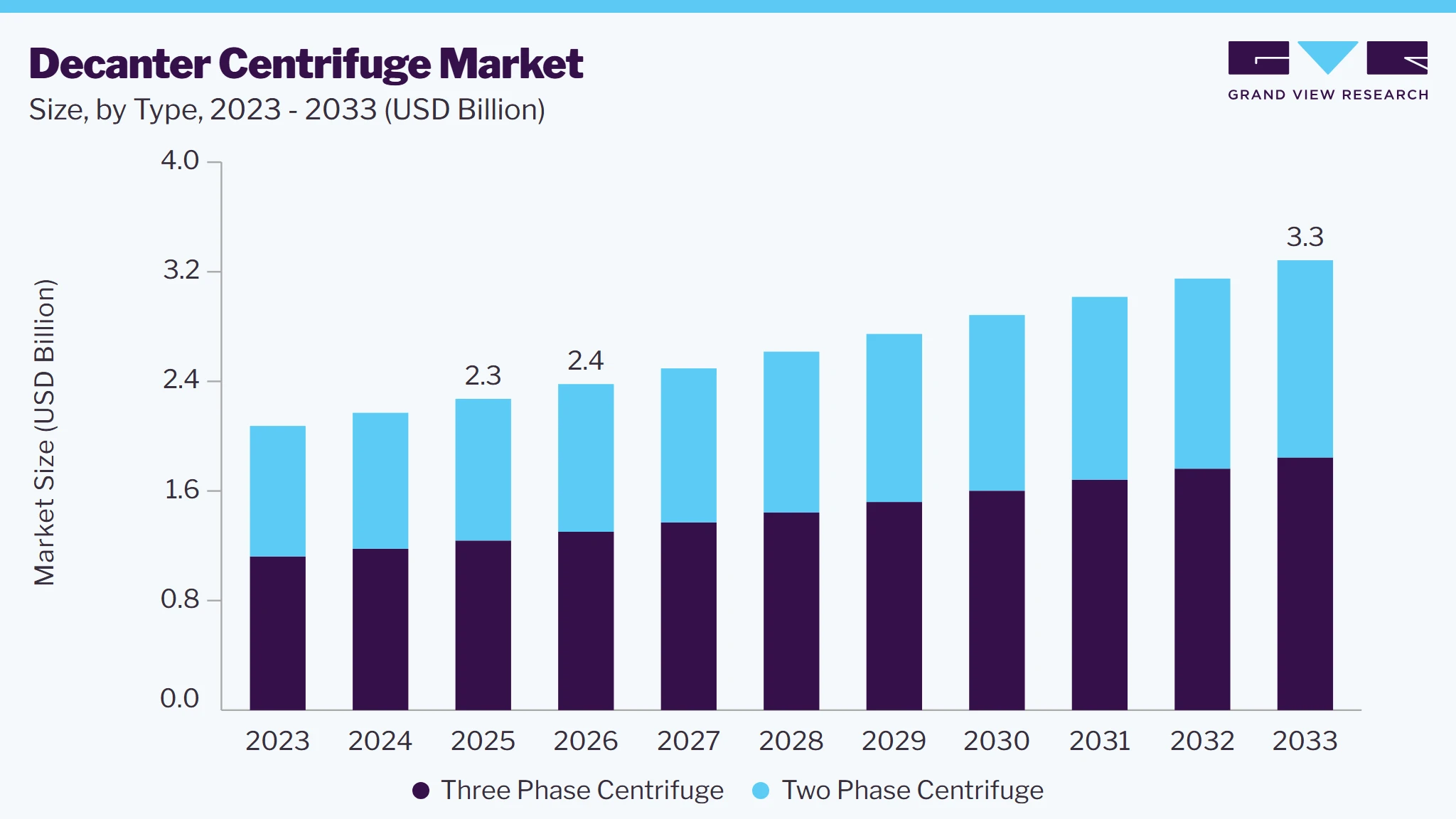 To learn more about this report, Download Free Sample Report
Decanter centrifuge is critical in processes requiring precise solid-liquid separation and dewatering, playing a key role in industries that emphasize productivity and environmental compliance. Increasing environmental regulations, particularly in wastewater management, are a major driving force in this market, as industries seek sustainable and efficient waste treatment solutions. Advancements in decanter centrifuge design, including higher efficiency models with optimized control systems, are also contributing to market growth. Furthermore, the rising focus on recycling and sustainability in industries like food & beverage and oil & gas is creating additional opportunities for decanter centrifuge applications.
Market Dynamics
The decanter centrifuge market is witnessing growth due to increasing demand for efficient solid-liquid separation across wastewater treatment, food and beverage, chemical processing, mining, pharmaceuticals, and oil & gas industries. Growing industrialization, stricter environmental regulations, and rising investments in water treatment infrastructure are supporting market expansion. Technological advancements in automation, energy-efficient designs, and process optimization are improving operational performance. However, high capital costs and ongoing maintenance requirements continue to influence purchasing decisions across end-use industries.
The growing demand for wastewater treatment and sludge management is a major driver of the decanter centrifuge market. Municipal and industrial facilities increasingly rely on decanter centrifuges for efficient dewatering and solid-liquid separation to reduce waste volume and improve treatment efficiency. Rising urbanization, industrial wastewater generation, and stringent environmental regulations are encouraging investments in advanced separation equipment. Continuous expansion of wastewater treatment infrastructure is expected to support sustained demand for decanter centrifuges across municipal and industrial applications.
High initial investment and maintenance costs remain a significant restraint for the decanter centrifuge market. Advanced decanter centrifuges require substantial capital expenditure, particularly for large-capacity and automated systems. In addition, regular maintenance, replacement of wear components, and skilled servicing are necessary to ensure consistent operating performance and equipment reliability. These costs can discourage adoption among small and medium-sized industries, particularly in cost-sensitive markets where lower-cost separation technologies are available.
The increasing use of decanter centrifuges in food and beverage processing presents significant growth opportunities for the market. Manufacturers are adopting advanced separation equipment to improve product quality, maximize raw material recovery, and enhance production efficiency. Applications including edible oil processing, dairy products, beverages, starch production, and fruit juice clarification continue to expand. Rising demand for processed foods, stringent hygiene standards, and investments in modern food processing facilities are expected to support long-term market growth.
Analyst Perspective
The decanter centrifuge market is expected to witness growth, driven by increasing demand for efficient solid-liquid separation across wastewater treatment, food and beverage, chemical, pharmaceutical, and oil & gas industries. Stricter environmental regulations, rising investments in industrial processing infrastructure, and growing adoption of automated separation technologies are supporting market expansion. Manufacturers focusing on energy-efficient designs, higher processing capacities, and digital monitoring capabilities are expected to strengthen their competitive position and capitalize on emerging opportunities.
Type Insights
Based on type, the three phase centrifuge segment led the market with the largest revenue share of 54.5% in 2025. The three phase centrifuge segment is witnessing significant growth, driven by its ability to separate solids from two immiscible liquids simultaneously. This makes it highly valuable in industries such as food & beverage, petrochemicals, and oil & gas, where separation of oil, water, and solids is essential. The demand for three-phase centrifuges is expected to rise as industries seek more versatile separation solutions that offer high efficiency and precision.
Two-phase centrifuges are primarily used in industries like wastewater treatment, oil and gas, and chemical processing, where separating solids from liquids is critical for operational efficiency. The two-phase process's simplicity, coupled with its ability to handle large volumes, makes it a popular choice for industrial applications that prioritize solid-liquid separation.
Design Insights
Based on design type, the horizontal segment led the market with the largest revenue share of 69.4% in 2025. The horizontal decanter centrifuge is widely used across various industries, offering greater capacity and operational flexibility. Its design allows for easier maintenance and handling of larger volumes, making it a preferred choice for high-capacity applications in industries such as wastewater treatment, oil & gas, and petrochemicals. Horizontal decanter centrifuges are known for their durability and ability to manage continuous operations, enhancing their appeal in sectors that require robust separation technologies.
The vertical decanter centrifuge is favored for its compact design and space-saving capabilities. Its vertical alignment allows it to operate in environments with limited floor space, making it ideal for industries like pharmaceuticals, food & beverage, and chemicals, where space constraints are common. Despite its smaller footprint, vertical decanter centrifuges deliver high efficiency in separation processes, contributing to their growing demand in specific sectors.
End-use Insights
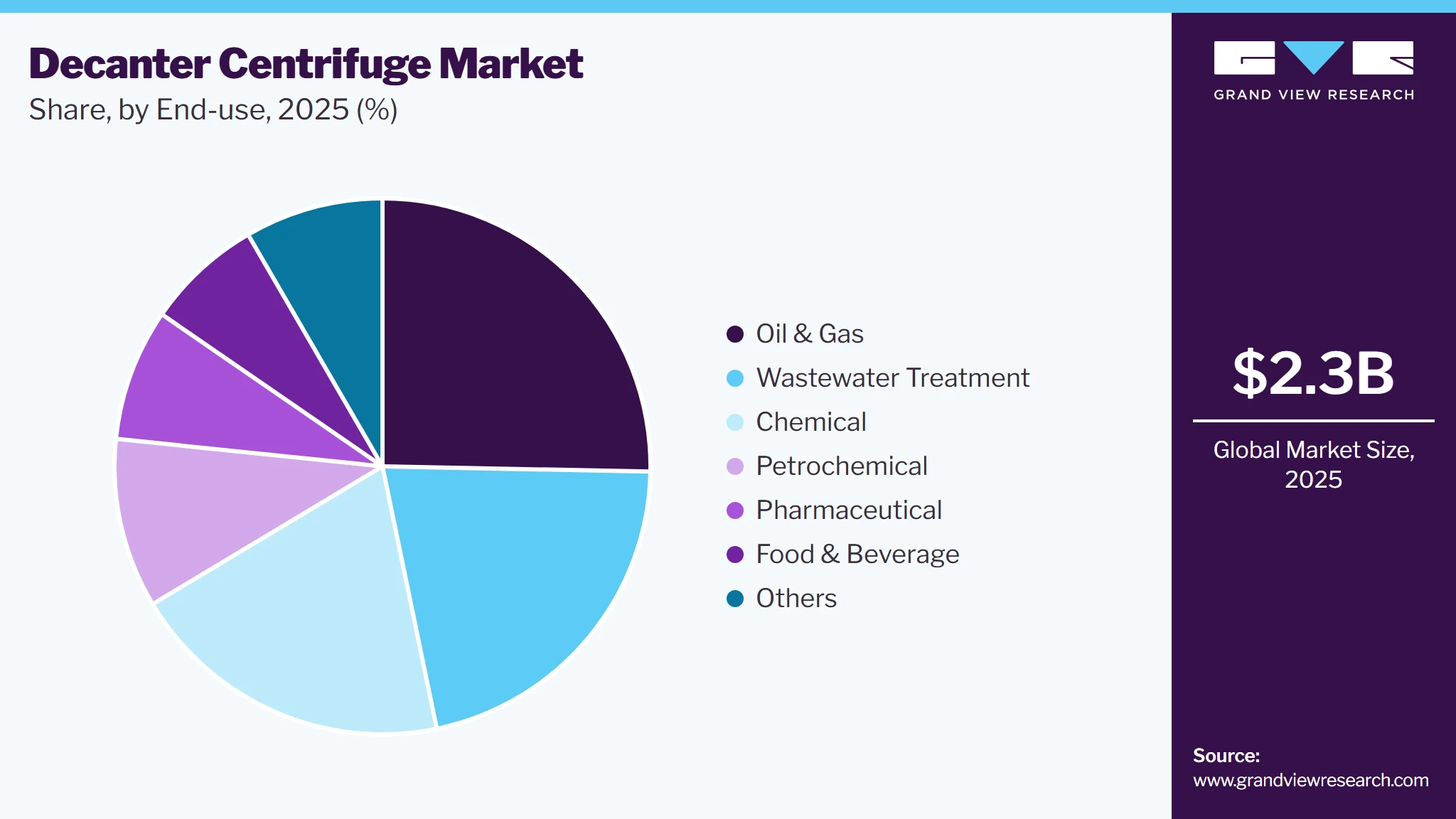
Based on end use, the oil & gas segment led the market with the largest revenue share of 25.3% in 2025. The oil & gas industry relies heavily on decanter centrifuges for applications such as drilling fluid management, oil-water separation, and waste reduction. As oil exploration activities increase globally, the demand for high-performance separation systems is rising. Decanter centrifuges play a critical role in enhancing productivity and minimizing environmental impact in this highly regulated industry.
 To learn more about this report, Download Free Sample Report
Wastewater Treatment is one of the largest end-use segments for decanter centrifuges. The need for effective solid-liquid separation in municipal and industrial wastewater treatment plants is a key driver for this market. Decanter centrifuges are crucial in helping industries and municipalities meet environmental regulations by efficiently processing large volumes of wastewater and reducing solid waste discharge.
Regional Insights
North America continues to be a largest region in the decanter centrifuge market, with the U.S. leading the way. The region's strict regulatory framework around wastewater management and the presence of a robust industrial base are key drivers of growth. The oil & gas industry, in particular, is a major contributor to the demand for decanter centrifuges in North America.
U.S. Decanter Centrifuge Market Trends
The U.S. decanter centrifuge market is witnessing steady growth, driven by increasing demand across various industries such as oil & gas, wastewater treatment, food & beverage, and chemical processing. Decanter centrifuges are favored for their ability to efficiently separate solids from liquids, providing a cost-effective and environmentally friendly solution in sludge dewatering and liquid-solid separation processes.
Asia Pacific Decanter Centrifuge Market Trends
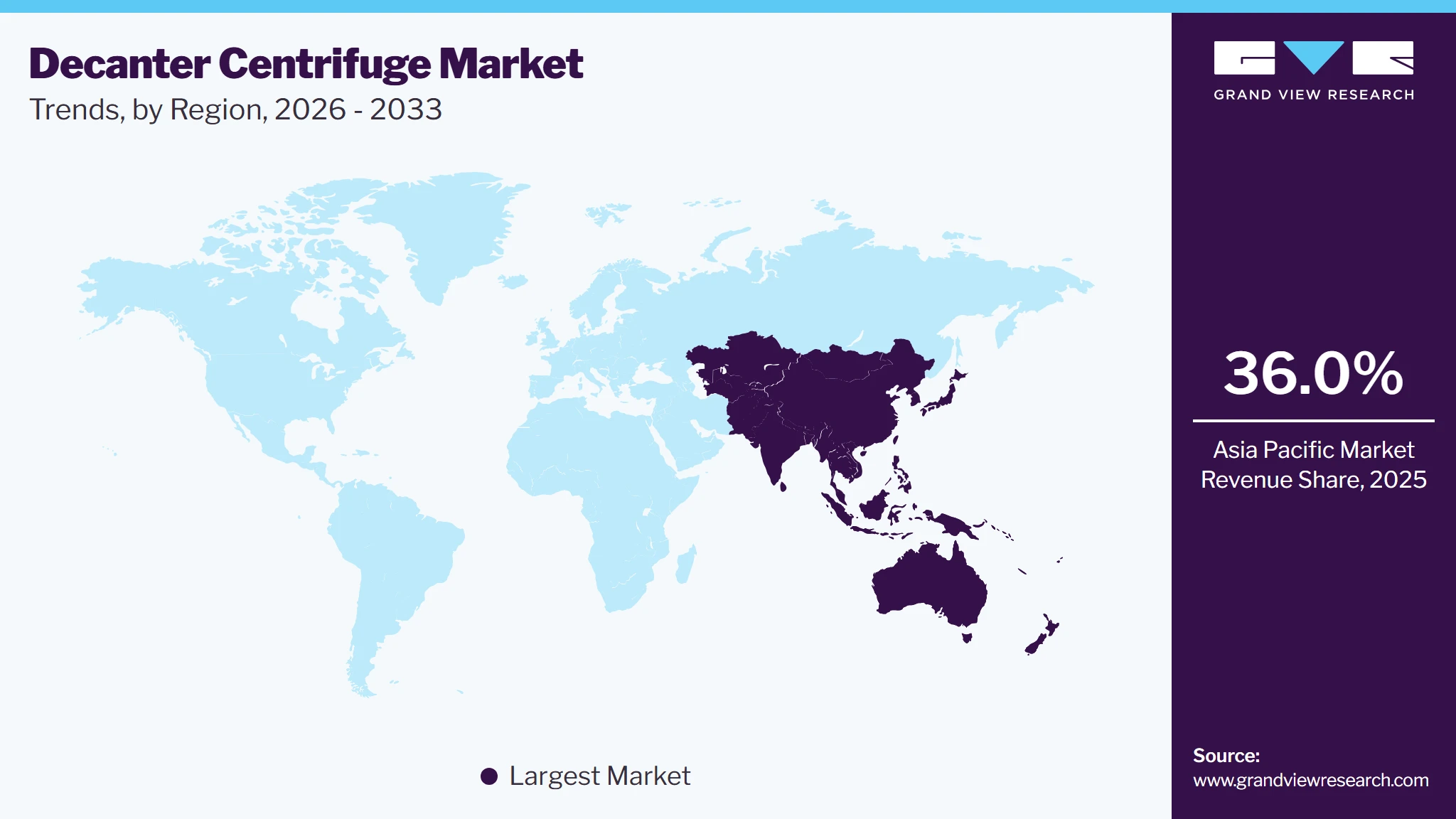
Asia Pacific dominated the decanter centrifuge market with the largest revenue share of 36.0% in 2025. Asia Pacific is expected to witness the fastest growth in the decanter centrifuge market, driven by rapid industrialization and growing demand for wastewater treatment solutions in countries such as China and India. The rising awareness of environmental protection and the implementation of stricter regulations on wastewater discharge are key factors contributing to the market's growth in this region.
 To learn more about this report, Download Free Sample Report
China Decanter Centrifuge Market Trends
The decanter centrifuge market in the China held the largest share in the Asia Pacific region in 2025. The country's rapid urbanization and industrialization are leading to increased demand for decanter centrifuge solutions, particularly in wastewater treatment and chemical industries.
Europe Decanter Centrifuge Market Trends
Europe is a well-established market for decanter centrifuges, particularly in industries such as food & beverage and pharmaceuticals. Strict environmental regulations and a strong focus on sustainability are key drivers for the market in countries such as Germany, France, and the UK. The region's commitment to reducing its environmental footprint has spurred the adoption of advanced decanter centrifuge technologies.
Key Decanter Centrifuge Company Insights
Some of the key players operating in the decanter centrifuge market include GEA Group Aktiengesellschaft, Flottweg SE, PIERALISI MAIP SPA, ALFA LAVAL, ANDRITZ, SLB, among others.
-
GEA Group Aktiengesellschaft is one of the leading players in the decanter centrifuge market, offering a wide range of separation technologies tailored to various industries. The company's innovative decanter centrifuge systems are designed to enhance efficiency and sustainability, making it a preferred choice in sectors like food & beverage and chemicals.
-
Flottweg SE is known for its high-performance decanter centrifuges, which are widely used in wastewater treatment and food & beverage industries. The company focuses on providing customized solutions that meet the specific needs of its clients, with a strong emphasis on operational efficiency and environmental protection.
-
PIERALISI MAIP SPA has a strong presence in the decanter centrifuge market, particularly in the oil & gas and petrochemical sectors. The company's advanced centrifuge systems are designed to handle complex separation processes, ensuring high efficiency and reliability in demanding applications.
-
ALFA LAVAL is a prominent player in the decanter centrifuge market, known for its innovative separation technologies. The company serves a wide range of industries, including pharmaceuticals, food & beverage, and wastewater treatment, providing advanced centrifuge systems that offer high performance and operational flexibility.
-
ANDRITZ is another key player in the market, offering decanter centrifuge systems that are highly efficient and reliable. The company's focus on sustainability and innovation has made it a leader in industries such as oil & gas and wastewater treatment, where efficient separation is critical for operational success.
Key Decanter Centrifuge Companies:
The following are the leading companies in the decanter centrifuge market.
- GEA Group Aktiengesellschaft
- Flottweg SE
- PIERALISI MAIP SPA
- ALFA LAVAL
- ANDRITZ
- SLB
- IHI Rotating Machinery Engineering Co., Ltd.
- Mitsubishi Kakoki Kaisha
- FLSmidth
- Elgin Separation Solutions
Competitive Benchmarking
Category
Operating Strategies
Competitive Edge
Weakness
Established Players (e.g. GEA Group Aktiengesellschaft; Flottweg SE; PIERALISI MAIP SPA; ALFA LAVAL; ANDRITZ; SLB; Mitsubishi Kakoki Kaisha; FLSmidth)
- Focused on expanding advanced solid-liquid separation and sludge dewatering solutions across wastewater treatment, oil & gas, mining, chemicals, and food processing industries.
- Invested heavily in automation technologies, energy-efficient centrifuge systems, wear-resistant materials, and digital monitoring platforms
- Strengthened global service networks, aftermarket support, and long-term industrial partnerships.
- Strong global brand recognition and extensive expertise in industrial separation technologies
- Advanced engineering capabilities for handling complex, high-volume industrial separation processes.
- Large installed customer base across municipal and industrial processing sectors.
- High equipment and maintenance costs compared to conventional separation technologies.
- Dependence on industrial capital expenditure and wastewater infrastructure investments.
- Complex installation, balancing, and operational maintenance requirements
- Exposure to fluctuations in industrial processing activity and commodity-driven sectors.
- Strong R&D capabilities supporting high separation efficiency and operational reliability.
Emerging & Regional Players (e.g IHI Rotating Machinery Engineering Co., Ltd.; Elgin Separation Solutions)
- Focused on specialized and application-specific centrifuge solutions for regional industrial markets.
- Increased emphasis on compact designs, operational flexibility, and customized sludge handling systems.
- Expanded offerings for oilfield services, wastewater treatment facilities, and industrial processing applications.
- Competitive flexibility and strong responsiveness to customer-specific separation requirements.
- Growing adoption in regional industrial and energy-related applications
- Ability to provide customized separation systems for niche processing environments.
- Comparatively lower global market penetration and brand visibility.
- Limited financial scale for large international expansion and advanced R&D investments
- Lower diversification compared to multinational separation equipment providers.
Recent Developments
-
In November 2023, ANDRITZ has expanded its lineup of three-phase decanter centrifuges to optimize oil recovery in the most demanding industrial environments. The ANDRITZ decanter centrifuge series includes machines certified for both ATEX Zone 1 and Zone 2, making them ideal for use in facilities where explosive atmospheres may arise during regular operations.
-
In August 2022, SPX FLOW, Inc. announced a new collaboration with Flottweg, a family-owned business specializing in separation technology. This partnership allows both companies to jointly design, supply, install, and commission comprehensive plant-based process solutions for customers in the nutrition, health, food, and beverage sectors.
Decanter Centrifuge Market Report Scope
Report Attribute
Details
Market size in 2025
USD 2.3 billion
Estimated market size in 2026
USD 2.4 billion
Projected market size by 2033
USD 3.3 billion
Growth rate
CAGR of 4.7% from 2026 to 2033
Base year for estimation
2025
Historical data
2021 - 2024
Forecast period
2026 - 2033
Quantitative units
Revenue in USD billion and CAGR from 2026 to 2033
Report coverage
Revenue forecast, company ranking, competitive landscape, growth factors, and trends
Segments covered
Type, design type, end use, region
Regional scope
North America; Europe; Asia Pacific; Latin America; Middle East & Africa
Country scope
U.S.; Canada; Mexico; Germany; France; Italy; UK; Spain; China; Japan; India; South Korea; Australia; Brazil; Argentina; South Africa; Saudi Arabia; UAE
Key companies profiled
GEA Group Aktiengesellschaft;Flottweg SE;PIERALISI MAIP SPA;ALFA LAVAL;ANDRITZ;SLB;IHI Rotating Machinery Engineering Co., Ltd.;Mitsubishi Kakoki Kaisha;FLSmidth;Elgin Separation Solutions
Customization scope
Free report customization (equivalent up to 8 analysts' working days) with purchase. Addition or alteration to country, regional & segment scope.
Pricing and purchase options
Avail customized purchase options to meet your exact research needs. Explore purchase options
Global Decanter Centrifuge Market Segmentation
This report forecasts revenue growth at global, regional & country levels and provides an analysis on the industry trends in each of the sub-segments from 2021 to 2033. For the purpose of this study, Grand View Research has segmented the decanter centrifuge market on the basis of type, end-use, design, and region:
 To learn more about this report, Download Free Sample Report
-
Type Outlook (Revenue, USD Million, 2021 - 2033)
-
Two Phase Centrifuge
-
Three Phase Centrifuge
-
-
Design Outlook (Revenue, USD Million, 2021 - 2033)
-
Horizontal
-
Vertical
-
-
End-use Outlook (Revenue, USD Million, 2021 - 2033)
-
Chemical
-
Oil & Gas
-
Petrochemical
-
Pharmaceutical
-
Wastewater treatment
-
Food & beverage
-
Others
-
-
Regional Outlook (Revenue, USD Million, 2021 - 2033)
-
North America
-
U.S.
-
Canada
-
Mexico
-
-
Europe
-
UK
-
Germany
-
France
-
Italy
-
Spain
-
-
Asia Pacific
-
Japan
-
China
-
India
-
Australia
-
South Korea
-
-
Latin America
-
Brazil
-
Argentina
-
-
Middle East & Africa
-
South Africa
-
Saudi Arabia
-
UAE
-
-
Research Methodology
The decanter centrifuge market figures in this report are based on a proven research process that combines executive interviews with secondary research from proprietary databases, company filings, and recognized regulatory and institutional sources. Market size is built through value-chain sizing - reconciling supply-side and demand-side estimates - and triangulated with bottom-up and top-down approaches. Every estimate passes multiple levels of expert validation before publication, with each cecanter centrifuge segment quantified using the revenue-capture definitions in the table below.
Segment Definition
Segment -Type
Revenue Capture Definition
Two Phase Centrifuge
Revenue generated from sales of two-phase decanter centrifuges used for separating solids from liquids across industrial processing applications.
Three Phase Centrifuge
Revenue generated from sales of three-phase decanter centrifuges designed to separate solids and two immiscible liquid phases simultaneously.
Segment - Design
Revenue Capture Definition
Horizontal
Revenue generated from sales of horizontal decanter centrifuges used for continuous, high-capacity solid-liquid separation in industrial processing operations.
Vertical
Revenue generated from sales of vertical decanter centrifuges used in specialized applications requiring compact installation and efficient separation performance.
Segment - End Use
Revenue Capture Definition
Chemical
Revenue generated from decanter centrifuge sales for chemical manufacturing, catalyst recovery, slurry processing, and solid-liquid separation applications.
Oil & Gas
Revenue generated from decanter centrifuge sales for drilling fluid recovery, produced water treatment, sludge dewatering, and oil separation operations.
Petrochemical
Revenue generated from decanter centrifuge sales for petrochemical processing, hydrocarbon separation, catalyst recovery, and wastewater treatment applications.
Pharmaceutical
Revenue generated from decanter centrifuge sales for pharmaceutical manufacturing, bioprocessing, fermentation, product purification, and solid-liquid separation processes.
Wastewater treatment
Revenue generated from decanter centrifuge sales for municipal and industrial wastewater treatment, sludge dewatering, and biosolid management applications.
Food & beverage
Revenue generated from decanter centrifuge sales for food and beverage processing, including edible oils, dairy, beverages, starch, and juice production.
Others
Revenue generated from decanter centrifuge sales across mining, pulp and paper, marine, biotechnology, agriculture, and other industrial applications.
Estimation Model
Layer Name
Key Question
Description
Industrial Processing and Separation Demand Layer
Which sectors generate demand for decanter centrifuges?
The estimation begins by evaluating demand across wastewater treatment, chemical processing, oil & gas, petrochemical, food & beverage, pharmaceutical, mining, pulp & paper, and other process industries. Market demand is influenced by industrial production, wastewater generation, sludge management requirements, environmental compliance, and the increasing need for continuous solid-liquid separation technologies.
Product Type and Design Layer
Which product types drive market demand?
This layer refines demand by assessing the adoption of two-phase and three-phase decanter centrifuges in horizontal and vertical configurations. Separation efficiency, processing capacity, energy consumption, automation capabilities, material compatibility, maintenance requirements, and operational reliability influence product adoption across industrial applications.
End-user Adoption Layer
What determines decanter centrifuge demand?
Market demand is estimated by evaluating decanter centrifuge deployment across chemical, oil & gas, petrochemical, pharmaceutical, wastewater treatment, food & beverage, and other industries. Industrial expansion, wastewater treatment capacity additions, production efficiency improvements, environmental regulations, equipment replacement cycles, and investments in process automation determine product adoption.
Revenue Layer
How is total market revenue calculated?
Revenue is estimated by aggregating sales of decanter centrifuges across product types, designs, end-use industries, and regional markets. Equipment pricing, industrial production, wastewater treatment investments, replacement demand, capital expenditure, distributor sales, manufacturer revenues, and regional processing capacity are incorporated to validate the overall market size.
Delivered Customizations
This report has been delivered with the following In-depth customizations
Client Request
Customization Delivered
Value Adds
Regional Segmentation
Delivered detailed market sizing, forecast analysis, and demand assessment for the Decanter Centrifuge Market across North America, Europe, Asia Pacific, Latin America, and the Middle East & Africa. Country-level analysis was further conducted across wastewater treatment, oil & gas, chemicals, mining, food & beverage, and pharmaceutical industries.
Helped identify high-growth industrial processing markets and future investment opportunities for solid-liquid separation technologies.
Opportunity Assessment
Identified and analyzed emerging growth opportunities driven by increasing wastewater treatment investments, stricter environmental regulations, rising industrial automation, expansion of mining activities, and growing demand for efficient sludge management systems.
Helped stakeholders prioritize high-growth investment opportunities and future expansion areas.
Competitive benchmarking
Delivered comprehensive market share analysis for leading decanter centrifuge manufacturers, covering revenue contribution, technological leadership, regional presence, and competitive intensity within the market.
Assisted in evaluating market concentration and competitive dynamics.
Frequently Asked Questions About This Report
The global decanter centrifuge market size was valued at USD 2.3 billion in 2025 and is estimated at USD 2.4 billion for 2026.
Asia Pacific dominated with a 36% revenue share in 2025.
Some of the key players operating in the decanter centrifuge market include GEA Group Aktiengesellschaft, Flottweg SE, PIERALISI MAIP SPA, ALFA LAVAL, ANDRITZ, SLB, IHI Rotating Machinery Engineering Co., Ltd., Mitsubishi Kakoki Kaisha, FLSmidth, Elgin Separation Solutions.
The decanter centrifuge market is fueled by growing use of centrifuges in oil & gas operations, expansion of applications in the food & beverage sector, technological advancements in centrifuge systems, and rising adoption in chemical and pharmaceutical industries.
The global decanter centrifuge market is expected to grow at a CAGR of 4.7% from 2026 to 2033, reaching USD 3.3 billion by 2033.
Based on type, the three phase centrifuge segment led the market with the largest revenue share of 54.5% in 2025.
Based on design, the horizontal segment led the market with the largest revenue share of 69.4% in 2025.
Based on end use, the oil & gas segment led the market with the largest revenue share of 25.3% in 2025.
The decanter centrifuge market in the China held the largest share in the Asia Pacific region in 2025.
About the Author(s)
Advanced Interior Materials Research Team
Advanced Materials · Advanced Interior MaterialsThis report was authored by the advanced interior materials research team at Grand View Research - comprising two research analysts, one senior research analyst, and one industry expert - with specialized expertise in the advanced interior materials segment of the advanced materials industry. All findings are based on proprietary advanced materials databases, executive interviews, and regulatory analysis, subject to internal peer review prior to publication.
Last Updated:
Speak to Analyst

Customize this report to your needs - add regions, segments, or data points, with 20% free customization.
Or view our licence options:


ISO 9001:2015 & 27001:2022 Certified
We are GDPR and CCPA compliant! Your transaction & personal information is safe and secure. For more details, please read our privacy policy.


