
- Home
- »
- Advanced Interior Materials
- »
-
Defense HVAC Systems Market Size Report, 2026-2033GVR Report cover

Defense HVAC Systems Market (2026 - 2033)
Size, Share & Trends Analysis Report By Equipment (Air Handling Units, Chillers, Dehumidification Systems), By Type (Vehicle HVAC, Facility HVAC Systems), By End User, By Application, By Region And Segment Forecasts
Market Size, 2025
$747.6MMarket Estimate, 2026
$765.3MMarket Forecast, 2033
$1,064.3MCAGR, 2026–2033
4.8%Defense HVAC Systems Market Summary
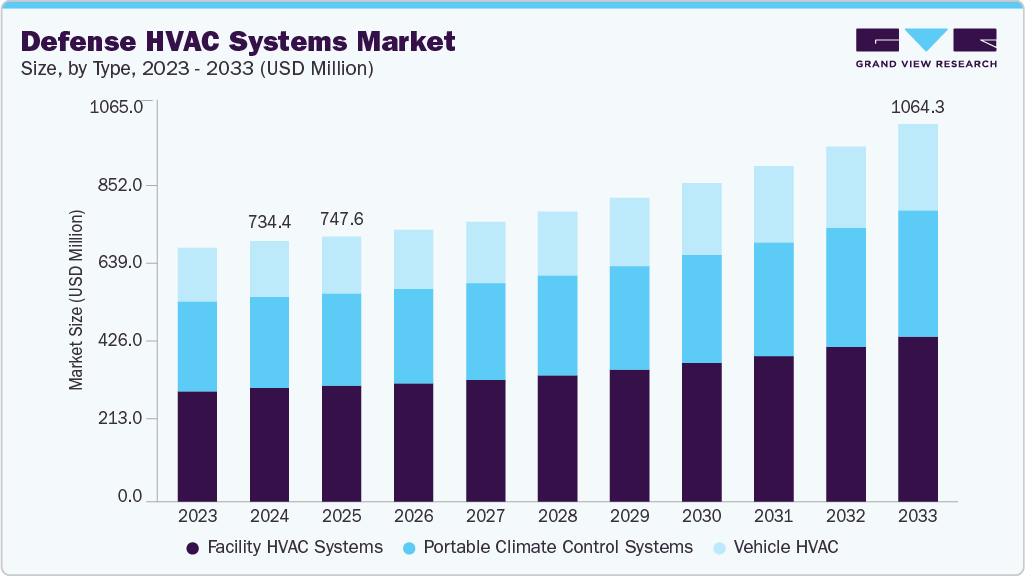
The global defense HVAC systems market size was valued at USD 747.6 million in 2025 and is projected to grow from USD 765.3 million in 2026 to USD 1,064.3 million by 2033, at a CAGR of 4.8% from 2026 to 2033. The market in North America dominated with a revenue share of 42.5% in 2025. The global defense HVAC systems market is driven by the increasing need for climate control in extreme and diverse operational environments.
 Source: Grand View Research, IR Documents, Primary Interviews, Paid DatabasesTo learn more about this report,
 Download Free Sample Report
 Key Market Trends & Insights
- By type: Facility HVAC systems segment held the largest market share of 43.5% in 2025.
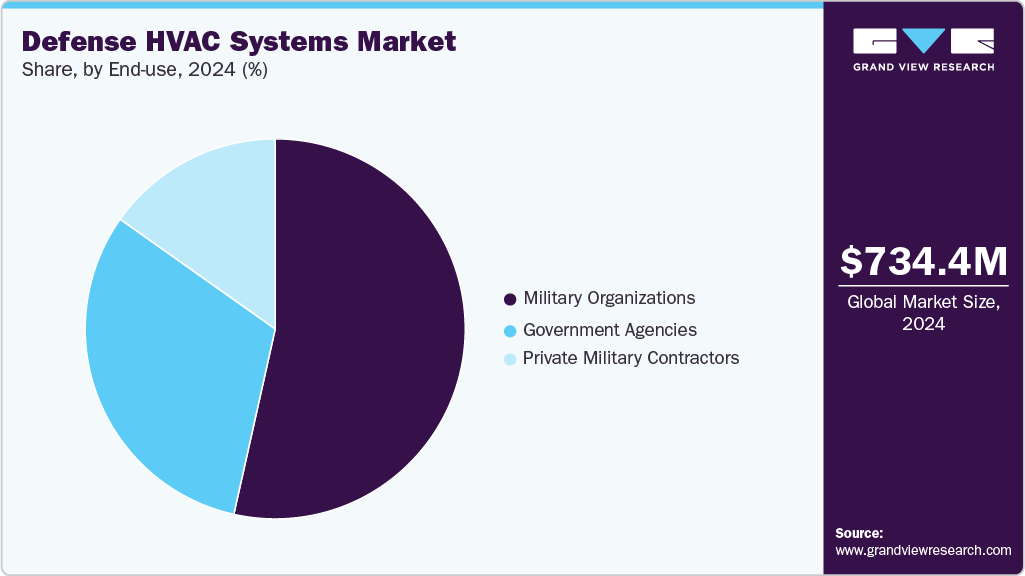
- By end user: Military organizations segment held the largest market share of 53.6% in 2025.
- By equipment: Heat pumps segment held the largest market share of 44.6% in 2025.
- By application: Military bases segment held the largest market share of 44.7% in 2025.
Regional Highlights
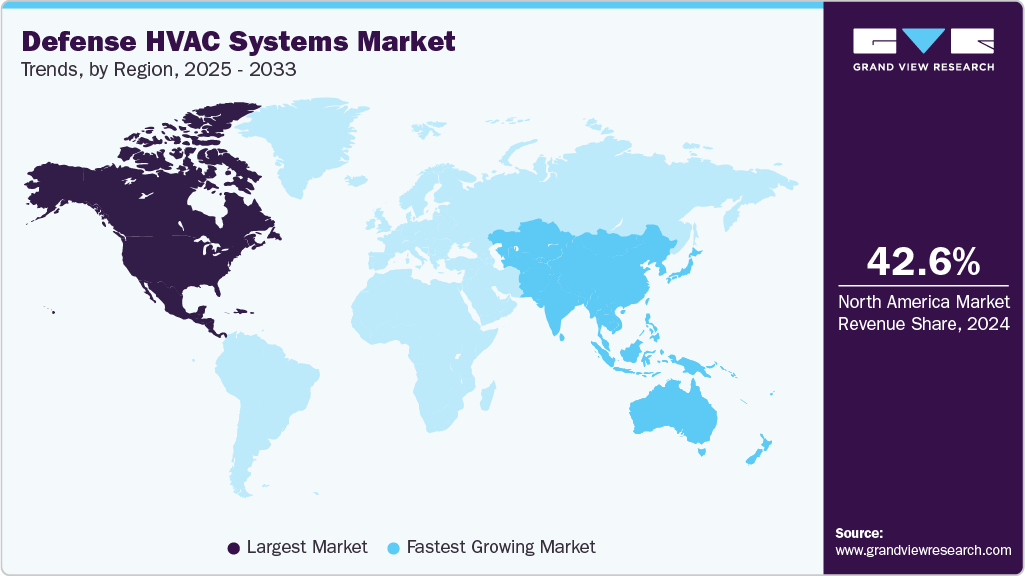
- Largest regional market: North America (42.5% revenue share, 2025)
- Fastest-growing regional market: Asia Pacific (highest CAGR, 2026-2033)
- By country: U.S. held the largest market share in 2025
Market Size & Forecast
- Market size in 2025: USD 747.6 Million
- Estimated market size in 2026: USD 765.3 Million
- Projected market size by 2033: USD 1,064.3 Million
- CAGR (2026-2033): 4.8%
Three ways to get this report
Buy it, customize it, or ask a question.Ask an Analyst
Analyst response in 1 business day
- AccessReport author, directly
- Reply timeWithin 1 working day
- No sales callDirect answer only
- FormatEmail reply
- CostFree, no cost
Get the Full Report
What the study covers
- FormatsPDF · Excel · Dashboard
- Timeline2026–2033 annual, 2025 base
- Coverage20+ countries, 5 regions
- Companies10+ key players profiled
Customize the Report
20% free customization
- IncludeCountries, segments, points
- TailorTo your product definition
- ExtendDeeper competitor detail
- OrA fully bespoke study
- Turnaround5–10 working days
 To learn more about this report, Download Free Sample Report
Defense forces require reliable heating, ventilation, and cooling systems to maintain the efficiency and safety of personnel and sensitive equipment. Another key driver is the rising investment in defense infrastructure such as bases, command centers, and mobile units, which require integrated and energy-efficient HVAC systems. The growing use of specialized military vehicles and aircraft also necessitates compact and rugged HVAC units. Moreover, stricter regulatory standards on environmental performance and energy use are pushing innovation in eco-friendly HVAC solutions. These factors collectively support sustained growth in the defense HVAC systems market. To learn more about this report, Download Free Sample Report
 Market Concentration & Characteristics
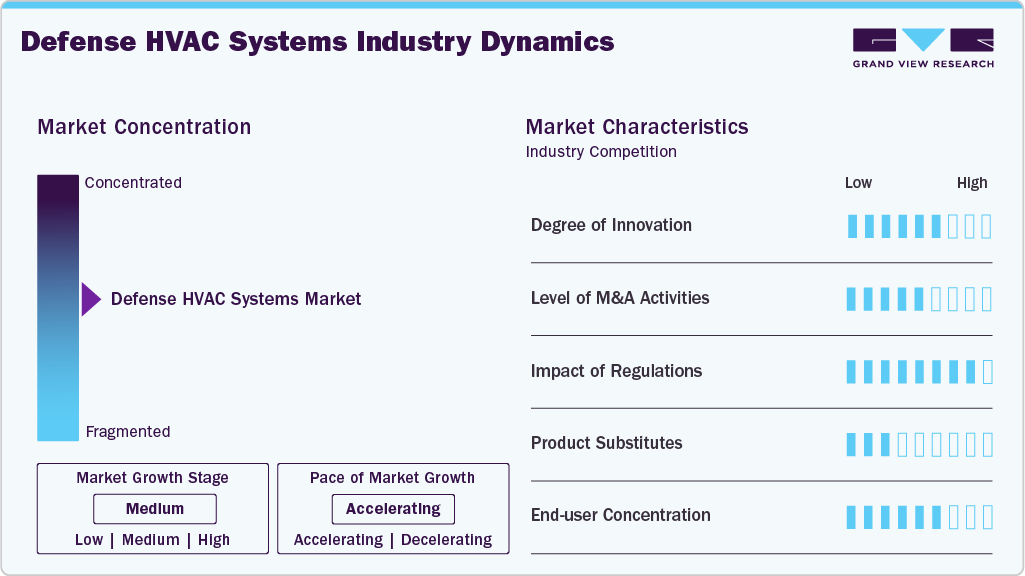
The global defense HVAC systems market is concentrated, with a few key players holding significant market share due to high entry barriers and specialized technical requirements. Leading companies often benefit from long-term government contracts and established defense relationships. Smaller firms face challenges entering the market due to strict compliance, certification needs, and capital-intensive R&D. As a result, competition is primarily among a limited number of well-established defense contractors and HVAC manufacturers.
The defense HVAC systems market exhibits a moderate to high degree of innovation, with advancements focused on improving energy efficiency, system miniaturization, and operational reliability in harsh conditions. Manufacturers are integrating smart controls and environmentally friendly refrigerants to meet evolving defense needs. Innovation is also driven by the demand for modular and lightweight systems in mobile defense platforms. Continuous R&D investments support the development of next-generation HVAC technologies tailored for military use.
 To learn more about this report, Download Free Sample Report
 The market sees a steady level of mergers and acquisitions, primarily driven by the need for technological enhancement and market expansion. Major defense contractors often acquire HVAC specialists to strengthen their system integration capabilities. Strategic partnerships and acquisitions help companies broaden their defense offerings and enter new geographic markets. This trend also supports quicker adaptation to changing defense procurement needs.
Regulations significantly impact the defense HVAC market, especially those concerning environmental safety, energy efficiency, and military standards. Compliance with defense-specific certifications and international norms is mandatory for suppliers. Governments also enforce policies related to emissions and the use of low-GWP refrigerants. These regulatory requirements influence product design, material selection, and production processes across the industry.
Drivers, Opportunities & Restraints
The increasing demand for advanced HVAC systems in military vehicles, bases, and portable shelters is a key growth driver. Rising defense budgets and modernization initiatives are driving the adoption of efficient climate-control technologies. Extreme weather conditions in deployment zones further necessitate reliable HVAC solutions. Additionally, technological advancements in compact and rugged systems enhance operational readiness.
Growing investments in unmanned systems and mobile command units present new opportunities for HVAC integration. The shift toward green and energy-efficient defense infrastructure creates demand for sustainable HVAC solutions. Emerging markets are expanding their defense capabilities, opening avenues for new installations. Additionally, innovations in smart and remote-controlled HVAC systems offer potential for future growth.
High development and installation costs of specialized HVAC systems can limit market adoption. Stringent defense regulations and certification processes increase time-to-market and operational complexity. Dependence on government contracts makes revenue streams vulnerable to policy and budget changes. Moreover, logistical challenges in integrating HVAC units into compact, mobile platforms impose design limitations.
Type Insights
The facility HVAC systems segment dominated the market, accounting for 43.5% in 2025, due to their widespread use on military bases, training centers, and command posts. These systems ensure optimal indoor air quality and climate control for personnel and equipment. Their large-scale deployment and longer operational life contribute to a higher market share. Additionally, rising investments in upgrading defense infrastructure support continued demand.
Vehicle HVAC systems are the fastest growing segment, driven by increasing use of armored vehicles, tanks, and mobile units in diverse climates. These systems are essential for maintaining comfort and functionality in enclosed military vehicles. The need for compact, durable, and energy-efficient solutions fuels innovation in this segment. Growth is further supported by the rising procurement of tactical and combat vehicles worldwide.
End User Insights
The military organizations segment dominated the market and accounted for a share of 53.6% in 2025, owing to their large-scale operations and extensive infrastructure. They require reliable HVAC solutions for bases, field hospitals, and vehicles to ensure operational efficiency. Continuous modernization and global deployments further drive demand in this segment. Long-term defense budgets and procurement programs reinforce their leading position.
 To learn more about this report, Download Free Sample Report
 Government agencies are witnessing significant growth in HVAC adoption, particularly for border control, disaster response, and emergency services. These agencies increasingly invest in mobile command centers and field units that require efficient climate control. The focus on national security and civil defense boosts their HVAC system needs. Additionally, climate resilience initiatives support further expansion in this segment.
Equipment Insights
The heat pumps segment accounted for a share of 44.6% in 2025. Heat pumps dominate the defense HVAC systems market due to their dual heating and cooling capabilities, offering energy-efficient solutions for military facilities. Their versatility and low environmental impact make them ideal for long-term installations. Defense sectors favor heat pumps for their reduced operational costs and maintenance needs. Growing emphasis on sustainability further drives their widespread adoption.
Chillers are the fastest growing equipment segment, driven by rising demand for precision cooling in critical military environments. These systems are essential for maintaining optimal conditions in data centers, radar stations, and communication hubs. Technological advancements have improved their efficiency and portability for field applications. The need for high-capacity cooling in advanced defense systems accelerates their deployment.
Application Insights
The military bases segment accounted for 44.7% of the market in 2025 due to their extensive infrastructure and ongoing operational requirements. These facilities need robust HVAC systems to ensure personnel comfort, equipment safety, and mission readiness. The continuous upgrade of base facilities across countries supports strong demand. Additionally, their size and fixed location make them ideal for large-scale HVAC installations.
Command centers are the fastest growing application segment, driven by the increasing reliance on advanced technology and data systems. These centers require precise climate control to ensure the performance of sensitive electronics and communication equipment. Growing investments in mobile and fixed command-and-control infrastructure are boosting HVAC needs. The demand for uninterrupted operations in secure environments accelerates adoption.
Regional Insights
North America dominates the global defense HVAC systems market and accounted for 42.5% share, due to its high defense spending and advanced military infrastructure. The U.S. Department of Defense consistently invests in modernizing HVAC systems across bases, vehicles, and mobile units. Established defense contractors and technological leadership further support market growth. Additionally, extreme weather zones across the region necessitate reliable climate control solutions.
 To learn more about this report, Download Free Sample Report
 U.S. Defense HVAC Systems Market Trends
The U.S. leads the North American defense HVAC systems market, due to its large-scale military operations and substantial defense budget. Ongoing modernization of military bases and mobile units drives continuous demand for advanced HVAC solutions. The country’s focus on energy-efficient and smart climate control systems supports innovation. Additionally, extreme weather zones across the U.S. necessitate robust and reliable HVAC installations.
The Canada defense HVAC systems market is witnessing steady growth in demand, driven by increased investments in Arctic and cold-weather military infrastructure. The government is upgrading bases and mobile units to improve operational efficiency in harsh climates. Emphasis on sustainable and low-emission HVAC systems aligns with national environmental goals.
Europe Defense HVAC Systems Market Trends
Europe is experiencing rapid growth in the defense HVAC market, driven by increased military collaboration and rising defense budgets. NATO members are enhancing operational readiness through infrastructure upgrades and the deployment of advanced HVAC systems. The region also focuses on energy-efficient and eco-friendly HVAC technologies in line with EU regulations. Growing security concerns and geopolitical tensions accelerate modernization efforts.
The Germany defense HVAC systems market dominated the European market due to its increasing defense budget and infrastructure upgrades. The country is modernizing military bases and enhancing climate control systems in armored vehicles and command centers. Emphasis on energy efficiency and compliance with EU environmental standards drives adoption of advanced HVAC technologies. Germany’s role in NATO operations also contributes to sustained demand.
The UK defense HVAC systems market is the fastest-growing market in Europe, driven by the modernization of naval bases, airfields, and mobile military units. Investments in smart and portable HVAC systems for rapid deployment in overseas operations are rising. The UK government prioritizes energy-efficient and eco-friendly solutions in line with climate policies. Additionally, heightened focus on homeland security and global military presence drives system integration.
Asia Pacific defense HVAC systems Market Trends
Asia Pacific is the fastest-growing region at CAGR of 5.8%, due to rapid industrialization, urbanization, and infrastructure development in countries like China and India. A strong automotive base and expanding shipbuilding industry contribute to high equipment demand. Government initiatives supporting manufacturing and skill development also aid market expansion. Low labor costs and rising foreign investments further boost regional growth.
The China defense HVAC systems market dominates the Asia Pacific market due to large-scale military expansion and infrastructure development. The country is heavily investing in upgrading bases, naval fleets, and mobile units with advanced climate control systems. Harsh regional climates and diverse terrains increase the need for reliable and adaptive HVAC solutions. Additionally, domestic manufacturing capabilities and defense R&D support technological advancements.
The India defense HVAC systems market is experiencing steady growth in driven by rising defense spending and border infrastructure enhancement. The government’s focus on modernizing military facilities and armored vehicle fleets boosts HVAC system demand. Climatic extremes across deployment zones necessitate efficient and durable systems. The “Make in India” initiative further encourages domestic production and integration of advanced HVAC technologies.
Middle East & Africa Defense HVAC Systems Market Trends
The Middle East and Africa region is witnessing steady growth, primarily driven by oil & gas, construction, and energy sectors. Countries like the UAE and Saudi Arabia are investing in industrial infrastructure and renewable energy projects. However, limited manufacturing capabilities constrain widespread adoption. Growth is expected as diversification efforts and industrial investments increase.
The Saudi Arabia defense HVAC systems market is expanding rapidly due to ongoing military infrastructure development. The country’s extremely high temperatures create a strong need for efficient and durable cooling systems across bases and mobile units. Growing emphasis on energy-efficient and environmentally friendly technologies supports the adoption of advanced HVAC solutions. Additionally, increased local defense manufacturing and partnerships are driving domestic demand for integrated HVAC systems.
Latin America Defense HVAC Systems Market Trends
Latin America is an emerging market, with Brazil and Mexico leading in industrial growth and automotive production. The demand for welding equipment is rising due to infrastructure projects and regional manufacturing expansion. However, market development is somewhat limited by economic volatility. Increasing foreign investment and industrialization present future opportunities.
The Brazil defense HVAC systems market is experiencing steady growth, driven by modernization of military bases and infrastructure across the country. Rising investments in command facilities, border security, and defense data centers are increasing the need for advanced climate control systems. The country’s diverse climate conditions from hot, humid zones to cooler regions demand adaptable and reliable HVAC solutions. Additionally, national efforts to promote energy efficiency and local manufacturing support the adoption of sustainable HVAC technologies in defense applications.
Key Defence HVAC Systems Company Insights
Some of the key players operating in the market include Meggitt., DAIKIN INDUSTRIES Ltd., Trans ACNR.
-
Daikin Industries Ltd. is recognized for its specialized HVAC systems engineered for high-performance and mission-critical environments, including defense infrastructure. The company offers customized climate control solutions suited for extreme temperatures and rugged conditions found in military applications. Its product range includes energy-efficient heat pumps, VRF systems, and air purification technologies tailored to sensitive installations. Daikin’s R&D focuses on integrating low-GWP refrigerants and smart control technologies into HVAC equipment for secure and reliable operation. Their systems are also compatible with modular structures and mobile facilities used in defense deployments.
-
Trans ACNR specializes in delivering HVAC and refrigeration systems for high-demand sectors, with a strong focus on precision climate control in defense and critical infrastructure. The company is known for its expertise in retrofitting and customizing solutions for armored vehicles, mobile units, and data-intensive command centers. It integrates advanced filtration, insulation, and vibration-resilient components into its units, making them ideal for rugged military environments. Trans ACNR also supports turnkey project execution, including design, installation, and long-term service support. Their solutions are engineered for operational efficiency, thermal stability, and minimal maintenance in field conditions.
Key Defense HVAC Systems Companies:
The following key companies have been profiled for this study on the defense HVAC systems market
- Meggitt
- DAIKIN INDUSTRIES Ltd.
- Trans ACNR.
- Eberspächer
- Echoblue Ltd.
- Advanced Cooling Technologies, Inc.
- Grayson
- DC Airco
- ECU Corporation
- Trane
- Munters
- TAT Technologies
- Honeywell International Inc.
- BAE Systems
- Collins Aerospace
Recent Developments
-
In December 2025, Daikin Applied announced a USD 163 million investment to establish a new research and development test laboratory at its headquarters in Plymouth, Minnesota. The facility will support testing and development of commercial HVAC technologies, including chillers, air handlers, heat pumps, and cooling systems designed for large data centers and industrial applications.
-
In July 2025, ECU Corporation introduced a specialized line of HVAC systems built for highly demanding environments like defense installations and nuclear sites. These systems meet strict military and industrial standards, offering resistance to shock, radiation, and electromagnetic interference. Designed for reliability in critical conditions, they are suited for use in radar stations and containment facilities. The company focuses on custom solutions that prioritize durability, safety, and operational precision.
-
In January 2025, The U.S. Department of Defense has invested $90 million to secure a reserve of hydrofluorocarbons (HFCs) essential for military cooling and fire suppression systems. This investment supports operational readiness amid global restrictions on HFC production and usage. The Defense Logistics Agency will manage storage and facility upgrades to safeguard the supply. This initiative ensures continuous climate control capabilities across military operations worldwide.
Defense HVAC Systems Market Report Scope
Report Attribute
Details
Market size in 2025
USD 747.6 million
Estimated market size in 2026
USD 765.3 million
Projected market size by 2033
USD 1,064.3 million
Growth Rate
CAGR of 4.8% from 2026 to 2033
Historical data
2021 - 2024
Forecast period
2026 - 2033
Quantitative units
Revenue in USD million and CAGR from 2026 to 2033
Report coverage
Revenue forecast, company ranking, competitive landscape, growth factors, and trends
Segments covered
Type, end user, equipment, application, region.
Regional scope
North America; Europe; Asia Pacific; Latin America; Middle East & Africa
Country scope
U.S.; Canada; Mexico; UK; Germany; France; Spain; Italy; China; Japan; India; Australia; South Korea; Brazil; Argentina; Saudi Arabia; South Africa; UAE
Key companies profiled
Meggitt.; DAIKIN INDUSTRIES Ltd.; Trans ACNR.; Eberspächer; Echoblue Ltd.; Advanced Cooling Technologies, Inc.; Grayson; DC Airco; ECU Corporation; Trane; Munters; TAT Technologies; Honeywell International Inc.; BAE Systems; Collins Aerospace
Customization scope
Free report customization (equivalent up to 8 analysts working days) with purchase. Addition or alteration to country, regional & segment scope.
Pricing and purchase options
Avail customized purchase options to meet your exact research needs. Explore purchase options
Global Defense HVAC Systems Market Report Segmentation
This report forecasts revenue growth at global, regional, and country levels and provides an analysis of the latest industry trends in each of the sub-segments from 2021 to 2033. For this study, Grand View Research has segmented the global defense HVAC systems market report based on type, end user, equipment, application and region.
-
Type Outlook (Revenue, USD Million, 2021 - 2033)
-
Portable Climate Control Systems
-
Vehicle HVAC
-
Facility HVAC Systems
-
-
End User Outlook (Revenue, USD Million, 2021 - 2033)
-
Military Organizations
-
Government Agencies
-
Private Military Contractors
-
-
Equipment Outlook (Revenue, USD Million, 2021 - 2033)
-
Air Handling Units
-
Chillers
-
Dehumidification Systems
-
Air Filtration Systems
-
Air Conditioning Systems
-
Heat Pump
-
Others
-
-
Application Outlook (Revenue, USD Million, 2021 - 2033)
-
Military Bases
-
Vehicles
-
Field Operations
-
Command Centers
-
-
Regional Outlook (Revenue, USD Million, 2021 - 2033)
-
North America
-
U.S.
-
Canada
-
Mexico
-
-
Europe
-
Germany
-
France
-
Italy
-
Spain
-
UK
-
-
Asia Pacific
-
China
-
India
-
Japan
-
South Korea
-
Australia
-
-
Latin America
-
Brazil
-
Argentina
-
-
Middle East and Africa
-
Saudi Arabia
-
UAE
-
South Africa
-
-
Frequently Asked Questions About This Report
North America dominated with a 42.5% revenue share in 2025.
Asia Pacific is the fastest-growing region over the forecast period.
The facility HVAC systems segment led with a 43.5% revenue share in 2025, while the vehicle HVAC systems segment is the fastest-growing.
The heat pumps segment led with a 44.6% revenue share in 2025, while the chillers segment is the fastest-growing.
The global defense HVAC systems market size was estimated at USD 747.6 million in 2025 and is expected to be USD 765.3 million in 2026
The global defense HVAC systems market, in terms of revenue, is expected to grow at a compound annual growth rate of 4.8% from 2026 to 2033 to reach USD 1,064.3 million by 2033
The military organizations segment dominated the market and accounted for a share of 53.6% in 2025 owing to their large-scale operations and extensive infrastructure. They require reliable HVAC solutions for bases, field hospitals, and vehicles to ensure operational efficiency. Continuous modernization and global deployments further drive demand in this segment
Some of the key players operating in the global defense HVAC systems market include Meggitt.; DAIKIN INDUSTRIES Ltd.; Trans ACNR.; Eberspächer; Echoblue Ltd.; Advanced Cooling Technologies, Inc.; Grayson; DC Airco; ECU Corporation; Trane; Munters; TAT Technologies; Honeywell International Inc.; BAE Systems; Collins Aerospace
Key factors driving the global defense HVAC systems market include rising military modernization efforts and the need for reliable climate control in extreme environments. Increasing deployment of mobile units and advanced military vehicles further boosts demand for compact and energy-efficient systems
About the Author(s)
Advanced Interior Materials Research Team
Advanced Materials · Advanced Interior MaterialsThis report was authored by the advanced interior materials research team at Grand View Research - comprising two research analysts, one senior research analyst, and one industry expert - with specialized expertise in the advanced interior materials segment of the advanced materials industry. All findings are based on proprietary advanced materials databases, executive interviews, and regulatory analysis, subject to internal peer review prior to publication.
Last Updated:
Speak to Analyst

Customize this report to your needs - add regions, segments, or data points, with 20% free customization.
Or view our licence options:


ISO 9001:2015 & 27001:2022 Certified
We are GDPR and CCPA compliant! Your transaction & personal information is safe and secure. For more details, please read our privacy policy.


