
- Home
- »
- Next Generation Technologies
- »
-
Demand Planning Solutions Market Size, Growth Report, 2026-2033GVR Report cover

Demand Planning Solutions Market (2026 - 2033)
Size, Share & Trends Analysis Report By Component (Solutions, Services), By Deployment, By Enterprise Size (Large Enterprises, Small & Medium Enterprises), By Industry (BFSI, IT & Telecom), By Region, And Segment Forecasts
Market Size, 2025
$5.3BMarket Estimate, 2026
$5.8BMarket Forecast, 2033
$11.7BCAGR, 2026–2033
10.4%Demand Planning Solutions Market Summary
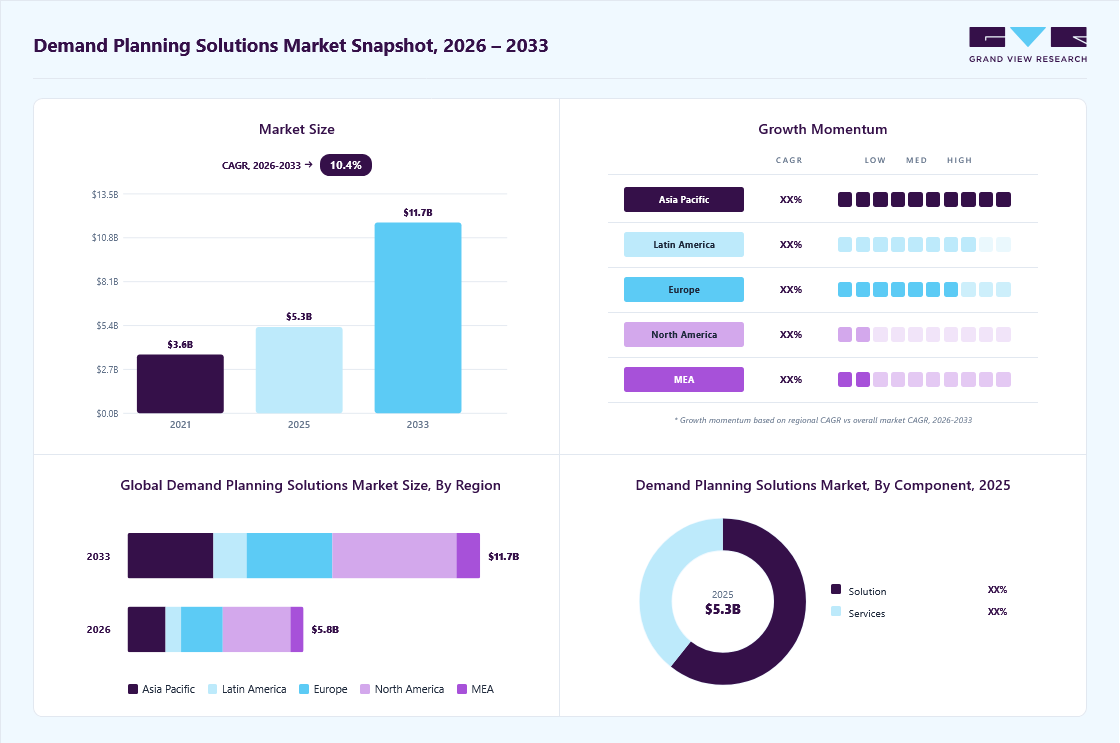
The global demand planning solutions market size was estimated at USD 5.3 billion in 2025 and is projected to grow from USD 5.8 billion in 2026 to USD 11.7 billion by 2033, growing at a CAGR of 10.4% from 2026 to 2033. North America dominated the global market with the largest revenue share of 38.9% in 2025. Demand forecasting is a part of the supply chain management process that enables a business to customize its production, whether goods or services, by analyzing customer demands.
 Source: Grand View Research, IR Documents, Primary Interviews, Paid DatabasesTo learn more about this report,
 Download Free Sample Report
 Key Market Trends & Insights
- By component: Solution segment dominated the market, with a revenue share of 60.6% in 2025.
- By deployment: On-premises segment held the largest market share of 50.3% in 2025.
- By enterprise size: SMEs segment held the largest revenue share in 2025.
- By industry: BFSI segment accounted for the largest revenue share in 2025.
Regional Highlights
- Largest regional market: North America (38.9% revenue share, 2025)
- Fastest-growing regional market: Asia Pacific (highest CAGR, 2026-2033)
- By country: The U.S. held the largest market share in 2025.
Market Size & Forecast
- Market size in 2025: USD 5.3 Billion
- Estimated market size in 2026: USD 5.8 Billion
- Projected market size by 2033: USD 11.7 Billion
- CAGR (2026-2033): 10.4%
Three ways to get this report
Buy it, customize it, or ask a question.Ask an Analyst
Analyst response in 1 business day
- AccessReport author, directly
- Reply timeWithin 1 working day
- No sales callDirect answer only
- FormatEmail reply
- CostFree, no cost
Get the Full Report
What the study covers
- FormatsPDF · Excel · Dashboard
- Timeline2026–2033 annual, 2025 base
- Coverage20+ countries, 5 regions
- Companies10+ key players profiled
Customize the Report
20% free customization
- IncludeCountries, segments, points
- TailorTo your product definition
- ExtendDeeper competitor detail
- OrA fully bespoke study
- Turnaround5–10 working days
Growing awareness about the benefits offered by these solutions, including improved customer experience, lowered inventory costs, excess storage costs, and increased efficiency in overall production, is the factor driving the market growth. Also, adopting advanced planning and analytics Solutions and tools among various industries like healthcare, retail, and IT & telecom is anticipated to boost the market growth during the forecast period. Further, the industries mentioned above are adopting solutions to recover from the COVID-19 impact.Companies are also adopting enterprise analytics platforms to enhance the performance of the supply chain management process. Demand planning solutions help to understand the changing market demands and distribution network issues by analyzing historical data and production capabilities. Furthermore, these solutions offer forecasting by using statistical and mathematical functions, clustering algorithms, ML (Machine Learning) technology, and automated data forecasting techniques. Further, it helps improve customer planning by employing predictive analytics to identify future trends and the resources needed for production planning and achieving revenue targets. For instance, Demand Management Systems (DMS) announced to upgrade to the recent version of the Logility digital supply chain platform used by the client, PharmaCare Laboratories.
 To learn more about this report, Download Free Sample Report
 However, businesses using demand planning tools deal with security and privacy concerns. Companies hold sensitive information that must be protected to prevent theft and data breaches that could damage their market standing. Data from businesses may be exposed online and accessible to unauthorized individuals, which is an increasing risk. Due to this, concerns regarding security and privacy among enterprises are increasing, which is anticipated to restrain the market expansion during the forecast period.
The increasing need for real-time data analytics and predictive forecasting across industries is significantly driving the demand planning solutions industry. With supply chains becoming more complex and customer expectations growing rapidly, businesses are turning to advanced demand planning tools to enhance visibility, reduce stockouts, and optimize inventory levels. The integration of artificial intelligence (AI), machine learning (ML), and cloud-based architectures is enabling companies to process large datasets with greater accuracy and agility.
Market Dynamics
The demand planning solution market is experiencing steady growth driven by increasing supply chain complexity, the growing need for accurate demand forecasting, and rising adoption of data-driven business strategies. Organizations across industries are investing in advanced planning solutions to improve inventory management, reduce operational costs, and enhance customer service levels. However, challenges related to data quality and high implementation costs continue to affect adoption. In addition, advancements in artificial intelligence, machine learning, and cloud-based planning platforms are creating new growth opportunities.
The growing need for accurate demand forecasting is a major driver of the demand planning solution market. Businesses are operating in increasingly dynamic environments where customer preferences, market conditions, and purchasing patterns change rapidly. Demand planning solutions help organizations analyze historical data, market trends, and sales patterns to generate more accurate forecasts. Improved forecasting enables companies to optimize inventory levels, reduce stockouts, and minimize excess inventory costs. Organizations are increasingly recognizing the financial and operational benefits of aligning inventory with actual market demand. Advanced demand planning tools also support better production scheduling and procurement planning. These advantages continue to accelerate market adoption across multiple industries.
The importance of inventory optimization has become even more critical as businesses seek to improve working capital efficiency and operational performance. Inaccurate forecasts can result in lost sales opportunities, higher warehousing costs, and reduced customer satisfaction. Demand planning solutions provide greater visibility into future demand fluctuations, enabling organizations to make informed decisions. Companies are increasingly integrating forecasting capabilities with broader supply chain management strategies. The growing emphasis on cost reduction and service improvement is expected to sustain demand for these solutions.
Increasing demand volatility and rapidly changing customer behavior present another major restraint for the demand planning solution market. Consumer preferences, seasonal fluctuations, promotional activities, economic conditions, and unexpected market events can significantly influence demand patterns. Traditional forecasting approaches often struggle to accurately predict these dynamic changes, resulting in forecast errors and inventory imbalances. Businesses operating across multiple channels, regions, and product categories face additional complexity due to varying demand characteristics. The expansion of product portfolios and shorter product lifecycles further complicates planning. These factors make it difficult for organizations to consistently maintain accurate demand forecasts and efficient inventory levels.
The growing complexity of modern supply chains requires planners to account for numerous variables that can affect demand outcomes. Promotional campaigns may create demand shifts, cannibalization effects, and sudden spikes that are difficult to predict accurately. External disruptions, such as supply chain interruptions, changing consumer spending patterns, and weather-related events, can further affect forecast reliability. Even advanced forecasting tools may struggle when historical demand patterns no longer reflect current market conditions. As forecasting accuracy declines, businesses may experience stockouts, excess inventory, increased costs, and reduced service levels. These ongoing forecasting complexities continue to pose a challenge to the broader adoption of demand planning solutions.
The integration of artificial intelligence (AI) and machine learning (ML) presents a significant opportunity for the demand planning solution market. AI is expected to significantly enhance demand planning by improving forecasting accuracy, responsiveness, and operational efficiency. AI-driven predictive models leverage large volumes of historical and real-time data to generate more precise demand forecasts, helping organizations adjust inventory levels and supply chain operations in response to changing market conditions. These capabilities enable businesses to optimize resource utilization, reduce operational risks, and improve customer service outcomes.
In addition, AI-powered chatbots and virtual assistants are helping streamline communication and collaboration across supply chain functions, enabling faster, more informed decision-making. Machine learning technologies are increasingly being utilized beyond traditional forecasting applications, continuously analyzing market trends, customer purchasing behavior, and supply chain performance. This allows organizations to identify emerging demand patterns, anticipate potential disruptions, and take proactive measures to improve planning effectiveness. As AI adoption continues to expand, its role in enhancing supply chain visibility and decision-making is expected to create significant opportunities for the demand planning solution market.
Analyst Perspective
The demand planning solution market is evolving from a forecasting-focused function to a strategic component of supply chain and business planning. Organizations are increasingly adopting advanced planning platforms to improve demand visibility, enhance cross-functional collaboration, and support more agile decision-making. Market players are focusing on integrating AI, machine learning, and cloud-based capabilities to improve forecasting accuracy and operational efficiency. As businesses continue to prioritize supply chain resilience and data-driven planning, demand for intelligent demand planning solutions is expected to witness steady growth.
Component Insights
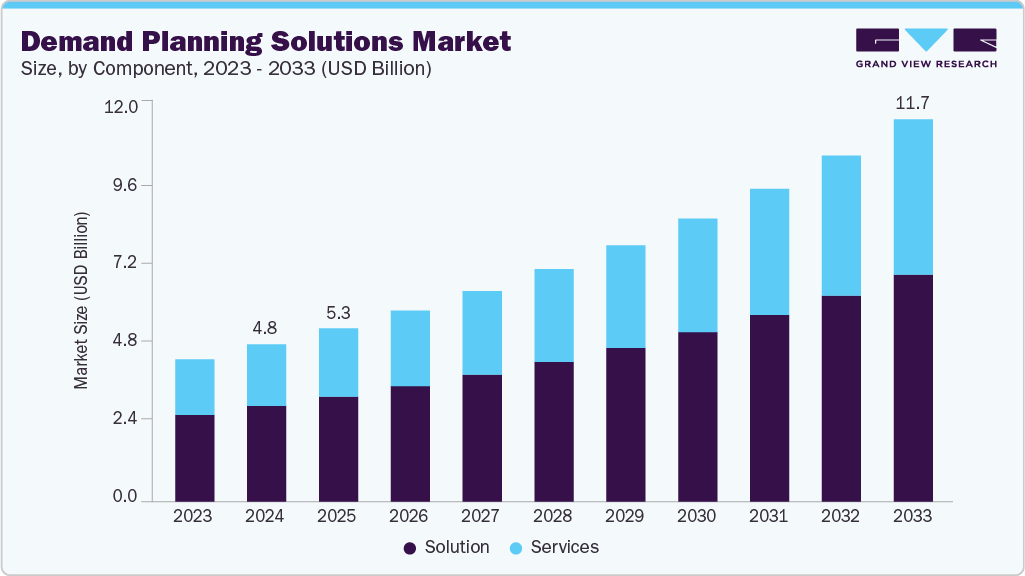
Based on component, the solution segment led the market with the largest revenue share of 60.6% in 2025. The solutions segment is further classified into demand planning & optimization, demand sensing & forecasting, pricing & promotion analysis, and others. Demand sensing & forecasting accounted for a significant market share in 2024. It allows responding to shifting customer demand and market trends and enhancing the supply chain pipeline and production in real-time. Demand forecasting analyzes historical data, which includes sales data, trends, and seasonal data, to predict future demand. Furthermore, according to the demand planning solutions provider, demand sensing has enabled clients to improve forecast accuracy by approximately 15-40%, decrease inventory by 10-30%, and improve customer service levels by 2-5%.
The pricing and promotion analysis segment accounted for a significant share of the demand planning solutions market in 2024. Pricing analysis uses machine learning algorithms and price elasticity models to create promotion-influenced forecasts. Many companies use sales promotion analysis to boost interest and create awareness of a good/service among customers. These promotions frequently include higher costs (such as advertising) or revenue losses (such as discounts), as well as additional expenses (such as increased production).
Deployment Insights
Based on deployment, the on-premises segment led the market with the largest revenue share of 50.3% in 2025. The cloud-based segment is anticipated to expand at the highest CAGR during the forecast period. With the growing internet adoption, cloud-based systems offer applications that exceed the capabilities of on-premises systems. Adaptability and agility are essential components of any planning system, as seen by the constantly changing supply chain. Also, cloud-based systems are considered to be more cost-effective. However, they are fee-based, which can be treated as an operational cost, whereas on-premises systems are usually capital expenditure.
Previously, on-premises demand planning solutions were mainly used, providing automation, cutting-edge features, and the capacity to raise supply chain productivity and accuracy. However, cloud-based solutions have advanced and dominate over on-premises solutions owing to the growing internet. Today’s cloud-based planning Solutions platform comes with functionality that can be incorporated with other business software. Further, demand planning solutions also provide a configurable, feature-rich platform that can be coupled with other enterprise-level software, such as ERP systems, by leveraging the cloud.
Enterprise Size Insights
Based on enterprise, the SMEs segment led the market with the largest revenue share of 51.8% in 2025. The increasing number of small and mid-sized enterprises across the globe and their rising expenditure on implementing forecasting analysis to hold a position in the demand planning solutions industry and compete against other key players is expected to boost the market's growth over the forecast period. Also, mid-sized enterprises were severely affected by the COVID-19 impact due to the lockdowns, which is indirectly influencing the companies to adopt demand planning solutions.
Further, large enterprises initially used on-premises Solutions to maintain data security and boost operational effectiveness. However, small & mid-sized enterprises with fewer resources could not pay for a comprehensive on-premises system. Small and mid-sized businesses (SMB) can now take advantage of full-featured planning Solutions tools that are more flexible and agile than on-premises alternatives, owing to the development of more adaptable cloud-based demand planning apps.
Industry Insights
Based on industry, the BFSI segment led the market with the largest revenue share of 17.4% in 2025 and is expected to continue its dominance during the forecast period. The manufacturing segment is estimated to expand at the fastest CAGR from 2025 to 2030. Manufacturing industries are adopting demand planning and business analytics platforms to improve the performance of the supply chain management process. Utilizing historical data, these companies are implementing these solutions to comprehend shifting consumer demands, manufacturing constraints, and distribution network challenges.
 To learn more about this report, Download Free Sample Report
 Demand forecasting in retail and e-commerce helps in predicting future sales with the help of past online sales, market trends, and sales cycles. Demand forecasting Solutions used by retailers and CPG (consumer packaged goods) automate time-consuming and difficult decisions and use machine learning to improve forecasts. Further, it also helps e-commerce stores by offering various advantages, which include reduced inventory expenses, a pricing strategy that reflects demand, and improved financial decision-making.
Regional Insights
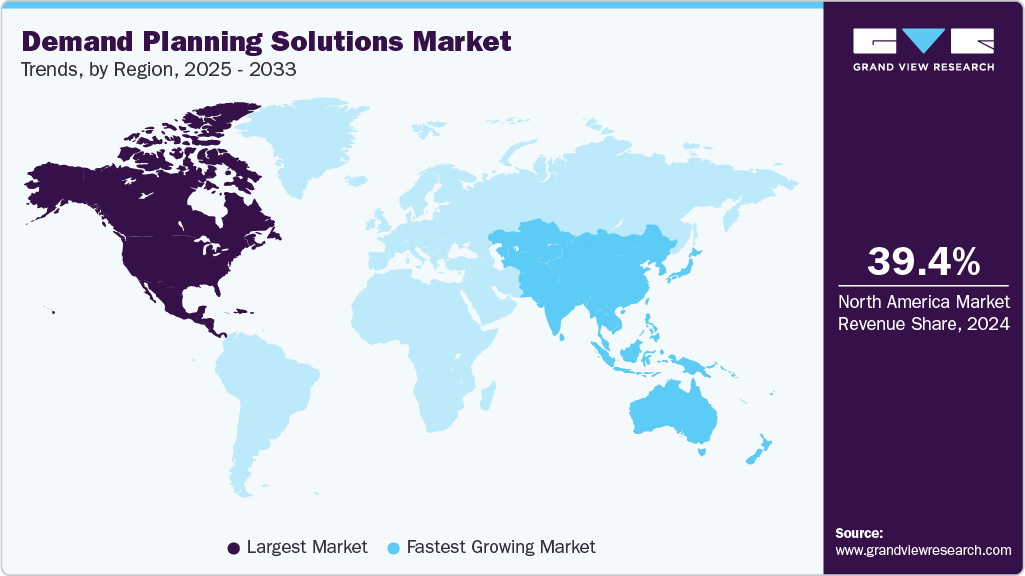
North America dominated the global demand planning solutions market with the largest revenue share of 38.9% in 2025 and is expected to continue its dominance in the coming years. The presence of Major tech companies offering demand planning solutions such as IBM, Blue Ridge Solutions Inc., and Demantra (Oracle Corporation), coupled with established technological infrastructure and many adopters of such Solutions, is boosting the market growth in the region. Therefore, owing to these factors, the usage of demand planning Solutions in North America is high and contributes more to revenue generation.
 To learn more about this report, Download Free Sample Report
 U.S. Demand Planning Solutions Market Trends
The demand planning solutions market in the U.S. held the largest share in the North America region in 2025, fueled by the widespread adoption of AI-enabled forecasting tools and advanced analytics platforms. Companies across sectors such as retail, healthcare, and manufacturing are increasingly leveraging demand planning solutions to manage supply volatility, optimize inventory, and improve service levels.
Europe Demand Planning Solutions Market Trends
The Europe demand planning solutions industry was identified as a lucrative region in 2024. The region's focus on sustainability and demand-driven planning is pushing large enterprises to replace outdated legacy systems with agile, cloud-based platforms. Advanced demand planning systems that support scenario planning, carbon tracking, and demand sensing are in high demand across sectors such as automotive, food & beverage, and pharmaceuticals. Moreover, EU-wide digital supply chain initiatives and the focus on cross-border trade efficiency are further catalyzing market expansion, particularly in Germany, the Nordics, and the Benelux region.
The UK demand planning solutions market is expected to grow rapidly in the coming years. Government and healthcare institutions are adopting demand planning platforms to forecast critical supplies more accurately and ensure continuity of operations. In the private sector, mid-sized and large enterprises are increasingly moving toward integrated planning systems that offer SKU-level accuracy, improved supplier collaboration, and predictive analytics.
Asia Pacific Demand Planning Solutions Market Trends
The Asia Pacific demand planning solutions industry is expected to grow at the fastest CAGR in 2024. The region is well-equipped with technology for adopting such software, which has increased adoption, supporting the regional market's growth. The pandemic has accelerated digital adoption in economies like China and India, which in turn has positively impacted market growth. Further, increasing the number of tech companies providing demand planning solutions is also a significant factor supporting regional market growth.
The Japan demand planning solutions market is expected to grow rapidly as enterprises focus on enhancing supply chain precision and minimizing operational waste. The country's manufacturing-heavy economy, coupled with a cultural emphasis on quality and efficiency, aligns well with demand planning tools that offer real-time insights and automated planning workflows.
The demand planning solutions market in China held a substantial market share in 2024, driven by its massive industrial output, digital transformation programs, and smart city initiatives. The government’s focus on supply chain modernization-through policies encouraging e-invoicing, digital logistics, and real-time tracking-is pushing enterprises to adopt sophisticated demand planning platforms.
Key Demand Planning Solutions Company Insights
Some of the key companies in the demand planning solutions market include SAP SE; Oracle Corporation (Demantra); Kinaxis Inc.; IBM; and Infor. These organizations are actively focused on expanding their customer base to gain a competitive edge. As a result, leading players are engaging in strategic initiatives such as mergers and acquisitions, partnerships, and technology upgrades to enhance platform capabilities and market reach.
-
SAP is a prominent company in enterprise application software, and its Integrated Business Planning (IBP) platform is widely recognized for robust demand planning capabilities. The solution offers real-time forecasting, inventory optimization, and AI/ML-driven predictive analytics. SAP IBP is widely adopted across industries such as manufacturing, retail, and life sciences.
-
Oracle’s Demantra Demand Management solution continues to be a strong player, especially for enterprises requiring advanced demand sensing, collaborative forecasting, and sales & operations planning (S&OP). Integrated within Oracle Cloud SCM, it offers scalable, cloud-based planning that supports global and complex supply chains.
Key Demand Planning Solutions Companies:
The following key companies have been profiled for this study on the demand planning solutions market.
-
Aspire Systems
-
Blue Ridge Solutions Inc.
-
Cognizant Technology Solutions
-
Demantra (Oracle Corporation)
-
IBM
-
Logility, Inc.
-
RELEX Oy
-
NETSTOCK
-
SAP SE
-
Syncron AB
Competitive Benchmarking
Category
Operating Strategies
Competitive Edge
Weakness
Established Players (SAP SE
Oracle Corporation
IBM)
These players are focused on pursuing strategic initiatives, such as new solution launches, partnerships, collaborations, agreements, and contracts, with other organizations to cement their foothold in the market.
These players emphasize R&D to develop advanced technology-based demand planning solutions. Their global presence and vast customer base make them a go-to choice for large enterprises and SMEs seeking unified systems.
Despite their prominent brand names and significant market shares, these players face intense market competition. Holding a large share is challenging in the competitive environment as the fragmented market requires companies to improve their solutions while reducing prices constantly.
Emerging Players (RELEX Solutions, Netstock, Logility, Inc., Syncron AB)
These players are pursuing dedicated strategic initiatives to gain a larger market share. For instance, these companies are launching new solutions to attract new customers and expand their customer base.
These players leverage unique strategies to stay competitive in the market. These players are focusing on innovation, cloud-native design, and industry-specific agility. These companies offer cutting-edge alternatives, especially for companies seeking agility and digital transformation over traditional complexity.
Given the strong presence of established players in both global and regional markets, emerging players may find it challenging to gain market share.
Recent Developments
-
In March 2025, Crisp, a company that offers retail data solutions, acquired Shelf Engine, an AI-driven demand forecasting platform focused on perishable goods. The acquisition enhances Crisp’s capabilities in real-time inventory optimization, food waste reduction, and shelf management. By integrating Shelf Engine’s algorithms into its collaborative commerce platform, Crisp aims to empower retailers with actionable insights for SKU-level forecasting and supply chain efficiency. This move reflects Crisp’s strategic expansion into fresh supply chains amid rising retail margin pressures. The combined platform will deliver enhanced forecasting accuracy, supporting CPG brands, distributors, and retailers in building more resilient and data-driven operations.
-
In January 2025, Ikigai Labs launched a new AI-powered Demand Forecasting and Planning solution designed to tackle the complexities of modern supply chains. Leveraging its patented Large Graphical Model (LGM) technology, the platform delivers highly accurate demand predictions, even for new or unpredictable products. It supports advanced features like Time2Vec for trend detection, synthetic data generation for sparse scenarios, and real-time external data integration for dynamic forecasting. The solution also includes Expert-in-the-Loop (XITL) capabilities, allowing human experts to refine AI-driven forecasts for greater accuracy. With these tools, businesses can reduce inventory costs, avoid stockouts, and better navigate demand volatility.
Demand Planning Solutions Market Report Scope
Report Attribute
Details
Market size value in 2025
USD 5.3 billion
Market size value in 2026
USD 5.8 billion
Revenue forecast in 2033
USD 11.7 billion
Growth rate
CAGR of 10.4% from 2026 to 2033
Base year for estimation
2025
Historical data
2021 - 2024
Forecast period
2026 - 2033
Quantitative units
Revenue in USD billion and CAGR from 2026 to 2033
Report coverage
Revenue forecast, company market share, competitive landscape, growth factors, and trends
Segments covered
Component, deployment, enterprise size, industry, region
Regional scope
North America; Europe; Asia Pacific; Latin America; MEA
Country scope
U.S.; Canada; Mexico; Germany; U.K.; France; China; Japan; India; South Korea; Australia; Brazil; Saudi Arabia; UAE; and South Africa
Key companies profiled
Aspire Systems, Blue Ridge Solutions Inc., Cognizant Technology Solutions, Demantra (Oracle Corporation), IBM
Logility, Inc., RELEX Oy, NETSTOCK, SAP SE, Syncron AB
Customization scope
Free report customization (equivalent up to 8 analysts' working days) with purchase. Addition or alteration to country, regional & segment scope.
Pricing and purchase options
Avail customized purchase options to meet your exact research needs. Explore purchase options
Global Demand Planning Solutions Market Report Segmentation
This report forecasts revenue growth at global, regional, and country levels and provides an analysis of the latest industry trends in each of the sub-segments from 2021 to 2033. For this study, Grand View Research has segmented the global Demand Planning Solutions Market report based on component, deployment, enterprise size, industry, and region.
-
Component Outlook (Revenue, USD Million, 2021 - 2033)
-
Solutions
-
Demand Planning and Optimization
-
Demand Sensing and Forecasting
-
Pricing and Promotion Analysis
-
Others
-
-
Services
-
Professional Services
-
Managed Services
-
-
-
Deployment Outlook (Revenue, USD Million, 2021 - 2033)
-
On-Premises
-
Cloud
-
-
Enterprise Size Outlook (Revenue, USD Million, 2021 - 2033)
-
Large Enterprises
-
Small & Medium Enterprises (SMEs)
-
-
Industry Outlook (Revenue, USD Million, 2021 - 2033)
-
BFSI
-
IT & Telecom
-
Healthcare
-
Retail & e-Commerce
-
Automotive
-
Food & Beverages
-
Manufacturing
-
Others
-
-
Regional Outlook (Revenue, USD Million, 2021 - 2033)
-
North America
-
U.S.
-
Canada
-
Mexico
-
-
Europe
-
Germany
-
UK
-
France
-
-
Asia Pacific
-
China
-
Japan
-
India
-
South Korea
-
Australia
-
-
Latin America
-
Brazil
-
-
Middle East and Africa (MEA)
-
KSA
-
UAE
-
South Africa
-
-
Research Methodology
The demand planning solutions market figures in this report are based on a proven research process that combines executive interviews with secondary research from proprietary databases, company filings, and recognized regulatory and institutional sources. Market size is built through value-chain sizing - reconciling supply-side and demand-side estimates - and triangulated with bottom-up and top-down approaches. Every estimate passes multiple levels of expert validation before publication, with each demand planning solutions segment quantified using the revenue-capture definitions in the table below.
Segment Definition
Segment - Component
Revenue capture definition
Solutions
The segment includes solutions such as demand planning and optimization, demand sensing and forecasting, pricing and promotion analysis, and others.
- Demand Planning and Optimization: Demand planning and optimization refers to the process of planning customer demand and aligning supply chain operations to meet that demand efficiently.
- Demand Sensing and Forecasting: Demand sensing and forecasting uses real-time data combined with advanced analytics and AI to generate highly responsive, short-term demand forecasts.
- Pricing and Promotion Analysis: Pricing and promotion analysis involves evaluating the impact of pricing strategies and promotional activities on product demand.
- Others: The others segment includes solutions such as life cycle planning, new products forecasting, and operations planning.
Services
The segment covers a services such as professional services and managed services.
- Professional Services: Professional services include software implementation, system integration, customization, training, and consulting.
- Managed Services: Managed services include continuous monitoring, system maintenance, updates, performance optimization, and sometimes even forecast generation or analytics.
Segment - Deployment
Revenue capture definition
On-Premises
On-premise deployment refers to installing and running demand planning software on the company’s own servers and infrastructure, typically located at its physical premises.
Cloud
Cloud-based deployment refers to a model where demand planning software is hosted on remote servers and accessed over the internet, typically through a subscription-based Software-as-a-Service (SaaS) model.
Segment - Enterprise Size
Revenue capture definition
Large Enterprises
Large enterprises are organizations with more than 1,000 employees and significant annual revenues.
Small & Medium Enterprises
(SMEs)
SMEs typically include businesses with a limited number of employees (usually under 1,000) and moderate annual revenue.
Segment - Industry
Revenue capture definition
BFSI
This segment includes institutions such as banks, insurance companies, credit unions, investment firms, and financial service providers.
IT & Telecom
This segment comprises companies that provide information technology services, telecommunications infrastructure, internet services, and digital solutions.
Healthcare
This segment includes hospitals, clinics, pharmaceutical companies, medical device manufacturers, and healthcare service providers.
Retail & e-Commerce
This segment covers physical retail stores, online shopping platforms, and omnichannel businesses.
Automotive
This segment includes manufacturers of vehicles and auto parts, as well as suppliers and distributors.
Food & Beverages
This segment encompasses producers, processors, distributors, and retailers of food and drink products.
Manufacturing
This segment includes industries involved in the production of goods across various sectors, such as electronics, chemicals, textiles, and machinery.
Others
This category includes a range of other industries such as energy, logistics, transportation, education, and public sector organizations.
Estimation Model
Layer Name
Key Question
Description
Enterprise Planning Demand Base Layer
Who requires demand planning capabilities?
Establish the total potential demand base by identifying enterprises across manufacturing, retail, healthcare, automotive, and other industries that manage inventory, procurement, production, and supply chain operations.
Addressable Market Layer
Who can realistically be reached and served by demand planning solution providers?
Refine the total enterprise ecosystem into the realistically serviceable market by considering factors such as digital maturity, ERP adoption, supply chain software penetration, IT infrastructure readiness, cloud adoption, and budget availability. It helps determine the share of organizations that can potentially implement demand planning solutions.
Demand Planning Solution Adoption Layer
Who is actively deploying demand planning solutions?
Estimate annual demand generation by analyzing adoption rates of demand planning software and services. It converts the addressable market into measurable software deployments across large enterprises and SMEs operating in various end-use industries.
Revenue Layer
How does demand planning solution adoption translate into market revenue?
Convert demand planning solution deployments into market revenue through software subscriptions, licensing fees, implementation services, consulting services, training, maintenance, and support contracts. Revenue is generated by applying pricing for cloud-based and on-premises demand planning platforms and recurring software service fees.
Delivered Customizations
This report has been delivered with the following In-depth customizations
Client Request
Customization Delivered
Value Adds
Regional & Country Opportunity Analysis
Delivered region-wise and country-wise market size, forecasts, and growth analysis across North America, Europe, Asia Pacific, Latin America, and Middle East & Africa
Assessment of digital supply chain transformation, enterprise software adoption, and planning technology investments by country
Identification of high-growth markets and emerging demand centers
Supported regional expansion and investment planning
Enabled geographic opportunity assessment
Assisted in identifying emerging markets
Technology Adoption & AI-Driven Forecasting Analysis
Delivered analysis of AI, machine learning, predictive analytics, digital twins, demand sensing, and automation technologies integrated within demand planning solutions
Assessment of technology adoption trends and forecast accuracy improvements
Evaluation of next-generation planning capabilities
Supported technology roadmap development
Identified high-growth innovation opportunities
Assisted in product differentiation strategies
Competitive Benchmarking & Strategic Landscape Analysis
Delivered benchmarking of key demand planning solution providers based on product portfolio, AI capabilities, forecasting accuracy, partnerships, deployment flexibility, geographic presence, and innovation initiatives
Analysis of mergers & acquisitions, partnerships, and product launches
Supported competitive intelligence and strategic decision-making
Enabled identification of market gaps and growth opportunities
Assisted in strengthening market positioning
Frequently Asked Questions About This Report
The global demand planning solutions market size was estimated at USD 5.3 billion in 2025 and is expected to reach USD 5.8 billion in 2026.
The global demand planning solutions market is expected to grow at a compound annual growth rate of 10.4% from 2026 to 2033 to reach USD 11.7 billion by 2033.
Based on industry, the BFSI segment led the market with the largest revenue share of 17.4% in 2025. This is attributable to the growing adoption of demand planning and business analytics platforms by BFSI industry to improve the performance of the supply chain management process.
Some key players operating in the demand planning solutions market include Aspire Systems, Blue Ridge Solutions Inc., Cognizant Technology Solutions, Demantra (Oracle Corporation), IBM, Logility, Inc., RELEX Oy, NETSTOCK, SAP SE, and Syncron AB.
Key factors that are driving the market growth include the growing awareness about the benefits offered by these solutions, and the enhanced performance of the supply chain managment process with the adoption of demand planning solutions.
North America dominated the global demand planning solutions market with the largest revenue share of 38.9% in 2025.
Asia Pacific is the fastest-growing region over the forecast period.
Based on component, the solution segment led the market with the largest revenue share of 60.6% in 2025, while services is the fastest-growing component.
Based on deployment, the on-premises segment led the market with the largest revenue share of 50.3% in 2025, while cloud is the fastest-growing deployment model.
About the Author(s)
Next Generation Technologies Research Team
Technology · Next Generation TechnologiesThis report was authored by the next generation technologies research team at Grand View Research - comprising two research analysts, one senior research analyst, and one industry expert - with specialized expertise in the next generation technologies segment of the technology industry. All findings are based on proprietary technology databases, executive interviews, and regulatory analysis, subject to internal peer review prior to publication.
Last Updated:
Speak to Analyst

Customize this report to your needs - add regions, segments, or data points, with 20% free customization.
Or view our licence options:


ISO 9001:2015 & 27001:2022 Certified
We are GDPR and CCPA compliant! Your transaction & personal information is safe and secure. For more details, please read our privacy policy.


