
- Home
- »
- Medical Devices
- »
-
Dermatoscope Market Size, Share & Growth Report, 2033GVR Report cover
![Dermatoscope Market (2026 - 2033)Report]()
Dermatoscope Market (2026 - 2033)
Size, Share & Trends Analysis Report By Technology (LED, Xenon, Halogen, UV), By Product (Contact, Hybrid, Noncontact), By Modality (Handheld, Headband), By End Use, By Region, And Segment Forecasts
Market Size, 2025
$1.4BMarket Estimate, 2026
$1.5BMarket Forecast, 2033
$2.9BCAGR, 2026–2033
9.8%Dermatoscope Market Summary
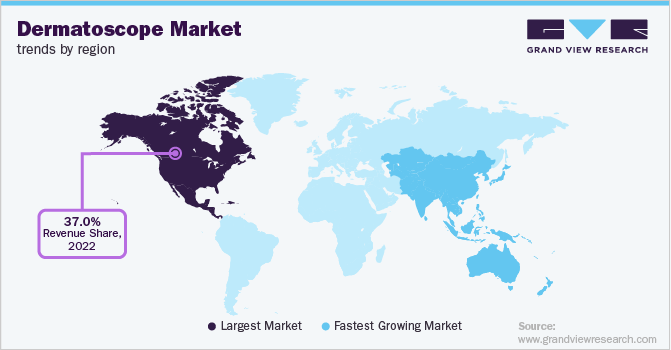
The global dermatoscope market size was valued at USD 1.4 billion in 2025 and is projected to grow from USD 1.5 billion in 2026 to USD 2.9 billion by 2033, at a CAGR of 9.8% from 2026 to 2033. North America dominated the global market, accounting for the largest revenue share of 35.0% in 2025. Increasing skin cancer prevalence is a primary driver of the market.
Key Market Trends & Insights
- By product: The contact dermatoscopes segment held the largest market share of around 35.0% in 2025.
- By modality: The handheld device segment held the largest market share of over 50.0% in 2025.
- By technology: The LED segment held the largest market share of over 40.0% in 2025.
- By end use: The dermatology clinics segment held the largest market share of more than 55.0% in 2025.
Regional Highlights
- Largest regional market: North America (35.0% revenue share, 2025)
- Fastest-growing regional market: Asia Pacific (highest CAGR, 2026-2033)
Market Size & Forecast
- Market size in 2025: USD 1.4 billion
- Estimated market size in 2026: USD 1.5 billion
- Projected market size by 2033: USD 2.9 billion
- CAGR (2026-2033): 9.8%
The American Academy of Dermatology (AAD) estimated that one in three Americans visits a dermatologist and that one in four is affected by skin disease each year. Hence, owing to a strong need to treat these conditions as well as minimize deaths caused by them, there is a high demand for sophisticated diagnostic techniques for chronic skin disorders. Over the past few years, the introduction of technologically advanced products has led to the widespread availability of diagnostic devices for detecting skin disorders. Healthcare professionals are using these devices to diagnose various skin diseases, which have proven highly effective and more productive than conventional diagnostic methods.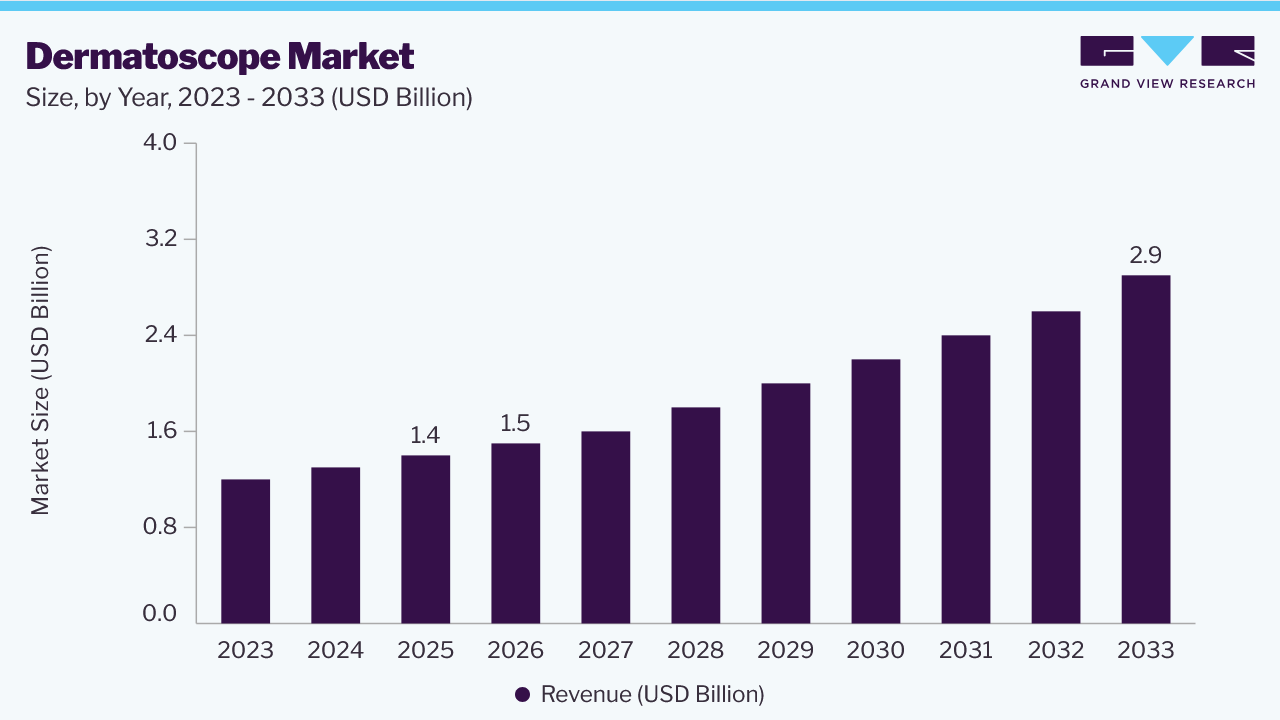
On the other hand, rapid technological advancements are driving up the prices of dermatoscopes, making them less affordable for people in developing regions. This is therefore anticipated to hamper the market's growth. Nevertheless, a growing inclination towards dermatology to enhance aesthetic appearance is projected to drive market growth during the forecast period.
Market Dynamics
Increasing public awareness of skin cancer and the benefits of early diagnosis are major drivers of the dermatoscope industry. Growing awareness campaigns carried out by healthcare organizations, government institutions, and cancer organizations in developed and developing economies have increased the number of individuals seeking regular skin checkups. Given the rise in prevalence of skin cancer, such as melanoma and non-melanoma skin cancer worldwide, medical professionals are putting greater emphasis on detecting the disease at an early stage. In diagnosing skin lesions, a dermatoscope helps detect skin cancer non-invasively. With a dermatoscope, doctors can examine the subsurface structures of the skin that are not visible to the naked eye. Rise in awareness of preventive dermatology and regular skin checks is increasing the number of dermatology consultations, driving market growth.
The high cost of dermatoscopes and the limited availability of dermatology services in many developing regions are constraints on the dermatoscope industry. Modern digital and video dermatoscopes offer sophisticated features such as high-resolution imaging, AI, and image storage, which, in turn, require significant capital investment. This makes such equipment unaffordable for small clinics, individual professionals, and healthcare institutions with constrained capital. Furthermore, adequate training and skill are required to treat skin lesions using dermoscopy. The absence of such experts in many remote regions forces professionals to continue relying on conventional manual examination methods, which, in turn, slows market growth.
Analyst Perspective
The dermatoscope industry has become increasingly important as healthcare providers place greater emphasis on early and accurate detection of skin diseases. Demand is expected to favor devices that improve diagnostic confidence while fitting seamlessly into routine clinical practice. Companies with strong product reliability, clinical credibility, and established relationships with dermatologists and healthcare institutions are likely to strengthen their market position. As skin screening becomes a more common part of preventive care, value is expected to shift toward advanced, easy-to-use diagnostic solutions that enable faster, more informed clinical decision-making.
Product Insights
The contact dermatoscopes segment led the market with the largest revenue share of more than 35.0% in 2025. Many of these devices are available, including those with LED or halogen bulbs, optical lenses, and rechargeable batteries. For instance, in March 2024, FotoFinder Systems acquired DermLite LLC, a premier manufacturer of handheld dermatoscopes. This association marks a milestone in dermatology.
The hybrid dermatoscopes segment is anticipated to grow at a robust CAGR during the forecast period. These novel medical devices possess qualities of both contact and noncontact dermatoscopes. They also combine polarized and non-polarized modes for imaging. The Dermlite DL200, developed by 3Gen Company, is a hybrid dermatoscope that combines non-polarized and polarized illumination to enhance the visualization of vascular structures and pigment.
Technology Insights
The LED segment led the market with the largest revenue share of over 40.0% in 2025 and is also anticipated to exhibit at the fastest CAGR during the forecast period. This technology is increasingly used because LEDs produce less heat during illumination and help prevent accidental fatalities. The illumination from these bulbs is also brighter than that of xenon and halogen bulbs.
Xenon technology and halogen lights are likely to account for relatively smaller shares in the market throughout the forecast period. Halogens produce a large quantity of heat, which can cause fatalities in medical settings where they are used. Similarly, xenon lights have several disadvantages.
The ultraviolet technology segment is expected to witness at a lucrative CAGR during the forecast period, driven by its introduction as a novel technology in dermatoscopy. Lumio UV, manufactured by 3Gen, helps capture clinical images quickly and easily in the workplace, delivering high-resolution images and ultraviolet light.
Modality Insights
The handheld devices segment led the market with the largest revenue share of over 50.0% in 2025, owing to the convenience of use. The enhanced visualization they offer allows dermatologists to better understand various conditions. In contrast to trolley-mounted dermatoscopes, these instruments are lightweight and offer an enhanced viewing experience, which is driving their adoption.
The growth of the trolley-mounted instruments segment is expected to be limited by high prices and limited portability. However, they are useful for mapping out and monitoring several skin diseases and lesions. These devices are designed to provide full-body images and capture the entire skin surface in a few clicks.
The headband dermatoscopes segment is expected to exhibit at a significant CAGR over the forecast period, driven by the novel technology of these devices. Dermatologists wear these devices on their heads to illuminate lesions on a patient’s skin.
End Use Insights
The dermatology clinics segment led the market with the largest revenue share of more than 55.0% in 2025. The increasing prevalence of skin cancer and melanoma is boosting the number of patients who visit dermatology clinics for treatment and care. The availability of sophisticated medical equipment in dermatology clinics enables rapid diagnosis, which, in turn, leads to better treatment.
For instance, in October 2025, a prospective trial published by Canfield Scientific involved 1,274 high-risk melanoma patients who were followed up with 3D total-body imaging and digital dermoscopy.The management of more than 1,200 high-risk patients using digital dermoscopy specifies that dermatology clinics are major purchasers and users of dermatoscopes.
The hospitals segment is anticipated to grow at a significant CAGR during the forecast period, owing to the high risk of skin cancer. Patients diagnosed with cancer are more likely to visit hospitals for advanced diagnosis and treatment. Moreover, the easy availability of specialized doctors in hospitals aids in convenient cancer diagnosis and treatment.
Regional Insights
North America dominated the global dermatoscope market with the largest revenue share of over 35.0% in 2025. The high prevalence of skin diseases, advanced healthcare infrastructure, medical device manufacturers, and economic development are key growth drivers for the regional market. Companies have also begun investing in AI-based technology. For instance, in September 2025, Medical Care Technologies Inc., a company operating in AI-powered preventive healthcare, announced an artificial intelligence platform designed to revolutionize the early detection of melanoma, the deadliest form of skin cancer.
Europe Dermatoscope Market Trends
The dermatoscope market in Europe is anticipated to grow at a significant CAGR during the forecast period, driven by the high adoption of technologically advanced devices for the diagnosis of skin cancer, inflammatory dermatoses, and lesions, especially in Germany. The rising incidence of skin-related diseases in the UK is driving growth in the regional market.
Key Dermatoscope Company Insights
Key manufacturers in the global dermatoscope industry are continuously adopting strategic initiatives such as mergers and acquisitions, new product development, and geographic expansion.
Key Dermatoscope Companies
The following key companies have been profiled for this study on the dermatoscope market:
-
Canfield Scientific, Inc.
-
3Gen
-
FotoFinder Systems
-
Optilia Instruments AB
-
HEINE Optotechnik GmbH & Co. KG
-
Caliber Imaging & Diagnostics, Inc.
-
Firefly Global
-
ILLUCO Corporation Ltd.
-
Welch Allyn
-
Bio-Therapeutic Inc.
Recent Developments
-
In March 2026, D2 was awarded an innovative medical dermatological diagnostic device at the DERM 2026 awards. The device is a high-definition imaging system integrated with comprehensive software, providing a solution for dermatologists and skin care specialists.
-
In April 2025, HEINE Optotechnik launched the DELTA X dermatoscope series, the DELTA 30, and the DELTA one.
Dermatoscope Market Report Scope
Report Attribute
Details
Market size in 2025
USD 1.4 billion
Estimated market size in 2026
USD 1.5 billion
Projected market size by 2033
USD 2.9 billion
Growth rate
CAGR of 9.8% from 2026 to 2033
Base year for estimation
2025
Historical data
2021 - 2024
Forecast period
2026 - 2033
Quantitative units
Revenue in USD Billion/billion, and CAGR from 2026 to 2033
Report coverage
Revenue forecast, company ranking, competitive landscape, growth factors, and trends
Segments covered
Product, technology, modality, end use, region
Regional scope
North America; Europe; Asia Pacific; Latin America; Middle East & Africa
Country scope
U.S.; Canada; Germany; UK; France; Italy; Spain; Denmark; Sweden; Norway; Japan; China; India; Australia; South Korea; Thailand; Brazil; Mexico; Argentina; South Africa; Saudi Arabia; UAE; Kuwait
Key companies profiled
Canfield Scientific, Inc.; 3Gen; FotoFinder Systems, Inc.; Optilia; HEINE Optotechnik GmbH & Co. KG; Caliber Imaging & Diagnostics, Inc.; Firefly Global; ILLUCO Corporation Ltd.; Welch Allyn; Bio-Therapeutic, Inc.
Customization scope
Free report customization (equivalent up to 8 analysts working days) with purchase. Addition or alteration to country, regional & segment scope.
Pricing and purchase options
Avail of customized purchase options to meet your exact research needs. Explore purchase options
Global Dermatoscope Market Report Segmentation
This report forecasts revenue growth at the regional and country levels and provides an analysis on the latest industry trends and opportunities in each of the sub-segments from 2021 to 2033. For this study, Grand View Research has segmented the global dermatoscope market report based on the product, technology, modality, end use, and region:
-
Product Outlook (Revenue, USD Billion, 2021 - 2033)
-
Contact Dermatoscope
-
Hybrid Dermatoscope
-
Noncontact Dermatoscope
-
-
Technology Outlook (Revenue, USD Billion, 2021 - 2033)
-
LED
-
Xenon
-
Halogen
-
Ultraviolet
-
-
Modality Outlook (Revenue, USD Billion, 2021 - 2033)
-
Handheld
-
Trolley Mounted
-
Headband
-
-
End Use Outlook (Revenue, USD Billion, 2021 - 2033)
-
Dermatology Clinics
-
Hospitals
-
-
Regional Outlook (Revenue, USD Billion, 2021 - 2033)
-
North America
-
U.S.
-
Canada
-
-
Europe
-
Germany
-
UK
-
France
-
Italy
-
Spain
-
Denmark
-
Sweden
-
Norway
-
-
Asia Pacific
-
Japan
-
China
-
India
-
Australia
-
South Korea
-
Thailand
-
-
Latin America
-
Brazil
-
Mexico
-
Argentina
-
-
MEA
-
South Africa
-
Saudi Arabia
-
UAE
-
Kuwait
-
-
Frequently Asked Questions About This Report
The global dermatoscopes market size was valued at USD 1.4 billion in 2025 and is estimated at USD 1.5 billion in 2026.
Some key players operating in the dermatoscopes market include Canfield Scientific, Inc.; 3Gen; FotoFinder Systems, Inc.; Optilia; HEINE Optotechnik GmbH & Co. KG; Caliber Imaging & Diagnostics, Inc.; Firefly Global; ILLUCO Corporation Ltd.; Welch Allyn; and Bio-Therapeutic, Inc.
The global dermatoscopes market is expected to grow at a CAGR of 9.8% from 2026 to 2033 to reaching USD 2.9 billion.
North America dominated the dermatoscopes market with a share of 35.0% in 2025.
The handheld devices segment led the market with the largest revenue share of over 50.0% in 2025.
About the Author(s)
Medical Devices Research Team
Healthcare · Medical DevicesThis report was authored by the medical devices research team at Grand View Research - comprising two research analysts, one senior research analyst, and one industry expert - with specialized expertise in the medical devices segment of the healthcare industry. All findings are based on proprietary healthcare databases, executive interviews, and regulatory analysis, subject to internal peer review prior to publication.
Last Updated:
Speak to Analyst


Customize this report to your needs — add regions, segments, or data points, with 20% free customization.
Or view our licence options:


ISO 9001:2015 & 27001:2022 Certified
We are GDPR and CCPA compliant! Your transaction & personal information is safe and secure. For more details, please read our privacy policy.


