
- Home
- »
- Sensors & Controls
- »
-
Detection Tools Market Size And Share Report, 2026-2033GVR Report cover

Detection Tools Market (2026 - 2033)
Size, Share, & Trends Analysis Report By Product (Wall Scanners, Utility & Pipe Detectors), By Technology (Electromagnetic Detection, Radar-Based Detection, Ultrasonic Detection), By Industry, By Region, And Segment Forecasts
Market Size, 2025
$5.9BMarket Estimate, 2026
$6.2BMarket Forecast, 2033
$9.1BCAGR, 2026–2033
5.7%Detection Tools Market Summary
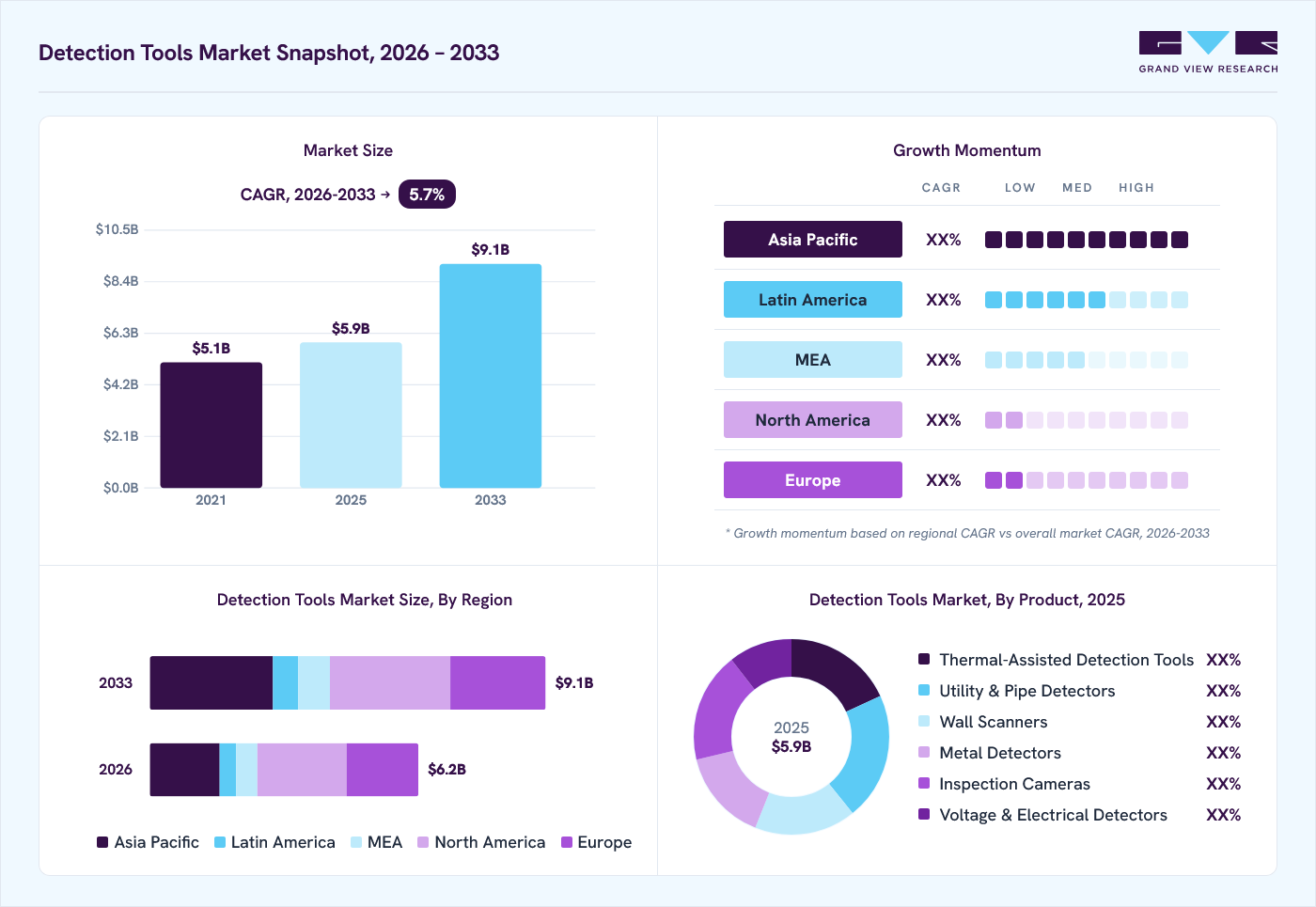
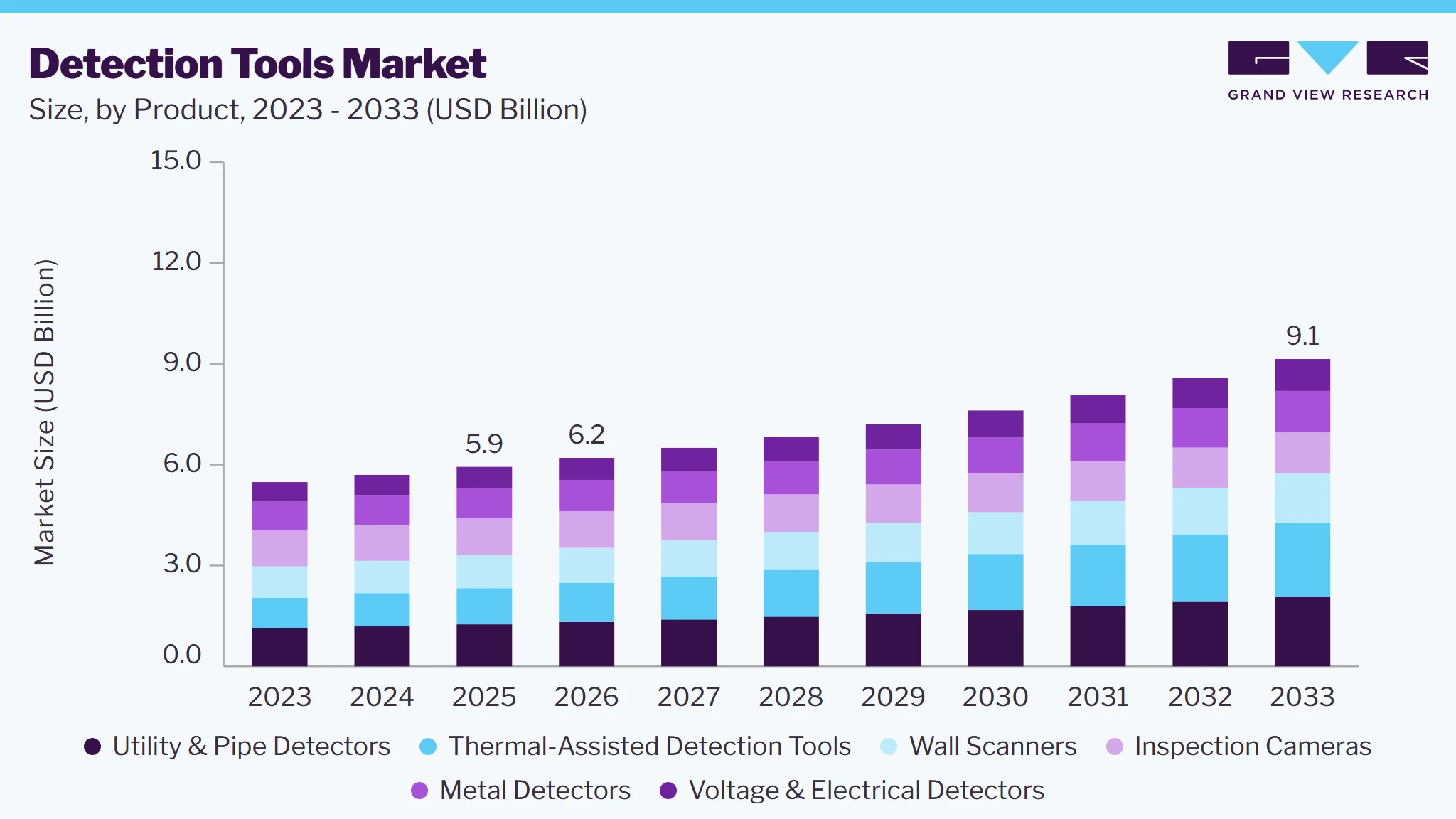
The global detection tools market size was valued at USD 5.9 billion in 2025 and is projected to grow from USD 6.2 billion in 2026 to USD 9.1 billion by 2033, at a CAGR of 5.7% from 2026 to 2033. North America dominated the market, accounting for a revenue share of 33.6% in 2025. The market growth is primarily driven by increasing infrastructure development, expansion and modernization of utility networks, rising construction and renovation activity, growing emphasis on worker and excavation safety, and the need for accurate, non-destructive detection of concealed utilities, electrical wiring, pipes, structural elements, and other hidden assets.
 Source: Grand View Research, IR Documents, Primary Interviews, Paid DatabasesTo learn more about this report,
 Download Free Sample Report
 Key Market Trends & Insights
- By product: Utility & pipe detectors segment held the largest market share of 21.1% in 2025.
- By technology: Electromagnetic detection segment held the largest market revenue share of 37.3% in 2025.
- By industry: Industrial facilities segment led the market with the largest revenue share of 25.2% in 2025.
Regional Highlights
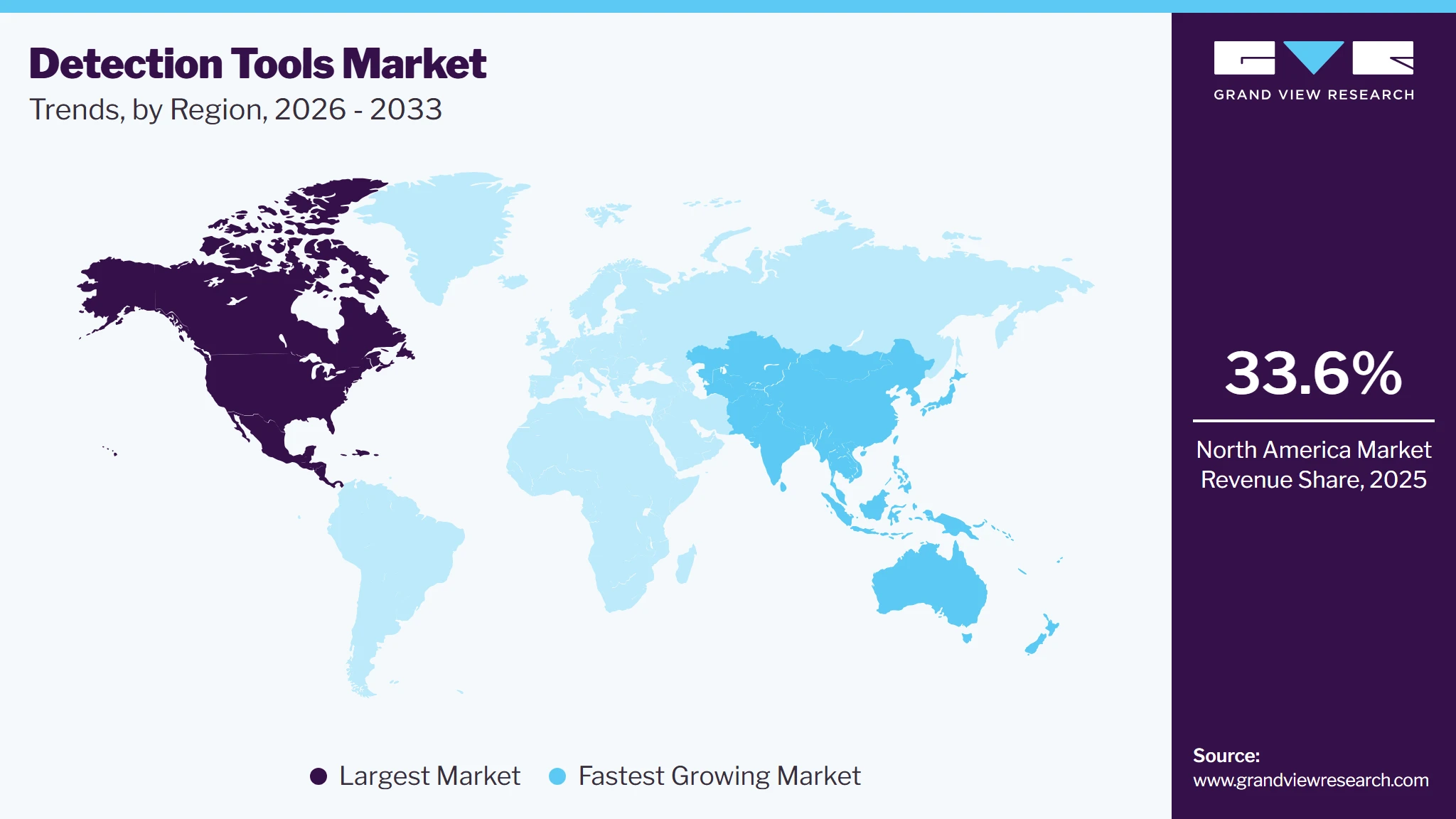
- Largest regional market: North America (33.6% revenue share, 2025)
- Fastest-growing regional market: Asia Pacific (highest CAGR, 2026-2033)
- Leading country: The U.S. held the largest share in 2025
Market Size & Forecasts
- Market size in 2025: USD 5.9 Billion
- Estimated market size in 2026: USD 6.2 Billion
- Projected market size by 2033: USD 9.1 Billion
- CAGR (2026-2033): 5.7%
Three ways to get this report
Buy it, customize it, or ask a question.Ask an Analyst
A direct answer, usually in 1 working day
- AccessReport author, directly
- Reply timeWithin 1 working day
- No sales callDirect answer only
- FormatEmail reply
- CostFree, no cost
Get the Full Report
What the study covers
- FormatsPDF · Excel · Dashboard
- Timeline2026–2033 annual, 2025 base
- Coverage20+ countries, 5 regions
- Companies10+ key players profiled
Customize the Report
20% free customization
- IncludeCountries, segments, points
- TailorTo your product definition
- ExtendDeeper competitor detail
- OrA fully bespoke study
- Turnaround5–10 working days
Increasing investments in transportation infrastructure, power grids, water and gas pipelines, telecommunications networks, and commercial construction is driving demand for detection tools that can identify concealed utilities, cables, pipes, reinforcing bars, and other subsurface assets before drilling, excavation, or installation. In addition, the growing complexity and density of underground infrastructure further increase the need for accurate detection to minimize utility strikes, project delays, service disruptions, and repair costs, thereby driving the detection tools industry expansion.Growing focus on worker safety and prevention of accidental damage to underground utilities is strengthening the adoption of wall scanners, utility locators, voltage detectors, and related equipment. Contractors increasingly use detection tools before drilling, cutting, and excavation to identify electrical wiring, pipes, cables, and structural elements, reducing safety risks and supporting compliance with increasingly stringent construction and excavation practices. With safety requirements becoming more stringent and the cost of utility strikes and workplace accidents increases, these applications are driving greater demand for reliable detection tools across construction, renovation, and infrastructure projects.
 To learn more about this report, Download Free Sample Report
 Furthermore, the increasing need to inspect buildings, industrial equipment, electrical systems, pipelines, and infrastructure without causing physical damage is supporting demand for thermal cameras, inspection cameras, radar systems, and other non-destructive detection technologies. Thermal-assisted detection is gaining traction for identifying overheating components, insulation problems, moisture intrusion, and mechanical faults, supporting condition-based maintenance and early fault identification. The growing emphasis on preventive maintenance, asset reliability, and early fault detection is expanding the use of non-destructive detection tools, thereby creating sustained market growth across industrial, commercial, and infrastructure applications.
Moreover, detection tools are increasingly evolving from basic sensing devices toward high-precision, digitally enabled systems. Radar-based detection improved electromagnetic sensing, multi-sensor architectures, high-resolution thermal imaging, AI-assisted object recognition, and advanced signal processing are improving detection accuracy and object classification. Connected tools with wireless communication, digital visualization, and cloud-based reporting are also enabling faster data sharing and more efficient inspection workflows. These technological advancements are increasing detection accuracy, reducing false readings, and improving inspection productivity, encouraging users to replace conventional equipment with advanced systems and supporting the expansion of the detection tools industry.
Market Dynamics
The detection tools industry is shaped by evolving inspection requirements, increasing asset complexity, replacement of conventional inspection practices, and the need for faster and more reliable field-level decision-making. Demand is further shaped by equipment lifecycle replacement, expansion of specialized detection applications, and growing preference for portable solutions that improve operational efficiency. However, high upfront costs and operator skill requirements can constrain adoption, while the shift toward automated, connected, and application-specific detection solutions creates opportunities for market participants.
The availability of compact, battery-powered, handheld, and increasingly intuitive detection equipment is broadening adoption beyond large industrial users to contractors, maintenance teams, facility managers, and smaller service providers. Improvements in battery efficiency, ergonomic designs, digital displays, sensor sensitivity, and simplified interfaces are making professional detection capabilities easier to deploy in field environments. This trend is particularly relevant as labor constraints encourage users to adopt tools that reduce inspection time and improve field productivity. The growing accessibility and ease of use of portable detection equipment are expanding the addressable customer base and increasing adoption across smaller contractors, maintenance providers, and field-service applications, thereby contributing to overall market growth.
Advanced detection equipment incorporating radar, thermal imaging, multi-sensor systems, and sophisticated signal-processing capabilities can involve relatively high acquisition costs and require trained personnel for proper operation and interpretation. Smaller contractors and organizations with limited budgets may therefore delay equipment upgrades or continue using conventional detection methods. This cost and skill barrier can limit adoption, particularly among small and medium-sized end users, restraining overall market growth.
The expansion and aging of buildings, utility networks, transportation infrastructure, pipelines, and industrial assets are creating significant opportunities for advanced detection tools. Increasing requirements for non-destructive inspection, preventive maintenance, utility mapping, and early fault identification are encouraging infrastructure owners and maintenance providers to adopt radar-based, thermal, electromagnetic, and camera-based detection technologies. This shift toward proactive asset inspection and maintenance is expected to create substantial opportunities for detection tool manufacturers, particularly for high-accuracy and digitally enabled systems.
Market Concentration & Characteristics
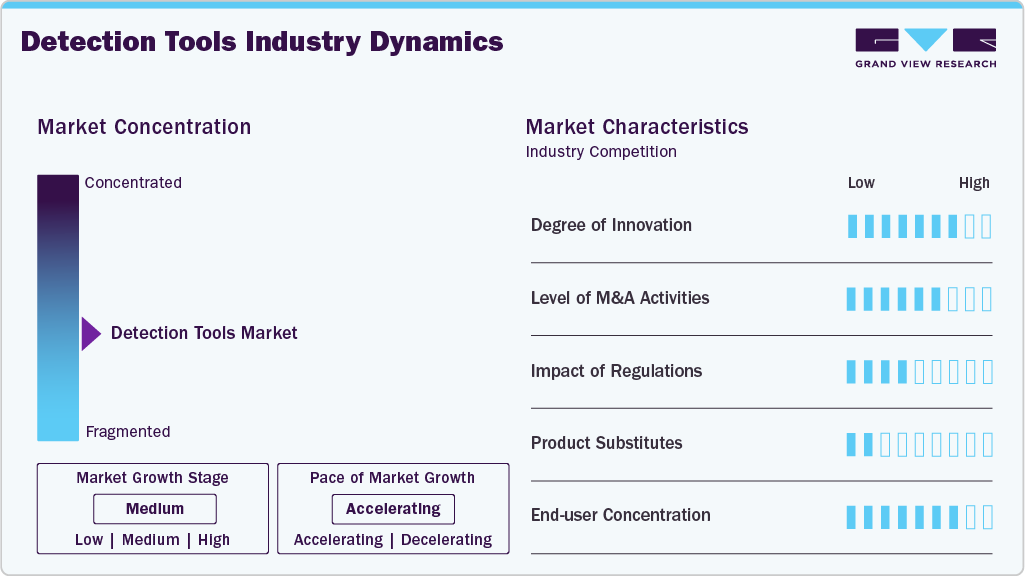
The detection tools market is moderately fragmented, with competition among established equipment manufacturers, specialized detection technology providers, industrial inspection companies, and diversified sensing solution providers offering products across construction, utilities, industrial facilities, infrastructure, oil and gas, mining, and residential applications. The market is characterized by product specialization, sensor performance, detection accuracy, portability, durability, and application-specific functionality, with manufacturers increasingly differentiating through advanced radar, electromagnetic, thermal, ultrasonic, and imaging capabilities.
 To learn more about this report, Download Free Sample Report
 Product portfolio breadth, distribution networks, technical support, and relationships with contractors, utilities, infrastructure operators, and industrial customers play an important role in competitive positioning. Increasing requirements for higher detection depth, improved signal interpretation, reduced false readings, ergonomic designs, and field usability are encouraging manufacturers to invest in product development and sensor technologies. High R&D requirements, brand reputation, calibration expertise, and established distribution channels create barriers for new entrants, while competition from lower-cost conventional equipment can constrain pricing. Growing demand for specialized inspection, utility locating, equipment maintenance, and concealed-object detection is expected to support continued product differentiation across the global detection tools market.
Analyst Perspective
The market is evolving from conventional standalone detection devices toward more accurate, portable, digitally enabled, and application-specific inspection solutions. The convergence of advanced sensing technologies, improved signal processing, thermal imaging, digital visualization, and connected equipment is expanding detection capabilities across construction, utilities, industrial maintenance, infrastructure, and resource-intensive industries. Users are increasingly prioritizing detection accuracy, operational efficiency, and faster field decisions, thereby manufacturers with differentiated sensing technologies, broad application coverage, and strong service capabilities are positioned to strengthen their competitive presence.
Product Insights
The utility & pipe detectors segment dominated the detection tools market with a share of 21.1% in 2025, driven by the widespread application of utility locating equipment across construction, excavation, infrastructure development, plumbing, telecommunications, and pipeline maintenance activities. These tools enable contractors and utility operators to accurately identify buried pipes, cables, conduits, and other underground assets before excavation or drilling, helping minimize accidental utility damage, service interruptions, project delays, and associated repair costs. Increasing underground infrastructure density and the need for reliable utility mapping and locating are therefore sustaining strong demand for utility and pipe detection solutions.
The thermal-assisted detection tools segment is expected to grow at the highest CAGR of 9.5% from 2026 to 2033, fueled by growing adoption of thermal imaging and temperature-based detection for early identification of electrical faults, overheating equipment, insulation deficiencies, moisture intrusion, and mechanical abnormalities. Increasing emphasis on preventive maintenance and early fault identification is encouraging industrial facilities, commercial buildings, electrical contractors, and infrastructure operators to deploy thermal-assisted tools for routine inspections and condition monitoring. The ability to identify developing faults without physical contact, combined with improvements in thermal sensor resolution, portability, and digital analysis capabilities, is expected to expand applications and accelerate segment growth.
Technology Insights
Electromagnetic detection segment dominated the detection tools market with a revenue share of 37.3% in 2025, driven by the widespread use of electromagnetic sensing for locating buried metallic pipes, cables, conduits, and other concealed conductive objects across construction, excavation, utility maintenance, and infrastructure projects. Its established technology, relatively high reliability, portability, and suitability for routine field applications support broad adoption among contractors and utility operators.
Radar-based detection segment is expected to grow at the highest CAGR from 2026 to 2033, supported by increasing demand for deeper and more comprehensive subsurface detection, particularly for identifying both metallic and non-metallic objects, structural elements, voids, and underground utilities. Advances in ground-penetrating radar, signal processing, data visualization, and digital interpretation are improving detection accuracy and usability, while growing requirements for non-invasive infrastructure assessment and utility mapping are expanding the technology's application scope.
Industry Insights
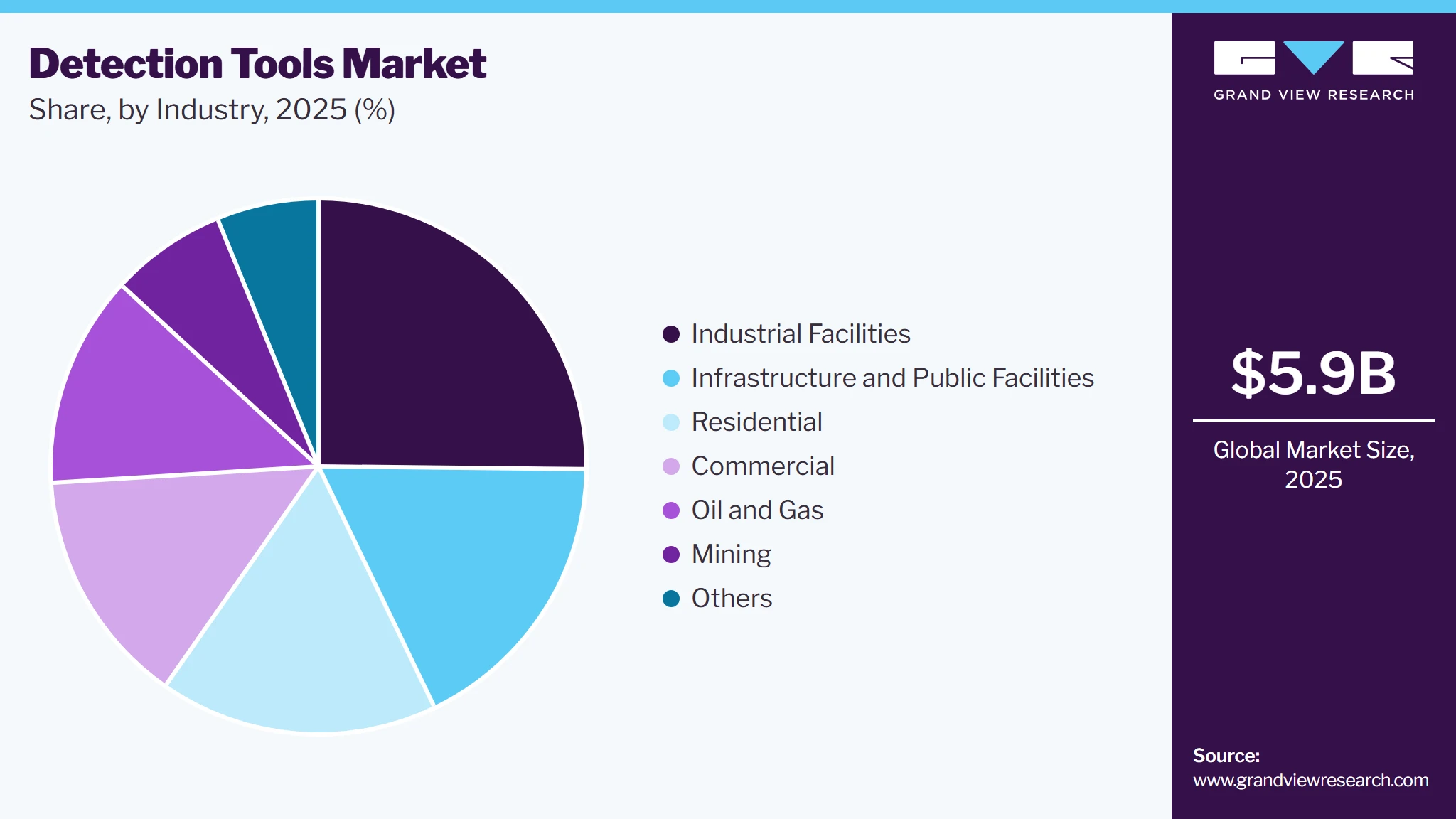
Industrial facilities segment dominated the market with a revenue share of 25.2% in 2025, driven by the extensive deployment of detection equipment for electrical safety, equipment inspection, preventive maintenance, fault identification, and monitoring of critical industrial assets. In addition, the need to minimize unplanned downtime, improve asset reliability, and extend equipment operating life is encouraging industrial operators to conduct more frequent inspection and maintenance activities. The increasing emphasis on operational continuity, workplace safety, and efficient asset management therefore continues to support strong demand for detection tools across industrial facilities.
 To learn more about this report, Download Free Sample Report
 Infrastructure and public facilities segment is expected to grow at the highest CAGR from 2026 to 2033, supported by increasing investment in transportation networks, public buildings, power infrastructure, water and wastewater systems, telecommunications networks, and other critical public assets requiring continuous inspection and maintenance. Furthermore, the expansion of smart infrastructure and greater adoption of advanced inspection practices are encouraging infrastructure operators to deploy radar-based, electromagnetic, thermal, and camera-based detection solutions, which is expected to drive the segmental growth in the coming years.
Regional Insights
North America detection tools industry held the largest share of 33.6% in 2025, supported by strong demand for advanced detection equipment across construction, industrial facilities, utilities, infrastructure, and commercial applications. The region benefits from established underground utility networks, high construction and renovation activity, stringent workplace and electrical safety practices, and widespread adoption of professional inspection equipment. Increasing replacement of aging infrastructure and growing emphasis on preventive maintenance are further supporting demand for utility detectors, wall scanners, thermal-assisted tools, and inspection cameras.
 To learn more about this report, Download Free Sample Report
 U.S. Detection Tools Market Trends
The U.S. detection tools industry accounted for the largest share of the North America market with a share of 86.1% in 2025, driven by extensive construction and infrastructure maintenance activity, a large installed base of underground utilities, and strong demand for professional inspection equipment. The country's mature utility locating ecosystem and emphasis on preventing damage to buried power, telecommunications, gas, and water infrastructure support sustained use of electromagnetic and radar-based detection technologies. In addition, industrial maintenance, electrical inspection, and building renovation activities are creating continued demand for portable and technologically advanced detection tools.
Europe Detection Tools Market Trends
The detection tools industry in Europe accounted for a significant share of 27.1% in 2025, supported by stringent safety requirements, infrastructure modernization, building renovation, and extensive industrial activity. The region's aging buildings and utility networks are increasing the need to locate concealed pipes, cables, and structural elements before construction and renovation work. Strong adoption of preventive maintenance and non-destructive inspection practices across manufacturing, utilities, transportation, and commercial facilities is further supporting demand for advanced detection solutions.
The UK detection tools industry is gaining traction, owing to extensive building renovation, utility maintenance, infrastructure upgrades, and stringent requirements for safe excavation and construction activities. Dense underground networks of electricity, gas, water, and telecommunications infrastructure increase the importance of accurate utility locating before drilling and excavation. In addition, demand for thermal imaging and inspection cameras is expanding across electrical maintenance, building diagnostics, and industrial applications, supporting broader adoption of detection equipment.
The detection tools industry in Germany is developing alongside the country's large manufacturing base, advanced machinery industry, and ongoing infrastructure modernization. Industrial facilities increasingly use detection equipment for electrical inspection, equipment maintenance, fault identification, and condition monitoring, while construction companies require utility locating and wall-scanning technologies for renovation and installation activities. The continued development of automated manufacturing and high-value industrial assets is creating opportunities for increasingly accurate and digitally enabled detection solutions.
Asia Pacific Detection Tools Market Trends
The Asia Pacific detection tools industry is expected to register the highest CAGR of 8.4% from 2026 to 2033, supported by rapid urbanization, infrastructure expansion, industrialization, and increasing construction activity across emerging economies. Expanding electricity, telecommunications, water, transportation, and underground utility networks are creating greater requirements for utility locating and concealed-object detection. In addition, growing manufacturing capacity and investment in industrial facilities are increasing demand for inspection, electrical safety, and preventive maintenance equipment in the region.
The detection tools industry in Japan is gaining traction, driven by the country's aging infrastructure, advanced manufacturing sector, and strong emphasis on maintenance and operational reliability. The need to inspect aging buildings, transportation infrastructure, utilities, and industrial assets is increasing demand for accurate and non-invasive detection technologies. Japan's mature industrial ecosystem also supports adoption of thermal imaging, inspection cameras, and sophisticated sensing equipment for equipment diagnostics and preventive maintenance.
The China detection tools industry is expanding alongside the country’s rapid infrastructure development, urban construction, industrial expansion, and modernization of utility networks. Large-scale development of transportation, energy, telecommunications, and municipal infrastructure is increasing requirements for underground utility locating and inspection equipment. Moreover, the country's extensive manufacturing base is supporting demand for electrical detection, thermal inspection, and equipment-monitoring tools as industrial operators place greater emphasis on productivity, maintenance efficiency, and asset reliability.
Key Detection Tools Company Insights
Some of the mature players operating in the market are Hilti Corporation and Stanley Black & Decker, among others.
-
Hilti Corporation is a mature, construction-focused detection technology provider with a strong position in concrete scanning and embedded-object detection. Its detection portfolio includes cordless systems designed to identify rebar, pipes, live wires, PT cables, wood, and other metal and non-metal objects within concrete and masonry. Its PS-series scanning systems and PROFIS Detection software also support 2D/3D visualization, structural analysis, documentation, and scan-data management, giving the company a differentiated position in professional construction and infrastructure applications.
-
Stanley Black & Decker is a mature global tools manufacturer with detection capabilities primarily positioned around professional and consumer construction, electrical, and DIY applications. Through brands such as BLACK+DECKER and its broader professional-tool portfolio, the company offers stud-finding and wall-scanning solutions that detect changes in wall density and can identify wood or metal studs as well as wires, pipes, and other objects behind walls. Its established tool distribution network, brand recognition, and broad construction-tool portfolio provide a strong platform for detection products across residential and commercial applications.
ZKTeco Co., Ltd and Laserliner (UMAREX GmbH & Co. KG) are some of the emerging and established market participants in the detection tools market.
-
ZKTeco represents an emerging player in the Detection Tools Market, particularly in security-oriented metal detection and inspection equipment. The company offers handheld metal detectors, walk-through metal detectors, and X-ray inspection systems, with its ZK-D series incorporating features such as multiple detection zones, adjustable sensitivity, visual indicators, and audible or vibration-based alarms. Its expanding security-inspection portfolio positions the company to benefit from increasing demand for detection solutions across transportation, commercial facilities, public venues, and security applications.
-
Laserliner is a specialized measurement and detection-tools player with a broad portfolio spanning thermal imaging cameras, video inspection systems, moisture meters, pipe inspection equipment, laser-based measurement tools, and other diagnostic instruments. Its products are targeted toward construction, building renovation, installation, maintenance, automotive, and industrial applications, giving it exposure across several of the Detection Tools Market's product categories. The company's focus on practical, portable measurement and inspection technologies, combined with continued product development, supports its positioning as an emerging/specialist competitor in the market.
Key Detection Tools Market Companies
The following key companies have been profiled for this study on the detection tools market.
-
Fluke Corporation
-
Hangzhou Hikvision Digital Technology Co., Ltd.
-
Hilti Corporation
-
Hioki E.E. Corporation
-
Klein Tools, Inc.
-
Leica Geosystems AG
-
Robert Bosch GmbH
-
Stanley Black & Decker, Inc.
-
Techtronic Industries Company Limited
-
Zircon Corporation
Competitive Benchmarking
Operating Strategies
Competitive Edge
Weaknesses
Mature Players: Hilti Corporation, Stanley Black & Decker, Inc.
- Focus on professional construction, infrastructure, electrical, renovation, and industrial detection applications.
- Invest in wall scanners, utility detection, thermal inspection, finding, and laser/digital measurement technologies.
- Strong brand recognition and established relationships with professional contractors and industrial users.
- Broad product portfolios spanning multiple detection categories, allowing cross-selling across construction and maintenance applications.
- Advanced multi-sensor and radar-based products generally carry higher acquisition costs.
- Broad product portfolios can result in greater product complexity and training requirements.
Emerging Players: ZKTeco Co., Ltd., Laserliner (UMAREX GmbH & Co. KG)
- Focus on specialized detection and inspection applications, including handheld metal detection, security inspection, thermal imaging, video inspection, and electronic measurement.
- Expand product portfolios toward portable and application-specific detection solutions.
- Agile product development enables faster introduction of application-specific detection solutions.
- Competitive pricing can improve adoption among cost-sensitive customers and smaller contractors.
- Smaller global customer and distribution networks compared with Hilti and Stanley Black & Decker.
- Lower brand recognition in professional construction and industrial detection markets.
Recent Developments
-
In June 2026, Hioki Corporation launched the CT6704 and CT6705 Next-Generation Current Probes, designed for high-frequency and large-current measurement in power electronics, mobility, industrial equipment, and data center power applications.
-
In June 2025, Leica Geosystems launched the Leica DS4000, a new utility-detection system designed to locate underground assets using advanced radar technology.
-
In February 2025, Hikvision launched its latest Pro Series network cameras equipped with ColorVu 3.0, which incorporates the company's HikAI-ISP technology to enhance image quality, noise reduction, detail clarity, and color reproduction in challenging lighting conditions.
Detection Tools Market Report Scope
Report Attribute
Details
Market size in 2025
USD 5.9 billion
Estimated market size in 2026
USD 6.2 billion
Projected market size by 2033
USD 9.1 billion
Growth rate
CAGR of 5.7% from 2026 to 2033
Actual data
2021 - 2025
Forecast period
2026 - 2033
Quantitative units
Revenue in USD million/billion and CAGR from 2026 to 2033
Report coverage
Revenue forecast, company share, competitive landscape, growth factors, and trends
Segments covered
Product, technology, industry, and region
Regional scope
North America; Europe; Asia Pacific; Latin America; Middle East and Africa
Country scope
U.S.; Canada; Mexico; UK; Germany; France; China; Japan; India; South Korea; Australia; Brazil; UAE; KSA; South Africa
Key companies profiled
Fluke Corporation; Hangzhou Hikvision Digital Technology Co., Ltd.; Hilti Corporation; Hioki E.E. Corporation; Klein Tools, Inc.; Leica Geosystems AG; Robert Bosch GmbH; Stanley Black & Decker, Inc.; Techtronic Industries Company Limited; Zircon Corporation
Customization scope
Free report customization (equivalent to up to 8 analyst working days) with purchase. Addition or alteration to country, regional & segment scope.
Pricing and purchase options
Avail customized purchase options to meet your exact research needs.
Global Detection Tools Market Report Segmentation
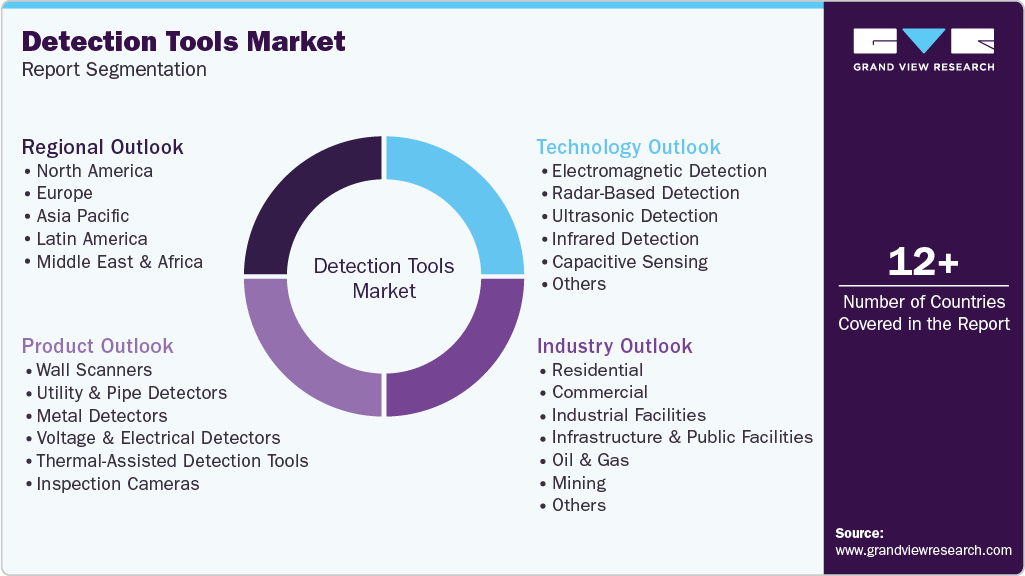
This report forecasts revenue growth at global, regional, and country levels and provides an analysis of the latest industry trends in each of the sub-segments from 2021 to 2033. For this study, Grand View Research has segmented the global detection tools market report based on product, technology, industry, and region.
 To learn more about this report, Download Free Sample Report
 -
Product Outlook (Revenue, USD Million, 2021 - 2033)
-
Wall Scanners
-
Utility & Pipe Detectors
-
Metal Detectors
-
Voltage & Electrical Detectors
-
Thermal-Assisted Detection Tools
-
Inspection Cameras
-
-
Technology Outlook (Revenue, USD Million, 2021 - 2033)
-
Electromagnetic Detection
-
Radar-Based Detection
-
Ultrasonic Detection
-
Infrared Detection
-
Capacitive Sensing
-
Others
-
-
Industry Outlook (Revenue, USD Million, 2021 - 2033)
-
Residential
-
Commercial
-
Industrial Facilities
-
Infrastructure and Public Facilities
-
Oil and Gas
-
Mining
-
Others
-
-
Regional Outlook (Revenue, USD Million, 2021 - 2033)
-
North America
-
U.S.
-
Canada
-
Mexico
-
-
Europe
-
UK
-
Germany
-
France
-
-
Asia Pacific
-
China
-
Japan
-
India
-
South Korea
-
Australia
-
-
Latin America
-
Brazil
-
-
Middle East and Africa
-
UAE
-
KSA
-
South Africa
-
-
Research Methodology
The detection tools market figures in this report are based on a proven research process that combines executive interviews with secondary research from proprietary databases, company filings, and recognized regulatory and institutional sources. Market size is built through value-chain sizing-reconciling supply-side and demand-side estimates-and triangulated with bottom-up and top-down approaches. Every estimat passes multiple levels of expert validation before publication, with each detection tools segment quantified using the revenue-capture definitions in the table below.
Segment Definition
Product
Revenue Capture Definition
Wall Scanners
Revenue is generated through the sale of electronic wall-scanning devices used to detect concealed objects such as studs, pipes, electrical wiring, rebar, and other materials within walls, floors, ceilings, and concrete structures.
Utility & Pipe Detectors
Revenue is generated through the sale of equipment used to locate and trace underground or concealed utilities, including water and gas pipes, electrical cables, telecommunications lines, and other buried infrastructure assets.
Metal Detectors
Revenue is generated through the sale of handheld and other metal-detection devices used to identify ferrous and non-ferrous metallic objects in construction, security, industrial, maintenance, and related applications.
Voltage & Electrical Detectors
Revenue is generated through the sale of electrical detection equipment used to identify the presence, absence, or characteristics of electrical voltage, energized wires, circuits, and electrical faults.
Thermal-Assisted Detection Tools
Revenue is generated through the sale of thermal imaging and temperature-sensing detection tools used to identify heat variations, overheating components, electrical faults, insulation deficiencies, moisture intrusion, and mechanical abnormalities.
Inspection Cameras
Revenue is generated through the sale of portable visual inspection cameras, including borescopes and videoscopes, used to inspect concealed, enclosed, or difficult-to-access areas such as pipes, machinery, walls, ducts, and equipment.
Technology
Revenue Capture Definition
Electromagnetic Detection
Revenue is generated through the sale of detection tools that use electromagnetic fields or changes in electromagnetic signals to identify metallic objects, conductive pipes, underground cables, electrical wiring, and other detectable materials.
Radar-Based Detection
Revenue is generated through the sale of radar-based detection systems that transmit electromagnetic waves and analyze reflected signals to identify concealed objects, structural elements, utilities, and subsurface assets.
Ultrasonic Detection
Revenue is generated through the sale of detection and inspection tools that use high-frequency ultrasonic waves to identify material discontinuities, defects, leaks, voids, or objects within equipment and structures.
Infrared Detection
Revenue is generated through the sale of infrared and thermal-sensing tools that detect temperature variations and thermal signatures to identify overheating, electrical faults, insulation problems, moisture-related anomalies, and mechanical defects.
Capacitive Sensing
Revenue is generated through the sale of detection tools that measure changes in capacitance caused by variations in material composition, density, proximity, or electrical properties to identify concealed objects and materials.
Other Technologies
Revenue is generated through the sale of detection tools employing technologies outside the major electromagnetic, radar, ultrasonic, infrared, and capacitive categories, including emerging, hybrid, sensor-fusion, and specialized detection technologies.
Industry
Revenue Capture Definition
Residential
Revenue is generated through the sale of detection tools used in homes and residential construction, renovation, maintenance, electrical work, plumbing, and DIY applications to locate concealed studs, pipes, wiring, and other objects.
Commercial
Revenue is generated through the sale of detection tools used in commercial buildings, offices, retail facilities, hotels, warehouses, and other non-residential properties for construction, renovation, facility maintenance, electrical inspection, and building diagnostics.
Industrial Facilities
Revenue is generated through the sale of detection tools used in manufacturing plants, factories, power facilities, processing facilities, and other industrial sites for equipment inspection, preventive maintenance, electrical diagnostics, asset monitoring, and workplace safety.
Infrastructure & Public Utilities
Revenue is generated through the sale of detection tools used for locating, inspecting, and maintaining transportation infrastructure, power grids, water and wastewater networks, gas pipelines, telecommunications networks, and other public infrastructure assets.
Oil & Gas
Revenue is generated through the sale of detection and inspection tools used across upstream, midstream, and downstream oil and gas operations to identify equipment abnormalities, leaks, electrical faults, pipeline conditions, and other potential safety or asset-integrity issues.
Mining
Revenue is generated through the sale of detection tools used in mining operations to locate underground utilities and structures and inspect electrical systems, machinery, pipelines, equipment, and other mine-site assets.
Others
Revenue is generated through the sale of detection tools used across other applications such as including automotive, aerospace, marine, healthcare, research, security, and specialized inspection activities.
Estimation Model
Layer
Key Questions
Description
End-User Adoption Layer
Who are the potential adopters?
Identifies residential users, commercial facilities, industrial plants, construction companies, infrastructure operators, utilities, oil & gas companies, mining companies, transportation organizations, and public-sector agencies that use detection tools to locate concealed objects, utilities, pipes, cables, electrical hazards, structural elements, heat sources, and other subsurface or hidden conditions.
Detection Solution Provider Layer
Who supplies detection tools and solutions?
Evaluates manufacturers and technology providers offering wall scanners, utility and pipe detectors, metal detectors, voltage and electrical detectors, thermal-assisted detection tools, inspection cameras, and related sensing equipment. This layer also considers companies providing professional-grade, handheld, portable, and specialized detection systems.
Detection Deployment Layer
Where are detection tools being used?
Maps deployment across construction and renovation, electrical installation and maintenance, plumbing, infrastructure inspection, industrial maintenance, facility management, utilities, oil & gas, mining, transportation infrastructure, residential improvement, and safety and inspection activities.
Technology & Sensing Layer
What technologies influence adoption?
Evaluates electromagnetic detection, radar-based detection, ultrasonic detection, infrared sensing, capacitive sensing, thermal imaging, signal processing, multi-sensor detection, digital displays, connectivity, and other sensing technologies that improve detection depth, accuracy, object classification, visualization, and false-positive reduction.
Revenue Generation Layer
How is market revenue generated?
Estimates revenue through sales of detection equipment, professional and industrial-grade systems, replacement sensors and accessories, software-enabled detection solutions, equipment upgrades, calibration and maintenance services, technical support, training, and related inspection and detection services.
Delivered Customizations
This report has been delivered with the following in-depth customizations
Client Request
Customization Delivered
Value Adds
Market Sizing, Segmentation & Growth Opportunity Assessment
Assessed the global Detection Tools Market size, historical trends, forecast growth outlook, and detailed segmentation by Product (Wall Scanners, Utility & Pipe Detectors, Metal Detectors, Voltage & Electrical Detectors, Thermal-Assisted Detection Tools, Inspection Cameras), technology (Electromagnetic Detection, Radar-Based Detection, Ultrasonic Detection, Infrared Detection, Capacitive Sensing, Other Technologies), and industry (Residential, Commercial, Industrial Facilities, Infrastructure & Public Utilities, Oil & Gas, Mining, Others).
Enables detection tool manufacturers, sensing technology providers, inspection companies, utilities, construction firms, and industrial operators to identify high-growth product and technology segments, prioritize product development, optimize portfolios, and capture emerging revenue opportunities.
Regional Market Demand & Growth Opportunity Assessment
Assessed Detection Tools demand across North America, Europe, Asia Pacific, Latin America, and Middle East & Africa, considering construction activity, infrastructure modernization, utility network development, industrial maintenance, electrical safety requirements, mining and oil & gas activity, building renovation, and adoption of advanced detection technologies.
Provides actionable insights into regional growth opportunities, market-entry priorities, investment hotspots, and competitive positioning, enabling stakeholders to prioritize high-potential geographies, strengthen distribution networks, and localize product offerings.
Competitive Landscape & Strategic Positioning Analysis
Evaluated the competitive environment across major detection tool manufacturers, sensing technology providers, industrial inspection companies, and specialized equipment suppliers, comparing product portfolios, detection technologies, sensing capabilities, application coverage, product innovation, geographic presence, distribution networks, partnerships, and recent product developments.
Enables companies to benchmark their market position, identify product and technology gaps, assess differentiation opportunities, prioritize R&D investments, and strengthen competitive positioning across construction, utilities, electrical safety, industrial inspection, infrastructure, mining, and oil & gas applications.
Frequently Asked Questions About This Report
Utility & pipe detectors segment held the largest market share of 21.1% in 2025 while thermal-assisted detection tools segment is expected to be the fastest-growing market.
North America accounted for the largest revenue share of 33.6% in 2025.
Electromagnetic detection segment held the largest market revenue share of 37.3% in 2025 while radar-based detection segment is second fastest growing market.
Asia Pacific is the fastest-growing region over the forecast period.
The global detection tools market size was valued at USD 5.9 billion in 2025 and is projected to reach USD 6.2 billion in 2026.
The global detection tools marketis expected to grow at a CAGR of 5.7% from 2026 to 2033, reaching USD 9.1 billion by 2033.
Key factors include primarily driven by increasing infrastructure development, expansion and modernization of utility networks, rising construction and renovation activity, growing emphasis on worker and excavation safety, and the need for accurate, non-destructive detection of concealed utilities, electrical wiring, pipes, structural elements, and other hidden assets.
Key players include Fluke Corporation; Hangzhou Hikvision Digital Technology Co., Ltd.; Hilti Corporation; Hioki E.E. Corporation; Klein Tools, Inc.; Leica Geosystems AG; Robert Bosch GmbH; Stanley Black & Decker, Inc.; Techtronic Industries Company Limited; Zircon Corporation are the key players in detection tools market.
Industrial facilities segment dominated the market with a revenue share of 25.2% in 2025, driven by the extensive deployment of detection equipment for electrical safety, equipment inspection, preventive maintenance, fault identification, and monitoring of critical industrial assets.
About the Author(s)
Sensors & Controls Research Team
Semiconductors & Electronics · Sensors & ControlsThis report was authored by the sensors & controls research team at Grand View Research - comprising two research analysts, one senior research analyst, and one industry expert - with specialized expertise in the sensors & controls segment of the semiconductors & electronics industry. All findings are based on proprietary semiconductors & electronics databases, executive interviews, and regulatory analysis, subject to internal peer review prior to publication.
Last Updated:
Speak to Analyst

Customize this report to your needs - add regions, segments, or data points, with 20% free customization.
Or view our licence options:


ISO 9001:2015 & 27001:2022 Certified
We are GDPR and CCPA compliant! Your transaction & personal information is safe and secure. For more details, please read our privacy policy.


